Market Analysis reports and market data
Documents



The Unbound Network of Product and Service Interaction of the MMOG Industry: With a Case Study of China
The MMOG industry is presented as a rapidly expanding, knowledge-intensive service sector whose competitive dynamics cannot be fully explained by studying individual firms in isolation.
- The MMOG industry is best understood as an 'unbound network' of tightly interdependent relationships spanning technology infrastructure, outsourced development, and continuous customer service, so studying individual firms in isolation cannot fully explain competition.
- The Asian online game market was reportedly worth $3.4 billion in 2005 and projected to reach $13 billion by 2011, with Asia outside Japan accounting for more than half of the market.
- Chinese online game companies built their competitiveness on cost-efficient customer service, extensive distribution such as point-card sales through internet cafés, and early reliance on licensed foreign titles, financed largely through venture capital and stock market listings.

CERO Age Rating System: Survey Results After New System Implementation
The Computer Entertainment Supplier’s Association (CESA) conducted a nationwide survey of 681 retail outlets in Japan to evaluate the implementation of the revised CERO age rating system.
- As of mid-2006, 95.1% of Japanese retailers surveyed by CESA perform mandatory age verification for Z-rated video game products.
- Industry adoption of the revised CERO rating system is high, with 91.2% of the 681 surveyed retail outlets reporting a clear understanding of the new operational requirements.
- Retailer compliance with physical store standards is strong, as 85.3% of stores have successfully implemented segregated display practices for Z-rated titles.

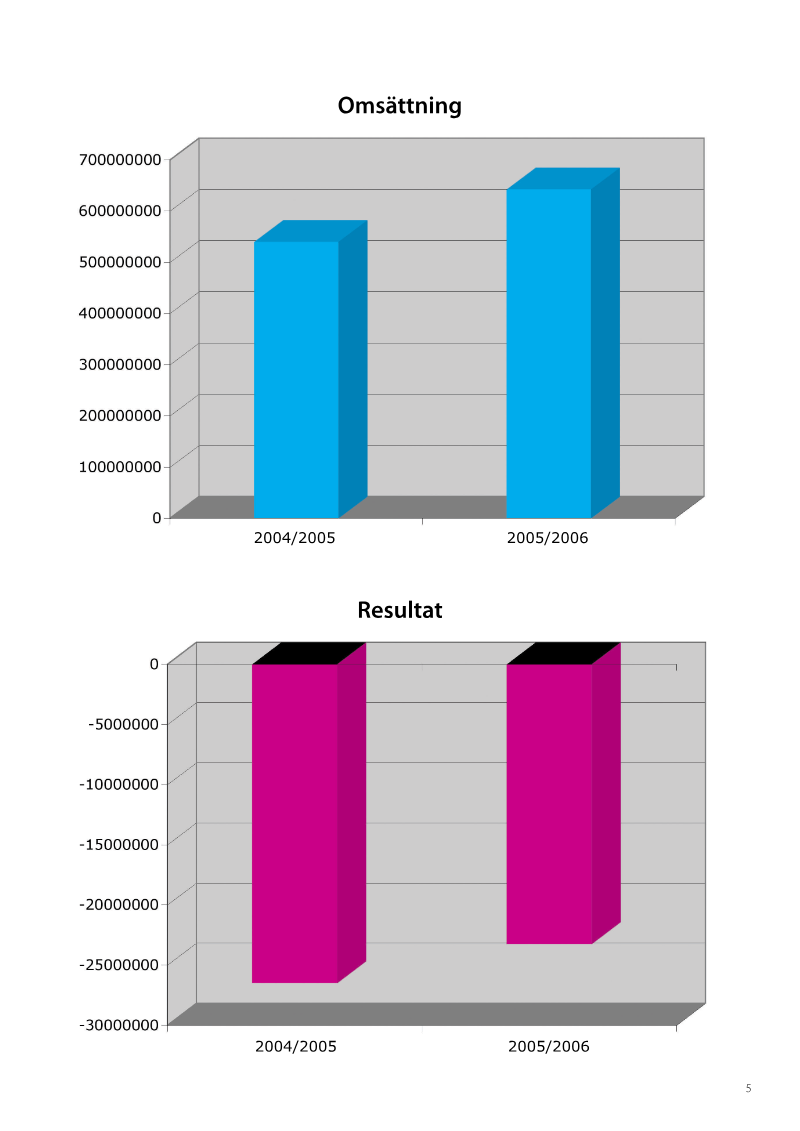

Spelutvecklarindex: Sweden 2005
The Swedish game development industry experienced significant growth and consolidation during 2005, characterized by rising revenues and an expanding workforce despite a reduction in the total number of active firms.
- The Swedish game industry generated 642 million SEK in total turnover in 2005, marking a 19 percent increase from the previous year.
- Market concentration is high, with five major studios—Avalanche Studios, EA DICE, Jadestone, Paradox Interactive, and Starbreeze—generating 59 percent of total industry revenue.
- The industry workforce grew by 14 percent to 812.5 full-time equivalents, though the gender balance remained stagnant with women representing only 15 percent of staff.



Bandai Namco Group Strategic Presentation Session
The Bandai Namco Group strategic presentation outlines the formal integration of Bandai and Namco following their merger, establishing a unified corporate structure designed to foster global growth through the fusion of their respective entertainment portfolios.
- Bandai and Namco are merging to form NAMCO BANDAI Holdings Inc. by April 2006, creating a unified corporate structure organized into six strategic business units.
- The group forecasts total sales growth from 475 billion yen in fiscal year 2006 to 550 billion yen by fiscal year 2008.
- Operating income is projected to increase from 44.2 billion yen to 55 billion yen over the two-year period following the merger.

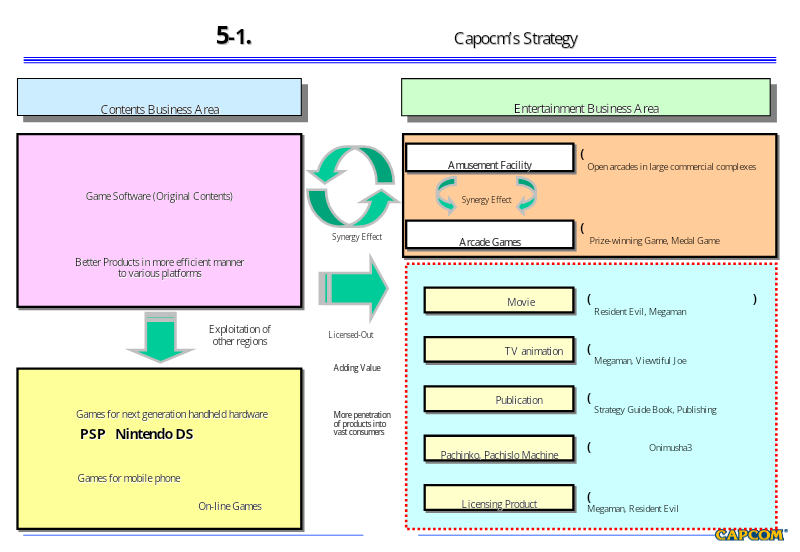

Company Profile: May 2005
Capcom concluded the fiscal year ending March 31, 2005, with robust financial results, reporting net sales of 65.8 billion yen and an operating income of 7.7 billion yen.
- Capcom reported fiscal year 2005 net sales of 65.8 billion yen and an operating income of 7.7 billion yen, driven by Resident Evil 4, Mega Man, and the pachislo LCD business.
- The company projects net sales of 70 billion yen for the 2006 fiscal year, despite acknowledging volatility in the hit-driven home console market.
- Capcom is targeting a global sales distribution ratio of 2:5:3 across Japan, North America, and Europe to mitigate the maturity of the domestic Japanese market.
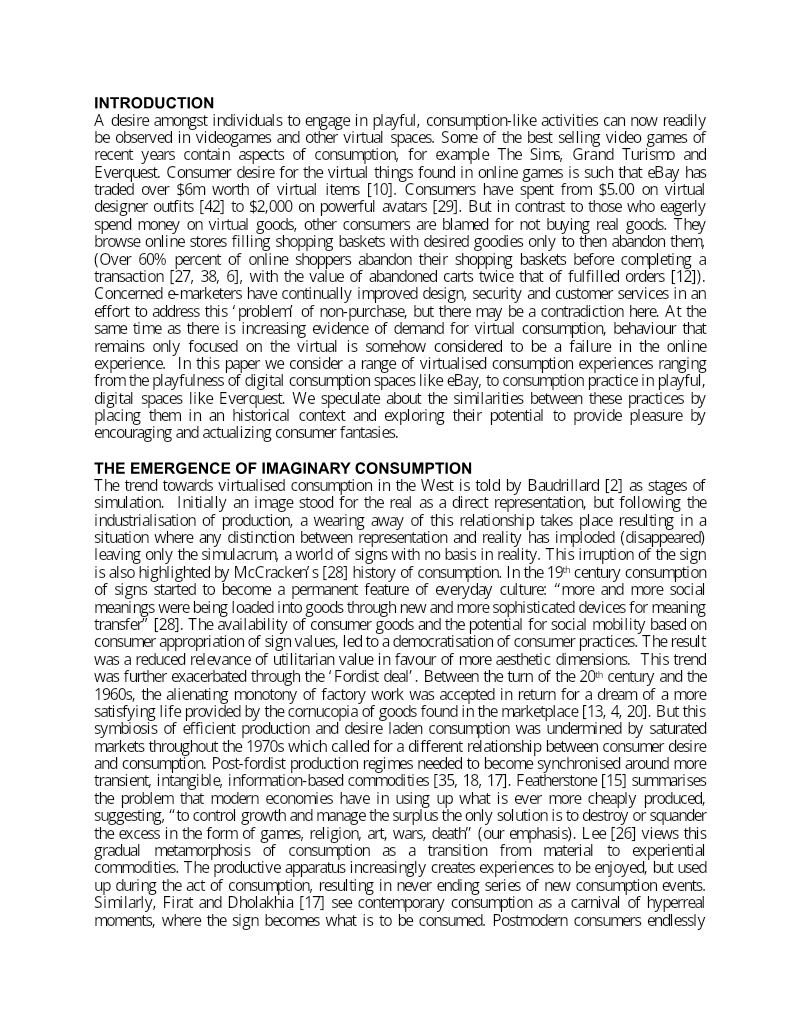


The Pleasures and Practices of Virtualised Consumption in Digital Spaces
This conceptual paper, presented at the DiGRA 2005 conference, argues that virtualised consumption, such as buying virtual goods in games, browsing virtual marketplaces, and displaying digital possessions, should be understood as a legitimate and pleasurable form of consumption rather than a failure of marketing.
- The paper argues that virtualised consumption, such as buying virtual goods and browsing virtual marketplaces, should be treated as a legitimate, pleasurable form of consumption rather than a failure of marketing.
- Its central thesis frames virtual consumption as the latest stage in a historical shift from utility toward emotional, sign-based, and playful experience, with digital spaces acting as liminoid play-spaces where imagination is stimulated and partly actualised.
- The authors contend that cart abandonment is a misreading of consumers who gain satisfaction from imaginative engagement with goods they never intend to buy, rather than a sign of lost sales.
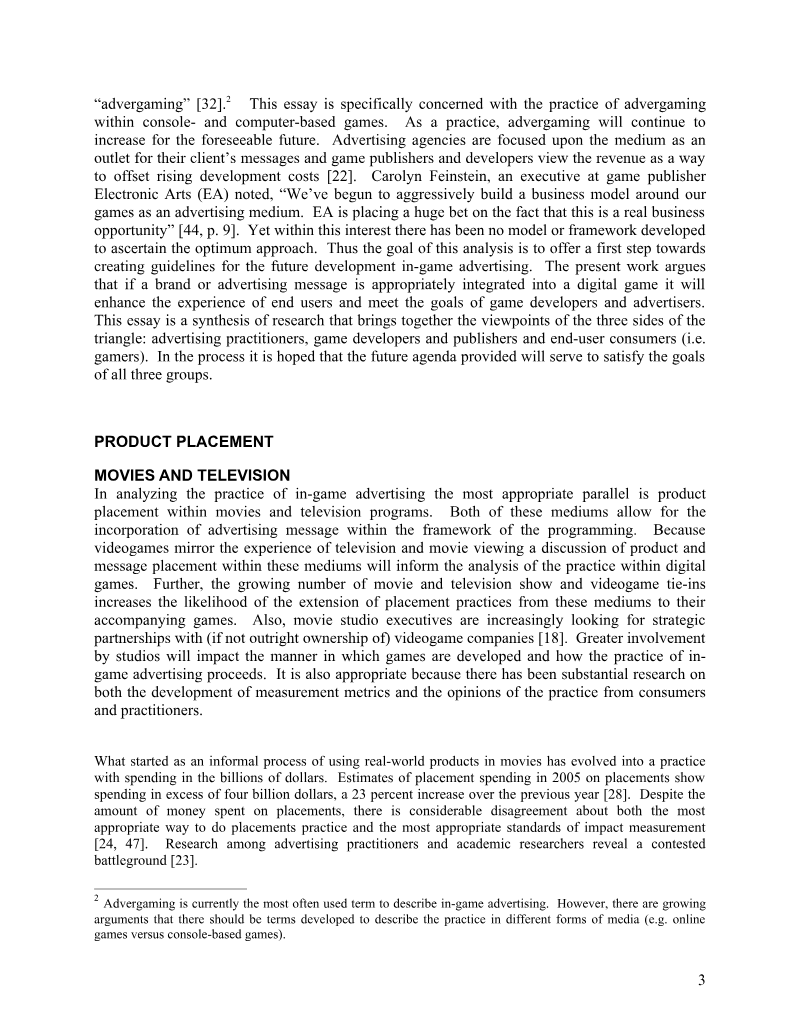
The Sponsored Avatar: Examining the Present Reality and Future Possibilities of Advertising in Digital Games
This paper examines advertising within digital games, both current practice and future possibilities, including full sponsorship, product placement, brand integration, and cross-promotion with other entertainment media.
- Advertising spending is shifting away from traditional television commercials toward placements in entertainment, with one cited beverage company redirecting more than $300 million in annual spending.
- Game-based advertising remained a small share of revenue relative to film and television, with projections of roughly $260 million by 2008, though agencies increasingly seek game placements and some have created dedicated game advertising divisions.
- Players generally accept in-game advertising, mostly because it enhances realism, but they worry that placements may feel incongruous and detract from the experience.



Early Games Production in New Zealand
Melanie Swalwell's paper examines the early digital games industry in New Zealand during the late 1970s and 1980s, a period that is largely absent from mainstream accounts of games history, which tend to focus on the United States, United Kingdom, and Japan.
- Early digital games reached New Zealand in the late 1970s and 1980s despite geographic isolation and restrictive import policies, yet this history is largely absent from mainstream games histories focused on the US, UK, and Japan.
- Major systems including Atari, Sinclair, Commodore, Sega, and Nintendo products did reach New Zealand, typically one to two years after their overseas release, with distribution uneven across platforms.
- Local manufacturers produced at least four early consoles, most prominently the Sportronic, a Pong-style clone, and around eleven companies were involved in arcade cabinet manufacture at some point.
Virtual Worlds in Asia: Business Models and Legal Issues
This paper examines the business models and legal challenges facing virtual world developers as their enterprises mature, using Korea and China as case studies.
- The central argument is that early technical obstacles for virtual world businesses have largely been overcome, while new environmental, security, and governance challenges now demand a fundamental rethinking of the game industry's guiding assumptions.
- Korea's item trading market, where real-world currency is exchanged for digital items stored on company servers, exceeded $200 million in transactions in 2004 and supported more than 300 item trade companies.
- Korean developers sharply disagree on item trading: NCSoft opposes it, while smaller developers see it as a way to attract players, and a 2003 industry survey ranged from outright prohibition to unrestricted individual trade.


B.Sc. Computer Game Development: Why Not?
This paper, presented at the DiGRA 2005 conference, argues for a new four-year Bachelor of Science degree in Computer Science with a Game Development specialization at Grande Prairie Regional College in Alberta, Canada.
- The paper proposes a four-year B.Sc. in Computer Science with a Game Development specialization at Grande Prairie Regional College in Alberta, Canada, motivated by declining computing science enrolments in North America since around 2000.
- The authors argue the computer game industry, with global sales exceeding $30 billion, offers strong economic growth and largely unmet demand for qualified graduates.
- The central thesis is that a game development program can meet industry needs while preserving the integrity of a standard computing science education by blending ACM computing curriculum guidelines with the International Game Developers Association's curriculum framework.
History of Digital Games in Turkey
This paper, a DiGRA 2005 conference study by Erdal Yılmaz and Kürşat Çağıltay of Middle East Technical University, traces the history of digital games in Turkey and assesses the state of its game development industry.
- Turkish players' habits and play durations parallel global averages, but domestic game development has been extremely limited and poorly documented.
- Digital games reached Turkey in the early 1980s via arcade-style "Atari Salonu" halls, which prompted a 1985 regulatory response requiring local permits.
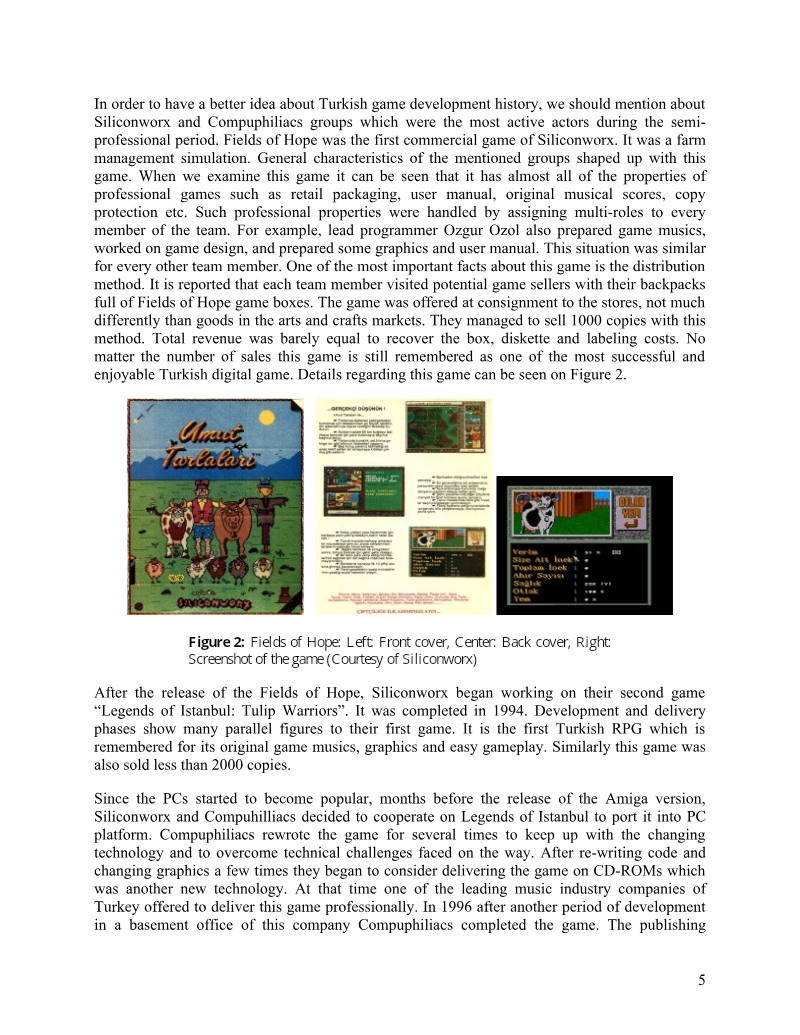
- Turkish home game development passed through three phases: an amateur 1980s period built on the Commodore 64 and magazine-published source code, a semi-professional 1990s period centered on Amiga and PC groups like Siliconworx and Compuphiliacs, and a professional stage from 2000 onward.

iDTV Gamers: The Emergence of a New Community?
Interactive digital television (iDTV) gaming in the United Kingdom is examined as the emergence of a distinct and growing viewer community, one that departs from the traditional image of the PC or console gamer.
- Roughly 40% of UK homes now have interactive digital television (iDTV), and 44% of digital consumers play games on it, with NTL's games channel drawing older, family-oriented, and lower socio-economic audiences.
- iDTV gaming is characterised by short "dipping" sessions alongside television viewing and a preference for simple, family-friendly titles, making it an extension of household TV habits rather than a dedicated pastime.
- A Netpoll study of 50 homes identified three iDTV player types: Generation I teens, Early Clickers, and Daytime Dabblers.