Market Analysis reports and market data
Documents

Biz Daily: Why is Rovio cutting up to 260 jobs?
Rovio, the developer behind the Angry Birds franchise, is undergoing a significant corporate restructuring involving the redundancy of up to 260 employees, representing approximately 50 percent of its total workforce.
- Rovio is laying off up to 260 employees, representing approximately 50 percent of its total workforce, to pivot away from an unsustainable merchandising infrastructure.
- The company is refocusing on its core gaming operations after a period of rapid expansion that saw staff numbers grow to roughly 800 between 2009 and 2013.
- While total turnover declined by 9 percent in 2014, gaming revenue grew by 16 percent, eventually accounting for 70 percent of the company's total turnover.

Biz Daily: How China's economic woes will impact mobile games
The Chinese mobile gaming market, once viewed as a primary engine for global industry growth, faces significant headwinds due to broader economic instability.
- The Chinese mobile gaming market is transitioning from a period of explosive growth to a more mature, challenging environment, ending the era of relying on sheer market momentum.
- Despite broader economic volatility, China remains a substantial $45 billion mobile gaming industry that requires more sophisticated, localized strategies for success.
- Western developers can no longer treat China as a guaranteed growth engine and must now prioritize increased marketing investment and nuanced cultural adaptation to compete.

Biz Daily: Is Agar.io this year's Flappy Bird?
The mobile game Agar.io emerged as the most downloaded iOS title in July 2015, mirroring the viral, rapid-growth trajectory previously established by Flappy Bird.
- Agar.io became the most downloaded iOS title in July 2015, mirroring the rapid viral growth trajectory of Flappy Bird.
- Despite its popularity—reaching the sixth most-played iPhone game in the U.S. during its peak—the game currently lacks in-app purchases and relies entirely on advertising.
- Miniclip faces a significant challenge in introducing monetization to Agar.io without alienating a user base accustomed to the free, non-monetized experience of its original browser-based version.

Biz Daily: Glu Mobile hit by maturing Kim Kardashian audience
Glu Mobile experienced a challenging second quarter in 2015, characterized by a 19 percent decline in revenue to 56.2 million dollars compared to the previous quarter.
- Glu Mobile reported a 19% revenue decline to $56.2 million in Q2 2015, shifting from a $1.1 million profit to a $5.5 million loss.
- The financial downturn is driven by the maturation and user churn of the 'Kim Kardashian: Hollywood' title, which currently generates one-third of the company's total sales.
- Despite operational losses, Glu Mobile maintains a strong liquidity position with $190 million in cash reserves, bolstered by a $120 million strategic investment from Tencent.

Biz Daily: Why iDreamSky invested $10M into Rumble
The Chinese mobile publisher iDreamSky has expanded its global footprint through a 10 million dollar investment in the United States-based developer Rumble Entertainment.
- iDreamSky has invested $10 million for a majority stake in U.S.-based developer Rumble Entertainment to expand its global footprint beyond the Chinese Android market.
- The investment grants iDreamSky exclusive rights to publish Rumble’s titles within China, securing a pipeline of high-fidelity Western content for a market that demands premium graphical quality.
- Rumble Entertainment, which has previously raised over $30 million in seed and Series A funding, required the $10 million infusion to provide the marketing liquidity necessary to scale its current soft-launch projects.

Biz Daily: A Candy Crush Saga gap in King's profits
King’s financial performance for the second quarter of 2015 reflects a period of transition as its flagship Candy Crush Saga franchise enters a mature phase.
- King experienced a significant Q2 2015 downturn, with revenue falling 14% to $490 million and profits dropping 27% to $164 million compared to the previous quarter.
- The primary driver of the financial decline is the maturation and slowing momentum of the flagship Candy Crush franchise, which new releases like Candy Crush Soda Saga failed to fully offset.
- Despite the quarterly dip, King maintains a strong financial position with $800 million in cash reserves and derives 80% of its total revenue from mobile platforms.

Biz Daily: EA Mobile's record $145m financial quarter
EA Mobile achieved a record-breaking financial performance for the first quarter of the 2016 fiscal year, covering the period from April to June 2015.
- EA Mobile generated a record $145 million in revenue for the first quarter of fiscal year 2016, marking a 17 percent increase over the previous quarter.
- The revenue growth was driven by a games-as-a-service model that focuses on continuous updates to existing titles rather than new game launches.
- Key titles supporting this financial performance included The Simpsons: Tapped Out, Real Racing 3, and The Sims FreePlay.

Biz Daily: How Com2uS become a world player
Com2uS has successfully transitioned from a localized South Korean mobile publisher into a significant global industry player, driven primarily by the sustained performance of its flagship RPG, Summoners War.
- Com2uS reported Q2 2015 sales of $97 million, representing a 16% increase quarter-on-quarter and over 100% growth compared to the same period in 2014.
- The RPG 'Summoners War' is the primary driver of company growth, necessitating an increase in quarterly marketing and user acquisition spend from $15 million to $18 million.
- Com2uS has successfully pivoted from a local Korean publisher to a global player, with 82% of its Q2 2015 sales generated outside of Korea.
10 Years of Funding and Networks: The Finnish Game Industry 2004-2014
The Finnish game industry experienced astronomical growth between 2004 and 2014, with its turnover increasing from €40 million to €1.8 billion, representing a total of €3.647 billion over the decade.
- The Finnish game industry’s annual turnover grew from 40 million euros in 2004 to 1.8 billion euros by 2014, accounting for nearly 20 percent of the nation's total ICT sector turnover.
- Industry employment expanded from 600 to 2,500 workers over the decade, demonstrating the high-productivity potential of an intellectual property-focused, born-global business model.
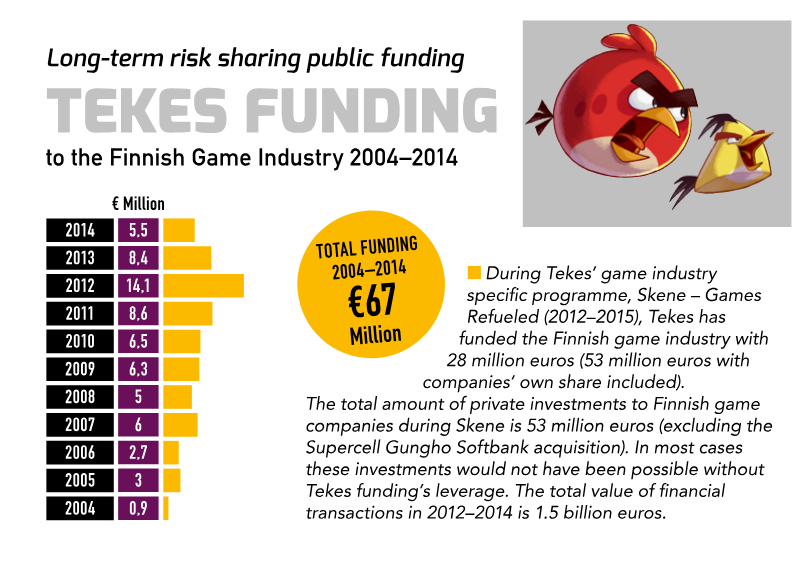
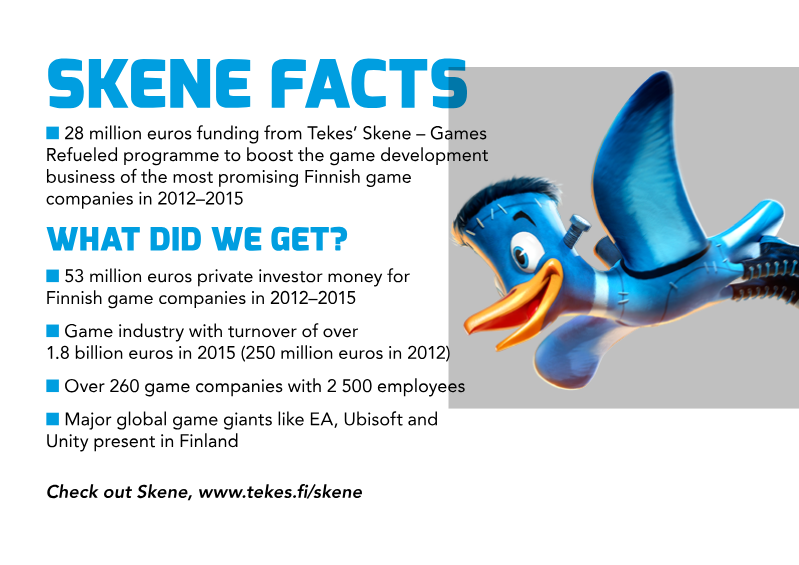
- Public funding through the Tekes Skene program provided 67 million euros in total support between 2004 and 2014, with 28 million euros specifically allocated between 2012 and 2015.

Mike Bithell on strategies for indie success
Independent developers achieve long-term sustainability by prioritizing unique, non-clonable experiences over chasing fleeting market trends.
- Prioritize unique, non-clonable game experiences over chasing market trends to ensure long-term studio sustainability.
- Maintain lean business structures by capping headcount to preserve agility and using rapid prototyping, such as game jams, to test core mechanics.
- Utilize platforms like Early Access to integrate player feedback throughout the production cycle, which aligns the final product with audience expectations and extends the game's lifecycle.

Biz Daily: Angry Birds hits 20 million downloads
Angry Birds 2 has achieved significant market penetration, reaching 20 million downloads within its first week of release.
- Angry Birds 2 reached 20 million downloads in its first week, a milestone that took the original title nine months to achieve.
- The game has secured the number 1 download spot in over 100 countries across the Americas, Europe, and China.
- Rovio is prioritizing the Chinese market through a strategic partnership with Kunlun to capture new player demographics.

A Generation of Remasters - Welcome Updates or Troubling Omens? - Extra Credits
The proliferation of video game remasters represents a complex shift in the industry, balancing the preservation of gaming history against a potential stagnation in creative innovation.
- The industry's reliance on remasters signals a broader struggle to fund and produce original, high-budget AAA titles due to the high costs and risks associated with new development.
- Publishers prioritize remasters of recent console-generation games because they are low-risk, cost-effective, and leverage existing fan bases to fill release schedules.
- There is an economic paradox where truly necessary remasters of 1990s-era games require complete rebuilds, making them as expensive and high-risk as developing entirely new intellectual property.