Live Ops reports and market data
Documents
Why Warframe (and Other AAA Shooters) Struggle on Mobile
The mobile gaming market presents significant challenges for established PC and console shooters, as evidenced by the performance of titles like Warframe.
- The global games market reached $188.8 billion in 2025, a 3.4% year-over-year increase, though the mobile segment is experiencing a slowdown in the Asia-Pacific region.
- While the number of paying players rose 5% to 1.6 billion, the average spend per payer is declining, forcing developers to navigate higher user acquisition costs and shifting monetization dynamics.
- Porting complex, hardcore shooters like Warframe to mobile has proven ineffective, as these titles often fail to achieve market fit or the necessary polish when outsourced to smaller studios.

From Offerwall to Always-On: Xsolla’s Take on Player Engagement
The evolution of game commerce is shifting toward integrated, "always-on" ecosystems that prioritize player engagement through a combination of brandformance, gamification, and unified monetization tools.
- Xsolla is consolidating game commerce tools—including webshops, offerwalls, and social quests—into a single integration to reduce resource overhead and eliminate fragmented data for publishers.
- Brands are shifting toward 'brandformance' marketing, which moves beyond passive awareness to trackable, measurable return on ad spend (ROAS) within gaming environments.
- Offerwalls are evolving from simple reward mechanisms into sophisticated engagement platforms where users earn virtual currency by interacting with brands, such as subscribing to services like Paramount+.

Game Review Radar #9: The Curse of the podcast strikes again. Or maybe not!
The mobile gaming landscape is currently defined by unexpected resilience and aggressive scaling, defying earlier market skepticism that predicted rapid declines for established titles.
- Last War continues to dominate as a revenue leader, generating approximately $6.6 million per day with a consistent upward trajectory.
- Short-form drama applications have become a massive market force, with DramaBox and ReelShort generating monthly revenues of $32 million and $36 million, respectively.
- King Shot has emerged as a top-performing title, reaching a peak of $3 million in daily revenue and maintaining a stable, long-term growth profile.
The 4 Generations of Rewarded Ads: Personalization + LiveOps = The Future of Offerwalls
The evolution of rewarded advertising has transitioned through four distinct stages, moving from rudimentary rank-boosting installs and simple level-based rewards to the sophisticated, playtime-centric models popularized by platforms like Mistplay.
- Rewarded monetization has evolved into a fourth generation characterized by hyper-personalization, data-driven targeting, and LiveOps-powered engagement.
- Offerwalls can contribute between 5% and 30% of a game's total revenue, serving as a critical alternative monetization channel for non-payers and 'dolphins'.
- Modern offerwall solutions must integrate media source data from platforms like AppLovin, Unity, and Google to dynamically match game offers to specific user acquisition sources and behaviors.

TWIG #346: EU Wants to Ban Free-to-Play as Supercell Introduces a New Boss
The global gaming industry is currently navigating a period of intense regulatory and structural transformation.
- Proposed EU consumer protection regulations, including mandatory real-world currency displays and transaction warnings, threaten the free-to-play business model with potential revenue losses of up to 25% for major publishers.
- Industry leaders are actively mobilizing legal and lobbying efforts to counter the economic impact of these impending European regulatory changes on the market and its labor force.
- Gamescom 2024 highlighted a significant decline in venture capital for large-scale PC and console projects, signaling a shift toward more cautious spending and fiscal discipline.
Duolingo, Tinder, DraftKings: How Top Apps Got Gamified
Leading non-gaming applications are increasingly adopting core game design principles to transform utility-based platforms into habit-forming, interactive ecosystems.
- Non-gaming apps like Duolingo, Tinder, and DraftKings are adopting core game design mechanics—such as streaks, experience points, and live operations—to transform utility-based platforms into habit-forming, interactive ecosystems.
- The primary strategic objective of integrating gamification is to increase daily active usage and long-term retention by moving away from static interfaces toward dynamic, social environments.
- Platforms are diversifying their engagement tactics: Duolingo uses AI-driven role-playing for language acquisition, while DraftKings and Crypto.com utilize mission systems and social betting groups to turn solitary transactions into community-driven experiences.
Casual Games Report H1 2025: Three Genres Generating 80% of Revenue
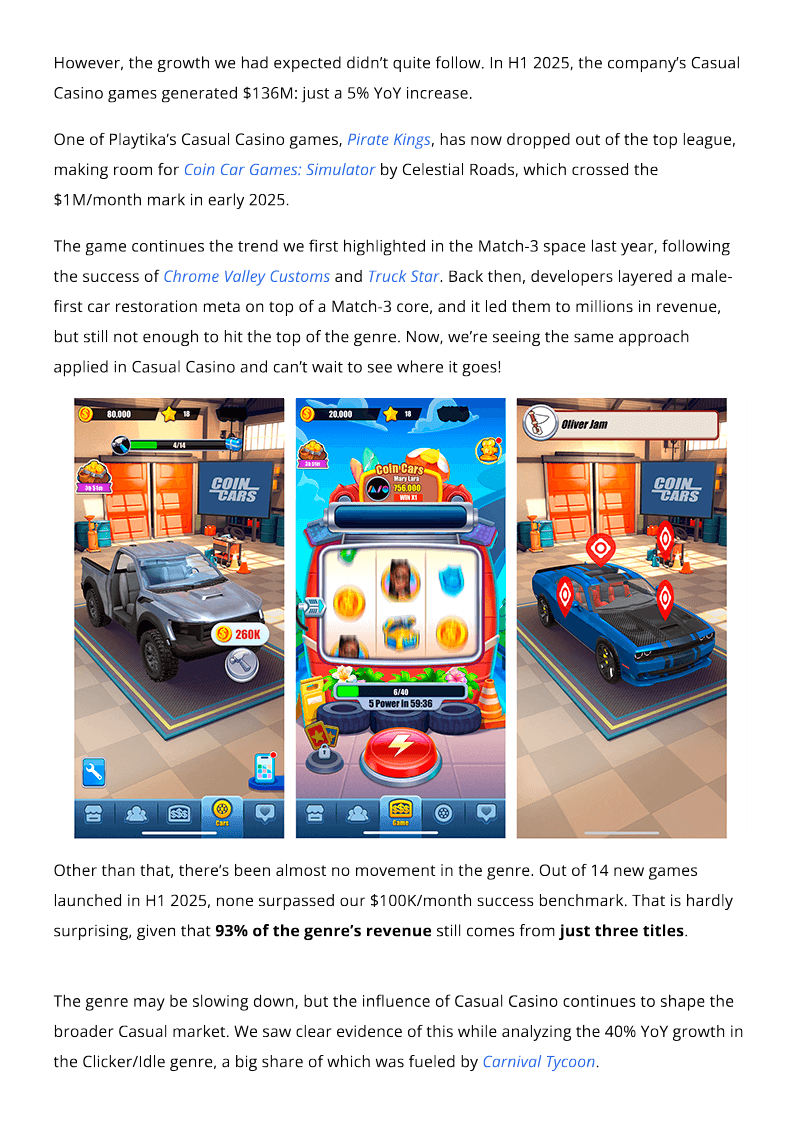
The casual games market generated $12 billion in net in-app purchase revenue during the first half of 2025, with 80% of this total concentrated within the Puzzle, Casino, and Simulation genres.
- The casual games market generated $12 billion in net in-app purchase revenue in H1 2025, with 80% of total earnings concentrated in the Puzzle, Casino, and Simulation genres.
- Puzzle games remain the primary growth engine with a 13% year-over-year revenue increase, driven largely by a 94% surge in the Merge-2 with Complex Meta subgenre.
- The Casual Casino sector saw a 33% revenue contraction in H1 2025, primarily due to the scaling back of major titles like Monopoly GO!.

EA Mobile is Suddenly Worth Watching Again
Electronic Arts is currently experiencing a resurgence in its mobile gaming portfolio, driven primarily by the sustained performance of EA Sports FC Mobile.
- EA Sports FC Mobile is currently generating approximately $20 million in monthly revenue, marking a record high for the company's mobile division.
- EA has shifted its mobile development strategy by outsourcing product management to specialized teams in China, a move that has proven more effective at monetization than previous North American-led efforts.
- The company is testing the expansion of its sports IP through spin-offs like EA Sports FC Tactical, which integrates squad RPG mechanics into the Ultimate Team framework.

The Business of Esports at EA
Electronic Arts leverages its esports division as a strategic marketing engine designed to deepen engagement among its most dedicated player base rather than serving as a primary profit center.
- EA positions its esports division as a strategic marketing engine to drive player engagement and title longevity rather than as a primary profit center.
- The company utilizes a 'couch-to-champion' model that creates a structured progression path from casual gaming to professional competition.
- EA maintains internal creative control over its competitive ecosystem while outsourcing production to ensure responsiveness to fan feedback and gameplay trends.

Segmentation Is Over. Long Live Personalization!
Traditional manual segmentation has become an obsolete framework for modern game development, failing to address the complexities of global scale and evolving privacy regulations.
- Manual segmentation is being replaced by machine learning-driven personalization, which uses contextual multi-armed bandits to create thousands of unique, real-time player journeys.
- Automated personalization systems typically increase player lifetime value by 8% to 15%.
- These automated growth strategies are most effective for titles that have reached a threshold of 25,000 to 30,000 daily active users.
Make An Online Game That Lasts 30 Years
The longevity of online gaming services depends on a disciplined transition from hobbyist development to professional business operations, prioritizing long-term sustainability over short-term gains.
- Online service games offer superior long-term revenue stability compared to single-player titles, which typically experience a sharp decline in sales after the initial launch week.
- The free-to-play model allows developers to capture a wider range of player value by enabling high-engagement users to spend more than a fixed purchase price while still allowing lower-budget players to participate.
- Rigorous stage-gate processes, which require ideas to be evaluated and validated against defined criteria before proceeding, are essential to avoid wasting resources on features that lack player appeal.

Casual LiveOps Report: H1 2025
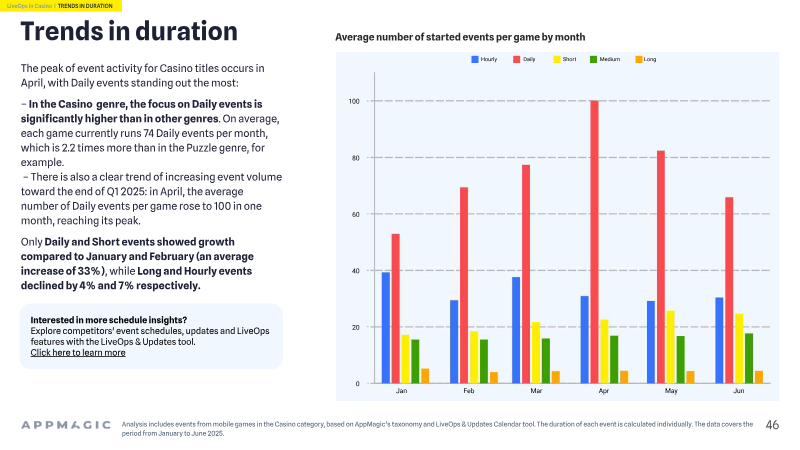
The casual mobile gaming market experienced modest growth during the first half of 2025, characterized by a 3.6% increase in global revenue and a 6% rise in downloads.
- The casual mobile gaming market grew by 3.6% in revenue and 6% in downloads during H1 2025, with legacy titles dominating as only 11% of top-grossing games were released within the last two years.
- Hypercasual games experienced a 111% revenue surge in H1 2025, driven by a strategic pivot toward deeper monetization mechanics.
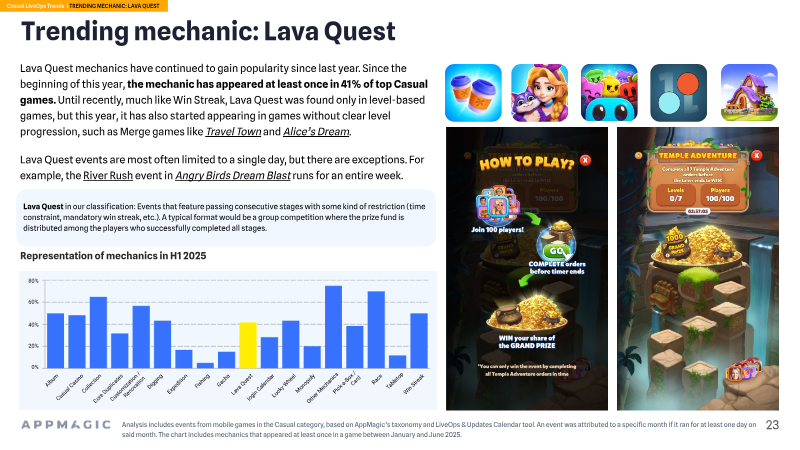
- LiveOps has become an industry standard, with 82% of top-grossing titles running at least one event to drive retention through recurring mechanics like win streaks and resource-depletion challenges.