Global reports and market data
Documents

Wargaming and Computer Games: Fun with the Future
This essay examines the historical trajectory of wargaming to offer new insights into contemporary computer games, particularly addressing the ludological perspective on the marginal role of narrative and "texture" in games.
- Patrick Crogan argues that modern computer games extend a relationship to the future rooted in the Enlightenment project of rational prediction and control, with the core activity being modelling and simulation.
- Narrative and cultural 'texture' are treated as marginal in games because the central pleasure lies in modelling complex systems, a claim that positions the essay within the ludological tradition while challenging its positivist tendencies.
- Wargaming is traced from Helwig's 1780 squared-board game through Reisswitz's 1824 Kriegsspiel, which impressed the Prussian military and was adopted into officer training, and on through postwar American military and research simulation.


Player Character Design Facilitating Emotional Depth in MMORPGs
The research outlines a novel approach to player character design in MMORPGs, aiming to foster profound emotional depth and dramatic interaction beyond conventional statistical progression.
- The report argues that individually authored MMORPG characters cannot scale to thousands of players, so emotional depth must come from a generative system rather than hand-crafted content.
- It proposes a "virtual mind" for player characters, replacing conventional numerical levelling with "being-values" organized around a Mind System, Story Daemons, and a Metaphysics System, developed within the Purgatory Engine and Ouroboros project at the Interactive Institute's Zero Game Studio.
- The mind model layers a two-dimensional affect framework (emotion, mood, sentiment, personality) over a Five Factor trait structure and Maslow's being-values, modeling Ekman's eleven emotions plus "pain".

Computer Games and the Complexity of Experience
The document, "Computer Games and the Complexity of Experience," argues that the prevailing sensory-motor model for studying computer games, which focuses on action-driven, Aristotelian dramaturgy, fails to capture the full complexity of player experience.
- The paper argues that computer games are typically analyzed through a sensory-motor model borrowed from classical cinema, which privileges action, causality, and an Aristotelian action-driven dramaturgy, and that this framing fails to capture the full complexity of experience both represented in games and lived by players.
- Kattenbelt and Raessens draw on Peirce's categories of firstness (feeling), secondness (action and resistance), and thirdness (reflection), and on Deleuze's movement-image, time-image, and thought-image, to build a framework for analyzing the emotional, volitional, and cognitive dimensions of play.
- The authors propose three player subject positions relative to a game's represented world: the lyric (emotional and affective), the dramatic (action-oriented and sensory-motor), and the epic (reflective and contemplative).

The Other Game Researcher: Participating in and Watching the Construction of Boundaries in Game Studies
Marinka Copier's paper argues that the emergence of game studies as an autonomous academic discipline depends on the active construction of boundaries, and that researchers themselves are participants in this boundary-work rather than detached observers.
- Marinka Copier argues that game studies' emergence as an autonomous discipline depends on active boundary-work, and that researchers are participants in drawing these boundaries rather than detached observers, drawing on Thomas Gieryn's boundary-work and Donna Haraway's situated knowledge.
- The paper traces the field's formation through early-2000s debates, including the 2001 founding editorial of the journal Gamestudies, which separated ludology from narratology and argued games deserve study on their own terms.
- Copier treats boundaries between game studies, designers, gamers, and neighboring fields as resting on both content-based and institutional arguments, and treats divides like ludology versus narratology as political constructions rather than fixed categories.


"You Can't Help Shouting and Yelling": Fun and Social Interaction in Super Monkey Ball
This paper investigates the relationship between social interaction and the experience of "fun" in multi-player console gaming, specifically using Super Monkey Ball (SMB) as a case study.
- Console multiplayer play happens in shared living-room settings close to other players, resembling television viewing as a domestic social activity, which encourages sociability distinct from isolated PC gaming.
- Fun in the study emerges from oscillating between mastering a game's rules and staying absorbed in its world, with games acting as "affective alliances" around shared, time-limited experiences.
- A pilot study of nine participants (aged 20 to 30) in groups of experienced players, inexperienced players, and a contrasting male group found all experienced players wanted to play again and most inexperienced players did too.
Approaches to Computer Game Design: Characters and Conflict
This document explores methods for creating and directing player action in computer games, emphasizing that action is the most crucial feature from a player's perspective.
- Action is presented as the defining feature of games from the player's perspective, and it can be created and directed through well-defined characters with conflicting needs and motivations.
- Players perceive a game as logically coherent only when character motivations are consistent with the game's structure; the design of characters, expectations, and space must work together to guide meaningful engagement.
- Player expectations shape interpretation and behavior, including an assumed 'expectation of gaming' that a game should be interesting, challenging, and actionable, plus expectations driven by genre and intermediality.
iDTV Gamers: The Emergence of a New Community?
The document examines the emerging landscape of Interactive Digital TV (iDTV) gaming, positing it as a significant and rapidly expanding segment within the global games industry.
- Roughly 40% of UK homes now have interactive digital television (iDTV), and 44% of digital consumers play games on it, with NTL's games channel drawing older, family-oriented, and lower socio-economic audiences.
- iDTV gaming is characterised by short "dipping" sessions alongside television viewing and a preference for simple, family-friendly titles, making it an extension of household TV habits rather than a dedicated pastime.
- A Netpoll study of 50 homes identified three iDTV player types: Generation I teens, Early Clickers, and Daytime Dabblers.
Console Games in the Age of Convergence
Console gaming has undergone a significant evolution, characterized by a cyclical "convergence-divergence-convergence" trend over two decades.
- Console gaming has cycled through repeated phases of convergence and divergence since the 1980s, with each phase shaped by institutional strategy as much as by technical capability.
- Nintendo held over 80 percent of the US console market and about 90 percent of Japan's in 1989, before Sony's CD-ROM-based PlayStation entered in 1995 and captured over 20 percent of the games market by 1996 through aggressive pricing and a larger software library.
- Sega withdrew from hardware after the Dreamcast's online strategy failed amid slow modem speeds and weak uptake of its service, while Sony's PlayStation came to dominate the late-1990s and early-2000s market.
All the World's a Botfighter Stage: Notes on Location-Based Multi-User Gaming
Olli Sotamaa's paper examines how location-based multi-user games such as Botfighters challenge classical definitions of play and game, while reshaping the meaning of mobile gaming and urban space.
- The paper argues that location-based multi-user games like Botfighters challenge the classical view of play as autonomous and separated from real life, because games using city streets as a board intrude on everyday reality.
- Location-based games are classified into three technological groups: GPS-based treasure hunts lacking real-time multi-user features, local network and proximity-sensor experiments mostly from research projects, and GSM cell-identification games that need only standard phones and are likely to reach large audiences.
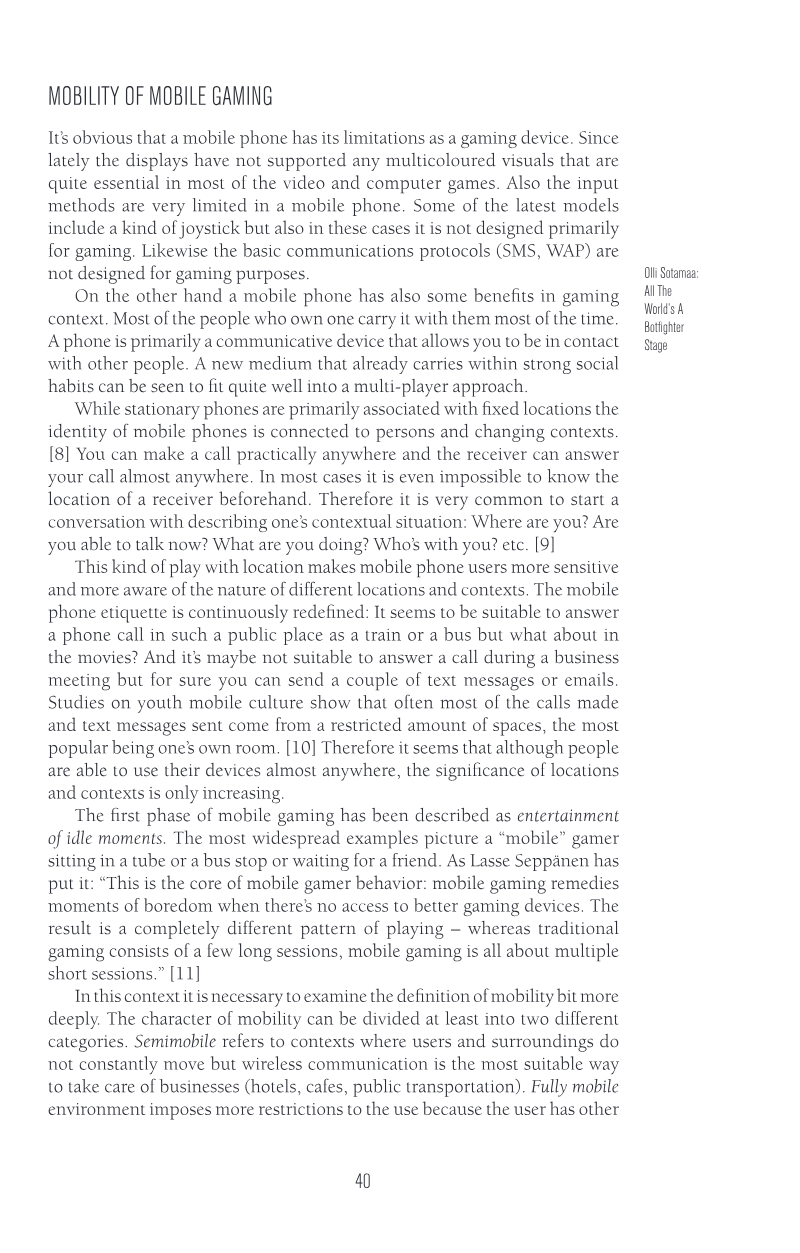
- Botfighters, launched in Sweden in 2001 and offered in Sweden and Finland by April 2002, let players hunt and shoot each other via SMS commands, with a web interface for building robots and tracking scores.
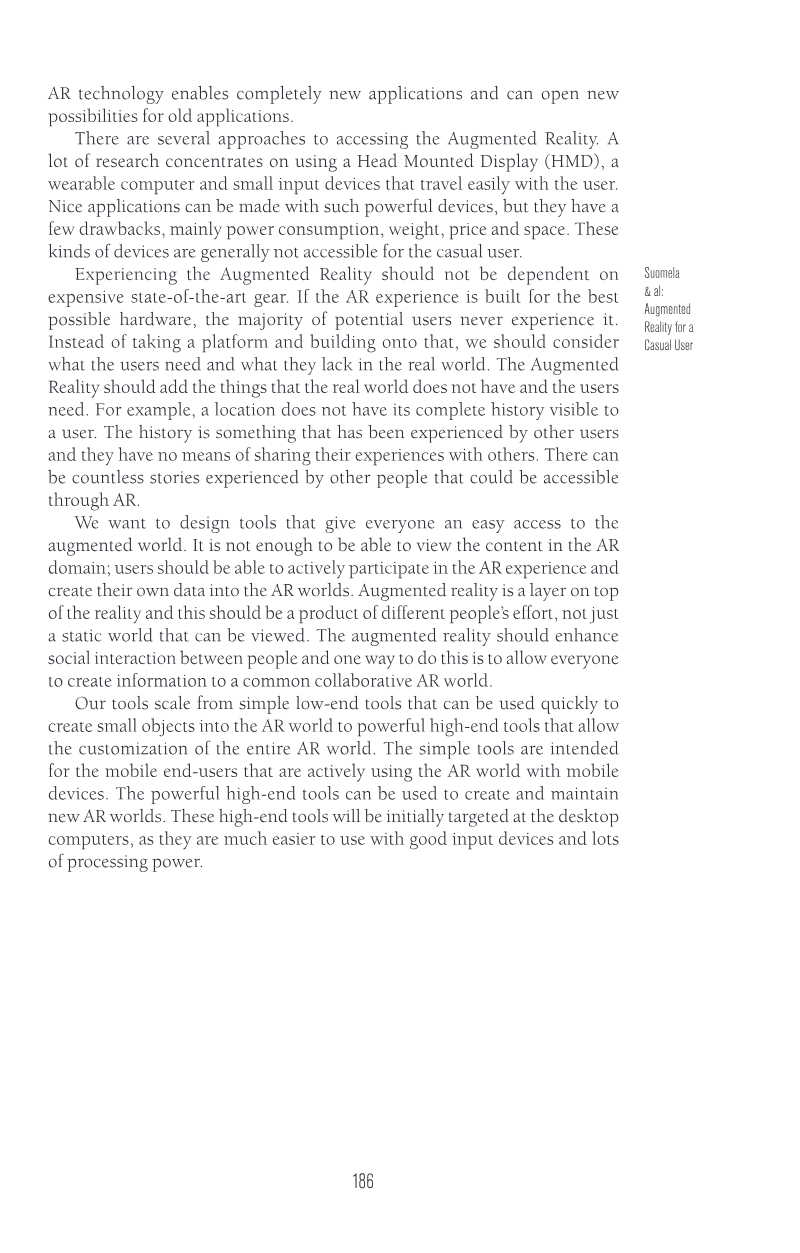
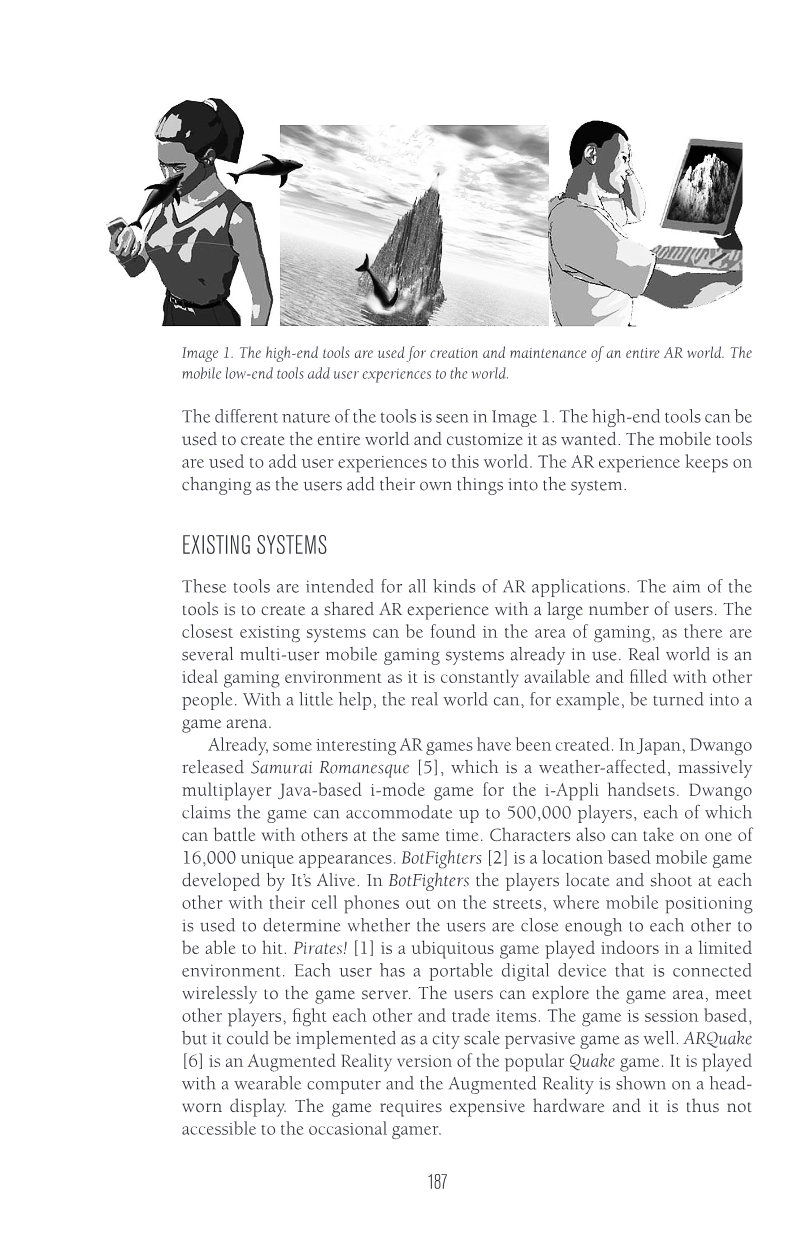
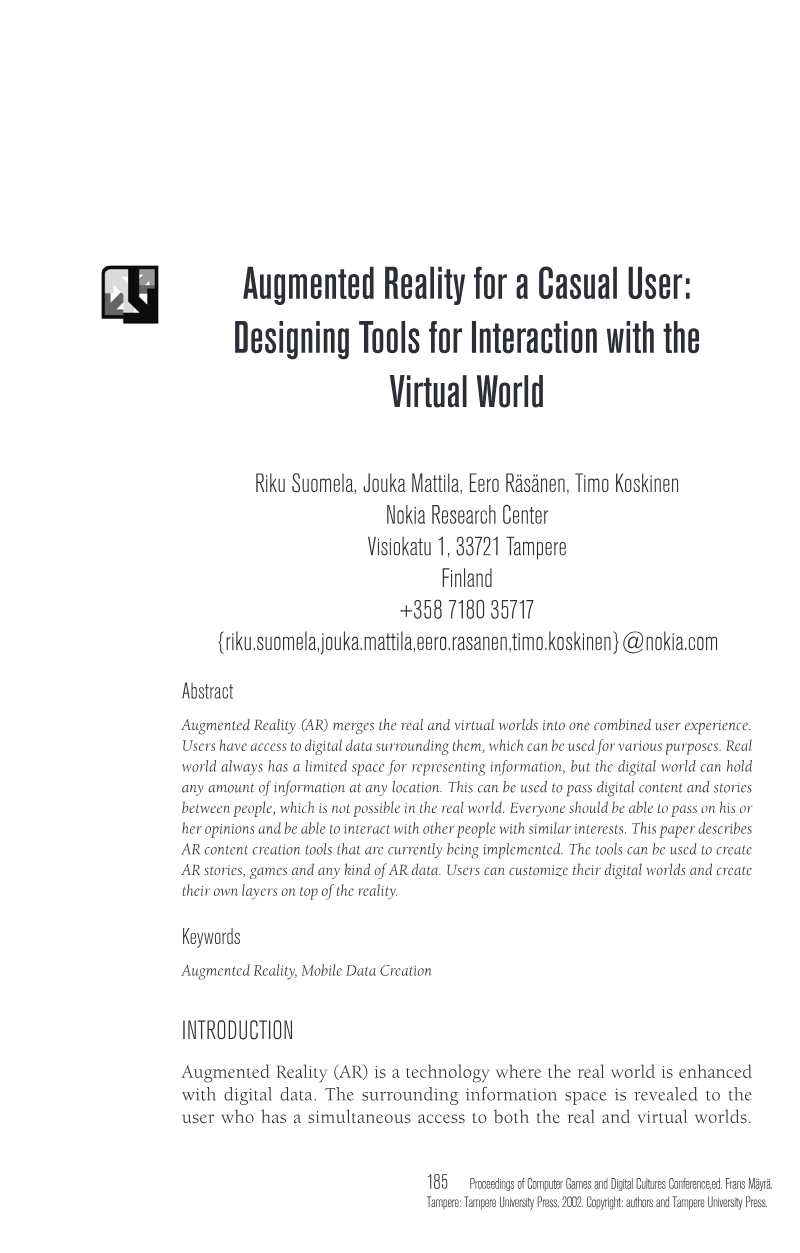
Augmented Reality for a Casual User: Designing Tools for Interaction with the Virtual World
This document outlines the design and implementation of Augmented Reality (AR) content creation tools aimed at casual users, developed by Nokia Research Center.
- The paper argues AR should be accessible to casual users rather than dependent on expensive head-mounted displays and wearable computers, with users actively creating content in a shared, collaborative AR layer instead of only viewing a static world.
- The central thesis is that letting everyone contribute digital objects, stories, and games to shared AR spaces can enhance social interaction between people.
- The proposed system pairs an AR world server, which stores data objects with triggers tied to location, temperature, or other available information, with client devices through which users see and interact with that content.

The Similar Eye: Proxy Life and Public Space in the MMORPG
The document, "The Similar Eye: Proxy Life and Public Space in the MMORPG," examines the intricate relationship between game design, player behavior, and the emergence of complex social and economic systems within Massively Multiplayer Online Role-Playing Games.
- The report argues that MMORPGs such as EverQuest, Ultima Online, Anarchy Online, and Star Wars Galaxies function as genuine public spaces, countering theorists like Richmond, Davidson, and Gibson who deny that virtual environments can support authentic public interaction.
- Its central mechanism is oppositional game design: dividing the world into safe cities, dangerous wilderness, and quest zones, with the environment acting as antagonist, creates functional dependence on other players, which the author identifies as the foundation of community.
- Drawing on de Certeau's strategies and tactics, along with the figures of the crowd and the flâneur, the analysis holds that public space emerges through player improvisation within designed frameworks rather than from the designed structure alone.
In Defense of Cutscenes
"In Defense of Cutscenes" posits that cutscenes and pre-written narratives are not merely supplementary but fundamental to the design and player experience of many popular video games.
- Klevjer's essay argues against radical ludology, the view that narrative in games is an irrelevant ornament, and instead holds that cutscenes are an integral part of the gaming experience where narration and play can coexist.
- Klevjer contends that game events are inherently representational and rhetorical 'symbolic actions,' which gives narrative framing a legitimate role in shaping how players understand their activity.
- The essay addresses the 'paradox of make-believe' in story-based games such as Grand Theft Auto III, where players want both open-ended agency and a pre-written narrative, and argues cutscenes resolve this tension through genre-based framing.