Global reports and market data
Documents
Motivations of Play in MMORPGs
This study develops an empirical model of player motivations in Massively-Multiplayer Online Role-Playing Games (MMORPGs) to understand how motivations relate to player demographics and usage patterns.
- Nick Yee's factor analysis of a 3,000-player survey across EverQuest, Dark Age of Camelot, Ultima Online, and Star Wars Galaxies replaces Bartle's forced player-type taxonomy with a continuous profile of motivations.
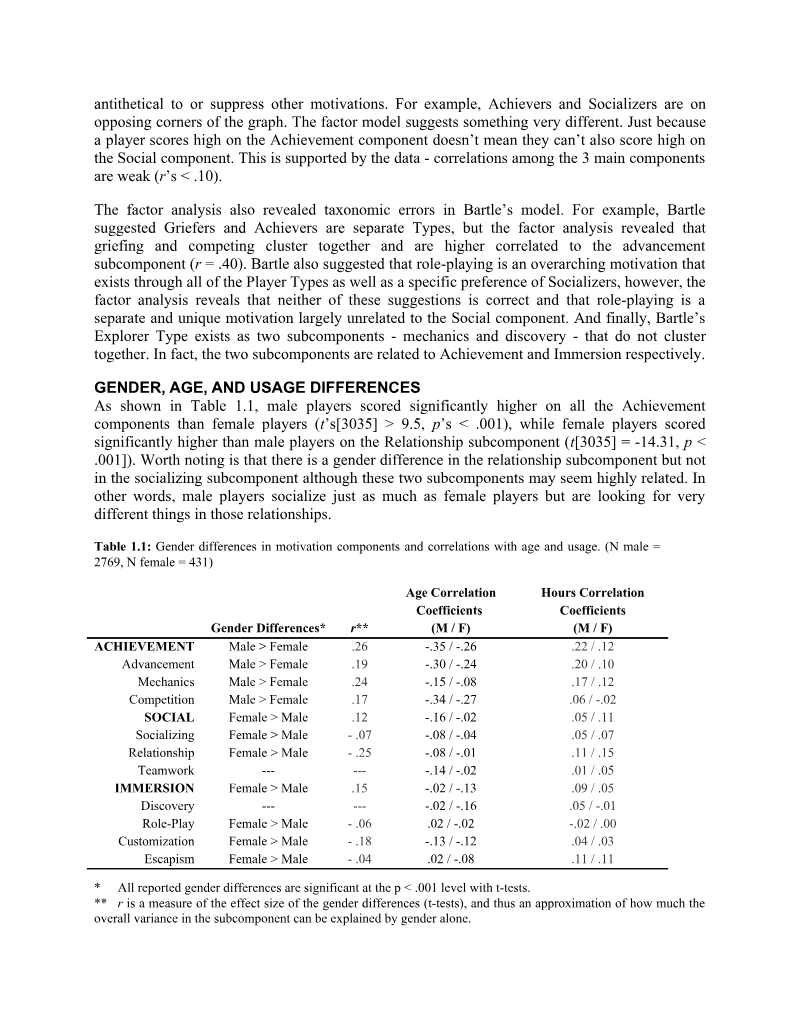
- The model identifies 10 motivation subcomponents grouping into three overarching components: Achievement (Advancement, Mechanics, Competition), Social (Socializing, Relationship, Teamwork), and Immersion (Discovery, Role-Playing, Customization, Escapism).
- The three main components are largely uncorrelated (r's under .10), meaning a player scoring high in one domain does not necessarily score low in another, so players are better described by motivation profiles than single archetypes.
CameraBots: Cinematography for Games with Non-Player Characters as Camera Operators
This paper proposes CameraBots, autonomous virtual camera operators modelled on the non-player character bots already common in 3D games, as a way to bring cinematographic principles into real-time game camera work.
- The paper proposes CameraBots, autonomous virtual camera operators built on the NPC bot code already common in 3D games, to bring film cinematography (shot selection, cutting, framing) into real-time game camera work.
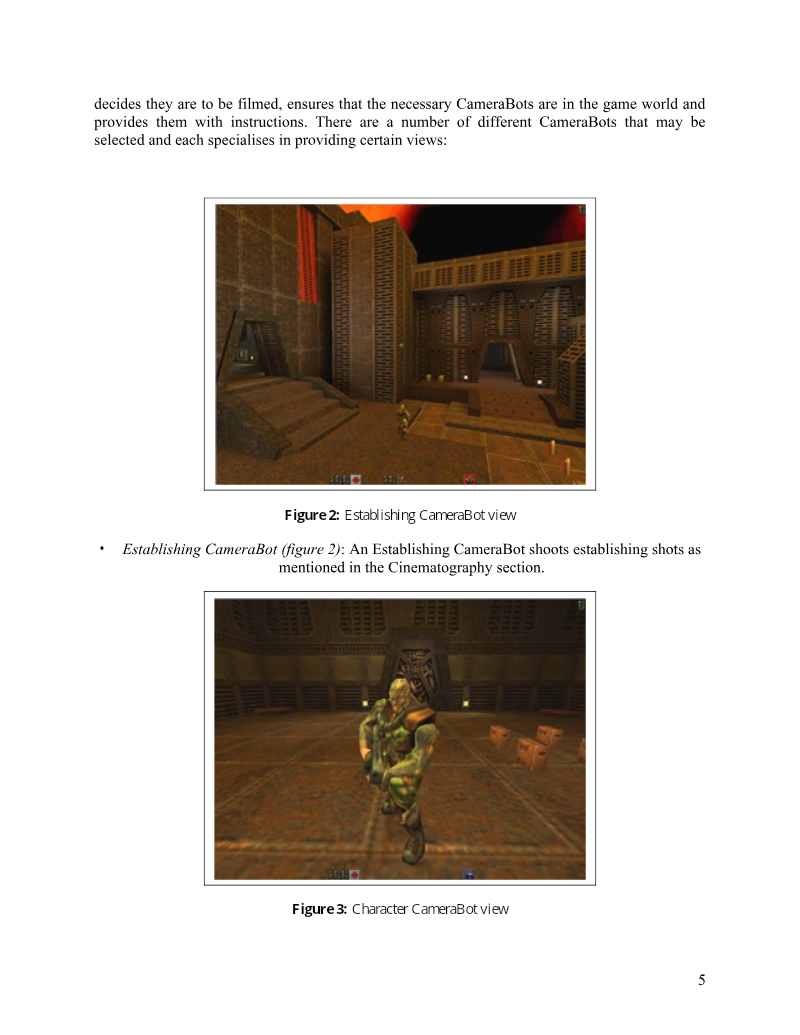
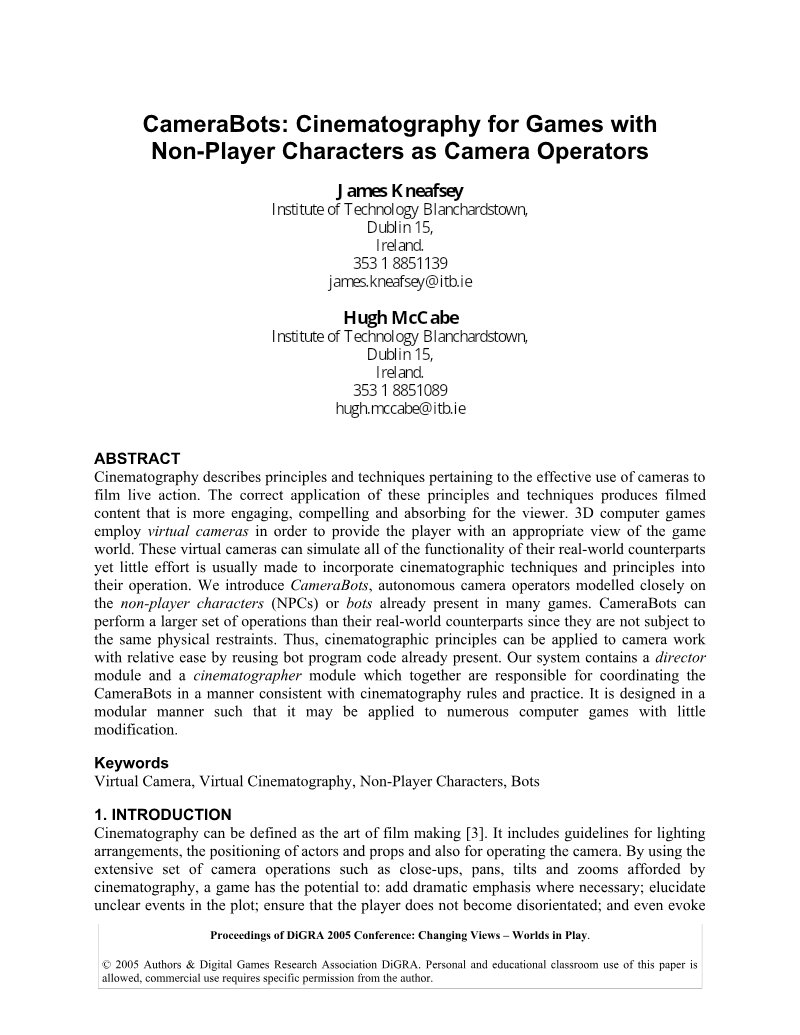
- The architecture mirrors a film set: a director module selects characters and props to film several times per second, and a cinematographer module assigns specialised CameraBots to shot types including establishing, character (long and medium), close-up, first-person, and over-the-shoulder.
- The cinematographer chooses shots based on whether the player's avatar or another principal character is attacking, moving, or stationary, and the modular design lets new CameraBot types be added and the system be ported to other engines via an API.
Simulating the Storytelling Qualities of Life: Telling Stories with the Sims
This document explores the relationship between games and storytelling, specifically focusing on how certain game genres, like simulations and role-playing games, facilitate narrative creation despite games being fundamentally non-narrative structures.
- Heliö argues that narrativization is a deeply embedded human cognitive tendency, drawing on cognitive psychology research into narrative schemas and scripts, and that certain game forms amplify it rather than games being inherently narrative.
- The paper proposes the 'narrative mindset' and social schemas as a more useful framework than a strict ludology-versus-narratology divide for understanding player motivation.
- The Sims (2000) and The Sims 2 (2004) are identified as 'borderline cases' in Jesper Juul's taxonomy and are presented as especially suited to storytelling, with their god-like external perspective inviting a third-person narrator's interpretive stance.
Pretty Good for a Girl: Gender, Identity and Computer Games
"Pretty Good for a Girl: Gender, Identity and Computer Games" examines the intricate relationship between gender, identity, and computer game engagement among teenagers, both within educational settings and informal social contexts.
- Gendered identities in gaming are not fixed in advance; they are actively formed within particular game-playing contexts, so generalizing about games and gender obscures this process.
- The study is a small, qualitative, interpretive two-site design (a Melbourne Year 8 English unit and five South East Asian women aged 18 to 22 in an all-girls Counter-Strike clan at a LAN café), so its findings are not statistical and are limited in geography, age, and sample size.
- Students' expertise and strategies for learning games (persistence, trial and error, using tutorials or cheats, giving up) varied more with experience and interest than with gender, although boys were more often familiar with games.
The Pleasures and Practices of Virtualised Consumption in Digital Spaces
This document explores virtualized consumption in digital spaces, particularly within video games and online marketplaces, arguing that these platforms foster new consumption practices driven by digital play and imagination.
- The paper argues that virtualised consumption, such as buying virtual goods and browsing virtual marketplaces, should be treated as a legitimate, pleasurable form of consumption rather than a failure of marketing.
- Its central thesis frames virtual consumption as the latest stage in a historical shift from utility toward emotional, sign-based, and playful experience, with digital spaces acting as liminoid play-spaces where imagination is stimulated and partly actualised.
- The authors contend that cart abandonment is a misreading of consumers who gain satisfaction from imaginative engagement with goods they never intend to buy, rather than a sign of lost sales.
Enhancing Player Experience in MMORPGs with Mobile Features
This study investigates how mobile features can enhance the player experience and pervasiveness of Massively Multiplayer Online Role-Playing Games (MMORPGs).
- The paper proposes six categories through which mobile phone features can extend MMORPGs into pervasive gameplay: communication access, event notifications, asynchronous gameplay, synchronous player-to-player interaction, passive participation, and parallel reality.
- Findings come from six focus groups held in February and March 2005 with 20 players aged 17 to 40 (roughly 13 percent female), plus two developers who contributed by e-mail, and the authors frame the work as qualitative research for game design rather than marketing research.
- Players and developers reacted most favorably to optional, controllable, and peripheral features such as access to in-game chat and mobile auction or trading systems.
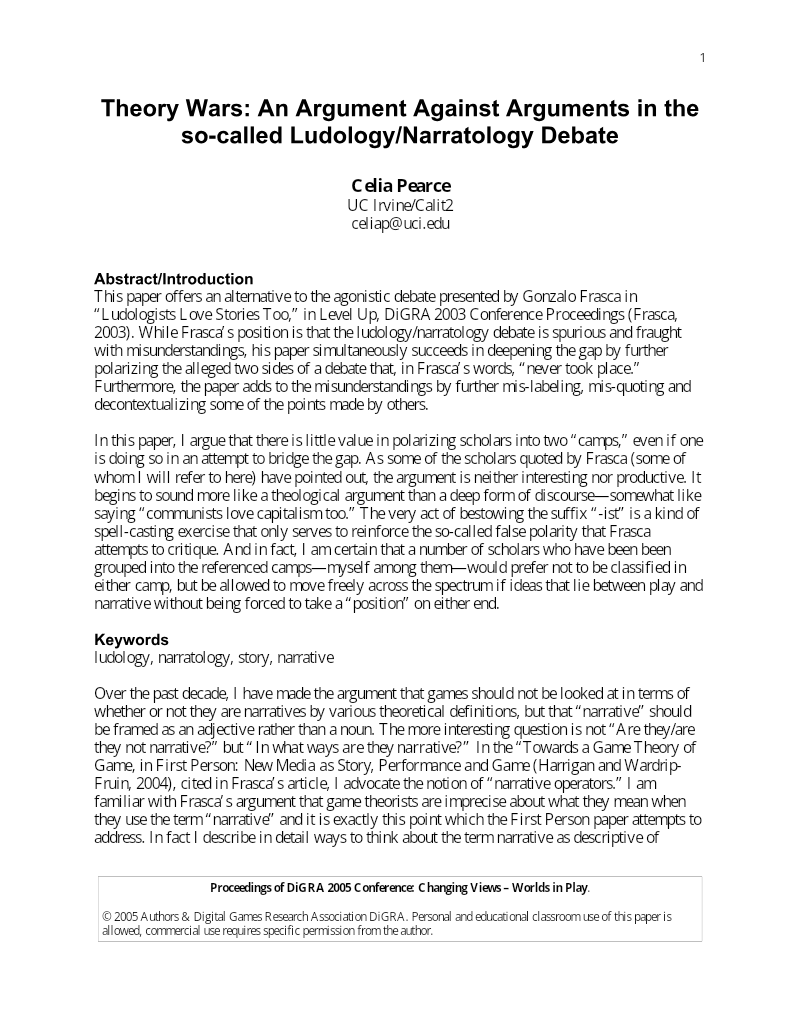
Theory Wars: An Argument Against Arguments in the So-Called Ludology/Narratology Debate
The document, "Theory Wars: An Argument Against Arguments in the So-Called Ludology/Narratology Debate," critiques the polarizing nature of the ludology/narratology debate in game studies, arguing that such binary classifications are unproductive and misrepresent the nuanced relationship between games and narrative.
- Celia Pearce's "Theory Wars" responds to Gonzalo Frasca's 2003 essay "Ludologists Love Stories Too," arguing that Frasca's essay deepens the ludology/narratology divide by polarizing scholars into opposing camps and mislabeling their positions.
- Pearce contends that attaching the "-ist" suffix to researchers creates a false binary, and that many scholars would prefer to move freely between play-centered and narrative-centered perspectives.
- Her central proposal is to reframe "narrative" as an adjective rather than a noun, shifting the question from whether games are narratives to in what ways they are narrative.
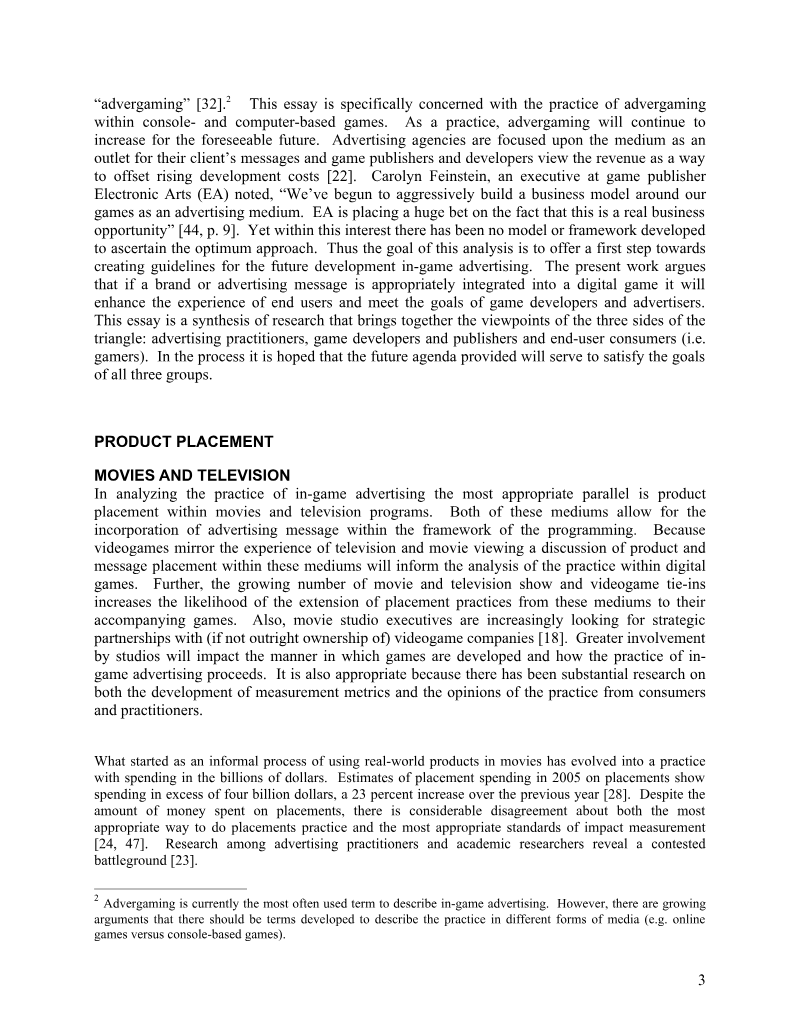
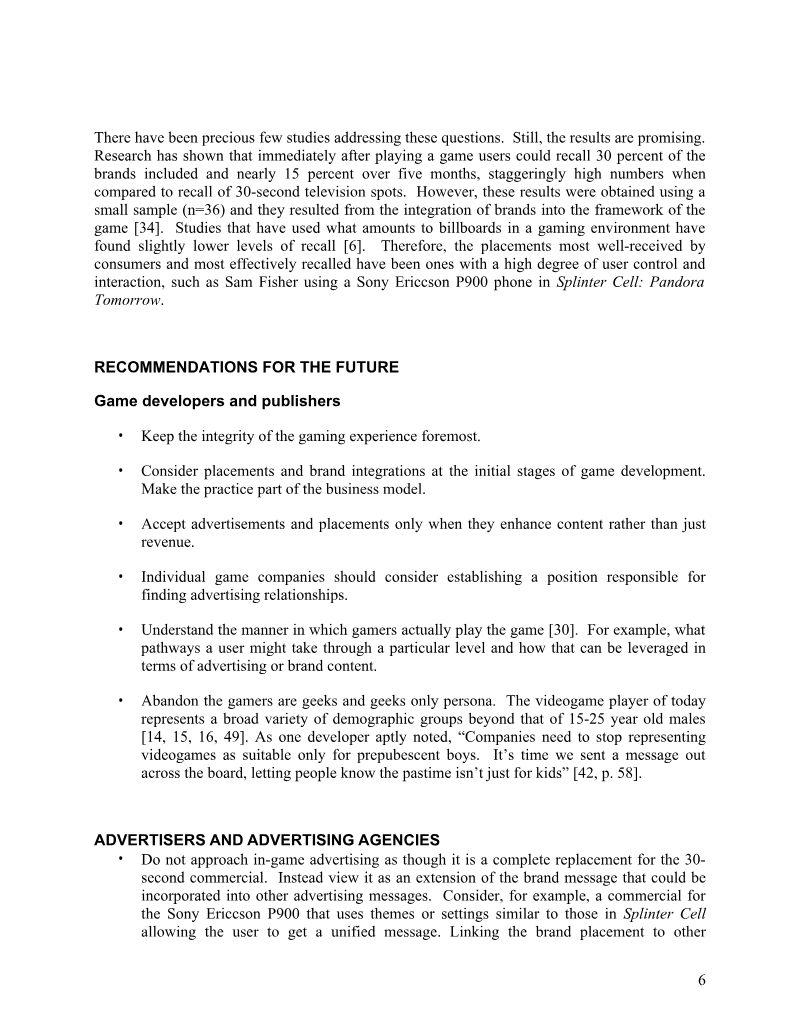
The Sponsored Avatar: Examining the Present Reality and Future Possibilities of Advertising in Digital Games
This paper examines the current state and future potential of advertising within digital games, a practice often termed "advergaming."
- Advertising spending is shifting away from traditional television commercials toward placements in entertainment, with one cited beverage company redirecting more than $300 million in annual spending.
- Game-based advertising remained a small share of revenue relative to film and television, with projections of roughly $260 million by 2008, though agencies increasingly seek game placements and some have created dedicated game advertising divisions.
- Players generally accept in-game advertising, mostly because it enhances realism, but they worry that placements may feel incongruous and detract from the experience.
How Serious Are Serious Games?: Some Lessons From Infra-games
This paper explores the potential of serious games for advanced academic and professional learning, particularly in supporting decision-making and management of complex infrastructures like utilities, ports, and wind farms.
- Serious simulation games are argued to help managers, policymakers, and young professionals grasp complex infrastructure systems (utilities, ports, wind farms) by letting them experiment with decisions and observe consequences over time in a safe setting.
- The authors contend that simulation games are only effective when combined with realism and engagement and embedded in broader research, debriefing, and follow-up processes, not used as standalone tools.
- Infrastructure planning is framed as a 'wicked' problem, marked by weak consensus on values and facts, pluricentric decision-making, and strategic stakeholder behaviour, which games can help participants experience and manage.
Affective Videogames and Modes of Affective Gaming: Assist Me, Challenge Me, Emote Me
The document explores the concept of affective videogames, distinguishing them from traditional biofeedback games by focusing on the use of uncontrolled physiological responses to dynamically influence gameplay.
- Affective games differ from biofeedback games: in biofeedback the player consciously controls physiological responses to influence play, while affective games sense uncontrolled emotional reactions and feed them back into gameplay, forming an affective feedback loop.
- The authors' case study used an early prototype built with their Intelligent Gaming System toolkit, a Missile Command-style target-acquisition game that adjusted threat number and damage based on the player's heartbeat relative to a resting baseline to keep engagement in an optimal range.
- The evaluation involved only eight participants aged 21 to 38, so the findings are preliminary; players reported enjoyment, but experienced gamers responded less physiologically than novices, which the authors link to habituation and individual differences that must be compensated for.
Playing Through: The Future of Alternative and Critical Game Projects
Patrick Crogan's DiGRA 2005 paper, "Playing Through: the Future of Alternative and Critical Game Projects," examines experimental games that disrupt the usual virtuality of play by making its physical and political stakes visible.
- Patrick Crogan's 2005 DiGRA paper reads experimental games such as Tekken Torture Tournament and the Painstation consoles as 'theatres of cruelty' that use real bodily consequences, like electric shocks and whips, to provoke reflection on the technocultural conditions of gaming.
- Crogan's central critical target is Gonzalo Frasca's claim that simulation is 'the form of the future,' positioned against narrative as the past and drama as the present, which Crogan argues is too rigid a temporal schema.
- Crogan argues that computer simulation grows out of military-industrial technoscience and therefore shares narrative's mnemotechnical, future-directed character rather than standing apart from it.

Dialog as a Game
The document "Dialog as a Game" proposes a novel technique for managing pre-written dialog in computer games by conceptualizing conversation as a game.
- Border proposes treating in-game dialog as a rule-governed game in which speakers move between short dialog "chunks" rather than traversing ever-larger decision trees, with the central claim that this yields more socially and emotionally coherent NPCs.
- The framework models characters with simplified emotional states (e.g., happy/sad, afraid/confident) and relationship variables (closeness, face, liking or irritation, trust), with the conversational "ball" passing between speakers as face is gained or lost.
- Relationship and emotional values decay toward zero over time unless refreshed, and each character uses a payoff function to decide whether a chunk is offered based on whether its requirements are met.