1 free read left. Create a free account for unlimited reading + AI research.
Create free accountWhitepaper DiGRA
1 free read left. Create a free account for unlimited reading + AI research.
Create free accountWhitepaperDiGRA
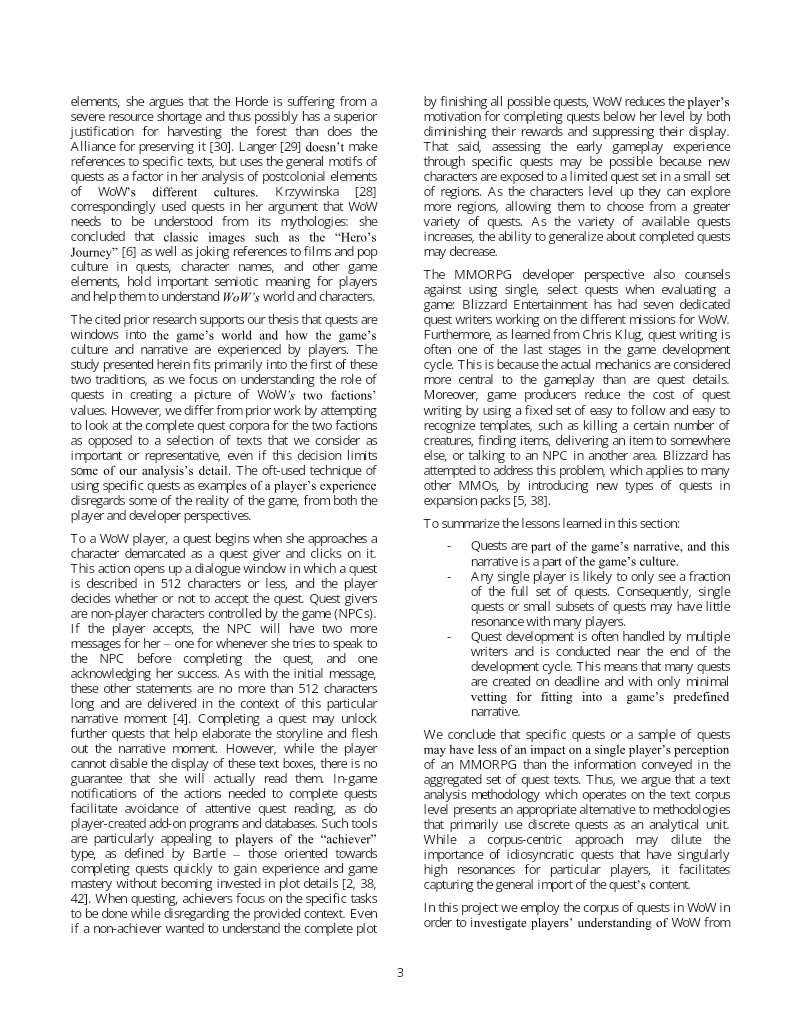
Richard Bartle's Player Types sorted players into single archetypes. The study argues these categories were poorly validated and could not be meaningfully tested.
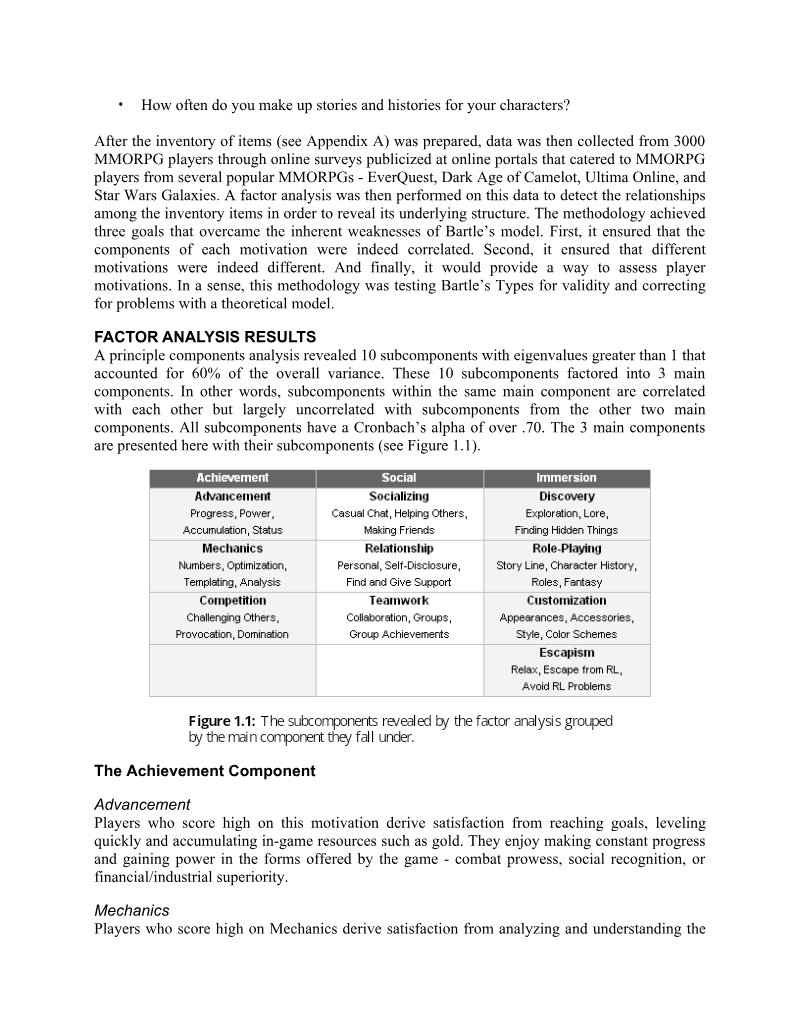
Nick Yee's study develops an empirical model of player motivations in massively multiplayer online role-playing games (MMORPGs), aiming to replace the theoretical taxonomy of Richard Bartle's Player Types with a data-driven framework. The central argument is that Bartle's forced, mutually exclusive categories are poorly validated and cannot be meaningfully tested, and that players are better understood as possessing a profile of motivation scores rather than belonging to a single archetype. Using factor analysis of survey responses, the study identifies 10 motivation subcomponents that group into three overarching components: Achievement (Advancement, Mechanics, Competition), Social (Socializing, Relationship, Teamwork), and Immersion (Discovery, Role-Playing, Customization, Escapism).
The study surveyed 3,000 players recruited through online portals serving four popular games: EverQuest, Dark Age of Camelot, Ultima Online, and Star Wars Galaxies. Each subcomponent achieved a Cronbach's alpha above .70, and the three main components were largely uncorrelated (r's under .10), suggesting that high scores in one domain do not preclude high scores in another. The analysis also found specific taxonomic problems in Bartle's model, such as griefing clustering closely with competitive achievement rather than forming a separate type, and role-playing standing apart from social motivation.
Demographic findings show that male players scored significantly higher on all Achievement subcomponents, while female players scored higher on the Relationship subcomponent, with the gender difference in socializing being negligible. Younger players were more driven by advancement, competition, and mechanics. Among heavy users, men's playtime correlated most with advancement and mechanics, whereas women's correlated most with relationship-building. The author acknowledges that the resulting components depend on the initial item inventory, meaning unmeasured motivations may exist.
DiGRA · 2016
Newzoo · 2025