Global reports and market data
Documents
The Order of Play: Seeing, Teaching, and Learning Meaning in Video Games
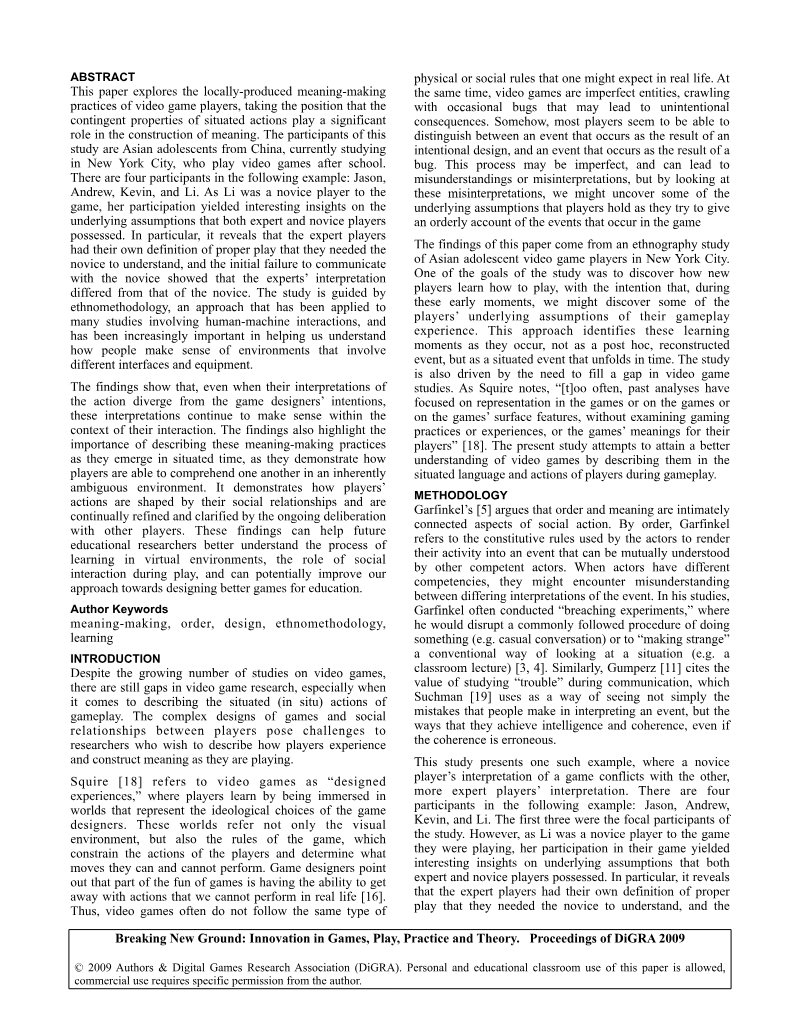
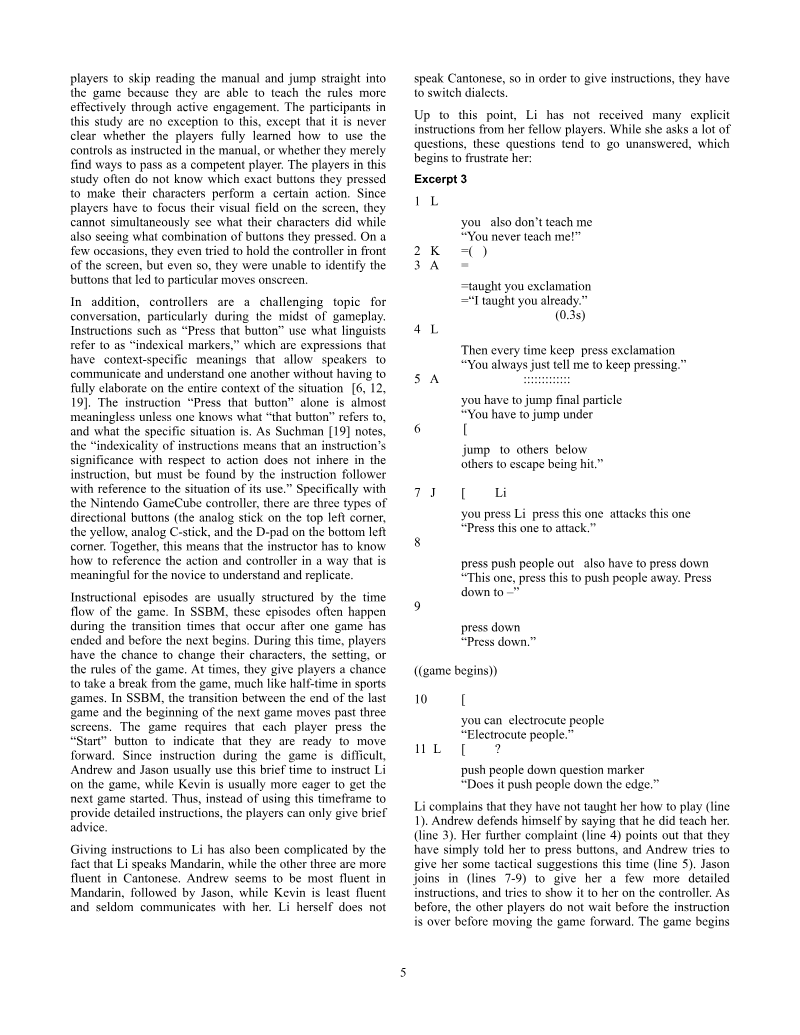
Hung's "The Order of Play: Seeing, Teaching, and Learning Meaning in Video Games" examines how players collectively make sense of a game and pass that understanding to others.
- A novice's misreading of Super Smash Bros. Melee's damage-percentage indicator as "more is good" was internally coherent and grounded in embodied experience, and experts corrected it by treating their shared interpretation as the accountable norm rather than by faulting her logic.
- Breakdowns in interpretation and the corrections that follow them expose the implicit rules of play and the social work through which meaning is collectively established among players.
- Situated learning within a community does not guarantee mechanical mastery: a novice receiving fragmented, often unanswered instructions from friends speaking a different dialect of play ultimately abandoned the game when her needs went unmet.


Contextually-Ambiguous Pervasive Games: An Exploratory Study
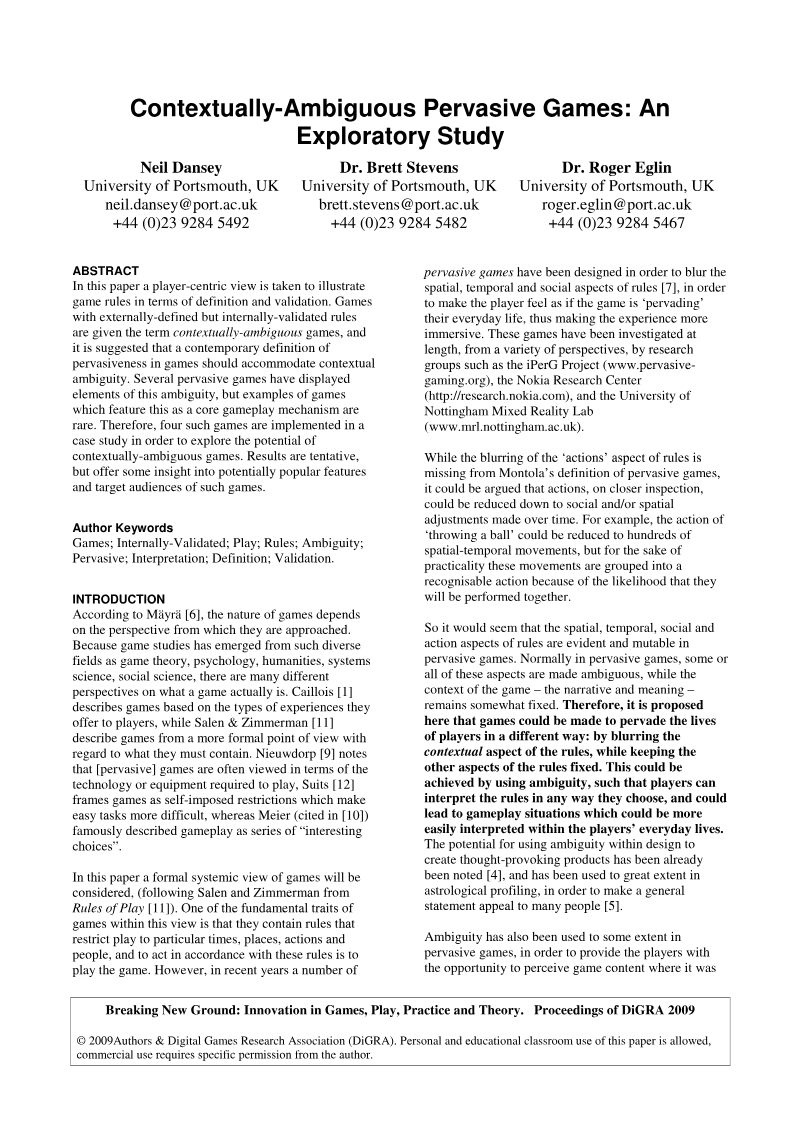
This exploratory study examines "contextually-ambiguous" pervasive games, a category in which game rules are externally defined by the game system but internally validated by the player, meaning players interpret the rules according to their own everyday circumstances.
- Contextually-ambiguous pervasive games are defined by externally set rules that players validate internally against their own everyday circumstances, a category the authors say remains rare in practice.
- The authors propose a two-dimensional framework plotting games by rule definition (internal vs. external) and rule validation, with free play, performance, ambient games, and contextually-ambiguous games at its extremities, and suggest contextual ambiguity could complement Montola's temporal, spatial, and social definition of pervasiveness.
- The study built four simple cognitive games loosely modeled on The Game and SF0, varying complexity, reward structure, and thematic valence (conflict vs. expression), and ran them by email over 48-hour periods with University of Portsmouth staff and students.
A Literary Excursion Into the Hidden (Fan) Fictional Worlds of Tetris, Starcraft, and Dreamfall
This academic paper, presented at the 2009 DiGRA conference, examines fan fiction written about three games representing different genres: the puzzle game Tetris, the real-time strategy game StarCraft, and the adventure game Dreamfall: The Longest Journey.
- The paper is a small, exploratory qualitative study of fan fiction posted to fanfiction.net about three games from different genres: Tetris, StarCraft, and Dreamfall: The Longest Journey, presented at the 2009 DiGRA conference.
- Tetris fan fiction personifies the falling blocks and uses allegory, dialogue, and humor to turn the game's repetitive, plotless nature into commentary on human life, frustration, or addiction.
- StarCraft fan fiction is generally longer and more plot-driven, relying on science fiction conventions, battle scenes, and stereotyped characters familiar to genre readers.
Emulation as a Strategy for the Preservation of Games: The KEEP Project
The paper presents the KEEP project, a European initiative launched in January 2009 and funded through the Framework 7 program, aimed at building an open emulation access platform for preserving digital games.
- Game preservation is currently piecemeal and insufficient, because preserving a game's runtime access requires more than the final artifact: patches, versions, build tools, middleware, and community-generated material are all part of the archive.
- Emulation is argued to be the most viable strategy for retaining runtime functionality over time, as opposed to migration, which alters objects to suit current platforms and accelerates data degradation while emulation recreates original environments and leaves the object untouched.
- The KEEP project is a European initiative launched in January 2009 under the Framework 7 program, designed as a virtual machine framework rather than a platform-specific emulator, allowing multiple existing emulators to be integrated with both automated and manual access modes.
Player Perception of Context Information Utilization in Pervasive Mobile Games
This study examines how players perceive the use of context information, including environmental, spatio-temporal, proximity, and social context, in Mythical: the Mobile Awakening, a pervasive mobile multiplayer game.
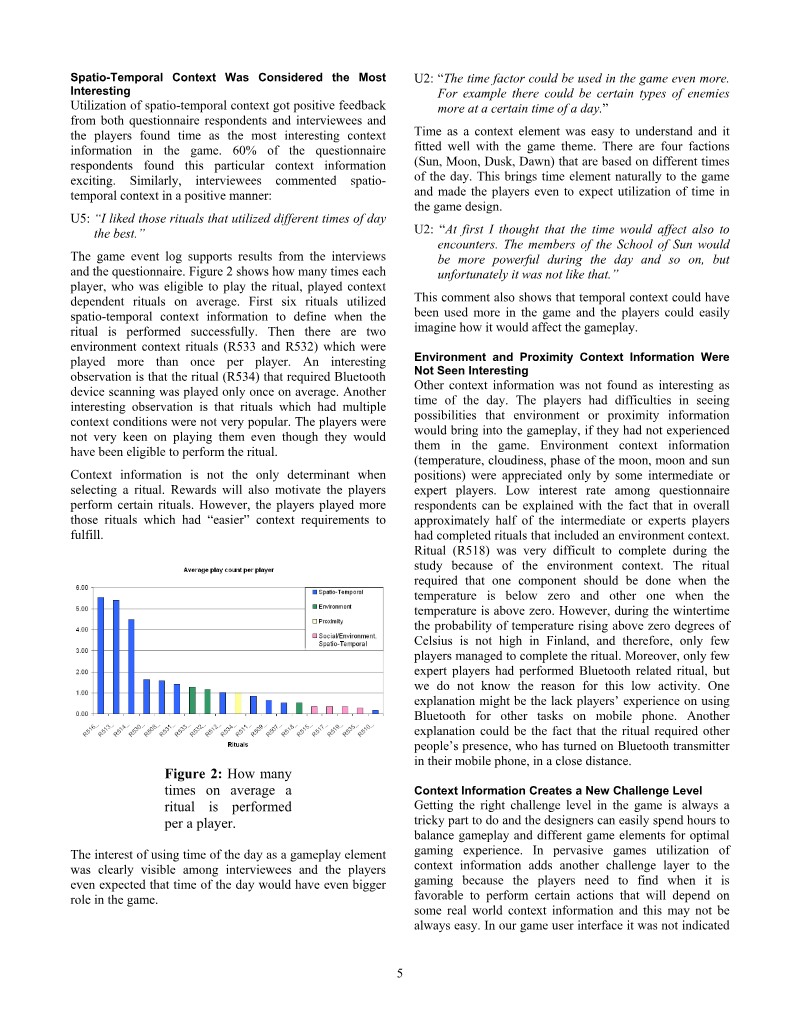
- Players reacted positively overall to context-based gameplay in the pervasive mobile multiplayer game Mythical: the Mobile Awakening, based on interviews, a questionnaire, and server logs from 373 players over 116 days.
- Time of day was the most appreciated form of context, with roughly 60 percent of questionnaire respondents favoring time-based rituals because its role in gameplay was easy to grasp.
- Fragmented play spread across the day correlated strongly with fun (r = .924, p<0.01), suggesting that splitting play sessions over time was a meaningful source of enjoyment.
Towards Data-Driven Drama Management: Issues in Data Collection and Annotation
This work argues for a data-driven approach to intelligent drama management, moving away from hand-authored top-down systems toward models learned from real human play.
- The report argues for replacing hand-authored, top-down drama management systems with models learned from real human play, using pen-and-paper role-playing games as the data source because they embody collaborative storytelling governed by a structured decision–action–reaction–processing cycle and an explicit story-facilitating game master role.
- The empirical basis is annotated transcripts from ten sessions involving 51 participants and roughly 60 hours of recorded play, all run by experienced game masters using a D20-based scenario.
- Player and game master communication is coded along dimensions including narrative progression, character actions, assistance, critique, and dramatic language, with codes organized into hierarchical case frames.
Beyond Adversarial: The Case for Game AI as Storytelling
The paper argues that game AI should move beyond the single goal of winning and instead aim to craft satisfying player experiences.
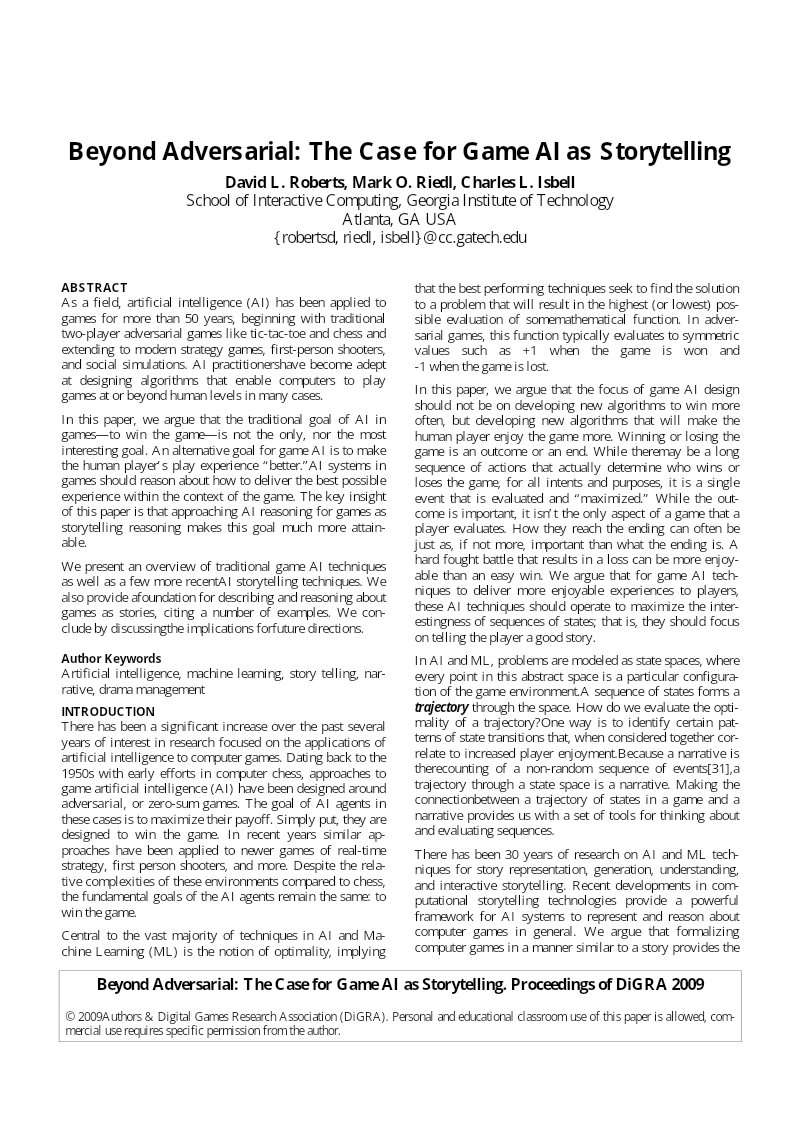
- The paper argues that game AI should aim to craft satisfying player experiences rather than solely to win, treating a game's trajectory (the sequence of states during play) as a narrative that can be evaluated, shaped, and optimized.
- Proposed narrative heuristics for judging trajectories include thought flow, plot homing, dramatic arc, and suspense, offering criteria beyond win or loss outcomes.
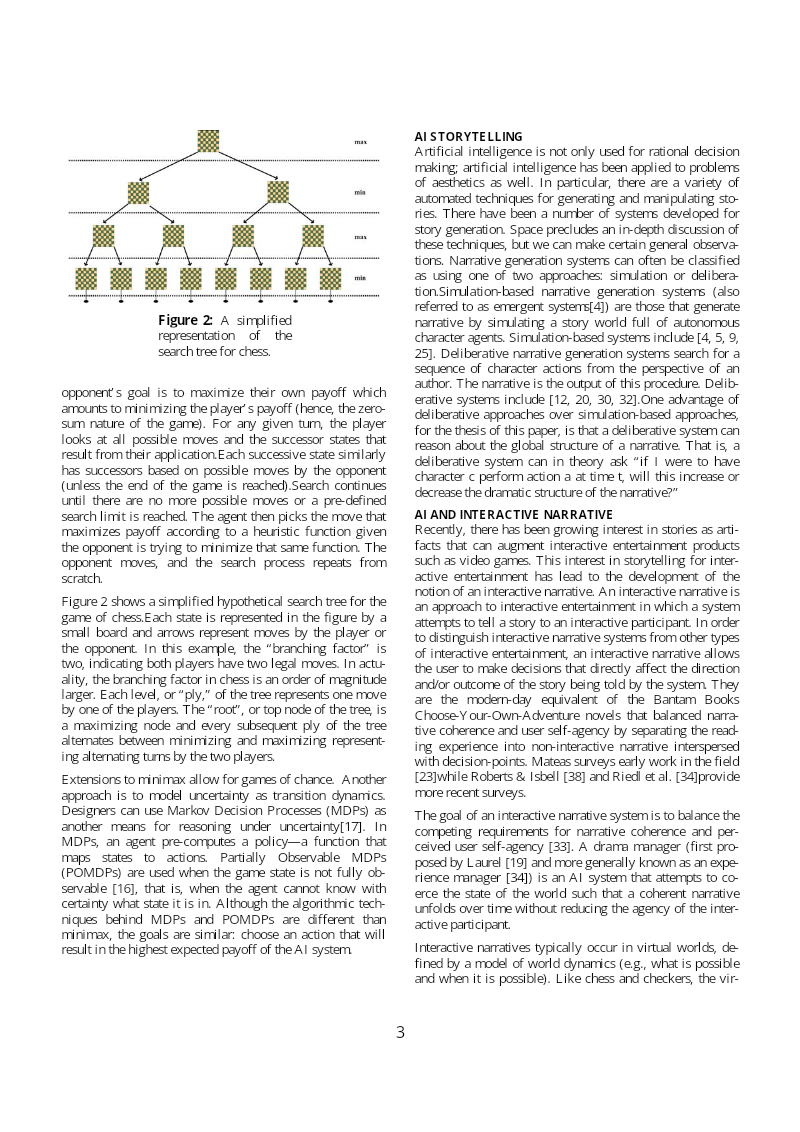
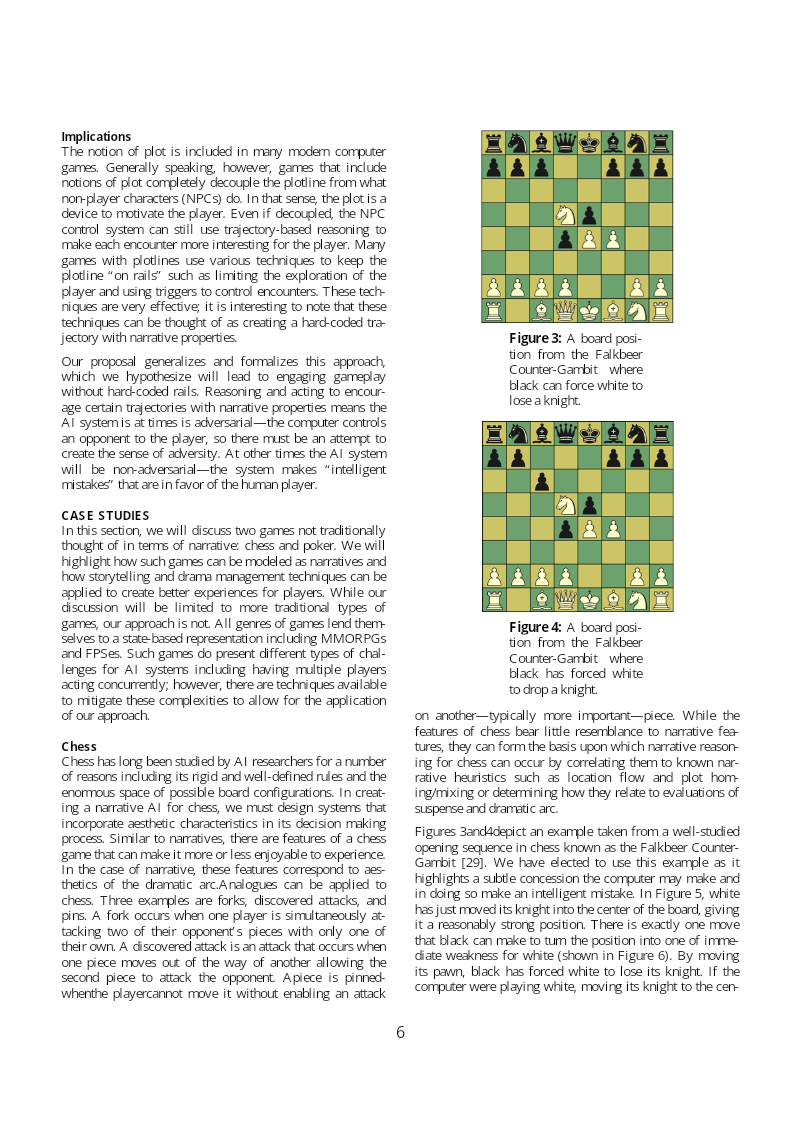
- The authors suggest an AI may deliberately make "intelligent mistakes," illustrated in chess by the Falkbeer Counter-Gambit, where a deliberate material concession creates a later advantage.
Textual Analysis, Digital Games, Zombies
This paper argues that textual analysis is a valuable tool for digital game studies, because meaning in games emerges through situated play rather than residing fixed within the game itself.
- The paper argues that textual analysis suits digital game studies because meaning emerges through situated play rather than residing fixed within the game, so interpretation depends on the analytical lens and reading context rather than a single dominant meaning.
- The proposed framework draws on Barthes' structural and lexia-based methods and on Bennett and Woollacott's concepts of intertextuality and "reading formations," and is tested on an early section of the 2005-era survival-horror game Resident Evil 4.
- The framework is also intended to resolve classification puzzles, such as whether the game's villagers, who are infected humans rather than true undead, belong in the zombie category at all.
Experiential Narrative in Game Environments
Calleja's "Experiential Narrative in Game Environments" argues that the notion of narrative in games has been over-generalized, and that meaningful analysis requires distinguishing the specific forms games take rather than applying narratology developed for literature or film to every game, from chess to GTA IV.
- Calleja argues that narrative in games has been over-generalized, and that meaningful analysis must distinguish the specific forms games take rather than applying literary or cinematic narratology to every game, from chess to GTA IV.
- The work's central framework is "alterbiography," a personal life-story a player constructs through real-time interaction with a virtual environment, shaped by the game's rules, AI, and objects as well as the player's own interpretation.
- Alterbiography emerges from a synthesis of three elements: the game's representational signs, its mechanical rules, and the player's imagination, with the player's disposition and focalization (self-centered, entity-centered, or miniature-oriented) shaping the result.
Girls' Play: Context, Performance & Social Videogame Play
This paper examines how girls aged 10 to 16 play video games, with particular attention to how social context shapes performance and creativity.
- Video games are increasingly part of girl culture rather than solely an extension of male gaming culture, a framing the authors argue much prior literature has overlooked.
- The study examines girls aged 10 to 16 playing physically interactive, performance-oriented games such as Dance Dance Revolution, SingStar, Wii Sports, and Rock Band, which are frequently played in groups.
- The authors cite Entertainment Software Association data showing a significant increase in the number of girls who play video games over the preceding nine years, which they tie to the expansion of game genres.
Complexities of Gaming Cultures: Adolescent Gamers Adapting and Transforming Learning
This paper examines adolescent gamers' learning through the lens of complexity theory, arguing that game-based learning is embedded in overlapping social, technological, and cultural systems that are not easily articulated by the learners themselves.
- The paper frames adolescent gaming cultures as adaptive, self-organizing systems and argues that the learning occurring within them should prompt educators to revise their assumptions about how teaching and learning take place.
- Based on a three-year ethnographic study of ten adolescent male gamers, the authors find that boundaries between the gamers' learning, knowing, and teaching are blurred, with collective knowledge production closely tied to both online and offline contexts.
- The study finds that play becomes validated and purposeful when understood through principles of mutual respect, shared responsibility, and stimulating engagement, and that gamers' communities of practice function as productive learning spaces in their own right.
Evaluating Interactive Entertainment Using Breakdown: Understanding Embodied Learning in Video Games
This study examines how players learn video games through embodied interaction, using the concept of "breakdown" as its central lens.
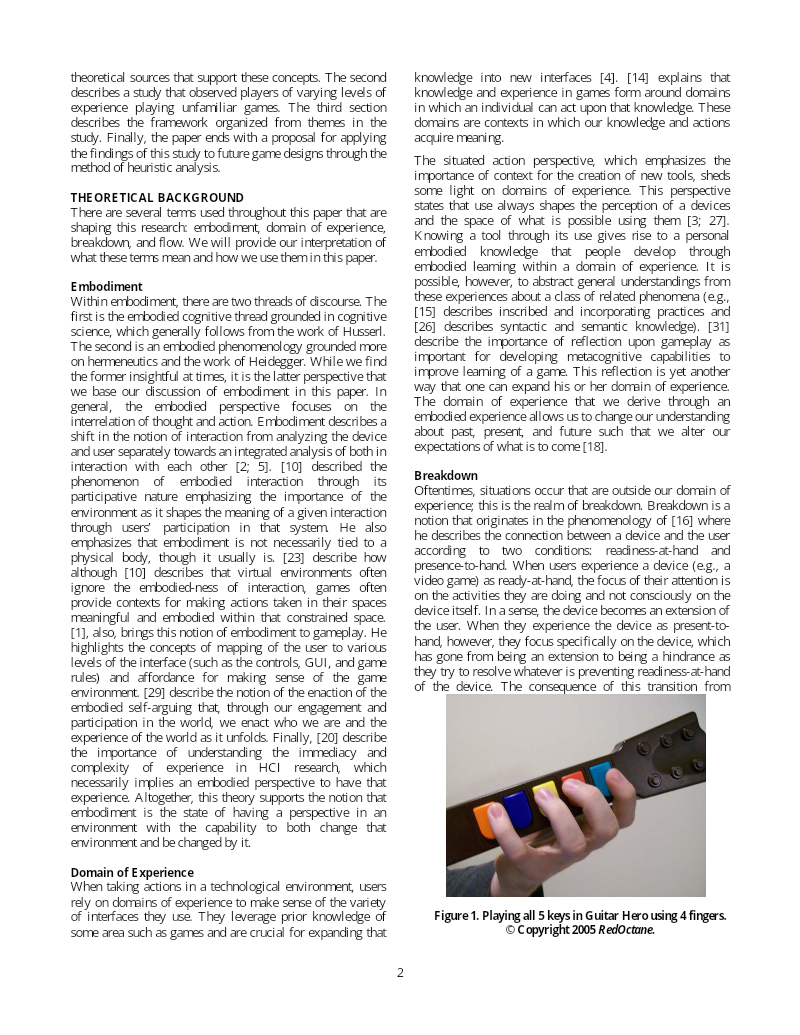
- Breakdowns in video game play occur when a player's everyday strategies fail, leading either to behavioral adaptation (breakdown in interaction) or loss of immersion (breakdown in illusion), and they can be identified through observable signs such as surprise, erratic movement, and frustration.
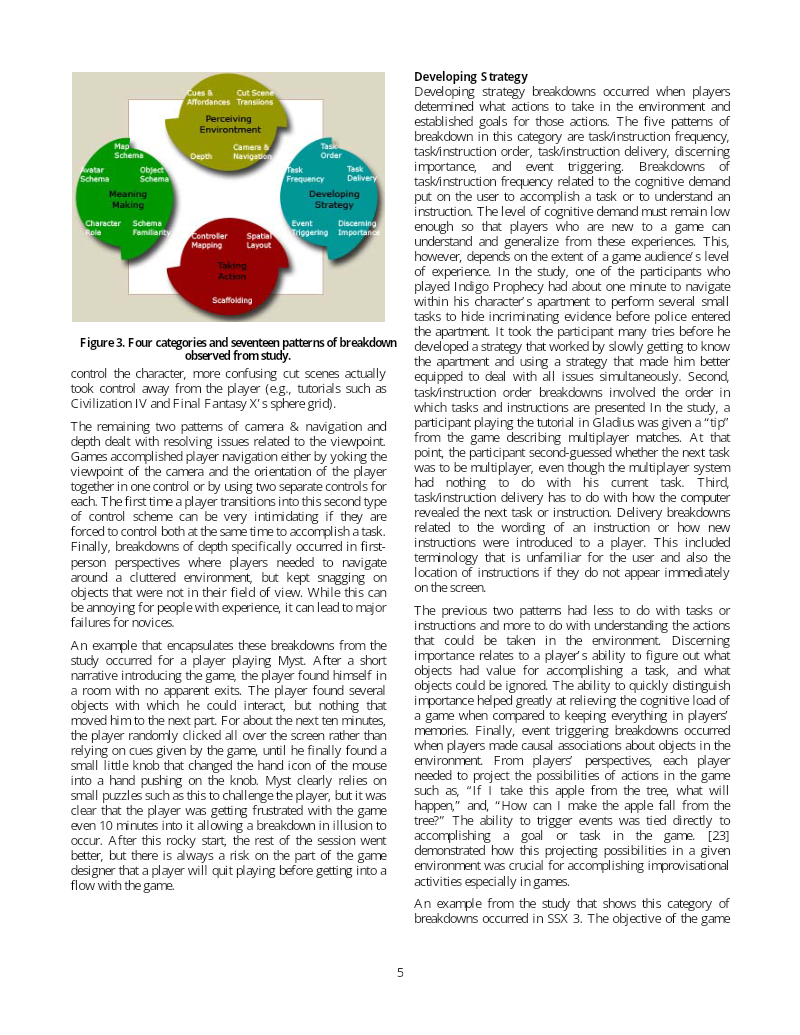
- Based on talk-aloud protocols and interviews with 13 Indiana University participants (eight male, five female) playing unfamiliar games like Myst, SSX 3, Sly 2, and Indigo Prophecy over roughly three-hour sessions, the authors identified a taxonomy of 17 breakdown patterns across four categories: perceiving the environment, developing strategy, taking action, and meaning making.
- Many breakdowns stem from unclear environmental cues, poorly delivered or sequenced instructions, mismatched control mappings, and disconnects between tutorials and core gameplay.