1 free read left. Create a free account for unlimited reading + AI research.
Create free accountWhitepaper DiGRA
1 free read left. Create a free account for unlimited reading + AI research.
Create free accountWhitepaperDiGRA
Distilling the key insights…
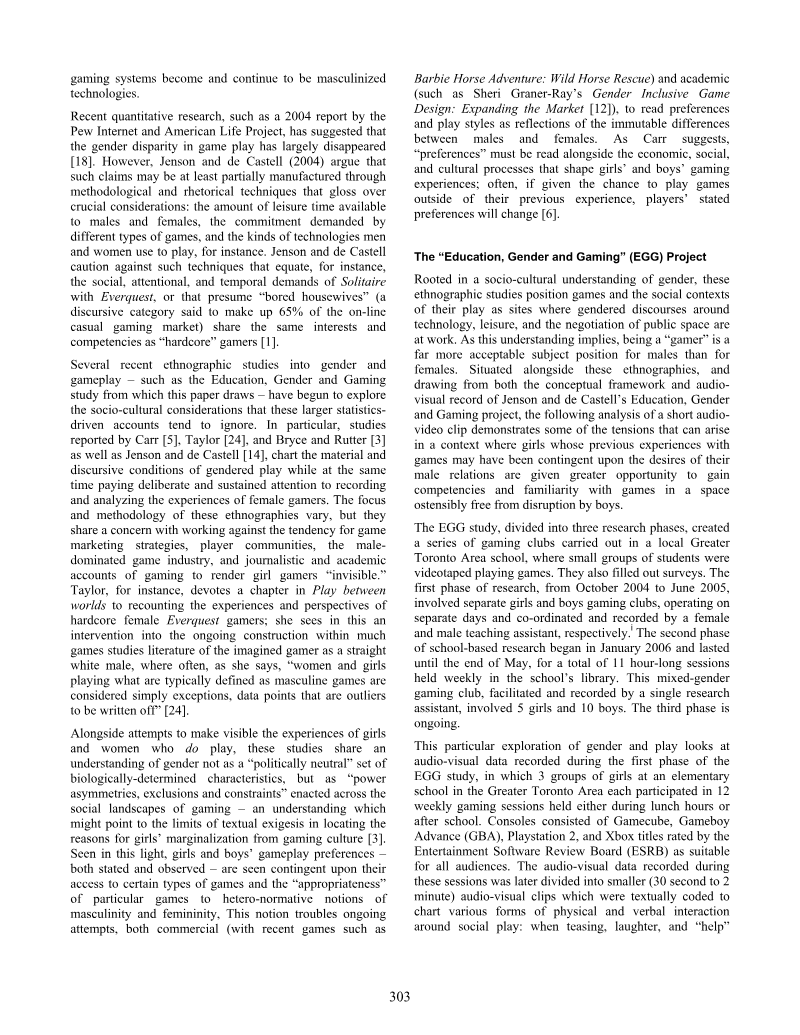
This paper examines how girls aged 10 to 16 play video games, with particular attention to how social context shapes performance and creativity. Its central argument is that video games are increasingly part of girl culture rather than being solely an extension of male gaming culture, a framing the authors suggest much prior literature has overlooked. The authors position their work as a response to Schott and Horrell's 2000 study, which they argue framed female respondents' experiences in relation to male gameplay, and they aim to give voice to girls' experiences from within girl culture itself.
The research focuses on physically interactive, performance-oriented games such as Dance Dance Revolution, SingStar, Wii Sports, and Rock Band, which are popular among girls and frequently played in groups. Drawing on a decade-spanning literature review and ethnographic fieldwork with girls who have home or friend-based access to these games and identify as gamers, the study compares group and solo play. It considers "player performance" broadly, encompassing not only success as defined by game design but also performative elements and group-created goals pursued for entertainment beyond the game's mechanics.
The authors cite industry data from the Entertainment Software Association indicating a significant increase in the number of girls who play video games over the preceding nine years, which they tie to the expansion of game genres. Their analysis centers on whether and how social setting affects levels of creative play, with the aim of contextualizing girls' voices within current scholarship on gender and games.
Beyond its substantive focus, the paper seeks to contribute methodologically to the study of digitally mediated social interaction, with implications for game studies and the social sciences more broadly. It is an early-stage framing piece in which the ethnographic findings are described as a long-term goal rather than presented as results.



DiGRA · 2016



DiGRA · 2016

GameMakers · 2021