Global reports and market data
Documents

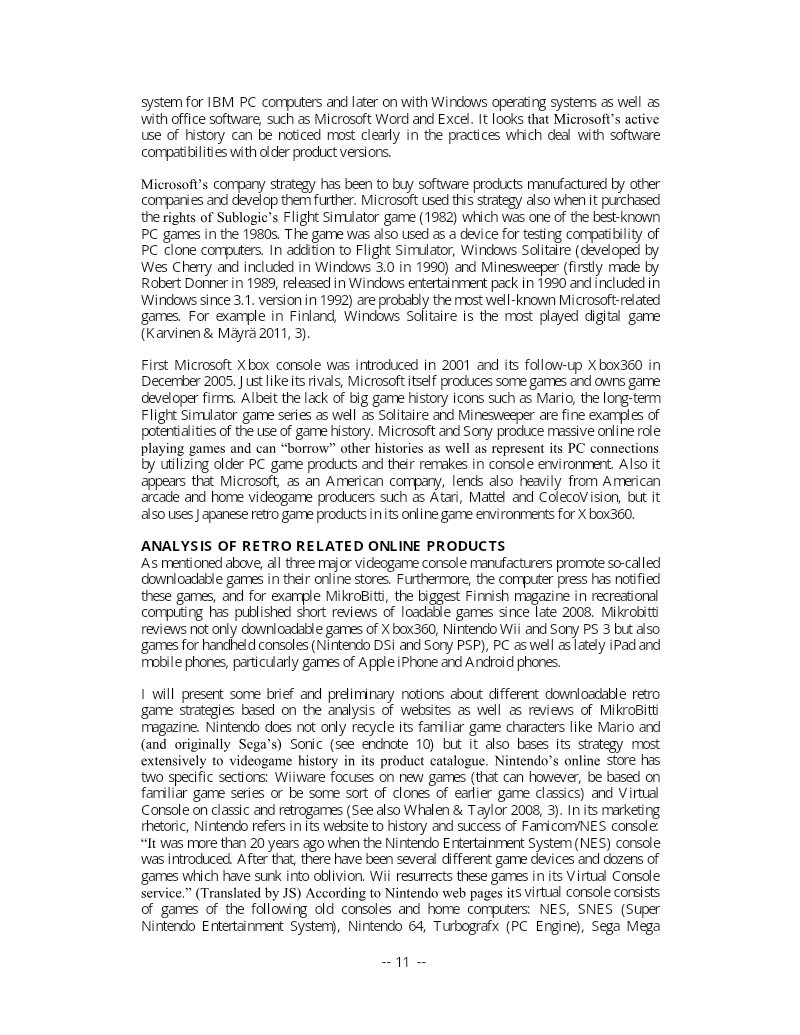
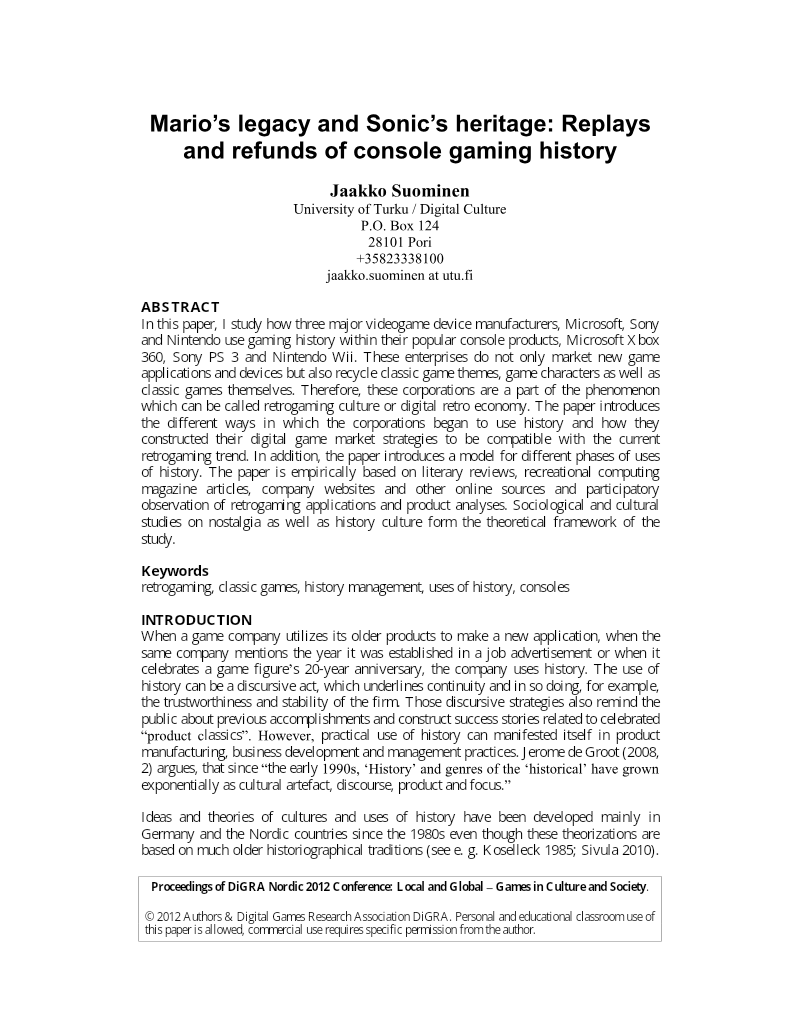
Mario's Legacy and Sonic's Heritage: Replays and Refunds of Console Gaming History
This study examines how major console manufacturers Nintendo, Sony, and Microsoft use, reuse, and manage their gaming histories, proposing a heuristic model that distinguishes awareness of historicity, the uses of history, and the management of history at both organizational and product levels.
- Nintendo is the most history-conscious of the three major console makers, leaning heavily on iconic characters like Mario and its Virtual Console, which offered 379 classic games in the Finnish store by late 2011.
- Nintendo's historical awareness appears to have sharpened after a 2003–2004 Famicom anniversary exhibition, which suggested retro products could serve as a long-tail revenue source.
- Sony and Microsoft draw more on third-party and PC-era software, such as Windows Solitaire and Flight Simulator, and their downloadable offerings may gradually shift toward new games as third-party developers mature.
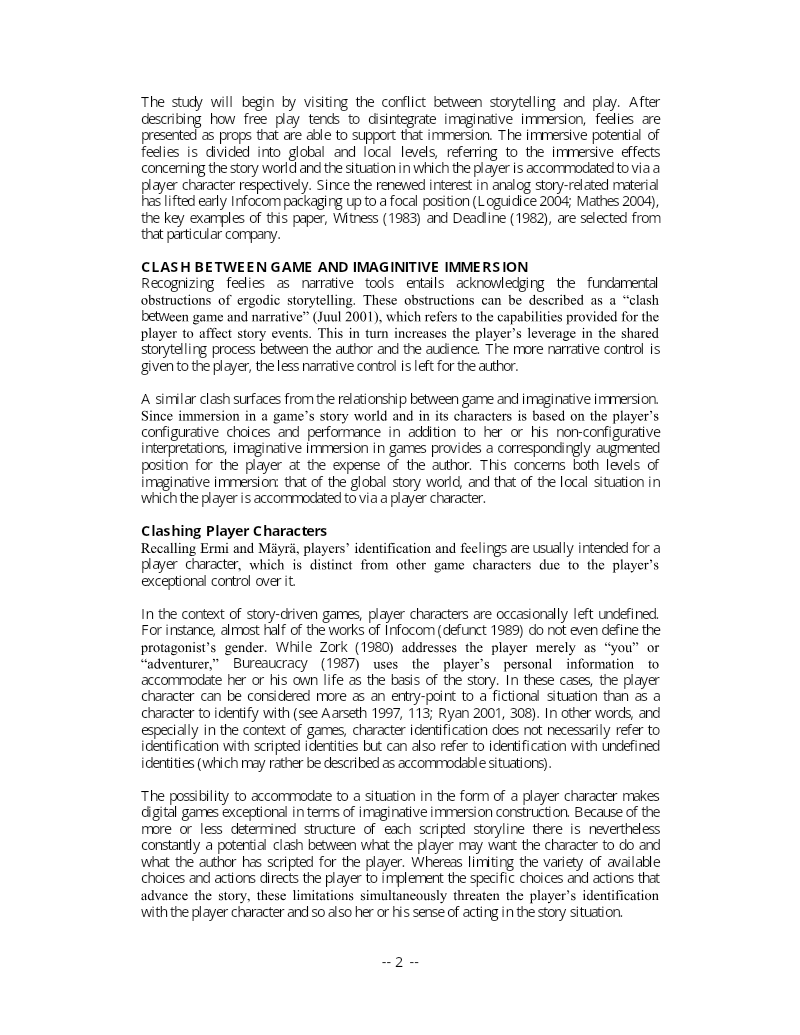
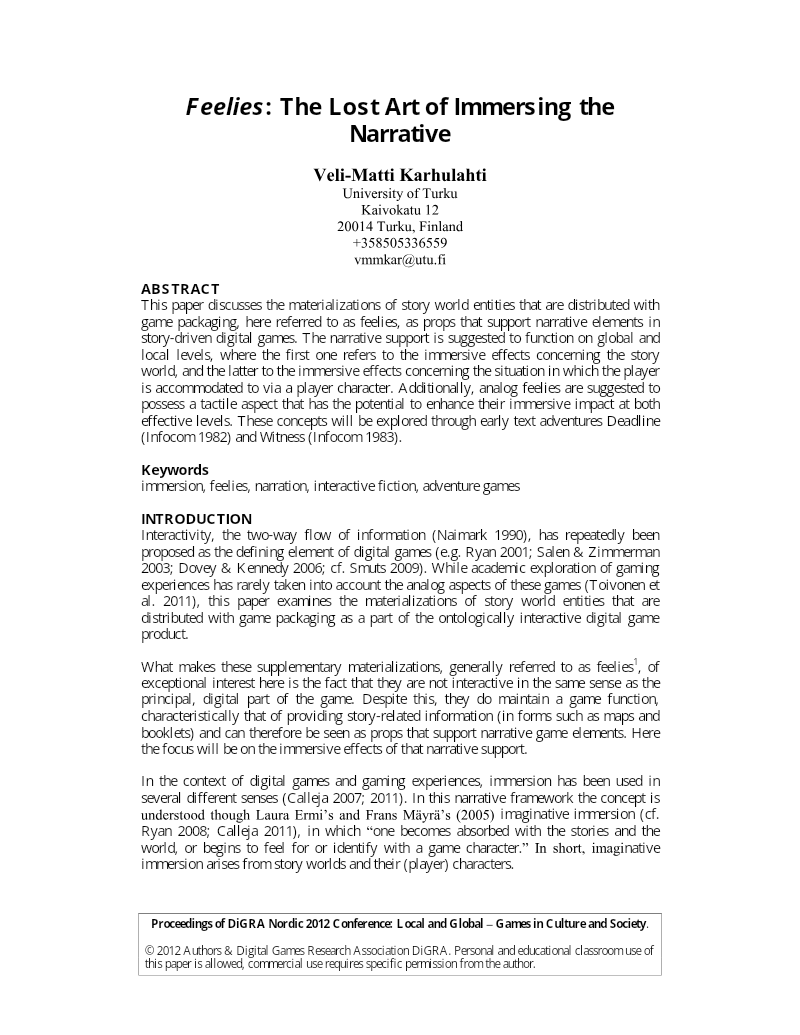
Feelies: The Lost Art of Immersing the Narrative
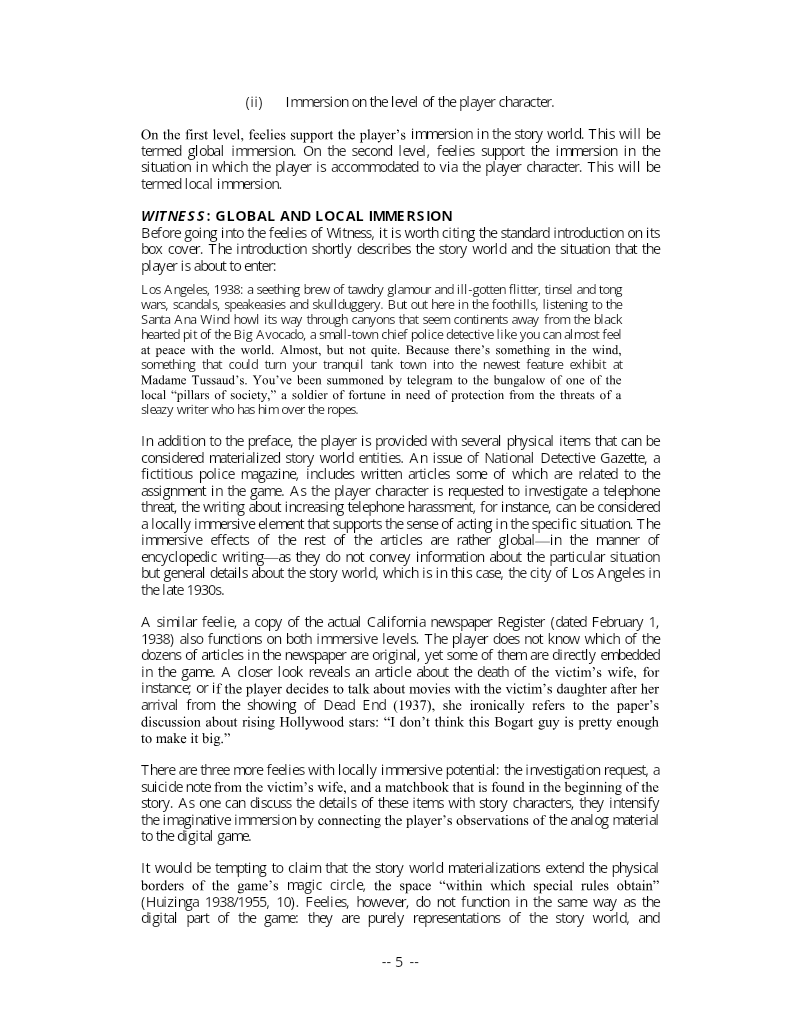
Veli-Matti Karhulahti's paper examines "feelies," the physical story-related materials, such as maps, documents, and novelty items, distributed with early digital games, and argues that these objects act as narrative props that deepen players' imaginative immersion.
- Feelies are physical story-related materials (maps, documents, novelty items) packaged with early digital games, which the paper argues act as narrative props that deepen players' imaginative immersion.
- The paper frames feelies as a counterweight to the tension between interactivity and authorial control: as games grant players more agency, they weaken the author's grip on the story and can fragment player identification with a character or world.
- Feelies are said to work on two levels: a global one that enriches the sense of the story world, and a local one that anchors the player within a specific situation and player character.
Should I Stay or Should I Go: Boundary Maintaining Mechanisms in Left 4 Dead 2
Linderoth, Björk, and Olsson's study examines how players of Left 4 Dead 2 manage the boundary between their in-game identities, defined by gaming skill, and their social identities outside the game.
- The study is autoethnographic, based on roughly 200 hours of observed public, anonymous, short-session pick-up matches in Left 4 Dead 2, with the researchers participating as observers.
- Players continually negotiate the game's frame through informal soft rules, such as waiting for teams to fill and improvised tactics like "go before they all drop," to manage the risk of collapse from dropouts and bot substitution.
- Design patterns Symbiotic Player Relations and Helplessness generate emotional pressure that drives rage-quitting and blame, while players use face-saving excuses such as citing "lag" or calling others "noob" to avoid the loser role, consistent with Goffman's frame analysis.
Domesticating Play, Designing Everyday Life: The Practice and Performance of Family, Gender, and Gaming
Enevold's paper argues that digital gaming is best understood through the domestic arrangement of its material objects, including screens, consoles, and handhelds, which families position and move around the home in ways that domesticate play and reflect broader norms of family, gender, and gaming.
- Digital gaming is best understood through the domestic arrangement of its devices (screens, consoles, handhelds), which families position and move around the home, and technology adoption and domestic design are mutually constitutive with family life rather than driven by individual choice.
- Play is consistently subordinated to sleep, food preparation, work, and joint family activities, with bedroom computers ranked by activity so that sleep takes priority over both work and play.
- Regulation of gaming operates mainly through routine and implicit household norms rather than overt surveillance, and mothers typically carry the greatest share of domestic labor, which shapes who gains access to play.

The Stereotype of Online Gamers: New Characterization or Recycled Prototype?
This study examines whether the stereotype of online gamers, characterized by social ineptitude, reclusiveness, obsessiveness, and maleness, is a distinctive modern characterization or a recycled prototype shared with other groups.
- The online gamer stereotype (socially inept, reclusive, obsessive, male) was attributed significantly more often than in 12 of 16 comparison groups, with only MMORPG players rated as more stereotypical.
- Online gamers' stereotypical profile did not differ significantly from those of Arcade Gamers, Dungeons & Dragons players, comic book enthusiasts, and geeks, pointing to substantial overlap across gaming and nerd subcultures.
- The stereotype appears to be a variant of an older prototype applied to a particular subculture, rather than an entirely new characterization, consistent with Williams (2005)'s argument about media-driven distrust of new technologies.
Rating Logic Puzzle Difficulty Automatically in a Human Perspective
This paper proposes a method for rating the difficulty of logic puzzles from a human perspective, using Sudoku as the test case.
- The paper proposes a game-independent method for rating logic puzzle difficulty from a human perspective, tested on Sudoku, aiming to rank both designed and randomly generated puzzles without heavy manual analysis.
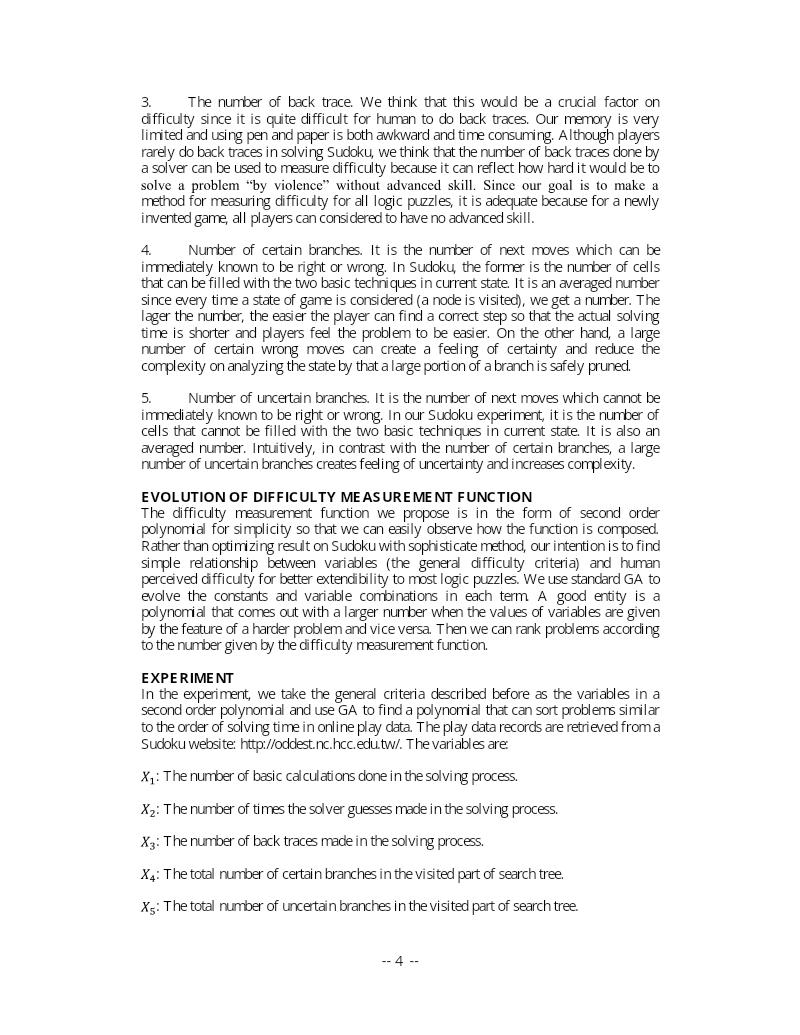
- The method derives five features from the solving path of a beginner-level solver using only basic single-candidate techniques with guessing and backtracking: basic calculations, guesses, backtraces, average certain next moves, and average uncertain next moves.
- A second-order polynomial combining these features was evolved with a genetic algorithm to match average solving times from online Sudoku play records, reaching a Spearman's rho of 0.8 on training data and 0.69 on a validation set of 150 problems.
Main(s) and Alts: Multiple Character Management in World of Warcraft
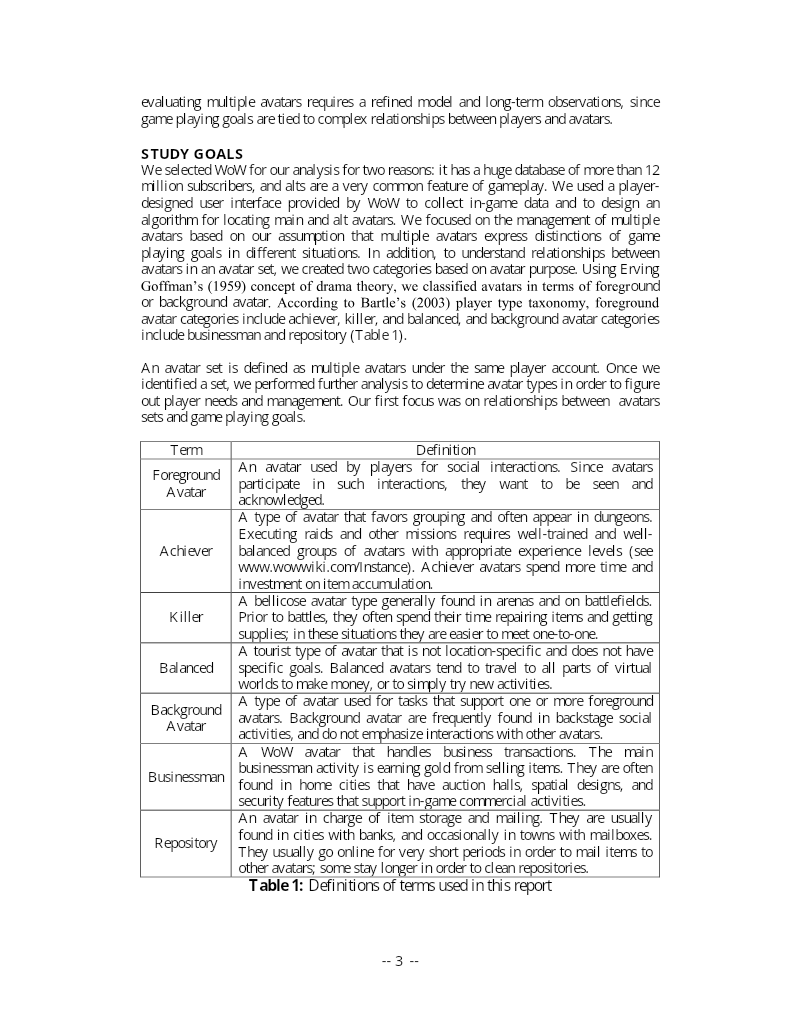
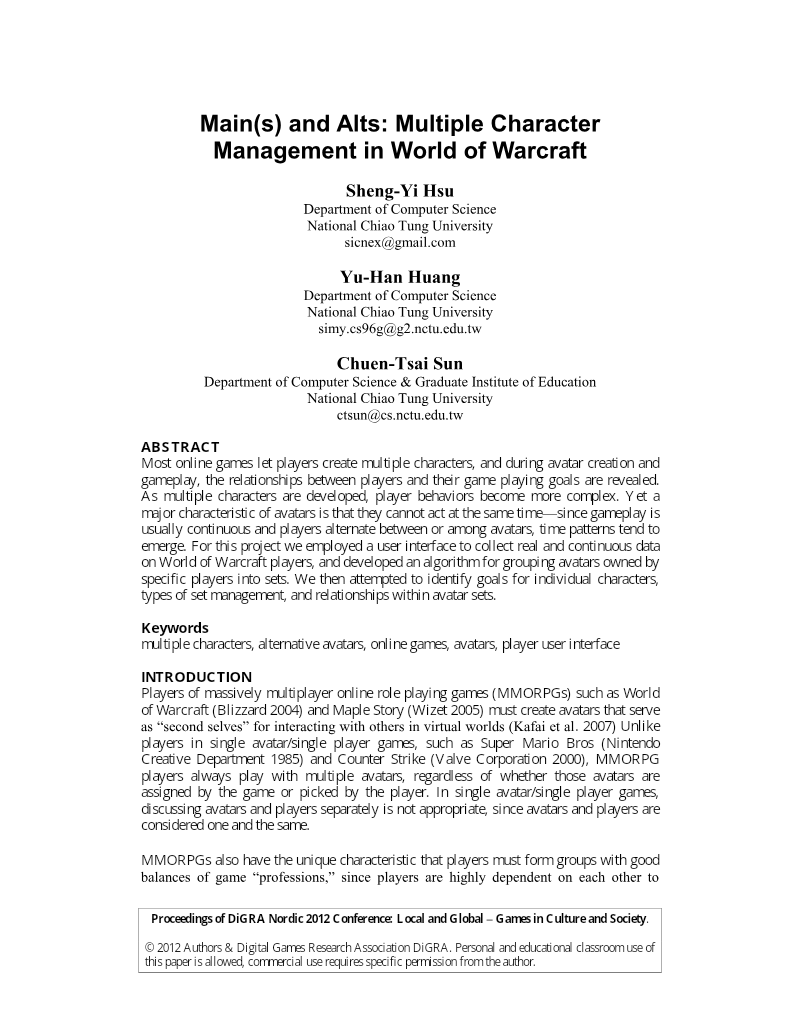
This study examines how players manage multiple characters, or "mains and alts," in World of Warcraft, focusing on how account owners group their avatars into sets and what those groupings reveal about player goals.
- The algorithm inferred avatar sets from publicly accessible online-status data, since account-to-avatar ownership is confidential, and was validated with a recall of 78.5% and precision of 97%.
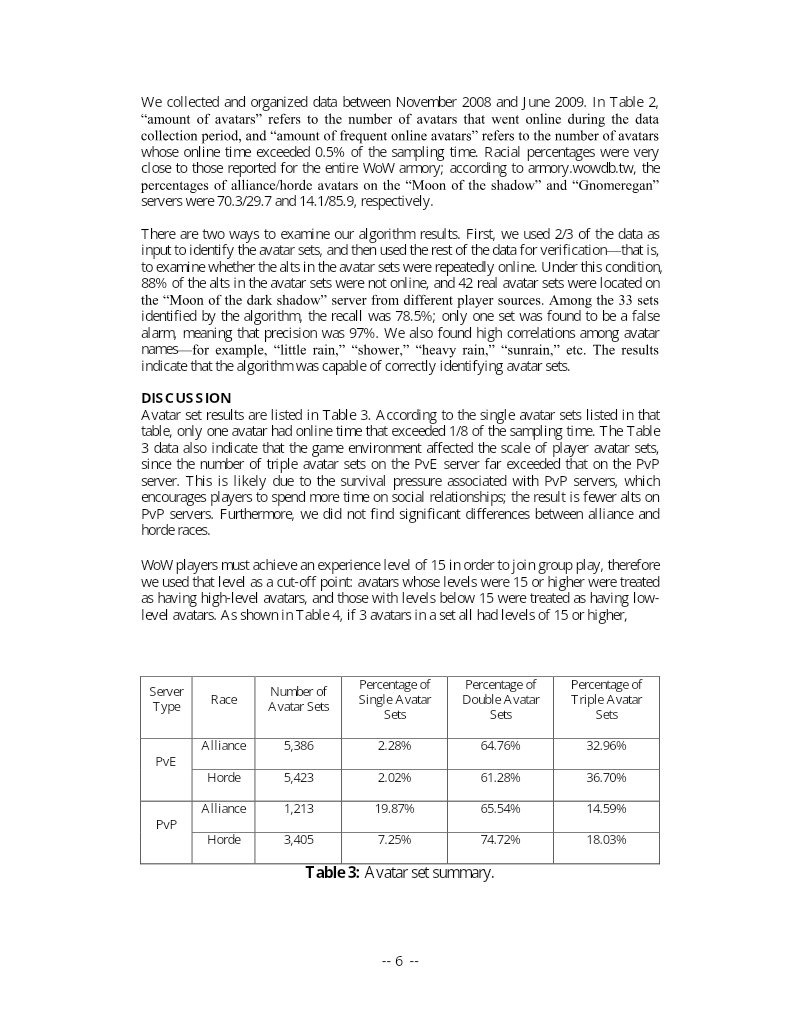
- Data was collected continuously on two Taiwanese World of Warcraft servers (one PvE, one PvP) from November 2008 to June 2009, using a player-designed interface.
- Single-avatar sets were most common on PvP servers, while triple sets were more prevalent on PvE servers, which the authors attribute to survival pressures and social dynamics on PvP realms.
Age-Restriction: Re-examining the Interactive Experience of 'Harmful' Game Content
This document challenges New Zealand's approach to classifying video games, which currently applies film-based rating models that treat interactivity as a secondary concern.
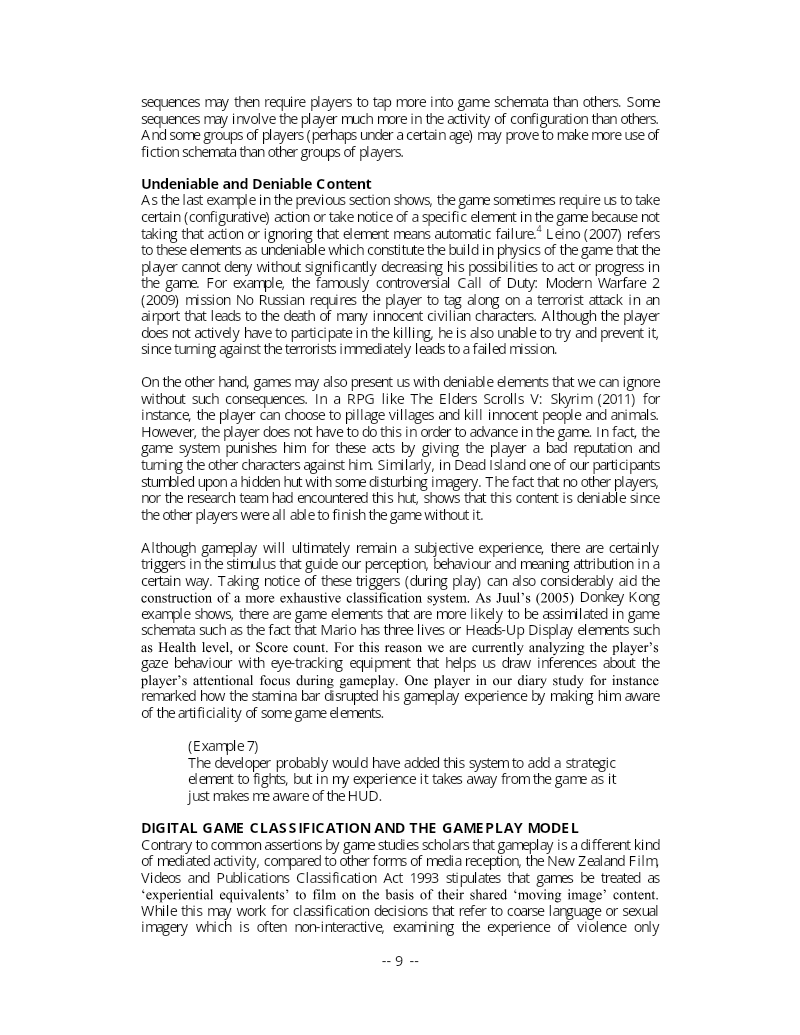
- The report argues that New Zealand's film-based game classification model is inadequate because it treats interactivity as secondary, and proposes that classification instead be grounded in empirical evidence of how players actually experience interactive content.
- The authors propose a gameplay model in which players shift between 'fiction schemata' (interpreting a coherent fictional world) and 'game schemata' (navigating rule-constrained play).
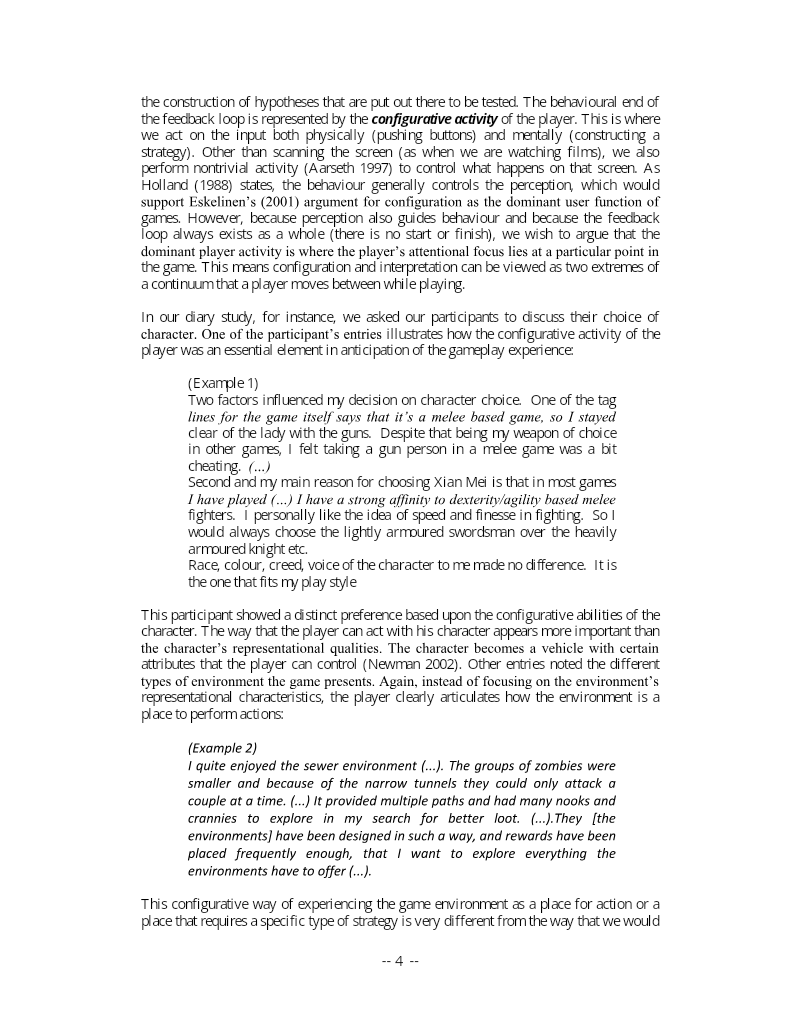
- A seven-week diary study of ten male participants playing Dead Island (2011) found that player attention moves along a continuum between configuration (acting on the game) and interpretation (reading its narrative elements), with configuration typically dominant during violent encounters.
Tackling the Metaphor-Simulation Dilemma
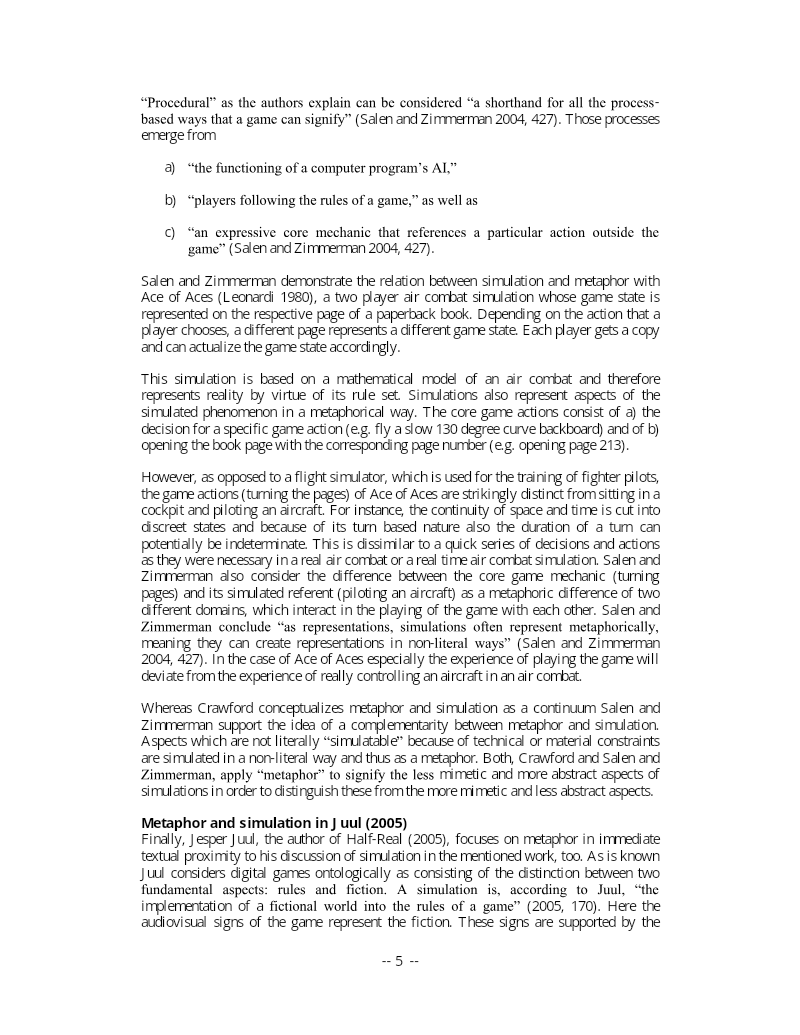
Sebastian Möring's "Tackling the Metaphor-Simulation Dilemma" addresses a persistent puzzle in game studies: the terms "metaphor" and "simulation" are frequently invoked together and often defined in strikingly similar ways, raising the question of whether one is superfluous.
- Sebastian Möring argues that the long-standing distinction between metaphor and simulation in game studies is largely illusory, since examples cited as metaphorical (such as the serve mechanic in Top Spin or the puzzle duels in Puzzle Pirates) can equally be read as simulations.
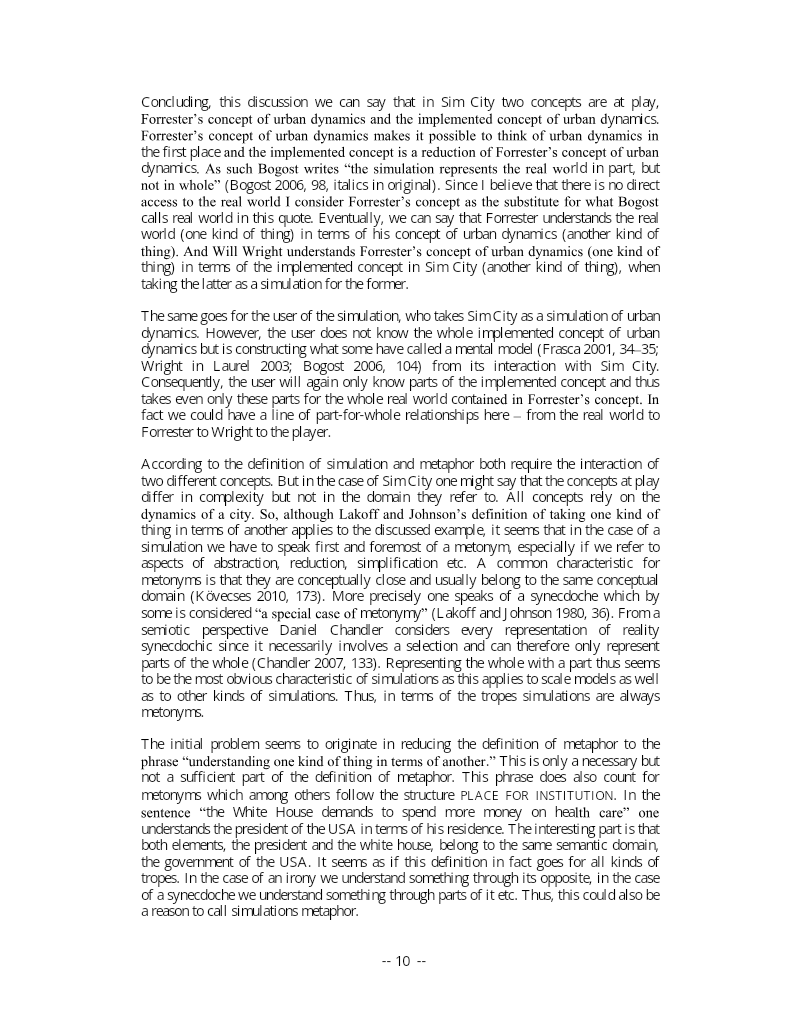
- The core reason the distinction fails is that all simulations are stylized, simplified, and abstracted, so abstraction cannot cleanly separate the two categories, producing what the paper calls a "metaphor-simulation dilemma."
- The proposed resolution treats simulations as metonyms, more precisely synecdoches, in which a selected part stands for a whole drawn from a single conceptual domain.

flâneur, a Walkthrough: Locative Literature as Participation and Play
The study examines textopia, a locative literature system in which users geotag texts that play as audio while they walk through a city, and the flâneur game built on it as a way to sustain participation in such a project.
- Locative literature depends on user-generated content for its aesthetic aims, but contributions do not appear simply because they are invited; participation must be actively facilitated.
- The October 2008 textopia writing competition drew 46 submissions and offered cash prizes of around 1300 euro with notable media attention, yet it did not produce lasting use of the system.
- The flâneur game (2009–2010) yielded modest results, with its final online round producing only 13 texts despite generally positive participant feedback.
Game Design Tools: Time to Evaluate
Game designers have long lacked formal tools for designing gameplay, relying instead on natural-language game design documents and physical or simplified production prototypes.
- Game designers have historically relied on natural-language design documents and physical or simplified prototypes, both of which struggle to capture the systemic, emergent behavior of games.
- The central claim is that numerous formal frameworks and software tools for game design have been developed (including Machinations, Ludocore, and Sketch-It-Up), yet none have been meaningfully evaluated in practical settings.
- The field has lacked a common formal vocabulary and standardized notation for game mechanics, and critics have long pointed to reliance on anecdote and intuition as a barrier to rigor.
Meta-Synthesis of Player Typologies
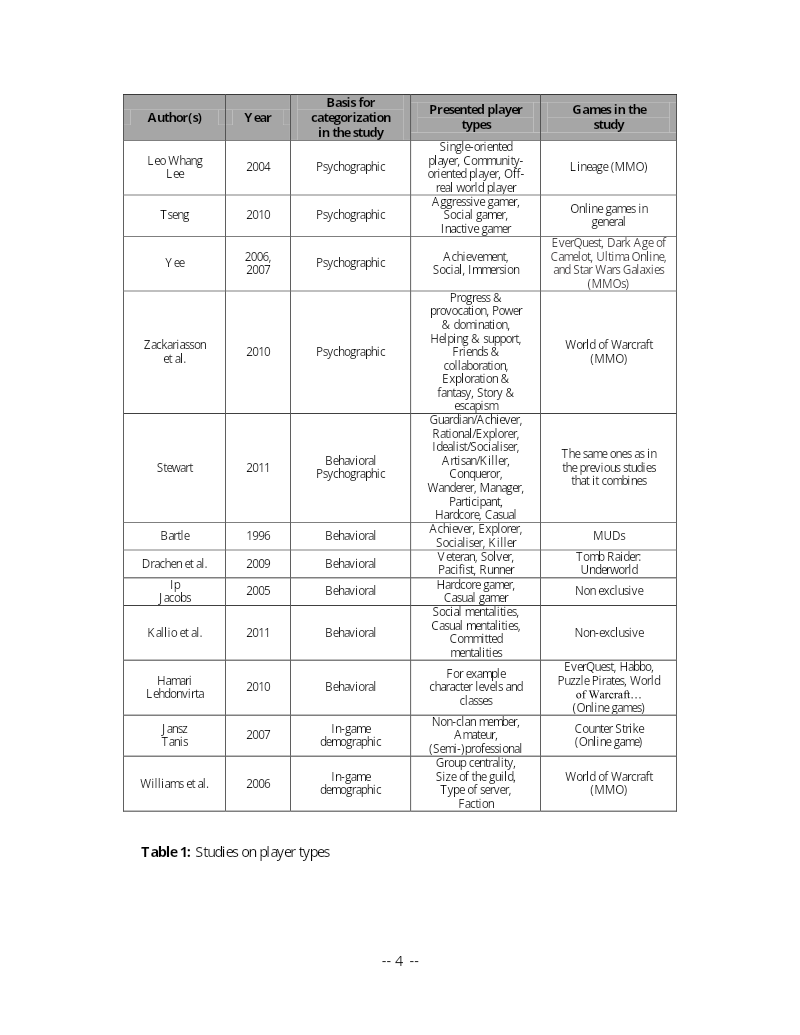
Tuunanen and Hamari's meta-synthesis takes stock of how game research has classified players, asking whether the field's many typologies amount to a coherent body of knowledge or a set of overlapping, self-referential frameworks.
- The literature on player typologies is surprisingly uniform: Bartle's four player types, Yee's three-factor motivational model, and other schemes cluster around psychographic and behavioral bases and share recurring concepts such as achievement and sociability.
- The authors argue the widely used hardcore/casual dichotomy is too simplistic and should be understood as a continuum rather than two discrete categories.
- Psychographic and behavioral categories resist clean separation, since motivation drives behavior and the two are difficult to disentangle empirically.