Global reports and market data
Documents


Visualizing Persuasive Structures in Advergames
This document proposes a framework for analyzing persuasive structures in advergames, arguing that procedural rhetoric alone is insufficient to convey a message and should be complemented by narrative, visual, audiovisual, and textual persuasion.
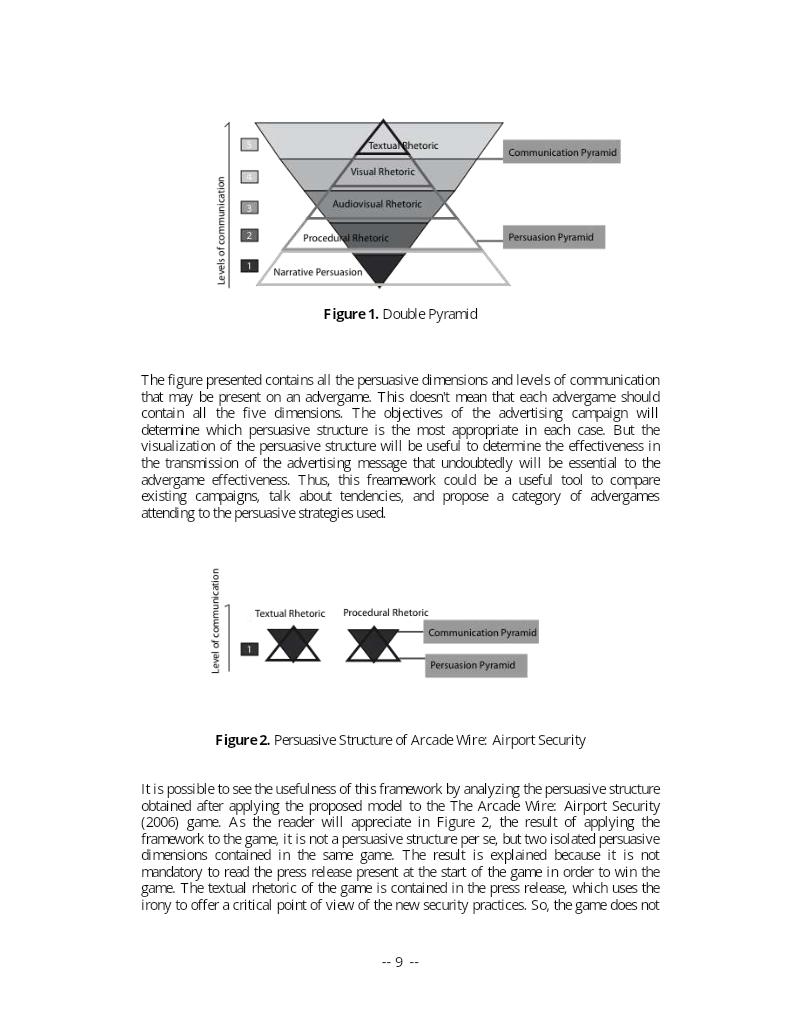
- Procedural rhetoric alone is insufficient for advergames; the authors argue they should combine narrative, visual, audiovisual, and textual persuasion across five communication levels, forming a "double pyramid" structure.
- In the double pyramid model, one persuasive dimension is dominant and guides players through the others, ensuring the intended message is received rather than left to optional content players may ignore.
- Arcade Wire: Airport Security was found to lack full autonomy and to have a misalignment between learning and game goals, since players could succeed without absorbing the persuasive message.


Game Audio Curriculum Guideline
The game audio industry faces a persistent talent gap caused by the unique intersection of traditional linear media production and complex, non-linear technical implementation.
- The game audio industry suffers from a persistent talent gap caused by the difficulty of bridging traditional linear media production with complex, non-linear technical implementation.
- A standardized 120-credit, four-year undergraduate curriculum framework has been proposed to provide a consistent roadmap for higher education institutions in the United States.
- The curriculum prioritizes a constructivist pedagogical approach that emphasizes core principles and adaptability over software-specific training to ensure graduates can navigate evolving technologies.

Pattern Recognition: Gameplay as Negotiating Procedural Form
Pattern Recognition: Gameplay as Negotiating Procedural Form argues that pattern recognition, grounded in Gestalt psychology, is central to how players engage with games, and that this engagement is generated through procedural programming rather than simply perceived in fixed designs.
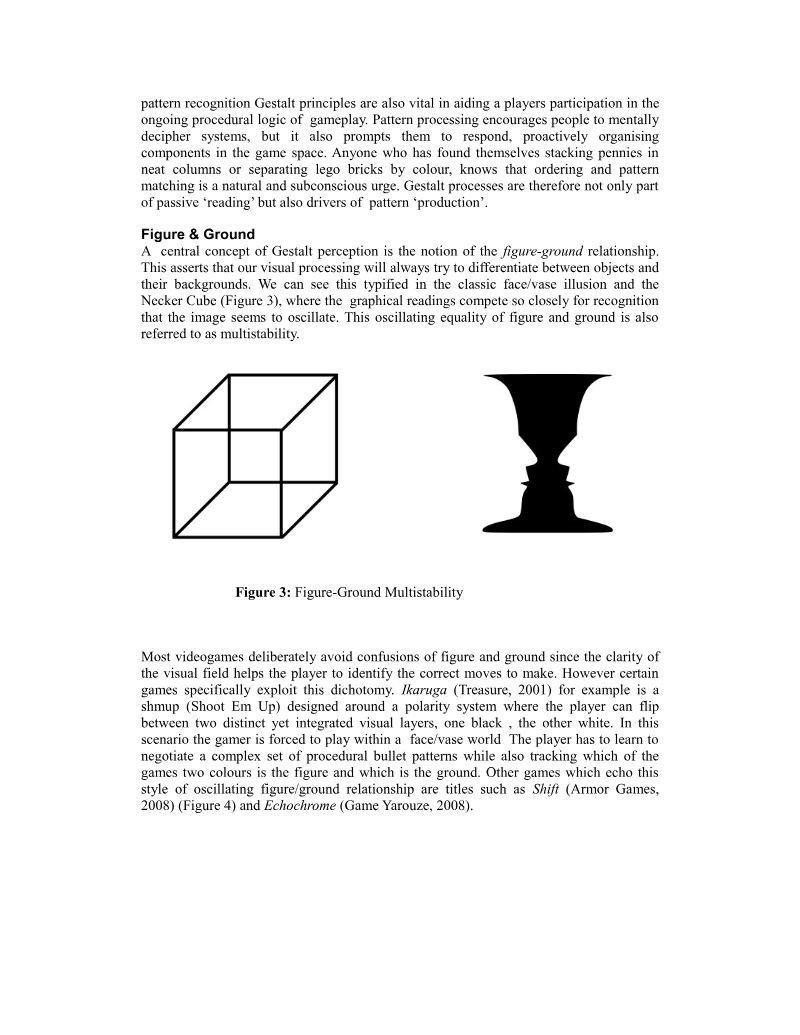
- The paper argues that pattern recognition, grounded in Gestalt psychology, is central to player engagement and that players actively produce patterns (not just perceive them), citing Metzger's claim that Gestalt principles govern both perception and production.
- Its most distinctive contribution is the concept of "pattern immersion," a sub-linguistic, Gestalt-based engagement developed through direct play that aligns with Csikszentmihalyi's notion of Flow, set against "narrative immersion," which relies on authored story and cultural convention.
- The author contends that designers often apply Gestalt principles as a top-down layer over predefined structures, underutilizing their capacity to generate emergent gameplay.
Experiential Metaphors in Abstract Games
Jason Begy's "Experiential Metaphors in Abstract Games" argues that abstract games, which lack obvious representational "aboutness," can nonetheless be interpreted through experiential metaphor.
- Begy argues that abstract games, whose objects function as symbols rather than icons (e.g., Go and Rod Humble's The Marriage, versus the largely iconic Chess), can still carry meaning through experiential metaphor, a cognitive form of structural metaphor grounded in the player's lived experience of play.
- Meaning emerges when players map the affective texture of gameplay (tension, relief, panic) onto other experiences, relying on image schemata and systemic correlations within a game's formal properties.
- Both metaphor and simulation amplify some aspects of their source while masking others, so any interpretation depends on what a game emphasizes or omits.
Collaboration and Team Composition in Applied Game Creation Processes
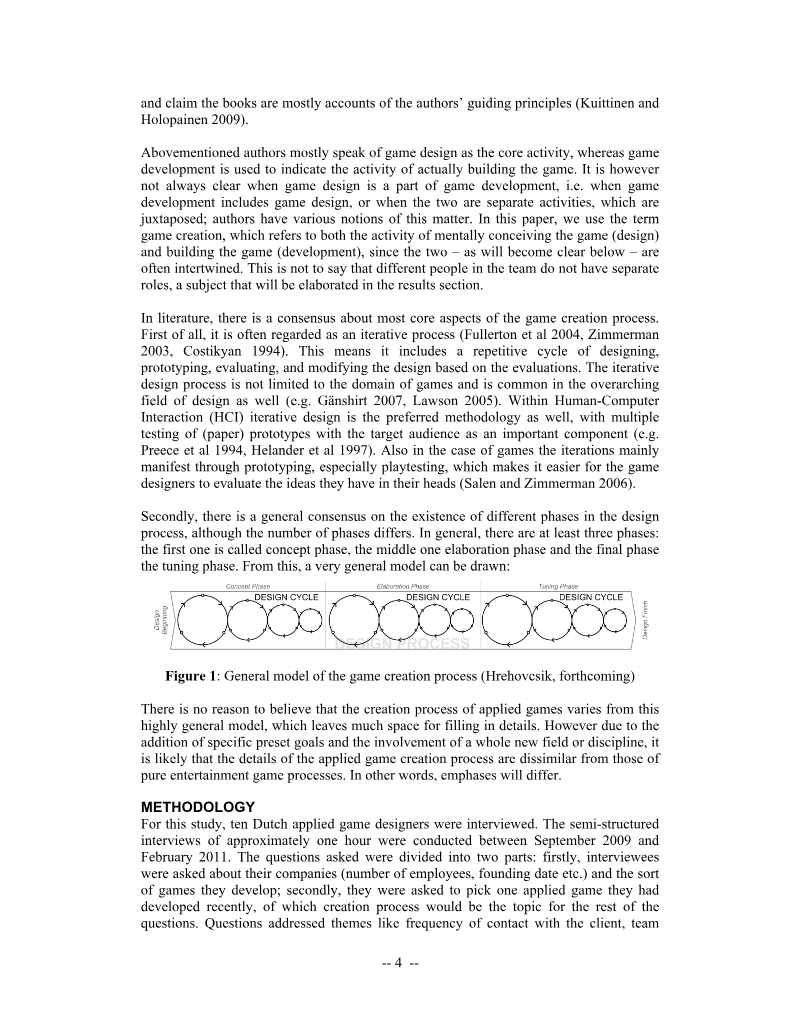
Applied game creation, the development of games with goals beyond entertainment such as learning, training, or persuasion, is shaped more by how teams are composed and how they collaborate than by any single design method.
- Team composition and collaboration, rather than any single design method, are the main determinants of whether applied games can balance entertainment with their out-of-game objectives.
- A subject matter expert is involved from the start in nearly all projects, usually as the client or someone working for the client, yet only half of SME-involved companies treated the expert as a full team member, reflecting unclear authority over content.
- None of the eight projects included a pedagogical or transfer expert, despite theoretical frameworks treating such expertise as central to achieving learning outcomes.
Game Prototyping: The Negotiation of an Idea
Game Prototyping: The Negotiation of an Idea examines prototyping in game design as a communicative and negotiative process rather than merely a technical or testing activity.
- Prototyping in game design is framed as a communicative and negotiative process, in which prototypes act as a "language of experience" that helps design teams resolve contested problems and build pistis (trust and consensus) among collaborators.
- The study draws on qualitative interviews with 27 respondents (16 game designers, 10 students, and one teacher) in Sweden and Poland.
- Prototypes typically isolate a single mechanic or experience to stand in for the whole game, acting as reality checks that turn vague ideas into playable form.


Guidelines to Design Interactive Open-Ended Play Installations for Children Placed in a Free Play Environment
This document examines how children use SmartGoals, a mobile, sensor-equipped open-ended play installation, when it is placed in a free play environment alongside three predefined-rule installations: Nintendo Wii, Swinx, and CosmicCatch.
- The study of open-ended play centred on SmartGoals, a sensor-equipped, light-responsive mobile play installation of six goals, tested with 50 primary school children aged 9 to 12 across five gym sessions alongside Nintendo Wii, Swinx, and CosmicCatch installations.
- Goal placement and presentation strongly shaped creativity: football-framed introductions produced football-only games, and aggression-prone objects had to be replaced with smaller, lighter ones.
- Analysis of twelve observations yielded seven design guidelines, emphasising clearly communicated action possibilities (mobile and fixed modes), feedback and feed-forward on interaction, rewards for coordinated multi-player actions, object-to-object influence, and ambiguous abstract design.

Do We Need Real-Time Hermeneutics? Structures of Meaning in Games
Arjoranta's paper argues that games, as procedural and interactive systems, create and transmit meaning in ways that set them apart from film, literature, and other media, and that interpretation of games must therefore account for their internal logic and the player's participation.
- Games are procedural, interactive, and temporally complex objects, so interpreting them must account for their internal logic and the player's participation, unlike film or literature.
- Players' interpretations directly shape their actions and outcomes, producing a 'real-time hermeneutics' with no real equivalent in other media.
- The paper argues that the real-time versus turn-based binary is too simple, since 'real-time' covers a wide range of speeds and structures, drawing on Aarseth, Zagal and Mateas's four temporal frames, and Juul's distinction between play time and event time.


Game Reward Systems: Gaming Experiences and Social Meanings
This study examines video game reward systems, arguing that rewards are a source of enjoyment in their own right and carry social meaning through motivation, status, and interpersonal use.
- Rewards in video games are treated as enjoyable in their own right and as carriers of social meaning, operating through motivation, status, and interpersonal use rather than serving only as progress markers.
- The authors classify eight reward forms (scores, experience points, items, resources, achievements, feedback messages, plot animations, and unlocking mechanisms) and assess them against four attributes: social value, effect on gameplay, suitability for collection and review, and timing.
- A dual-axis model maps reward usage across advancement, review, sociality, and cooperation versus competition, offering a structured way to analyse how players use rewards.

Integrating Emergence and Progression
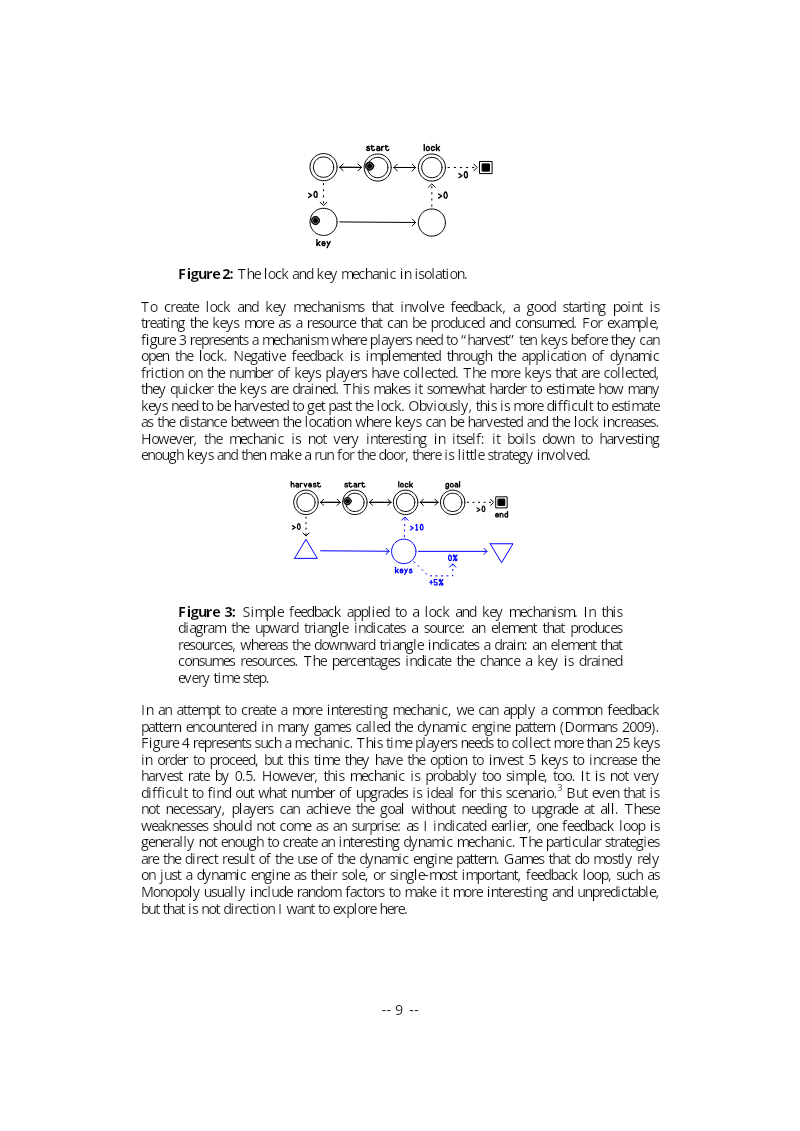
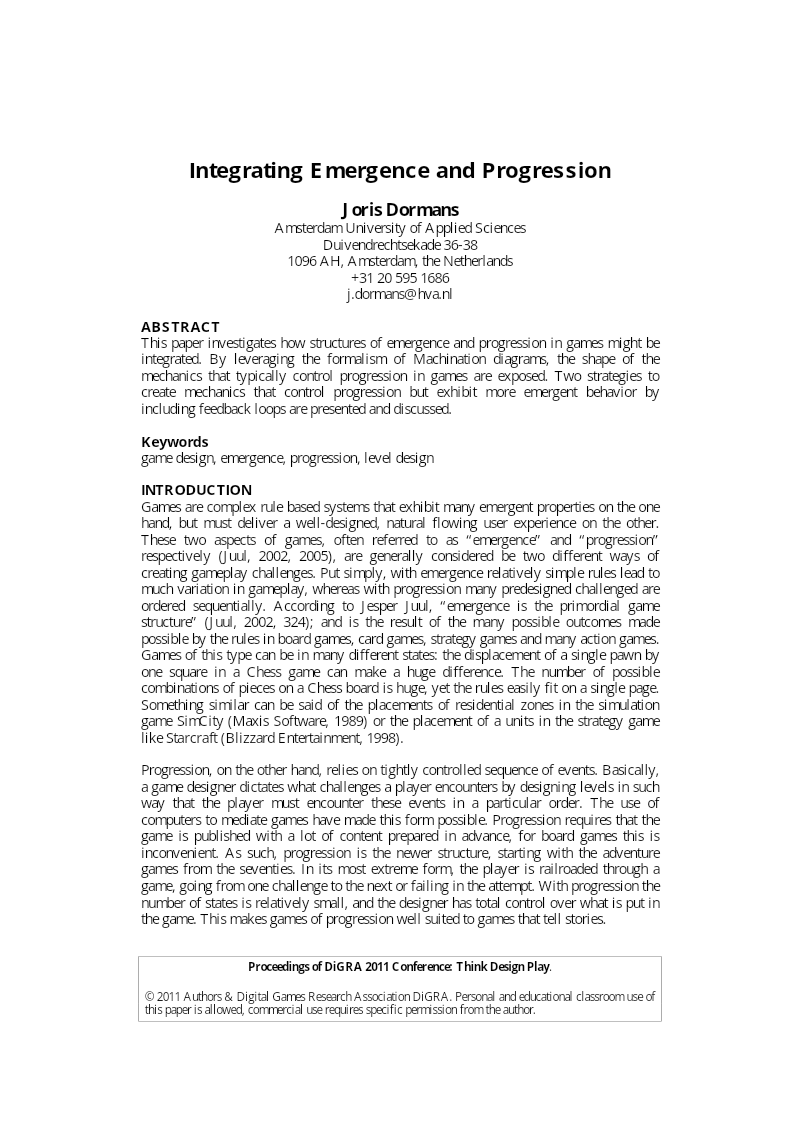
Dormans argues that emergence and progression, often treated as opposing design modes, can be integrated by understanding the feedback loops that generate emergent behavior within a game's internal economy.
- Emergence tends to arise when roughly two to four feedback loops operate together within a game's internal economy, and designers can use these loops to make sequenced, designer-controlled progression more dynamic and strategically rich.
- Topology (the logical structure of player tasks) and geography (the physical spatial layout) should be treated as separate design dimensions, since they can be decoupled, as System Shock 2's reuse of a single space for multiple missions illustrates.
- Conventional quest tools such as dialog trees and Boolean-flag milestones are considered inefficient and offer limited player agency, while Machinations diagrams are proposed as a modeling method for designing mission and quest logic.


The Making of Nordic Larp: Documenting a Tradition of Ephemeral Co-Creative Play
Stenros and Montola's paper examines the difficulties of documenting larp, or live action role-playing, a form defined by its ephemerality, subjectivity, first-person audience, and co-creative character.
- Larp documentation is difficult because the form is defined by ephemerality, subjectivity, a first-person audience, and co-creative character, so it shares affinities with performance-art documentation but needs game-studies tools adapted to its distinctive features.
- Effective documentation must capture three interrelated dimensions together: the game design itself, individual player experiences, and the subcultural understanding that emerges after play has ended.
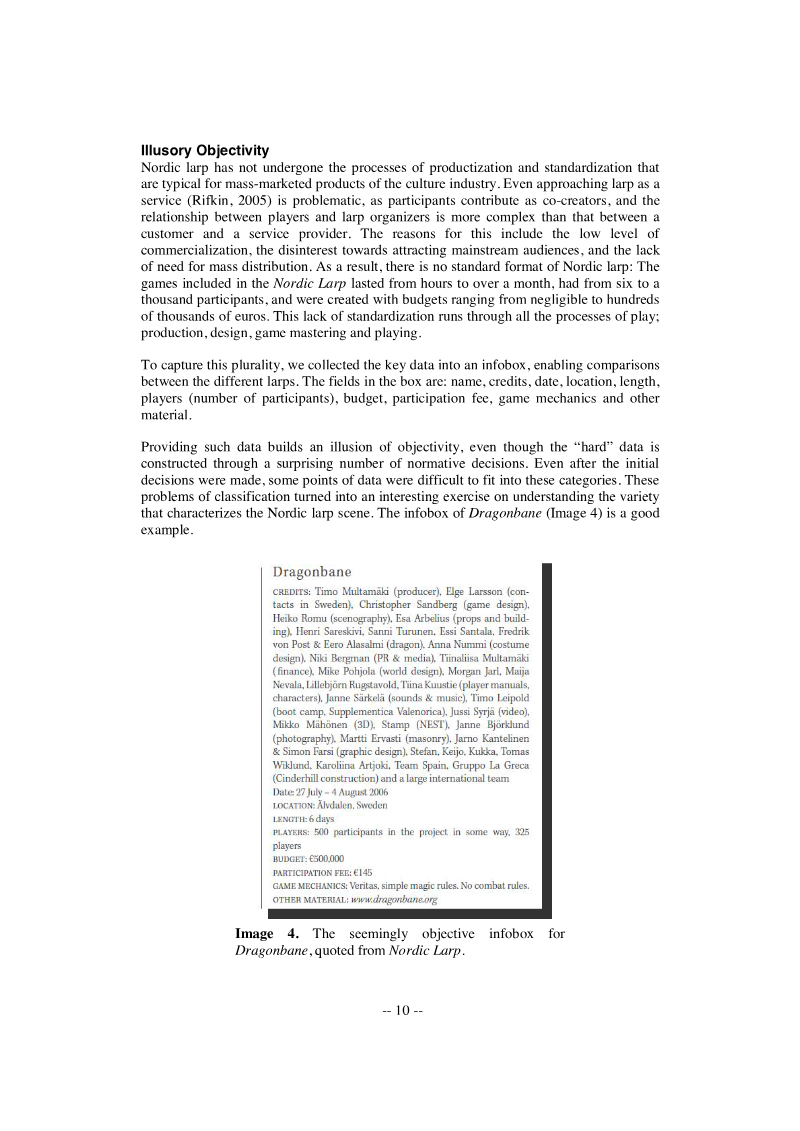
- The Nordic Larp book covered thirty Nordic larps selected through community collaboration and soft quotas, and the editors used four strategies: polyphonic case descriptions by multiple authors, diverse sources such as player photographs and debriefs, a requirement that contributors be participants, and standardized infoboxes.
Chores Are Fun: Understanding Social Play in Board Games for Digital Tabletop Game Design
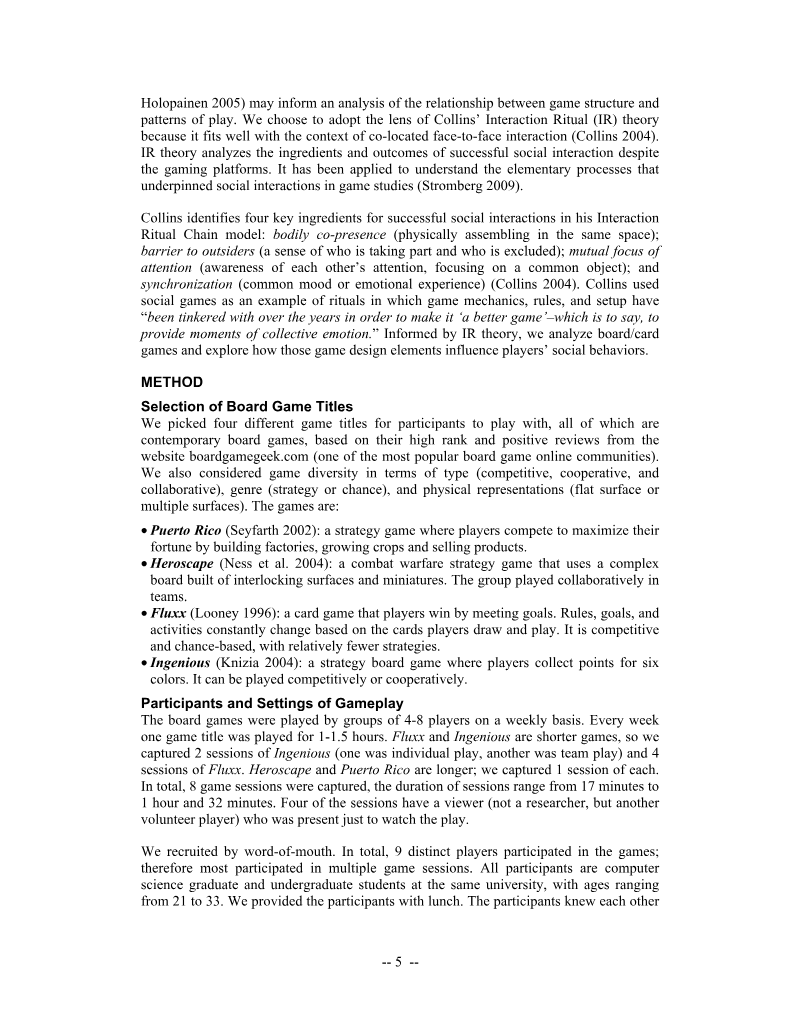
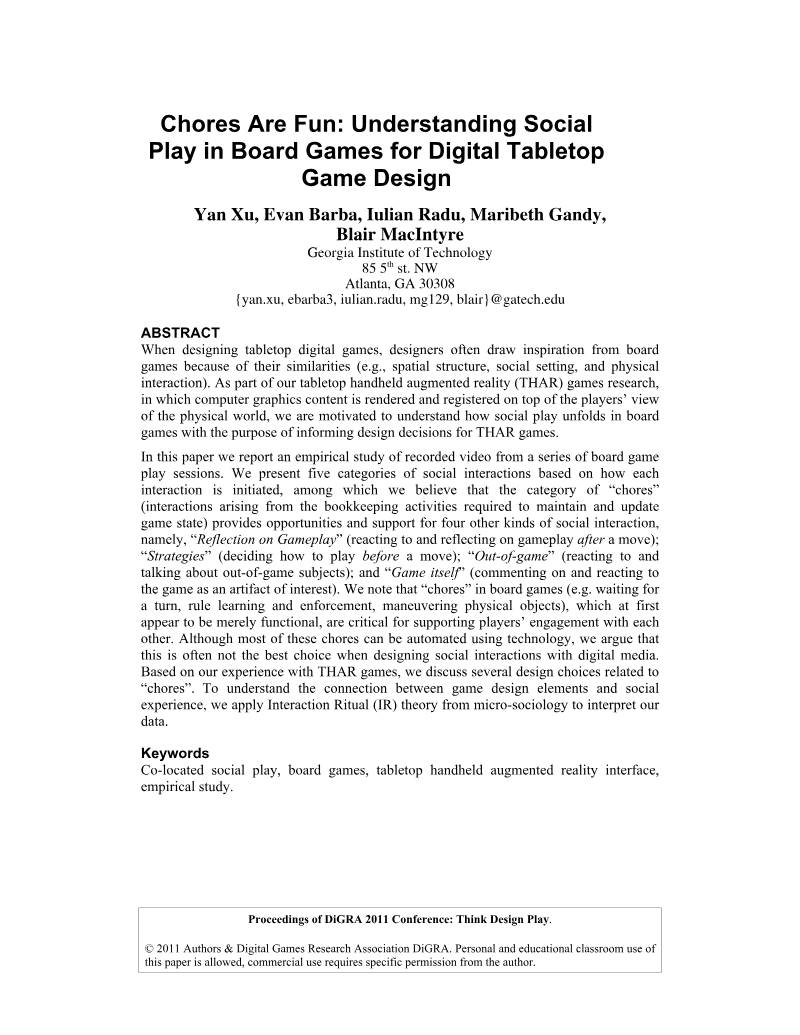
Xu and colleagues, in a 2011 DiGRA paper titled "Chores Are Fun," argue that the mundane maintenance tasks of board gaming, such as bookkeeping, rule enforcement, waiting for turns, and handling physical pieces, are not peripheral to play but form the foundation of its social life.
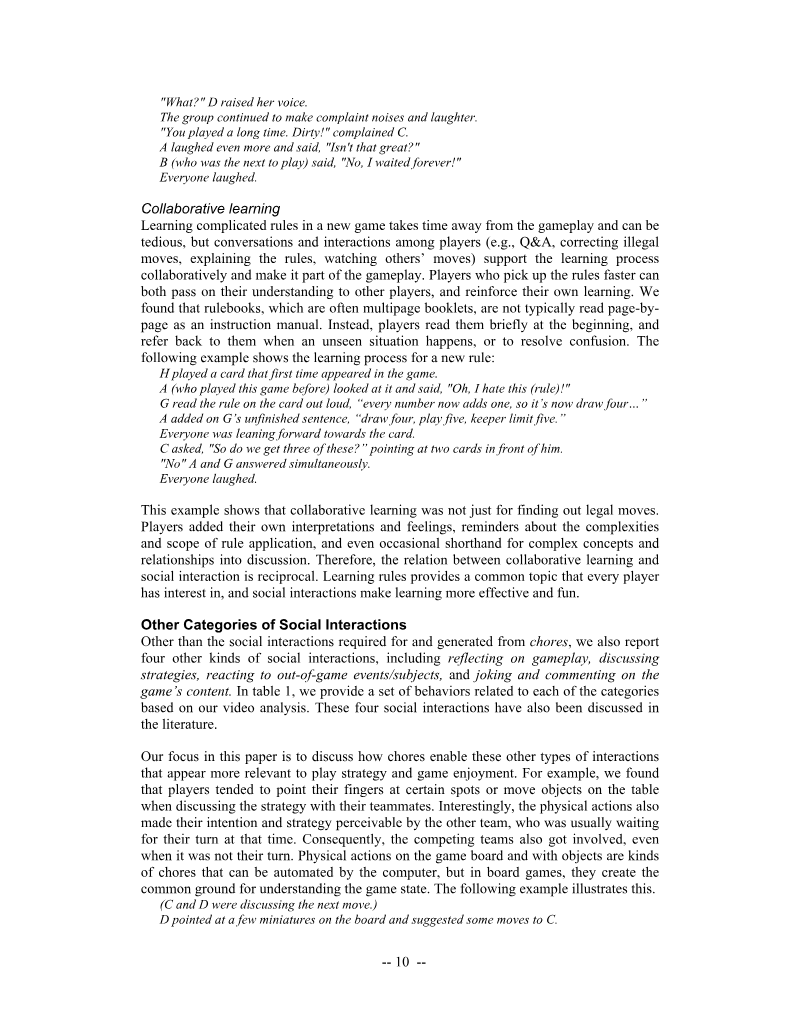
- Board game 'chores' such as bookkeeping, rule enforcement, waiting for turns, and handling physical pieces are argued to be the foundation of social play rather than peripheral to it, and digital games that automate them remove a major source of social interaction.
- The authors' evidence is a video analysis of 262 minutes of play by groups of four to eight players, yielding 358 social events across titles including Heroscape and Fluxx.
- The study identifies five categories of social interaction (chores, reflection on gameplay, strategy discussion, out-of-game talk, and commentary on the game) and positions chores as the base from which the other four emerge.