Game Studies reports and market data
Documents

Digital Games as Experiment Stimulus
Digital games offer researchers a rich but demanding experimental stimulus, and this work argues that their careful use can advance experimental psychology and human-computer interaction.
- Digital games are a valuable experimental stimulus because they are familiar and engaging to most participants, can safely evoke emotions, and can simulate ethically sensitive scenarios that are hard to recreate in a lab.
- Survey evidence cited in the report shows broad population reach, with 72 percent of U.S. households and 54 percent of Finnish respondents being active gamers.
- Interactive games vary from player to player due to differences in skill, AI behavior, randomness, and prior familiarity, making stimulus control much harder than with conventional experimental materials.
First-Person Shooters: Immersion and Attention
First-person shooter immersion has been studied as a multifaceted and still-contested phenomenon, and the research discussed here frames it as a convergence of perceptual, attentional, and design factors.
- Immersion in first-person shooters lacks a single accepted definition, but scholars broadly agree it involves incorporation into the gameworld, emotional involvement, and perceived plausibility rather than strict realism.
- The research frames immersion as a sustained state of selective attention, in which players filter out their physical surroundings and focus on the gameworld, sustained by self-motivated engagement and a sense of progression rather than task difficulty alone.
- Routinized, automated control actions free cognitive resources for gameplay, and Brown and Cairns' three-level model (engagement, engrossment, total immersion) describes how attention shifts progressively toward the virtual environment.
Sadomasochist Role-Playing as Live-Action Role-Playing: A Trait-Descriptive Analysis
Harviainen's paper contends that sadomasochist role-playing, or BDSM role-play, is best understood as a form of live-action role-playing (larp) rather than as a wholly separate category.
- The paper argues that consensual BDSM role-play is best understood as a form of live-action role-playing (larp), based on shared traits such as physical performance, fictional characters, and narrative structure.
- Structurally, BDSM role-play meets established definitions of games and role-playing games, sharing a magic circle, a set of rules, a dominant partner functioning much like a game master, and comparable immersion and staging mechanics.
- The main difference between the two activities lies in framing rather than structure: BDSM role-play is framed as a sexual activity and is often part of a broader sadomasochistic lifestyle, while larp is framed as a game for fun or experiential purposes.

The Consecration of Musical Incoherence
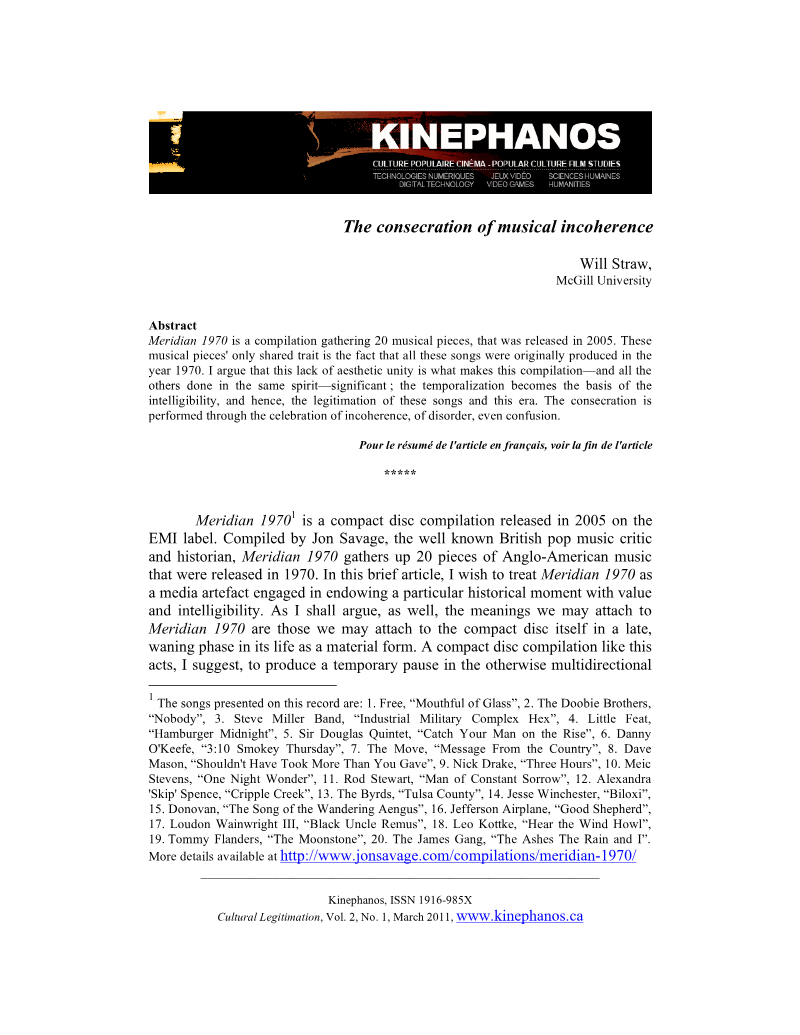
The analysis explores how music compilations, specifically those organized by a single calendar year, function as historiographical projects that assign value to periods of stylistic uncertainty.
- Year-based music compilations, such as 'Meridian 1970,' function as historiographical tools that legitimize periods of stylistic uncertainty rather than tracing clear musical genealogies.
- The lack of aesthetic unity in these collections is a deliberate mechanism that frames historical moments as systems of variation rather than coherent movements.
- Physical compact discs serve as essential boundaries that curate and limit the infinite nature of digital archives, forcing listeners to engage with a fragmented representation of a historical 'cusp'.
Vers un « Nouveau Hollywood »? Considérations sur la métalepse dans le cinéma populaire contemporain
Contemporary popular cinema is undergoing a significant narrative evolution characterized by the frequent use of metalepsis, a technique involving the transgression of boundaries between distinct narrative levels.
- Mainstream Hollywood cinema is increasingly adopting metalepsis—the transgression of boundaries between narrative levels—as a core storytelling device rather than an avant-garde experiment.
- The shift toward structural complexity reflects a strategic industry move to prioritize intellectually demanding, interactive narratives to maintain audience engagement.
- Modern audiences are now expected to move beyond passive consumption, requiring more complex cognitive processing to navigate multi-layered, non-linear cinematic structures.
« Ils n'en font qu'à leur tête »: Les lycéens français face au cinéma enseigné
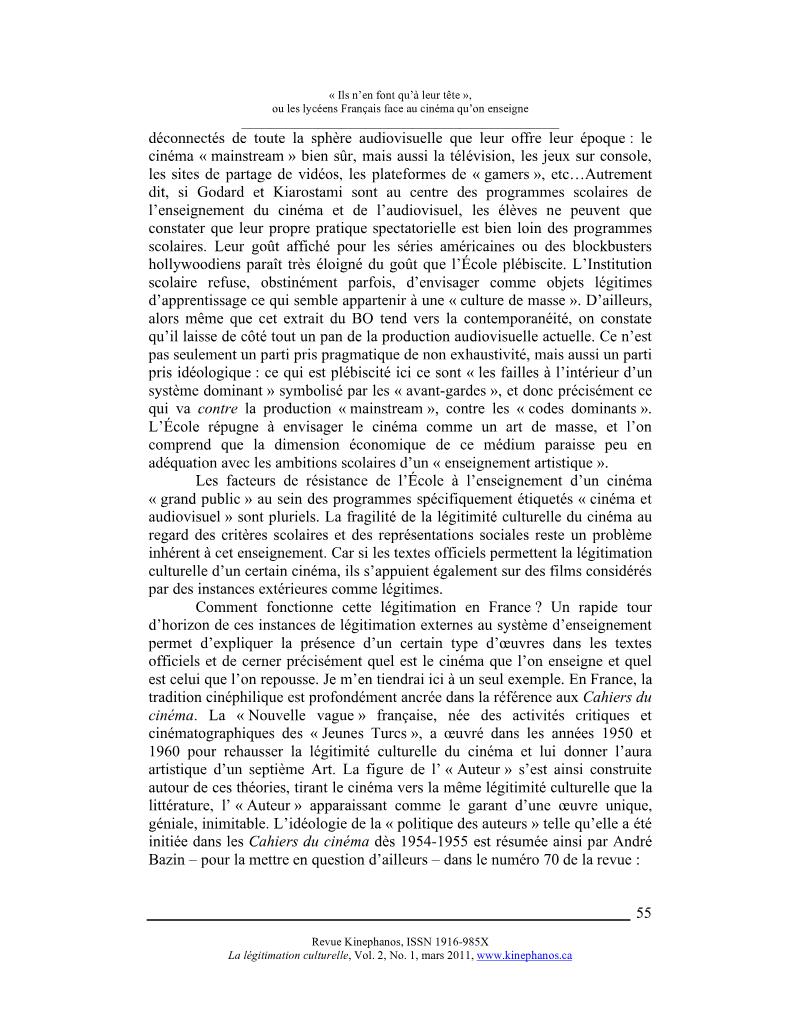
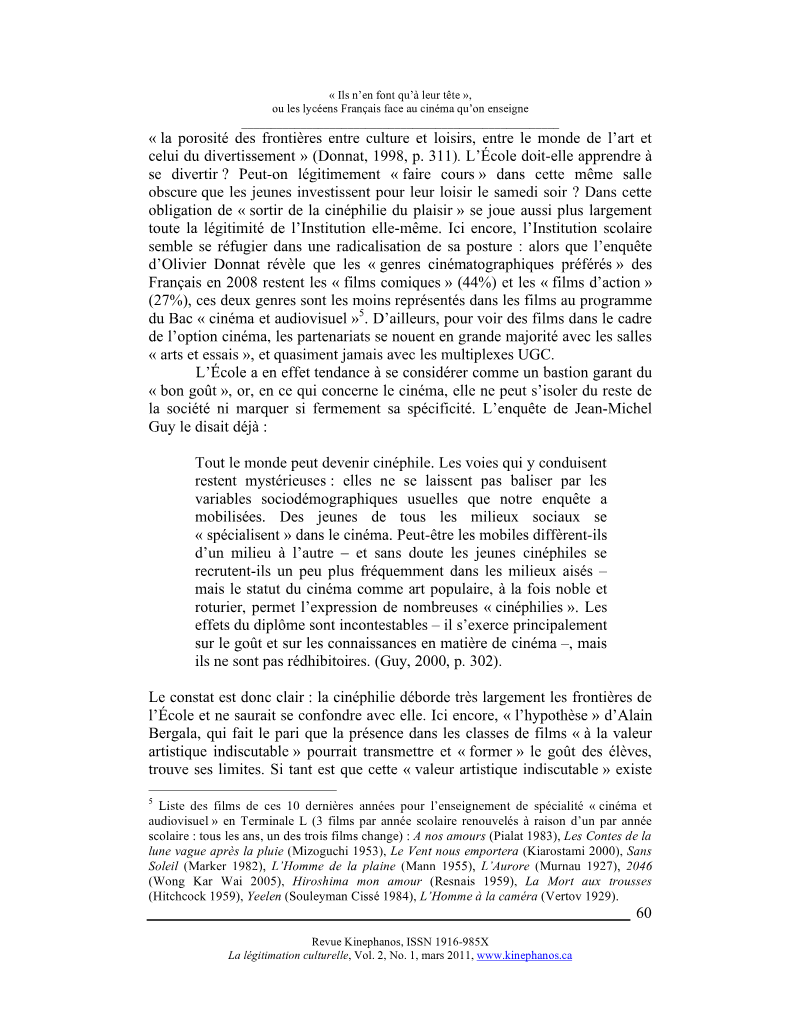
The French secondary education system currently faces a significant pedagogical impasse regarding the instruction of cinema.
- The French secondary education system’s cinema curriculum is currently failing because it relies on an outdated, narrow canon rooted in the 'politique des auteurs' and traditionalist values.
- There is a widening disconnect between the state-sanctioned hierarchy of 'good taste' and the eclectic, autonomous viewing habits of contemporary high school students.
- Students actively resist institutional attempts to dictate aesthetic values, preferring to prioritize personal relevance and their own lived experiences over academic prestige.

Cover & Remix: Paradigms of Adaptation in Installation Art
Installation art increasingly relies on the paradigms of the cover and the remix to navigate the complex space between production and reproduction.
- Contemporary installation art increasingly utilizes 'cover' and 'remix' paradigms to treat cultural motifs as raw material, rejecting the traditional hierarchy that prioritizes original works over derivatives.
- Adaptive artistic practices function as creative translations that establish a networked relationship, allowing the source and the adaptation to coexist and mutually legitimize one another.
- Artists employ internal spatiality to transform physical objects and spaces into externalized memories, turning static works into open systems that facilitate ongoing cultural dialogue.


A Survey of Final Project Courses in Game Programs: Considerations for Teaching Capstone
Zagal and Sharp's paper examines how game programs design and deliver capstone courses, aiming to give educators and administrators a clearer picture of current practice and the considerations that should shape capstone design.
- Capstone courses in game programs are typically taught by one full-time faculty member working with about fifteen students over roughly twenty-one weeks, according to a survey of 37 self-selected game educators.
- Only about 2.5 percent of capstone projects become commercial products, revealing a considerable gap between student expectations and realistic outcomes.
- Educators most often prioritize developing students' soft skills, producing portfolio-quality projects, offering industry-like experiences, and granting student independence, while software, development kits, and game libraries are the most widely available resources.
Jane Fonda's Wii Fit: Continuity, Contingency, and Concordance in Fitness Gaming
This paper examines Nintendo's Wii Fit (2007) through a historical and discursive comparison with Jane Fonda's Workout video (1982), arguing that the two products share structural parallels in how they were adopted by consumers and promoted by their producers.
- The paper argues that exercise content, rather than novelty alone, turned Wii Fit and Jane Fonda's Workout from fleeting entertainment into regular routines, and that this shift drove both products' economic and cultural success.
- Using Celeste Condit's concept of concordance, the author treats new technology adoption as a negotiated process in which producers, existing users, and wider publics contest what a device means and whether it is useful.
- Both products reached audiences broader than their predecessors and relied heavily on women for market penetration, despite the media being typically associated with men.
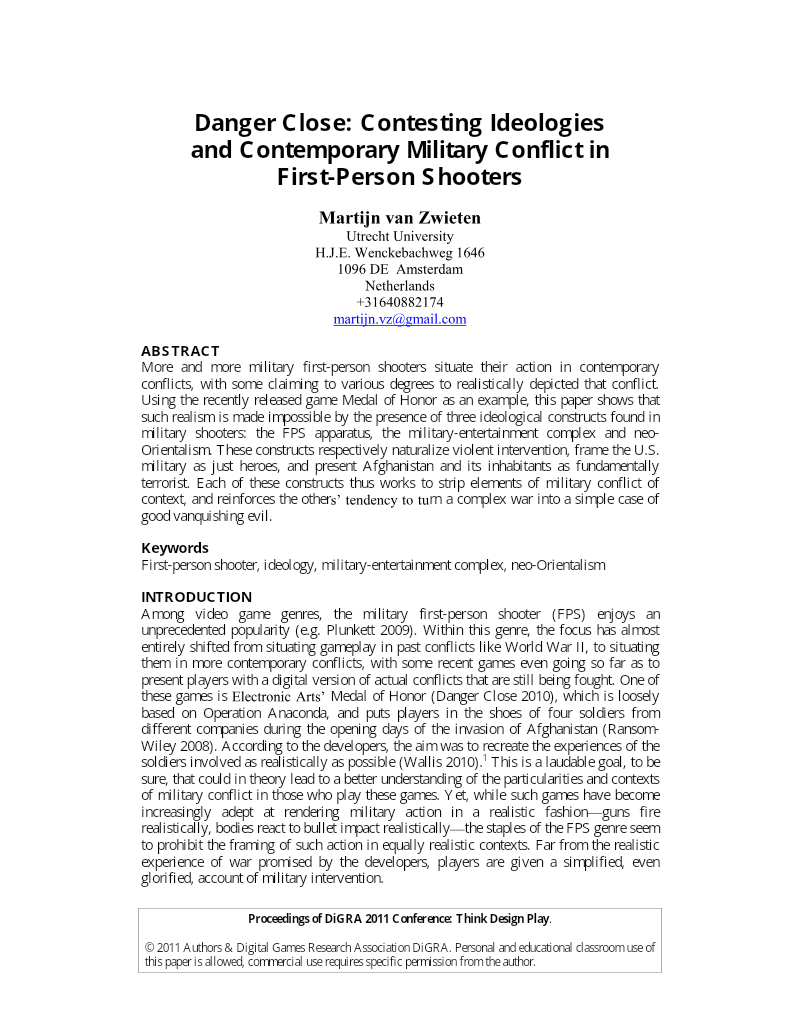
Danger Close: Contesting Ideologies and Contemporary Military Conflict in First-Person Shooters
Danger Close examines how the military first-person shooter Medal of Honor (2010) embeds ideological assumptions within its gameplay and presentation, despite its developers' claims of realism.
- The report argues that Medal of Honor (2010) embeds ideological assumptions despite its developers' claims of realism, driven by three interlocking forces: first-person shooter genre conventions, the military-entertainment complex, and neo-Orientalist framings of Afghans as a generic enemy Other.
- These forces strip the Afghan conflict of historical and political context, recasting the invasion of Afghanistan as a simple contest between good and evil.
- Gameplay mechanics such as the first-person gun perspective, invincible player avatars, headshot bonuses, and repetitive kill sequences (exemplified by the sniper mission "Friends from Afar") position the player as a super-human warrior and naturalize domination through destruction.

Playful Crowdsourcing for Energy-Efficient Automotive Navigation
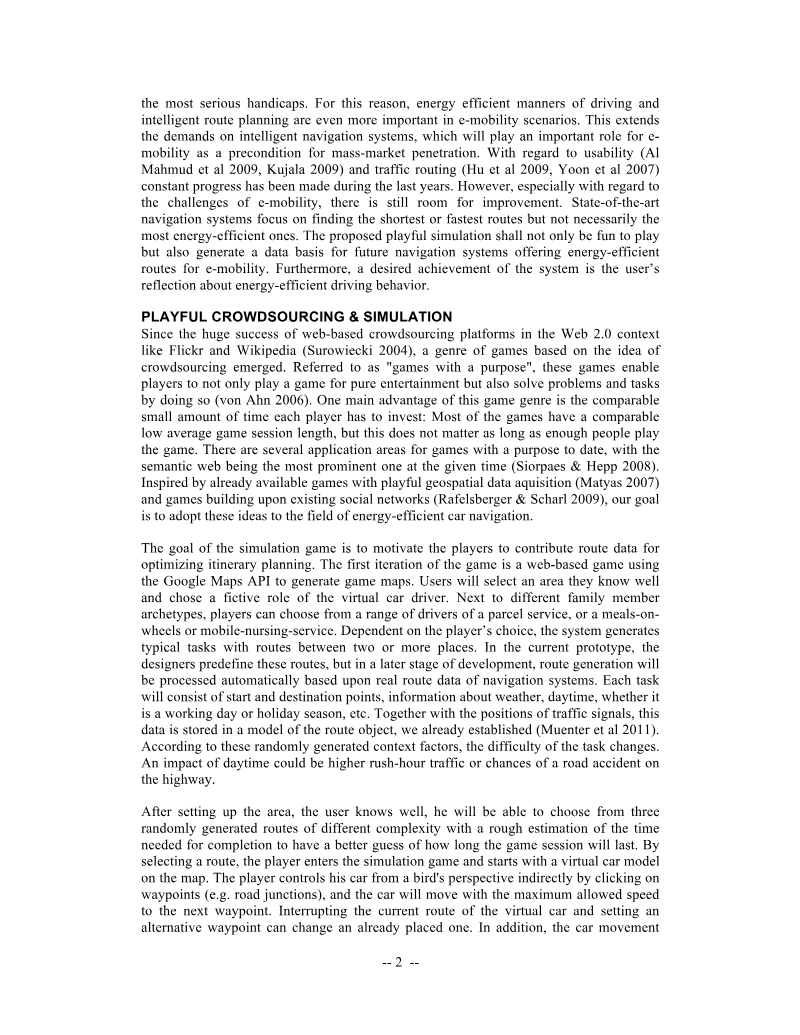
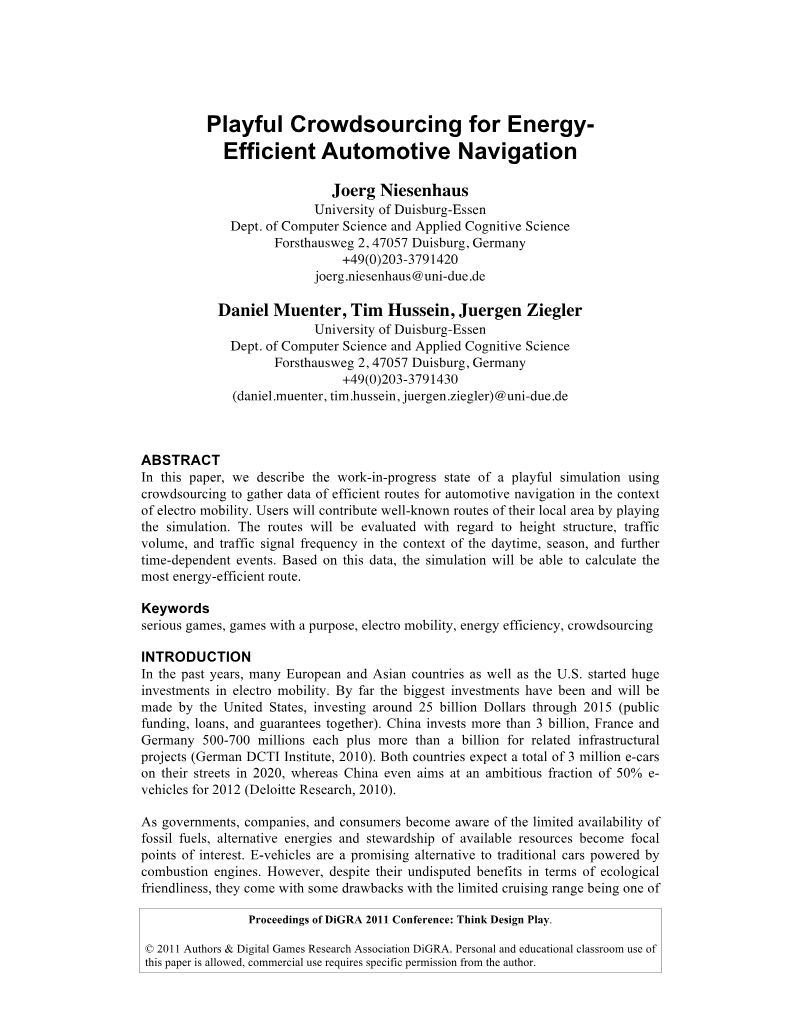
This work-in-progress paper describes a playful, web-based simulation game designed to crowdsource route data for energy-efficient automotive navigation in the context of electromobility.
- A playful, web-based simulation game is proposed to crowdsource route data for energy-efficient navigation of electric vehicles, where players complete randomized routes as fictive drivers such as parcel couriers or mobile nursing workers.
- The game follows the 'games with a purpose' tradition, aiming both to gather usable routing data and to encourage players to reflect on energy-efficient driving, addressing the limited cruising range of electric vehicles.
- The system enriches route waypoints with geographic and topographic data, including altitude, drawn from LinkedGeoData, OpenStreetMap, GeoNames, and Topocoding, and feeds the enriched routes and simulated car movement into an energy-efficiency calculator that also sets the highscore.
Marbles and Machiavelli: The Role of Game Play in Children’s Social Development
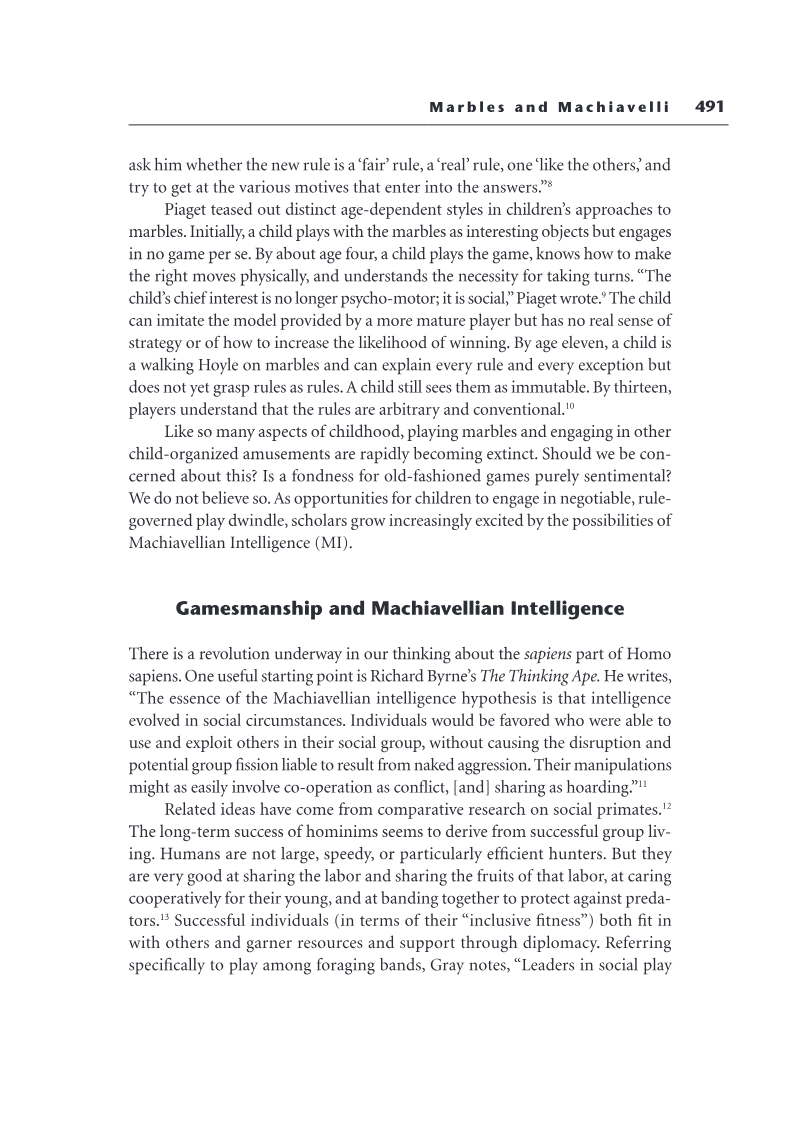
Lancy and Grove argue that children develop Machiavellian intelligence (MI), the social skills of alliance-building, negotiation, and strategic influence, through rule-governed, self-directed play such as marbles, hopscotch, jump rope, and make-believe.
- Lancy and Grove argue that children build "Machiavellian intelligence" (alliance-building, negotiation, and strategic influence) through rule-governed, self-directed play such as marbles, hopscotch, and jump rope, and call the resulting diplomatic competence "gamesmanship."
- The authors contend that as adult-managed activities and video games displace free play, children lose a key training ground for social intelligence.
- The argument draws on evolutionary theory, which holds that human intelligence evolved in response to the demands of group living, and on Piaget's account of children moving from motor play to seeing rules as conventional and negotiable.