Game Development reports and market data
Documents
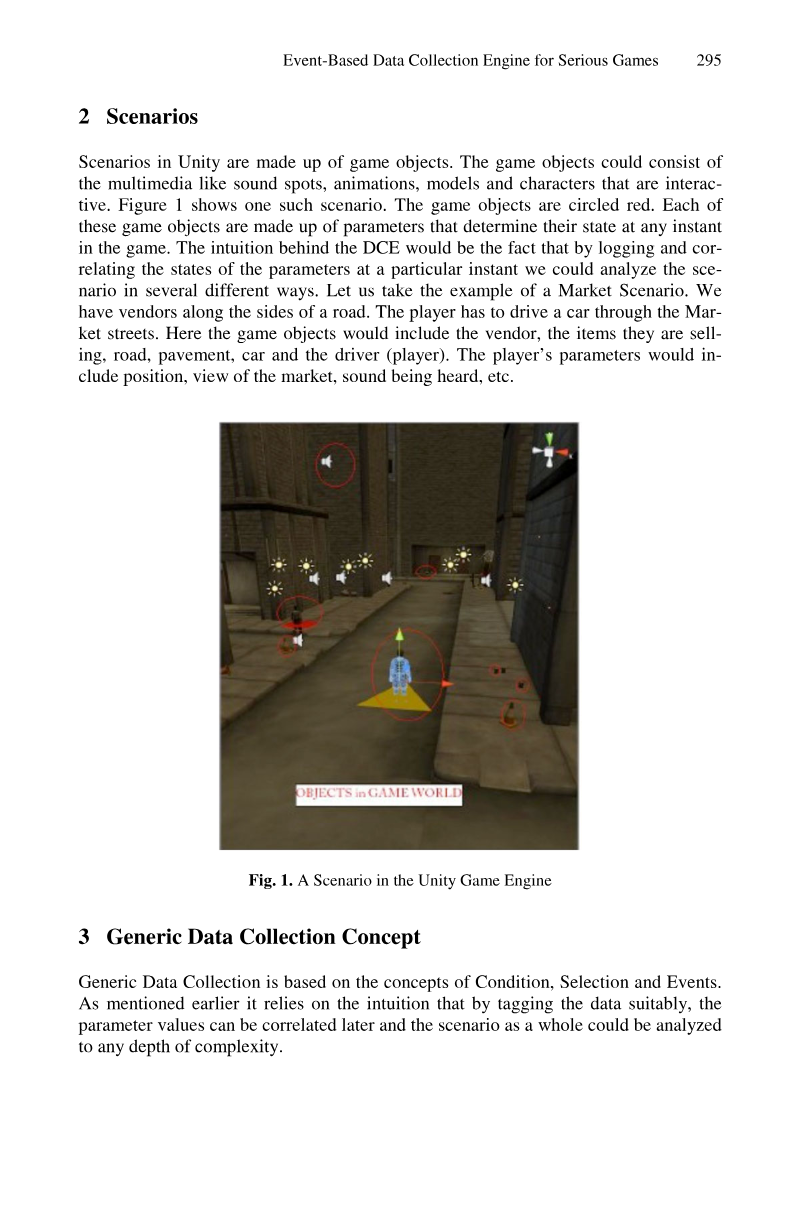
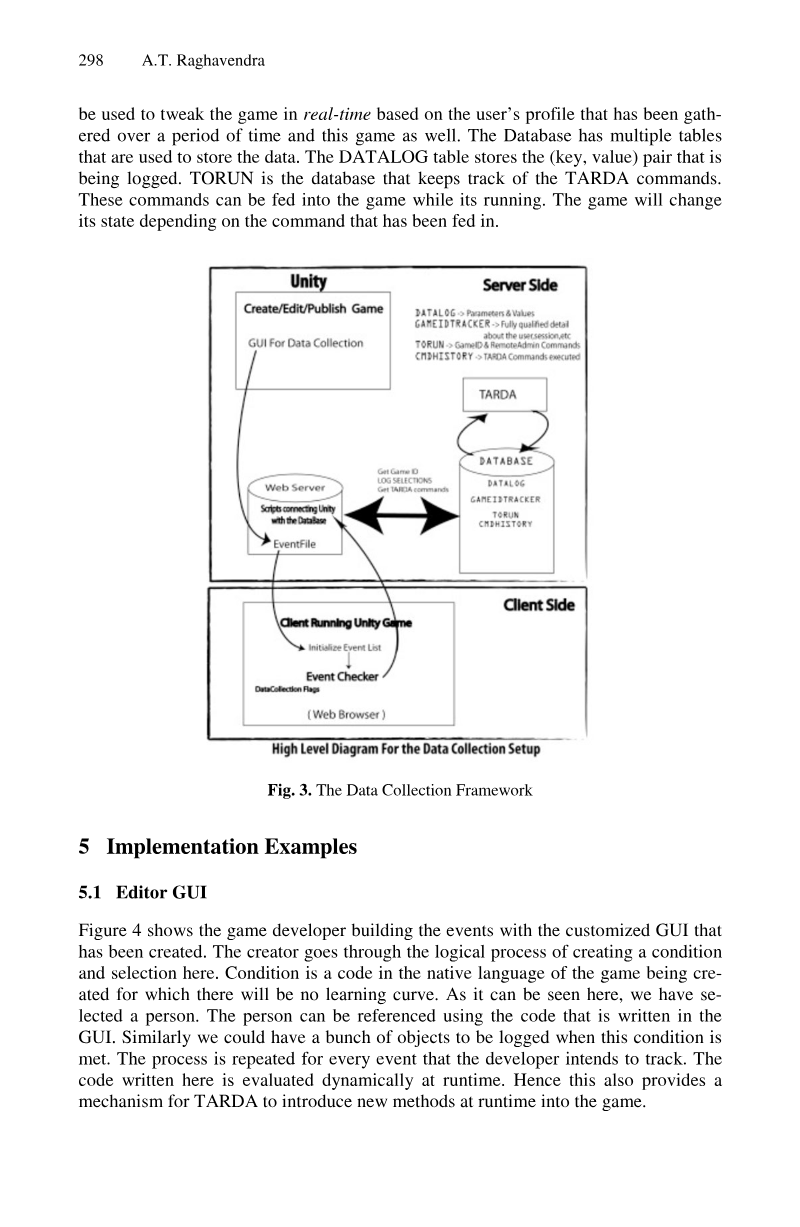
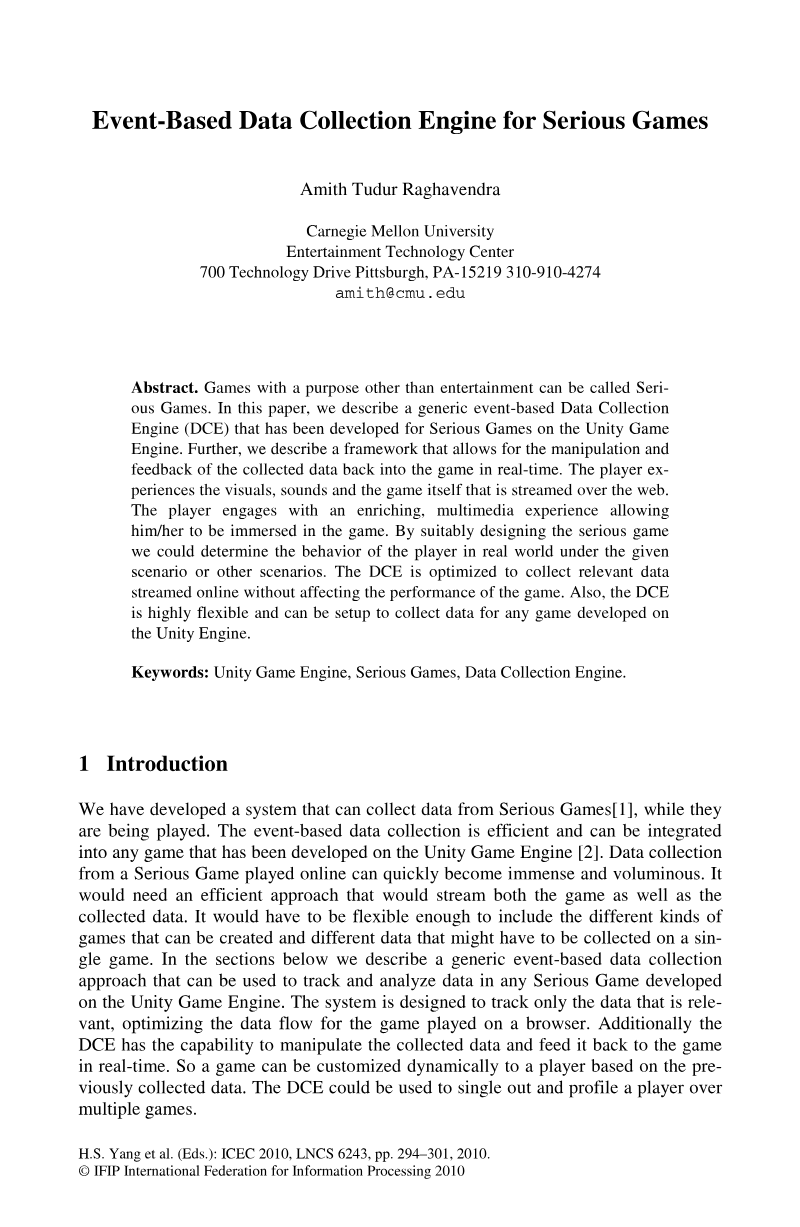
Event-Based Data Collection Engine for Serious Games
Amith Tudur Raghavendra of Carnegie Mellon University's Entertainment Technology Center describes a generic event-based Data Collection Engine (DCE) built for serious games, meaning games with a purpose beyond entertainment, on the Unity Game Engine.
- Events combine a Condition, which determines when logging occurs, with a Selection, which determines what is logged. The event checker evaluates conditions every frame, and the sampling granularity can be customised to the hardware.
- Logged data is keyed by game ID and frame number, so parameter values can be queried at a specific frame, such as when a car drove over a pavement.
- Sampling every 24 frames instead of every frame is described as trading away precision of later data analysis.
Declarative Terrain Modeling for Military Training Games
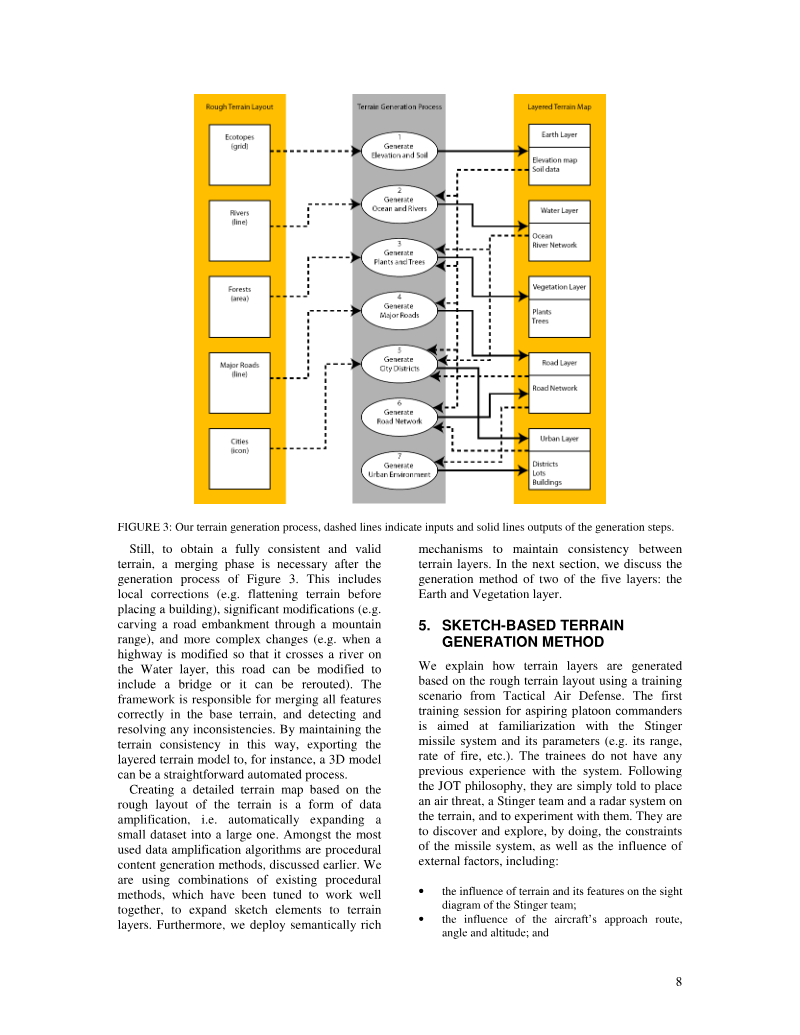
The authors, from TNO Defence, Security and Safety and Delft University of Technology, examine how terrain is modeled for military training games, using the training game Tactical Air Defense as the illustrative case.
- The authors state that the CUDA implementation of their generation and merging process is about 20 times faster than their original CPU implementation.
- The framework divides the terrain into five separately edited layers, ordered so that later layers can depend on earlier ones.
- The authors state that the Earth layer's base elevation is derived from the instructor's ecotope sketch, with interpolation and noise applied on top.
Automated Discovery of Search-Extension Features
The design of effective search-extension schemes in game-playing programs traditionally relies on manual, intuition-based selection of move categories, a process that is both time-consuming and prone to human error.
- The Gradual Focus algorithm automates the discovery of search-extension features, replacing manual, intuition-based selection with a systematic, iterative process.
- Empirical testing in the game Breakthrough shows that Gradual Focus explores a search space two orders of magnitude smaller than brute-force methods while maintaining high precision and recall.
- The algorithm constructs complex features from atomic properties like piece type and placement, effectively mitigating the combinatorial explosion typically seen in feature generation.
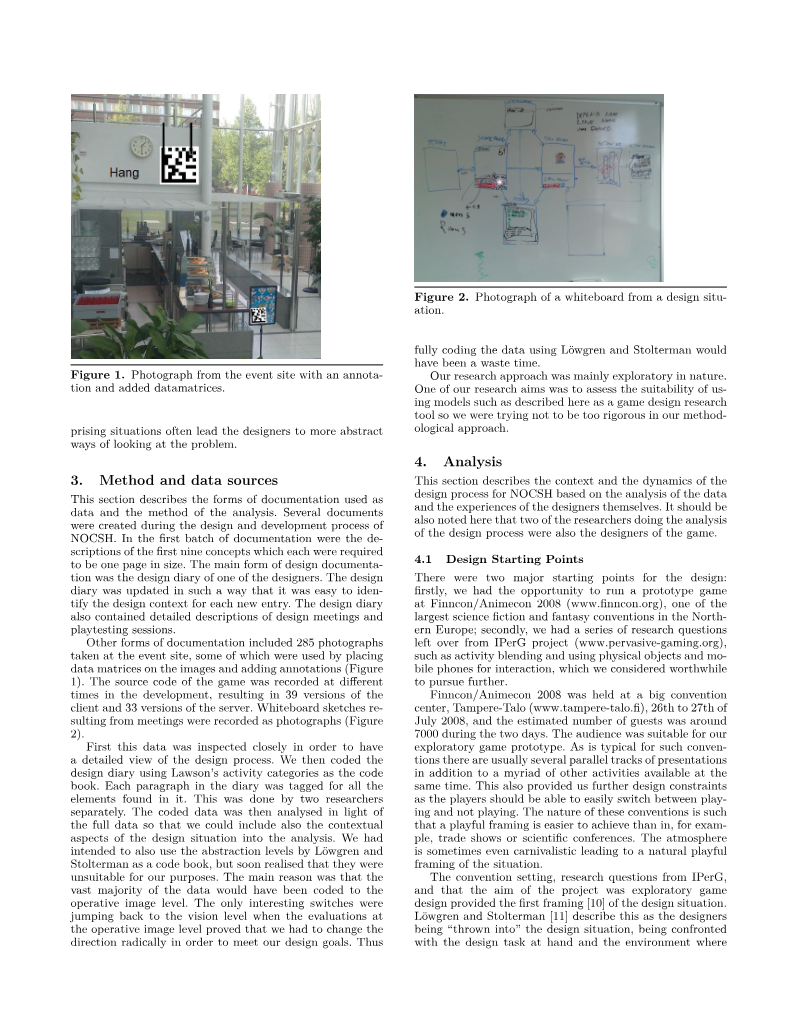
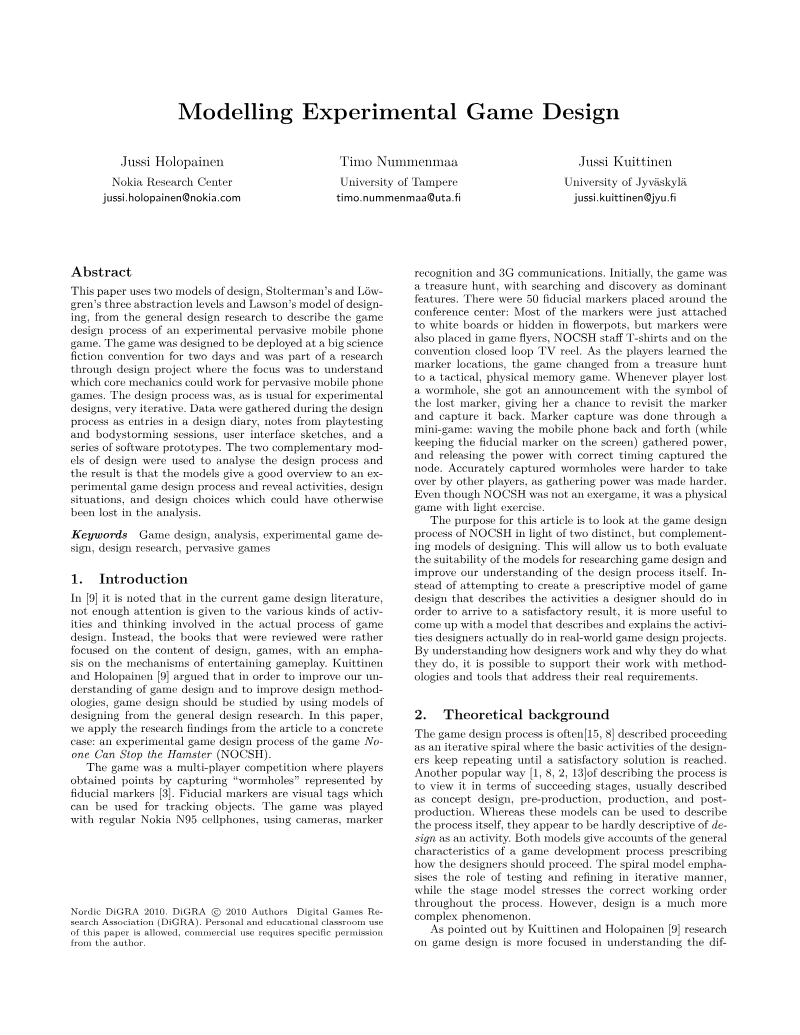
Modelling Experimental Game Design
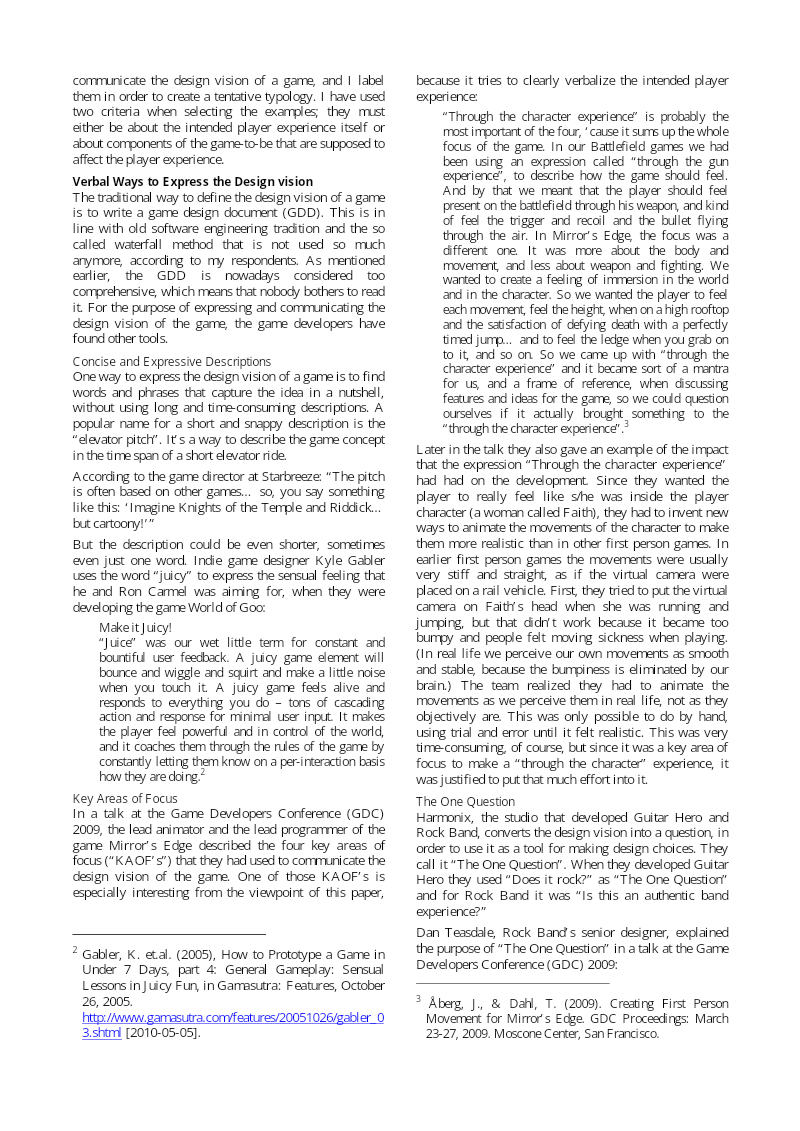
This paper applies two design-research models, Stolterman and Löwgren's three levels of abstraction and Lawson's six-category model of designing, to analyse the iterative design process of Nokia's experimental pervasive mobile game "No One Can Stop the Hamster" (NOCSH).
- The paper applies Stolterman and Löwgren's three levels of abstraction and Lawson's six-category model of designing to analyse the iterative design of Nokia's experimental pervasive mobile game "No One Can Stop the Hamster," aiming both to test these general design models for game design research and to understand how designers actually work.
- The authors argue that existing game design literature focuses on content and gameplay mechanics, leaving the activities and thinking within the design process under-studied.
- The game was a multiplayer competition where players captured fiducial markers ("wormholes") using Nokia N95 camera phones, designed for Finncon/Animecon 2008 in Tampere, attended by an estimated 7,000 guests over two days.

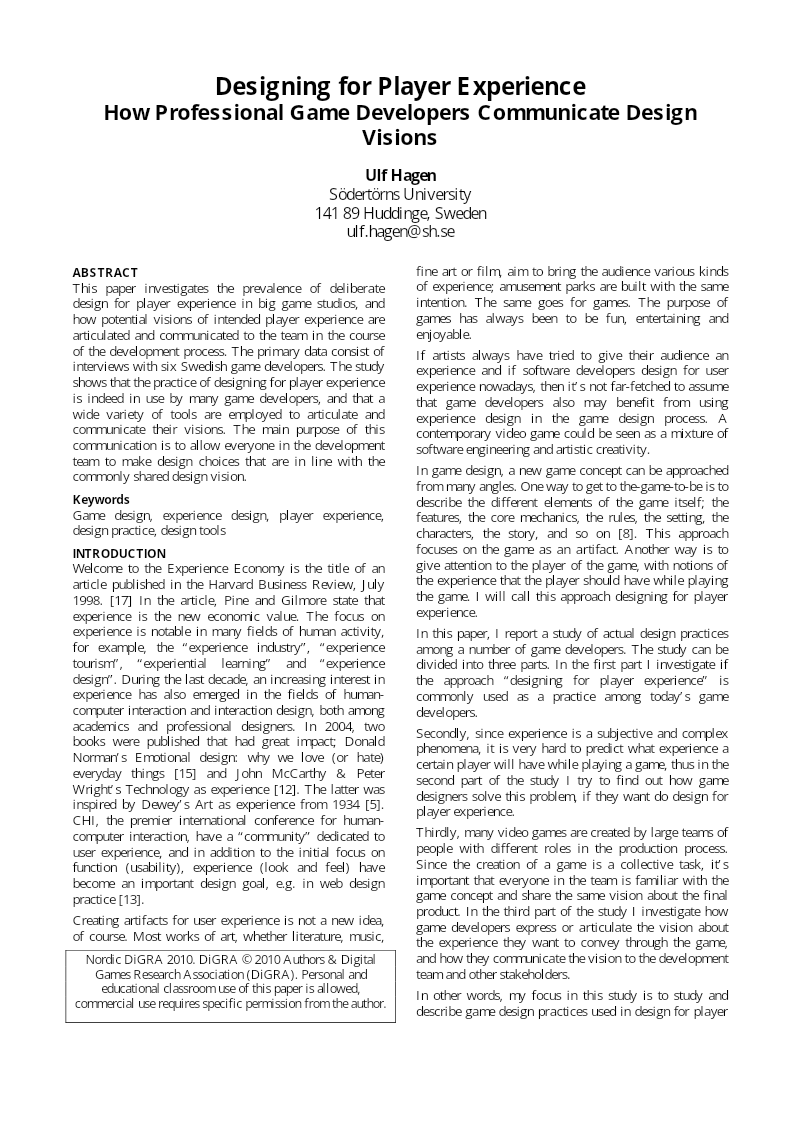
Designing for Player Experience: How Professional Game Developers Communicate Design Visions
Professional game developers in major studios deliberately design for player experience, employing a range of communication tools to ensure team alignment with a shared vision.
- Designing for player experience, meaning the feelings a player should have rather than mechanics alone, is a widely practiced approach among professional developers, according to Hagen's study of six interviews with developers from five major Swedish studios.
- Strong game development depends on communicating a shared design vision so that team members can be creative within a common framework across large, multidisciplinary groups.
- Studios such as Dice, Harmonix, Avalanche, and Starbreeze communicate their visions through concise descriptors, similes, anti-exemplars, concept art, animation, and music rather than lengthy documents.



Capcom Annual Report 2010
Capcom's 2010 annual report outlines a challenging fiscal year ending March 31, 2010, marked by significant declines in sales and profitability, but also details a robust strategic plan for a V-shaped recovery.
- Capcom experienced a significant financial downturn in fiscal year 2010, with net sales dropping 27.3% to 66.8 billion yen and net income falling by 73.1%.
- The company is pivoting to a 'Single Content, Multiple Usage' strategy to leverage core IPs like Resident Evil, Street Fighter, and Monster Hunter across consoles, mobile, and online platforms.
- Management implemented a new matrix management structure and separated CEO and COO roles to improve operational accountability and decision-making speed.

Good Moods: Outlook, Affect and Mood in Dynemotion and the Mind Module
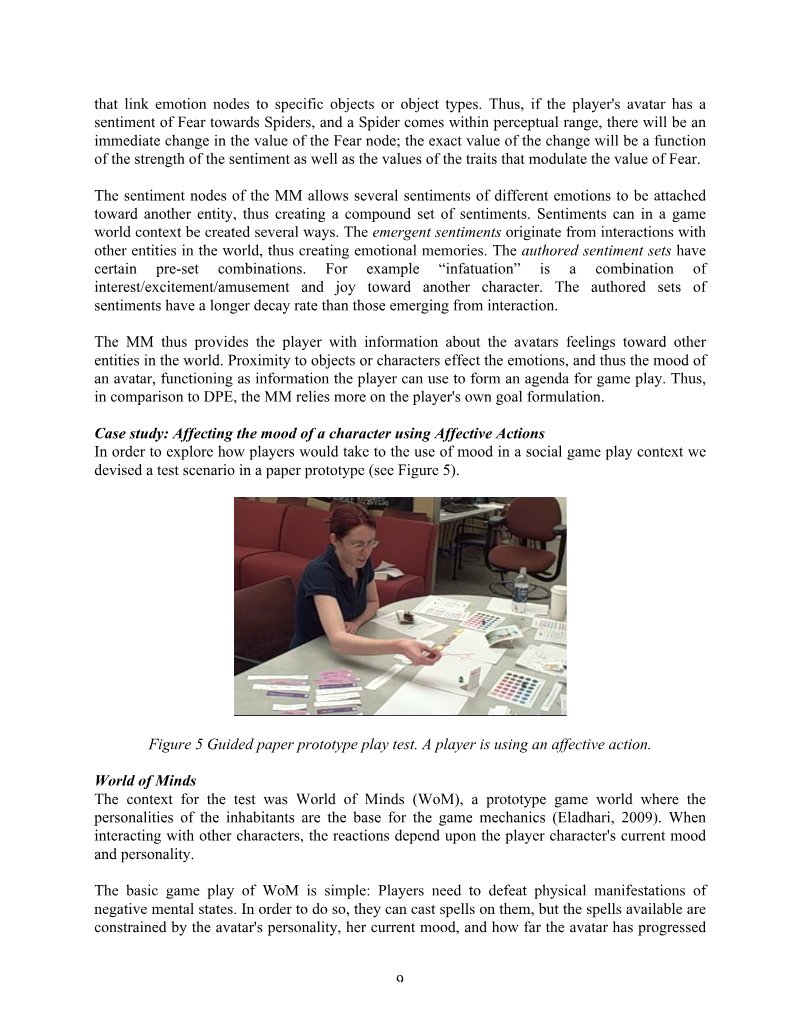
The authors Mirjam Palosaari Eladhari (Gotland University) and Mike Sellers (Online Alchemy) describe two agent-based systems for autonomous characters in multiplayer game worlds: the Dynemotion People Engine (DPE) and the Mind Module (MM).
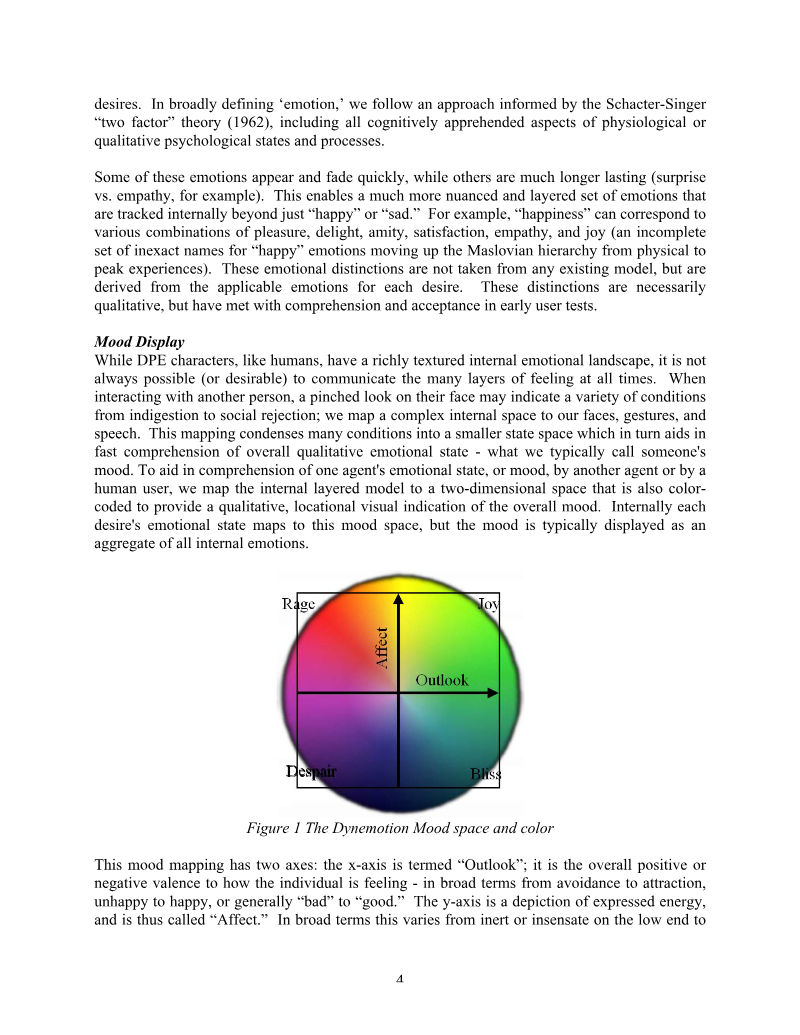
- In the DPE, mood is displayed as a two-axis colour-coded space, with Outlook running from negative to positive valence and Affect running from low to high energy. Early user tests found the colour combinations readily recognizable as shorthand for mood.
- The Mind Module measures mood on two independent scales, inner and outer, each ranging from -50 to 50, which the authors say allows more complex states than a single binary axis.
- The Mind Module's 30 trait nodes are grouped into five factors, and each emotion node is weighted by connections to trait nodes, so the same stimulus produces different emotional responses across avatars.
Content Scheduling in Multimedia Interactive Mobile Games
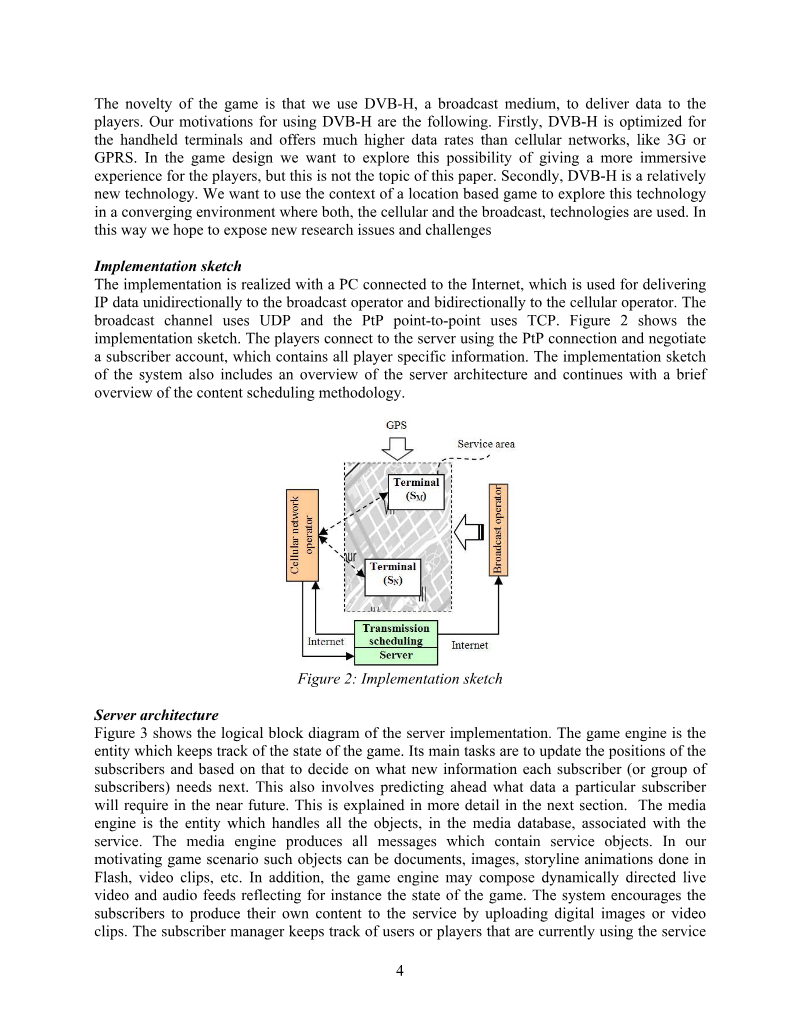
The paper by M. Mohsin Saleemi, Kristian Nybom, Jerker Björkqvist and Johan Lilius of Åbo Akademi University, Finland, studies how to schedule multimedia content sent over a DVB-H broadcast channel combined with a point-to-point 3G or GPRS channel in a location-based interactive mobile game called Åbot.
- In the simulation with 10 players and 10 locations at 200 Kb per location, all deadlines were met while using 175 Kbps of the 384 Kbps channel.
- Increasing players by 50 percent, from 10 to 15, raised bandwidth utilization from 175 Kbps to 300 Kbps, about 75 percent, so utilization did not grow linearly with player count.
- With 300 Kb of data per location, deadlines began to be missed because server position updates consumed the remaining bandwidth, and increasing the threshold value allowed all deadlines to be met for 10 players.
Experiments in the Use of Game Technology for Pre-Visualization
Michael Nitsche of Georgia Institute of Technology presents an overview paper on using real-time 3D game engines for pre-visualization, a pre-production technique used in many film productions to plan camera work before shooting.
- The author argues that camera control in game worlds seems to be one of the most versatile features of game technology for pre-visualization.
- In games, animations are generally pre-produced and direct control over the animation is not available.
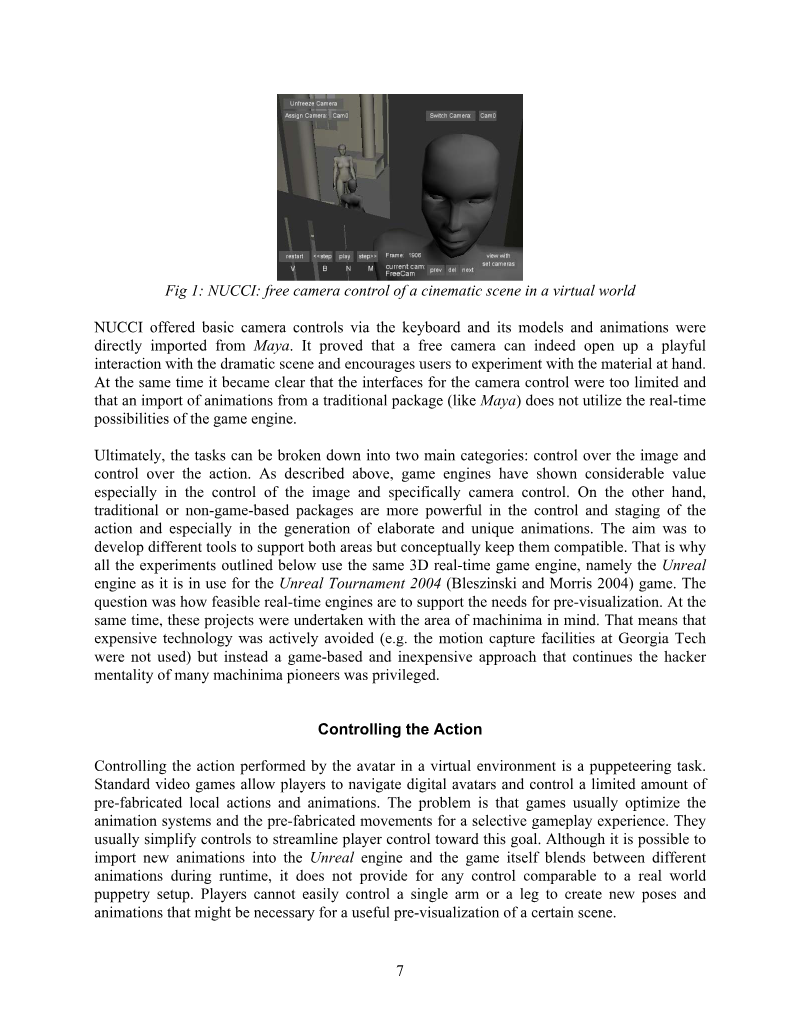
- The NUCCI project let players interrupt a scene reproduced from Fincher's Panic Room at any moment and create their own camera viewpoints.
GPU-Based One-Dimensional Convolution for Real-Time Spatial Sound Generation
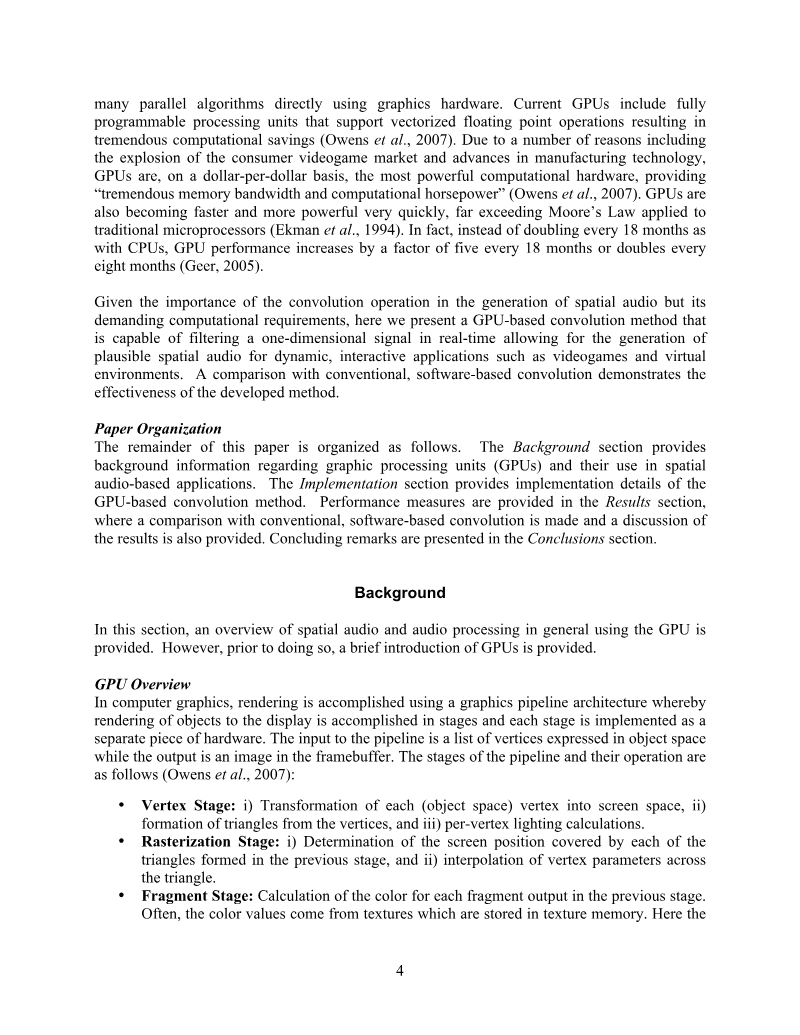
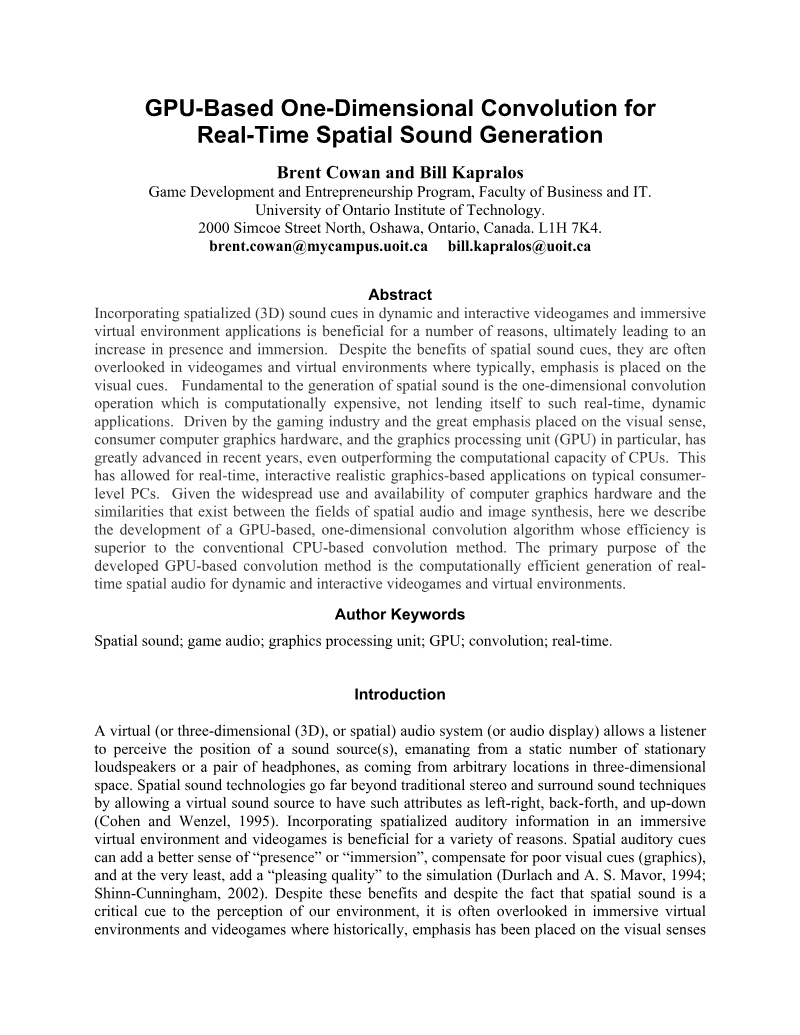
Brent Cowan and Bill Kapralos of the University of Ontario Institute of Technology describe a GPU-based one-dimensional convolution method for generating real-time spatial audio in videogames and virtual environments.
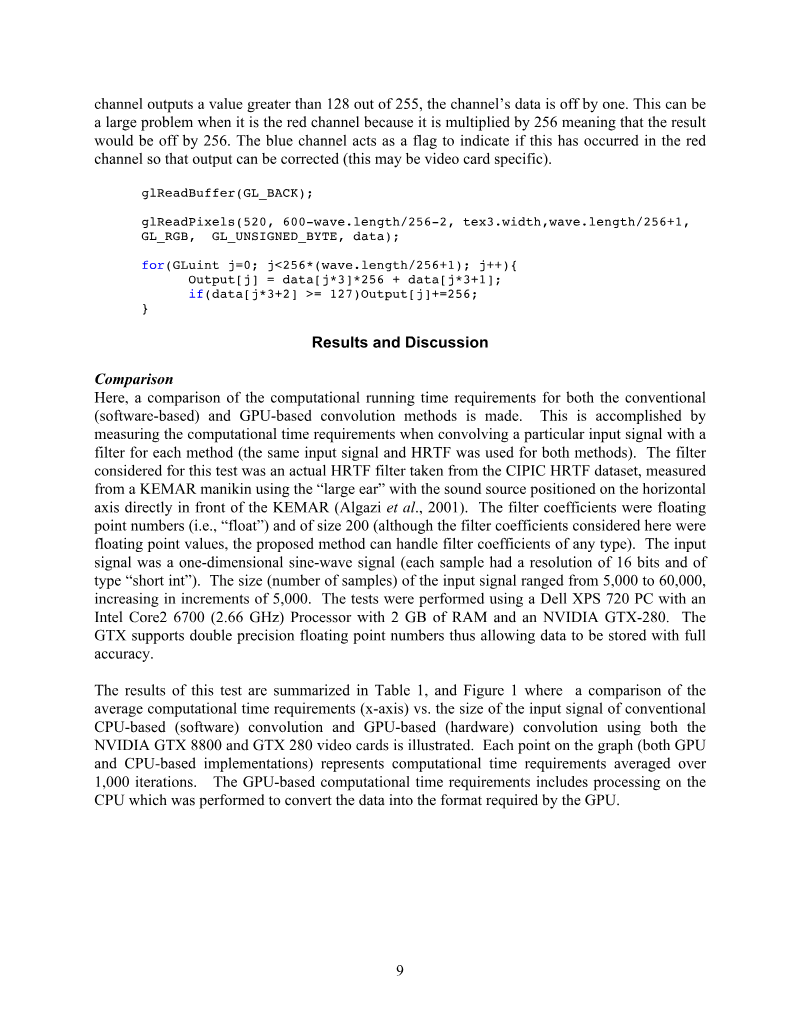
- On a 200-coefficient filter, the GPU method's average running time ranged from 0.45 ms at 5,000 samples to 0.99 ms at 60,000 samples.
- The CPU-based convolution averaged 45.27 ms for a 60,000-sample input, compared with 0.99 ms for the GPU method on the same input.
- The authors calculate that the GPU method's sub-1 ms time for 60,000 samples corresponds to approximately 1,000 fps, while the CPU method gives 22 fps.
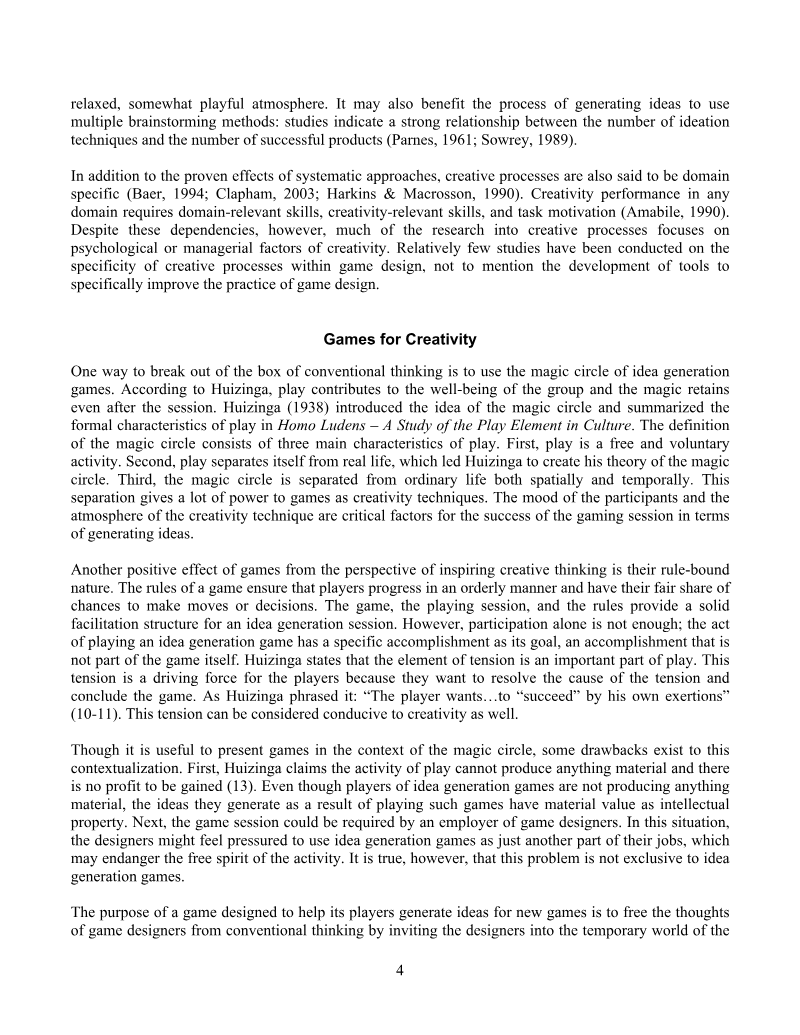
Designing “Game Idea Generation” Games: Finland
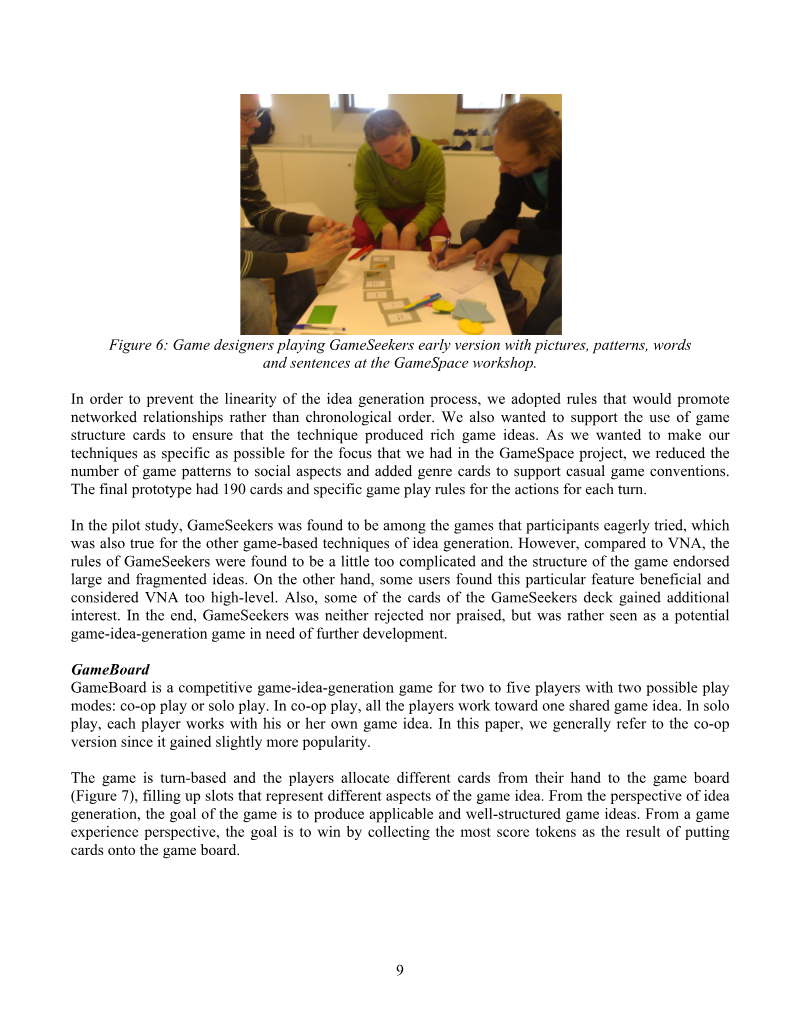
The paper, by Annakaisa Kultima, Johannes Niemelä, Janne Paavilainen and Hannamari Saarenpää of the University of Tampere, Finland, introduces three brainstorming card and board games for game designers.
- The authors report that VNA was considered the favorite technique of the pilot study set by nearly all participating users.
- The three games were tested in an authentic production environment at four Finnish game companies over roughly three months, followed by participant interviews.
- Over 240 new game ideas were documented in the GameSpace workshops held during 2006 and 2007.
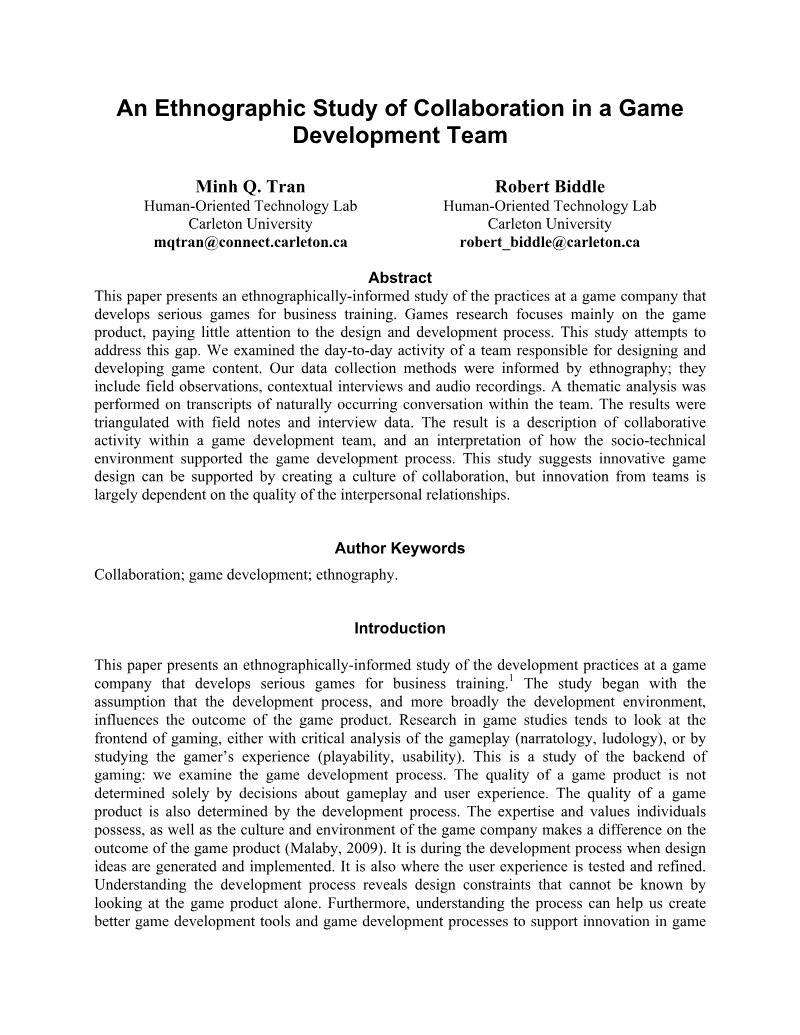
An Ethnographic Study of Collaboration in a Game Development Team
Minh Q. Tran and Robert Biddle of Carleton University present an ethnographically-informed study of a six-member creative studio at a Flash-based serious games company that develops games for business training.
- The team's open-plan office made group conversations and frequent brief meetings possible without scheduling. Because everyone was always within talking range, coordination happened on short time scales, even by the hour.
- Content analysis of work-related conversations found that more than 60% concerned the game itself, while about 23% were planning and 14% concerned tools.
- The authors identify three core factors behind the team's collaborative spirit: role respect, short iteration cycles and shared vision.
Writers
Games and companies
Games