1 free read left. Create a free account for unlimited reading + AI research.
Create free accountWhitepaper DiGRA
1 free read left. Create a free account for unlimited reading + AI research.
Create free accountWhitepaperDiGRA
The authors argue that the activities and thinking within the design process remain under-studied.
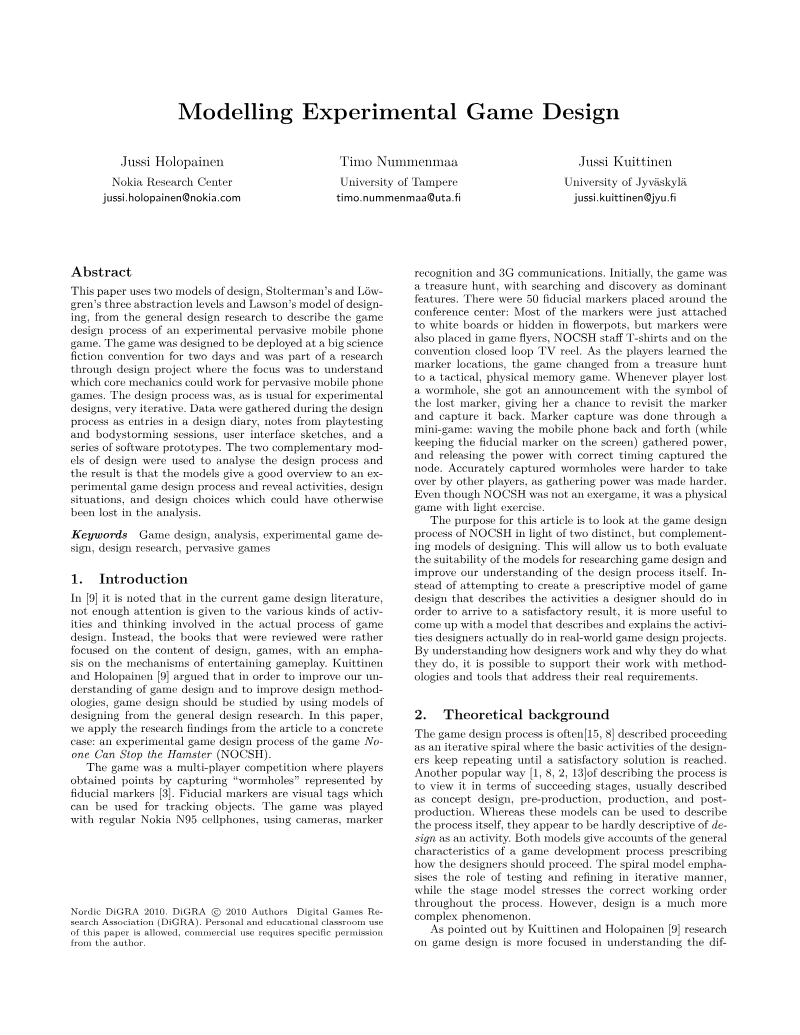
This paper applies two design-research models, Stolterman and Löwgren's three levels of abstraction and Lawson's six-category model of designing, to analyse the iterative design process of Nokia's experimental pervasive mobile game "No One Can Stop the Hamster" (NOCSH). The authors aim both to test whether these general design models suit game design research and to deepen understanding of how game designers actually work, rather than prescribing how they should. They argue that existing game design literature focuses on content and gameplay mechanisms, while the activities and thinking involved in the design process are under-studied.
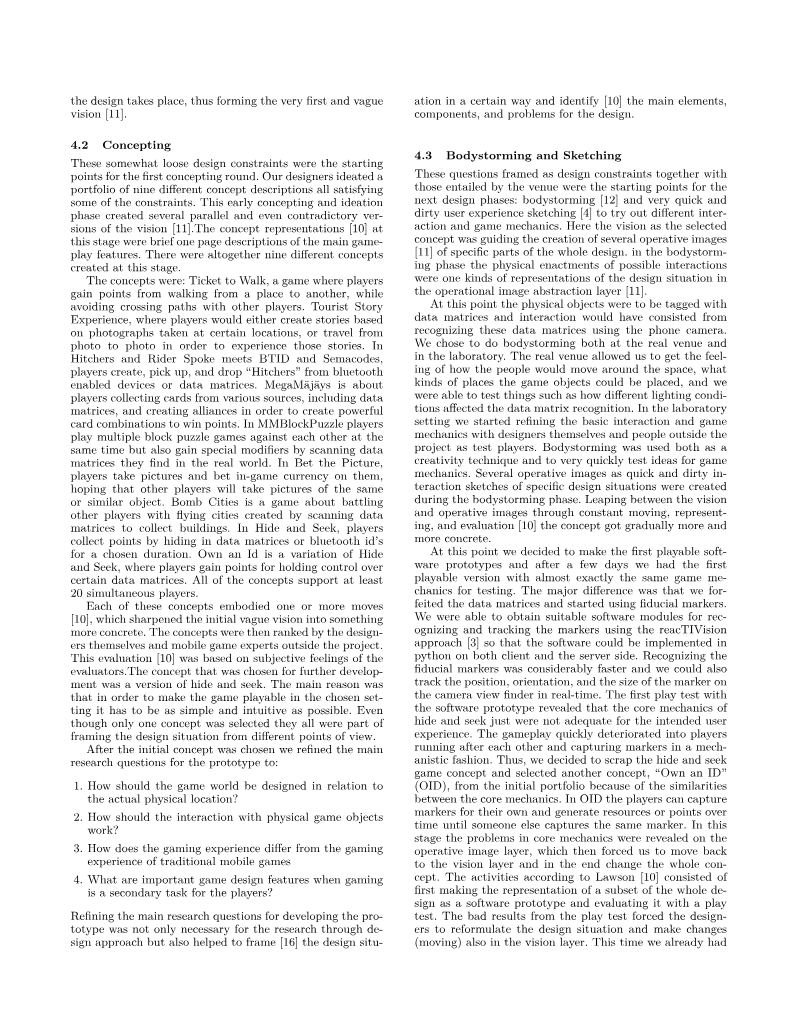
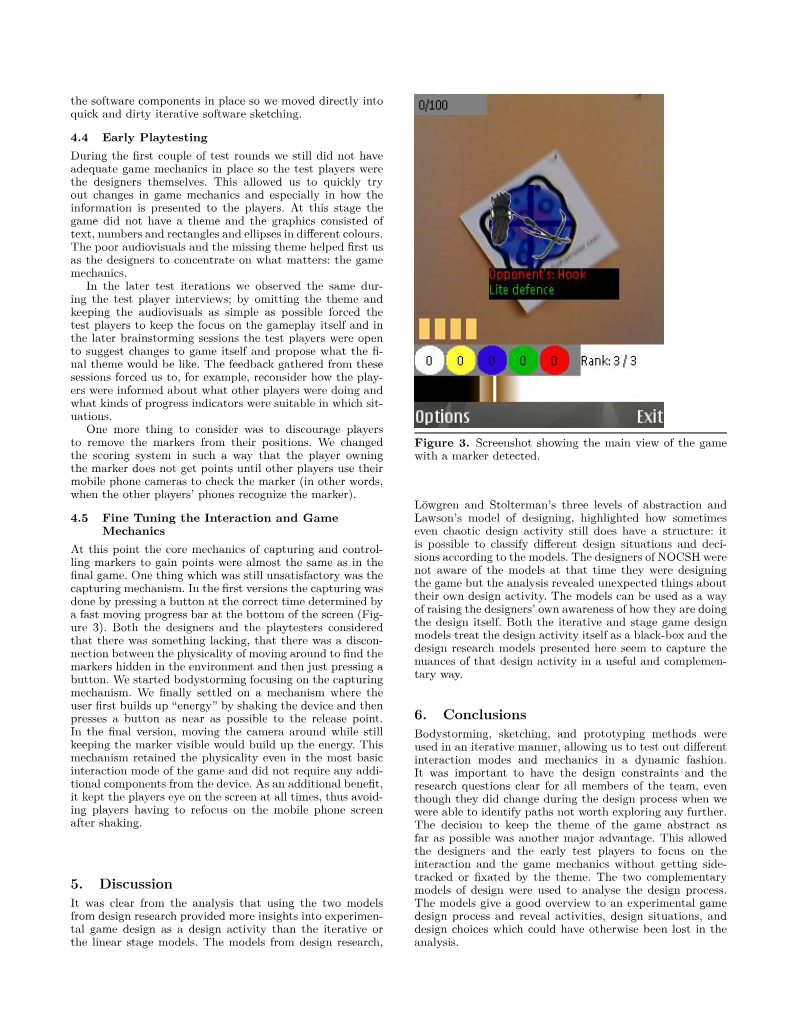
The game was a multiplayer competition in which players captured fiducial markers, representing "wormholes," using Nokia N95 phones with cameras. It was designed for Finncon/Animecon 2008, a large science fiction convention in Tampere attended by an estimated 7,000 guests over two days. The design moved through nine one-page concepts, bodystorming and sketching sessions, and successive software prototypes. The team abandoned an initial hide-and-seek concept after playtesting showed its mechanics were mechanistic and unsatisfying, and later replaced a timing-based capture button with a mechanic in which players build "energy" by moving the camera while keeping the marker visible, preserving physicality and keeping attention on the screen. Data came from a design diary, 285 photographs, whiteboard sketches, and 39 client and 33 server code versions, with two researchers independently coding the diary.
The authors conclude that the design-research models revealed activities, situations, and choices that a simpler iterative or stage model would have missed, and that such models can raise designers' own awareness of their process. The study is exploratory, with a single case and a small set of data, so its generalisability is limited.
Each row is a game or company this document names, each column a document, oldest first. A mark means that document names it. Select a row to see those documents.

DiGRA · 2026

DiGRA · 2026



DiGRA · 2026



DiGRA · 2026



DiGRA · 2026



DiGRA · 2026



DiGRA · 2026



DiGRA · 2026



DiGRA · 2026

DiGRA · 2026



DiGRA · 2026



DiGRA · 2026