Game Development reports and market data
Documents
Make A Gorgeous Start Menu (Unity UI Tutorial)!
Developing a professional, responsive start menu in Unity requires a structured workflow that begins with high-fidelity design.
- Establish a consistent UI across resolutions by using the Canvas Scaler component set to scale with screen size and utilizing sliced sprite modes to preserve asset integrity.
- Create a high-fidelity visual baseline by designing 4K mock-ups in external software like Photoshop or Illustrator before exporting individual assets as PNGs.
- Implement dynamic visual feedback by using an Animator state machine to manipulate scale and color properties rather than modifying rect-transform dimensions.
No Booth, No Problem: Showcasing Your Game on the Go
Independent developers can achieve significant marketing and networking objectives at industry conferences without the prohibitive costs and logistical burdens of maintaining a physical booth.
- Independent developers can achieve marketing and networking goals at conferences without the high costs of a physical booth by utilizing a mobile, active engagement strategy.
- Success requires a specialized conference build optimized for a concise, high-quality play experience lasting between five and ten minutes.
- Developers should prioritize direct, proactive networking by engaging with attendees in lines or approaching press and influencers at other booths.
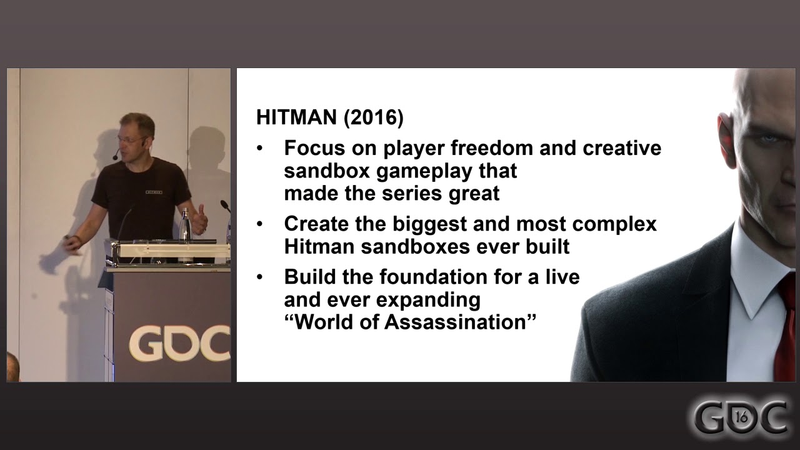
HITMAN Season 1: From Executive Producer to Showrunner
The transition of the Hitman franchise to an episodic, live-service model represents a strategic shift from static, retail-dependent releases toward a continuous World of Assassination.
- Transitioning to an episodic release model allows developers to react to player feedback in real-time, overcoming the long development cycles that previously separated titles like Blood Money and Absolution by six years.
- Data-driven development requires balancing 'hard facts' (in-game telemetry like feature usage and play duration) with 'soft facts' (community sentiment from Reddit, Twitter, and Facebook) to inform production decisions.
- The shift to a live-service model necessitates a 'war room' approach where international publishing and marketing teams meet weekly to align on global territory requirements, pricing, and communication strategies.
How To Finish Long Game Projects!
The primary challenge for indie game developers is the inability to complete long-term projects, which serves as a critical barrier to success.
- Adopt an iterative development strategy by finishing a fully functional, releasable version of your game every three months.
- Limit project scope by condensing long-form concepts into shorter, complete experiences that still contain essential pillars like tutorials, boss fights, and narrative.
- Utilize Parkinson’s Law by setting strict, short-term deadlines to increase productivity and prevent tasks from expanding to fill indefinite timeframes.
Mind Games: Brain Training for Game Developers
Game developers can significantly enhance their professional performance and long-term cognitive health by actively leveraging the principles of neuroplasticity.
- The REACH framework—Repetition, Effort, Attention, Complexity, and Health—serves as the core strategy for cognitive optimization and neuroplastic development.
- Neural growth requires pushing the brain beyond effortless tasks, necessitating engagement in complex, challenging activities that demand sustained, intense focus.
- Multitasking acts as a primary performance inhibitor by functioning as inefficient task-switching, whereas protecting flow states and practicing mindfulness strengthens the prefrontal cortex.

5 Secrets To FINISH Your Game!
Successfully completing a game development project requires a disciplined approach to both the creative process and personal management.
- Prioritize the refinement of existing mechanics over the addition of new features to prevent feature creep and avoid unnecessary project scope expansion.
- Establish external accountability through recurring commitments with a partner, including defined consequences for failing to meet progress goals.
- Maintain a small, manageable project scope by focusing on creating a high-quality 'diamond' rather than attempting to emulate the scale of AAA titles.
The Catharsis of Doing - Designing Emotionally Intense Experiences - Extra Credits
The concept of catharsis in video games differs fundamentally from traditional media like film or literature, which rely on passive observation.
- Video games offer a 'catharsis of doing,' a unique form of emotional release derived from active participation and agency rather than the passive observation found in traditional media.
- The interactive nature of games allows players to process real-world frustrations and explore personal decision-making by confronting challenges and moral choices in a controlled environment.
- Because games require active effort, they carry an inherent risk of compounding existing stress, rage, or sadness if a player fails to achieve a desired victory or is troubled by their own in-game actions.
Life is Strange: The Blue Age of Storytelling
The emergence of the Blue Age of storytelling in video games represents a fundamental shift toward prioritizing emotional resonance, character-driven narratives, and lo-fi, painterly aesthetics over the industry’s traditional pursuit of photorealistic, high-budget spectacle.
- The 'Blue Age' of game design prioritizes emotional resonance and character-driven narratives over photorealistic, high-budget spectacle.
- Developers are increasingly utilizing interactive narrative branching and naturalistic dialogue to explore complex social themes like mental health and moral ambiguity.
- Effective storytelling in this model relies on avoiding stereotypical archetypes and using stylized, regional-specific writing to ground characters in objective humanity.
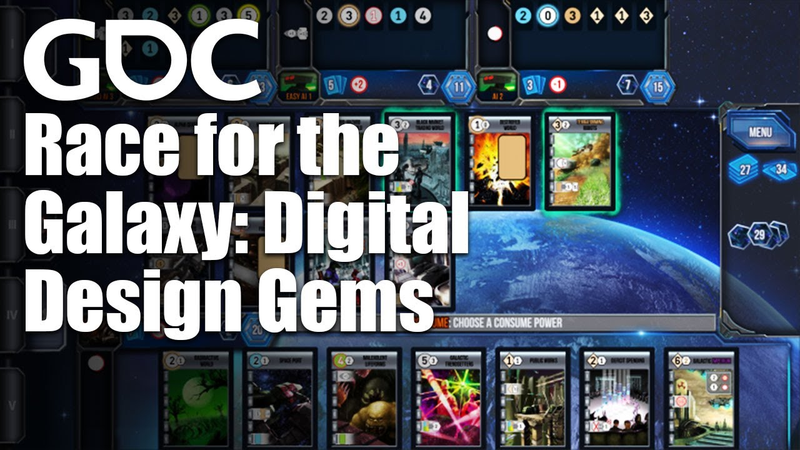
Board Game Design Day: Race for the Galaxy: Digital Design Gems
The successful transition of tabletop experiences into digital environments relies on selecting titles with structured, phase-based mechanics that favor strategic decision-making over physical tactility or social negotiation.
- Digital board game adaptations should prioritize asynchronous gameplay features, such as contextual prompts and automated rule execution, to reduce analysis paralysis and allow players to manage multiple games simultaneously.
- To maintain a vibrant community, developers should display both active and inactive multiplayer games in the lobby to broadcast a high level of activity, even if some games are not joinable.
- Developers should implement a system of 'attention tokens' to triage game events, ensuring that critical moments (like a major move) lock the screen while secondary events (like drawing cards) proceed in the background to maintain both speed and legibility.
Make Cool Games With Unity 3D! - (Part 2)
Efficient game development in Unity relies heavily on the strategic use of prefabs to streamline object management and level design.
- Utilize prefabs as modular building blocks for game elements like enemies and obstacles to enable global updates and ensure consistency across multiple scenes.
- Implement object-finding workarounds in scripts to manage enemy behavior, as prefabs cannot maintain direct references to objects within a specific scene.
- Develop core mechanics by combining foundational, reusable scripts for collision detection, object destruction, and dynamic movement rather than writing redundant code.
How To Make 2D Platformers (Unity Fundamentals Tutorial)
Building a professional 2D platformer in Unity requires a disciplined approach to project architecture and the integration of specialized animation tools.
- Establish a scalable foundation by prioritizing organized object hierarchies and utilizing layered artwork exported from external design software.
- Implement player physics using capsule colliders and configure orthographic cameras with Cinemachine to ensure consistent movement and reliable tracking.
- Simulate three-dimensional depth in 2D environments by applying parallax scrolling scripts that assign varying movement factors to background and foreground layers.
Creative Panic: How Agility Turned Terror Into Triumph
Double Fine successfully navigated a period of significant financial instability and project cancellation by adopting an agile, multi-team organizational structure.
- Double Fine transitioned from a single-project model to a flexible, multi-project organization by adopting an agile structure that empowered small, autonomous teams to lead their own concepts.
- The studio implemented 'Amnesia Fortnight,' a recurring two-week internal game jam, to serve as both a professional development pipeline and a source for new intellectual property.
- Operational efficiency was maintained through an 'economy of design' strategy, which prioritized core mechanics and the strategic reuse of existing assets to maximize output under tight constraints.
Writers
Games and companies
Games