Game Culture reports and market data
Documents
Speak with Blocks: Minecraft, Environmental Education and Activism
This paper by Gaia Amadori examines how digital games, specifically the sandbox title Minecraft, can serve as platforms for environmental education and ecological activism.
- The paper argues that video games should be analyzed as nodes in a network of stakeholders (NGOs, corporations, public institutions, developers, and gaming communities), not as isolated software products.
- It proposes an analytical model with three dimensions: the ecological issue addressed, the network of actors, and the video game ecosystem (assets, affordances, and paratexts such as user-generated content and streamer discussions).
- Greenpeace's 'To The Last Tree Standing' campaign recreated Poland's Białowieża Forest in Minecraft and then altered the map to show near-total deforestation; the paper says it reached millions and helped build public pressure that contributed to halting real-world logging there.
Preserving Japanese Indie Games at BitSummit Drift 2024
This extended abstract, authored by Michael Pennington and James Newman of Bath Spa University, argues that Japan's contributions to videogame history are at serious risk of being lost, both because digital games are becoming unplayable and because English-language histories tend to privilege American and Eurocentric…
- Japan's videogame heritage is at serious risk of being lost, both because digital games are becoming unplayable and because English-language histories tend to privilege American and Eurocentric perspectives.
- A central finding is that many Japanese indie developers worry their games will become unplayable due to hardware breakage or financial constraints that prevent ongoing maintenance.
- The authors conclude that audiovisual documentation of gameplay and spectatorship is itself a meaningful form of preservation.
Music beyond Gameplay: Embodied Experience of Acoustic Music in the Covers of Original Game Soundtracks
This paper examines fan-produced YouTube videos in which musicians perform acoustic covers of video game original soundtracks, treating these uploads as a form of participatory culture, prosumption, and meaning-making within game culture.
- Fan-produced acoustic covers of video game soundtracks are framed as active reconstructions rather than imitations: moving a digital, interactive score to traditional instruments forces performers to interpret the material and creates a distinct embodied musical experience.
- The authors treat these YouTube covers as de-centered paratexts and player-produced texts that document game reception and function as artistic expression within participatory game culture.
- The authors argue that a soundtrack's popularity tracks the size of its fandom and the cultural visibility of its publisher, citing Nintendo series such as The Legend of Zelda, Super Mario, and Pokemon as enduringly prominent.
Copyright and Games Preservation: Lessons and Opportunities in De-colonization
This extended abstract examines how copyright law and institutional preservation practices struggle to accommodate video games in a global, post-colonial context.
- Copyright frameworks and heritage institutions were built around static, physical, territorially bounded objects, while digital games require ongoing copies, updates, and platform maintenance, exposing these limitations.
- Digital distribution and 'service' business models mean libraries and archives often hold only licenses rather than ownership, which limits their long-term capacity to preserve games.
- Territorial licensing creates uneven global availability; the authors cite Sony's PlayStation Network restricting access to roughly 85 countries.
Mutual Incorporation: On Eating and Being Eaten in Bugsnax (2020)
This paper is an extended abstract from a DiGRA 2025 proceedings that offers a phenomenological and affect-theory analysis of Bugsnax (Young Horses, 2020), using the game as a case study for rethinking eating in digital play.
- The paper is a conceptual, text-based analysis of the single game Bugsnax (Young Horses, 2020), drawing on close reading and secondary literature rather than empirical data, sample sizes, or quantitative findings.
- Its central thesis is that Bugsnax literalises 'incorporation' through a comedic body-horror premise in which players capture hybrid bug-snacks and use them to recompose the limbs and bodies of non-player characters.
- Drawing on Annemarie Mol's Eating in Theory and Calleja's model of incorporation, the author argues the game moves beyond eating as sustenance or resource management toward 'mutual incorporation', in which eaters are themselves eaten by what they consume.
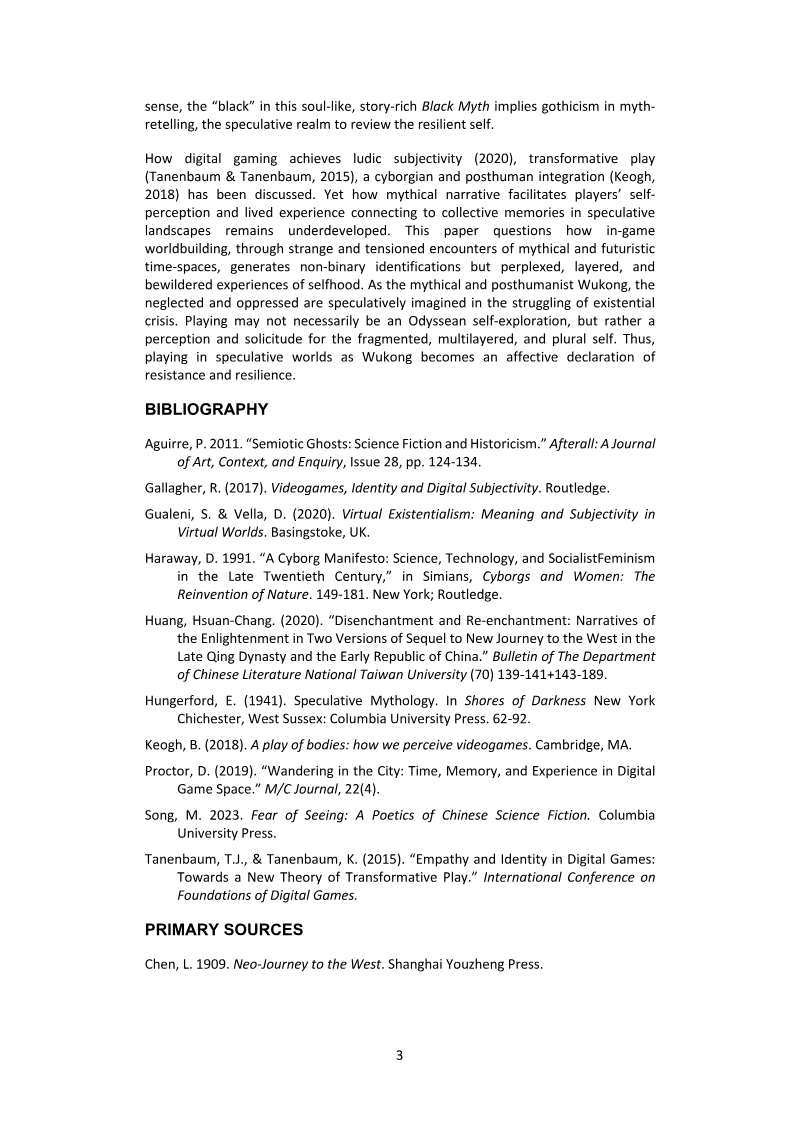
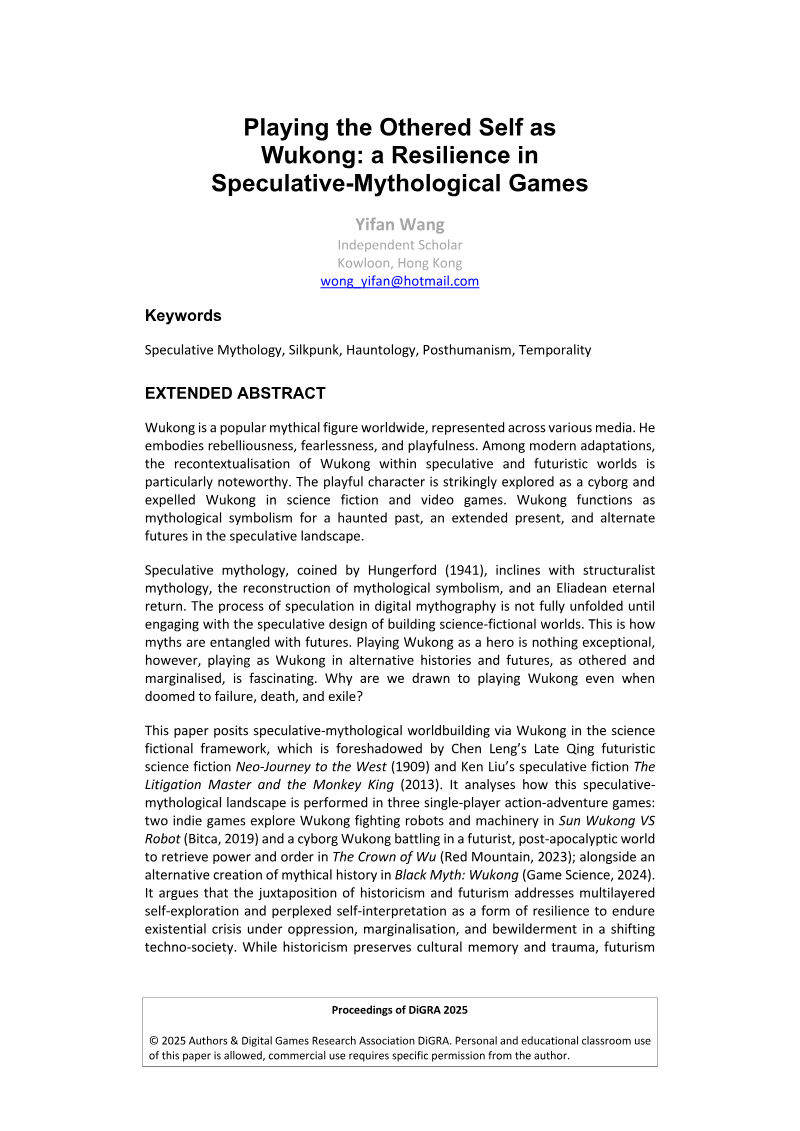
Playing the Othered Self as Wukong: A Resilience in Speculative-Mythological Games
This paper examines how Sun Wukong, the Monkey King of Chinese mythology, is reimagined within speculative and science fictional settings, and how such reimaginings in video games shape players' experience of selfhood.
- The paper's central argument is that speculative-mythological worlds, which juxtapose historicism (preserving cultural memory and trauma) with futurism (pushing myth toward adaptive transformation), give players a way to work through existential crisis, marginalisation, and disorientation in a rapidly changing techno-social environment.
- The Monkey King Sun Wukong is treated as a site of temporal friction, where archiving cultural memory and imagining redemption meet within reimagined speculative and science fictional settings.
- The analysis applies precedents including Chen Leng's late Qing novel Neo-Journey to the West (1909) and Ken Liu's short story The Litigation Master and the Monkey King (2013) to three single-player action-adventure games: Sun Wukong VS Robot (Bitca, 2019), The Crown of Wu (Red Mountain, 2023), and Black Myth: Wukong (Game Science, 2024).



At the Crossroads of Art and Games: NPCs in Contemporary Video Art
This paper examines how contemporary video artists are using the figure of the non-player character (NPC) to explore questions of agency, labour, race, and subjectivity.
- The paper examines how contemporary video artists use the non-player character (NPC) to explore agency, labour, race, and subjectivity, scoping 'game art' as artworks that reference videogames or appropriate game content.
- The term 'NPC' migrated from gaming communities into online political discourse in the late 2010s, where it was used both to ridicule perceived conformity and to reinforce racialised and gendered hierarchies, before creators reclaimed it to describe constraints of economic and sociotechnical systems.
- Larry Achiampong and David Blandy's GOD MODE (2023), shown at the Wellcome Collection, uses game-engine imagery to reflect on scientific racism, eugenics, and how popular media shapes ideas about heredity and race, contrasting the free player with the pre-ordained, labouring NPC.
Speculative Games: Games Envisioning Possible Futures
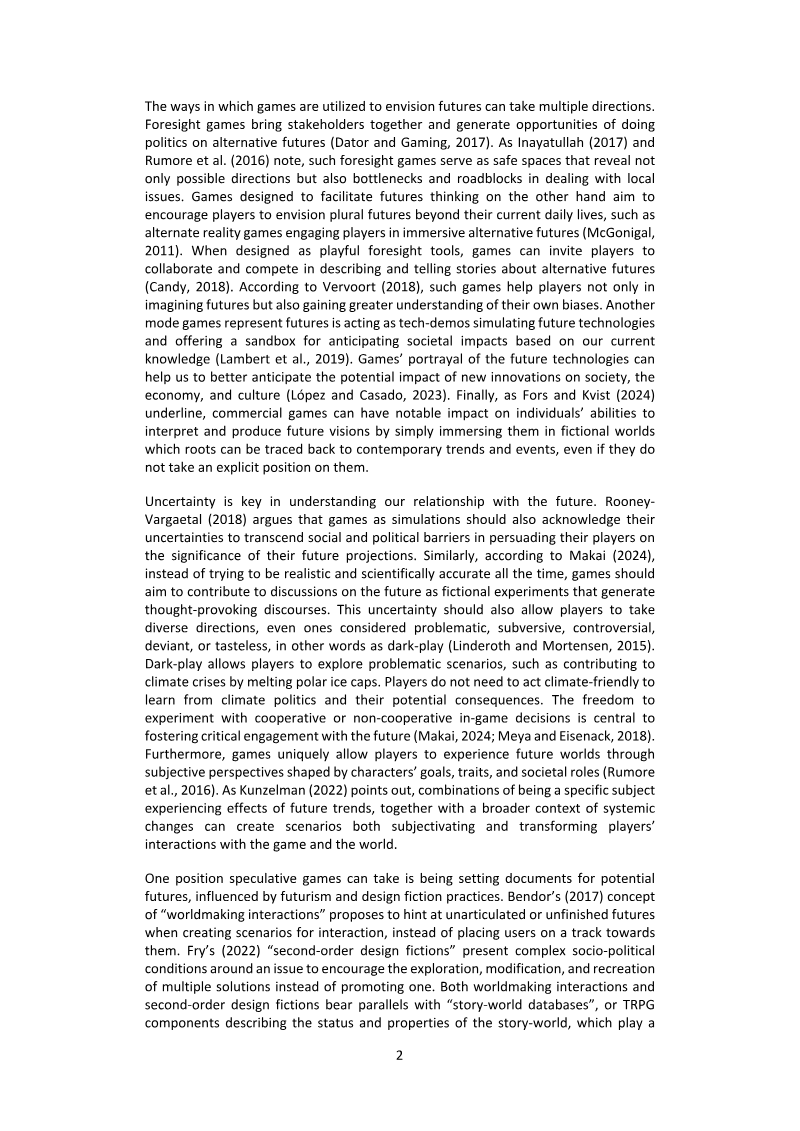
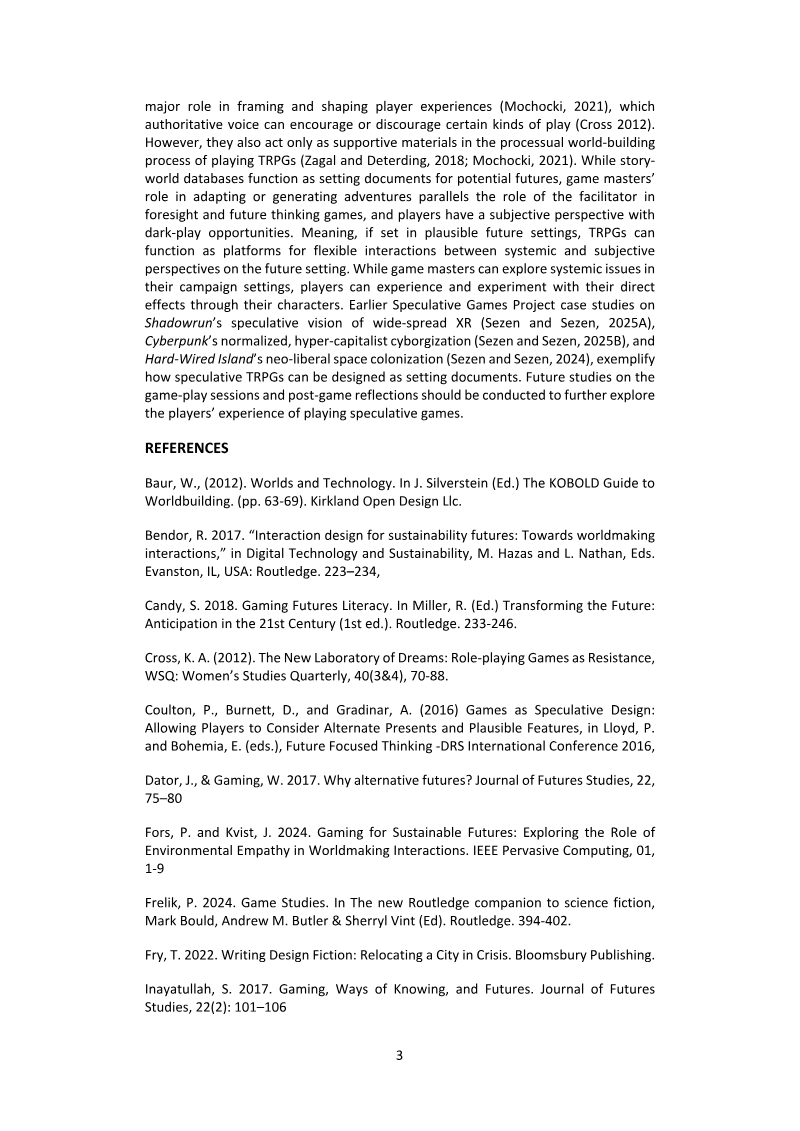
This paper, presented as an extended abstract from the Speculative Games Project, examines how games engage with possible futures and proposes principles for designing speculative games, with particular attention to tabletop role-playing games (TRPGs).
- Speculative games are defined as featuring plausible, fact-based mid- and long-term future scenarios, mainly extrapolated from current scientific, technological, social, and environmental trends, though they may also move beyond contemporary conditions.
- The paper treats game design itself as a form of speculative design, inviting players to reflect on plausible futures rather than predict them precisely.
- Games represent futures through several modes: foresight games that expose bottlenecks in local issues, alternate reality and playful foresight games that surface players' biases, and technology demonstrators that simulate emerging technologies to anticipate social, economic, and cultural impacts.
The Fractured Imbunche: A Study of Chilean Horror Games
This extended abstract, presented as a work in progress at DiGRA 2025, examines Chilean horror videogames through the lens of transculturation, a concept describing cultural contact that generates new identities, forms, and motifs through heterogeneous authorship and active audience participation.
- The study examines Chilean horror videogames through transculturation, a concept describing how cultural contact generates new identities, forms, and motifs through heterogeneous authorship and active audience participation.
- The central research questions are whether Chilean horror games enact transculturation and whether recurring motifs can be identified as distinctly Chilean; the paper is presented as a work in progress at DiGRA 2025, not as established findings.
- The author argues the videogame is a particularly suitable medium for transculturation because it functions as a space of cultural creation requiring participation from both developers and players.



Crafting Comfort: Postdigital Practices in Current Cozy Games
This paper examines how a subset of cozy video games, a genre defined more by aesthetic feel than by conventional game mechanics, incorporates nondigital media technologies and practices into its design.
- The paper proposes "postdigital practices" as a framework for cozy games that incorporate nondigital media such as tape recorders, instant cameras, and scrapbooks, distinguishing this from the glitch and failure aesthetics that dominated earlier postdigital discussions.
- The authors argue that foregrounding analog tools within digital spaces evokes nostalgia and reinforces the cozy genre's sense of safety, abundance, and softness.
- The framework draws on remediation theory, transmediality, and game studies, and is complementary to existing research on cozy games covering feminist design, the politics of care, neoliberal critique, and mental health benefits.
A Call for an Appalachian Game Studies
This paper argues for establishing Appalachian game studies as an intersection of Appalachian studies and game studies, drawing on the emerging "regional turn" in game research.
- The paper proposes establishing Appalachian game studies as an intersection of Appalachian studies and game studies, arguing each parent discipline would gain from the other.
- The argument is framed within the internal colony model of Appalachian underdevelopment, while acknowledging critiques that postcolonial analogies can overreach or oversimplify complex histories.
- Games cited as featuring Appalachia include Fallout 76, Nights in the Woods, Kentucky Route Zero, and the early text adventure Colossal Cave Adventure, which was inspired by a regional cave system.
Undead Ecologies: Reconceptualising Zombiism in Videogames
Lawrence May's paper, presented at DiGRA 2025, argues that zombies in contemporary videogames are shifting from embodied figures into distributed "undead ecologies" that reflect the ecological crisis and the material conditions of the Anthropocene.
- Lawrence May's DiGRA 2025 paper argues that zombies in contemporary videogames are shifting from embodied figures into distributed "undead ecologies" reflecting the ecological crisis and the Anthropocene.
- The paper links the necrotisation of Earth to late-stage capitalism and contends that videogames, reliant on extractive mineral sourcing, exploitative labour and fossil energy, are well placed to make players notice a damaged planet's entangled lives, deaths and temporalities.
- The analysis is a qualitative textual study with close readings of Timberborn (Mechanistry, 2021) and Elden Ring (FromSoftware, 2022), not an empirical survey, and reports no quantitative data or sample sizes.