Game Culture reports and market data
Documents
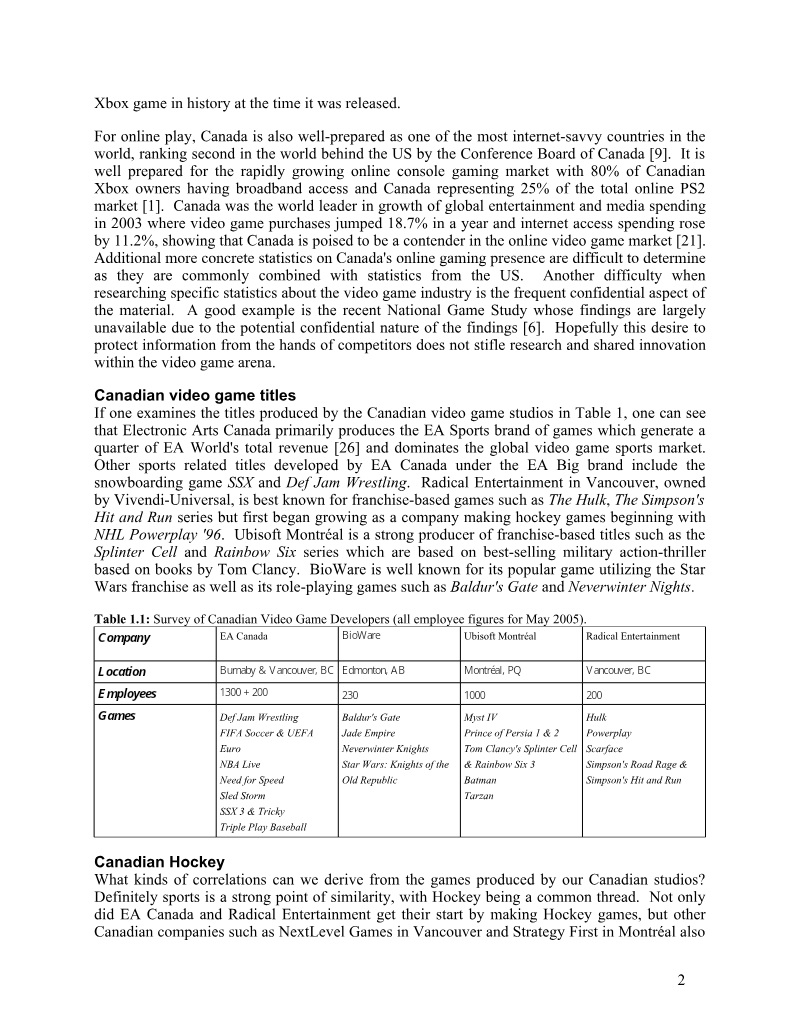

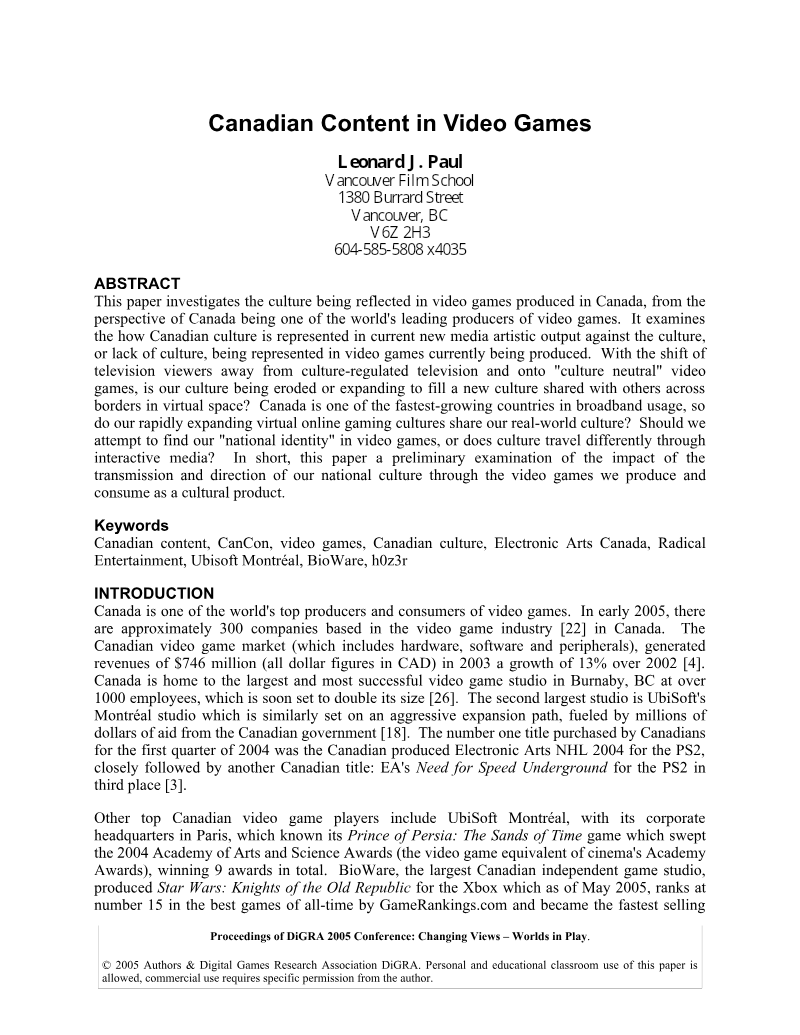
Canadian Content in Video Games
Leonard J. Paul's paper, "Canadian Content in Video Games," examines whether video games produced in Canada reflect a distinct national culture, despite Canada being one of the world's leading producers and consumers of the medium.
- The paper's central finding is that Canadian-made video games show little distinct cultural identity, with Canadian content surfacing mainly in isolated touches like hockey-themed details or Quebec French-language requirements.
- Studios often replace Canadian place names and spellings with American or generic equivalents to reach the largest market, indicating that publisher market calculations, not national cultural policy, drive how Canadian content appears.
- The author concludes that the sector's economic growth has not yet been matched by culturally distinctive output, though academic game programs and new funding may eventually change this.
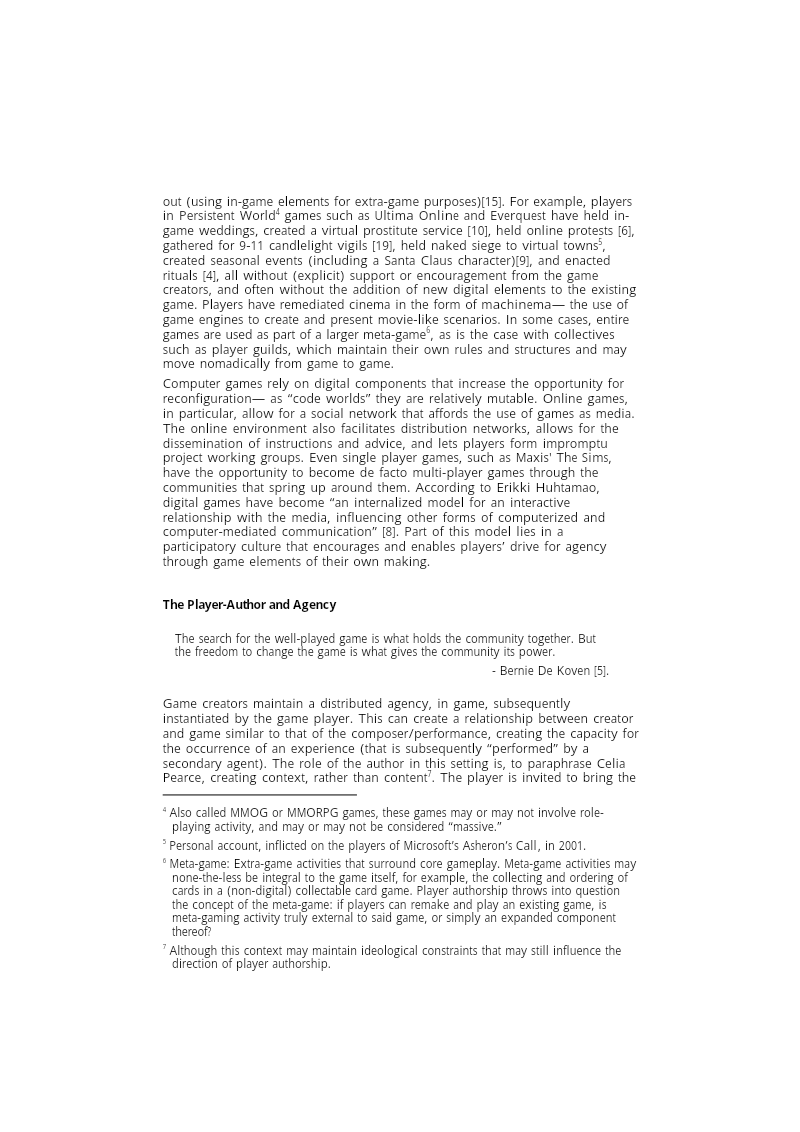

Tiny Patches of Peace: Signs of Agency in Digital Games
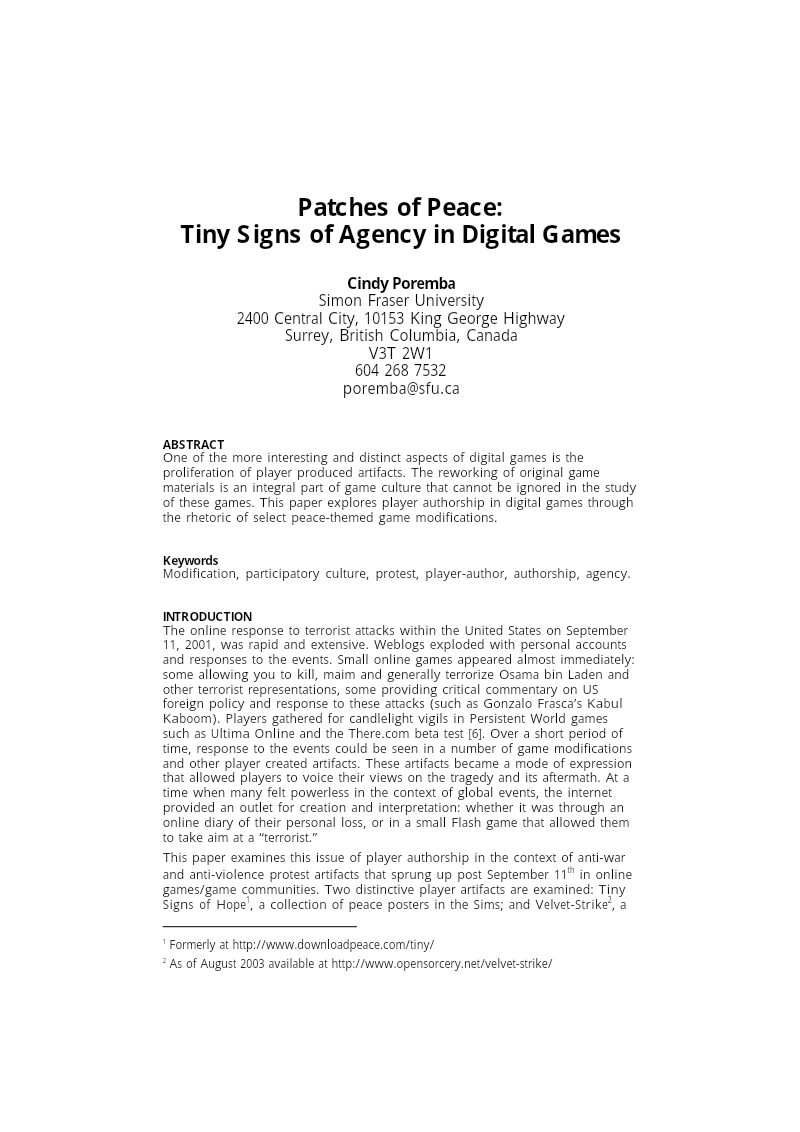
Cindy Poremba's study examines how player-created modifications function as a form of authorship in digital games, with particular attention to peace-themed works produced after September 11, 2001.
- Player-created modifications are framed as an independent form of authorship that both expresses and reinforces the player's legitimacy as an author, with the study focusing on peace-themed mods made after September 11, 2001.
- Cindy Poremba's analysis centers on two cases: the anti-war Counter-Strike modification "Velvet-Strike" and the anti-war posters "Tiny Signs of Hope" created for The Sims.
- Velvet-Strike adopts a "gamer" persona to gain credibility within the combative first-person shooter community while aiming its message at an outside audience of artists and activists.

A Multidimensional Typology of Games
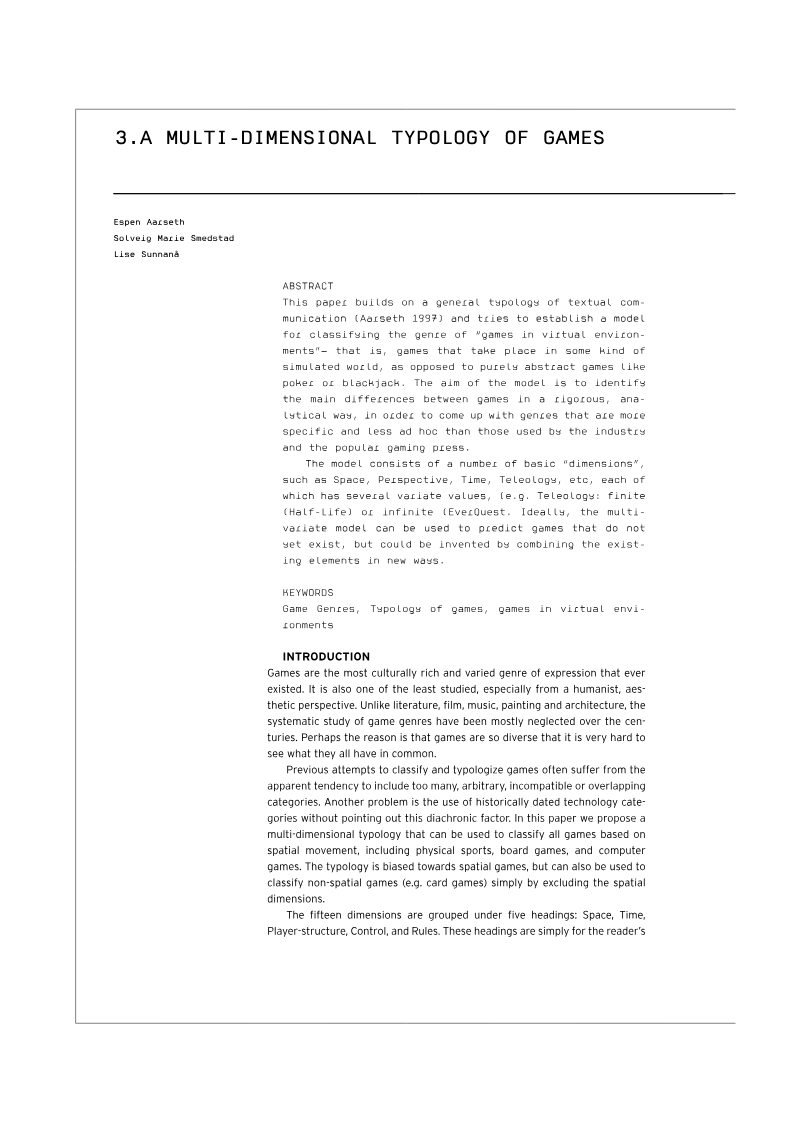
Aarseth, Smedstad, and Sunnanå propose a multidimensional typology for classifying games set in simulated virtual environments, aiming to replace the ad hoc genre labels used by the gaming industry and popular press with a more rigorous analytical framework.
- Aarseth, Smedstad, and Sunnanå propose a multidimensional typology of virtual-environment games to replace ad hoc industry and press genre labels with a more rigorous analytical framework.
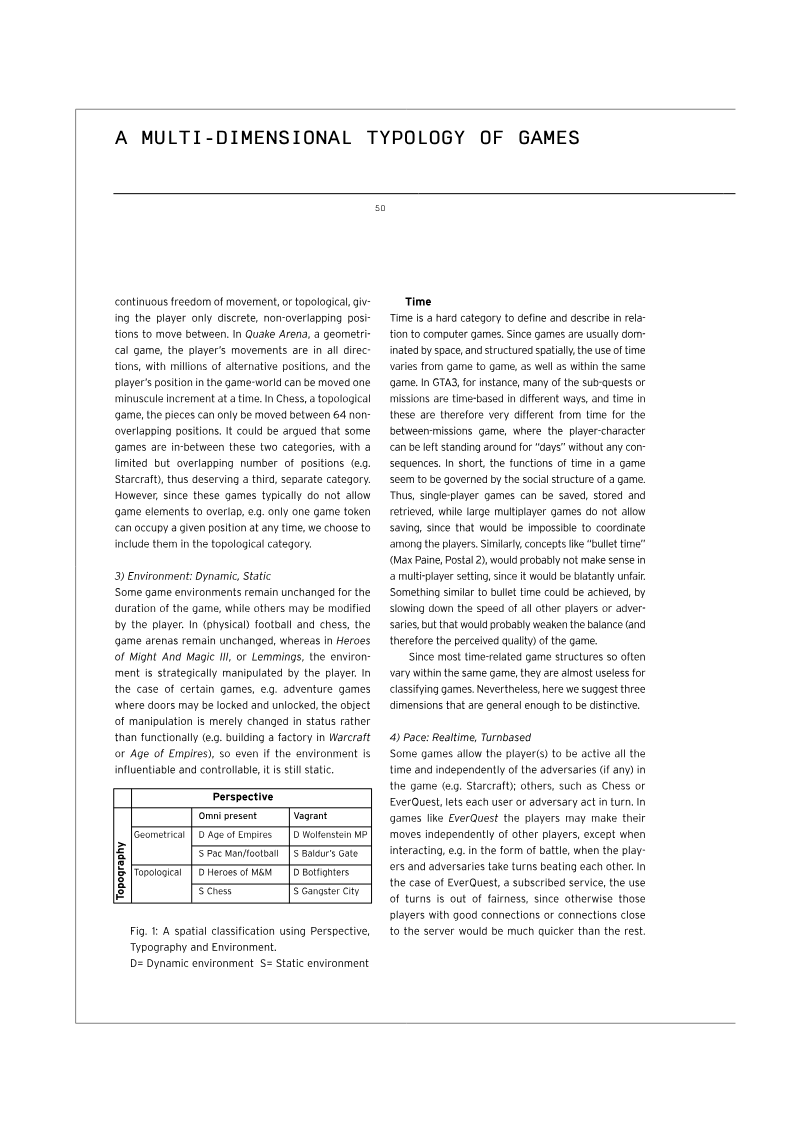
- The typology comprises fifteen dimensions grouped under Space, Time, Player-structure, Control, and Rules, including perspective (omni-present vs. vagrant), pace (realtime vs. turnbased), and teleology (finite vs. infinite).
- The dimensions were derived by comparing pairs of similar games, such as Morrowind and Diablo, and extracting principles intended to apply broadly across games.

From Text to Talk: Multiplayer Games and Voiceover IP
This study examines how voice-over IP, as used in systems like Roger Wilco and Xbox Live, reshapes the social experience of multiplayer gaming compared with text chat.
- Voice communication in multiplayer games shapes social dynamics differently than text chat, and the medium itself alters language functions, identity management, presence, and social protocols.
- In a Soldiers of Fortune clan, voice communication produced better coordination, higher scores, and a stronger sense of security than text, which players disliked and used sparingly.
- Strangers on Xbox Live relied on formulaic greetings and "scoping" to protect their identities, while co-located friends playing Halo produced high-energy, simultaneous talk oriented toward joshing, crowing, and strategy.

Gamescapes: Exploration and Virtual Presence in Game-Worlds
Geoff King and Tanya Krzywinska's "Gamescapes" examines how video game worlds shape players' experience of exploration and virtual presence.
- Restriction is treated as a deliberate design tool rather than mere limitation, with designers balancing 'hard' and 'soft' boundaries to govern pleasure, fear, and narrative and to manage the tension between constraint and freedom.
- Perspective is a major determinant of presence: isometric and god-view strategy games offer the most distanced experience, third-person games a mediated sense of being in the world, and first-person games the strongest illusion of presence.
- Games can generate powerful psychological immersion through gameplay alone, independent of sensory realism, though early haptics such as the dual-shock controller's crude vibration remained far from true virtual reality fidelity.

Delightful Identification & Persuasion: Towards an Analytical and Applied Rhetoric of Digital Games
This document develops a theoretical rhetoric of digital games, arguing that gameplay constitutes a symbolic performance among designer, game, and player in which players are persuaded and come to identify with a game's design.
- Gameplay is framed as a symbolic performance among designer, game, and player, in which players are persuaded and come to identify with a game's design, drawing on Aristotle's rhetorical triad and Burke's concept of identification.
- Persuasion in games becomes visible through behavioral change: the shift from not playing to playing, and from playing to continuing.
- The model rests on three couplings between designer and player: systemic (an experiential "eigenworld" of reciprocal control, mastery, and empowerment), symbolic (performance loops grounded in identification), and structural (aligning the game's motivational offers and demands with player expectations).

The Other Game Researcher: Participating in and Watching the Construction of Boundaries in Game Studies
Marinka Copier's paper argues that the emergence of game studies as an autonomous academic discipline depends on the active construction of boundaries, and that researchers themselves are participants in this boundary-work rather than detached observers.
- Marinka Copier argues that game studies' emergence as an autonomous discipline depends on active boundary-work, and that researchers are participants in drawing these boundaries rather than detached observers, drawing on Thomas Gieryn's boundary-work and Donna Haraway's situated knowledge.
- The paper traces the field's formation through early-2000s debates, including the 2001 founding editorial of the journal Gamestudies, which separated ludology from narratology and argued games deserve study on their own terms.
- Copier treats boundaries between game studies, designers, gamers, and neighboring fields as resting on both content-based and institutional arguments, and treats divides like ludology versus narratology as political constructions rather than fixed categories.
All the World's a Botfighter Stage: Notes on Location-Based Multi-User Gaming
Olli Sotamaa's paper examines how location-based multi-user games such as Botfighters challenge classical definitions of play and game, while reshaping the meaning of mobile gaming and urban space.
- The paper argues that location-based multi-user games like Botfighters challenge the classical view of play as autonomous and separated from real life, because games using city streets as a board intrude on everyday reality.
- Location-based games are classified into three technological groups: GPS-based treasure hunts lacking real-time multi-user features, local network and proximity-sensor experiments mostly from research projects, and GSM cell-identification games that need only standard phones and are likely to reach large audiences.
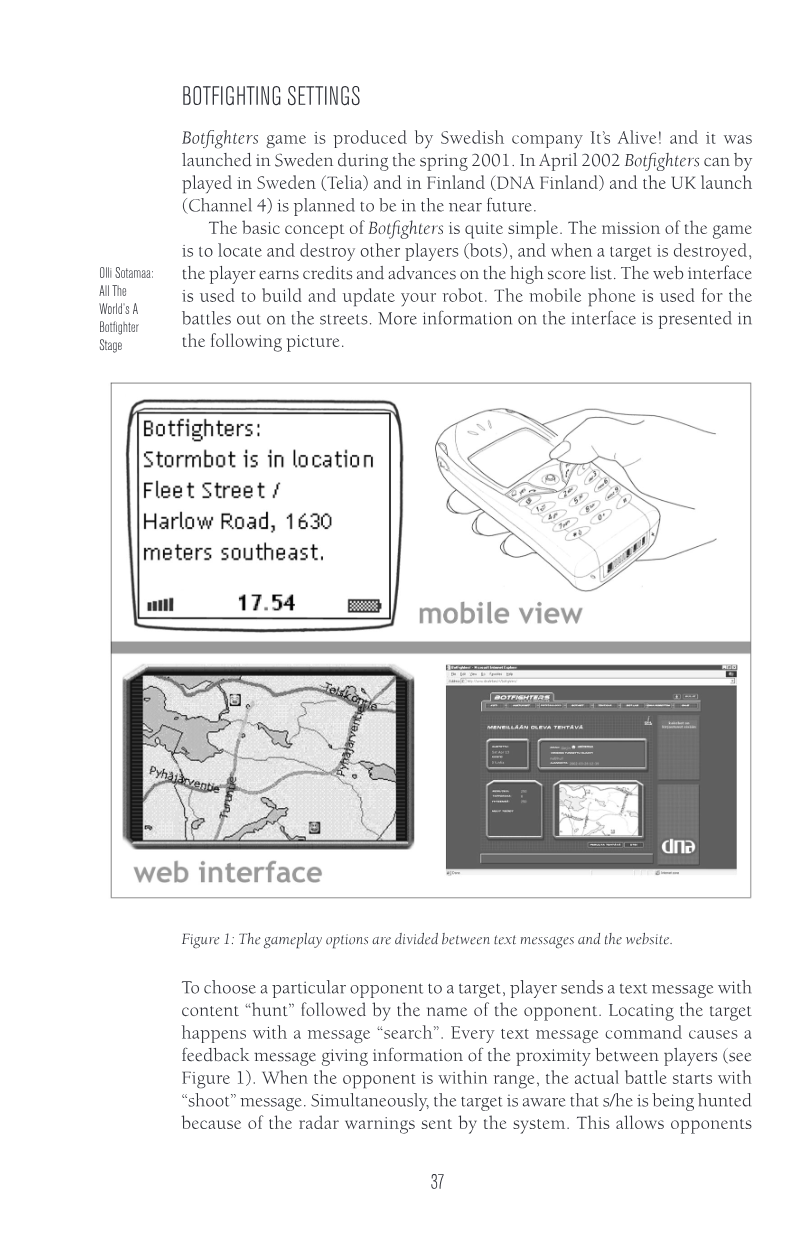
- Botfighters, launched in Sweden in 2001 and offered in Sweden and Finland by April 2002, let players hunt and shoot each other via SMS commands, with a web interface for building robots and tracking scores.
Computer Games / Cinema / Interfaces
King and Krzywinska's "Computer Games / Cinema / Interfaces" examines the formal and industrial relationship between video games and film, arguing that cinematic concepts provide useful analytical tools for some games but that the two media should be compared on their distinct qualities rather than reduced one to the other.
- The authors argue that cinematic concepts are useful analytical tools for some games, but that games and film should be compared on their distinct qualities rather than one being reduced to the other.
- Cinema has shaped games far more than the reverse, since games rarely lend themselves to cinematic adaptation and their narrative and character development remain less developed than film's.
- Games demand more active engagement than film viewing, and the authors propose Aarseth's term "ergotic" as a more precise alternative to "interactive."
The Study of Computer Games as a Second-Order Cybernetic System
Kücklich's paper argues that the dominant literary and narratological approaches to computer games rest on a problematic two-level model of code and interface, inherited from Aristotelian and structuralist traditions.
- The paper argues that narratology should not be the governing discipline for game studies; games should instead be situated within ludic, representational, and media traditions.
- It proposes a constructivist, second-order cybernetic framework in which game and player form an interdependent whole, shifting focus from the underlying code to the player's experience of play.
- Interactivity and narrativity are treated as synergetic effects of semiosis rather than fixed properties of the software.