Game Culture reports and market data
Documents
Losing and Finding Oneself: Duo- and Autoethnographic Study of "Character" in the Larp Superrealism
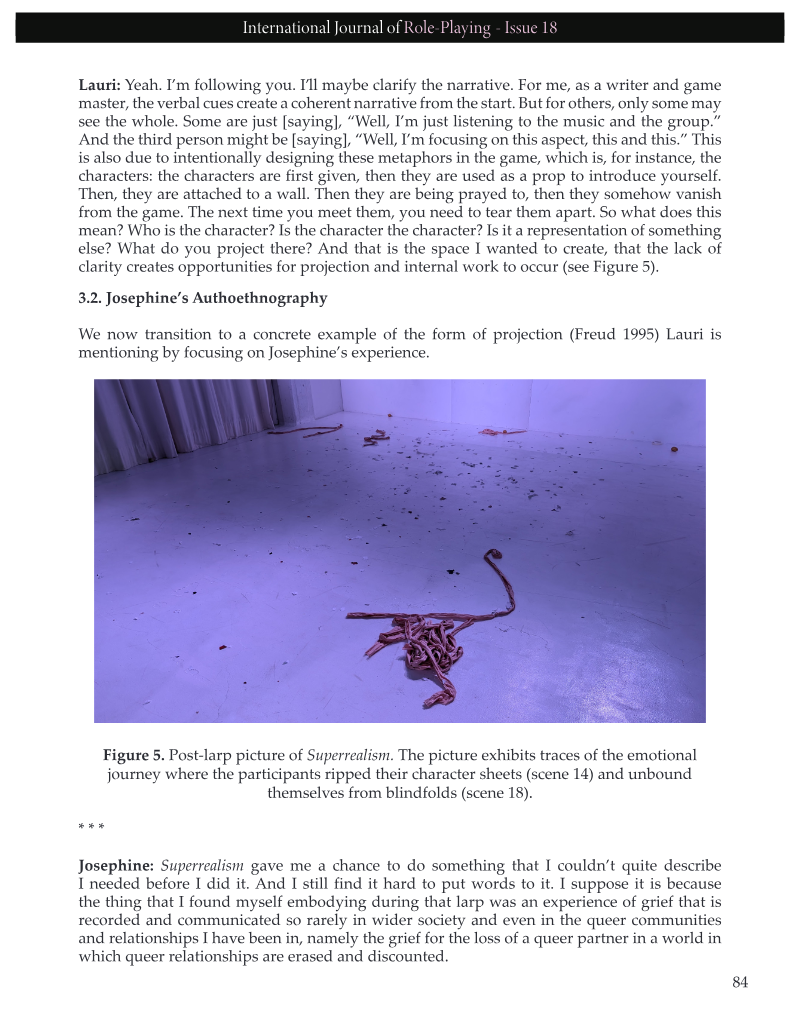
The larp Superrealism serves as a unique case study for understanding how abstract, non-verbal, and music-driven game design facilitates profound personal transformation.
- Minimalist character frameworks and vague narrative prompts act as primary catalysts for deep emotional processing and self-discovery in larp.
- The absence of explicit narrative structure shifts the value of the game from designer intent to the player’s ability to project internal histories and repressed emotions onto the experience.
- The phenomenon of 'bleed'—where personal emotions permeate the character—is a central mechanism for transformative play in non-verbal, music-driven environments.
Hack, Slash, Heal, Repeat: Theorizing the Concept of the Murderhobo in Dungeons & Dragons
This analysis examines the concept of the "murderhobo" within tabletop role-playing games, specifically focusing on Dungeons & Dragons.
- The 'murderhobo' playstyle is defined by a lack of permanent character roots, a focus on combat-driven loot acquisition, and the treatment of NPCs as expendable obstacles.
- This behavior is driven by the intersection of player habitus, the gaming field, and the accumulation of symbolic capital through mastery of game rules.
- Foundational components of this style include prioritizing adventure over narrative, accepting character death as an inevitable outcome, and emphasizing combat as the primary game function.
Another Kind of Future/Past: Decolonial and Asiafuturist Imagination in the Philippines
Contemporary Filipino tabletop role-playing games serve as a vital medium for decolonial storytelling, functioning as speculative projects that challenge Western-centric narratives.
- Contemporary Filipino tabletop RPGs, including titles like The Islands of Sina Una, Gubat Banwa, Karanduun, BALIKBAYAAN, and ON THE BONES OF BATALA, function as a medium for decolonial storytelling and cultural reconstruction.
- These games utilize speculative fiction and fantasy to subvert colonial tropes, actively reimagining pre-colonial indigenous mythology and folklore to dismantle lingering colonial structures.
- The movement draws direct intellectual lineage from 19th-century anti-colonial writers such as Pedro Paterno and Isabelo de los Reyes, bridging historical scholarship with modern interactive media.
Utilizing Psychophysiological Measures in Role-playing Studies
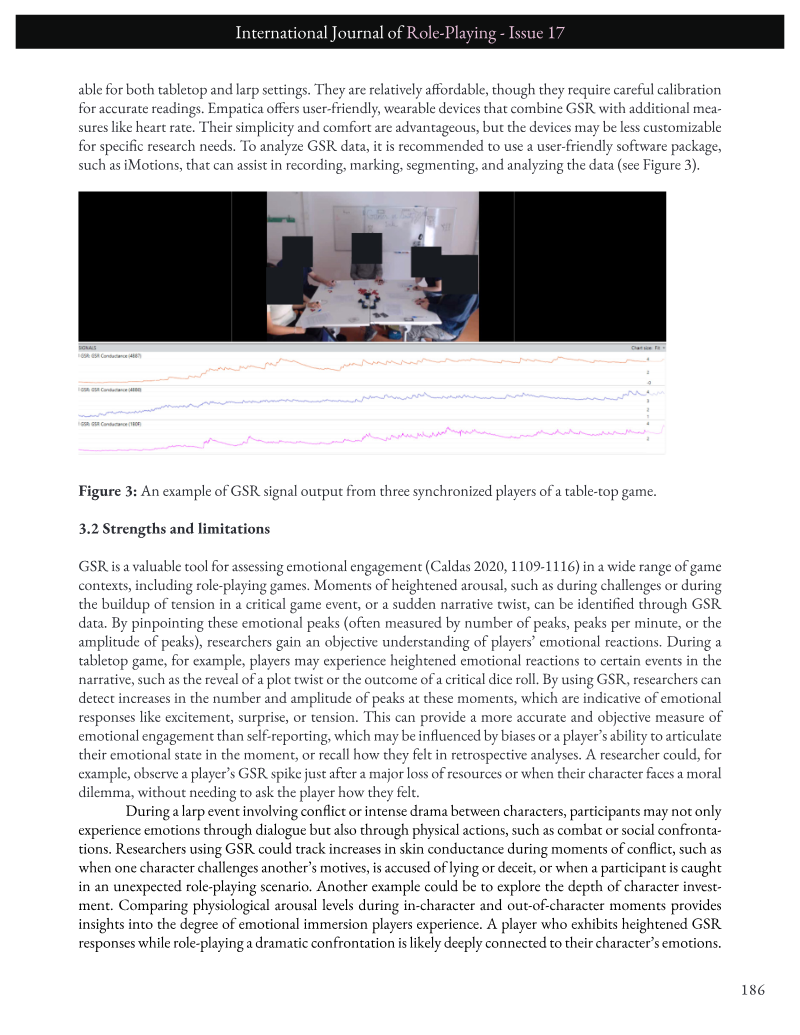
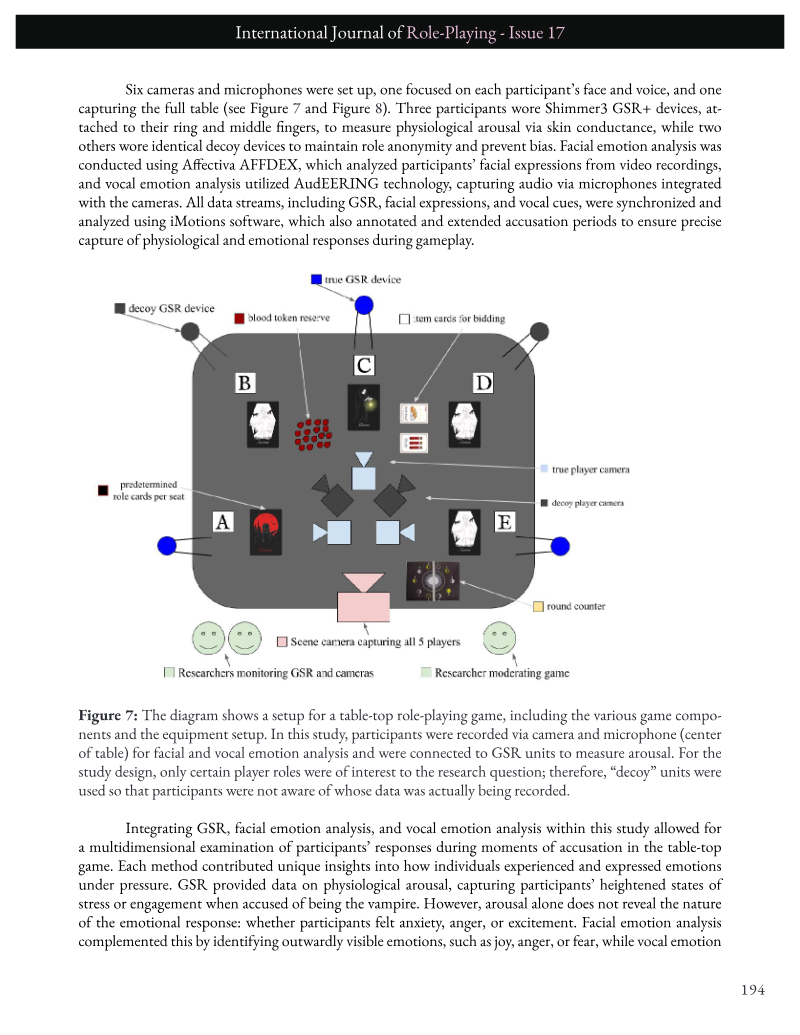
The integration of psychophysiological measures into role-playing game research provides a robust framework for capturing objective, real-time data on player engagement, cognitive processing, and emotional arousal.
- Psychophysiological tools like eye-tracking, galvanic skin response, heart rate monitoring, and emotion analysis provide objective, real-time data on player engagement that surpasses the limitations of self-reporting.
- Integrating physiological metrics allows designers to precisely quantify immersion, cognitive processing, and emotional arousal during complex narrative and social interactions.
- A mixed-methods approach is essential to mitigate challenges such as individual variability, environmental noise, and the difficulty of isolating specific emotional states.
From Tradition to Interaction: A Systematic Literature Review of Cultural Heritage Representation in Entertainment Videogames
This systematic literature review examines how cultural heritage is represented in entertainment videogames, analysing 80 publications from 2005 to 2022 identified through a PRISMA-guided Scopus search and ASReview-assisted screening.
- The review analyses 80 publications from 2005 to 2022, identified via a PRISMA-guided Scopus search and ASReview-assisted screening, and applies a tangible/intangible heritage framework adapted from Balela and Mundy.
- Scholarship is heavily skewed toward European heritage (notably Nordic mythology and architecture) and modern American culture as depicted in Grand Theft Auto, while Asian heritage is markedly understudied.
- Research concentrates on Triple-A role-playing and real-time strategy titles on PC and consoles, leaving mobile and indie games largely unexamined.
Reified Gameplay: Revisiting Playbour Through Critical Theory
Manninen's article argues that the concept of "playbour," which blurs the boundary between play and labour in digital games, can be sharpened through critical theory.
- Manninen proposes 'reified gameplay' as a more rigorous alternative to the ambiguous term 'playbour,' built on Marx's alienation, Lukács's reification, and Adorno and Horkheimer's critique of the culture industry.
- The article argues that the liberal-romantic view of play as separate from work is outdated under neoliberal conditions, where play is increasingly absorbed into economic purpose.
- Reified gameplay is defined as play that becomes instrumentalised, repetitive, and economically purposeful, with play resembling labour through shifting goals, structurally limited player agency, and repetitive technical engagement.
The Infusion of Virtuality and Reality: Video Games in Exhibition Space and the Flow of Power
This research examines video games in exhibition spaces as ecosystems of human and non-human actors, focusing on how agency and power circulate among institutions, artists, audiences, and machines.
- Video games in exhibition spaces redistribute agency among institutions, artists, audiences, and machines, destabilizing traditional curatorial hierarchies and making exhibition power dynamics more complex and less stable.
- Games tend to attract more diverse visitor types and give audiences greater agency within the exhibition experience.
- Technological labour and machine maintenance function as non-human participants in game-based exhibitions, and are often overlooked because they are treated as mere tools.
The Terrible Victims: "Female Ghosts" as a Cultural Symbol in Chinese Indie Video Games
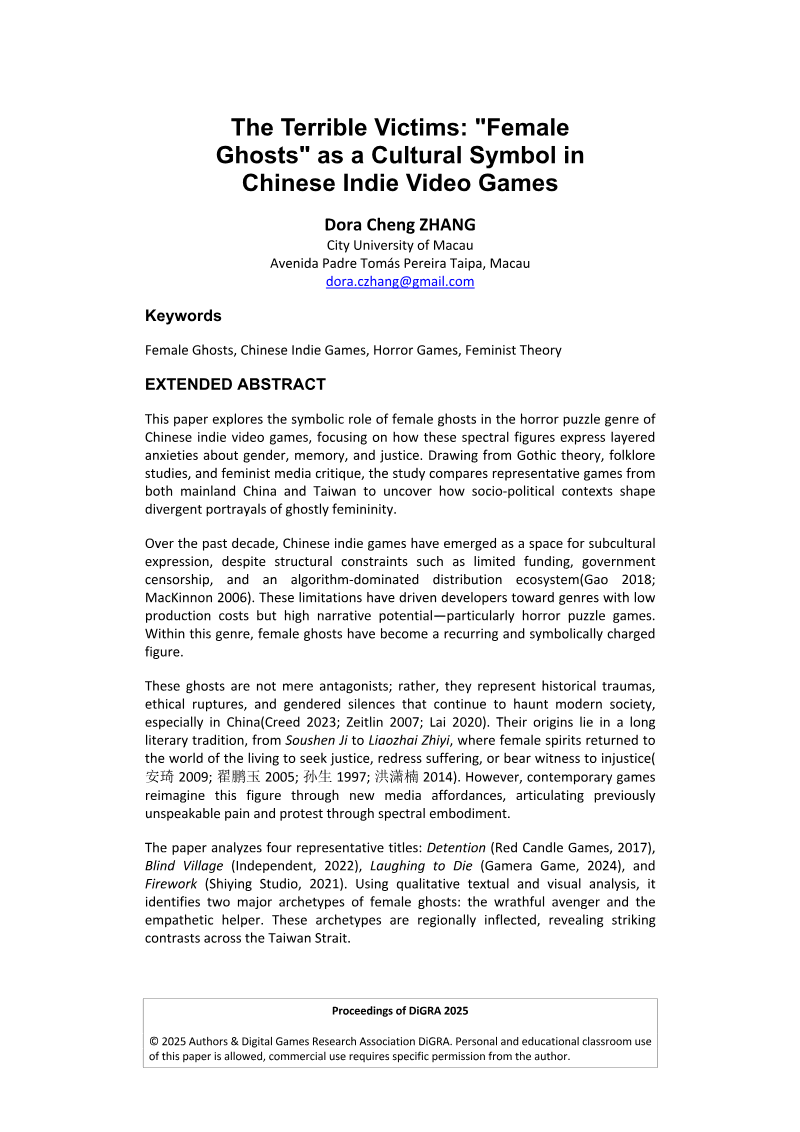
This paper examines the symbolic function of female ghosts in the horror puzzle genre of Chinese indie video games, arguing that these spectral figures give expression to anxieties about gender, memory, and justice that are difficult to voice openly.
- The paper argues female ghosts in Chinese indie horror puzzle games act as "terrible victims" who reclaim narrative space and ethical agency, expressing anxieties about gender, memory, and justice that are hard to voice openly.
- Analysis of four titles (Detention 2017, Blind Village 2022, Laughing to Die 2024, Firework 2021) identifies two archetypes, the wrathful avenger and the empathetic helper, each shaped by regional context.
- In Detention, the ghost serves as an ethical witness to Taiwan's White Terror, prompting civic reflection on guilt and remembrance, whereas Blind Village presents a vengeful folk-derived spirit reflecting anger over gender injustice and institutional failure in mainland settings.

Backyard Survival: Ecology of Killer Insects and Violent Nature in Grounded (2022)
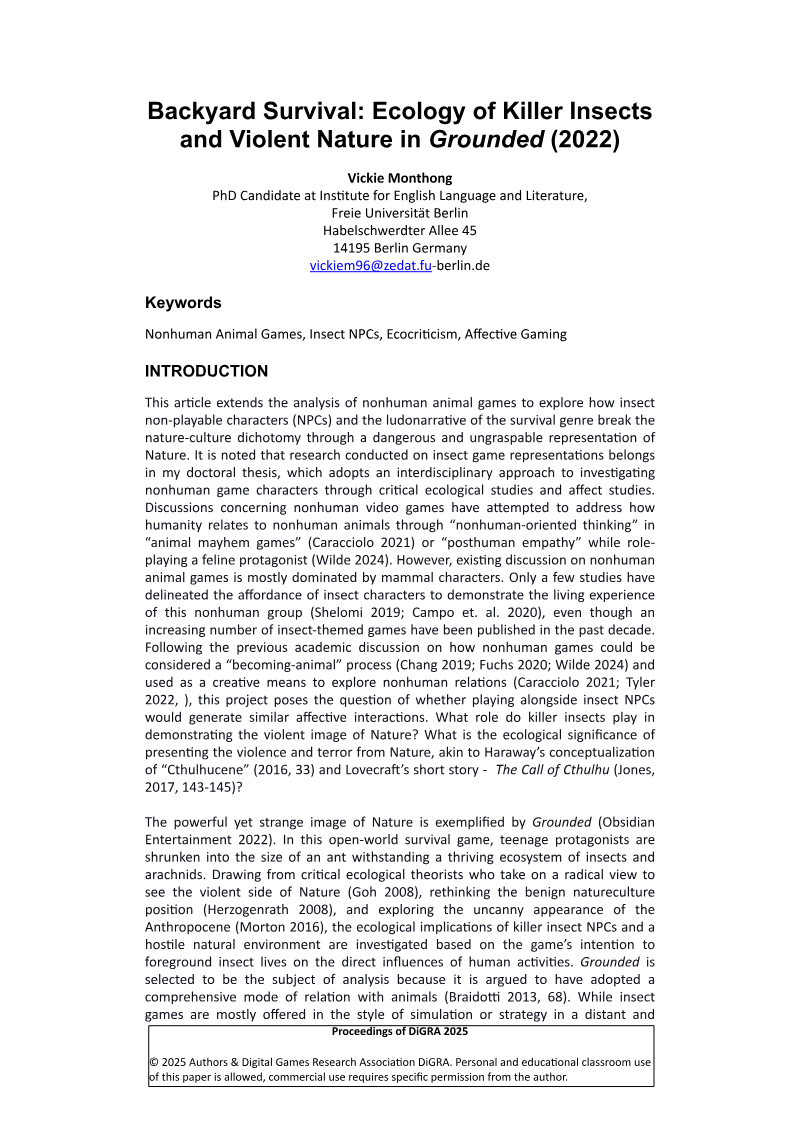
This article, a conference paper from the DiGRA 2025 proceedings, examines how insect non-playable characters and the survival genre in the open-world game Grounded (Obsidian Entertainment, 2022) challenge the division between nature and culture.
- The paper argues that Grounded (Obsidian Entertainment, 2022) portrays nature as violent, unfamiliar, and dangerous, which can prompt players to reconsider the benign view of nature found in traditional ecological thinking.
- Three ludonarrative features drive this representation: the monstrous scale and behavior of insect NPCs, the intimate proximity of natural and human worlds in the backyard setting, and disasters caused when players act as god-like manipulators of the environment.
- The author contends these features can cultivate respect for nature through fear of a more powerful existence, interpreted through Haraway's Cthulhucene, Morton's dark ecology, and Braidotti's posthumanism.



Test Trophy Please Ignore: Achievements as Paratexts in Palimpsestic Readings of Remasters and Remakes
This paper argues that achievements, or trophies, function as paratexts in Genette's sense, offering authorial commentary that reveals the palimpsestic relationship between original video games and their remakes and remasters.
- The paper argues that achievements/trophies act as paratexts in Genette's sense, offering authorial commentary that exposes the palimpsestic relationship between original games and their remakes and remasters.
- Trophy lists persist, change, or are newly created across versions, and these traces of revision can be read as interpretive, navigational, and commercial thresholds, a dimension the authors say previous scholarship on remakes as paratexts has largely omitted.
- A 2007 industry study cited in the paper correlated higher achievement volume with higher Metacritic scores and sales, and achievements became mandatory on Microsoft and Sony platforms after the Xbox 360's 2005 launch.
Rhetorics of Puppy Love and Death in The Pale Beyond (2023)
This paper offers a close reading of the 2023 survival game The Pale Beyond, examining how it portrays non-human animals, specifically the sled dogs under the care of crew member Ingrid Cordell.
- The paper's central claim is that The Pale Beyond (2023) builds a warm human-animal bond with its sled dogs and then removes the player's ability to intervene, forcing their deaths, which many players experience as manipulative rather than meaningful.
- The author argues that respectful animal representation in games rests on three traits (individuality, agency, and ephemerality), and The Pale Beyond creates conflict among them by giving the dogs emotional weight and narrative value while denying them any power over their own fate.
- The game is framed as a tension between promised player choice and later revoked agency, and the author interprets player frustration as stemming both from the portrayal of animal death and from this perceived hypocrisy.



Cozy History? Frameworks, Contrasts, and Affect in Cozy Historical Video Games
Alexander Vandewalle's paper argues that cozy historical video games, including titles with mythological content, constitute a distinct mode of "doing" history that departs from the dominant conventions of historical gaming.
- Alexander Vandewalle argues that cozy historical video games constitute a distinct way of 'doing' history, departing from the conventions of violence, conquest, technological progression, and cinematic realism typical of historical gaming.
- The paper introduces the concept of 'cozy history': an affective form of engagement in which players invest emotionally in a self-constructed presence within a loosely defined past, rather than in an authentic reconstruction of a specific region or era.
- Cozy historical titles such as Tiny Glade, REKA, Valheim, Dawn of Defiance, and Manor Lords emphasize building, nature, collectivity, and non-photorealist aesthetics while largely removing combat and stressful mechanics.