Game Culture reports and market data
Documents
Undead Ecologies: Reconceptualising Zombiism in Videogames
Lawrence May's paper, presented at DiGRA 2025, argues that zombies in contemporary videogames are shifting from embodied figures into distributed "undead ecologies" that reflect the ecological crisis and the material conditions of the Anthropocene.
- Lawrence May's DiGRA 2025 paper argues that zombies in contemporary videogames are shifting from embodied figures into distributed "undead ecologies" reflecting the ecological crisis and the Anthropocene.
- The paper links the necrotisation of Earth to late-stage capitalism and contends that videogames, reliant on extractive mineral sourcing, exploitative labour and fossil energy, are well placed to make players notice a damaged planet's entangled lives, deaths and temporalities.
- The analysis is a qualitative textual study with close readings of Timberborn (Mechanistry, 2021) and Elden Ring (FromSoftware, 2022), not an empirical survey, and reports no quantitative data or sample sizes.
Virtual Burden: Representations of Animal Disabilities in Video Games and Their Posthuman Contexts
This paper examines how animals with disabilities are represented in video games and how these representations participate in posthuman questions of agency, embodiment, and relationality.
- The paper treats animals with disabilities in video games as ambiguous figures, both computational constructs and narrative agents that shape players' subjectivity within hybrid systems of affect, automation, and human and non-human causality.
- It identifies recurring strategies for deploying disabled animals: cultivating sympathy through "cute animals with dysfunctions," depicting "transhuman camouflage" where implants or exoskeletons fully compensate for impairment, framing disabled animals as monstrous, and treating animals as military or war resources.
- The authors attribute these patterns to converging conditions: the predominantly agonistic structure of gameplay, the general underrepresentation of disability in games, instrumental attitudes toward animals, and broader cultural stereotypes.
At the Crossroads of Game Studies and Business Ethics: Sustainability Obligations
This paper examines the sustainability obligations of stakeholders in the video game industry, arguing that the industry has made comparatively little systematic progress on sustainability and corporate social responsibility since scholars first raised these concerns.
- The paper argues the video game industry has made comparatively little systematic progress on sustainability and corporate social responsibility since scholars first raised these concerns.
- The authors frame sustainability across three pillars: economic (market disruption among shareholder-driven triple-A publishers, acquisitions and closures of mid-sized developers, and independent developers struggling for visibility), social (crunch, unionization conflicts, indie self-exploitation, and gaps in diversity, equity, and inclusion), and environmental.
- Mobile models built on user data extraction, big-spender dependence, and free-to-play loot boxes and gacha mechanics that approach gambling are flagged as ethically and regulatorily contentious.
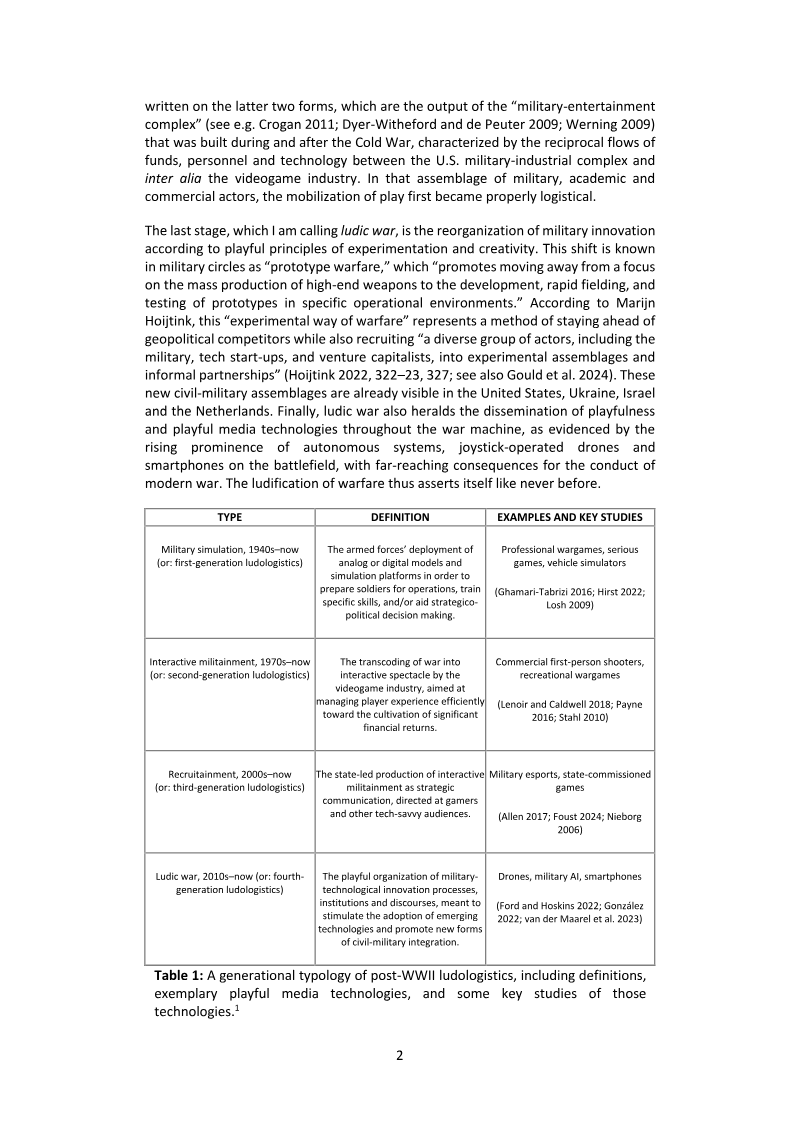
From Military Simulation to Ludic War: A Generational Typology of the Mobilization of Play
This paper, presented at DiGRA 2025, proposes a generational typology of how play and games have been mobilized for military purposes since the end of the Second World War.
- The paper's central thesis is that play has been absorbed into a logistical procedure it calls "ludologistics," which serves warfare and the militarization of society in NATO states and allies, eroding distinctions such as citizen/soldier and war/peace much as capitalism erodes work/play.
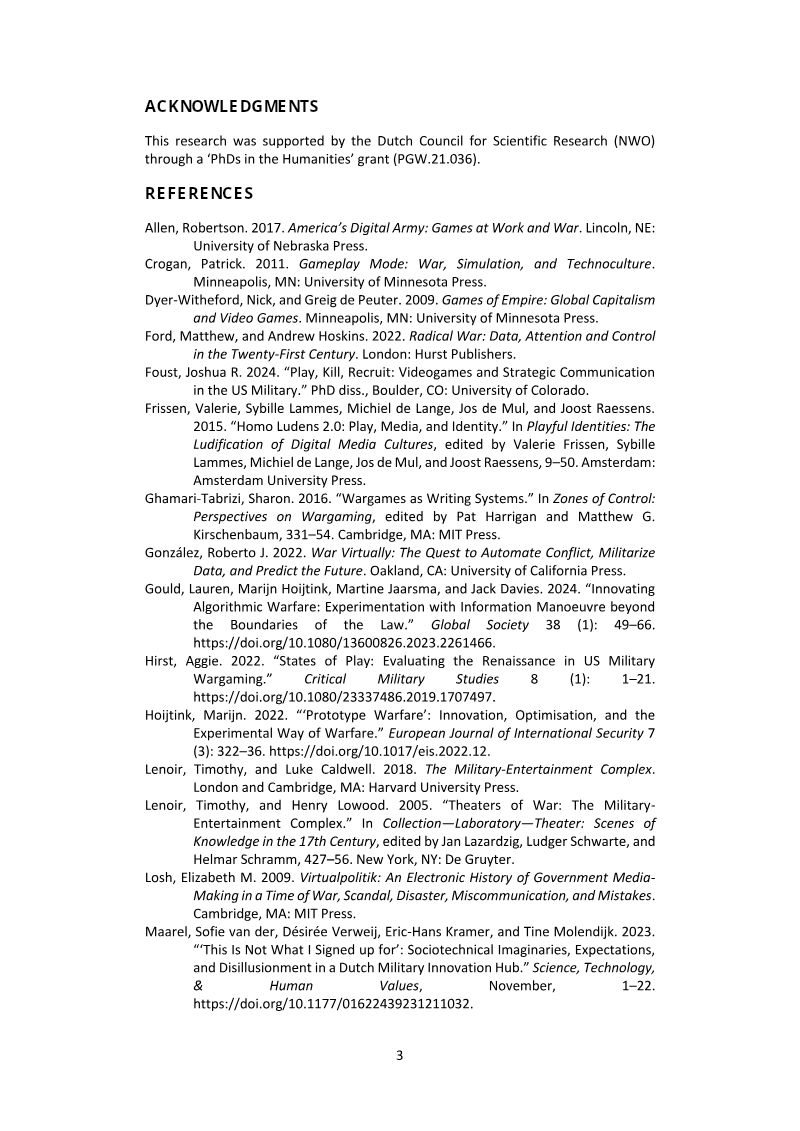
- A four-generation typology traces military play from first-generation military simulation (1940s: professional wargames, vehicle simulators, training platforms) through second-generation interactive militainment (1970s: commercial shooters and recreational wargames), third-generation recruitainment (2000s: state-commissioned games and military esports), to fourth-generation ludic war (2010s).
- Fourth-generation ludic war is characterized by "prototype warfare," which relies on rapid experimentation and civil-military partnerships with tech start-ups and venture capitalists, producing examples such as drones, military AI, and battlefield smartphones.

Towards a Southern Epistemology in Game Studies: Gaming Practices, Ideological Struggle, and Common Sense in Latin America
This paper argues for a Southern epistemology in Game Studies, grounded in Latin American cultural studies, as a corrective to the field's reliance on frameworks developed in the Global North.
- The paper argues for a Southern epistemology in Game Studies, grounded in Latin American cultural studies, to correct the field's reliance on Global North frameworks.
- It contends that video games made for Global North markets are not simply alienating for Latin American players, who reinterpret and resignify them by integrating local temporalities, historical memory, and popular traditions through cultural hybridity.
- Drawing on Martín-Barbero, the author reframes gaming as an active, negotiated practice of everyday consumption and appropriation rather than a passive ideological effect.
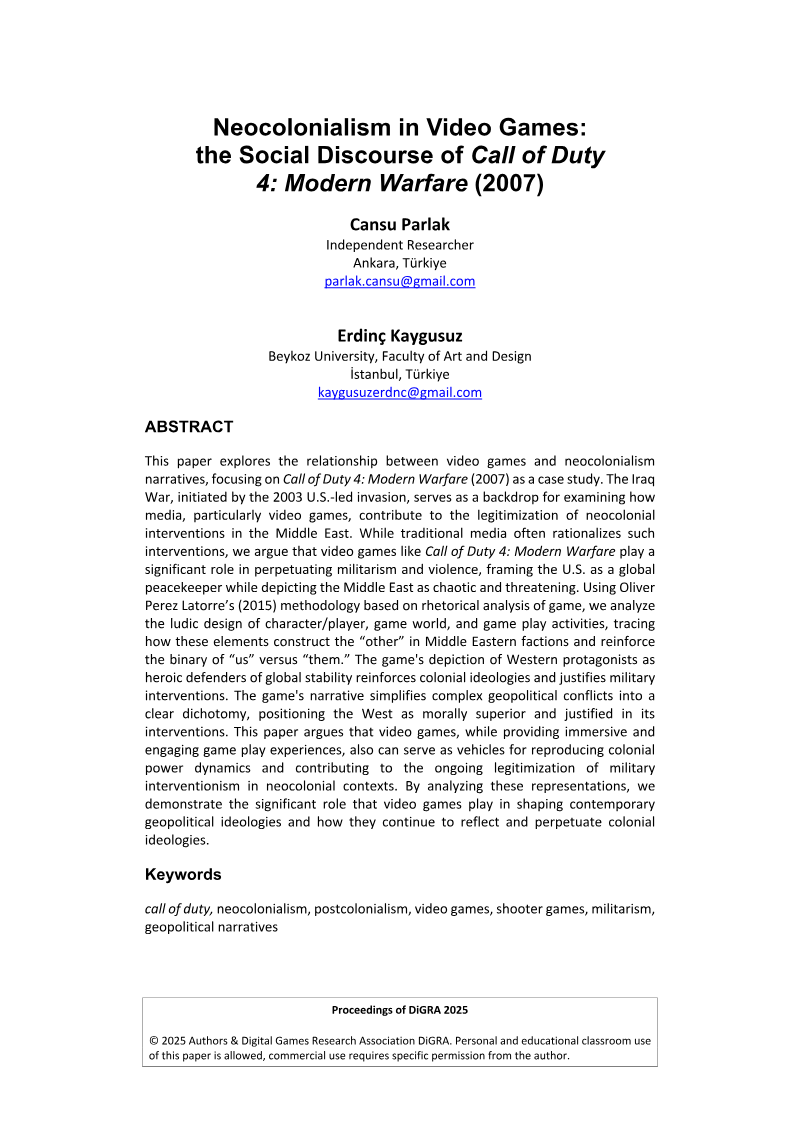
Neocolonialism in Video Games: The Social Discourse of Call of Duty 4: Modern Warfare (2007)
Call of Duty 4: Modern Warfare (2007) is examined here as a case study of neocolonial discourse in video games, with the central thesis that the game's Western-centric narrative reinforces militarism and legitimizes interventionist policy.
- The study argues that Call of Duty 4: Modern Warfare (2007) reinforces militarism and legitimizes interventionist policy through a Western-centric narrative, using postcolonial and neocolonial theory (including Edward Said's work) as its framework.
- The game is said to frame the United States as a global peacekeeper while portraying Middle Eastern and Russian factions as irrational, homogeneous "others," a binary structure the authors say recurs across contemporary military shooters.
- The analysis contextualizes the game's narrative against the 2003 Iraq War, arguing that its nuclear-attack storyline parallels the justifications offered for that war.
The Politics of Care: The Possibilities and Limits of Video Games for Political Campaign
This article examines two 2022 mobile games, Lugawan ni Leni and Let Leni Lead, released during the Philippine presidential campaign to support Leni Robredo's candidacy.
- The article introduces the category of "propagandistic advergames," arguing that political games sell a candidate the way commercial advergames sell products, drawing on Ian Bogost's concept of procedural rhetoric.
- Two 2022 mobile games supporting Leni Robredo's presidential campaign, Lugawan ni Leni and Let Leni Lead, express the "Robredo style" of politics, which combines public service performance with personal approachability.
- Lugawan ni Leni uses the lugaw (rice porridge), a humble campaign symbol, to frame serving others as inherently rewarding, while Let Leni Lead adapts the campaign's house-to-house volunteer strategy into an infinite-runner format.
Death at the Crossroads of Subjecthood in Happy Wheels
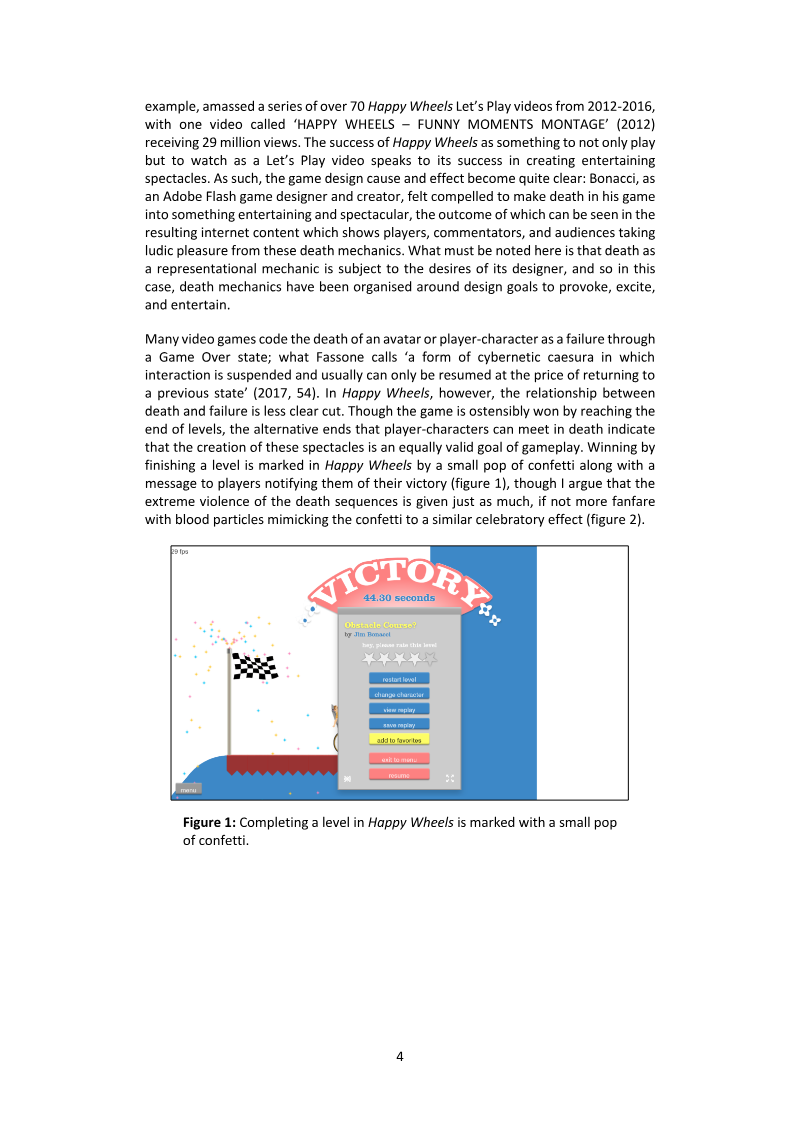
Happy Wheels (Fancy Force, 2010) is examined as a case study in how its death mechanics, built around ragdoll physics and cartoon gore, turn each character's demise into a deliberate visual spectacle.
- The analysis frames Happy Wheels (Fancy Force, 2010) death mechanics, built on ragdoll physics and cartoon gore, as deliberate visual spectacle, positioning digital corpses between subject and object.
- The paper reads the game's absence of a level-complete screen after death and its unlimited retries as design features that encourage repeated consumption of failure, which it calls "ludic pornography."
- Drawing on Agamben, Mbembe, and Butler, the work argues that bodies designed for destruction risk normalising the idea that some lives are expendable and unmournable.


Ludus Triumphorum: A Ludological Introduction to Tarot
Ludus Triumphorum argues that tarot originated as a ludic object rather than a divinatory one, emerging in central-northern Italy around 1410–1420 and serving primarily as a game for roughly four centuries before esoteric card-reading practices appeared during the Enlightenment.
- Tarot likely originated in central-northern Italy around 1410–1420 as a game rather than a divinatory tool, and served primarily as a pastime for roughly four centuries before esoteric card-reading emerged during the Enlightenment.
- The work frames the triumph sequence through game-studies theory (Roger Caillois, Brian Sutton-Smith), reading it as either regression or progression, with the central contrast being the anonymous Sermo perutilis de ludo's 'ladder to hell' reading versus Francesco Piscina's 1565 Discorso's view of the sequence as a constructive moral ascent.
- Sixteenth-century Italian sources show tarot as a contested social pastime, with preacher condemnations, Alberto Lollio's satirical 1550 Invettiva, and Vincenzo Imperiali's 1554 defense revealing divided opinion on its links to gambling, vice, and social identity.


D5.3 Prototype Report: Games, Heritage, Arts, & Sport
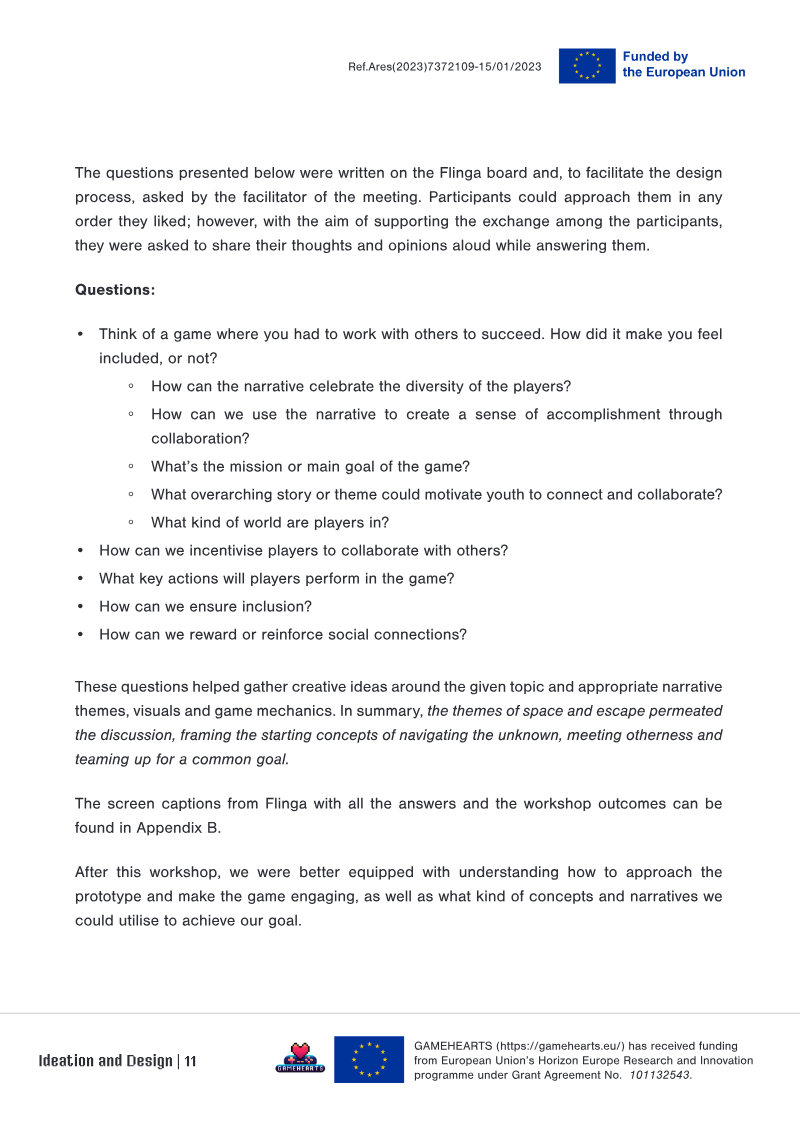
The GAMEHEARTS D5.3 Prototype Report presents an early-stage, player-centred video game prototype designed to support youth social inclusion.
- The GAMEHEARTS prototype is a player-centred game for youth social inclusion, grounded in the Positive Youth Development framework and its "5 C's" (competence, confidence, connection, character, caring).
- Its central thesis is that connection itself can serve as the core gameplay mechanic, requiring moderator-supervised collaboration among young people to advance the narrative.
- A needs assessment with a Helsinki youth work centre serving people aged 15 to 25 identified uneven gaming proficiency, limited basic technical skills, language barriers, and loneliness as key challenges.

D2.2 Workshop Report: Games, Heritage, Arts, & Sport
The GAMEHEARTS D2.2 Workshop Report sets out to strengthen the European video game industry ecosystem (EVGIE) within the broader creative and cultural industries.
- The European video game sector is valued at over €23 billion annually, and European player numbers grew from 222 million in 2019 to 246 million in 2023.
- Women make up only 22% of the European video game workforce (2020 figure), highlighting a persistent diversity gap across the industry.
- Stakeholders widely criticised grant systems as film-oriented, bureaucratic, and lacking game-specific expertise, and called for milestone-based payments, plain-language applications, and greater developer involvement.

A Thinly Veiled Formalist Temptation: A Critique
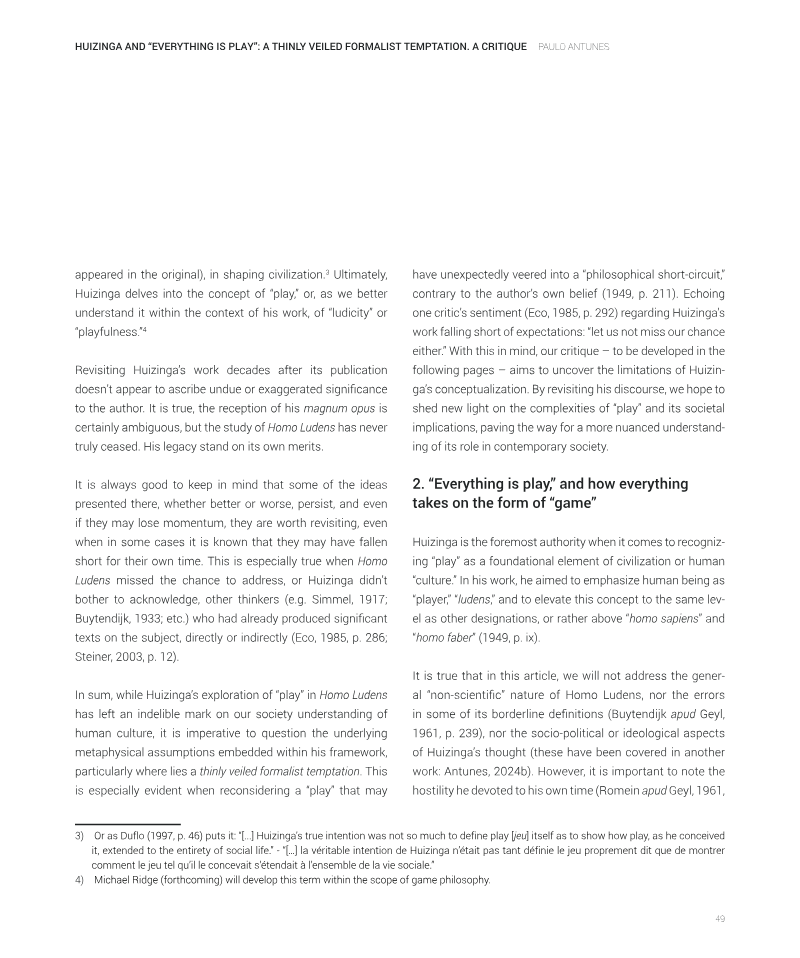
Antunes's critique examines Johan Huizinga's Homo Ludens (1938), which elevates "play" to a foundational element of culture.
- The critique argues that Johan Huizinga's Homo Ludens (1938) amounts to a "thinly veiled formalist temptation" by abstracting play into a metaphysical, universal essence and treating it as the foundation of civilization rather than analysing it historically.
- The author faults Huizinga for conflating "play" with formalized "game," importing rule-governed structure into all of cultural life.
- The critique identifies reliance on Platonic and theological interpretations, such as the notion that man is made God's plaything, as a weakness that displaces socio-cultural and historical analysis.