
Report32 pages
Gaming Spotlight: 2022 Review
Mobile gaming has emerged as the primary engine of the global games market, projected to reach $136 billion in 2022 and accounting for over 60% of the industry's total $222 billion valuation. This segment is expanding 3.3 times faster than the home console market, driven largely by the Asia-Pacific region and the sustained popularity of core titles such as Genshin Impact and Roblox. While macroeconomic instability and geopolitical conflict have caused localized spending declines in Eastern Europe, the broader global trend points toward a more inclusive player base. Female gamers and Gen Z cohorts are increasingly influential, serving as primary drivers of monetization and shifting the demographic focus of the industry.
The monetization landscape is undergoing a significant transformation toward hybrid models, with 42% of top-grossing U.S. games now combining in-app purchases with advertising. Although global audiences generally accept advertisements in exchange for free content, privacy concerns regarding individual tracking have intensified. In a post-IDFA environment, success depends on leveraging contextual third-party data rather than granular user tracking. Player sentiment varies significantly by format; rewarded video and playable ads enjoy the highest levels of acceptance, while standard video ads remain divisive, particularly among the high-growth female and Gen Z demographics.
Strategic intelligence for this evolving market relies on extensive global research infrastructure, utilizing data from over 1,100 analysts across 50 countries. By surveying more than 350,000 end users annually, market analysts provide the necessary framework for developers, publishers, and hardware manufacturers to navigate shifting consumer behaviors and technological transitions. This comprehensive oversight ensures that stakeholders can adapt to the rapid pace of innovation and the diversifying needs of the global gaming community.
- Mobile gaming is the dominant industry force, projected to reach $136 billion in 2022 and accounting for over 60% of the total $222 billion global market valuation.
- The mobile segment is expanding 3.3 times faster than the home console market, bolstered by the sustained popularity of core titles like Genshin Impact and Roblox.
- Hybrid monetization is becoming standard, with 42% of top-grossing U.S. games now combining in-app purchases with advertising.
- In a post-IDFA environment, developers must shift from granular user tracking to contextual third-party data to navigate intensified privacy concerns.
- Female gamers and Gen Z cohorts are the primary drivers of industry monetization and are increasingly shaping the demographic focus of the market.
+1
data.ai & IDCMay 2022
Presentation9 pages
Omówienie Wyników Q1 2022
PCF Group S.A., the parent company of the People Can Fly game development studio, reported significant year-over-year growth in its financial results for the first quarter of 2022. The primary objective of the data is to provide an overview of the Group’s fiscal performance, comparing Q1 2022 against Q1 2021 and the full year of 2021. The findings indicate a robust expansion in scale, with total revenues reaching 50.4 million PLN, a 63.1% increase over the same period in the previous year.
Profitability metrics also showed substantial gains. EBITDA rose by 77.2% to 16.5 million PLN, while adjusted EBITDA, which accounts for MSSF2 warrant valuations, grew by 61.5% to 16.8 million PLN. Net profit for the quarter reached 13.9 million PLN, representing a 78.8% increase year-over-year. This growth was largely driven by development revenues, which climbed to 47.4 million PLN, while royalty income remained a minor contributor at 0.5 million PLN.
The Group’s operational capacity expanded alongside its financials, with total employment increasing from 495 at the end of 2021 to 550 by March 31, 2022. On the balance sheet, the value of development work in progress saw a significant 49% increase, reaching 38.6 million PLN. While cash reserves saw a marginal 1% decline to 135.8 million PLN, total equity grew by 6.3% to 276 million PLN. These figures reflect a period of intensive production activity and organizational scaling within the global gaming industry.
- PCF Group S.A. reported Q1 2022 total revenues of 50.4 million PLN, representing a 63.1% year-over-year increase.
- Net profit for the first quarter of 2022 reached 13.9 million PLN, a 78.8% increase compared to the same period in 2021.
- EBITDA grew by 77.2% to 16.5 million PLN, while adjusted EBITDA rose 61.5% to 16.8 million PLN.
- Development revenues were the primary financial driver at 47.4 million PLN, while royalty income contributed only 0.5 million PLN.
- The value of development work in progress increased by 49% to 38.6 million PLN, reflecting intensive production activity.
PCF GroupMay 2022
Report48 pages
Mobile Gaming Market Outlook 2022
The global mobile gaming landscape has entered a period of stabilization following pandemic-era surges, with quarterly downloads maintaining a steady baseline of 14 billion. Although total revenue experienced a 6% year-over-year decline to $21.2 billion in early 2022, the market remains significantly larger than its pre-pandemic state. Casual games continue to lead in volume, representing 80% of all downloads, yet Mid-Core titles remain the primary economic engine, generating 60% of total player spending. While the United States maintains its position as the leading consumer market, the Asia-Pacific region exerts increasing influence, evidenced by Taiwan’s rise to the fifth-largest global market and the region's dominance in high-monetization genres like MMORPGs and Card Battlers.
Strategic advertising and intellectual property integration have become essential for navigating this competitive environment. Strategy and RPG titles are increasingly prioritizing YouTube for share of voice, while the acquisition of MoPub by AppLovin has shifted the advertising landscape for strategy games. Success in the rapidly growing Card Battler sub-genre, which earns 62% of its revenue from the APAC region, is largely driven by high-performing titles like Yu-Gi-Oh! Master Duel and the effective use of Live Ops and Season Passes. Furthermore, cross-media synergies, such as the impact of the Netflix series Arcane on game downloads, demonstrate the power of multimedia IP in driving user acquisition.
The market outlook suggests a temporary correction phase with a projected return to growth by 2023. While Asian markets currently account for 80% of MMORPG revenue, Western interest is growing, as seen with the successful U.S. launch of Diablo Immortal. Similarly, the Real-Time Strategy sector is seeing a geographic shift, with China overtaking the U.S. as the top market for the sub-genre. Future expansion across these segments will likely depend on localized IP collaborations and sophisticated user acquisition strategies tailored to specific regional preferences.
- The mobile gaming market is in a stabilization phase, with quarterly downloads holding at 14 billion despite a 6% year-over-year revenue decline to $21.2 billion in early 2022.
- Casual games dominate volume at 80% of all downloads, while Mid-Core titles remain the primary revenue driver, accounting for 60% of total player spending.
- The Asia-Pacific region is a critical economic force, generating 80% of global MMORPG revenue and 62% of Card Battler revenue.
- Success in high-monetization genres like Card Battlers is increasingly driven by Live Ops, Season Passes, and high-performing titles such as Yu-Gi-Oh! Master Duel.
- Cross-media IP integration, exemplified by the impact of the Netflix series Arcane on user acquisition, has become a vital strategy for driving game downloads.
+2
Sensor TowerMay 2022

Report75 pages
Store Intelligence Data Digest: Q1 2022
Global app downloads reached 36.9 billion in the first quarter of 2022, representing a 1.4% year-over-year increase. This period marked a significant milestone for TikTok, which surpassed 3.5 billion all-time downloads to become the top global app, while Meta reclaimed its position as the leading publisher for the first time in two years. Although Google Play growth began to flatten as pandemic-era surges subsided, the mobile gaming sector showed signs of recovery with total downloads reaching 14.34 billion across both major storefronts. India remained the largest market for total downloads, while Vietnam and Pakistan emerged as high-growth regions with year-over-year increases exceeding 20%.
Market dynamics were heavily influenced by viral trends and macroeconomic shifts. The "Wordle" phenomenon revitalized the word game sub-genre, driving a 74% quarter-over-quarter increase in U.S. downloads and prompting major publishers like AppLovin and Rovio to acquire similar titles. Simultaneously, high inflation and rising fuel costs triggered a 1,500% spike in demand for gas-tracking apps like GasBuddy in the United States. In the entertainment sector, the U.S. video streaming market continued to fragment; the market share of the top three apps plummeted from 80% in 2019 to just 37% as newer platforms like HBO Max and Disney+ gained traction through major content releases and live sports.
The competitive landscape remains dominated by established giants, yet regional variations persist. While Meta and Google maintained a stronghold in Western markets, shopping apps like Shopee saw massive adoption in Asia, where Google Play shopping installs surged by 63%. In the gaming sector, Garena Free Fire maintained its global lead, particularly in Asia, while Subway Surfers experienced a notable 45% growth resurgence in Europe. These findings illustrate a maturing global app economy where growth is increasingly driven by specific regional demands, viral social trends, and shifting consumer priorities in response to economic pressures.
- Global app downloads reached 36.9 billion in Q1 2022, a 1.4% year-over-year increase, with mobile gaming accounting for 14.34 billion of those installs.
- The U.S. video streaming market has significantly fragmented, with the top three apps' market share dropping from 80% in 2019 to 37% in Q1 2022 due to the rise of competitors like Disney+ and HBO Max.
- TikTok surpassed 3.5 billion all-time downloads to become the top global app, while Meta reclaimed its position as the leading global publisher for the first time in two years.
- Viral trends and economic pressures drove specific market spikes, including a 74% quarter-over-quarter increase in U.S. word game downloads and a 1,500% surge in demand for gas-tracking apps.
- India remains the largest market for total downloads, while Vietnam and Pakistan emerged as high-growth regions with year-over-year increases exceeding 20%.
+1
Sensor TowerApr 2022
Presentation24 pages
Omówienie Wyników Finansowych FY 2021
PCF Group S.A. reported significant financial and operational growth for the 2021 fiscal year, driven by a strategic transformation toward becoming a leading independent developer. The group achieved a 73.7% year-over-year increase in revenue, reaching 180.3 million PLN. Profitability metrics showed even stronger momentum, with EBITDA rising 129.2% to 73.2 million PLN and net profit increasing 149.7% to 61.4 million PLN. This financial performance was supported by a massive expansion of the workforce, which grew by over 90% to exceed 550 employees across multiple global hubs, including Warsaw, New York, and Montreal.
The strategic focus for the period centered on diversifying the project portfolio and enhancing development capabilities through the adoption of Unreal Engine 5 and agile management methodologies. The group is currently managing a robust pipeline of projects, including Gemini with Square Enix and Bifrost with Take-Two Interactive, both slated for 2024 releases. Additionally, the group is expanding into self-publishing and new market segments like Virtual Reality through its subsidiary Incuvo, which saw the successful launch of Green Hell VR.
Looking forward, the group aims for a consistent release cadence of at least one game per year starting in 2024. Growth is expected to be driven by both organic expansion and an active M&A strategy targeting studios with established intellectual property or specialized technical competencies. The financial position remains strong to support these ambitions, with cash reserves increasing by 232% to 137.1 million PLN by the end of 2021. The data reflects a transition from a work-for-hire model toward a balanced approach involving major publisher partnerships and independent self-publishing initiatives.
- PCF Group achieved significant financial growth in 2021, with revenue rising 73.7% to 180.3 million PLN, EBITDA increasing 129.2% to 73.2 million PLN, and net profit growing 149.7% to 61.4 million PLN.
- The company is transitioning from a work-for-hire model to a balanced strategy featuring major publisher partnerships and independent self-publishing.
- The project pipeline includes two major titles slated for 2024 release: Gemini in collaboration with Square Enix and Bifrost with Take-Two Interactive.
- Workforce capacity expanded by over 90% in 2021, reaching more than 550 employees across global hubs in Warsaw, New York, and Montreal.
- The group is pursuing an active M&A strategy and organic growth to support a target release cadence of at least one game per year starting in 2024.
PCF GroupApr 2022
Report33 pages
Casual Gaming Trends Snapshot Report March 2022
This analysis examines the evolving landscape of the casual mobile gaming market as of March 2022, focusing primarily on the United States iOS market. The central thesis posits that the casual sector has become increasingly competitive, forcing developers to move beyond simple core gameplay by integrating sophisticated meta-elements, hybrid mechanics, and social features to maintain chart positions and drive player retention.
Key findings indicate a massive shift in the Match3 genre, where the presence of meta-elements in top-100 grossing games rose from under 10% six years ago to 70% by early 2022. Renovation and construction mechanics have emerged as the dominant trend; notably, every top-100 grossing casual game released in the two years preceding the report utilizes renovation elements. Construction features specifically appeared in 49% of top Match3 games, a significant increase from 7% in 2016. These elements are prized for providing visual progression and satisfying psychological "completionist" motivations without disrupting core game balance.
The scope of the research covers the casual genre hierarchy—including subgenres like Match3, Solitaire, and Time Management—with a specific focus on top-grossing titles on the US iOS platform. Data points highlight the stability of the top three casual games between Q4 2020 and Q4 2021, while noting that newer titles like Royal Match and Project Makeover successfully captured market share by leveraging episodic design and deep customization.
Methodologically, the insights are derived from the GameRefinery SaaS platform, utilizing a proprietary three-layered taxonomy (Category, Genre, Subgenre) developed with industry experts. The analysis concludes that successful casual games are increasingly adopting midcore-inspired features, such as social hangouts, competitive tournaments, and diverse minigames, to broaden their motivational appeal and create new monetization sinks in a post-IDFA marketing environment.
- By early 2022, 70% of top-100 grossing Match3 games incorporated meta-elements, a massive increase from less than 10% six years prior.
- Renovation and construction mechanics have become industry standard, appearing in every top-100 grossing casual game released between 2020 and 2022.
- The integration of construction features in top Match3 games surged to 49% in 2022, up from just 7% in 2016.
- Newer titles like Royal Match and Project Makeover successfully disrupted the market by utilizing episodic design and deep customization to challenge established top-grossing games.
- Casual games are increasingly adopting midcore features—such as social hangouts, competitive tournaments, and minigames—to drive retention and monetization in a post-IDFA environment.
+2
GameRefineryMar 2022
Report33 pages
Casual Gaming Trends Snapshot Report
The casual gaming landscape is undergoing a significant transformation driven by the rise of hybrid designs that blend core puzzle mechanics with complex meta-layers. This shift is most evident in the Match3 genre, where 70% of the top-grossing titles now incorporate elements such as renovation, collectibles, or RPG mechanics to enhance long-term engagement and monetization. Data indicates a dramatic pivot in player preferences over the last six years, with construction mechanics in top Match3 games surging from 7% to 49%. Currently, every top-100 casual game released within the past two years utilizes renovation elements, highlighting their role in providing visual progression and psychological satisfaction.
Beyond permanent gameplay features, developers are increasingly leveraging renovation and construction layers within limited-time events across diverse genres, including card games and puzzle RPGs. This strategy allows studios to introduce new monetization sinks and broaden motivational appeal without disrupting core gameplay balance. Furthermore, the industry is moving toward a model of digital togetherness by integrating social and competitive features into traditionally solitary experiences. Features such as guilds, chat functions, and communal hangout areas are becoming standard tools for improving player retention and fostering cooperative environments.
Competitive elements have emerged as a primary differentiator between market leaders and lower-performing titles. Top-tier games like Candy Crush Saga are successfully attracting players motivated by rivalry through the integration of leaderboards and head-to-head challenges. While the highest-grossing titles in the casual segment have aggressively adopted these social and competitive frameworks to distinguish themselves in a saturated market, underperforming titles have been slower to adapt. This evolution reflects a broader industry trend toward multifaceted gaming experiences that prioritize social connectivity and diverse motivational drivers to maintain a dominant market position.
- Every top-100 casual game released in the last two years now incorporates renovation elements to drive visual progression and player satisfaction.
- The integration of construction mechanics in top Match3 games has surged from 7% to 49% over the past six years.
- 70% of top-grossing Match3 titles currently utilize hybrid designs that blend core puzzle mechanics with complex meta-layers like RPG elements or collectibles.
- Developers are increasingly deploying renovation and construction layers within limited-time events across genres like card games and puzzle RPGs to create new monetization opportunities.
- Competitive features such as leaderboards and head-to-head challenges, exemplified by Candy Crush Saga, are now primary differentiators between market leaders and lower-performing titles.
+1
GameRefineryMar 2022
Report23 pages
Video Game Streaming Trends Report: 2022 First Quarter
The primary aim of the analysis is to map the state of global video‑game streaming in the first quarter of 2022, linking audience behavior to platform performance, game releases, and advertising potential. While overall viewership growth has begun to temper—total hours watched fell 6 % from the previous quarter—it remains 66 % higher than the same period in 2020 and 140 % above Q1 2019, underscoring the sector’s continued expansion despite pandemic stabilization.
Twitch retains overwhelming dominance, delivering roughly three‑quarters of all streamed hours and accounting for 80 % of esports viewership, which itself showed only a 0.3 % dip year‑over‑year but rose 63 % since 2019. Emerging competitors such as AfreecaTV, Trovo and NaverTV posted double‑digit growth, yet YouTube and Facebook together contributed less than 10 % of total hours. Core viewers—just 7.8 % of the audience—generated two‑thirds of watch time, averaging 276 minutes per day and proving 24 times more receptive to repeated advertising than casual viewers, who average 12 minutes daily.
Game‑level insights reveal that legacy titles like Grand Theft Auto V and League of Legends remain top‑draws, while new releases such as Elden Ring and Lost Ark captured strong core‑viewer engagement, each accounting for over half of their streaming hours. Mobile game streaming is heavily core‑oriented, with 78 % of hours coming from core fans despite casual dominance in downloads. Content creators mirror these patterns: xQcOW led live streams with 62.8 million hours, while VOD‑first creators like Rubius generated twice as many video‑on‑demand views per concurrent viewer, highlighting divergent monetization pathways.
- Twitch maintains a dominant market position, accounting for approximately 75% of all streamed hours and 80% of esports viewership.
- Total hours watched in Q1 2022 declined 6% from the previous quarter, yet remains 66% higher than Q1 2020 and 140% above Q1 2019 levels.
- A small segment of core viewers, representing only 7.8% of the total audience, generates two-thirds of all watch time and is 24 times more receptive to repeated advertising than casual viewers.
- While YouTube and Facebook combined contribute less than 10% of total streaming hours, emerging platforms like AfreecaTV, Trovo, and NaverTV are experiencing double-digit growth.
- New releases such as Elden Ring and Lost Ark successfully captured core-viewer engagement, with both titles deriving over 50% of their streaming hours from this demographic.
+1
Stream HatchetMar 2022
Report31 pages
Motivations and Demographics Snapshot Report: The Motivations Driving Top Mobile Games, February 2022
The mobile gaming landscape in the United States is defined by a complex interplay between player demographics and a diverse set of motivational drivers. Analysis of the top 200 grossing titles as of early 2022 reveals that while certain motivations like excitement and thrill are universal, their execution is highly demographic-specific. Younger male audiences gravitate toward high-sensomotoric challenges such as Battle Royales, whereas players aged 45 and older seek similar thrills through low-sensomotoric experiences like Slots. A significant shift in the casual market is also evident, as every top-grossing casual game released between 2020 and 2022 has integrated renovation and customization elements to broaden appeal and foster player expression.
Gender and age remain primary indicators of genre preference and monetization behavior. Thinking and solving motivations, prevalent in Match3 and Hidden Object games, attract a 63% female audience that frequently monetizes through level retries. Conversely, strategic planning and mastery drivers are dominated by male players, who make up 76% to 84% of the audience in 4X strategy and synchronous PvP titles. However, these gender lines blur in specific sub-genres; for instance, while men dominate resource optimization in strategy games, women represent 61% of the audience for similar mechanics within the Tycoon and Crafting categories.
The integration of secondary motivational drivers has become a standard industry practice to enhance retention and engagement. Collection mechanics have permeated nearly all genres, with Slots and character-driven RPGs leading the trend. Social drivers are increasingly facilitated through non-competitive co-op and guild systems, particularly among men aged 25 to 44, while exploration is driven by live events and sandbox elements. Ultimately, the most successful mobile titles are those that layer multiple drivers—such as milestone completion, skill improvement, and social interaction—to appeal to the nuanced psychological profiles of their target demographics.
- Gender and age are primary indicators of genre preference, with women comprising 63% of the audience for Match3 and Hidden Object games, while men make up 76% to 84% of the audience in 4X strategy and synchronous PvP titles.
- Every top-grossing casual game released between 2020 and 2022 has integrated renovation and customization elements to increase player expression and broaden market appeal.
- Motivational drivers are demographic-specific; younger males prefer high-sensomotoric challenges like Battle Royales, while players aged 45 and older seek similar thrills through low-sensomotoric experiences like Slots.
- Gender-based genre preferences are not absolute, as evidenced by women representing 61% of the audience for resource optimization mechanics within Tycoon and Crafting categories.
- Secondary engagement drivers such as collection mechanics have become industry-standard, with Slots and character-driven RPGs leading the trend to improve retention.
+2
GameRefineryFeb 2022
Report31 pages
Motivations and Demographics Snapshot Report
The mobile gaming landscape in the United States is defined by a complex interplay between game mechanics and player psychology, categorized through a framework of twelve distinct motivational drivers. Analysis of the top 200 grossing titles reveals that while broad categories like Excitement and Thrill account for nearly a quarter of the market, the specific implementation of these drivers varies significantly across demographic lines. Younger male audiences typically engage with high-action PvP environments to satisfy mastery and competition, whereas players aged 45 and older gravitate toward progressive jackpots in social slots.
A significant shift in the casual gaming sector demonstrates the universal appeal of renovation and customization mechanics. Every top-100 grossing casual title released within the last two years has integrated renovation elements, signaling that Expression—the desire to customize and decorate—has become a fundamental requirement for modern engagement. This trend is particularly pronounced among female players, who show a strong preference for tycoon games and creative customization, while male players remain more focused on role-playing elements and reaction-based skill mastery.
Strategic drivers such as Management and Exploration show varying levels of market penetration. While Exploration is widely utilized through gacha mechanics and sandbox discovery, Management remains a specialized niche dominated by 4X strategy titles, which account for 70% of that segment. These findings underscore the necessity for developers to align specific gameplay features with the nuanced motivational profiles of their target age and gender groups to achieve commercial success in the competitive US mobile market.
- Renovation and customization mechanics are now a fundamental requirement for casual gaming, appearing in 100% of the top-100 grossing casual titles released in the last two years.
- Motivational drivers for US mobile gaming are highly demographic-specific, with younger males prioritizing mastery and competition in PvP, while players aged 45 and older favor social slots.
- The 'Expression' driver, centered on customization and decoration, is a primary engagement factor particularly among female players who show a strong preference for tycoon and creative titles.
- Excitement and Thrill-based mechanics account for nearly 25% of the market across the top 200 grossing titles.
- The Management genre is a specialized niche in the US market, with 4X strategy titles currently controlling 70% of that segment.
+1
GameRefineryFeb 2022

Presentation43 pages
1Q FY2022 Presentation Material: October to December 2021
CyberAgent demonstrated significant financial growth during the first quarter of fiscal year 2022, with consolidated sales reaching 171 billion yen and operating profit increasing nearly threefold to 19.8 billion yen. This performance was primarily catalyzed by the Game business, where sales nearly doubled to 58.3 billion yen. The massive success of Uma Musume Pretty Derby, which surpassed 12 million downloads, drove a 15.1-fold year-over-year increase in operating profit for the segment. Despite this momentum, the inherent volatility of the gaming market led to a cautious approach regarding full-year forecasts.
The Media segment, led by the streaming platform ABEMA, achieved 24.9 billion yen in sales but reported an operating loss of 3.8 billion yen. This deficit reflects aggressive reinvestment into the online betting platform WINTICKET and content expansion, including the acquisition of Babel Label and integration with the Nintendo Switch. ABEMA continues to scale its reach, recording over 76 million downloads and 18 million weekly active users. Meanwhile, the Internet Advertisement business achieved record sales, supported by the launch of three new subsidiaries focused on digital transformation.
The long-term strategic framework involves utilizing high-margin profits from the Advertising and Game segments to fund the evolution of Media into a primary growth pillar and essential social infrastructure. This vision is underpinned by a corporate purpose focused on overcoming economic stagnation through digital innovation and global expansion. Future growth in the gaming sector is anticipated through a robust pipeline of high-profile intellectual properties, including titles based on Final Fantasy VII and Jujutsu Kaisen, while broader corporate sustainability is managed through integrated ESG initiatives.
- CyberAgent’s consolidated sales reached 171 billion yen in 1Q FY2022, with operating profit nearly tripling to 19.8 billion yen.
- The Game business segment saw sales nearly double to 58.3 billion yen, driven by the success of 'Uma Musume Pretty Derby' which exceeded 12 million downloads.
- Operating profit for the Game segment grew 15.1-fold year-over-year, though management remains cautious about full-year forecasts due to gaming market volatility.
- The Media segment, anchored by ABEMA, recorded 24.9 billion yen in sales but incurred an operating loss of 3.8 billion yen due to heavy reinvestment in WINTICKET and content expansion.
- ABEMA reached 76 million total downloads and 18 million weekly active users as of the end of 2021.
+1
CyberAgentJan 2022
Report230 pages
Türkiye Game Market 2022 Report
The 2022 Turkish gaming market represents a landscape of significant resilience and structural transition. Despite facing substantial economic headwinds, including currency depreciation and a contraction in total revenue to $625 million, the industry solidified its position as a major global hub for mobile development and esports. The primary thesis of the market’s evolution is a strategic pivot away from the rapid, volume-based "gold rush" of hyper-casual gaming toward sustainable, high-quality production, intellectual property creation, and diversification into PC, console, and hybrid-casual projects.
The sector’s maturity is evidenced by record-breaking investment activity, with over $424 million raised across 23 deals, positioning Istanbul as a top-tier global city for gaming capital. This financial influx supports a robust ecosystem of nearly 6,000 publishers and a growing network of entrepreneurship centers and academic programs. While the number of new startups declined by 48% compared to the previous year, the remaining entities are increasingly focused on long-term viability through technological integration, including AI and gamification, as well as a professionalized esports infrastructure that saw the Turkish Esports Federation gain official status.
Geographically and demographically, the market remains highly engaged, with 44 million players and a notable shift toward high-income consumer segments. While traditional physical venues like internet cafes have contracted due to rising operational costs, the digital infrastructure remains strong, supported by widespread social media penetration and a sophisticated network of payment institutions. Moving forward, the industry’s trajectory is defined by a need for better alignment between academic curricula and commercial requirements, alongside a continued focus on global expansion and the development of specialized talent to maintain Türkiye’s competitive edge in the international gaming arena.
- The Turkish gaming market generated $625 million in 2022, reflecting a structural pivot from hyper-casual volume toward sustainable, high-quality PC, console, and hybrid-casual intellectual property.
- Investment activity reached a record $424 million across 23 deals, establishing Istanbul as a premier global hub for gaming capital.
- While the number of new gaming startups fell by 48% year-over-year, the remaining 6,000 publishers are increasingly prioritizing long-term viability through AI integration and professionalized operations.
- The Turkish gaming ecosystem serves a highly engaged base of 44 million players, characterized by a growing shift toward high-income consumer segments.
- The Turkish Esports Federation achieved official status in 2022, signaling the professionalization of the country's esports infrastructure despite the decline of traditional physical venues like internet cafes.
+2
Riot GamesJan 2022
Report40 pages
2022 The Israeli Mobile Game Market Report
The Israeli mobile gaming sector has solidified its position as a premier global hub, characterized by a robust ecosystem of approximately 200 companies and 14,000 employees. Generating $9 billion in annual revenue, the industry has experienced extraordinary growth, with total earnings increasing by 760% since 2016. This expansion, accelerated by pandemic-era shifts in consumer behavior, is anchored by major developers such as Playtika, Plarium, and Moon Active, who maintain a strategic focus on the social, casual, and hyper-casual genres.
Despite this financial success, the advertising landscape underwent significant volatility in 2022. Total ad creatives declined by 17.8% year-over-year, even as the number of active advertisers grew by 4.2%. This contraction was most pronounced within the RPG segment, while casual and puzzle titles maintained dominance. A pivotal shift in platform strategy has emerged, with Android now capturing 70% of all mobile game advertising, a trend largely attributed to Apple’s IDFA privacy changes. Video content remains the industry standard, accounting for over 86% of all creative output.
Global marketing strategies have become increasingly localized to meet regional preferences, ranging from live-action influencer content in the United States to character-centric assets in Japan and high-fidelity technology showcases in South Korea. Furthermore, creative trends are evolving away from traditional failure-based hyper-casual tropes toward more positive, success-oriented gameplay. While the Israeli market continues to demonstrate immense scale and innovation, the industry faces ongoing structural challenges, specifically regarding the availability of venture funding and the persistent shortage of skilled human resources required to sustain long-term growth.
- The Israeli mobile gaming industry has grown by 760% since 2016, reaching $9 billion in annual revenue across a ecosystem of 200 companies and 14,000 employees.
- Android now accounts for 70% of all mobile game advertising, a shift driven by Apple’s IDFA privacy changes.
- Despite a 4.2% increase in the number of active advertisers, total ad creative volume declined by 17.8% in 2022, with the sharpest contraction occurring in the RPG segment.
- Video content remains the dominant advertising format, representing over 86% of all creative output in the industry.
- Major developers like Playtika, Plarium, and Moon Active continue to anchor the market by focusing on social, casual, and hyper-casual genres.
+2
SocialPetaJan 2022
Report42 pages
The State of Mobile Game and App Markets: H1 2022
The mobile app and gaming landscape underwent a significant strategic pivot during the first half of 2022, characterized by a transition from high-volume advertising to a quality-focused, data-driven methodology. Faced with rising user acquisition costs and the restrictive post-ATT environment, marketers reduced the total volume of mobile game creatives by nearly 30% year-over-year. This contraction reflects a broader industry shift toward precise traffic optimization, where performance metrics like Cost Per Purchase and In-App Purchase Return on Ad Spend have superseded raw install volume as the primary indicators of success.
Geographically, the United States remains the dominant market, commanding the highest share of traffic and the most expensive advertising costs. CPMs surged significantly during this period, rising 18% for mobile games and 64% for non-gaming applications. In response to these economic headwinds and privacy-related tracking limitations, advertisers have increasingly pivoted toward the Android ecosystem, which now hosts approximately 70% of mobile game creatives. Simultaneously, growth is being sought in emerging Tier-2 and Tier-3 markets to offset the saturation and high costs found in traditional Western strongholds.
To maintain performance, publishers are diversifying their acquisition channels, moving beyond traditional social media giants to include incentive-based traffic sources and search-driven discovery. App Store Optimization and Apple Search Ads have become critical components of visibility strategies, while the adoption of predictive analytics and first-party data collection allows developers to navigate the loss of IDFA-based targeting. By prioritizing user-generated content styles and optimizing opt-in prompts, which have reached success rates as high as 51% in certain hyper-casual segments, the industry is successfully recalibrating its approach to sustain long-term growth despite a challenging macroeconomic climate.
- Marketers reduced mobile game creative volume by nearly 30% year-over-year in H1 2022, shifting focus from raw install volume to performance metrics like Cost Per Purchase and In-App Purchase Return on Ad Spend.
- Advertising costs rose significantly, with CPMs increasing 18% for mobile games and 64% for non-gaming applications.
- Advertisers are increasingly prioritizing the Android ecosystem, which now accounts for approximately 70% of all mobile game creatives.
- To mitigate high costs and market saturation in the U.S., publishers are expanding into emerging Tier-2 and Tier-3 geographic markets.
- Publishers are diversifying beyond traditional social media channels, placing greater strategic emphasis on App Store Optimization, Apple Search Ads, and search-driven discovery.
+3
AdQuantumJan 2022
Report51 pages
Global Esports & Live Streaming Market Report 2022
The global esports and live streaming industry is undergoing a period of robust expansion, with total esports revenue projected to reach $1.38 billion in 2022 and an audience base of 532 million people. This growth trajectory is expected to continue, with market valuations potentially hitting $1.86 billion by 2025. While sponsorship remains the dominant revenue stream, accounting for nearly 60 percent of total earnings, the industry is actively diversifying its financial models. Organizations are increasingly pivoting toward direct-to-fan strategies, including digital merchandise, loyalty programs, and educational initiatives, to mitigate risk and transition toward sustainable, lifestyle-oriented business models.
The live streaming sector serves as a critical pillar of this ecosystem, with its audience projected to grow to 1.41 billion by 2025. Market dominance is currently split between major platforms like Twitch, YouTube Gaming, and Facebook Gaming, each leveraging distinct regional strengths. Twitch maintains a stronghold in Western PC and console markets, whereas YouTube and Facebook are capitalizing on the rapid proliferation of mobile gaming in emerging economies. These platforms are further evolving by integrating non-gaming content and interactive features to enhance user retention and broaden monetization opportunities.
Despite the positive outlook, the industry must navigate potential volatility stemming from shifting media consumption habits, evolving publisher investment strategies, and the lingering economic effects of the pandemic. Nevertheless, the sector remains highly attractive to stakeholders due to its core demographic of young, high-income professionals. As the market matures, the integration of co-streaming and the expansion into emerging regions—supported by localized platforms—will be essential for maintaining long-term growth and fostering deeper engagement with a global, digitally native audience.
- Global esports revenue is projected to reach $1.38 billion in 2022, with a total audience of 532 million, and is expected to grow to $1.86 billion by 2025.
- Sponsorship currently accounts for nearly 60% of total esports revenue, though organizations are shifting toward direct-to-fan models like digital merchandise and loyalty programs to improve financial sustainability.
- The live streaming audience is forecast to reach 1.41 billion by 2025, driven by the integration of non-gaming content and interactive features to boost user retention.
- Market dominance in live streaming is split between Twitch, which leads in Western PC and console markets, and YouTube Gaming and Facebook Gaming, which are capturing growth in mobile-first emerging economies.
- The industry remains highly attractive to stakeholders due to its core demographic of young, high-income professionals.
+3
NewzooJan 2022
Report18 pages
Consumer Insights: Games and Esports 2022
The Consumer Insights: Games and Esports 2022 report provides a comprehensive analysis of global gaming behaviors, motivations, and market engagement. The primary purpose of the research is to equip game developers, publishers, and industry stakeholders with actionable data to benchmark titles, understand player demographics, and identify growth opportunities across 36 diverse international markets. By examining over 100 key performance indicators, the analysis offers a granular view of how players interact with PC, console, and mobile platforms.
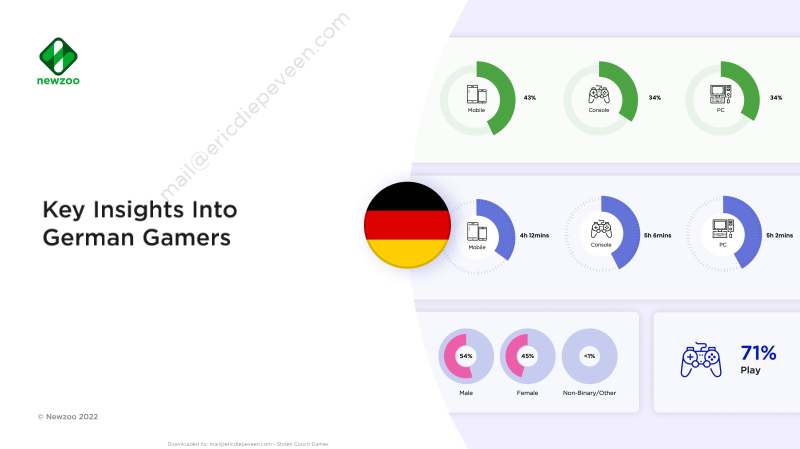
The research is underpinned by a robust methodology, drawing on survey data from over 75,000 consumers worldwide. The findings highlight distinct engagement patterns, such as the prevalence of specific gaming personas—notably Time Fillers and Mainstream Gamers—and the interplay between playing and viewing habits. For instance, data from the German market indicates that while playing remains the dominant activity, a significant portion of the population also engages with gaming video content and esports. Furthermore, the report identifies key drivers for consumer spending, noting that price sensitivity, the desire for exclusive content, and social connectivity are primary motivators for financial investment in games.
Covering a broad geographic scope that includes North America, Europe, Latin America, the Middle East, and the Asia-Pacific region, the report serves as a strategic tool for navigating the complex global gaming landscape. By synthesizing metrics such as monthly active users, daily active users, and lifetime player value, the analysis facilitates a deeper understanding of the motivations driving player behavior. Ultimately, the findings emphasize that a nuanced approach to audience segmentation and platform-specific engagement is essential for companies seeking to reach and retain diverse gaming populations in an increasingly competitive entertainment market.
- The research is based on a global dataset of over 75,000 consumers across 36 international markets, covering North America, Europe, Latin America, the Middle East, and the Asia-Pacific region.
- Consumer spending is primarily driven by three factors: price sensitivity, the desire for exclusive content, and the need for social connectivity.
- Gaming engagement is categorized into distinct personas, with 'Time Fillers' and 'Mainstream Gamers' identified as the most prevalent segments.
- Player behavior analysis utilizes over 100 key performance indicators, including monthly active users (MAU), daily active users (DAU), and lifetime player value (LPV).
- Engagement patterns in markets like Germany demonstrate that gaming video content and esports are significant activities that complement traditional gameplay.
+5
NewzooJan 2022
Report30 pages
Games, Esports, Live Streaming, Cloud and the Metaverse: 2022 Trends to Watch
The global gaming industry is currently undergoing a structural transformation characterized by the integration of emerging technologies and a pivot toward cross-platform accessibility. Central to this evolution is the expansion of cloud gaming, which serves as a critical bridge to overcome hardware constraints, allowing publishers to reach broader audiences on mobile devices and legacy consoles. Simultaneously, the metaverse is maturing into a robust commercial ecosystem, fueled by significant venture capital investment, the proliferation of virtual real estate, and the integration of digital fashion. These developments signal a broader industry shift toward enhanced creator-viewer interactivity and the adoption of Web3.0 business models.
Monetization strategies are diversifying as companies experiment with blockchain-based player trading and fan engagement tools, despite notable consumer resistance toward non-fungible tokens. This period is also defined by a surge in high-quality cross-media intellectual property adaptations and a crowded release calendar, which intensifies competition for consumer attention. Furthermore, regulatory and consumer pressures are forcing a transition toward more open app store ecosystems, challenging traditional distribution gatekeepers.
Within the esports sector, organizations are actively diversifying revenue streams by prioritizing mobile-first titles and leveraging co-streaming to maximize viewership reach. These trends, observed throughout 2022, reflect a strategic effort to sustain growth across global markets. By synthesizing market intelligence and tracking key performance metrics, the industry continues to navigate the complexities of digital transformation, balancing the pursuit of innovative monetization with the necessity of maintaining user trust in an increasingly interconnected virtual landscape.
- Cloud gaming is driving industry growth by bypassing hardware limitations, enabling publishers to deliver high-end experiences to mobile devices and legacy consoles.
- The metaverse is evolving into a commercial ecosystem supported by significant venture capital, virtual real estate markets, and digital fashion integration.
- Monetization models are shifting toward Web3.0 and blockchain-based player trading, despite ongoing consumer resistance to non-fungible tokens.
- Regulatory and consumer pressure is forcing a transition away from traditional app store gatekeepers toward more open distribution ecosystems.
- Esports organizations are prioritizing mobile-first titles and utilizing co-streaming strategies to diversify revenue and expand global viewership.
+5
NewzooJan 2022

Whitepaper106 pages
2022 Global White Paper on Mobile Advertising & Marketing
The 2022 global mobile gaming landscape underwent a significant transition toward quality and strategic refinement, characterized by a 2% decline in total advertisers and a 27.83% reduction in ad creatives during the first half of the year. This contraction in mature markets was offset by robust growth in emerging regions such as the Middle East, South America, and South Asia, where increasing smartphone penetration and young demographics present substantial expansion opportunities. The industry’s primary thesis centers on the necessity of localized, narrative-driven content and creative optimization to navigate a post-IDFA privacy environment that has increased advertising costs and shifted focus toward Android platforms.
While casual, puzzle, and simulation genres dominate download volumes, RPGs and strategy titles remain the primary revenue drivers, commanding the highest advertising costs with average CPMs reaching $21.58. Video remains the dominant creative format, accounting for over 86% of all advertisements, as marketers increasingly leverage dramatic storytelling and influencer-led content to boost engagement. Despite the industry’s fascination with emerging technologies, consumer sentiment remains grounded; only 16% of players express interest in NFT-based gaming, whereas up to 39% show interest in metaverse-integrated experiences. Most users continue to prioritize mobile games as accessible tools for relaxation and time-killing.
To sustain growth, publishers are pivoting toward programmatic channels, OEM integrations, and culturally relevant marketing strategies. Success in this competitive landscape requires a dual approach: maintaining high-frequency engagement through playable and video-based ads while simultaneously adapting to regional preferences, such as the demand for vernacular content in India or MOBA-focused titles in Southeast Asia. Ultimately, the market is moving away from broad-spectrum advertising toward highly targeted, immersive, and quality-focused campaigns that align with the core motivations of diverse global player bases.
- The mobile gaming market is shifting toward quality over volume, evidenced by a 2% decline in total advertisers and a 27.83% reduction in ad creatives during the first half of 2022.
- RPG and strategy titles remain the primary revenue drivers, commanding the highest advertising costs with average CPMs reaching $21.58.
- Video is the dominant advertising format, accounting for over 86% of all ad creatives as marketers prioritize dramatic storytelling and influencer-led content.
- Growth in mature markets is slowing, forcing publishers to expand into emerging regions like the Middle East, South America, and South Asia to capitalize on rising smartphone penetration.
- Consumer interest in gaming technology is polarized, with only 16% of players interested in NFTs compared to 39% expressing interest in metaverse-integrated experiences.
+3
SocialPetaJan 2022
Report56 pages
Data for Mobile Gaming 2022-2024
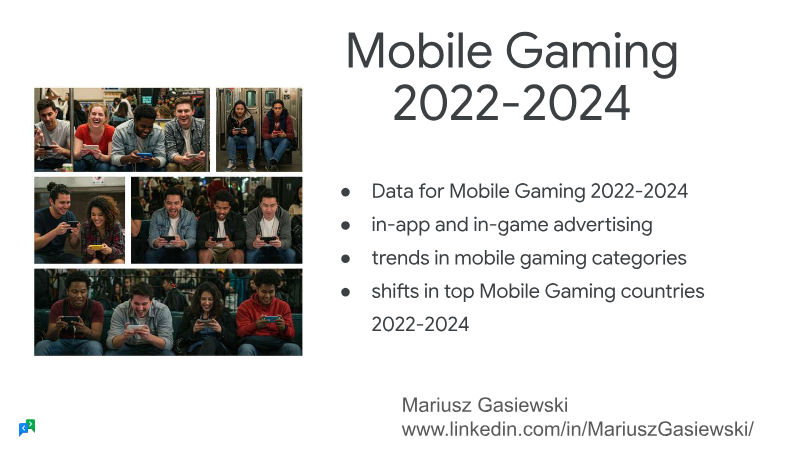
Mobile gaming maintains its position as the primary driver of industry expansion, fueled by widespread smartphone adoption and consistent engagement across both emerging and established markets. Between 2022 and 2024, the sector has demonstrated a clear trend where revenue growth consistently outpaces download volume on both iOS and Android platforms. This financial trajectory is increasingly supported by a strategic shift toward in-game advertising, which is currently outpacing traditional in-app purchases as a primary revenue stream.
Global market dynamics remain anchored by the United States, China, and Japan, which continue to serve as the most significant revenue generators. However, emerging markets are playing an increasingly critical role in the industry’s growth, particularly in regions like Brazil, where smartphone gaming penetration has surpassed 90% across all demographics. In these regions, player behavior is heavily influenced by free-to-play accessibility, narrative depth, and social recommendations. Furthermore, data from the U.S. and U.K. confirms that younger demographics prioritize smartphones over consoles and PCs, solidifying the mobile device as the central hub for modern gaming.
Despite the proliferation of available titles, the global player base exhibits a preference for focused engagement, with many users choosing to dedicate their time to a single game rather than managing multiple titles simultaneously. While market concentration among top-tier publishers remains stable, the rapid expansion of the advertising sector suggests a fundamental change in how developers monetize their audiences. Ultimately, the industry is transitioning toward a model that prioritizes long-term retention and diversified revenue streams over simple volume-based growth, ensuring that mobile gaming remains the most influential segment of the broader interactive entertainment landscape.
- Mobile gaming revenue growth is consistently outpacing download volume across iOS and Android platforms between 2022 and 2024.
- In-game advertising has overtaken traditional in-app purchases as the primary revenue stream for mobile developers.
- The United States, China, and Japan remain the dominant global revenue generators, while Brazil has reached over 90% smartphone gaming penetration across all demographics.
- Younger demographics in the U.S. and U.K. are increasingly prioritizing smartphones over consoles and PCs as their primary gaming platform.
- Player behavior is shifting toward focused engagement, with users increasingly dedicating their time to a single title rather than managing multiple games.
+2
GoogleJan 2022
Report31 pages
State of the Game Industry Report: 2022
The global game development landscape in 2022 reflects a period of significant structural and cultural transition. PC remains the primary development platform, while the PlayStation 5 maintains its position as the leading console choice. Conversely, mobile development has experienced a decade-long decline in developer interest. Emerging hardware like the Steam Deck and PlayStation VR2 continues to capture attention, yet the industry remains deeply skeptical of speculative technologies such as the metaverse, cryptocurrency, and NFTs. These concerns are rooted in anxieties regarding environmental sustainability, ethical business practices, and the long-term viability of blockchain-based models.
Workplace culture and labor dynamics have emerged as central themes, marked by a measurable improvement in work-life balance as 60 percent of developers now maintain a 40-hour work week or less. Despite this progress, the industry struggles with systemic issues, as a majority of studios have failed to adequately address internal reports of misconduct and toxicity. This environment has fueled a growing movement toward collective bargaining, with 55 percent of developers supporting unionization and nearly one-quarter of workplaces engaging in active discussions regarding labor organization.
The industry continues to prioritize accessibility, with a record 39 percent of developers integrating inclusive design features into their projects. However, broader efforts toward diversity and social activism remain inconsistent across various studios. Furthermore, the workforce remains predominantly male and early-career, highlighting a demographic imbalance that persists alongside ongoing tensions between developers and major platform holders. As evidenced by the 34 percent of developers who support Epic Games in its legal conflict with Apple, there is a clear desire for greater autonomy and a shift in the power dynamics that currently govern the digital distribution ecosystem.
- Labor organization is gaining significant momentum, with 55 percent of developers supporting unionization and nearly 25 percent of workplaces actively discussing collective bargaining.
- Work-life balance has improved, as 60 percent of developers now report working 40 hours per week or less.
- Despite progress in working hours, a majority of studios have failed to effectively address internal reports of workplace toxicity and misconduct.
- Developers are increasingly seeking autonomy from platform holders, evidenced by 34 percent of the industry supporting Epic Games in its legal battle against Apple.
- Accessibility is a growing priority, with 39 percent of developers incorporating inclusive design features into their projects.
+5
GDCJan 2022