Market (Mobile)·Updated Apr 8, 2026 by GameRefinery
Report · January 1, 2022
Published by GameRefinery
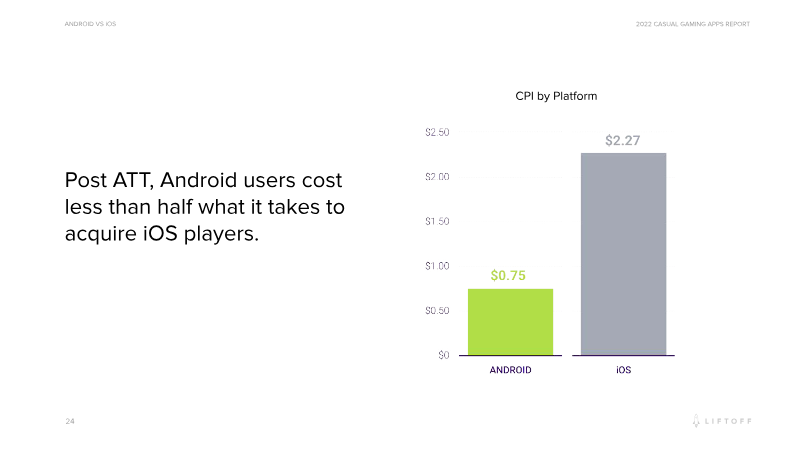
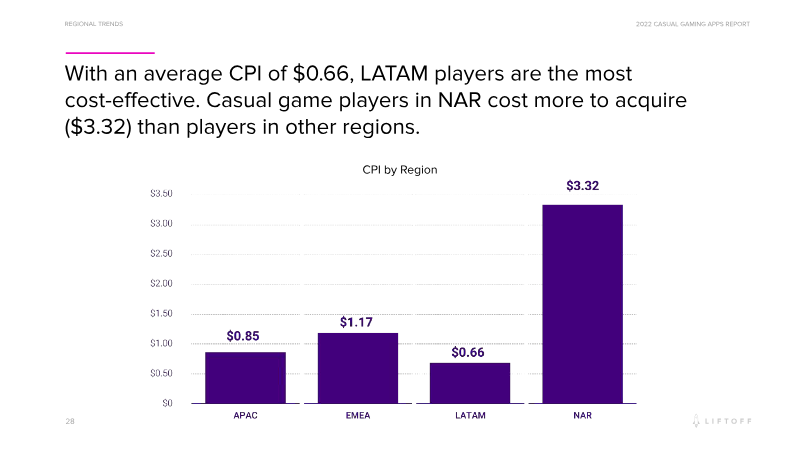
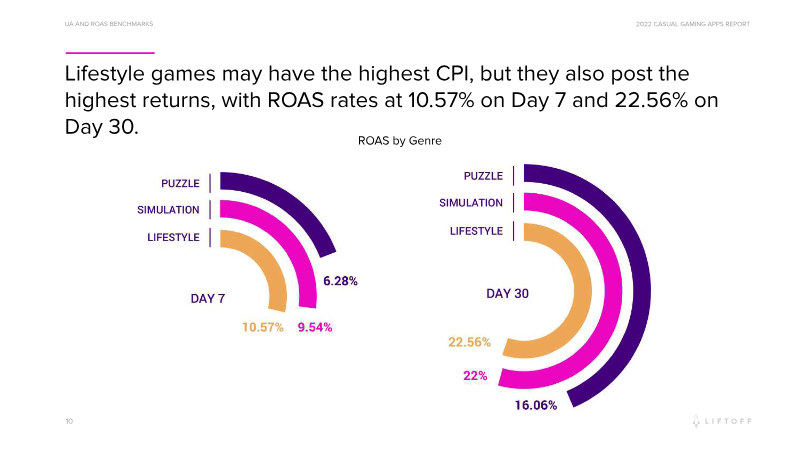
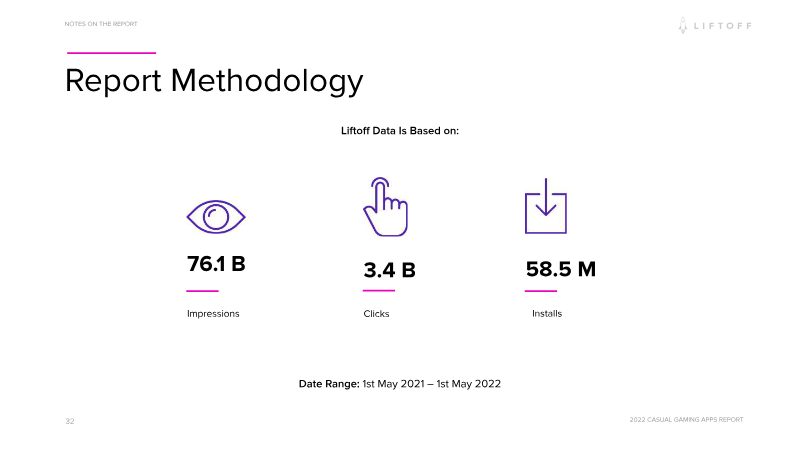
The 2022 Casual Gaming Report demonstrates that mobile gaming dominates the global market, accounting for more than sixty percent of total industry revenue. Despite this dominance, overall user spend declined in the first quarter of 2022 after reaching a pandemic‑era peak of $22.6 billion, indicating a shift in consumer behavior and heightened competition for monetization. Key performance metrics reveal that the average cost per install (CPI) rose to $1.10, with iOS users costing $2.27 and Android users $0.75. Return on ad spend (ROAS) remained stable, with 7‑day and 30‑day figures at 7.31 % and 17.81 %, respectively; lifestyle titles delivered the highest 30‑day ROAS at 22.56 %. Regional analysis shows that Asia-Pacific and Latin America offer the most cost‑effective acquisition opportunities, each maintaining CPIs below $1 while delivering ROAS comparable to other markets. Conversely, North America remains the most expensive segment with a CPI of $3.32. The report underscores that creative content is the pivotal factor in successful user acquisition, as it effectively communicates value and propels users through the funnel. Liftoff’s GameRefinery platform, backed by a dataset of 76.1 billion impressions, 3.4 billion clicks, and 58.5 million installs from May 2021 to May 2022, provides developers and publishers with granular insights into pre‑production and LiveOps performance drivers. These findings collectively inform strategic decisions across acquisition, creative development, and regional targeting for casual game stakeholders worldwide.
GameRefinery 2022 A Liftoff Company Casual Gaming GameRefinery, a Liftoff company, is the leading provider of feature-level data in the Apps Report mobile games market, with an ever-growing database covering hundreds of thousands of games. GameRefinery's customers include leading mobile games companies such as Zynga, Wargaming, King, and FunPlus Unlocking the Secrets of the Most developers, investors, and publishers delve into the very building blocks of mobile Popular Genre and how to achieve the same from pre-production to LiveOps. inDf gamerefinery.com
Where do your Ad shown Game installed installs come Casino AR/Location Based Casino Arcade AR/Location Based Arcade Hyper Casual from? Hyper Casual Lifestyle Our newest tool helps you find out by Lifestyie Puzzle providing an aggregate view of the sources of installs across different casual Puzzle gaming categories and genres. Simulation Simulation Card Games RPG Card Games Check out our RPG Shooter Shooter Strategy new tool Driving Strategy Driving Sports Sports 2022 CASUAL GAMING APPS REPORT
Contents Contents | Introduction | 4 Market Trends by | | --- | --- | | GameRefinery | 17 | UA, ROAS and Ad Android vs iOS | 23 Completion Benchmarks | 7 | Monthly CPI and ROAS Regional Trends | 27 | | --- | --- | | Trends | 13 | 3 2022 CASUAL GAMING APPS REPORT
Introduction In recent years, pandemic-driven demand led to record-breaking levels of spending in mobile games. Consumers worldwide coped with lockdowns by playing their favorite casual games. However, as policies shifted, user spending on mobile games dropped year-over-year for the first time in Q1 2022—down from the pandemic-driven spend peak of $22.6 billion in Q1 2021. Despite a market correction in the industry, mobile gaming increased its market share to over 60% of the gaming industry. Mobile is now 3.3x larger than its closest competitor, home console gaming. The casual gaming sector is also projected to grow steadily, retaining its place as the mobile gaming genre made for everyone. As the mobile gaming industry continues to scale, marketers need new models, metrics, and methods to keep their game portfolios thriving today and tomorrow. We’ve compiled insights from data based on more than 58 million installs to help marketers capitalize on new opportunities. The 2022 Liftoff Casual Gaming Apps Report includes an analysis of CPI, ROAS, and ad completion rates across the genre. The report also includes insights from Mobile Heroes at Jam City, Socialpoint, and Wooga who are at the top of their game in the casual gaming sector. 4 2022 CASUAL GAMING APPS REPORT
REPORT HIGHLIGHTS Report highlights Report Highlights User Acquisition Platform Trends In the past year, the average cost per ↑ ↓ Post ATT, CPI on iOS (2.27) was 2x that of install (CPI) for casual games was 1.10. Android ($0.75). Android and iOS users Simulation players cost the least to had similar D7 and D30 ROAS. acquire, at $0.91 each. Return on Ad Spend (ROAS) D7 and D30 ROAS stayed steady $ month-over-month between 2021 and 2022. Over 12 months, D7 and D30 ROAS averaged 7.31% and 17.81%, respectively. Regional Trends APAC and LATAM provide great value with CPIs of less than $1. ROAS is about the same across all regions except LATAM. 5 2022 CASUAL GAMING APPS REPORT
HOW WE DEFINE CASUAL GAME GENRES Report highlights How we define casual game genres The report is split into three of the biggest casual gaming genres: Lifestyle Puzzle Simulation Lifestyle games include Puzzles are a wide-ranging From adventures abroad to interactive stories (such as genre. A mainstay, match-3, creating new cities, simulation Lovelink), home customization remains one of the most popular. includes anything that puts the and dress-up titles (with famous Also included are Solitaire and player in charge of building an examples including Design Home Hidden Object (think June’s empire. Popular titles of the and Covet Fashion), as well as Journey). Other notable game genre include Rollercoaster rhythm and music games. types, such as Word games (like Tycoon, Cooking Diary, and—for Words With Friends), Coloring animal lovers—a range of virtual games, and trivia titles, make up pet sims. the rest of the category. 6 2022 CASUAL GAMING APPS REPORT
1. Market trajectory What direction is the PC and console market heading in 2026? 8 What direction is the PC and console market heading in 2026? 2. Attention & value allocation Where do players spend time and money on PC and console? 17 3. Market concentration What happens if you are not a top-20 game? 45 4.
The global live-streaming landscape underwent a transformative shift in the third quarter of 2025, characterized by record-breaking viewership and a significant redistribution of market power. Total viewership reached 9.6 billion hours across traditional platforms, representing a 13% year-over-year increase. However, the most profound development was the emergence of TikTok Live as a dominant force, recording 9.1 billion hours watched and nearly doubling the output of Twitch. This surge reflects a broader consumer pivot toward mobile-integrated content and has resulted in Twitch’s market share falling below 50% for the first time, a decline exacerbated by aggressive internal crackdowns on fraudulent viewbotting. Content trends during this period favored non-gaming categories and massive live events over traditional gameplay. Non-gaming content led with 1.7 billion hours watched, while Ibai’s *La Velada del Año V* set a new industry benchmark with 9.2 million peak concurrent viewers. Although esports viewership grew by 8% to 805 million hours, the sector saw a notable migration of audiences from Twitch toward YouTube and TikTok, largely driven by the Esports World Cup. In the gaming sector, *EA Sports FC 26* emerged as the quarter's premier release, generating 62.3 million hours watched within its first month. Individual creator performance and brand integration reached new heights of commercial impact. Kai Cenat dominated the landscape, leading all creators with 91.4 million hours watched and setting a record with 1.1 million subscriptions during his "Mafiathon 3" event. This level of engagement translated into significant brand visibility, as evidenced by a 26,000-mention surge for Crocs during Cenat’s broadcast. While female viewership was led by ExtraEmily and the VTuber category saw Usada Pekora reclaim the top spot, the overarching trend indicates that high-production marathons and cross-platform accessibility are now the primary drivers of growth and monetization in the streaming economy.
The response to the public consultation on the Digital Fairness Act argues that the European Union’s existing consumer‑protection framework, together with the continent‑wide PEGI rating system and Germany’s USK scheme, already delivers the breadth, flexibility and enforcement capacity required to safeguard minors and ensure transparency for in‑game currencies and loot‑box‑type rewards. By emphasizing self‑ and co‑regulatory measures—clear real‑world cost calculations for virtual currencies, mandatory disclosure of reward probabilities, 48‑hour refunds for unused purchases and robust, default‑zero‑spend parental‑control settings—the industry contends that new, draconian legislation would jeopardise a sector that generated €26.4 billion in 2024. Empirical evidence underpins the argument that current safeguards are effective: only about 18 % of children are permitted to buy in‑game items, 95 % of purchases are supervised, 79 % of parents recognise PEGI labels, and 80 % are familiar with USK age ratings. Survey data also show that parental‑control tools now allow consent to data processing, limit communication and content sharing, and are audited by self‑regulatory bodies such as USK. Multilingual awareness campaigns have been deployed across 16 EU countries, partnering with family and media‑literacy organisations to promote joint play and responsible spending. The industry further maintains that the EU’s Consumer Rights Directive, Digital Content Directive, Data‑Protection Regulation, AI Act and Digital Services Act already cover “dark‑pattern” and vulnerability‑targeting practices. It calls for concrete, industry‑co‑created guidance rather than expanded definitions that could dilute legal certainty and impose disproportionate compliance costs, especially for subscription‑cancellation mechanisms. Reclassifying in‑game currencies as “digital representations of value” would strip existing protections and generate an impractical proliferation of contracts. Overall, the position presented seeks to preserve the balance between consumer information, the right of withdrawal and market innovation, urging legislators to enforce and refine current rules while supporting the video‑games sector’s self‑regulatory governance structures that span the EU and address both economic and child‑protection concerns.
The digital landscape in the United States has reached a pivotal turning point as smartphones and connected televisions officially surpass traditional broadcast media as the primary vehicles for entertainment. With smart TV penetration reaching 63% and subscription services now more prevalent than cable or satellite, the American household is firmly rooted in a digital-first ecosystem. This transition is fueled by a surge in spending among younger consumers aged 18–34, who have increased their annual digital media expenditure by $235 over the past year. While the average household maintains 3.5 subscription video services, a growing trend of "subscription cycling" suggests consumers are becoming more price-sensitive and strategic with their digital commitments. Gaming has emerged as a near-universal activity, with 80% of the population engaging across various platforms and over half of the country playing mobile games daily. The industry is seeing a significant rise in social and cloud gaming, alongside a burgeoning interest in user-generated content and non-programmer creation tools. Although traditional game discovery channels are losing influence, total annual in-game spending has risen dramatically. Notably, 70% of computer gamers now spend $30 or more annually, and there is a growing consumer appetite for the ability to trade virtual goods between different titles, potentially facilitated by blockchain technology. Emerging technologies reveal a stark generational divide in adoption and sentiment. While the 18–34 demographic shows double-digit increases in familiarity and interest regarding the Metaverse and Virtual Reality, interest in Augmented Reality has declined sharply across all age groups. Cryptocurrency remains a niche expertise, yet a significant portion of younger investors plan to commit substantial capital to the sector in the coming year. Despite these advancements, privacy remains a critical barrier; over 60% of Americans express deep concerns regarding information security and the use of personal data for advertising. This tension between high digital engagement and data anxiety defines the current state of the American digital consumer.