Updated Mar 17, 2026 by game – Verband der deutschen Games-Branche e. V.
Report · January 1, 2022
Published by game – Verband der deutschen Games-Branche e. V.
01 Players in Germany 8 02 German market for computer 14 03 The games industry in Germany 26 .1 Employment figures and companies .3 The ten demands of the games industry 04 Esports 40 05 esports player foundation 42 06 gamescom and devcom 44 07 German Computer Games Awards 48 08 Entertainment Software 50 09 Foundation for Digital Games 52 10 About game –...
01 Players in Germany 8 02 German market for computer 14 and video games 03 The games industry in Germany 26 .1 Employment figures and companies .2 Games funding .3 The ten demands of the games industry 04 Esports 40 05 esports player foundation 42 06 gamescom and devcom 44 07 German Computer Games Awards 48 08 Entertainment Software 50 Self-Regulation Body (USK) 09 Foundation for Digital Games 52 Culture (Stiftung Digitale Spielekultur) 10 About game – the German 54 Games Industry Association Publisher 11 Development of the German 58 game – Verband der games market since 1995 deutschen Games-Branche e. V. Friedrichstraße 165 10117 Berlin Germany Design Bureau Ole Gehling www.olegehling.de
a number of highly positive developments: for example, the German games market managed to continue the impressively strong growth from 2020. Sales revenue from purchases of games and gaming accessories grew by 17 per cent, to about 9.8 billion euros. One year earlier, the industry experienced extremely high growth of 32 per cent. One of the primary reasons for the sharp upsurge is the increased number of players. Their numbers had already grown by 5 per cent in 2020; in 2021, even more players joined their ranks. During the pandemic (both the first and second year), computer and video games played entirely to their strengths as a social medium – while Dear readers, we all quickly tired of the endless video From the ongoing Covid-19 pandemic to the parliamentary elections, 2021 was an eventful year for the games industry in Germany. Computer and video game development initially continued on a positive path as people began working from home at the beginning of the pandemic, but as time went on, the inability of teams to do their creative work together in person presented significant challenges, and growing numbers of titles were delayed. At the same time, many games industry events were either cancelled or only took place online in 2021. Consequently, all-important networking and the search for publishers and investors was still difficult for many companies, particularly small ones. calls, games offered a much more exciting form of social interaction.
ny games industry events were either cancelled or only took place online in 2021. Consequently, all-important networking and the search for publishers and investors was still difficult for many companies, particularly small ones. calls, games offered a much more exciting form of social interaction. App versions of classic board games and card games, shared experiences of epic adventures in online roleplaying games or even digital tournaments: millions of Germans took advantage of the incredible diversity of games to keep in touch with friends and family and spend time having fun together. Today, six out of every ten Germans play games. The central theme of gamescom 2021 was a perfect fit for this development: Games: The New Normal. Once again, the world’s biggest event for computer and video games couldn’t be held on location in Cologne, but that didn’t put a damper on the community’s enjoyment of gamescom;
followed the events in 2021. The grand opening show gamescom: Opening Night Live reached around 5.8 million live viewers. In all, 13 million people watched gamescom shows in 2021 – an increase of 30 per cent compared to the previous year. companies still rate Germany’s international competitiveness in the industry as relatively low, as our game industry barometer indicated in mid-2021. As we can see: with federal games funding, the government games department, the games strategy 2021 was also an important year for the German games industry in political terms. The German parliamentary elections in September resulted in the formation of the first governing coalition between the political parties SPD, Bündnis 90/Die Grünen and FDP. For the games industry, this meant a move from the Federal Ministry of Transport and Digital Infrastructure to the Federal Ministry for Economic Affairs and Climate Action, headed by Vice Chancellor Robert Habeck. This change in leadership also affects the government’s games department, which was only just founded in 2021 and worked in close consultation with the games industry to develop the federal government’s first games strategy. All we have to do is take a look at the games industry to see how important these developments actually are. Along with the introduction of games funding at the federal level, these changes have made significant improvements to the underlying situation for games companies, and they are already having a noticeable effect.
ke a look at the games industry to see how important these developments actually are. Along with the introduction of games funding at the federal level, these changes have made significant improvements to the underlying situation for games companies, and they are already having a noticeable effect. For example, after the 20 per cent jump in 2020, the total number of games companies grew by a further 5 per cent within a single year, and numerous improvements at the state level, we have made enormous progress in the past few years in making Germany a top location for the games industry. But Germany still lags behind other games locations – countries like France, Canada and England already began providing strategic support to their games industries many years ago. If we want to tap the full cultural, economic and technological potential of the games industry in Germany, we still have a lot of work ahead of us. But the German games industry expects good things to come of this new federal government, as our game industry barometer also indicates. Consequently, the country is in a strong position for further positive growth. This annual report provides an overview of the various developments in the games industry in Germany. I hope you find it to be an enjoyable read. Felix Falk Managing Director of game – the German Games Industry Association
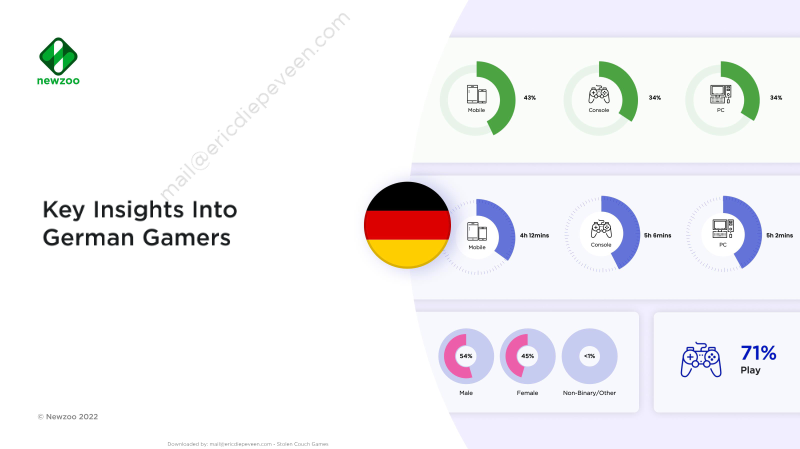
in Germany Players who play at least occasionally 59<sub>%</sub> of Germans play Games are more popular in Germany than computer and ever before: around six out of every ten video games Germans play computer and video games. 59 per cent of the population between the 7<sub>%</sub> 8<sub>%</sub> 9% 10% 10<sub>%</sub> 11<sub>%</sub> 60–69 ages of 6 and 69 reach for their PC, console, years old smartphone or tablet to dive into the digital 16<sub>%</sub> 17 17% world of games. % 18<sub>%</sub> 19% 18% 50–59 years old The past two years Taken together, the past two years witnessed a significant increase in player numbers, with 18<sub>%</sub> 17% 16% 16<sub>%</sub> 40–49 witnessed a significant some 6 per cent more people playing games 15% 15% years old increase in player than in 2019 – that’s a record-breaking number of Germans playing games. And the genders are numbers, with some 6 per essentially equal here: 48 per cent of players are 17<sub>%</sub> 17 17% 30–39 cent more people playing women and 52 per cent are men. The continuous % 17% 17<sub>%</sub> 18% years old increase in the number of players demonstrates games than in 2019. that, even after the sharp spike during the pandemic in 2020, millions of Germans are still 17% 16 16<sub>%</sub> 20–29 passionate about games. % 16% 15% 14<sub>%</sub> years old
01 Players in Germany 8 02 German market for computer 14 03 The games industry in Germany 24 .1 Employment figures and companies .4 The ten demands of the games industry 04 gamescom 38 05 About game – the German 42 .1 Diversity initiative Hier spielt Vielfalt .2 Environmental and climate protection in the .3 Foundation for Digital Games Culture .5 Entertainment Software Self-Regulation Body 06 D...
The German games industry navigated a period of significant contraction in 2024, with total market revenue falling 6% to €9.4 billion. This downturn, driven by a decline in mobile revenue and console hardware sales, resulted in the first recorded reduction in the number of active companies and industry employees in recent years. Despite these headwinds, Germany maintains its status as the largest games market in Europe and the fifth largest globally. The domestic player base remains robust and increasingly diverse, encompassing 37.5 million individuals with an average age of 39.5 years, reflecting the deep integration of gaming into the national cultural fabric. Strategic instability during this period stemmed largely from restrictive federal funding guidelines and project application freezes, which disproportionately impacted smaller studios. However, the outlook for 2025 is increasingly positive, anchored by a new coalition agreement that pledges to increase federal funding to €125 million annually by 2026 and introduce competitive tax incentives. These policy shifts aim to bolster Germany’s international standing, which industry leaders currently view as suboptimal despite the nation’s strong infrastructure, academic training programs, and successful startup initiatives like the "Press Start" grant. To secure long-term growth, the industry is prioritizing a hybrid funding model, the establishment of a dedicated "Games University," and the expansion of digital cultural heritage projects, such as the AI-driven archiving of over 40,000 titles. Professionalization efforts continue through the *game* association, which represents over 500 members and manages critical networking platforms like gamescom. By integrating esports development, sustainability commitments, and structured career pathways, the German ecosystem is positioning itself to transition from a period of market correction toward a more resilient and internationally competitive future.
01 Gamer in Deutschland 6 02 Markt für Computer- und 12 03 Games-Branche in Deutschland 22 .1 Beschäftigtenzahlen und Unternehmen .4 Die 10 Forderungen der Games-Branche 04 eSports 36 05 gamescom 40 06 Deutscher Computerspielpreis 42 07 Unterhaltungssoftware 44 08 Stiftung Digitale Spielekultur 46 09 Über den game – Verband 48 Herausgeber ...
01 Gamer in Deutschland 6 02 Markt für Computer- und 12 .2 Umsätze mit virtuellen Gütern und Zusatzinhalten sowie Abonnements .3 Umsätze mit Gebühren für Online-Netzwerke 03 Games-Branche in Deutschland 22 .1 Beschäftigtenzahlen und Unternehmen .4 Die 10 Forderungen der Games-Branche 04 eSports 36 05 gamescom 40 06 Deutscher Computerspielpreis 42 07 Unterhaltungssof...