Market (Mobile)·Updated Apr 8, 2026 by Sensor Tower
Report · January 1, 2022
Published by Sensor Tower
Global mobile‑app consumer spending is projected to reach $233 billion by 2026, reflecting a rise of more than $100 billion from 2021. The App Store will drive a 14 % CAGR ($161 billion), while Google Play will grow at 9 % ($72 billion). Worldwide downloads are expected to exceed 180 billion, with Google Play contributing 143 billion (5.2 % CAGR) and the App Store about 38 billion (3 % CAGR). The United States remains the largest market, expanding at a 16.5 % CAGR; non‑game spending is set to rebound and equal game revenue by 2026. In Europe, mature markets show limited upside. The United Kingdom’s growth is projected at only 1 %, and Germany and France are expected to decline slightly. The bulk of regional growth—about 5 %—will come from eastern European countries such as Ukraine, Romania, Poland and Russia. No other top European market is expected to exceed 10 % growth by 2026, underscoring saturation in Western Europe. Across Asia and the Americas, the United States will continue to outpace China on both App Store spending and downloads. India remains the leader in Google Play adoption. Mobile‑game revenue is projected to decline on both platforms, with non‑game apps surpassing games in consumer spending by 2024. Overall app revenue growth will outpace game growth (CAGR 23% vs. 6%). The pandemic’s legacy is evident, with business‑app installs doubling and travel apps still lagging behind pre‑COVID levels. The forecast emphasizes the importance of data‑driven decisions for organic growth, strategic benchmarking and financial analysis. Sensor Tower’s suite of tools—Top Charts, App Intelligence, Store Intelligence, Ad Intelligence and Usage Intelligence—provides competitive insights into app performance, store optimization, ad spend, SDK usage and user demographics. Daily market intelligence is available through the Sensor Tower blog, with demos offered for deeper engagement with its analytics platform.
Executive Summary: Highlights Global spending in mobile apps will reach $233 billion by 2026. The App Store will account for $161 billion at an annual growth rate of 13.7 percent, while Google Play will reach $72 billion with close to 9 percent annual growth. Worldwide mobile app downloads will surpass 180 billion by 2026. Google Play will contribute 143 billion downloads with 5.2 percent annual growth, while the App Store will approach 38 billion with about 3 percent annual growth. The mobile app market cooled off slightly J App Store consumer spending in non-games will following the unusually high pandemic-fueled surpass that from mobile games by 2024. Google growth seen in early 2020. Expect trends to shift Play will also see faster growth from non-games, back over the next several years as the market creating a roughly even split between games and adjusts to new societal and economic norms. non-games across both platforms by 2026.
Sensor Tower Solutions Topic Overview 1D Store App Ad Usage App Consumer 05 - Market Overview Intelligence Intelligence Teardown Intelligence 11 - Top Regions Develop winning Benchmark app Drive organic growth usage, engagement, Evaluate which SDKs Access unfiltered 25 - with the leading App User acquisition apps are using and mobile user Top Countries measure SDK Store Optimization campaigns with and demographics. engagement for 35 - Top Categories crucial mobile adoption across financial analysis. advertising insights. market segments. 47 - Conclusion
About This Data: Methodology Sensor Tower’s Mobile Insights team created the revenue and download forecasts Could your business benefit from featured in this report using the Sensor Tower Store Intelligence platform. access to Store Intelligence • Figures cited in this report reflect App Store and Google Play consumer spending and download estimates for January 1, 2014 through May 31, 2022. • The market forecast for 2022 to 2026 is based on past spending and download trends, macroeconomic projections, and additional factors. insights and the highly accurate data used to build this report? See the fastest growing apps and publishers by downloads or revenue. • All revenue figures in this report capture consumer spending (gross revenue). REQUEST DEMO This includes the revenue earned by the app developer as well as the portion earned by Apple or Google. • Android estimates represent revenue and downloads from the Google Play Store only. Sensor Tower does not provide spending or download estimates for third-party Android stores. • Since Google Play paused its billing for users in Russia on March 10th, 2022, Google Play consumer spending in Russia for the remainder of 2022 and beyond has been excluded from the forecast.
Market Overview: Global Mobile App Spending Forecast Note Regarding Revenue Estimates We report gross revenue (including the cut for Apple or Google). Android estimates do not include third-party stores. Asia App Store and Asia App Store and Worldwide App Store and Worldwide App Store Worldwide Google Play Google Play User Spending User Spending User Spending 100B 100B 100B 250B +6.2% CAGR 250B +6.2% CAGR $250B +12.0% CAGR 200B 200B $200B +7.2% CAGR 150B 207B 233B 150B +13.7% CAGR 83.4B 88.3B $150B OW er 100B 67.8B 159B 182B 100B 65.5B 67.8B 73.3B 78.3B 161B 100B +8.9% CAGR 69.1B 73.8B 50B 132B 137B 50B 92B 108B 124B 142B $50B 52.2B 54.1B 59.4B 64.2B 20B 20B 85B 20B 47B 45B 51B 58B 65B $72B 0 0 $0 0 2021 2022F 2023F 2024F 2025F 2026F 0 2021 2022F 2023F 2024F 2025F 2026F 0 2021 2022F 2023F 2024F 2025F 2026F 2021 2022F 2023F 2024F 2025F 2021 2022F 2023F 2024F 2025F 2021 2022F 2023F 2024F 2025F 2026F 2026F 2026F 233 Billion 161 Billion $72 Billion App Store + Google Play Revenue App Store Revenue Google Play Revenue By 2026 Downloads By 2026 Downloads By 2026 By 2026 By 2026 By 2026
Market Overview: Global Mobile App Download Forecast Asia App Store and Asia App Store and Worldwide App Store and Worldwide App Store Worldwide Google Play Google Play Downloads Downloads Downloads 200B +4.7% CAGR 200B +6.2% CAGR 200B 80B 80B 80B +5.2% CAGR 150B 150B 150B 60B 60B 60B OW er 100B 165B 173B 181B 100B 83.4B 88.3B 100B 40B 144B 148B 156B 78.3B 40B 73.3B 78.3B 40B 136B 143B 50B 65.5B 67.8B 50B 65.5B 67.8B +2.9% CAGR 50B 111B 114B 121B 129B 20B 20B 33B 34B 35B 36B 37B 38B 20B 52.2B 54.1B 0 0 0 0 2021 2022F 2023F 2024F 2025F 2026F 0 2021 2022F 2023F 2024F 2025F 2026F 0 2021 2022F 2023F 2024F 2025F 2026F 2021 2022F 2023F 2024F 2025F 2021 2022F 2023F 2024F 2025F 2021 2022F 2023F 2024F 2025F 2026F 2026F 2026F 181 Billion 38 Billion 143 Billion App Store + Google Play Downloads App Store Downloads Google Play Downloads By 2026 Downloads By 2026 Downloads By 2026 By 2026 By 2026 By 2026
Market Overview: U.S. Mobile App Spending Forecast Note Regarding Revenue Estimates We report gross revenue (including the cut for Apple or Google). Android estimates do not include third-party stores. Asia App Store and U.S. App Store and U.S. App Store U.S. Google Play Google Play User Spending User Spending User Spending 100B 100B 100B +6.2% CAGR 100B $100B 80B +16.5% CAGR 80B $80B +7.2% CAGR 60B 86B 60B +18.8% CAGR 83.4B 88.3B 60B OW er 40B 67.8B 73.3B 78.3B 75B 40B 73.3B 78.3B 40B +12.3% CAGR 69.1B 73.8B 20B 65.5B 43B 53B 64B 20B 43B 51B 59B $20B 52.2B 54.1B 59.4B 64.2B 20B 40B 25B 29B 36B 20B 15B 14B 17B 21B 24B 27B 0 0 $0 0 2021 2022F 2023F 2024F 2025F 2026F 2021 2022F 2023F 2024F 2025F 2026F 0 2021 2022F 2023F 2024F 2025F 2026F 2021 2022F 2023F 2024F 2025F 2021 2022F 2023F 2024F 2025F 2026F 2026F 86 Billion 59 Billion $27 Billion App Store + Google Play Revenue App Store Revenue Google Play Revenue By 2026 Downloads By 2026 By 2026 By 2026 By 2026
The study evaluates the German games industry in 2025, building on earlier reports to assess economic performance, employment, and the influence of federal funding. It surveys 343 companies—28 % of a population of 1,205—and integrates primary data with secondary sources such as gamesmap and DLR. The sector has expanded rapidly, doubling core‑market firms from 619 in 2018 to roughly 1,200 by mid‑2025 and nearly doubling the extended core market. Revenue rose from €3.06 bn in 2018 to €3.73 bn in 2024, a 22 % increase, with development‑sector sales growing 148 %. Despite this growth, the market remains highly fragmented: three‑quarters of firms employ fewer than ten people and only 19 % belong to foreign conglomerates. Export earnings dominate, accounting for 76 % of revenue, largely within the EU and North America/Asia. Employment data reveal a clear link between company size and workforce composition. Larger firms (>€25 M revenue) employ 85 % full‑time staff, whereas micro‑enterprises rely heavily on owners and freelancers. Female representation has risen to nearly one‑third of the workforce, and international talent now constitutes 35 % of employees. Technical and creative roles dominate, while commercial positions have declined. Salaries average €62 k annually, with lead‑level pay ranging from €50–80 k and a strong correlation between company size and remuneration. Federal funding has been pivotal, with 71 % of developers receiving or planning to receive support. In 2023, €70 million in subsidies generated €277 million of investment and €453 million of total value‑creation, yielding a multiplier of 6.5 for output and 2.5 for fiscal impact. However, high personnel costs remain a significant challenge, with 57 % of respondents rating them as “very bad.” The industry also serves as a talent magnet and innovation catalyst, with 70 % of spill‑overs stemming from game engines, gamification, and AR/VR technologies adopted across automotive, architecture, film, training, AI, and other sectors.
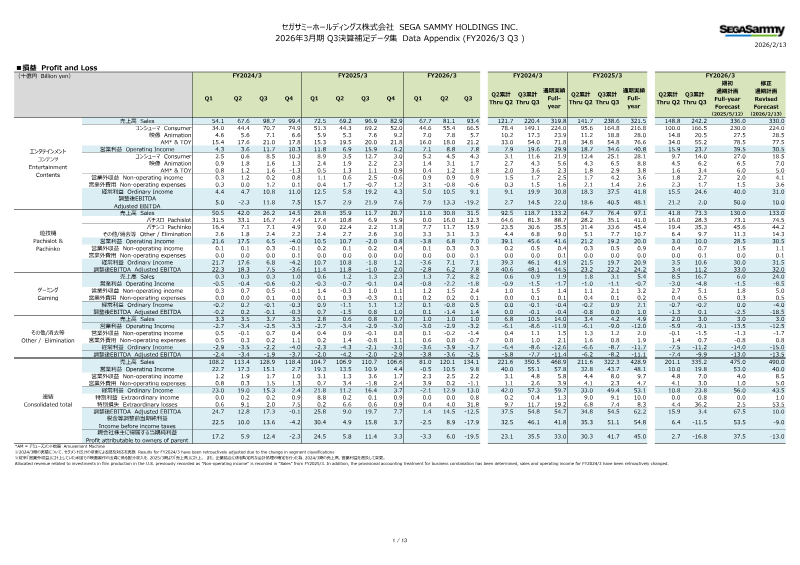
Financial results for the third quarter of the fiscal year ending March 2026 reveal a complex performance landscape characterized by robust revenue generation offset by substantial extraordinary losses. Consolidated sales reached 134.1 billion yen for the quarter, driven primarily by the Entertainment Contents segment. However, the company recorded a net loss of 19.5 billion yen due to 31.8 billion yen in extraordinary charges. These financial pressures necessitated a revision of the full-year forecast, which now anticipates higher overall sales of 490.0 billion yen but a projected net loss of 13.0 billion yen for the fiscal year. The consumer games division remains a cornerstone of the business, though it faces tempered expectations for the remainder of the year. While third-quarter sales were strong at 66.5 billion yen and full-game unit sales reached 8.69 million, the annual unit sales target was lowered from 30.0 million to 26.5 million. This adjustment stems largely from a decline in anticipated repeat sales of older titles. Key intellectual properties continue to demonstrate market resonance, with the Sonic series leading performance at 4.0 million units year-to-date, followed by the Total War, Like a Dragon, and Persona franchises, which each contributed between 2.4 million and 3.2 million units. In the amusement and resort sectors, the Pachislot and Pachinko segments show signs of recovery despite regulatory and competitive challenges. While Pachislot approval rates remain low and utilization shares have dipped to 14.5%, the Pachinko segment saw an improved utilization share of 10.0%, ranking the company third in the market. Simultaneously, the Paradise Segasammy casino resort reported growth, hosting 321,000 users year-to-date and generating a cumulative operating profit of 86.2 billion KRW. These diverse results highlight a period of strategic recalibration as the company manages high-performing legacy IPs against broader structural financial headwinds.
KADOKAWA’s financial performance through the third quarter of fiscal year 2026 reflects a period of transition characterized by a slight consolidated revenue decline to 202.9 billion yen and a sharp 59.7% drop in operating profit. This contraction stems primarily from profit margin compression in the publishing sector due to rising labor costs and smaller title scales, alongside difficult year-on-year comparisons in the gaming and anime divisions. While the previous fiscal year benefited from the massive global success of Elden Ring, current results show a normalization of earnings despite steady contributions from downloadable content and repeat sales totaling 2.5 million units. The gaming segment remains a focal point for future growth, with a strategic shift toward next-generation hardware. Development is currently underway for multiple titles for the successor to the Nintendo Switch, including Elden Ring Tarnished Edition and a platform-exclusive title, The Duskbloods, co-published with Nintendo. Although specific release dates and financial guidance for these projects remain undisclosed, they represent a core pillar of the long-term recovery strategy. Meanwhile, the anime segment continues to leverage a robust slate of 52 titles, including popular franchises like Re:Zero and Oshi no Ko, even as licensing income saw a temporary 22% decline. Geographically, international markets continue to play a vital role, with overseas revenue reaching 12.5 billion yen for the quarter. The United States and Asia remain the dominant territories, accounting for 45.6% and 39.3% of international sales, respectively. Positive momentum in the Education and EdTech divisions, which achieved 13.4% revenue growth through record student enrollment, provides a stabilizing counterweight to the volatility in entertainment software. Moving into the final quarter, recovery efforts will focus on strategic price revisions in publishing and a strong lineup of anime sequels to offset earlier margin pressures.
The global PC and console gaming market is projected to reach $92.7 billion by 2027, driven by a significant recovery in the console sector. While PC growth remains modest at a 2.6% CAGR, the console segment is expected to expand by 7.0%, fueled by the anticipated launch of the Nintendo Switch 2 and blockbuster releases such as Grand Theft Auto VI. Despite a revenue dip in 2024 due to a lighter premium release schedule, total playtime grew by 6%, signaling robust engagement even as market dynamics shift toward a "near zero-sum" competition for player attention. Player behavior is increasingly characterized by "calcification," where engagement is concentrated into a shrinking pool of established "forever games." Titles aged six years or older now command over 60% of playtime on PC and nearly half on consoles. This consolidation is most visible on PC, where just five legacy titles account for 30% of annual hours. While PlayStation has emerged as a growth leader with a 21% increase in playtime since 2021, the broader trend across all platforms shows players becoming more "unreachable," with a rising share of the audience engaging with only one to three games per year. To combat stagnation, publishers are increasingly leveraging "recursive nostalgia" by reintroducing classic maps and mechanics. While this strategy yielded massive engagement spikes for Fortnite, its effectiveness varies, often serving as a short-term boost rather than a long-term retention tool unless structured as a permanent gameplay mode. Furthermore, the discoverability crisis has intensified as annual releases on Steam approached 19,000 in 2024. With the impact of traditional seasonal sales declining fourfold since 2019, success now requires a shift toward targeted global events, external traffic generation, and product differentiation to break through a market dominated by AAA franchises and entrenched free-to-play titles.