Market (Mobile)·Updated Mar 17, 2026 by Newzoo
Report · January 1, 2022
Published by Newzoo
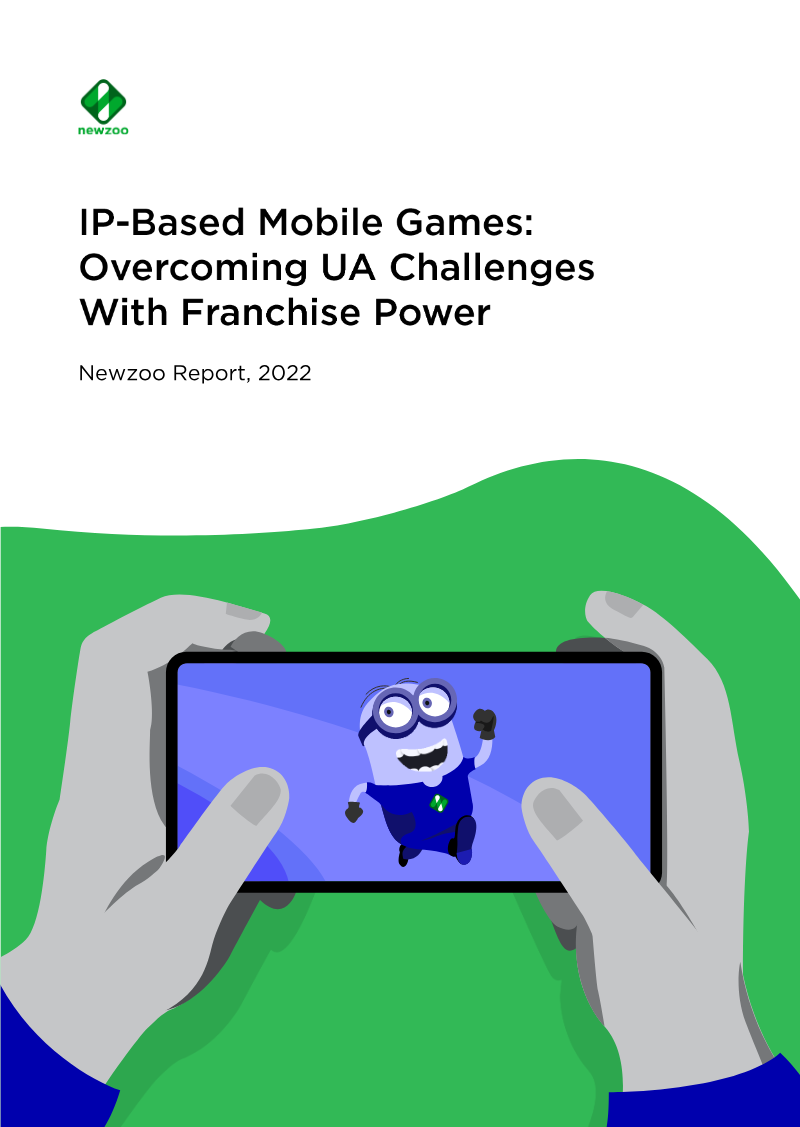
Intellectual property has emerged as a primary driver of success in the mobile gaming landscape, particularly as privacy changes like Apple’s IDFA have complicated traditional user acquisition. In 2021, the dominance of established franchises was underscored by the fact that only one non-IP title reached the top ten global downloads. High-spending players, defined as those investing over $25 per month, demonstrate a significantly higher propensity to download games based on familiar franchises compared to low spenders. This trend translates into superior long-term value and revenue potential for developers who leverage recognized brands to bypass rising marketing costs. The global market exhibits distinct regional dynamics regarding IP performance. While Western properties such as Disney and Marvel achieve massive download volumes worldwide, Eastern IPs—specifically those originating from Japanese manga and Chinese literature—consistently lead the top-grossing charts. This financial success is driven by the integration of deep monetization mechanics, such as gacha systems, and a strong cultural fit within Asian markets. However, the mere presence of a popular brand does not guarantee longevity. Success requires a "fan-first" approach where game mechanics align seamlessly with the source material. Titles like Umamusume: Pretty Derby illustrate how high-quality simulation and immersive character work drive retention, whereas technical shortcomings or a poor fit between the genre and the IP can lead to rapid player churn. Long-term profitability in the IP-based mobile sector depends on deep collaboration between developers and licensors to create exclusive content that expands the franchise's universe. Experts emphasize that localized cultural optimization and high production values are essential for maintaining engagement. By utilizing comprehensive market data and consumer research, industry stakeholders can better navigate these trends, sizing global opportunities and identifying the specific franchise-mechanic combinations that resonate most effectively with high-value audiences.
The content of this report is created with due care by Newzoo and protected by copyrights. This report, or any portion thereof, may not be reproduced, distributed, or transmitted in any form or by any means, including photocopying, recording, or other electronic or mechanical methods, or used in any manner whatsoever, without the express written permission of Newzoo. Reproducing, distributing, and/or transmitting this report, or any portion thereof, for commercial purposes is explicitly not allowed.
1. Overview of IP-Based Mobile Games 2. Evaluating IP-Based Mobile Games 3. Stakeholder Spotlights 4. Appendix
© Newzoo 2022 The origin of (referred to in this report as IP-based games) can be traced all the way back to the original Atari console. Compared to PC and console, mobile gaming often has Therefore, modern-day IP holders often choose mobile as their go-to- platform for bringing beloved franchises to gaming. The mobile game market continues to outperform PC and console as the biggest and fastest- growing gaming segment. By 2022, more than half (53%) of the global games market revenue will come from the mobile platform. For years, successful mobile developers relied on user tracking data to operate their live games and acquire audiences for new games. However, both policies, forcing publishers to find alternative ways to market their games. By leveraging well-known entertainment franchises to create an IP-based game, publishers are aiming to . To shed light on how IP-based games perform, we analyzed 650 IP-based mobile games based on data from our partner Airnow, of which 510 were active on the App Store and Google Play as of 2021. What’s more, we conducted a consumer survey across key mobile markets (i.e., U.S., Germany, Japan, and China) to understand mobile gamers’ attitude toward IP-based games on mobile. This report contains the findings of our analysis and the survey. It also includes our analysts’ commentary on key success drivers for top games globally and locally in the West and the East. Most excitingly, we feature stakeholder spotlights, based on interviews with key companies that are bringing IP to mobile games. Please note in the quantitative analysis of this report, we focus on entertainment franchises originally from movies, TV, literature, manga, comics, toys, etc. Our data excludes franchises that originated as games such as Pokémon, Call of Duty, and League of Legends. We believe that adopting entertainment IP to (mobile) gaming is fundamentally different than developing a mobile game based on an existing gaming franchise. 4 Foreword , Market Lead – Mobile , Market Analyst , Jr. Market Analyst , Jr. Market Analyst
© Newzoo 2022 6 Among top downloaded games launched in 2021, only 1 is not IP-based Among Top 100 Downloaded iOS Games | *Games Released in 2021 1 Wild Rift Riot Games Riot Games League of Legends 2 Rocket League Sideswipe Psyonix Psyonix Rocket League 3 Crash Bandicoot: On the Run! King King Crash Bandicoot 4 Pokémon Unite Tencent The Pokémon Company Pokémon 5 Battle of Golden Spatula [CN] Riot Games Tencent League of Legends 6 Soccer Super Star Real Free Soccer Real Free Soccer N N/A 7 Mole's World [CN] Game.61 Leiting Games Mole's World 8 Cookie Run: Kingdom Devsisters Devsisters The Gingerbread Man 9 Harry Potter: Magic Awakened Warner Bros. & NetEase NetEase Harry Potter Data is pivotal to success in mobile gaming, enabled through tracking and targeting of players. However, the past year has seen further shifts around privacy and tracking in the mobile space, creating challenges for mobile companies. Perhaps one of the most influential changes is Apple’s , which was launched in late April 2021. As a result, mobile game publishers are forced to find alternative ways to market their games. One of those alternatives is IP-based games. Simply put, Together with Airnow, our mobile intelligence partner, we looked all the new iOS games in 2021 that hit the top 100 download chart. We found that (Soccer Super Star) , proving that . Please note: our analysis excludes hypercasual games which naturally attract high downloads. Source: Airnow
© Newzoo 2022 22% 25% 22% 20% 21% 22% 20% 20% 14% 18% 18% 22% 18% 18% 18% 13% 11% 16% 16% 17% 20% 15% 12% 13% 11% 15% 16% 15% 14% 12% 14% 14% 8% 11% 18% 17% 12% 11% 13% 12% 8% 12% 14% 16% 6% 12% 15% 15% 9% 13% 12% 15% 9% 10% 11% 12% 3% 6% 3% 8% 10% 11% 4% 6% 10% 10% 2% 5% 9% 10% 4% 1% 0% 0% Highlighted cells indicate significant differences versus the average. Green: statistically higher vs. average; red: statistically lower vs. average Other Favorite celebrity was the spokesperson It featured favorite voice actors/actresses Likes the publisher/developer It’s an IP or universe liked Could make profits in real life The art style Recommendations from influencers Being able to play against others Reviews/ratings Leading app store recommendations Appealing advertisement Likes other games in the same franchise To see what all the fuss is about Being able to play with others Recommendations from friends or family Good storyline/setting/theme A new game in a genre Iiked Gameplay 7 Base: Total mobile players (n=5,372) In addition to its positive impact on a game’s user acquisition, strong IP plays a key role in attracting high spenders, potentially leading to higher revenues for IP-based mobile games. Our Consumer Insights in the U.S., Germany, Japan, and China suggest big spenders (who spend >$25/month on mobile games) and average spenders ($5-$25/month) are more likely to download a game if it’s based on an existing franchise or IP/universe that they like. In fact, (>$5/month) , compared to low spenders (<$5/month). This is the between the two spender groups when it comes to motivations to download mobile games. Clearly, . Source: ©Newzoo | Global Mobile Market Report | September 2021
© Newzoo 2022 game IP-based non-game IP-based Roblox PUBG MOBILE Pokémon GO Cashman Casino Candy Crush Saga Clash of Clans Call of Duty®: Mobile Candy Crush Soda Saga DoubleDown™ Casino Jackpot Party Garena Free Fire Clash Royale Homescapes Slotomania™ Gardenscapes Fishdom Genshin Impact Bingo Blitz™ State of Survival Coin Master 8 In the U.S., mobile adoptions of existing game franchises are prominent Source: Airnow U.S., Japan, and China | 2021 game IP-based Uma Musume Pretty Derby Knives Out Ensemble Stars eFootball PES 2021 Monster Strike Pokémon GO Project Sekai: Colorful Stage feat. Hatsune Miku Dragen Quest Tact Professional Baseball Spirits A Genshin Impact Idle Girl LINE: Disney Tsum Tsum Fate/Grand Order Dragon Quest Walk Disney: Twisted Wonderland Romancing SaGa Re: Universe Puzzle & Dragons Dragon Ball Z Dokkan Battle Mafia City Jikkyō Powerful Pro Yakyū Peacekeeper Elite Moonlight Blade Mobile Infinite Border QQ Speed Mobile Honor of Kings Rise of Kingdoms Harry Potter: Magic Awakening JJ Doudizhu Fantasy Westward Journey Immortal World Onmyoji Life After Three Kingdoms Strategy Edition Westward Journey Shenwu 4 Doula Continent: Soul Master Duel Genshin Impact CrossFire Mobile Naruto Mobile Wendao game IP-based non-game IP-based
The mobile gaming landscape has shifted toward intellectual property (IP) as a primary strategy for navigating user-tracking challenges like Apple’s App Tracking Transparency. By 2021, nearly all top-downloaded new iOS titles were based on existing IPs, demonstrating that established brands are essential for driving organic acquisition and attracting high-spending players. While Western franchises like Disney and Marvel lead in global download volume, Eastern IPs—particularly those rooted in Japanese manga and Chinese literature—command superior revenue through specialized monetization models like gacha. This geographic divide highlights a fundamental difference in market behavior, where Western audiences prioritize battle mechanics while Asian markets focus on deep character development and simulation. Success in this sector requires a rigorous alignment between an IP’s core values and the chosen game genre. Titles such as Marvel Strike Force and Umamusume: Pretty Derby illustrate how faithful adherence to lore and character-driven mechanics fosters emotional attachment and long-term retention. However, leveraging a known brand introduces operational complexities, including intensive stakeholder management, extended development timelines for licensor approvals, and the necessity of localized adaptations to meet regional preferences. The primary objective for developers is to deliver a unique IP experience rather than prioritizing original game design, as any perceived misalignment with the source material can lead to immediate user churn. The industry is currently evolving toward a transmedia model where mobile games are no longer secondary products but integral components of a franchise’s universe. This strategy involves integrating game-original content back into the broader IP narrative to sustain community engagement across multiple platforms. Ultimately, the effectiveness of an IP-based title hinges on its ability to lower user acquisition costs while maintaining a "perfect fit" between the theme and gameplay. As the market matures, the integration of cross-platform strategies will be vital for publishers seeking to maximize the lifecycle and monetization potential of global entertainment brands.
The global gaming landscape in 2023 was defined by the overwhelming commercial dominance of established intellectual properties, which accounted for every top launch on PC and console. Licensed mobile titles generated $16 billion in gross revenue, driven largely by the unprecedented success of Monopoly GO!, which reached $1 billion in revenue in under seven months. This performance propelled Hasbro and Scopely to the top of the corporate and publisher rankings, respectively. While video game and anime IPs continue to command the largest market share—particularly in Asia where they account for 70% of downloads—board game IPs experienced a significant revenue surge within the United States. Strategic integration of IP serves as a critical driver for both monetization and marketing efficiency. Role-playing games remain the most lucrative genre for licensed content due to the effectiveness of gacha-based monetization, while cross-platform collaborations and limited-time events continue to expand audience reach. Furthermore, established franchises demonstrate superior cost-efficiency compared to original titles, achieving high sales volumes with significantly lower marketing expenditures. This suggests that leveraging recognized brands provides a vital competitive advantage in an increasingly crowded marketplace. Despite the high visibility of major hits, the mobile IP market remains largely unsaturated, with licensed titles currently accounting for less than 20% of total revenue across most genres. While RPGs and social casino mechanics have proven successful, casual categories such as puzzle and simulation games represent significant untapped opportunities for future integration. Growth in the sector is increasingly dependent on high-profile new launches rather than the expansion of legacy titles, indicating that the strategic selection and execution of new IP partnerships will dictate the next phase of industry expansion.
The global mobile gaming market entered a period of mature recovery in 2024, characterized by a strategic pivot toward live services and high-value player retention. While total downloads declined by 6.6%, global in-app purchase revenue grew by 4% to reach $82 billion. This growth was primarily driven by North America and the Middle East, offsetting spending declines in Asia. The industry has transitioned into a "live operations" era, where 84% of all revenue is generated by games utilizing continuous updates and seasonal events. This shift is further evidenced by a 50% decrease in new game releases since 2020, as publishers prioritize high-quality core titles over volume. Genre performance highlights a market dominated by Strategy and RPG titles, which collectively generated over $34 billion in 2024. Action games emerged as the fastest-growing category with a 46% revenue increase, fueled by breakout hits like Last War: Survival. Despite the dominance of established franchises, a record 11 games surpassed $1 billion in annual consumer spend, including MONOPOLY GO!, which secured the top global position. The market is also seeing a demographic shift, particularly in the United States, where the 18-24 age group now represents 18% of the player base, up from 13% in 2022. Marketing strategies have evolved to combat rising user acquisition costs, with a significant move toward high-intent creative content and short-form video platforms. TikTok experienced a 67% year-over-year growth in social ad share, while mid-core developers nearly doubled their impression share on social networks. To maintain profitability, publishers are increasingly leveraging external web stores, celebrity partnerships, and localized cultural influencers, such as virtual YouTubers in the Japanese market. These trends underscore a broader industry movement toward sophisticated monetization models and IP-driven growth in an increasingly concentrated competitive landscape.
The analysis establishes that genre is the primary driver of mobile‑game discovery, influencing 49 % of players across nine major markets and outweighing recommendations and advertising. Within this framework, strategy titles deliver the highest lifetime value and revenue per install, a result of dense monetisation layers such as consumable boosts, speed‑ups, loot‑box bundles and limited‑time offers. Player motivations and churn factors differ markedly by genre and region: Japanese action‑RPG/MMORPG users play chiefly for stress relief (47 %) and item collection (37 %), while boredom, repetitiveness and aggressive monetisation trigger attrition, mirroring the experience of over a third of Korean RPG players who abandon games due to pushy in‑app purchases. Puzzle gamers are predominantly female (≈ 70 %) and older (≈ 60 % aged 35 +), favor short solo sessions, and seek stress relief and time‑killing. A pronounced mismatch exists between their expectations—learning, accomplishment and unique experiences—and current offerings, with only 17‑32 % feeling satisfied, leading to churn driven by boredom, slow progress and intrusive ads. Successful titles mitigate this through frequent live events, special‑event currencies and diverse level‑goal designs, while modest social engagement (20‑30 %) still influences retention. Notably, more than 80 % of U.S. puzzle players and roughly 68 % of Japanese players would return after a 30‑day hiatus if informed of new content, and 30‑36 % cite such updates as a decisive factor. Hyper‑casual audiences in the United States, United Kingdom and South Korea also demonstrate high receptivity to developer communication, exceeding 80 %. A comprehensive catalogue of core gameplay and monetisation mechanics—battle‑passes, consumable boosts, crafting, limited‑time bundles, VIP tiers, loot‑boxes