ReportNewzoo
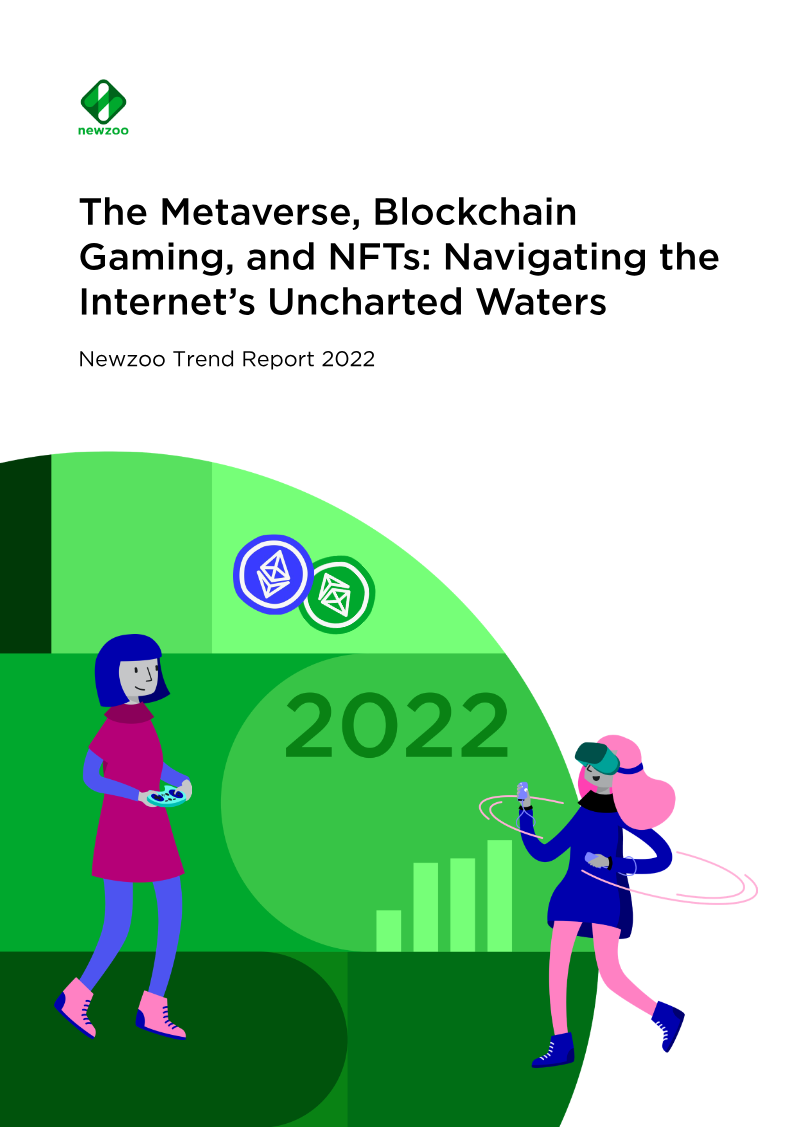
The Metaverse, Blockchain Gaming, and NFTs: Navigating the Internet’s Uncharted Waters
202246 pages~81 min full read
The metaverse represents a fundamental shift from a two-dimensional internet toward a persistent, three-dimensional social ecosystem driven by gamified virtual spaces. This evolution is currently led by "game as a platform" models, most notably Roblox, which leverages tens of millions of daily active users to host diverse commercial and social experiences. While major global brands in fashion, luxury, and finance are increasingly investing in "direct-to-avatar" economies and digital real estate to reach younger, digital-native demographics, the sector faces significant economic and technical hurdles. High developer take rates, consistent net losses among platform leaders, and networking limitations that prevent massive simultaneous user scaling remain primary obstacles to long-term growth.
The integration of blockchain technology and non-fungible tokens (NFTs) has introduced new economic paradigms, such as the "Play-to-Earn" model. Although these games accounted for nearly half of all decentralized application wallet activity by late 2021, their growth is largely concentrated in emerging markets where users treat gaming as an income-generating activity. The sustainability of these ecosystems is currently challenged by high entry barriers and a prioritization of financial speculation over core gameplay quality. For the industry to mature, it must transition toward higher-quality experiences and more robust virtual economies that offer genuine utility beyond profile-picture status symbols.
Mass adoption of these decentralized virtual worlds is currently constrained by technical and regulatory friction. Interoperability across different platforms remains a theoretical goal rather than a functional reality, while high transaction fees on networks like Ethereum and environmental concerns create additional barriers. Furthermore, the industry must navigate complex legal landscapes regarding digital privacy, content moderation, and the protection of intellectual property. Despite a cooling of initial market hype following a crypto correction in 2022, the long-term trajectory points toward a transmedia future where digital assets and virtual identities are central to global commerce and social interaction.

Google · 2026
Newzoo · 2026

Newzoo · 2026
Newzoo · 2026

Deconstructor of Fun · 2026
Newzoo · 2026
Newzoo · 2026
Newzoo · 2026
Newzoo · 2026

Newzoo · 2026
Newzoo · 2026
Newzoo · 2025
DappRadar · 2022
Newzoo · 2022
Newzoo · 2022
Newzoo · 2022
Stream Hatchet · 2024
Game7 Research · 2024
DappRadar · 2022
CMC Research · 2022
DappRadar · 2022
GDC · 2022
Newzoo · 2022
DappRadar · 2022