Report4 pages
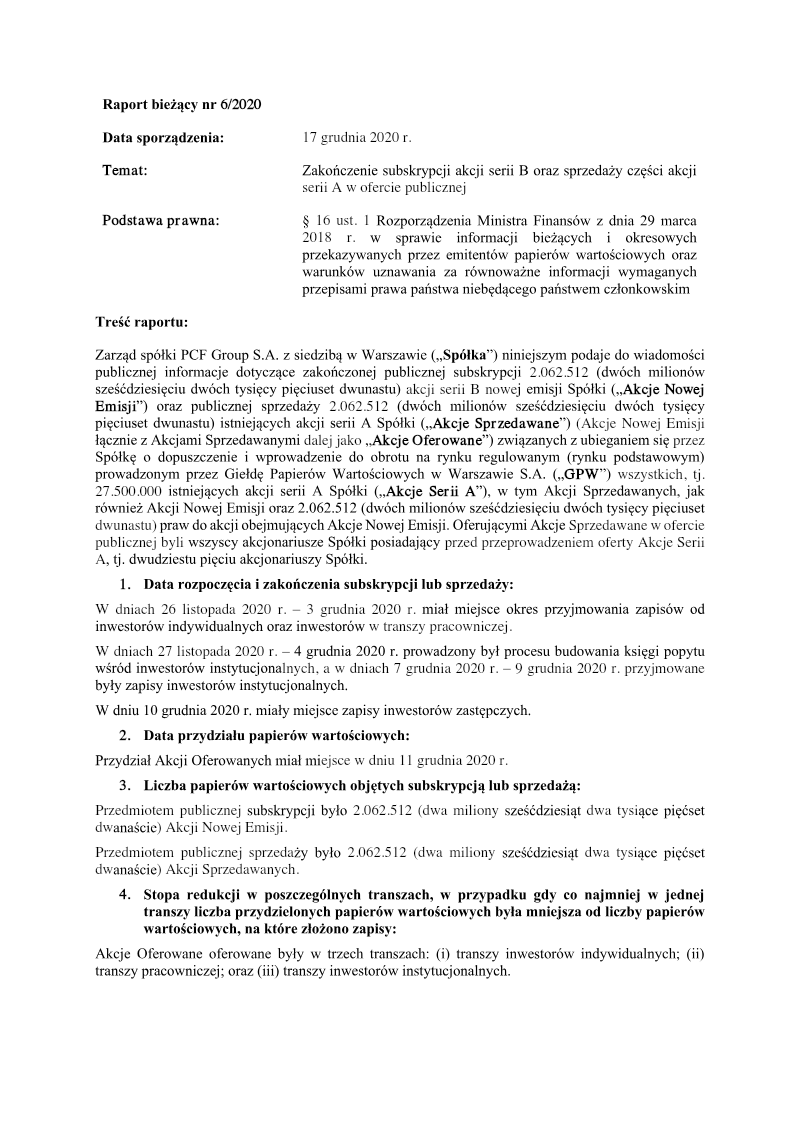
Zakończenie subskrypcji akcji serii B oraz sprzedaży części akcji serii A w ofercie publicznej
The report details the completion of PCF Group S.A.’s public subscription for 2,062,512 new Series B shares and the simultaneous sale of an equal number of existing Series A shares. The transaction aimed to secure listing on the Warsaw Stock Exchange and involved all 27,500,000 existing Series A shares. The subscription period ran from 26 November to 3 December 2020 for individual investors and employee‑shareholder tranches, while institutional investors were engaged from 27 November to 9 December. Allocation occurred on 11 December, with all offered shares fully distributed.
The offering was structured into three tranches: individual investors (price 46.00 PLN), employee‑shareholder tranches (41.40 PLN), and institutional investors (50.00 PLN). Employee‑shareholder bids were treated preferentially, and a 98.486 % reduction applied only to individual investor bids for new shares. Institutional investors received both new and existing shares, with 284 institutions subscribing to the sale of existing Series A shares.
Total subscription volume for new shares reached 42,310,783 bids across all tranches, while the sale of existing shares attracted exactly 2,062,512 bids from institutions. Allocation matched the offered quantities: 2,062,512 new shares and 2,062,512 existing shares were issued. The average price for new shares varied by tranche, with the institutional tranche at 50 PLN, resulting in a subscription value of approximately 100.29 million PLN and a sale value of about 103.13 million PLN.
The report notes that detailed cost breakdowns and final pricing will be disclosed in subsequent filings, as the company has not yet finalized all expense items. The transaction represents a significant capital‑raising effort, expanding the company’s share base and facilitating its entry onto Poland’s regulated market.
- PCF Group S.A. successfully completed a public offering of 2,062,512 new Series B shares and the sale of 2,062,512 existing Series A shares to facilitate its listing on the Warsaw Stock Exchange.
- The offering generated a subscription value of approximately 100.29 million PLN for new shares and a sale value of approximately 103.13 million PLN for existing shares.
- Shares were distributed across three tranches with varying prices: 46.00 PLN for individual investors, 41.40 PLN for employees, and 50.00 PLN for institutional investors.
- Demand for the new Series B shares significantly exceeded supply, resulting in a 98.486% reduction rate for individual investor bids.
- The institutional tranche was fully subscribed by 284 institutions, which acquired the entirety of the 2,062,512 existing Series A shares offered.
+1
PCF Group
Report1 pages
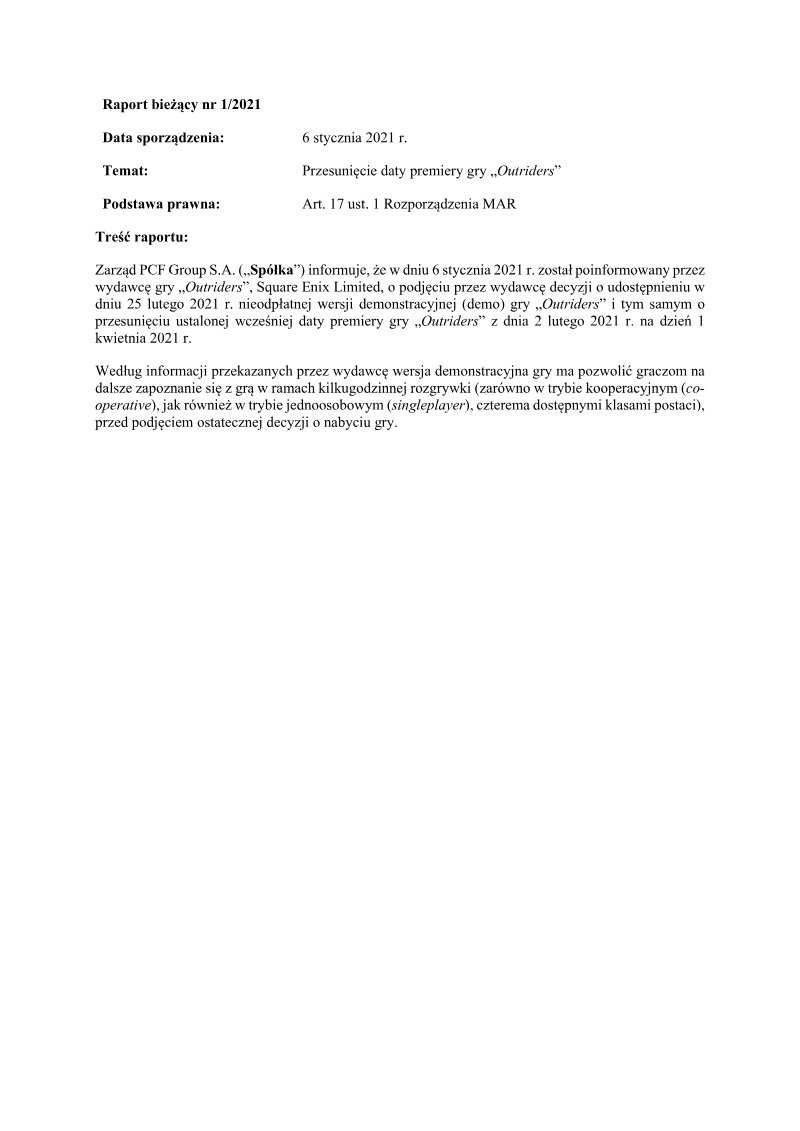
Raport Bieżący Nr 1/2021: Przesunięcie Daty Premiery Gry Outriders
The report informs stakeholders that Square Enix Limited has postponed the release of its title “Outriders.” The publisher announced that a free demo will be available on 25 February 2021, and the official launch date has been moved from 2 February to 1 April 2021. The demo is intended to provide players with several hours of gameplay, covering both cooperative and single‑player modes across all four character classes, to aid in purchase decisions. The information was received by the board of PCF Group S.A. on 6 January 2021, and the notice is issued under Article 17(1) of the MAR regulation. The scope covers the Polish market and pertains exclusively to the “Outriders” title, with no broader industry implications noted. No survey or statistical methodology is described; the update relies solely on publisher communication. The key outcome is a two‑month delay in launch, accompanied by an early demo release aimed at maintaining consumer interest and supporting sales conversion.
- Square Enix Limited has postponed the official release date of the game 'Outriders' from 2 February 2021 to 1 April 2021.
- A free demo for 'Outriders' will be released on 25 February 2021 to assist consumer purchase decisions.
- The demo will feature several hours of gameplay, supporting both single-player and cooperative modes across all four character classes.
- The board of PCF Group S.A. received official notification of the delay on 6 January 2021.
- This disclosure was issued in compliance with Article 17(1) of the MAR regulation.
+3
PCF Group
Report1 pages
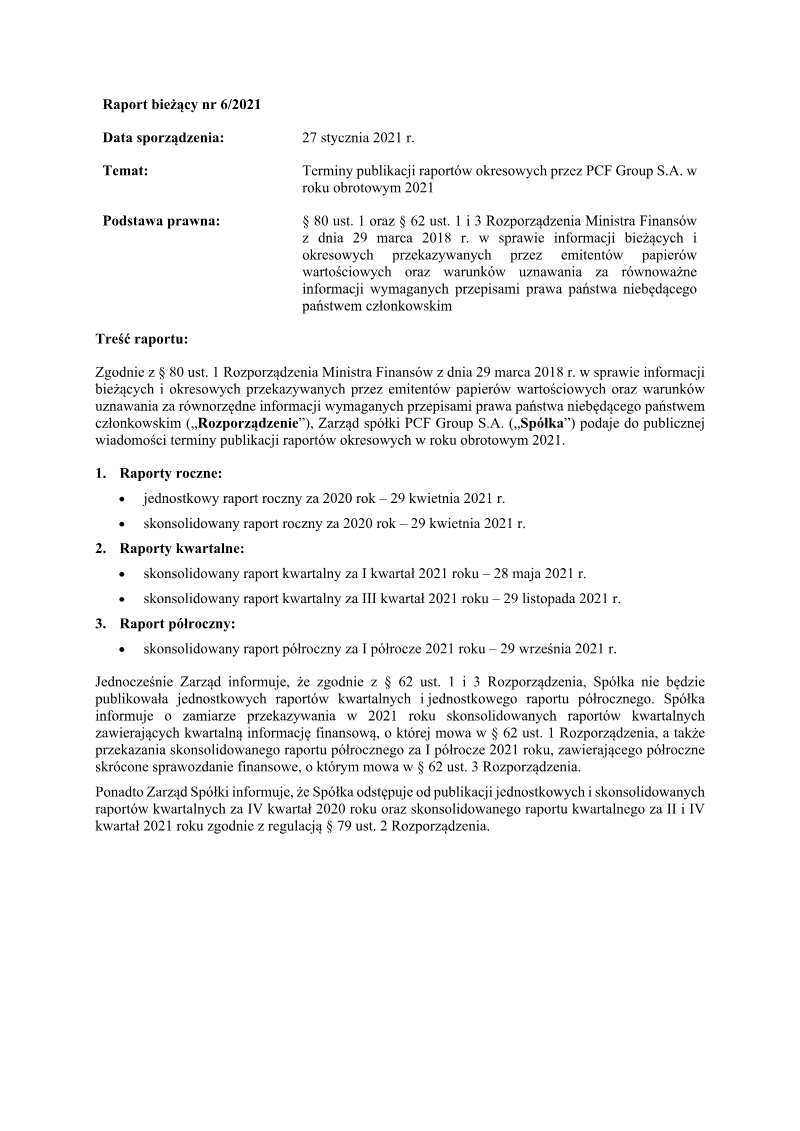
Terminy publikacji raportów okresowych przez PCF Group S.A. w roku obrotowym 2021
The report announces the publication schedule for PCF Group S.A.’s periodic disclosures in the 2021 fiscal year, pursuant to Polish financial regulation. It specifies that both the individual and consolidated annual reports for 2020 will be released on 29 April 2021. Consolidated quarterly reports are scheduled for the first quarter (28 May 2021) and third quarter (29 November 2021), while the consolidated half‑yearly report for the first half of 2021 will appear on 29 September 2021. The company confirms that it will not issue individual quarterly or half‑yearly reports, aligning with § 62 of the regulation. Instead, it will provide consolidated quarterly statements containing the required financial information and a consolidated half‑yearly report with a condensed financial statement. Additionally, PCF Group S.A. declares its decision to forgo publishing the consolidated quarterly report for Q4 2020 and the consolidated quarterly reports for Q2 and Q4 2021, in accordance with § 79(2) of the regulation. The scope covers all reporting obligations for PCF Group S.A. within Poland’s 2021 fiscal year, with no mention of external data sources or survey methodology, as the document serves purely to inform stakeholders of compliance timelines.
- PCF Group S.A. will release its 2020 individual and consolidated annual reports on 29 April 2021.
- The consolidated half-yearly report for the first half of 2021 is scheduled for publication on 29 September 2021.
- Consolidated quarterly reports for Q1 and Q3 2021 are set to be released on 28 May 2021 and 29 November 2021, respectively.
- PCF Group S.A. will not issue individual quarterly or half-yearly reports, opting instead to provide consolidated statements in accordance with Polish financial regulations.
- The company has formally opted out of publishing consolidated quarterly reports for Q4 2020, Q2 2021, and Q4 2021, as permitted under § 79(2) of the applicable regulations.
PCF Group
Report1 pages
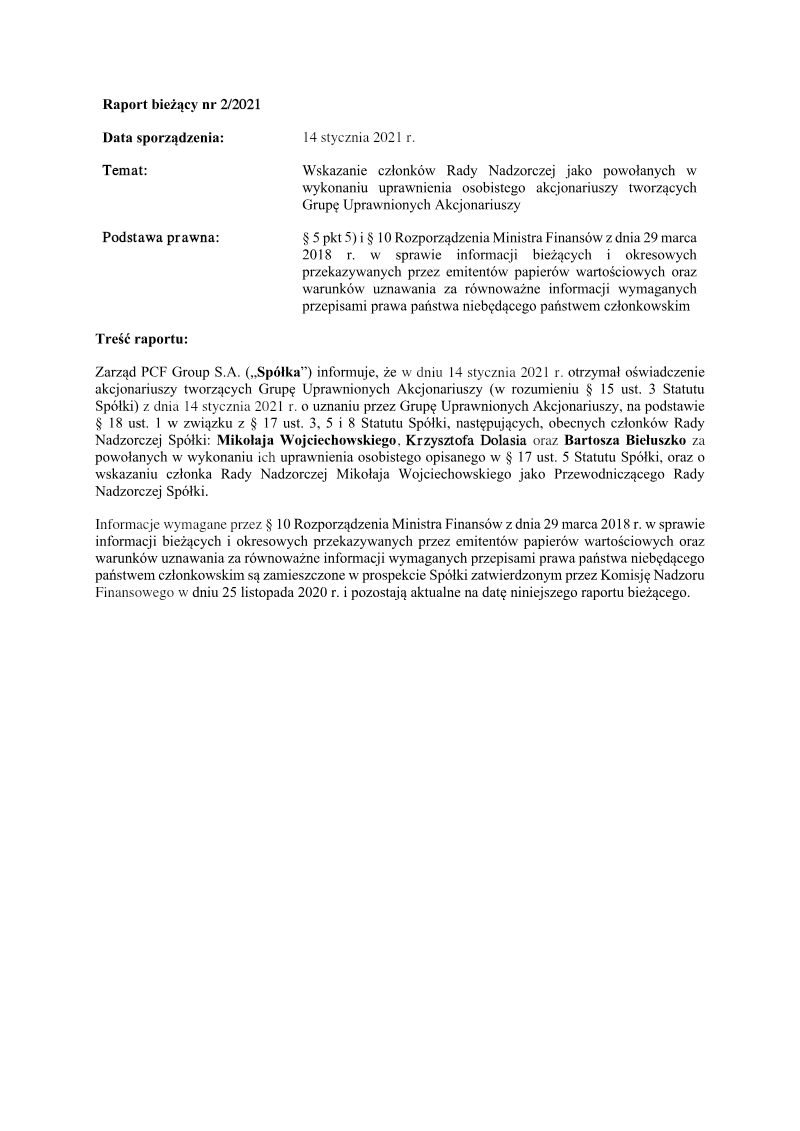
Current Report No. 2/2021: Appointment of Supervisory Board Members
The report announces the appointment of supervisory board members for PCF Group S.A. on 14 January 2021, following a declaration by the group of entitled shareholders. Under Polish corporate statutes and the 2018 Ministry of Finance regulation on current information, the board now includes Mikołaj Wojciechowski, Krzysztof Dolias, and Bartosz Biełuszko, all elected pursuant to the shareholders’ personal rights. Wojciechowski is designated as chairman of the supervisory board.
The document confirms that all required information under § 10 of the Ministry regulation is incorporated in the company’s prospectus, approved by the Polish Financial Supervision Authority on 25 November 2020, and remains current as of the report date. No additional data or statistics are presented; the scope is limited to the corporate governance update for PCF Group S.A. in Poland, covering a single event within the 2021 reporting period. The methodology is straightforward: the board composition was determined by shareholder vote in accordance with statutory provisions, and the report serves to inform stakeholders of this change.
- On 14 January 2021, PCF Group S.A. appointed Mikołaj Wojciechowski, Krzysztof Dolias, and Bartosz Biełuszko to its supervisory board.
- Mikołaj Wojciechowski has been designated as the chairman of the newly appointed supervisory board.
- The board members were elected based on the personal rights of entitled shareholders in accordance with Polish corporate statutes.
- The appointment process and board composition comply with the requirements detailed in the company’s prospectus, which was approved by the Polish Financial Supervision Authority on 25 November 2020.
- This corporate governance update fulfills the disclosure obligations mandated by the 2018 Ministry of Finance regulation regarding current information.
PCF Group
Report1 pages
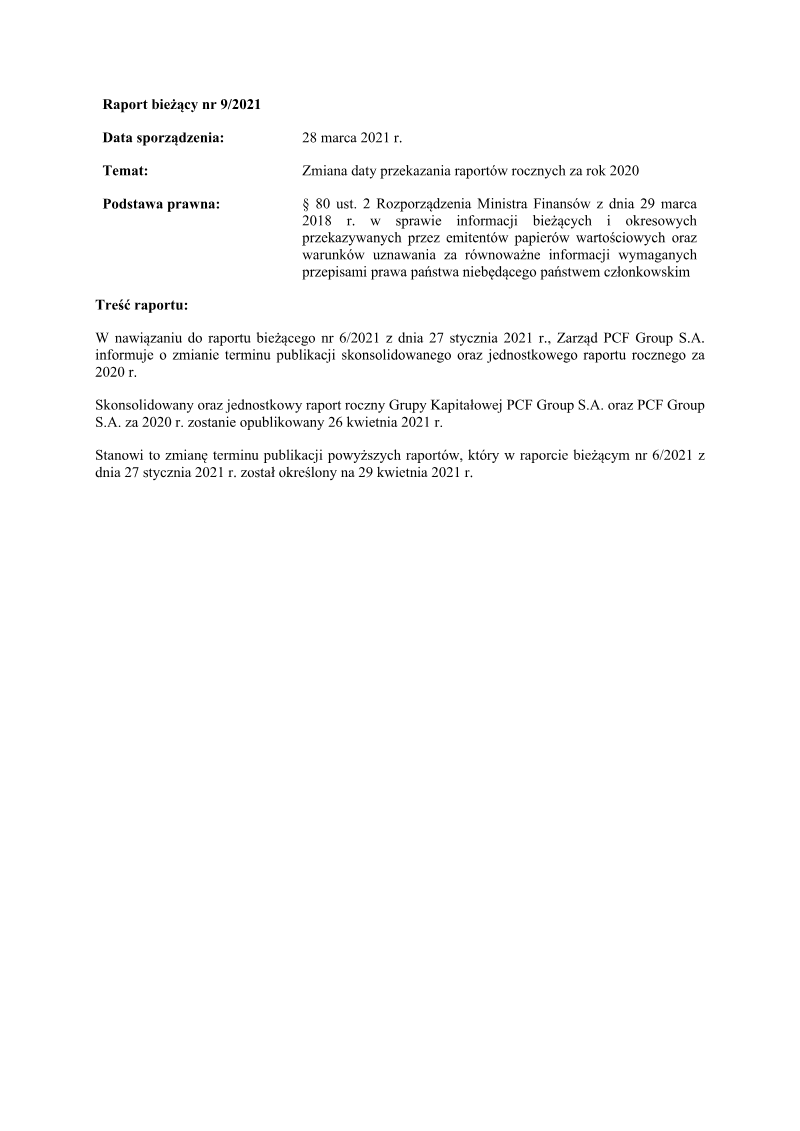
Raport Bieżący Nr 9/2021: Zmiana Daty Przekazania Raportów Rocznych za Rok 2020
The report announces a revision of the publication date for PCF Group S.A.’s consolidated and individual annual reports covering 2020. The change follows a prior interim report issued on 27 January 2021, which had set the release for 29 April 2021. The new schedule moves the publication forward to 26 April 2021, allowing stakeholders to receive financial statements earlier. The adjustment is grounded in § 80(2) of the Minister of Finance regulation dated 29 March 2018, which governs the timing and equivalence of information provided by securities issuers. The announcement is issued by the Board of PCF Group S.A., confirming that both the group’s consolidated report and the individual entity’s annual report will adhere to the updated deadline. No additional data, statistics, or broader industry context are provided; the focus remains solely on the procedural update. The scope is limited to PCF Group S.A. and its reporting obligations for the fiscal year 2020, with no mention of geographic expansion or comparative analysis. The methodology is implicit in regulatory compliance rather than empirical research, and the communication serves to inform investors, regulators, and other interested parties of the revised timeline.
- PCF Group S.A. has moved the publication date for its 2020 consolidated and individual annual reports from 29 April 2021 to 26 April 2021.
- The revised reporting schedule accelerates the release of financial statements by three days for stakeholders.
- The change in the reporting timeline is executed in accordance with § 80(2) of the Minister of Finance regulation dated 29 March 2018.
- The update applies exclusively to the 2020 fiscal year reporting obligations for PCF Group S.A.
- The Board of PCF Group S.A. confirmed that both the group’s consolidated report and the individual entity’s annual report will adhere to the new 26 April 2021 deadline.
PCF Group
Report1 pages
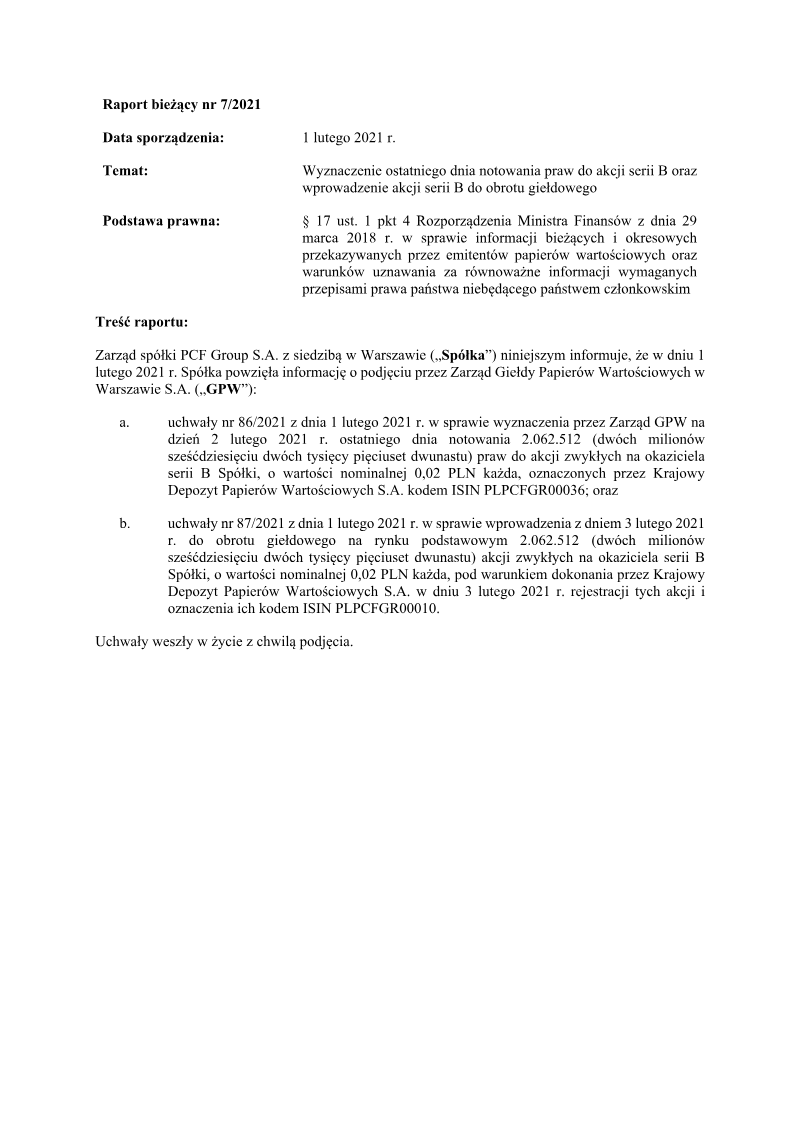
Raport Bieżący Nr 7/2021: Wyznaczenie Ostatniego Dnia Notowania Praw do Akcji Serii B
The report announces that on February 1, 2021 the board of PCF Group S.A. received confirmation from the Warsaw Stock Exchange (GPW) regarding two key decisions affecting the company’s Series B ordinary shares. First, GPW’s resolution No. 86/2021 designates February 2, 2021 as the final trading day for 2,062,512 Series B shares, each with a nominal value of 0.02 PLN and identified by ISIN PLPCFGR00036. Second, resolution No. 87/2021 authorises the introduction of the same number of Series B shares into primary market trading on February 3, 2021, contingent upon the National Securities Depository’s registration of these shares and assignment of ISIN PLPCFGR00010. Both resolutions became effective immediately upon adoption.
The document serves to inform shareholders and market participants of the scheduled cessation of trading for existing Series B shares and the subsequent listing of newly issued shares, thereby ensuring compliance with Polish financial regulations. It references § 17(1)(4) of the 2018 Ministerial Regulation on ongoing and periodic information required from issuers, underscoring the legal basis for disclosure. No additional data such as market impact figures or investor surveys are included; the focus remains strictly on procedural dates, share quantities, nominal values, and ISIN identifiers. The scope is limited to PCF Group S.A.’s Series B ordinary shares within the Polish capital market, covering a single time frame in early February 2021.
- PCF Group S.A. will cease trading of 2,062,512 Series B shares (ISIN PLPCFGR00036) on the Warsaw Stock Exchange after February 2, 2021.
- The company will introduce 2,062,512 new Series B shares to primary market trading on February 3, 2021, under the new ISIN PLPCFGR00010.
- The transition of Series B shares is contingent upon the registration of the new shares by the National Securities Depository.
- Each of the 2,062,512 Series B shares involved in the transition carries a nominal value of 0.02 PLN.
- The Warsaw Stock Exchange formalized these changes through resolutions No. 86/2021 and No. 87/2021, both effective as of February 1, 2021.
+1
PCF Group
Report2 pages
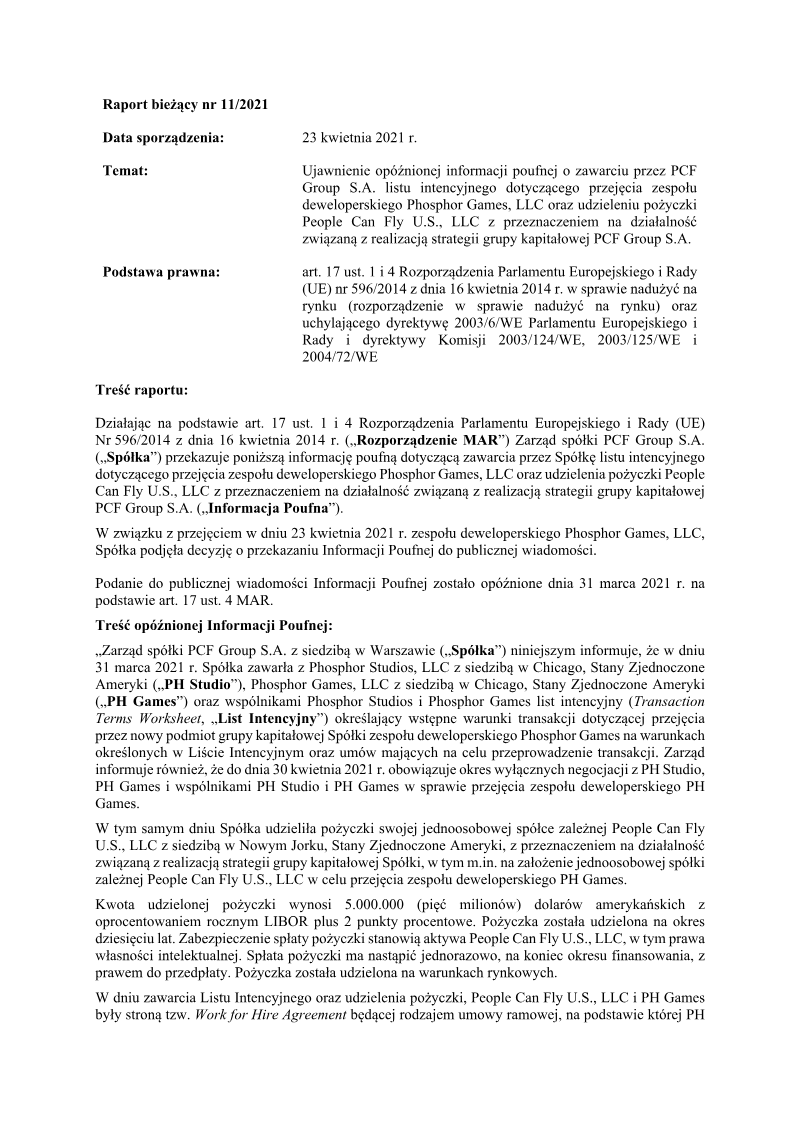
Raport bieżący nr 11/2021Ujawnienie opóźnionej informacji poufnej o zawarciu przez PCF Group S.A. listu intencyjnego dotyczącego przejęcia zespołu deweloperskiego Phosphor Games, LLC
The report discloses that PCF Group S.A., a Warsaw‑based holding, entered into an intention letter on 31 March 2021 to acquire the development team of Phosphor Games, LLC, a Chicago‑based studio. The transaction is subject to an exclusive negotiation period until 30 April 2021 and involves a loan of USD 5 million to the group’s subsidiary People Can Fly U.S., LLC, with LIBOR plus 2 % interest over ten years. The loan is secured by the subsidiary’s intellectual property and is intended to fund the acquisition of Phosphor Games’ team. The report clarifies that signing the intention letter and initiating negotiations does not guarantee completion of the acquisition, noting potential risks to negotiation outcomes.
The disclosure was delayed until 23 April 2021 in accordance with Article 17(4) of the EU Market Abuse Regulation (MAR). Management justified the delay by citing legal and commercial considerations: premature disclosure could jeopardise negotiation dynamics, affect transaction terms, or mislead the market. The report outlines that confidentiality was maintained through a controlled list of personnel with access to the information, updated per MAR requirements. Upon publication, PCF Group S.A. will notify the Polish Financial Supervision Authority of the delay and its compliance with MAR provisions.
The scope covers a single acquisition transaction involving U.S. entities, with financial terms specified in USD and interest linked to LIBOR. The methodology is a regulatory compliance disclosure, referencing MAR articles and European Securities and Markets Authority guidance on delayed information release.
- PCF Group S.A. signed a letter of intent on 31 March 2021 to acquire the Chicago-based development team of Phosphor Games, LLC.
- The acquisition is being funded by a USD 5 million loan provided to the subsidiary People Can Fly U.S., LLC, which is secured by the subsidiary's intellectual property.
- The loan terms include an interest rate of LIBOR plus 2% with a ten-year maturity period.
- The parties entered an exclusive negotiation period that was scheduled to conclude on 30 April 2021.
- PCF Group S.A. delayed the public disclosure of this information until 23 April 2021, citing the need to protect negotiation dynamics and transaction terms under EU Market Abuse Regulation (MAR) provisions.
+1
PCF Group
Report1 pages
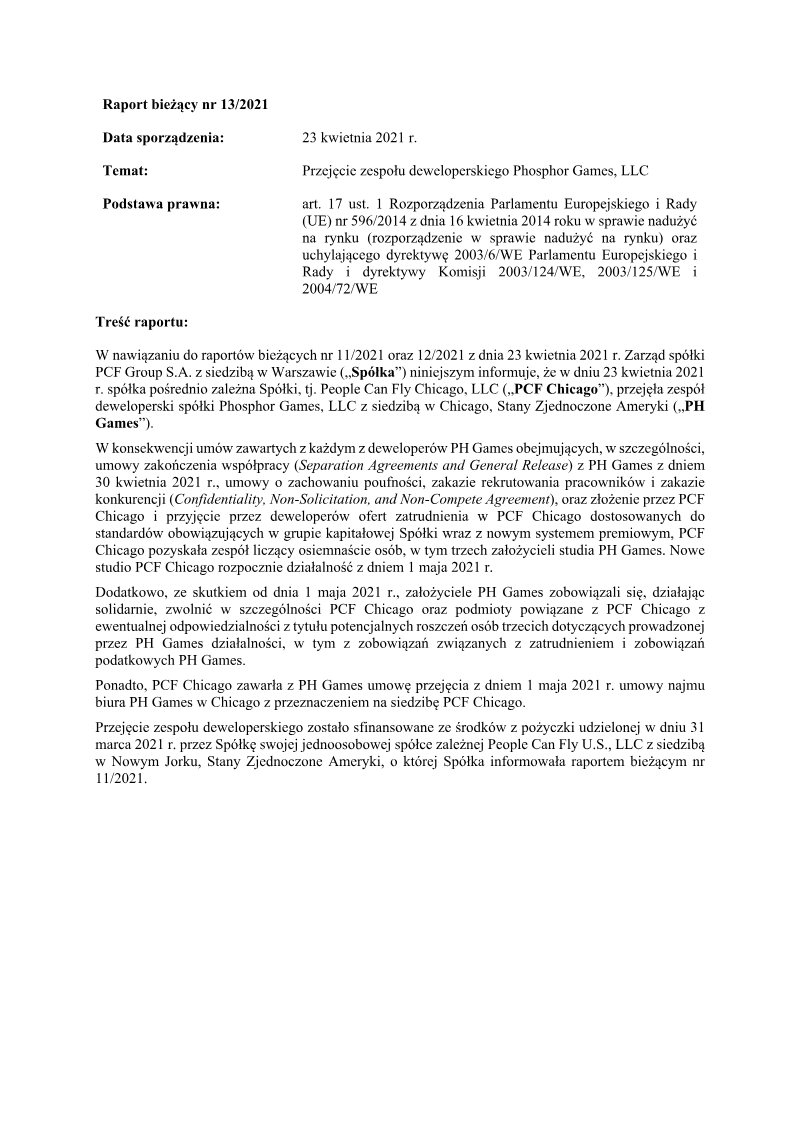
Raport Bieżący Nr 13/2021: Przejęcie Zespołu Deweloperskiego Phosphor Games, LLC
The report details the acquisition of Phosphor Games’ development team by People Can Fly Chicago, LLC (PCF Chicago), a subsidiary of PCF Group S.A. The transaction occurred on 23 April 2021, with the new studio commencing operations on 1 May 2021. PCF Chicago secured an eighteen‑person team, including three founding members of Phosphor Games. Employment agreements were signed under PCF Group standards, incorporating a new bonus scheme, while confidentiality, non‑solicitation, and non‑compete clauses were enforced. Separation agreements terminated prior collaborations with Phosphor Games as of 30 April 2021.
Liability protection was achieved through a joint indemnity commitment by Phosphor Games’ founders, shielding PCF Chicago and related entities from third‑party claims linked to former activities, including employment and tax obligations. Additionally, PCF Chicago assumed the lease of Phosphor Games’ Chicago office to serve as its headquarters. Financing for the acquisition was sourced from a loan granted on 31 March 2021 by People Can Fly U.S., LLC, a wholly owned subsidiary of PCF Group.
The scope covers the United States, specifically Chicago and New York, within the video‑game development sector. The report reflects a corporate restructuring aimed at consolidating talent and assets under the PCF Group umbrella, enhancing operational efficiency and expanding its North American presence.
- On 23 April 2021, PCF Group S.A. subsidiary PCF Chicago acquired the 18-person development team of Phosphor Games, LLC.
- The new studio officially commenced operations on 1 May 2021, with three founding members of Phosphor Games joining the PCF Chicago team.
- PCF Chicago assumed the lease of the existing Phosphor Games office in Chicago to serve as its new North American headquarters.
- The acquisition was financed through a loan provided on 31 March 2021 by People Can Fly U.S., LLC, a wholly owned subsidiary of PCF Group.
- To mitigate risk, Phosphor Games’ founders provided a joint indemnity commitment protecting PCF Chicago from third-party claims related to prior tax, employment, and business activities.
+1
PCF Group
Report2 pages
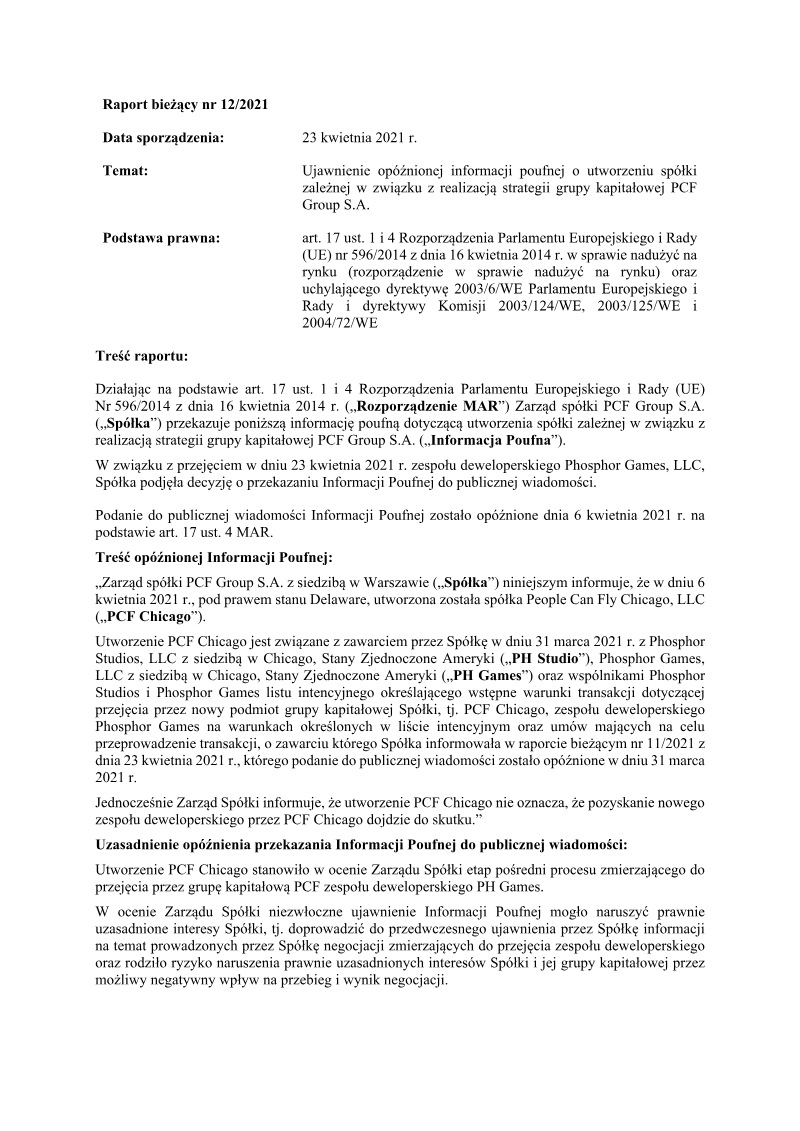
Raport Bieżący Nr 12/2021: Ujawnienie opóźnionej informacji poufnej o utworzeniu spółki zależnej
The report discloses a delayed confidential disclosure concerning the creation of a subsidiary, People Can Fly Chicago, LLC (PCF Chicago), under PCF Group S.A. The disclosure follows the acquisition of the Phosphor Games development team on 23 April 2021. The subsidiary was formed under Delaware law on 6 April 2021, as part of a letter‑of‑intent transaction with Phosphor Studios and Phosphor Games, intended to facilitate the acquisition of the development team. The report explains that the creation of PCF Chicago does not guarantee the successful acquisition of the team, and that the subsidiary’s establishment was an intermediate step in a broader strategy.
The delay in public disclosure, justified under Article 17(4) of the EU Market Abuse Regulation (MAR), was deemed necessary to protect the company’s legitimate interests. The board argued that premature release could have exposed ongoing negotiations, potentially harming deal terms and the company’s market value. Confidentiality was maintained through a monitored list of individuals with access, in compliance with Article 18 MAR. Upon publication, the company will notify the Polish Financial Supervision Authority of the delay and its justification.
The document covers a single corporate action within Poland’s PCF Group, involving entities in the United States and Delaware. It is a regulatory filing dated 23 April 2021, reflecting the company’s compliance with EU market‑abuse rules and its strategic acquisition activities in the gaming sector.
- PCF Group S.A. established a new subsidiary, People Can Fly Chicago, LLC, on 6 April 2021 to facilitate the acquisition of the Phosphor Games development team.
- The acquisition of the Phosphor Games team was finalized on 23 April 2021, following the formation of the Delaware-based subsidiary.
- PCF Group delayed the public disclosure of the subsidiary's creation under Article 17(4) of the EU Market Abuse Regulation to protect ongoing negotiations and market value.
- The company maintained strict confidentiality regarding the transaction by managing a monitored insider list in compliance with Article 18 of the EU Market Abuse Regulation.
- The establishment of People Can Fly Chicago, LLC served as an intermediate strategic step rather than a guarantee of the successful acquisition of the Phosphor Games team.
PCF Group
Report3 pages
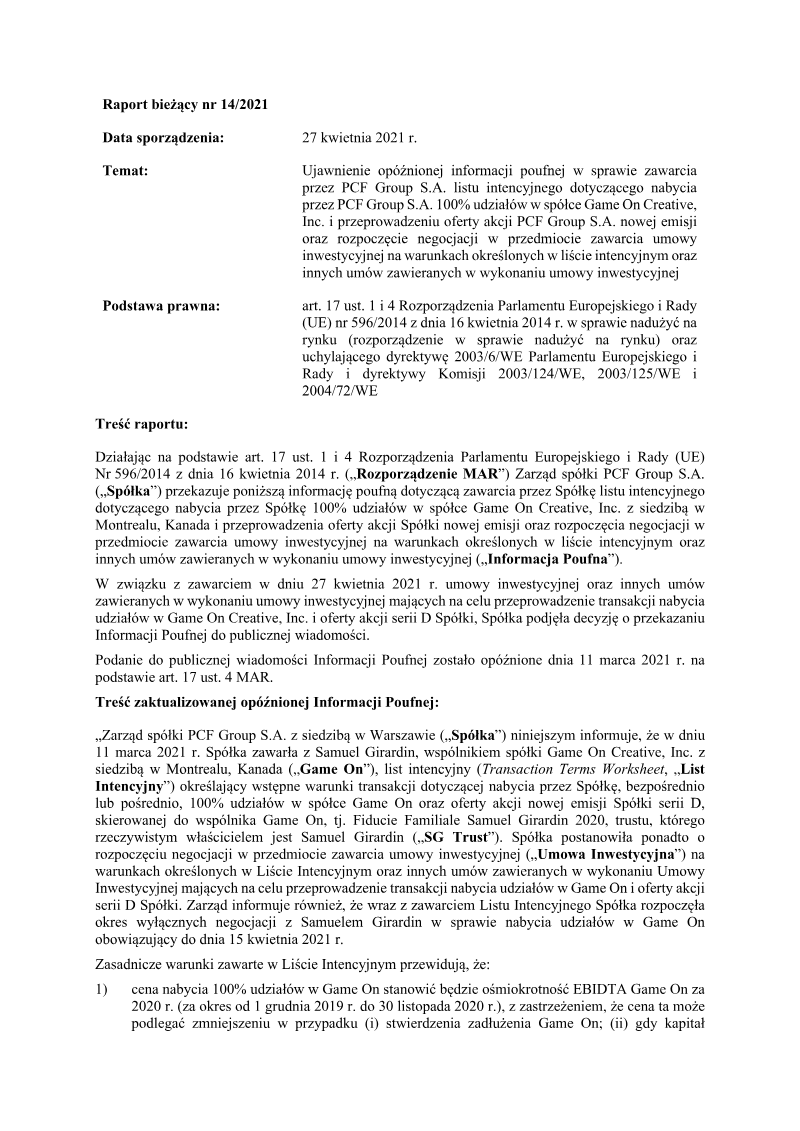
Current Report No. 14/2021: Acquisition of Game On Creative, Inc.
The report discloses that PCF Group S.A. entered into a letter of intent on 11 March 2021 to acquire 100 % of Game On Creative, Inc., a Montreal‑based studio, and to launch a Series D share offering. The transaction terms set the purchase price at eight times Game On’s 2020 EBITDA, subject to adjustments for debt, working‑capital thresholds and leakage. Upon acquisition, PCF plans an extraordinary general meeting to raise its share capital and offer Series D shares to the SG Trust, with a 15 % exemption from lock‑up and an earn‑out clause of 5 % EBITDA for years 2021–2025. Samuel Girardin, the Game On partner, will assume a dual role as Studio Head of People Can Fly Canada and President of Game On. The letter also outlines a legal and financial due‑diligence review, a potential call option for the SG Trust if capital increases are not registered by 31 December 2021, and a lock‑up period for the remaining Series D shares.
The disclosure was delayed until 27 April 2021 in accordance with EU Regulation 596/2014 (MAR) and the Polish Securities Authority guidelines, citing risks that early publication could harm negotiation dynamics or mislead investors. The report explains the confidentiality measures taken and states that the letter of intent does not guarantee completion of the acquisition. The information covers a single Canadian entity, pertains to a 2021 transaction timeline, and involves PCF Group’s Polish‑listed shares. No survey or external data sources are referenced; the methodology is limited to internal board deliberations and regulatory compliance.
- PCF Group S.A. signed a letter of intent on 11 March 2021 to acquire 100% of the Montreal-based studio Game On Creative, Inc.
- The acquisition price is set at eight times Game On’s 2020 EBITDA, with an additional earn-out clause of 5% EBITDA for the years 2021–2025.
- PCF Group plans to launch a Series D share offering to the SG Trust, which includes a 15% exemption from the standard lock-up period.
- Samuel Girardin will lead the expansion into Canada by serving as both Studio Head of People Can Fly Canada and President of Game On.
- The agreement includes a call option for the SG Trust if the required capital increases are not officially registered by 31 December 2021.
PCF Group
Report4 pages
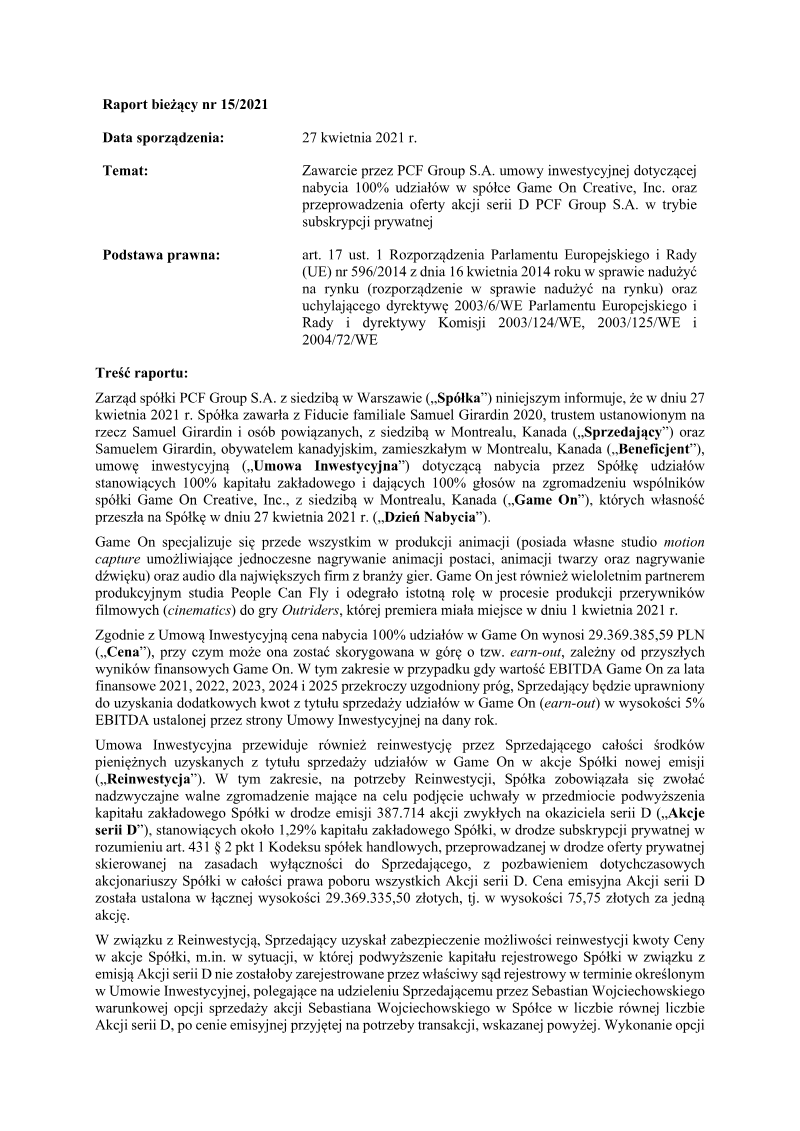
Current Report No. 15/2021: Investment Agreement and Share Acquisition
PCF Group S.A. completed a strategic acquisition of Game On Creative, Inc., a Montreal‑based animation and audio studio that supplies high‑end cinematics for major gaming titles, including the recent Outriders release. The transaction, finalized on 27 April 2021, involved a trust and its beneficiary Samuel Girardin. PCF paid PLN 29 369 385,59 for 100 % of Game On’s equity, with a potential earn‑out of 5 % of EBITDA for the fiscal years 2021‑2025 if predefined thresholds are surpassed.
To secure the purchase price, PCF agreed to issue 387 714 Series D ordinary bearer shares—approximately 1.29 % of its capital—at PLN 75,75 each in a private placement exclusively offered to the seller. The Series D shares are subject to a lock‑up covering 85 % of the issue, with staggered release dates through April 2023 and December 2024. A conditional call option from Sebastian Wojciechowski allows the seller to reacquire shares at the issue price if the capital increase is not registered on time, with a 30 % pre‑payment provision before lock‑up expiry.
The agreement includes standard representations, warranties, and a pledge covering roughly 30 % of the Series D shares to secure potential claims. Non‑competition clauses bind both seller and beneficiary, while Samuel Girardin will assume leadership roles within People Can Fly Canada, Inc., reinforcing PCF’s AAA development capabilities. The deal aligns with PCF’s strategy to enhance animation and audio production for simultaneous multi‑project development.
- PCF Group S.A. acquired 100% of Montreal-based animation and audio studio Game On Creative, Inc. for PLN 29,369,385.59 on April 27, 2021.
- The acquisition includes a performance-based earn-out provision granting the seller 5% of Game On’s EBITDA for the 2021–2025 fiscal years if specific thresholds are met.
- PCF financed the purchase by issuing 387,714 Series D shares at PLN 75.75 per share, representing approximately 1.29% of the company's total capital.
- The issued shares are subject to a staggered lock-up period ending in December 2024, with 85% of the shares restricted and 30% pledged to secure potential claims.
- Samuel Girardin will join People Can Fly Canada, Inc. in a leadership capacity to support PCF’s strategy of scaling animation and audio production for multi-project development.
+1
PCF Group
Report2 pages
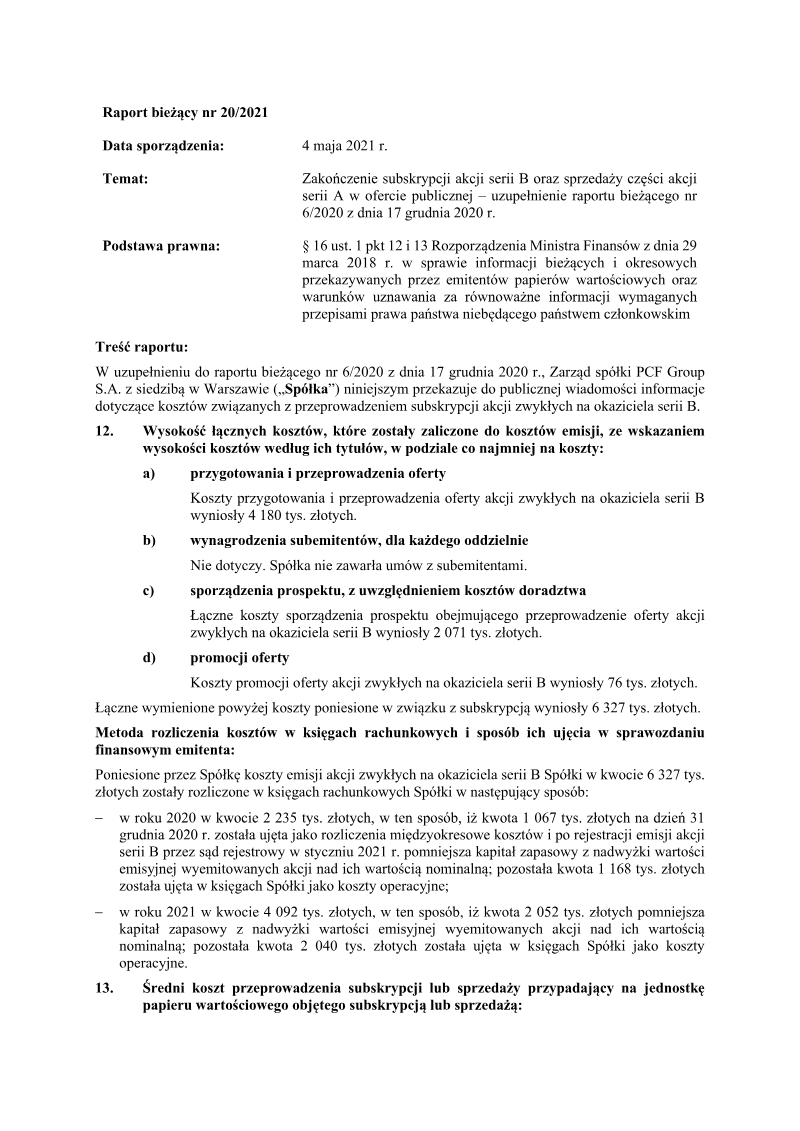
Current Report No. 20/2021: Conclusion of Series B Share Subscription and Partial Series A Sale
The report details the completion of a Series B share subscription and partial sale of Series A shares by PCF Group S.A. The primary objective is to disclose the costs incurred during the Series B subscription, supplementing earlier information released in report No. 6/2020. Total emission costs amounted to 6,327 thousand PLN, broken down into preparation and execution of the offer (4,180 k), prospectus drafting and advisory services (2,071 k), and promotional expenses (76 k). No sub‑emitter fees applied.
Accounting treatment of these costs is outlined: in 2020, 2,235 k PLN were recorded, with 1,067 k PLN treated as inter‑period cost adjustments reducing the capital reserve from excess issue value over par, and 1,168 k PLN expensed operationally. In 2021, 4,092 k PLN were recorded similarly, with 2,052 k PLN reducing the capital reserve and 2,040 k PLN expensed.
The average cost per security issued or sold was calculated at 1.53 PLN. The report covers the Polish market, focusing on PCF Group’s public offerings during 2020–2021. No survey or external data sources are cited; the methodology relies on internal financial records and regulatory reporting requirements under Polish finance ministry regulations. The concise disclosure fulfills legal obligations for ongoing information to investors and regulators, providing transparency on the financial impact of the share issuance activities.
- PCF Group S.A. incurred total costs of 6,327 thousand PLN for the Series B share subscription and partial Series A share sale conducted between 2020 and 2021.
- The total issuance costs comprised 4,180 thousand PLN for offer preparation and execution, 2,071 thousand PLN for prospectus and advisory services, and 76 thousand PLN for promotional expenses.
- The average cost per security issued or sold during the offering process was 1.53 PLN.
- In 2020, PCF Group recorded 2,235 thousand PLN in costs, split between 1,067 thousand PLN charged to capital reserves and 1,168 thousand PLN expensed operationally.
- In 2021, the company recorded 4,092 thousand PLN in costs, with 2,052 thousand PLN reducing the capital reserve and 2,040 thousand PLN expensed operationally.
PCF Group
Report12 pages
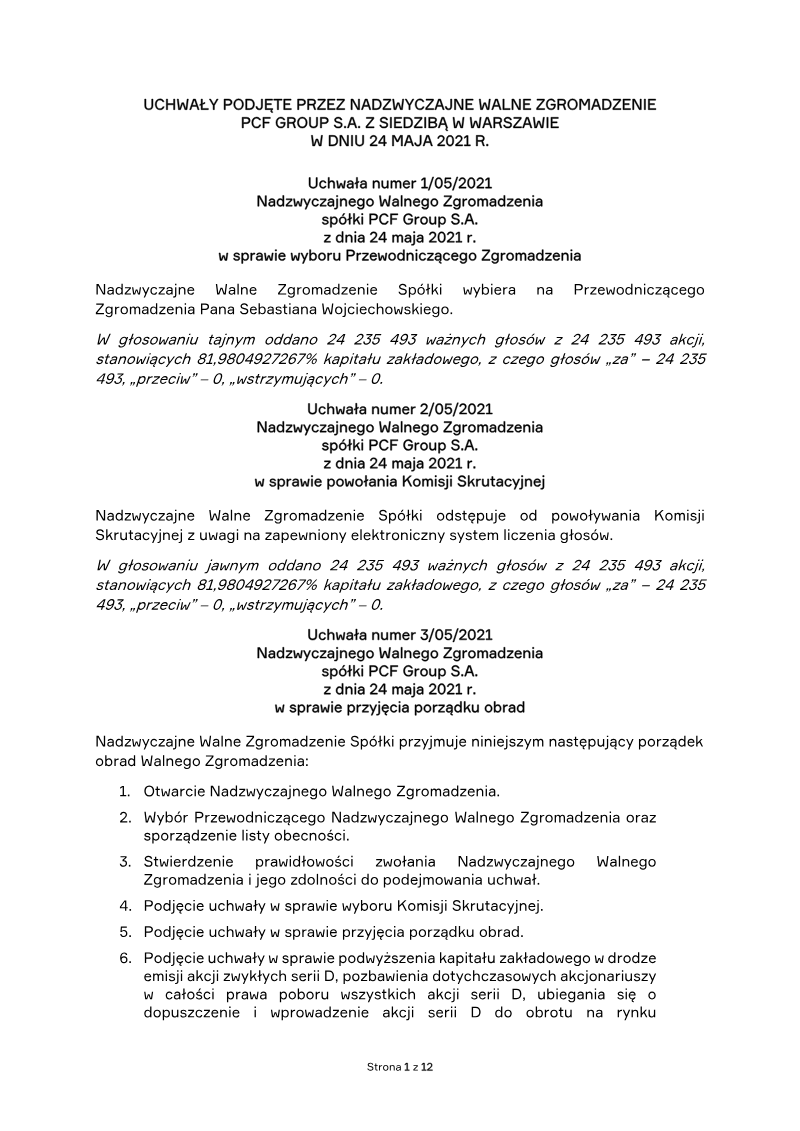
Resolutions of the Extraordinary General Meeting: PCF Group S.A.
The extraordinary general meeting of PCF Group S.A., held on 24 May 2021, approved a series of corporate actions aimed at expanding the company’s capital structure and strategic capabilities. The meeting elected Sebastian Wojciechowski as chair, confirmed the agenda, and resolved to forego a separate audit committee due to an electronic voting system. The core decisions involved a capital increase through the issuance of 387 714 new ordinary shares (Series D) at an emission price of PLN 75.75 per share, raising the paid‑up capital from PLN 591 250.24 to PLN 599 004.52. The shares were offered exclusively to Fiducie Familiale Samuel Girardin 2020, a trust linked to the acquisition of Game On Creative Inc., a Montreal‑based animation studio. The issuance was structured as a private subscription, with the new shares granted without voting rights to existing shareholders and subject to lock‑up until December 2024. The board’s opinion justified the exclusion of existing shareholders’ subscription rights and detailed pricing based on recent market activity. Additionally, the meeting adopted a “target capital” provision allowing the board to raise up to PLN 29.56 million in future issuances, with the option to exclude existing shareholders’ subscription rights upon supervisory board approval. Statutory amendments updated share classifications and authorized the board to manage future capital increases, while costs of convening the meeting were borne by the company. All resolutions received unanimous approval from 81.98 % of voting shares, reflecting strong shareholder support for the planned expansion and strategic acquisitions in the gaming and animation sector.
- PCF Group S.A. issued 387,714 new Series D shares at PLN 75.75 per share to acquire the Montreal-based animation studio Game On Creative Inc.
- The capital increase raised the company’s paid-up capital from PLN 591,250.24 to PLN 599,004.52.
- The new shares were issued via private subscription exclusively to Fiducie Familiale Samuel Girardin 2020 and are subject to a lock-up period ending in December 2024.
- Shareholders approved a 'target capital' provision authorizing the board to raise up to PLN 29.56 million in future share issuances.
- The board received authorization to exclude existing shareholders' subscription rights for future capital increases, subject to supervisory board approval.
PCF Group
Report4 pages
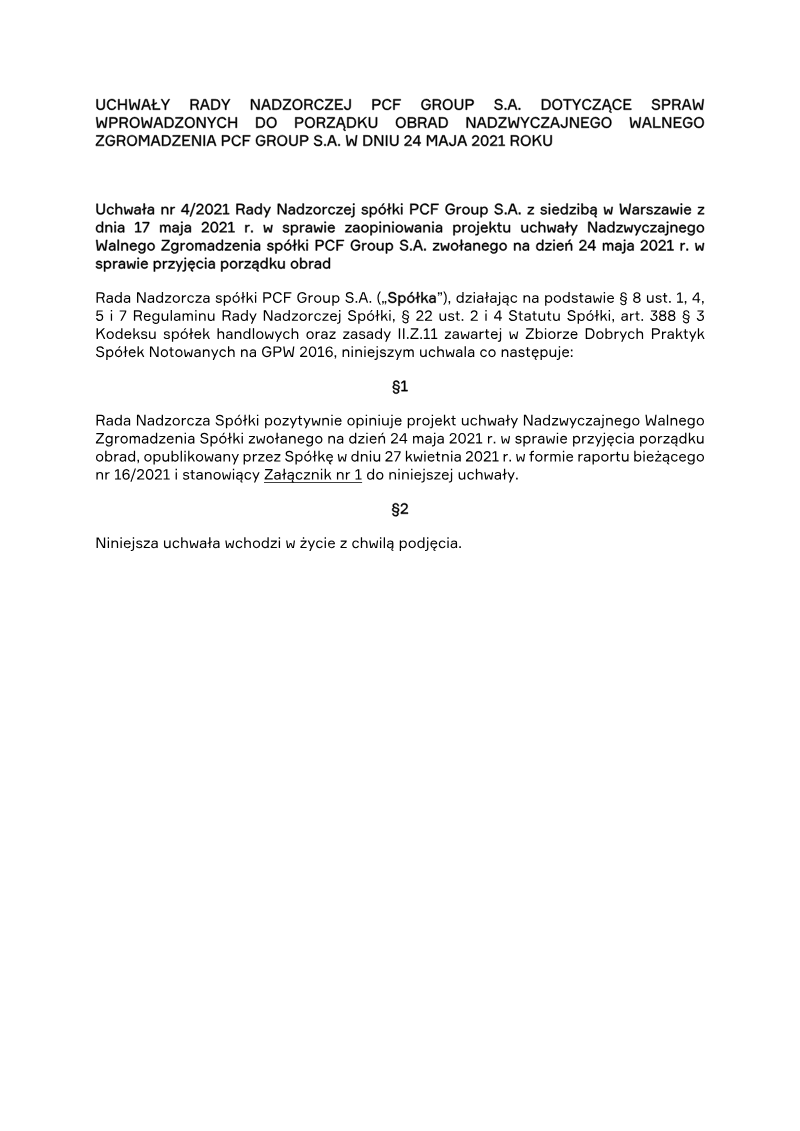
Uchwały Rady Nadzorczej PCF Group S.A. dotyczące spraw wprowadzonych do porządku obrad Nadzwyczajnego Walnego Zgromadzenia: 24 maja 2021
The document records the supervisory board’s approvals of several proposals presented at PCF Group S.A.’s extraordinary general meeting on 24 May 2021. The board, acting under its bylaws and the company’s articles, issued a series of resolutions (Nos. 4/2021 to 7/2021) that endorse the draft motions submitted by management. Each resolution confirms a positive opinion on specific items: adoption of the meeting agenda, a capital increase through issuance of Series D ordinary shares, removal of existing shareholders’ rights to subscribe for all Series D shares, application for listing and dematerialisation of Series D on the Warsaw Stock Exchange, and amendments to the company’s articles enabling further capital increases within a target capital framework with optional exclusion of subscription rights for current shareholders. The resolutions reference the company’s 16/2021 interim report, which served as an attachment to each motion. All approvals take effect immediately upon adoption. The scope is limited to PCF Group S.A., a Warsaw‑based listed entity, and concerns corporate governance and capital structure changes for the fiscal year 2021. No survey or external data sources are cited; the methodology consists of board review and formal endorsement under Polish corporate law.
- PCF Group S.A. approved a capital increase through the issuance of Series D ordinary shares during the Extraordinary General Meeting held on 24 May 2021.
- The Supervisory Board formally endorsed the removal of existing shareholders' subscription rights for all newly issued Series D shares.
- The company initiated the process for the listing and dematerialisation of Series D shares on the Warsaw Stock Exchange.
- Management received approval to amend the company’s articles to establish a target capital framework, allowing for future capital increases with the option to exclude subscription rights.
- Supervisory Board resolutions 4/2021 through 7/2021 provided the formal legal basis for these corporate governance and capital structure changes.
PCF Group
Report1 pages
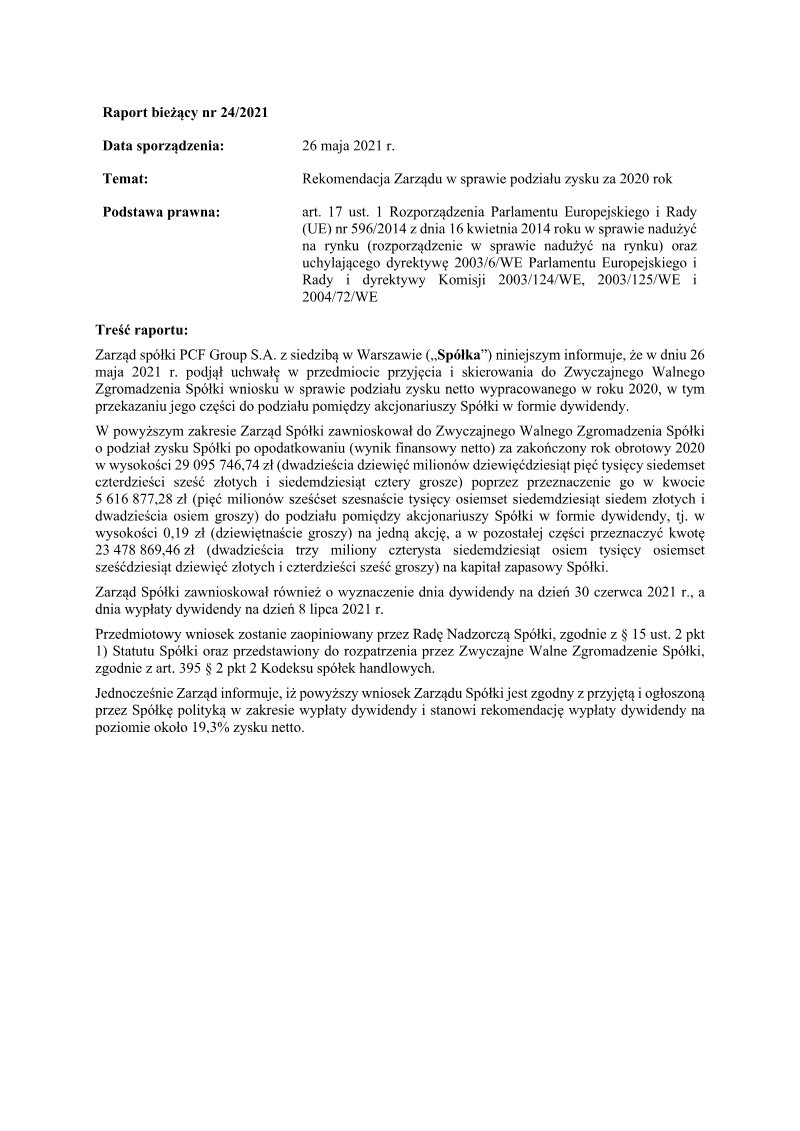
Current Report No. 24/2021: Management Board Recommendation Regarding Profit Distribution for 2020
The report presents the PCF Group S.A. board’s recommendation for distributing 2020 net profit, amounting to PLN 29,095,746.74. The board proposes allocating PLN 5,616,877.28—equivalent to a dividend of PLN 0.19 per share—to shareholders and retaining PLN 23,478,869.46 as a reserve for the company’s capital. Dividend payment is scheduled for 8 July 2021, with the record date set for 30 June 2021. The recommendation aligns with the company’s established dividend policy, targeting a payout ratio of approximately 19.3 % of net profit.
The recommendation follows legal requirements under EU Regulation 596/2014 and related directives, ensuring compliance with market abuse provisions. The board’s proposal will be reviewed by the supervisory board and presented to the ordinary general meeting, in accordance with the company’s articles of association and Polish commercial law provisions.
This communication is limited to PCF Group S.A., a Warsaw‑based entity, and concerns the fiscal year 2020 only. No additional data sources or survey methodologies are disclosed, as the recommendation is based on the company’s audited financial statements for that year.
- PCF Group S.A. reported a 2020 net profit of PLN 29,095,746.74.
- The board recommended a dividend payout of PLN 5,616,877.28, representing a payout ratio of approximately 19.3% of the 2020 net profit.
- Shareholders will receive a dividend of PLN 0.19 per share, with the payment scheduled for 8 July 2021.
- The record date for determining shareholder eligibility for the dividend is set for 30 June 2021.
- The company will retain PLN 23,478,869.46 of the 2020 net profit as a reserve for capital.
PCF Group
Report1 pages
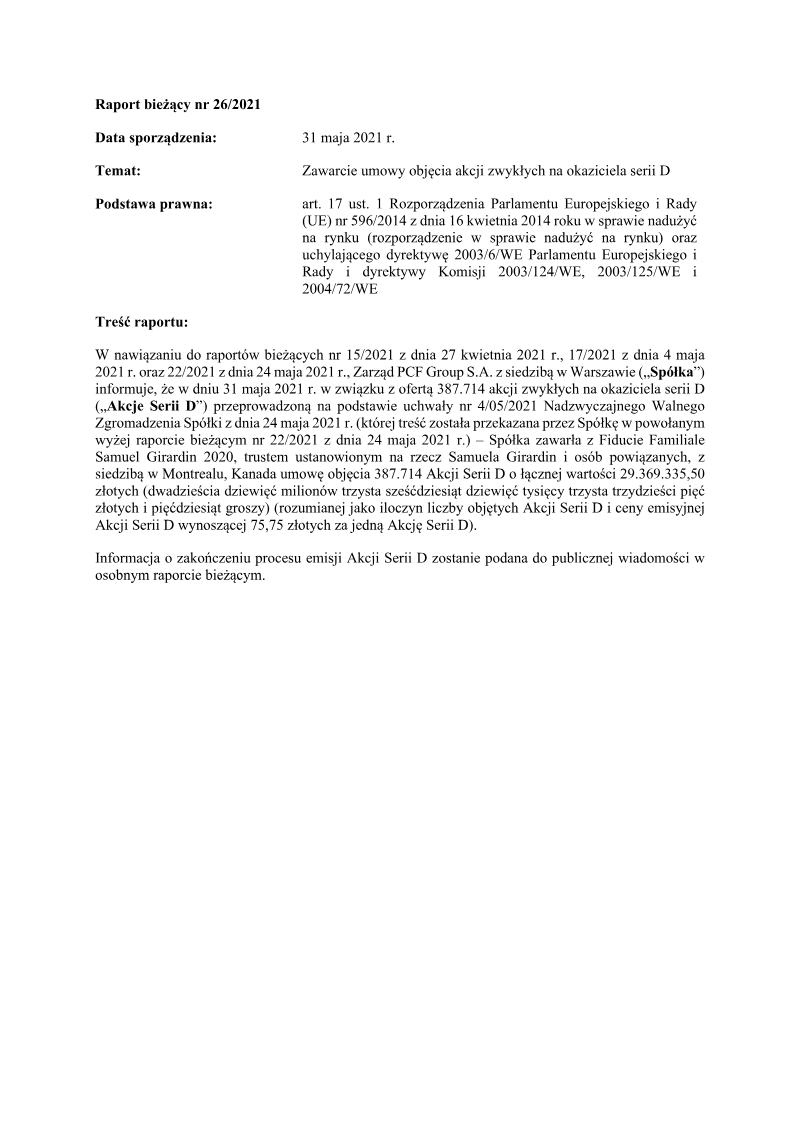
Raport Bieżący Nr 26/2021: Zawarcie Umowy Objęcia Akcji Zwykłych na Okaziciela Serii D
The report announces that on 31 May 2021 the board of PCF Group S.A. entered into an agreement to acquire 387,714 ordinary shares of Series D from Fiducie Familiale Samuel Girardin 2020, a trust based in Montreal. The transaction was executed pursuant to the company’s extraordinary general meeting resolution dated 24 May 2021 and follows earlier interim reports issued on 27 April, 4 May, and 24 May 2021. The purchase price was set at PLN 75.75 per share, resulting in a total consideration of PLN 29,369,335.50 (twenty‑nine million three hundred sixty‑nine thousand three hundred thirty‑five zlotys and fifty groszy). The shares were acquired at the issue price, confirming that the company has fully subscribed the offering. The report states that a separate communication will be issued once the issuance process is complete, providing further details on the finalization of the Series D share offering. The information is provided under EU Regulation 596/2014 on market abuse, ensuring compliance with disclosure obligations for significant share transactions. The report covers the Polish jurisdiction and pertains specifically to PCF Group S.A.’s equity issuance activities within the stated period.
- PCF Group S.A. acquired 387,714 Series D ordinary shares from the Montreal-based trust Fiducie Familiale Samuel Girardin 2020 on 31 May 2021.
- The total consideration for the share acquisition amounted to PLN 29,369,335.50.
- The transaction was executed at a price of PLN 75.75 per share, matching the established issue price.
- This acquisition confirms that PCF Group S.A. has fully subscribed the Series D share offering.
- The share purchase was authorized by an extraordinary general meeting resolution passed on 24 May 2021.
PCF Group
Report1 pages
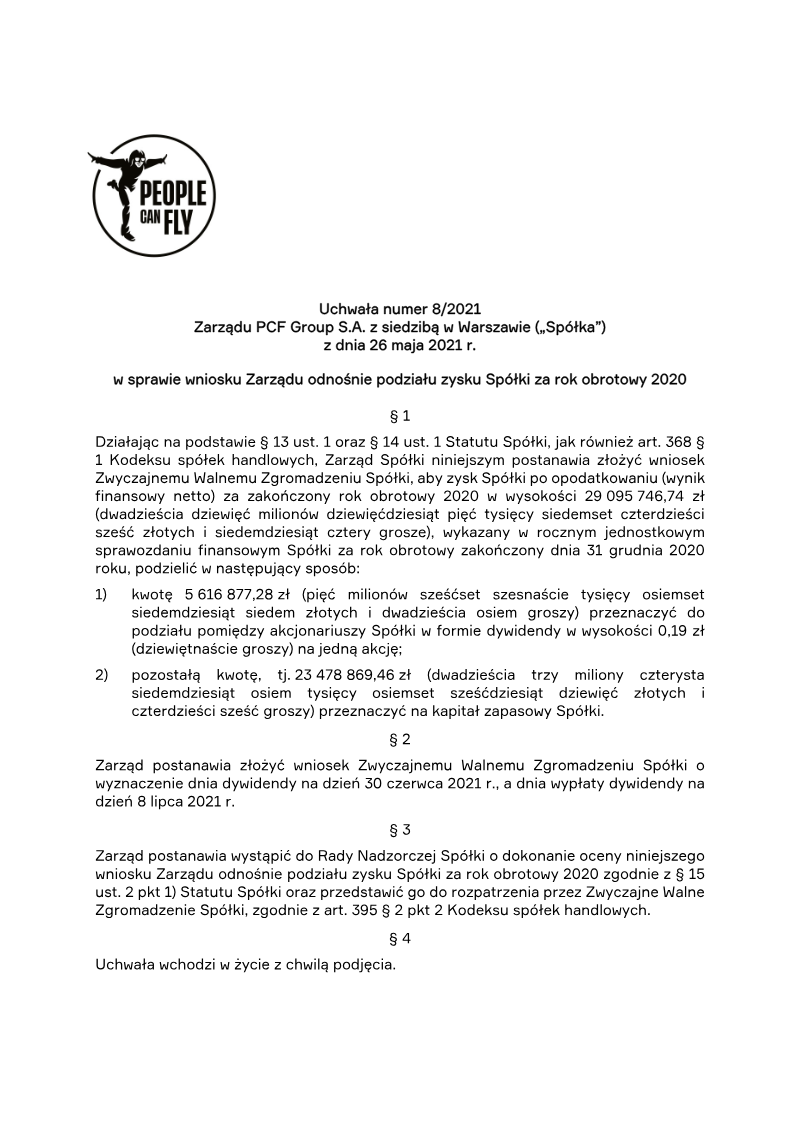
Uchwała Nr 8/2021 w Sprawie Podziału Zysku Spółki: 2020
The resolution of the Board of PCF Group S.A., dated 26 May 2021, proposes a specific allocation of the company’s net profit for the fiscal year 2020. The total after‑tax earnings amount to PLN 29,095,746.74. The Board recommends that PLN 5,616,877.28 be distributed to shareholders as a dividend of PLN 0.19 per share, while the remaining PLN 23,478,869.46 should be transferred to the company’s reserve capital.
The resolution further requests that the ordinary general meeting set the dividend record date for 30 June 2021 and the payment date for 8 July 2021. It also instructs the supervisory board to evaluate the proposed profit distribution in accordance with the company’s statutes and to present its assessment to the general meeting, as required by Polish corporate law.
The document is limited in scope to PCF Group S.A., a Warsaw‑based entity, and concerns only the 2020 financial year. No external data sources or survey methodology are cited; the figures derive from the company’s annual financial statements. The resolution is effective immediately upon adoption, ensuring that the proposed dividend and reserve allocations are implemented without delay.
- PCF Group S.A. reported a total net profit of PLN 29,095,746.74 for the 2020 fiscal year.
- The Board proposed a dividend distribution of PLN 5,616,877.28, equating to PLN 0.19 per share.
- The remaining PLN 23,478,869.46 of the 2020 net profit is designated for transfer to the company’s reserve capital.
- The proposed dividend record date is set for 30 June 2021, with a scheduled payment date of 8 July 2021.
- The resolution requires the supervisory board to formally evaluate the profit distribution plan to ensure compliance with company statutes and Polish corporate law.
PCF Group
Report1 pages
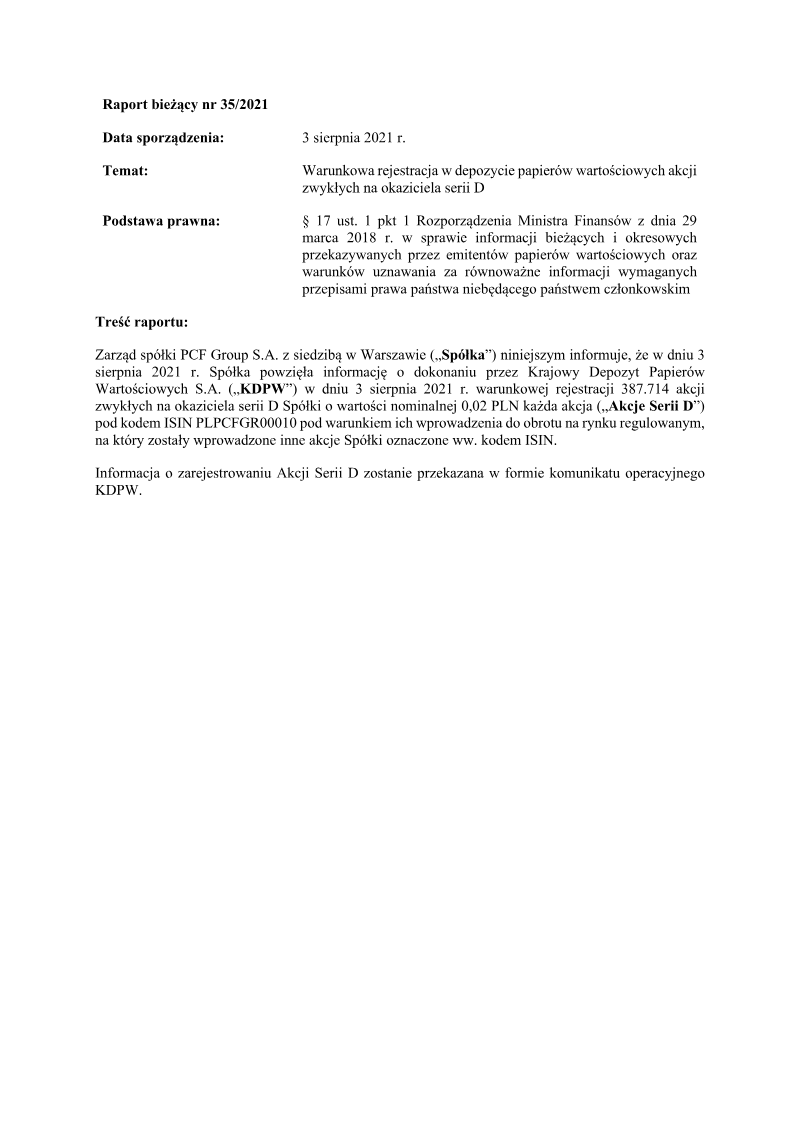
Current Report No. 35/2021: Conditional Registration of Series D Bearer Shares
The report announces that on 3 August 2021 the National Securities Depository (KDPW) conditionally registered 387,714 bearer shares of Series D issued by PCF Group S.A., a Warsaw‑based company. Each share carries a nominal value of 0.02 PLN and is identified by the ISIN PLPCFGR00010. The registration is contingent upon the shares being listed on a regulated market, where other PCF Group shares under the same ISIN are already traded. The announcement follows § 17(1)(1) of the Minister of Finance Regulation dated 29 March 2018, which governs ongoing and periodic information disclosures by securities issuers. The company’s board confirms that the conditional registration will be communicated through a KDPW operational notice. This brief communication serves to inform market participants of the impending availability of Series D shares, subject to regulatory listing requirements, thereby ensuring transparency and compliance with Polish securities disclosure obligations.
- The National Securities Depository (KDPW) conditionally registered 387,714 Series D bearer shares for PCF Group S.A. on August 3, 2021.
- Each Series D share has a nominal value of 0.02 PLN and is identified by ISIN PLPCFGR00010.
- The registration of these shares is contingent upon their formal listing on a regulated market where PCF Group shares under the same ISIN are already traded.
- The issuance and registration process complies with the Minister of Finance Regulation dated March 29, 2018, regarding securities issuer disclosure obligations.
- Market participants will receive further details regarding the availability of these shares through a forthcoming KDPW operational notice.
PCF Group
Report3 pages
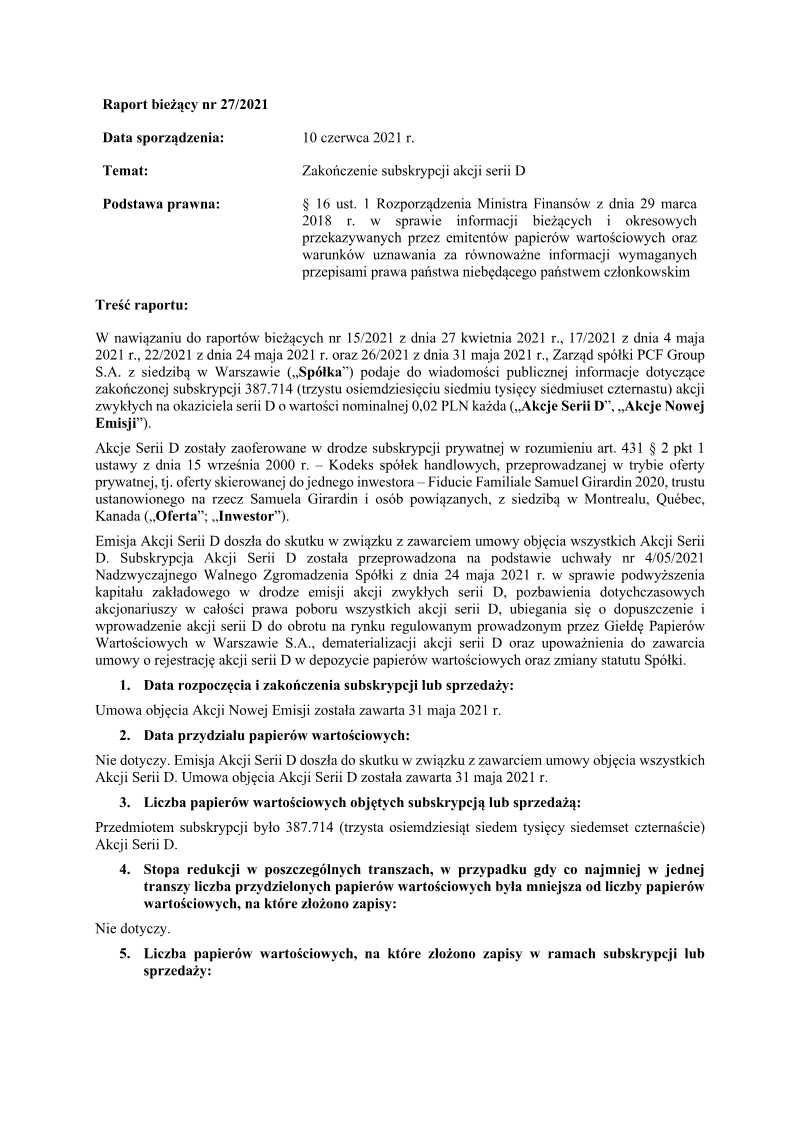
Zakończenie subskrypcji akcji serii D
The report announces the completion of a private subscription offering 387,714 ordinary shares of Series D by PCF Group S.A., a Warsaw‑based company. The subscription was directed solely to Fiducie Familiale Samuel Girardin 2020, a trust established in Montreal for Samuel Girardin and related parties. The transaction was authorized by the company’s Extraordinary General Meeting on 24 May 2021 and finalized with a subscription agreement dated 31 May 2021. Each Series D share carried a nominal value of PLN 0.02 and was issued at an emission price of PLN 75.75, resulting in a total subscription value of PLN 29,369,335.50.
The offering was conducted as a private placement under Polish company law (art. 431 §2(1) of the 2000 Companies Act), with no public solicitation or multiple tranches. Consequently, there were no subscription records, no allocation reductions, and the sole investor received all shares. The shares were paid for in cash; no sub‑emission arrangements or additional costs were disclosed at the time of reporting. Detailed cost breakdowns and average per‑share expenses are pending final invoicing and will be disclosed in a separate subsequent report. The transaction represents a capital increase for PCF Group, with the Series D shares intended to be listed on the Warsaw Stock Exchange and dematerialised in a securities depository, pending regulatory approval.
- PCF Group S.A. completed a private placement of 387,714 Series D ordinary shares to Fiducie Familiale Samuel Girardin 2020.
- The total subscription value of the transaction reached PLN 29,369,335.50, with each share issued at a price of PLN 75.75.
- The issuance was authorized by the company’s Extraordinary General Meeting on 24 May 2021 and finalized via a subscription agreement on 31 May 2021.
- The transaction was executed as a private placement under Polish law, with the entirety of the shares allocated to the single investor, Fiducie Familiale Samuel Girardin 2020.
- PCF Group S.A. intends to list the new Series D shares on the Warsaw Stock Exchange and proceed with their dematerialization in a securities depository.
+1
PCF Group
Report1 pages
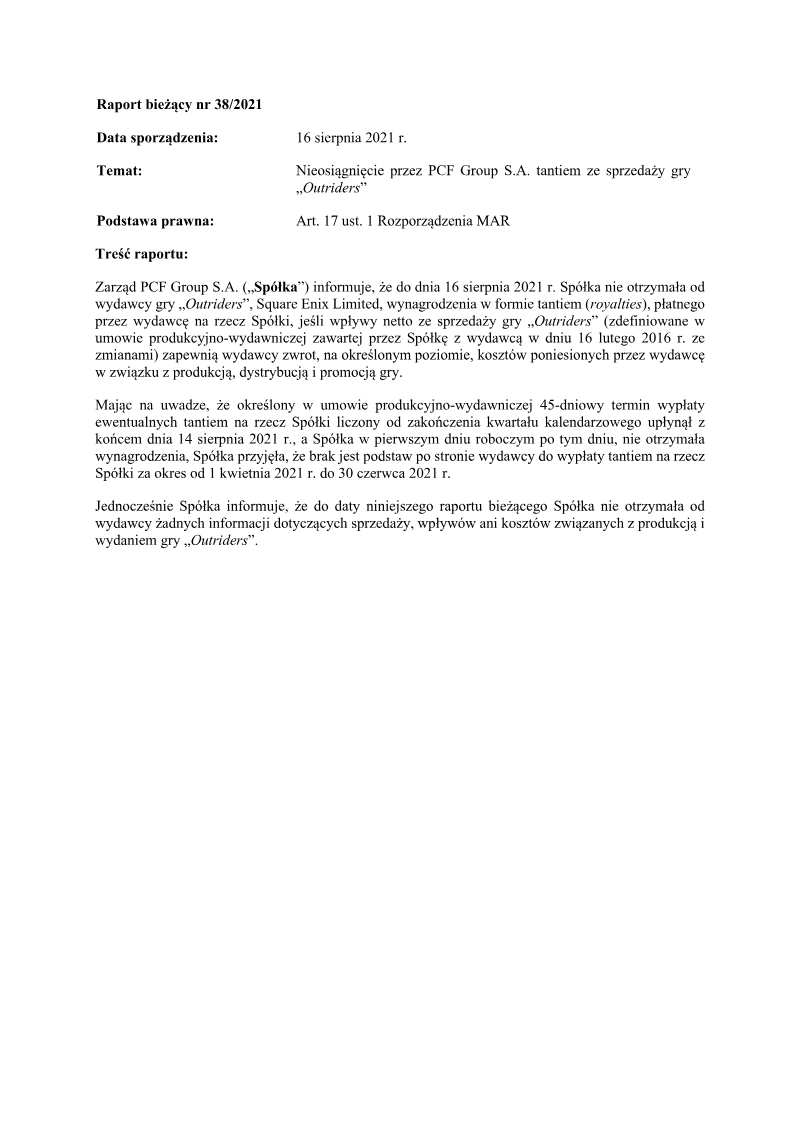
Raport Bieżący Nr 38/2021: Nieosiągnięcie przez PCF Group S.A. Tantiem ze Sprzedaży Gry „Outriders”
The report, dated 16 August 2021, explains that PCF Group S.A. has not received any royalty payments from Square Enix Limited for the game “Outriders.” According to the production‑and‑publishing agreement signed on 16 February 2016, royalties are payable only after the publisher recovers a specified level of production, distribution and promotion costs from net sales. The agreement also sets a 45‑day payment window following the end of each calendar quarter. That deadline expired on 14 August 2021, and PCF Group’s first working day thereafter yielded no payment. Consequently, the company concludes that the publisher has no obligation to pay royalties for the period covering 1 April 2021 through 30 June 2021. In addition, PCF Group reports that it has not received any sales figures, revenue data or cost information related to “Outriders” from the publisher up to the report’s date. The document serves as a formal notification under Article 17(1) of the MAR regulation, outlining the company’s position on unpaid royalties and lack of transparency from the publisher. No further financial or operational details are provided, and the report focuses solely on the contractual dispute over royalty payments for the specified quarter.
- PCF Group S.A. received no royalty payments from Square Enix Limited for the game 'Outriders' for the period of 1 April 2021 through 30 June 2021.
- The contractual deadline for royalty payments for the second quarter of 2021 expired on 14 August 2021 without any funds being transferred to PCF Group.
- PCF Group concluded that Square Enix has no current obligation to pay royalties, as the publisher has not yet recovered the specified production, distribution, and promotion costs required by the 16 February 2016 agreement.
- As of 16 August 2021, PCF Group has not received any sales figures, revenue data, or cost information from Square Enix regarding the performance of 'Outriders'.
- The lack of royalty payments and financial transparency prompted PCF Group to issue a formal notification under Article 17(1) of the MAR regulation.
+1
PCF Group