Report53 pages
Skonsolidowany raport kwartalny: Q3 2024
WARSZAWA | 26 LISTOPADA 2024 ROKU (dane w tys. zł, chyba że zaznaczone inaczej) PEOPLE ZAKOCZONY 30 WRZENIA 2024 ROKU (dane w tys. zł, chyba że zaznaczone inaczej) Grupa Kapitałowa PCF Group Spółka Akcyjna WYBRANE DANE W PRZELICZENIU NA EUR PLN EUR 30.09.2024 r. 31.12.2023 r. 30.09.2024 r. 31.12.2023 r.
- PCF Group S.A. reported a net loss attributable to shareholders of (33,151) thousand PLN for the nine months ended September 30, 2024, compared to a loss of (15,352) thousand PLN in the same period of 2023.
- Basic and diluted earnings per share (EPS) from continuing operations were (0.93) PLN and (0.91) PLN respectively for the nine months ended September 30, 2024, worsening from (0.43) PLN and (0.42) PLN in the prior year.
- Total revenue from sales for the nine months ended September 30, 2024, reached 131,886 thousand PLN, with 54,890 thousand PLN from Europe and 76,996 thousand PLN from other countries.
- The Group decided to discontinue work on 'Project Dagger' on April 5, 2024, resulting in a 100% write-off of incurred development costs totaling 68,331 thousand PLN in 2023.
- PCF Group S.A. launched 'Bulletstorm VR' on PICO platforms on September 19, 2024, and released a significant update (Update 1.4) for the game on other VR platforms.
PCF Group
Report86 pages
Annual Financial Report: PCF Group 2024
ZA ROK OBROTOWY ZAKONCZONY 31 GRUDNIA 2024 ROKU wybrane dane w przeliczeniu na EUR PLN EUR 31.12.2024 r. 31.12.2023 r. 31.12.2024 r. 31.12.2023 r. Sprawozdanie z sytuacji finansowej Aktywa 315 161 502 508 73 756 115 572 Zobowiązania długoterminowe 7 303 12 382 1 709 2 848 Zobowiązania krótkoterminowe ...
- PCF Group experienced a significant net loss of EUR 53,106 in 2024, worsening from a loss of EUR 14,277 in 2023.
- The company's operating loss also substantially increased to EUR 55,351 in 2024 from EUR 18,395 in 2023.
- Despite the losses, sales revenue grew from EUR 26,585 in 2023 to EUR 38,673 in 2024.
- Net cash flow from operating activities increased significantly to EUR 12,146 in 2024 from EUR 4,873 in 2023.
- PCF Group is exposed to currency risk as most costs are in PLN while most revenues are in EUR and USD, though a contract with Square Enix Limited for "Project Gemini" includes provisions against EUR/PLN exchange rate changes.
+1
PCF Group
Report105 pages
Annual Report of the Capital Group: PCF Group S.A. 2024
(dane w tys. zł, chyba że zaznaczono inaczej) Niniejsze Sprawozdanie z działalności Grupy Kapitałowej PCF Group S.A. i spółki PCF Group S.A. w 2024 r. zostało sporządzone na podstawie § 70 ust. 1 pkt 4, 6, 7 oraz § 71 ust. 1 pkt 4, 6, 7 Rozporządzenia Ministra Finansów z dnia 29.03.2018 r.
- PCF Group S.A.'s equity decreased by 41% (176.2 million PLN) in 2024 compared to 2023, primarily due to a net loss of 174.4 million PLN.
- Cash and cash equivalents significantly decreased by 53% (65.9 million PLN), from 124.0 million PLN at the end of 2023 to 58.1 million PLN at the end of 2024.
- The launch of "Bulletstorm VR" on Pico platforms occurred on September 19, 2024, but its market reception was poor due to unsatisfactory quality and negative reviews, leading to lower-than-expected revenues.
- PCF Group S.A. entered into a development and publishing agreement with Microsoft Corporation on June 13, 2023, for an AAA game codenamed "Project Maverick."
- The Group faces a high risk of losing highly qualified game development specialists due to strong market demand and a deficit of such professionals, which could negatively impact game quality, release schedules, and financial performance.
PCF Group
Report3 pages
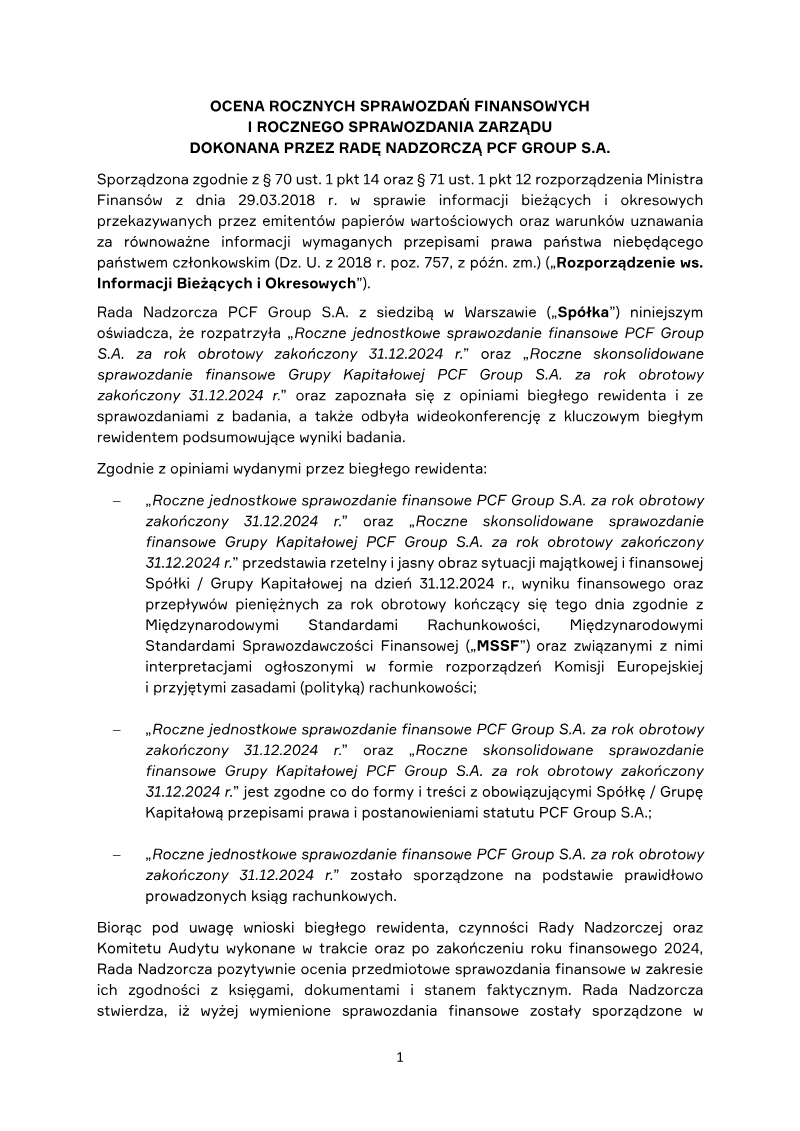
Assessment of Annual Financial Statements and the Management Board's Annual Report: 2024
The assessment confirms that PCF Group S.A.’s 2024 annual financial statements, both standalone and consolidated, provide a reliable and transparent depiction of the company’s assets, liabilities, equity, income, and cash flows as of 31 December 2024. The statements comply with International Financial Reporting Standards (IFRS) and related European Union regulations, and are based on properly maintained accounting records. The independent auditor’s opinion affirms the statements’ accuracy, consistency with applicable laws and statutes, and adherence to IFRS. The supervisory board’s review of the management report and corporate governance declaration also concludes that these documents accurately reflect the group’s performance, development, and financial position without material misstatement. The board’s evaluation covers all statutory requirements under Polish accounting law, confirming that the reports meet legal and regulatory standards. The assessment was conducted by the supervisory board following a review of the auditor’s reports, management disclosures, and a videoconference with the lead auditor. Signatories from the supervisory board, including the chairperson and five members, formally endorse the findings on 29 April 2025. The document therefore serves as a formal confirmation that PCF Group S.A.’s 2024 financial reporting is complete, compliant, and trustworthy for stakeholders.
- PCF Group S.A.’s 2024 standalone and consolidated financial statements are confirmed as accurate, transparent, and compliant with International Financial Reporting Standards (IFRS).
- The independent auditor verified that the financial statements, as of 31 December 2024, provide a reliable depiction of the company’s assets, liabilities, equity, income, and cash flows.
- The supervisory board formally endorsed the 2024 financial reporting and management disclosures on 29 April 2025.
- The management report and corporate governance declaration were found to accurately reflect the group’s performance, development, and financial position without material misstatement.
- The assessment confirms full adherence to Polish accounting law and all relevant European Union regulatory requirements.
PCF Group
Report10 pages
Sprawozdanie Niezależnego Biegłego Rewidenta z Badania Rocznego Skonsolidowanego Sprawozdania Finansowego: 2024
Sprawozdanie Grant ThorntonPolskaP.S.A. ul. Abpa Antoniego Baraniaka 88 E niezależnego 61-131 Poznań biegłego rewidenta T +48 61 62 51 100 Dla Akcjonariuszy PCF Group Spółka Akcyjna Sprawozdanie z badania rocznego skonsolidowanego sprawozdania finansowego Przeprowadziliśmy badanie rocznego skonsolidowanego sprawozdania finansowego Grupy Kapitałowej (Grupa Kapitałowa), w której jednostką dominującą jest PCF Group Spółka Akcyjna (Spółka Dominująca) z siedzibą w Warszawie...
- Grant Thornton Polska P.S.A. conducted an audit of the annual consolidated financial statements for PCF Group Spółka Akcyjna for the fiscal year ending December 31, 2024.
- The audit was performed in accordance with Polish auditing standards, including the Act on Statutory Auditors, National Auditing Standards (KSB), and EU Regulation 537/2014.
- Key audit matters included assets and liabilities from customer contracts/sales revenue, which amounted to PLN 9,580 thousand and PLN 5,808 thousand respectively, with sales revenue for 2024 totaling PLN 190,401 thousand.
- Another key audit matter was the impairment of goodwill, which involved assessing financial forecasts of subsidiaries and the methodology of valuation models based on discounted cash flows.
- The auditors noted an emphasis of matter regarding the uncertainty of deferred tax assets totaling PLN 52,917 thousand, as disclosed in note 8, due to uncertainties in tax result forecasts for 2025-2029 and the inability to implement the Group's strategy in its current form.
PCF Group
Report7 pages
Sprawozdanie z badania rocznego sprawozdania finansowego: 2024
The audit report confirms that PCF Group Spółka Akcyjna’s 2024 financial statements, prepared under International Financial Reporting Standards and European regulatory requirements, present a true and fair view of the company’s financial position as of 31 December 2024. The audited figures show total assets of PLN 42,225 thousand and equity of PLN 18,893 thousand after a write‑down for investments in subsidiaries. Revenue from contracts with customers reached PLN 166,457 thousand, while assets and liabilities related to such contracts were valued at PLN 9,580 thousand and PLN 5,808 thousand respectively. The audit identified key areas of significant judgment: valuation of contract assets and liabilities, impairment testing for investments in dependent entities, and capitalization of development costs for new games. In each case, the auditor performed substantive procedures including policy reviews, contract analysis, and discounted cash flow calculations to obtain sufficient evidence. The report also highlights uncertainty surrounding deferred tax assets of PLN 52,659 thousand due to projected future tax outcomes. Management’s responsibility for ongoing operations and internal controls is affirmed, with no material misstatement detected in the accompanying activity report or corporate governance statement. The audit was conducted in accordance with Polish and EU auditing standards, with the auditor maintaining independence throughout. Overall, the report delivers a clean opinion on the financial statements and related disclosures for the 2024 reporting period.
- PCF Group S.A. received a clean audit opinion for 2024, confirming its financial statements fairly represent the company's position under IFRS and EU standards.
- The company generated PLN 166,457 thousand in revenue from contracts with customers during the 2024 reporting period.
- As of December 31, 2024, PCF Group reported total assets of PLN 42,225 thousand and equity of PLN 18,893 thousand, the latter reflecting a write-down for investments in subsidiaries.
- The auditor identified significant uncertainty regarding the recoverability of deferred tax assets valued at PLN 52,659 thousand, which depend on future tax outcomes.
- Contract-related assets and liabilities were valued at PLN 9,580 thousand and PLN 5,808 thousand, respectively, as of the end of 2024.
PCF Group
Report45 pages
Consolidated Quarterly Report: Q1 2025
WARSZAWA | 29 MAJA 2025 ROKU (dane w tys. zł, chyba że zaznaczone inaczej) PEOPLE (dane w tys. zł, chyba że zaznaczone inaczej) Grupa Kapitałowa PCF Group Spółka Akcyjna WYBRANE DANE W PRZELICZENIU NA EUR PLN EUR 31.03.2025 r. 31.12.2024 r. 31.03.2025 r. 31.12.2024 r.
- The company experienced a net loss of 3,855 thousand PLN in Q1 2025, a significant increase from the 864 thousand PLN net loss in Q1 2024.
- Revenue from sales decreased substantially from 56,881 thousand PLN in Q1 2024 to 9,492 thousand PLN in Q1 2025.
- The company is gradually withdrawing from VR game publishing, with the last project, Bison, scheduled for release in Q4 2025.
- Work on Project Victoria, a self-published game, has resumed with an accelerated early access release planned for 2025, supported by an experienced development team primarily in Canada.
- The company began a new collaboration with Sony Interactive Entertainment LLC on March 13, 2025, to produce a prototype for a new video game, Project Delta, with revenue recognition starting in Q1 2025.
+1
PCF Group
Report55 pages
Skonsolidowany Raport Kwartalny: Q3 2025
Warszawa | 1 GRUDNIA 2025 ROKU PEOPLE ZAKOŃCZONY30 WRZEŚNIA 2025 ROKU (dane w tys. zł, chyba że zaznaczone inaczej) Grupa Kapitałowa PCF Group Spółka Akcyjna WYBRANE DANE W PRZELICZENIU NA EUR PLN EUR 30.09.2025 r. 31.12.2024 r. 30.09.2025 r. 31.12.2024 r.
- PCF Group S.A. reported a net loss of 116,960 thousand PLN for the period of January 1 to September 30, 2025, a significant increase from the previous year's performance.
- The company released its game "Lost Rift" (formerly Project Victoria) on September 25, 2025, in early access on Steam, following multiple demo and playtest phases in June, August, and September 2025.
- PCF Group S.A. is co-developing "Gears of War: E-Day" with The Coalition (part of Microsoft Corporation) under the codename Project Maverick, based on an agreement from June 13, 2023, and publicly announced on January 27, 2025.
- Development work on Project Gemini was halted on June 1, 2025, leading to a reduction of over 60 development team members and a mutual waiver of potential claims with Square Enix Limited related to past cooperation, contingent on delivery and verification of "closing kit" materials.
- Total revenue from sales for the period of January 1 to September 30, 2025, was 131,886 thousand PLN, with 107,020 thousand PLN from game production and 23,668 thousand PLN from publishing fees.
+1
PCF Group
Report51 pages
Półroczne sprawozdanie Zarządu z działalności Grupy Kapitałowej PCF Group S.A.
WarSzawa | 30 WRZESNIA 2025 ROKU PEOPLE PÓŁROCZNE SPRAWOZDANIE ZARZĄDU Z DZIAŁALNOŚCI GRUPY KAPITAŁOWEJ PCF GROUP S.A. ORAZ SPÓŁKI PCF GROUP S.A. KAPITALOWEJ PCFGROUP S.A. ORAZSPÓEKI PCF GROUP S.A. ZA OKRES 01.01.2025- 30.06.2025 ZA 0KRES 01.01.2025 - 30.06.2025 za okres 01.01.2025–30.06.202 5r.(dane w tys. zł, chyba że zaznaczono inaczej) Niniejsze półroczne sprawozdanie z działalności Grupy Kapitałowej PCF Group S.A. i spółki PCF Group S.A. za okres 01.01.2025 – 30.06.2025 r.
- PCF Group S.A. experienced a significant reduction in its development teams, laying off over 60 people from the Gemini project due to the expiration of an agreement with Square Enix Limited, and over 50 people from the Bifrost project due to a lack of funding for its self-publishing model, both occurring around June 1, 2025.
- The company's cash and cash equivalents decreased by 87% from 83,426 thousand PLN on June 30, 2024, to 11,190 thousand PLN on June 30, 2025, with net cash flows for the period being negative 46,370 thousand PLN.
- PCF Group's equity decreased by 12% (29.5 million PLN) as of June 30, 2025, compared to December 31, 2024, primarily due to losses incurred during the reporting period.
- PCF Group decided to gradually withdraw from VR game publishing activities, though it agreed with Incuvo S.A. on March 6, 2025, to complete the Bison project, with a planned release in Q4 2025, and Incuvo S.A. contributing to some production costs in exchange for a share of future revenues.
- The company has high revenue concentration risk, relying on agreements with publishers like Square Enix Limited (for Outriders and Project Gemini), Microsoft Corporation (Project Maverick), Krafton Inc. (Project Echo and Project Zulu), and Sony Interactive Entertainment LLC (Project Delta).
+1
PCF Group
Report95 pages
Skonsolidowany Raport Półroczny: H1 2025
Warszawa | 30 WRZESNIA 2025 ROKU PEOPLE ZA OKRES 01.01.2025- 30.06.2025 Grupa Kapitałowa PCF Group Spółka Akcyjna WYBRANE DANE W PRZELICZENIU NA EUR PLN EUR 30.06.2025 r. 31.12.2024 r. 30.06.2025 r. 31.12.2024 r.
- The company experienced a net loss of 21,274 PLN in H1 2025, an increase from a 33,289 PLN net loss in H1 2024. Operating loss also worsened from 35,805 PLN in H1 2024 to 19,666 PLN in H1 2025.
- The company faced significant financial challenges, including the inability to secure approximately 350 million PLN in financing by Q4 2024, leading to a strategic shift to balance self-publishing investment with work-for-hire revenue.
- Key project developments include production agreements with Sony Interactive Entertainment LLC (Project Delta), continued work with Microsoft Corporation (Project Maverick) and Krafton Inc. (Project Echo, Project Zulu).
- The company halted work on Project Gemini (with Square Enix Limited) and suspended Project Bifrost (self-publishing) due to cost optimization, resulting in a significant reduction of over 50 employees from the Bifrost development team.
- An impairment write-down of 5,967 thousand PLN was recorded for goodwill related to a development team previously employed by People Can Fly Chicago, LLC.
PCF Group
Report6 pages
Letter to Shareholders: 2024
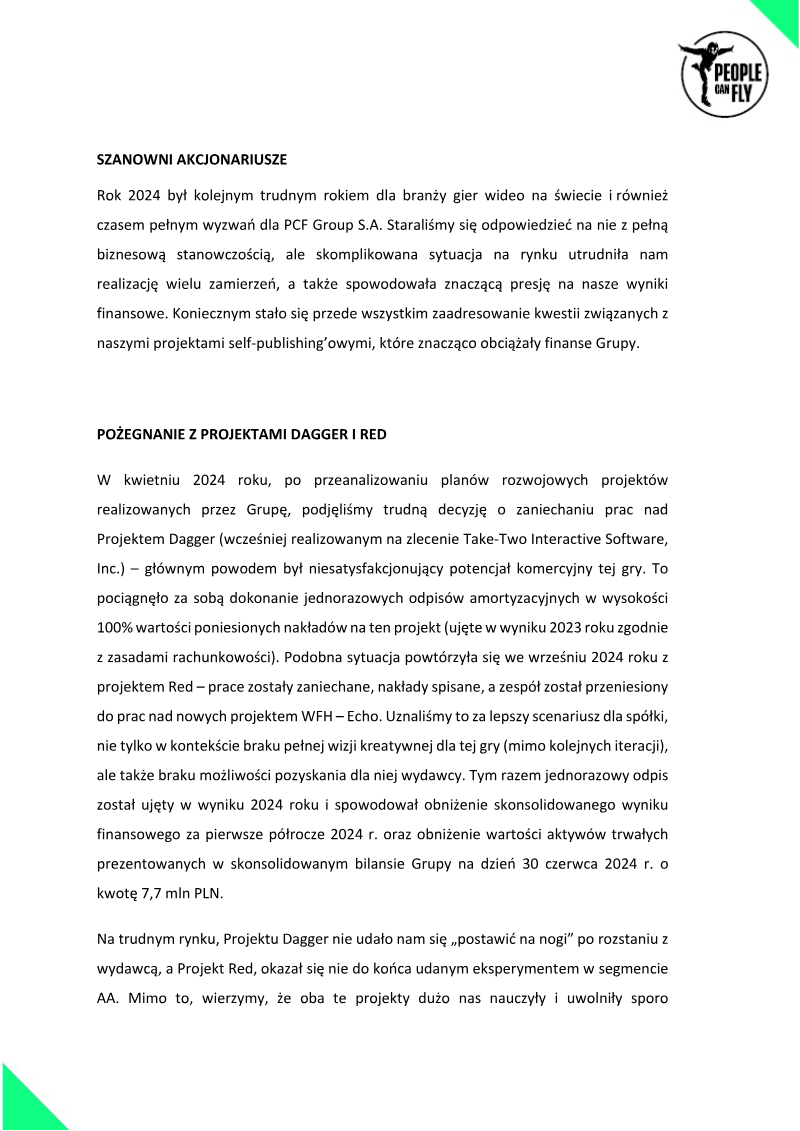
The letter explains that 2024 was a challenging year for the video‑game industry and for PCF Group S.A., prompting decisive actions to protect financial stability. In April, the company discontinued the Dagger project after a partner withdrawal and recorded a 100 % write‑off of its costs, followed by the cancellation of Red in September. These decisions reduced consolidated earnings for the first half of 2024 and lowered fixed‑asset values by PLN 7.7 million. The board also halted work on Victoria and Bifrost in December, laying off over 120 employees; a PLN 154.964 million impairment was booked for Bifrost, while Victoria’s costs were retained due to an upcoming early‑access release.
To counter market headwinds, the board launched a strategic options review in August aimed at securing external investment or restructuring. The effort failed, leaving the group to reassess short‑ and long‑term plans. Concurrently, the company tightened its self‑publishing pipeline, focusing on work‑for‑hire (WFH) contracts. In early 2024, a short‑term agreement with Square Enix for Gemini led to a workforce reduction of 30 staff, yet the project’s revenue only covered direct costs. New WFH deals were secured with Krafton (Echo), Sony Interactive Entertainment (Delta), and Microsoft (Project Maverick), bolstering revenue streams.
The VR segment was largely exited, with Incuvo’s Bison slated as the final title. Game On, another subsidiary, saw limited improvement in 2024‑25. Overall, the letter acknowledges losses and staff cuts but stresses a commitment to rebuilding through strategic partnerships, focused development on AAA action titles, and continued investment in high‑quality games for a global audience.
- PCF Group S.A. underwent a massive restructuring in 2024, cancelling four major projects (Dagger, Red, Victoria, and Bifrost) and recording a PLN 154.964 million impairment for Bifrost alone.
- The company significantly reduced its workforce, laying off over 120 employees in December following the cancellation of Victoria and Bifrost, in addition to 30 staff cuts earlier in the year related to the Gemini project.
- Financial stability was severely impacted by project cancellations, including a 100% write-off of Dagger costs and a PLN 7.7 million reduction in fixed-asset values during the first half of 2024.
- The company has pivoted its business model toward work-for-hire (WFH) contracts, securing new partnerships with Krafton (Echo), Sony Interactive Entertainment (Delta), and Microsoft (Project Maverick) to stabilize revenue.
- A strategic review initiated in August to seek external investment or restructuring failed, forcing the company to abandon its VR segment and narrow its focus to AAA action titles.
+2
PCF Group
Report2 pages
Report on the Review of the Condensed Interim Financial Statement: 2025
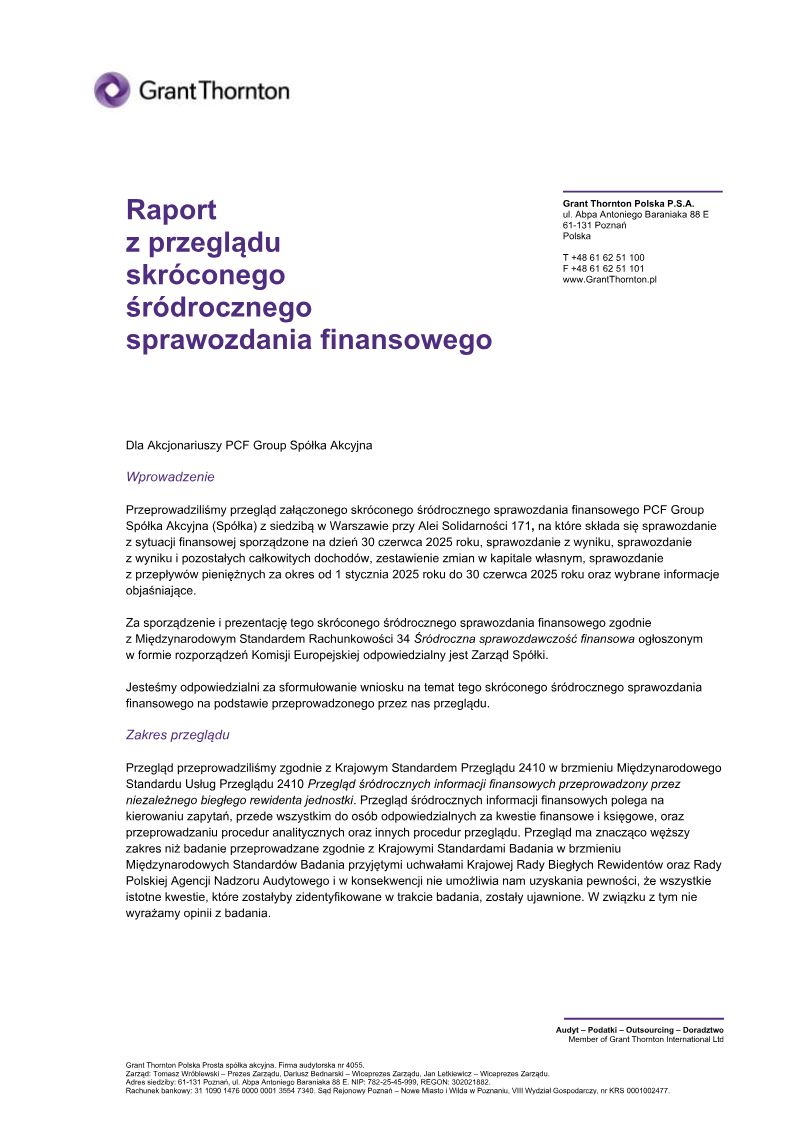
The report presents the findings of a review conducted by Grant Thornton Polska on the condensed interim financial statements of PCF Group Spółka Akcyjna for the period from 1 January to 30 June 2025. The review was performed in accordance with the Polish Standard for Review Engagements 2410, equivalent to International Standard on Review Engagements, and focused on the company’s compliance with IAS 34 Interim Financial Reporting as adopted by EU regulations. The scope included examination of the balance sheet, income statement, statement of comprehensive income, changes in equity, cash‑flow statement and selected explanatory notes.
Key conclusions indicate that no material misstatement was identified and the interim statements are presented in all significant respects in accordance with IAS 34. The review involved analytical procedures and inquiries of finance and accounting personnel, but did not provide assurance equivalent to an audit. The report highlights specific disclosures in explanatory notes: a valuation test for the cash‑generating unit related to development costs of a new game, noting uncertainty in projected cash flows due to potential deviations in early‑access sales; and an assessment of deferred tax assets amounting to PLN 52,659 thousand, reflecting uncertainty in five‑year tax profit forecasts and the feasibility of the company’s strategy.
The geographic coverage is limited to PCF Group’s operations in Poland, and the time frame covers the first half of 2025. The review methodology relied on management’s internal controls and financial records, with no sampling or audit evidence beyond the scope of a review engagement.
- Grant Thornton Polska concluded that PCF Group’s interim financial statements for the first half of 2025 comply with IAS 34 standards, with no material misstatements identified.
- The review highlighted uncertainty regarding the valuation of a cash-generating unit tied to new game development costs, specifically citing potential volatility in early-access sales projections.
- PCF Group carries deferred tax assets totaling PLN 52,659 thousand, which are subject to risks associated with five-year profit forecasts and the execution of the company’s strategic plan.
- The review was conducted under the Polish Standard for Review Engagements 2410 and involved analytical procedures and management inquiries, though it does not provide the same level of assurance as a full audit.
- The scope of the financial review was limited to the period between 1 January and 30 June 2025 and focused exclusively on PCF Group’s operations within Poland.
+1
PCF Group
Report2 pages
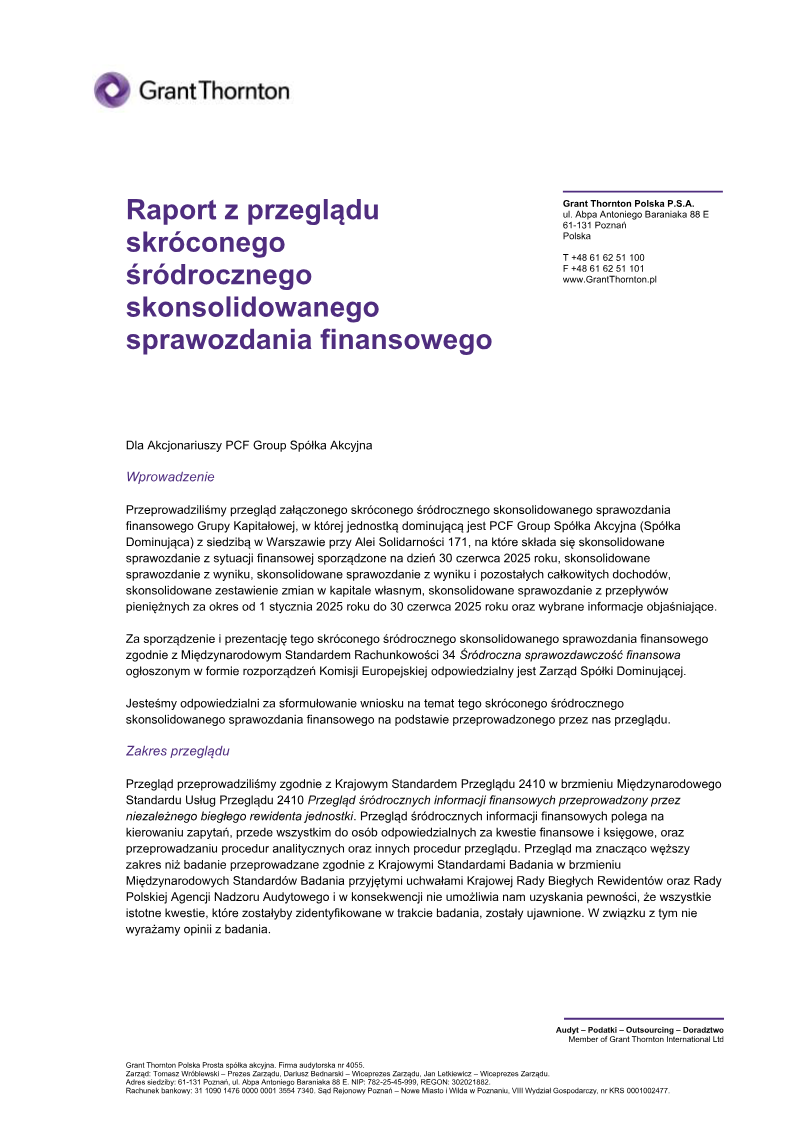
Raport z przeglądu skróconego śródrocznego skonsolidowanego sprawozdania finansowego: H1 2025
The review confirms that the consolidated interim financial statements for PCF Group Spółka Akcyjna, covering the period from 1 January to 30 June 2025, have been prepared in accordance with International Financial Reporting Standard 34 for interim reporting as adopted by European Union regulations. No material misstatements or omissions were identified during the review, which was conducted in accordance with Polish Standard 2410 (the local equivalent of International Standard on Review Engagements). The review involved inquiry procedures directed at financial and accounting personnel, analytical procedures, and other review activities. Because the scope of a review is narrower than that of an audit, no assurance is provided beyond the conclusion that nothing has come to the reviewers’ attention that would lead them to believe the statements are not prepared in all material respects.
Key disclosures highlighted include a valuation test for a cash‑generating unit related to capitalised development costs for a new game, with uncertainties noted regarding the assumptions underpinning projected cash flows and actual sales under an early‑access model. Additionally, a deferred tax asset of PLN 53,543 thousand is subject to uncertainty due to potential changes in the group’s tax‑profit forecasts over a five‑year horizon, reflecting doubts about the feasibility of current strategic plans. No modifications to these disclosures were recommended by the reviewers.
The review covers the entire PCF Group, headquartered in Warsaw, and was completed on 30 September 2025 by Grant Thornton Polska Prosta Spółka Akcyjna, a member of the Grant Thornton International network.
- Grant Thornton Polska completed a review of PCF Group’s H1 2025 financial statements, confirming they comply with IAS 34 and contain no material misstatements.
- A deferred tax asset valued at PLN 53,543 thousand is currently subject to uncertainty due to potential fluctuations in the group’s five-year tax-profit forecasts.
- The valuation of capitalised development costs for a new game remains uncertain, specifically regarding the reliability of cash flow projections and early-access sales assumptions.
- The review, conducted by Grant Thornton Polska, was finalised on 30 September 2025 and covered the entire Warsaw-based PCF Group.
- The review procedures were limited to inquiries and analytical activities, providing a lower level of assurance than a full financial audit.
PCF Group
Report5 pages
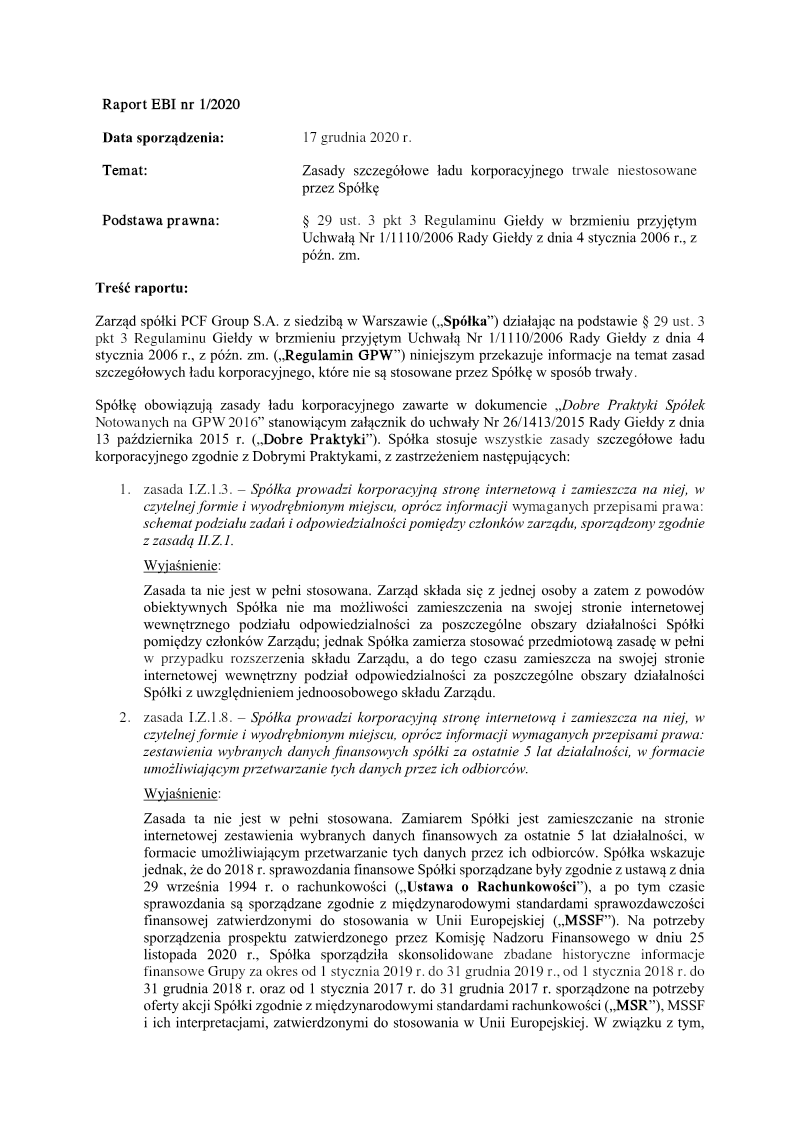
Raport EBI nr 1/2020: Zasady Szczegółowe Ładu Korporacyjnego Trwale Niestosowane
The report outlines PCF Group S.A.’s compliance with detailed corporate governance principles required by the Warsaw Stock Exchange regulations. It confirms that the company adheres to all “Good Practices” for listed companies, except where specific circumstances prevent full implementation. The governance framework is evaluated against seven key principles covering board responsibilities, risk management, audit independence, shareholder communication, and conflict‑of‑interest policies.
Key findings reveal that the single‑member board limits the ability to publish a detailed internal division of responsibilities and risk‑management oversight, though the company intends to adopt these practices if the board expands. Financial transparency is partially met; the firm plans to provide five‑year financial summaries in a machine‑readable format, noting that earlier reports were prepared under national accounting standards and recent ones under IFRS. A formal diversity policy is absent, with recruitment based solely on qualifications and experience rather than demographic criteria.
Shareholder engagement practices are largely compliant, with real‑time webcast provision for registered participants and a commitment to publish meeting recordings if demand arises. The company does not maintain a separate internal audit function but relies on an Audit Committee that meets independence criteria. Conflict‑of‑interest procedures are acknowledged in statutes, though detailed internal guidelines remain undeveloped.
The report covers the Polish market, focusing on PCF Group’s operations in 2020. Methodology is descriptive, based on board disclosures and regulatory requirements rather than external sampling. Overall, the company demonstrates a largely compliant governance posture while identifying areas for future enhancement as its board structure and operational scope evolve.
- PCF Group S.A. maintains general compliance with Warsaw Stock Exchange corporate governance principles, with specific exceptions noted for 2020.
- The company’s single-member board structure currently prevents the implementation of detailed internal divisions of responsibility and formal risk-management oversight.
- PCF Group lacks a formal diversity policy, prioritizing recruitment based exclusively on professional qualifications and experience over demographic criteria.
- Financial reporting transparency is currently limited, though the firm plans to transition to machine-readable, five-year financial summaries to bridge the gap between national accounting standards and IFRS.
- The company operates without a dedicated internal audit function, relying instead on an independent Audit Committee to fulfill oversight requirements.
PCF Group
Report18 pages
Information on the State of Application of Good Practices 2021
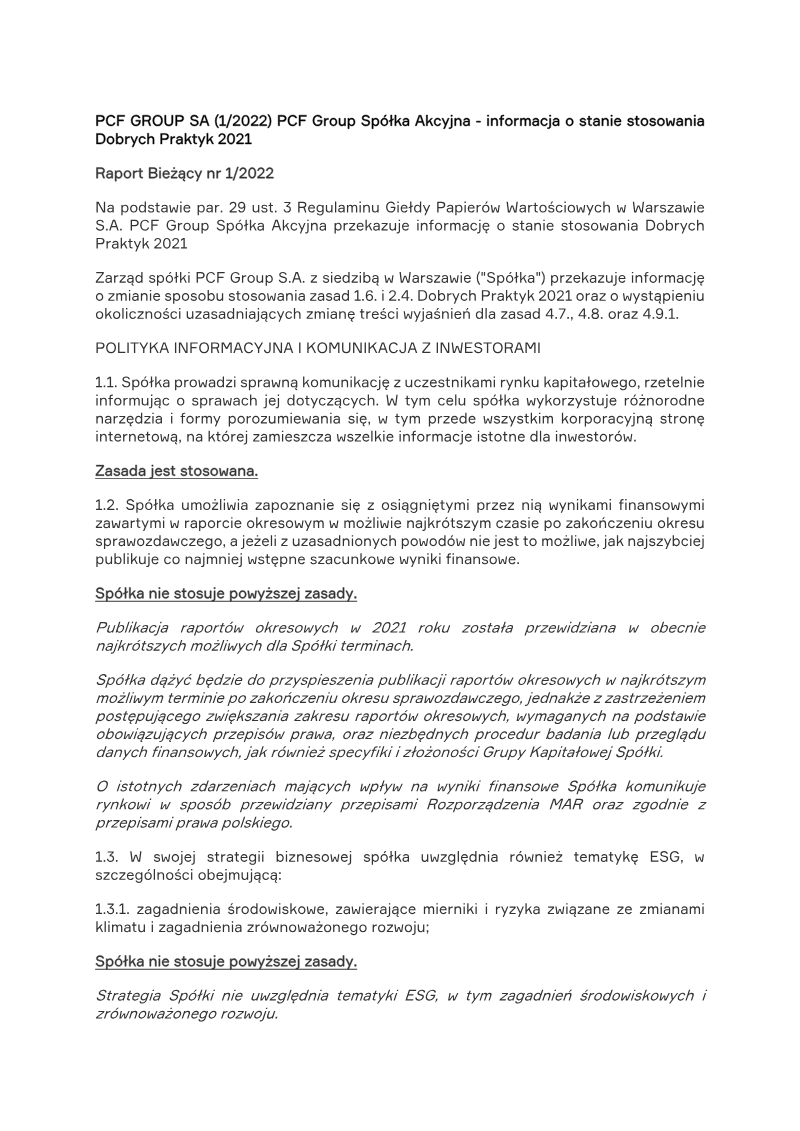
PCF GROUP SA (1/2022) PCF Group Spółka Akcyjna - informacja o stanie stosowania Na podstawie par. 29 ust. 3 Regulaminu Giełdy Papierów Wartościowych w Warszawie S.A. PCF Group Spółka Akcyjna przekazuje informację o stanie stosowania Dobrych Zarząd spółki PCF Group S.A. z siedzibą w Warszawie ("Spółka") przekazuje informację o zmianie sposobu stosowania zasad 1.6. i 2.4. Dobrych Praktyk 2021 oraz o wystąpieniu okoliczności uzasadniających zmianę treści wyjaśnień dla zasad 4.7., 4.8. oraz 4.9.1.
- PCF Group SA has changed its application of principles 1.6 and 2.4 of the Good Practices 2021 and updated explanations for principles 4.7, 4.8, and 4.9.1.
- The company does not apply the principle of publishing financial results as quickly as possible after the reporting period, stating that 2021 report publication was set for the shortest possible terms.
- PCF Group SA does not apply a diversity policy for its management board and supervisory board, citing dynamic growth and the need to acquire talent with specific competencies, rather than focusing on age, gender, or other diversity criteria.
- The company does not calculate or publish a gender pay gap indicator, arguing that due to the industry's employment structure, a cross-sectional indicator would be misleading, though it upholds equal pay for identical positions.
- PCF Group SA does not have a formal internal audit department, risk management, or compliance officers, but will consider establishing a dedicated internal audit unit in the future based on business model development and external feedback.
PCF Group
Report17 pages
Information on the State of Application of Best Practices 2021
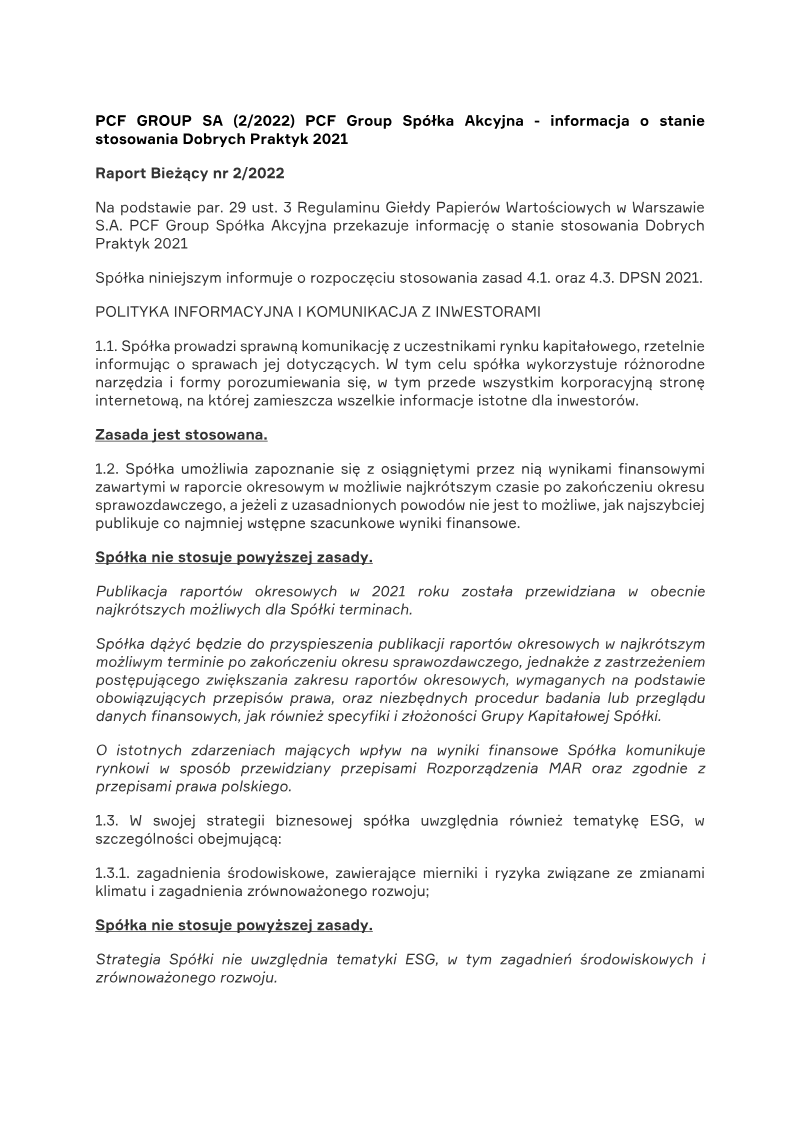
PCF GROUP SA ( 2/2022) PCF Group Spółka Akcyjna - informacja o stanie stosowania Dobrych Praktyk 2021 Na podstawie par. 29 ust. 3 Regulaminu Giełdy Papierów Wartościowych w Warszawie S.A. PCF Group Spółka Akcyjna przekazuje informację o stanie stosowania Dobrych Spółka niniejszym informuje o rozpoczęciu stosowania zasad 4.1. oraz 4.3. DPSN 2021. POLITYKA INFORMACYJNA I KOMUNIKACJA Z INWESTORAMI 1.1.
- PCF Group SA has begun applying principles 4.1 and 4.3 of the DPSN 2021 best practices.
- The company does not apply the principle of publishing financial results as quickly as possible after the reporting period, citing increasing scope of reports, audit procedures, and the complexity of its Capital Group as reasons.
- PCF Group SA does not apply a diversity policy for its management and supervisory boards, nor does it aim for a minimum 30% representation of minorities in these bodies, prioritizing qualifications and experience over other criteria.
- The company does not apply the principle of presenting a gender pay gap indicator, stating that due to the industry's employment structure, a cross-sectional indicator would be misleading, though it maintains equal pay for identical positions.
- PCF Group SA does not have an internal audit function or an internal auditor, and the management board does not prepare reports on the effectiveness of internal control, risk management, and compliance systems for the supervisory board.
PCF Group
Report17 pages
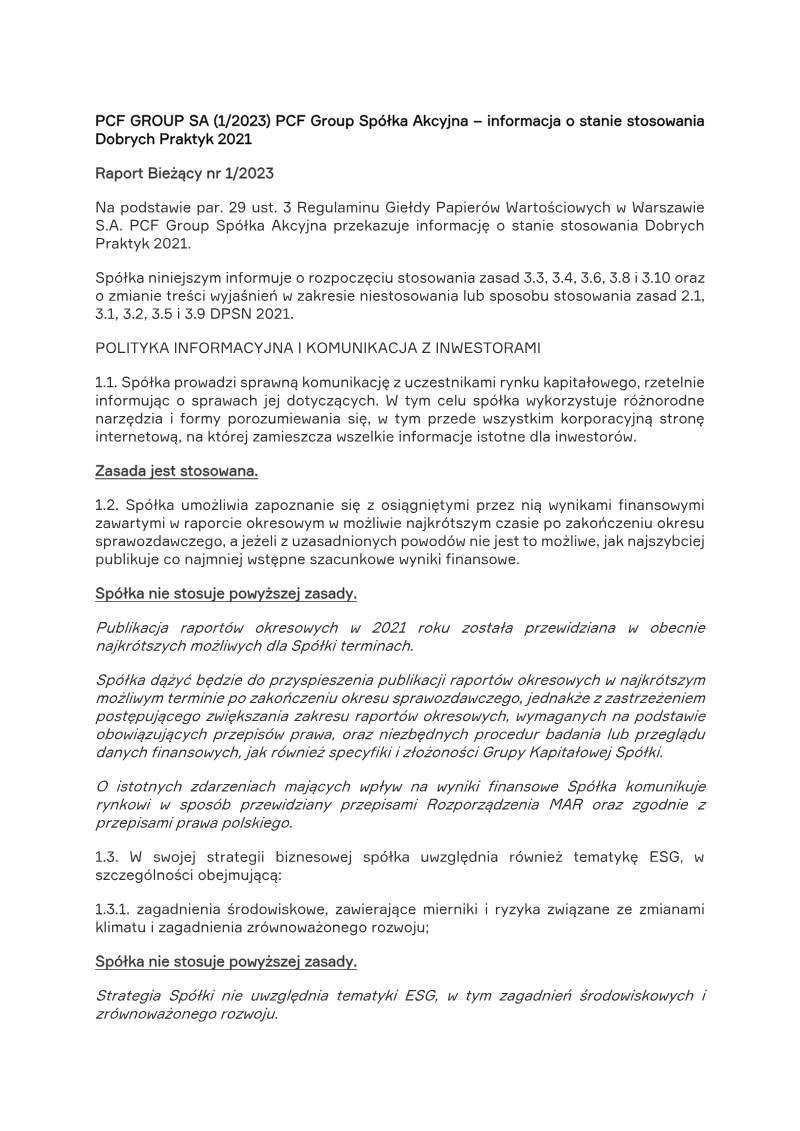
Information on the State of Application of Good Practices 2021: 1/2023
PCF GROUP SA (1/2023) PCF Group Spółka Akcyjna – informacja o stanie stosowania Na podstawie par. 29 ust. 3 Regulaminu Giełdy Papierów Wartościowych w Warszawie S.A. PCF Group Spółka Akcyjna przekazuje informację o stanie stosowania Dobrych Spółka niniejszym informuje o rozpoczęciu stosowania zasad 3.3, 3.4, 3.6, 3.8 i 3.10 oraz o zmianie treści wyjaśnień w zakresie niestosowania lub sposobu stosowania zasad 2.1, 3.1, 3.2, 3.5 i 3.9 DPSN 2021.
- PCF Group SA has begun applying new good practices (3.3, 3.4, 3.6, 3.8, 3.10) and modified explanations for non-application or application of others (2.1, 3.1, 3.2, 3.5, 3.9) as of January 2023.
- The company does not apply the principle of publishing financial results as quickly as possible, stating that 2021 reports were published at the shortest possible times.
- PCF Group SA does not apply a diversity policy for its management and supervisory boards (2.1) and does not use diversity criteria in selecting board members (2.2), citing dynamic growth and the need for specific competencies.
- The company does not report on pay equality indicators (1.4.2) due to the specific employment structure in the gaming industry, but states that gender does not influence employment conditions for identical positions.
- PCF Group SA has maintained a formalized internal audit function with an internal auditor since January 1, 2023, and plans an external review of this function within five years of DPSN2021's effective date.
PCF Group
Report1 pages
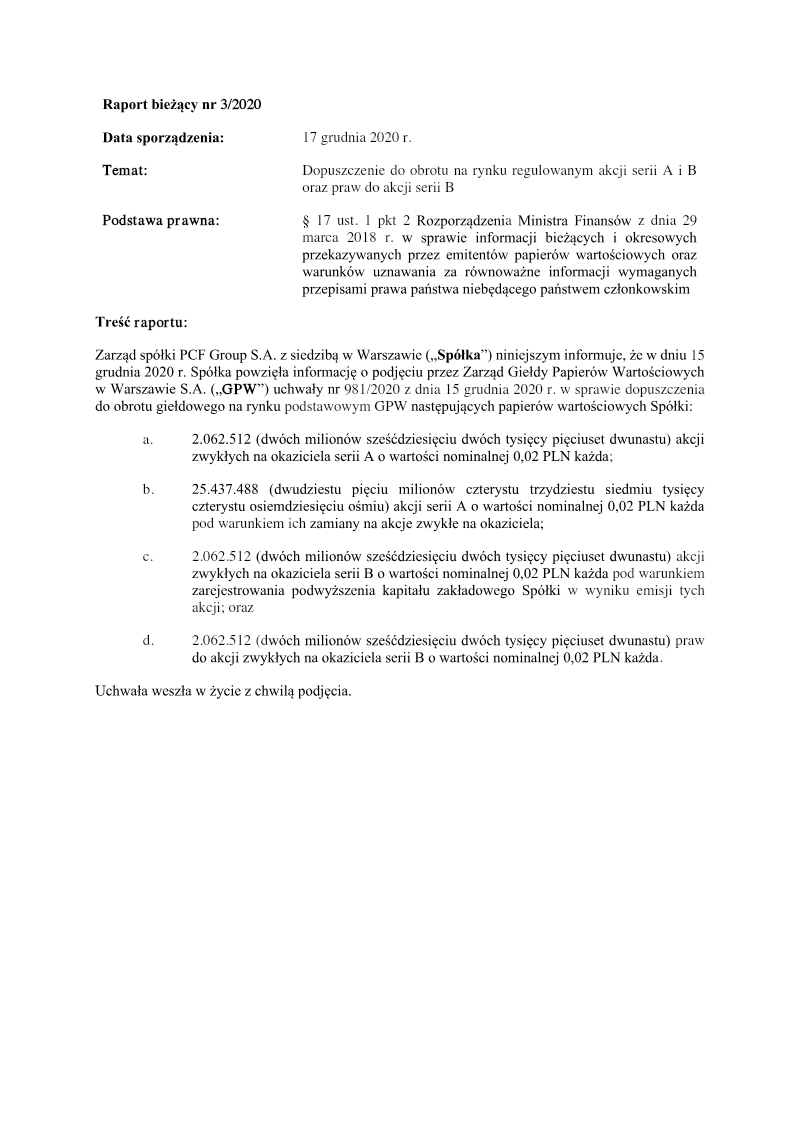
Current Report No. 3/2020: Admission of Series A and B Shares to Trading
The report announces that on 15 December 2020 the Warsaw Stock Exchange (GPW) adopted resolution 981/2020, authorizing PCF Group S.A. to list specific securities on the GPW primary market. The listed instruments include 2,062,512 ordinary bearer shares of Series A with a nominal value of PLN 0.02 each; 25,437,488 Series A shares subject to conversion into ordinary bearer shares; 2,062,512 ordinary bearer shares of Series B contingent on a capital increase resulting from their issuance; and 2,062,512 rights to ordinary bearer shares of Series B. All issuances carry a nominal value of PLN 0.02 per share or right.
The resolution became effective immediately upon adoption, enabling the securities to commence trading on the GPW. The announcement is framed within the legal basis of § 17(1)(2) of the Minister of Finance Regulation dated 29 March 2018, which governs current and periodic disclosures by issuers of securities. The document serves to inform shareholders and market participants that the company’s Series A and B shares, along with associated rights, are now eligible for trading on a regulated market. No additional data such as pricing, volume, or investor impact metrics are provided; the focus remains on regulatory compliance and the formal listing of the specified securities.
- On 15 December 2020, the Warsaw Stock Exchange (GPW) authorized PCF Group S.A. to list its Series A and B shares on the primary market.
- The listing includes 2,062,512 ordinary bearer shares of Series A and 25,437,488 Series A shares subject to conversion.
- The authorization covers 2,062,512 ordinary bearer shares of Series B contingent on a capital increase and 2,062,512 rights to Series B shares.
- All listed securities and rights carry a nominal value of PLN 0.02 per unit.
- The GPW resolution 981/2020 became effective immediately upon its adoption on 15 December 2020, enabling the commencement of trading.
PCF Group
Report1 pages
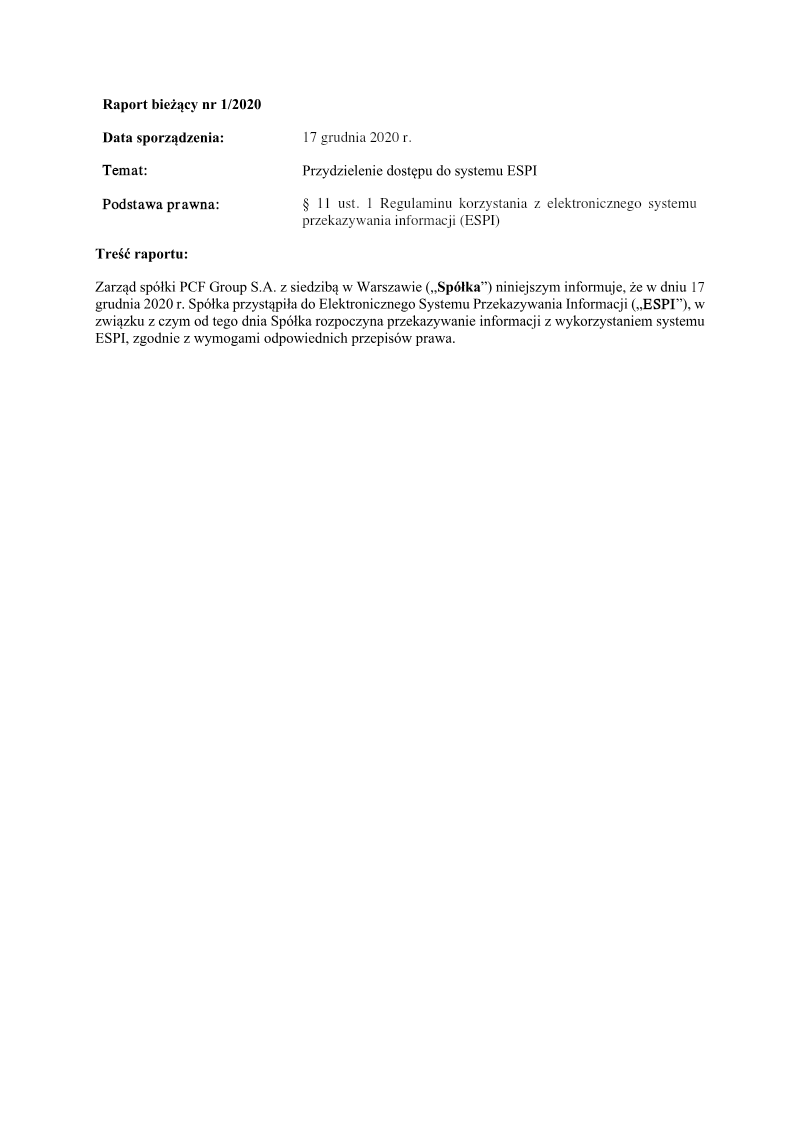
Raport bieżący 1/2020: Przydzielenie dostępu do systemu ESPI
The report announces that on 17 December 2020 the board of PCF Group S.A., headquartered in Warsaw, entered into the Electronic System for Information Transfer (ESPI). This action fulfills the legal requirement set out in § 11(1) of the ESPI usage regulations, thereby authorizing the company to transmit information through the system from that date onward. The document serves as an official notification of compliance with statutory obligations concerning electronic data exchange within the Polish corporate framework. It confirms that PCF Group S.A. has met the necessary procedural steps to become an ESPI participant, enabling it to submit required filings and communications electronically. No additional data or analysis is provided; the report functions solely as a compliance statement for regulatory purposes.
- On 17 December 2020, PCF Group S.A. officially gained access to the Electronic System for Information Transfer (ESPI).
- The company completed this registration to fulfill the legal requirements mandated by § 11(1) of the ESPI usage regulations.
- This authorization enables PCF Group S.A. to transmit regulatory filings and corporate communications electronically.
- The move ensures the Warsaw-based company remains in compliance with statutory obligations for electronic data exchange within the Polish corporate framework.
- This report serves as a formal notification of procedural compliance and contains no further financial or operational analysis.
PCF Group
Report1 pages
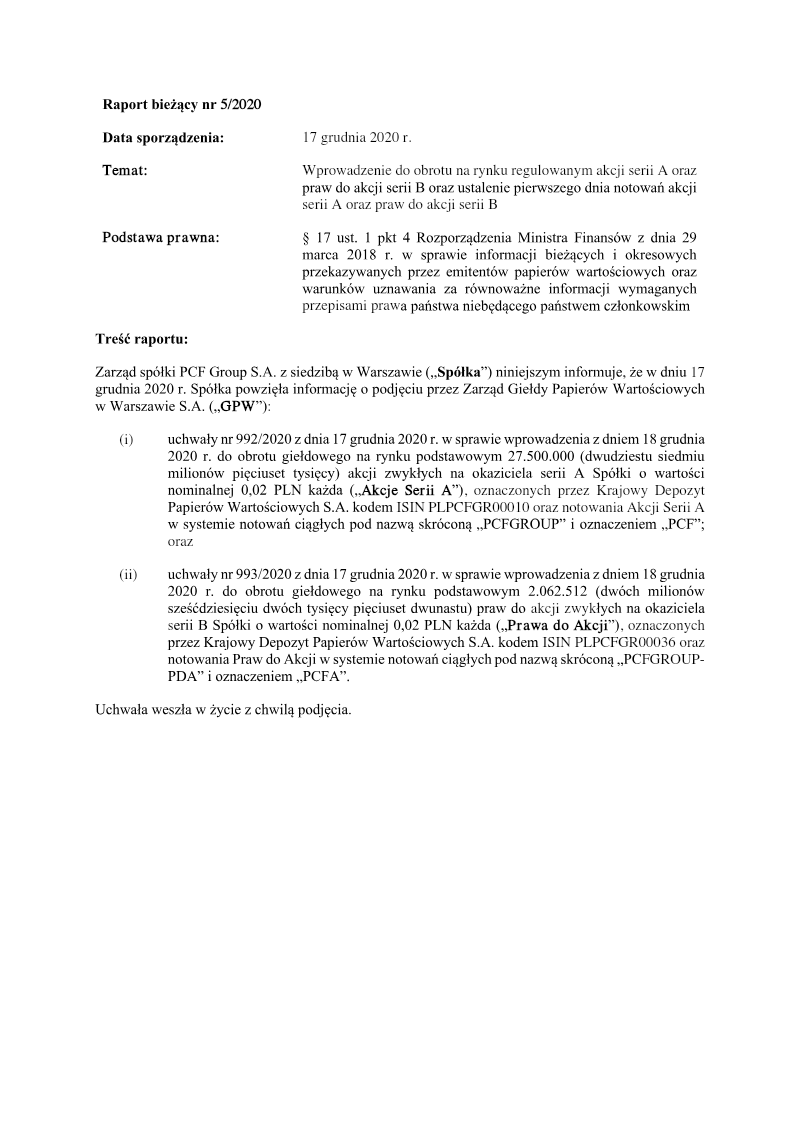
Raport bieżący nr 5/2020: Wprowadzenie do obrotu akcji i PDA
The report announces the initiation of trading for PCF Group S.A.’s Series A shares and Series B rights on the Warsaw Stock Exchange’s primary market, effective 18 December 2020. The company confirms receipt of the exchange’s resolutions: resolution 992/2020 authorises 27,500,000 Series A shares with a nominal value of PLN 0.02 each, listed under the ticker “PCF”; resolution 993/2020 authorises 2,062,512 Series B rights with the same nominal value, listed under “PCFA”. Both instruments are registered with KDPW and carry ISIN codes PLPCFGR00010 (Series A) and PLPCFGR00036 (Series B). The announcement is issued under the legal framework of §17(1)(4) of the 2018 Ministerial Regulation on ongoing and periodic information from issuers, ensuring compliance with disclosure requirements for non‑EU jurisdictions.
Key data points include the exact share and rights quantities, nominal values, ISIN identifiers, ticker symbols, and the precise effective date of market entry. The scope is limited to the Warsaw Stock Exchange’s primary market and pertains solely to PCF Group S.A.’s equity instruments. Methodologically, the report relies on official exchange resolutions and internal corporate communication; no survey or external data sources are cited. The document serves to inform investors and market participants of the new trading instruments, confirming regulatory approval and providing essential identifiers for trade execution.
- PCF Group S.A. initiated trading of its Series A shares and Series B rights on the Warsaw Stock Exchange primary market effective 18 December 2020.
- The exchange authorized 27,500,000 Series A shares under the ticker “PCF” with a nominal value of PLN 0.02 per share.
- The company listed 2,062,512 Series B rights under the ticker “PCFA” with a nominal value of PLN 0.02 per right.
- Series A shares are registered under ISIN code PLPCFGR00010, while Series B rights are registered under ISIN code PLPCFGR00036.
- Both the Series A shares and Series B rights are officially registered with the Central Securities Depository of Poland (KDPW).
PCF Group