
The analysis charts the evolution of the souls‑like subgenre from a niche curiosity to a mainstream pillar of the video‑game market, emphasizing the decisive role of APAC developers and Chinese players in shaping its commercial trajectory. By tracking titles released between January 2015 and early 2025, the study demonstrates that while indie studios supplied the bulk of new releases, AAA and AA publishers now dominate revenue, accounting for over 70 % of estimated units sold on Steam.
Sales data reveal a rapid escalation in both volume and concentration. Black Myth: Wukong leads with roughly 20 million units, followed by Elden Ring at 15.6 million, Monster Hunter World at 13 million, Dark Souls III at 9.1 million, and Hades with 8.4 million YTD. The shift in publisher composition is evident: AA releases peaked at 90 % of titles in 2017 but fell to around 30 % by 2023, while AAA output rose to nearly two‑thirds of the market, reflecting a transition from experimental indie projects to large‑scale investments.
Geographically, APAC’s influence surged, reaching roughly 80 % of development share by 2025, with Japan providing a historic foundation and China and Korea expanding both creation and consumption. Chinese gamers now represent close to half of the global souls‑like audience (≈47 %), eclipsing the United States (≈15 %) and Germany (≈5 %). This demographic weight makes success in China a critical determinant for high‑budget releases.
Methodologically, the findings rely on Video Game Insights’ estimations derived from Steam tagging, publisher classification, and sales‑estimation algorithms applied to all souls‑like titles launched from 2015 onward across Steam, PlayStation and Xbox platforms. The overarching conclusion is that the genre’s challenging, skill‑based design continues to attract investment and player engagement, with APAC innovation and the Chinese market ensuring its long‑term viability as a global mainstay.
Sensor Tower · 2026
Adjust · 2026
Sensor Tower · 2026

Sensor Tower · 2026
Sensor Tower · 2026
Sensor Tower · 2026
Sensor Tower · 2026

Sensor Tower · 2026

Sensor Tower · 2026

Sensor Tower · 2026

Sensor Tower · 2026

Sensor Tower · 2026

Niko Partners · 2026
Anzu · 2026

SpielFabrique · 2026
InvestGame · 2026
Telekom Malaysia · 2026
Deloitte · 2026
Bryter · 2026

Niko Partners · 2026
Newzoo · 2025

SELL – Syndicat des Éditeurs de Logiciels de Loisirs · 2025
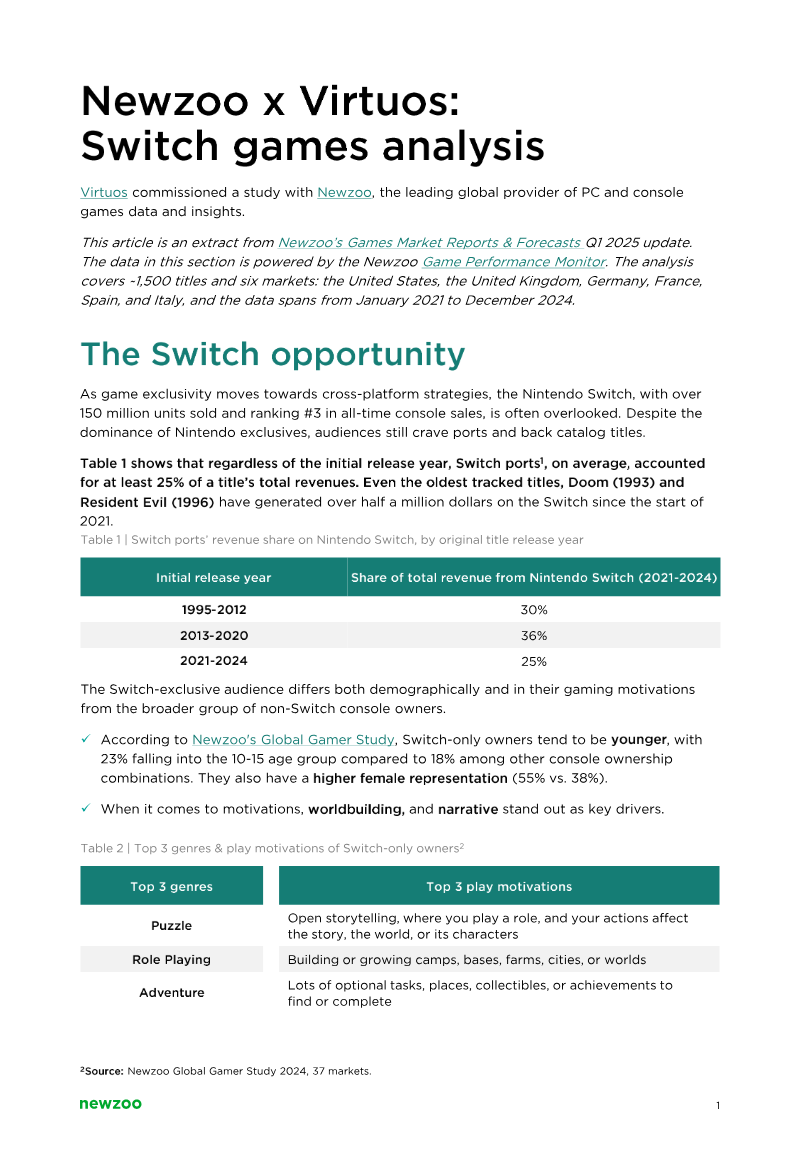
Newzoo · 2025
Stream Hatchet · 2025