Updated Mar 17, 2026 by Korea Creative Content Agency
Report · January 1, 2025
Published by Korea Creative Content Agency
The interview underscores a shift in Southeast Asia’s convergent‑content market from speculative metaverse enthusiasm to a pragmatic, ROI‑driven landscape where augmented reality has become the primary vehicle for marketing and tourism initiatives. Growth is anchored in measurable outcomes such as cost‑reduction ratios and increased foot‑traffic, supported by government funding and a mobile‑first infrastructure that leverages WebXR and expanding 5G networks. Large‑scale AR deployments at heritage and tourist sites illustrate the sector’s scalability, emphasizing the necessity of culturally resonant storytelling, clear narrative structures, and quantitative metrics like dwell time and interaction density to assess engagement. Effective experiences consistently incorporate gamified micro‑games and selfie‑style interactions that encourage user participation and social sharing. These design elements amplify interaction density and foster virality, reinforcing the importance of narrative quality over pure technological novelty. The chief operating officer highlights that AI‑generated, personalized storytelling—through digital humans and generative‑AI scripts—remains the chief catalyst for sustained user interest, with success measured by dwell time, interaction density and social‑virality indicators. A principal commercial obstacle is the high bandwidth demand of simultaneous, large‑scale XR experiences. The rollout of 5G and cloud‑native architectures such as CloudXR has already mitigated latency and loading challenges, as demonstrated by the AR broadcast of Singapore’s Chingay festival in 2020. Continued expansion across the region will depend on further high‑bandwidth network deployment, sustained government infrastructure investment, and deeper integration of AI technologies to produce adaptive, immersive content.
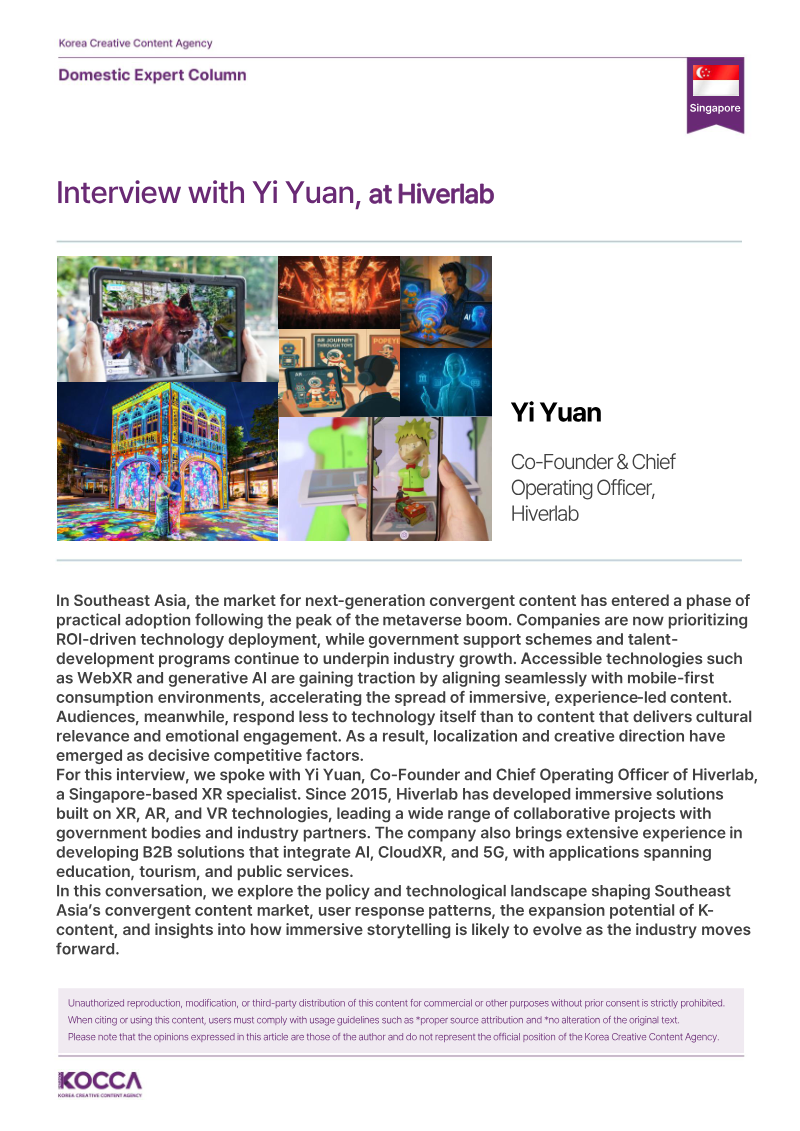
Singapore Singapore Looking forward, personalized storytelling powered by generative Al is likely to regain strong Interview with Yi Yuan, at Hiverlab and persistent location anchoring are gradually moving from experimentation toward real-world implementation. Together, these developments point to a future in which convergent content becomes more adaptive, continuous, and deeply integrated into everyday environments across Southeast Asia. What do you consider most important for improving the quality and user experience of convergent content driven by emerging technologies going forward? Co-Founder & Chief Operating Officer, Hiverlab metrics such as dwell time, interaction density, and share rates or social virality, all of which indicate how strongly users resonate with the content and how long they remain engaged. In Southeast Asia, the market for next-generation convergent content has entered a phase of practical adoption following the peak of the metaverse boom. Companies are now prioritizing ROI-driven technology deployment, while government support schemes and talentdevelopment programs continue to underpin industry growth. Accessible technologies such as WebXR and generative AI are gaining traction by aligning seamlessly with mobile-first consumption environments, accelerating the spread of immersive, experience-led content. Audiences, meanwhile, respond less to technology itself than to content that delivers cultural relevance and emotional engagement.
and generative AI are gaining traction by aligning seamlessly with mobile-first consumption environments, accelerating the spread of immersive, experience-led content. Audiences, meanwhile, respond less to technology itself than to content that delivers cultural relevance and emotional engagement. As a result, localization and creative direction have emerged as decisive competitive factors. For this interview, we spoke with Yi Yuan, Co -Founder and Chief Operating Officer of Hiverlab, a Singapore-based XR specialist. Since 2015, Hiverlab has developed immersive solutions built on XR, AR, and VR technologies, leading a wide range of collaborative projects with government bodies and industry partners. The company also brings extensive experience in developing B2B solutions that integrate AI, CloudXR, and 5G, with applications spanning education, tourism, and public services. In this conversation, we explore the policy and technological landscape shaping Southeast Asia’s convergent content market, user response patterns, the expansion potential of Kcontent, and insights into how immersive storytelling is likely to evolve as the industry moves forward.
public services. In this conversation, we explore the policy and technological landscape shaping Southeast Asia’s convergent content market, user response patterns, the expansion potential of Kcontent, and insights into how immersive storytelling is likely to evolve as the industry moves forward. Unauthorized reproduction, modification, or third-party distribution of this content for commercial or other purposes without prior consent is strictly prohibited. When citing or using this content, users must comply with usage guidelines such as *proper source attribution and *no alterationof the original text. Please note that the opinions expressed in this article are those of the author and do not represent the official position ofthe Korea Creative Content Agency.
Singapore Singapore How has Southeast Asia’s convergent content market evolved over the past two to three years? and persistent location anchoring are gradually moving from experimentation toward real-world Over the past two to three years, Southeast Asia’s convergent content market has clearly entered a phase of practical consolidation following the initial surge of interest in the metaverse. As consumer-driven hype subsided, investment and project activity shifted toward Southeast Asia. concrete enterprise use cases. In particular, the use of AI to accelerate digital content production and to enable more interactive interfaces has emerged as a defining trend. What do you consider most important for improving the quality and user experience of In response to this shift, our company has repositioned itself around B2B enterprise solutions. convergent content driven by emerging technologies going forward? A representative example is our work on AI-driven spatial digital twin projects, which reflect growing demand for scalable, real-world applications rather than experimental showcases. In some markets, limitations in network coverage still remain, making it important to manage user At the same time, AR has seen the most active adoption in marketing and communication over the past few years. Large-scale AR initiatives such as Jewel-rassic Quest in Singapore, as well as mobile-based AR product exhibitions across multiple industries, illustrate how AR has become a practical engagement tool.
time, AR has seen the most active adoption in marketing and communication over the past few years. Large-scale AR initiatives such as Jewel-rassic Quest in Singapore, as well as mobile-based AR product exhibitions across multiple industries, illustrate how AR has become a practical engagement tool. VR, by contrast, is primarily deployed in corporate training environments—particularly for industrial use cases such as machinery operation and on-site technical training. Beyond this, AI is increasingly being integrated across the entire content production pipeline in the entertainment, tourism, and education sectors. Examples include the virtual host “Allie” at the Asian Civilisations Museum and the TATAI project led by the Tourism Authority of Thailand, both of which demonstrate how AI-powered content is moving from experimentation to sustained operational use. What do you see as the key drivers behind the growth of Southeast Asia’s convergent content market, and what practical factors are most influential in motivating companies to adopt these technologies? The growth of Southeast Asia’s convergent content industry is being driven by a clear shift toward measurable outcomes and tangible impact. Companies are adopting new technologies with a strong focus on ROI, particularly where productivity gains and safety improvements can be clearly demonstrated
Singapore Singapore For example, when deploying AI-based spatial digital twin solutions, it is essential to present concrete metrics—such as cost reduction ratios or productivity improvement rates—to justify investment. This performance-oriented approach is now spreading across the broader convergent content sector. In many projects, success is increasingly assessed through indicators such as increases in physical footfall or growth in online visibility following content deployment, rather Southeast Asia. than through technological novelty alone. In parallel, government funding schemes and talent-development programs play a critical What do you consider most important for improving the quality and user experience of enabling role. By lowering the financial burden of early pilot projects, cultivating local expertise, convergent content driven by emerging technologies going forward? and helping generate initial market demand, public-sector support has become a key catalyst in accelerating industry adoption and scaling. In some markets, limitations in network coverage still remain, making it important to manage user
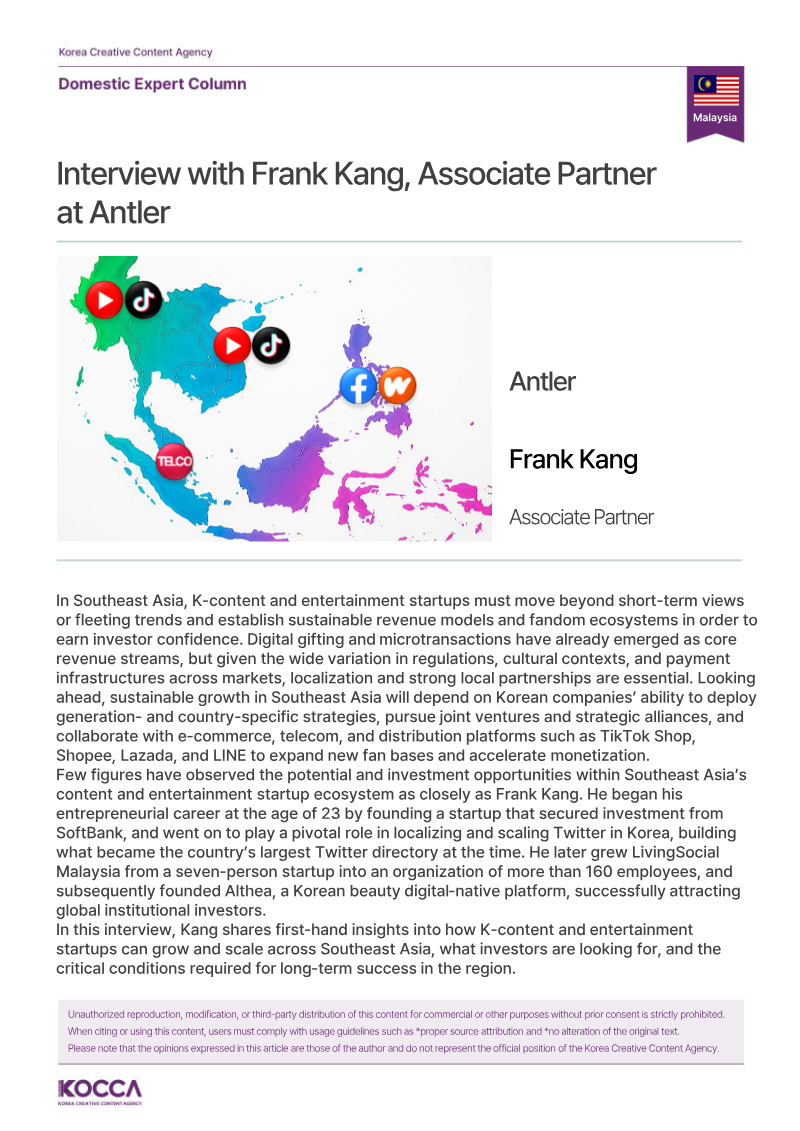
Korean content and entertainment startups are being urged to treat Southeast Asia as a primary growth engine rather than a peripheral market. Success hinges on deep localisation that goes beyond subtitles, requiring partnerships with local “co‑pilots” that can navigate fragmented linguistic, regulatory and payment landscapes in cities such as Jakarta, Manila and Bangkok. By embedding region‑specific monetisation schemes—micro‑transactions, live‑commerce, and hybrid free‑plus‑premium models—companies can align with the mobile‑wallet‑driven habits of Southeast Asian fans and convert grassroots enthusiasm into sustainable revenue streams. The region’s fandom operates as a decentralized, grassroots network where fans act as unpaid marketers, driving earnings through digital stickers, low‑priced concert tickets and other micro‑purchases that often outpace traditional subscription revenues seen in Korea or Japan. Promising niches include short‑form video, webtoons and IP‑centric ecosystems, mobile‑first games, and live‑commerce platforms, all of which benefit from early community testing and strong local alliances. Trust capital built by global Korean acts such as BTS and BLACKPINK demonstrates the willingness of Southeast Asian audiences to pay for authentic, culturally resonant experiences. Investors now demand proven revenue traction and genuine localisation before committing capital, and scalable startups are expected to adopt modular, locally adapted business models. Exits are likely to occur through mergers and acquisitions rather than public listings, underscoring the strategic importance of establishing a resilient foothold in Southeast Asia as a launchpad for broader global expansion.
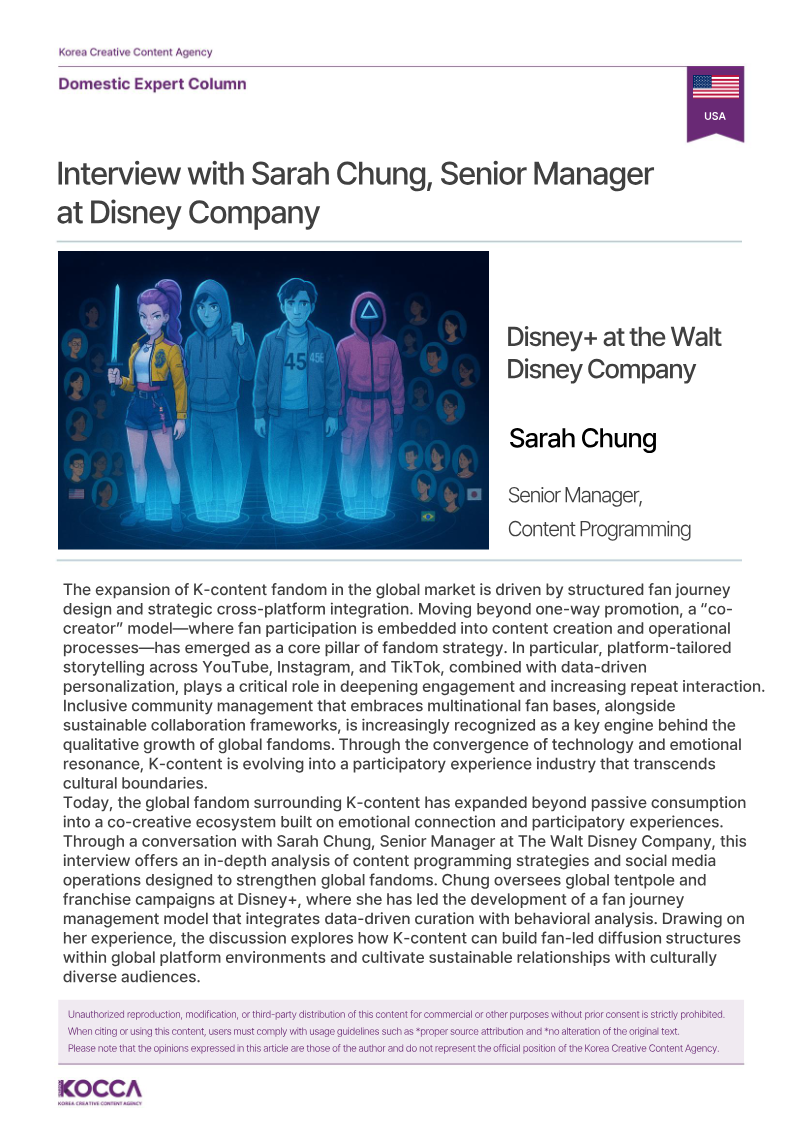
The interview underscores that the worldwide surge of Korean content is rooted in a “cocreator” fandom model, where streaming services offering seamless subtitle and dubbing options enable audiences to engage directly with material and co‑produce cultural moments. This participatory dynamic is amplified by nostalgia‑driven “comfort viewing” and the rapid diffusion of fan‑made short‑form clips on TikTok, which together reshape attention spans and create a feedback loop that fuels further consumption. A key finding is that Korean productions are breaking out of traditional genre boundaries, as illustrated by titles such as *The Glory*, *D.P.*, *Sweet Home* and *Gyeongseong Creature*. These series now contend not only with other OTT platforms but also with short‑form ecosystems like TikTok and YouTube, as well as user‑generated content. To secure global reach, Korean studios must prioritize distribution channels that combine extensive international footprints with aggressive off‑platform promotion, while exploiting AI‑driven recommendation engines to surface relevant titles amid an oversupply of options. Looking ahead to 2026, success will depend on a balanced strategy that merges technological adaptability, clear conceptual storytelling, and format experimentation. Integrating nostalgia‑centric comfort viewing with cross‑platform interactive campaigns will allow Korean creators to navigate a fragmented global content landscape and maintain competitive relevance across both long‑form and short‑form media environments.
The mobile advertising landscape in the third quarter of 2023 reveals a shifting environment characterized by a decline in total advertisers but a significant surge in video-centric content. Data indicates that the total number of advertisers fell to 54,900, a 7% year-over-year decrease compared to the 59,000 recorded in the third quarter of 2022. Despite this overall contraction, the gaming, entertainment, and lifestyle verticals maintained upward momentum in advertiser activity. In the United States specifically, the market saw 4.68 billion downloads and $6.5 billion in revenue, with gaming securing the top position in both metrics despite slight year-over-year market drops. Creative strategies have pivoted heavily toward video formats, which now account for 80% of all creatives, up from 69% in the previous quarter. This growth comes at the expense of static images, while playable ads remain a niche segment at 2% of the market. Analysis of the 15.2 million total creatives shows a heavy platform bias toward Android, which hosts 68% of ad content compared to 32% on iOS. In the competitive US market, top-tier advertisers maintain a massive scale, averaging nearly 54,000 creatives across nine different ad networks. The rise of User-Generated Content (UGC) has become a central pillar of modern mobile UA strategy. Effective creative execution now relies on organic trends, charismatic creators, and native storytelling techniques. Key findings suggest that successful UGC ads utilize "problem-solution" narratives, text overlays to accommodate sound-off viewing, and sketches that align with brand values. By leveraging creators who mirror the target audience and utilizing cliffhangers or popular music, advertisers are increasingly focusing on engagement and virality to offset the broader downward trend in the number of active market participants.
The Southeast Asian mobile gaming market in 2024 is characterized by high advertiser activity and a strategic shift toward video-centric marketing. Data collected between January and August 2024 reveals a monthly average of over 20,000 active advertisers in the region, representing a 9.5% year-over-year increase. While the proportion of new advertisers remained stable at approximately 3.7%, a significant surge occurred in June, where new game advertisers reached 8.5% of the total market. Geographically, Indonesia leads the region in the volume of monthly advertisers with 12.3K, surpassing major markets like Japan and South Korea. However, Thailand remains the most intensive in terms of content volume, serving as the only country in the region to exceed 100 monthly creatives per advertiser. From a platform perspective, Android dominates the landscape, accounting for over 70% of advertisers in markets like Indonesia, though iOS users see a higher proportion of image-based creatives. Genre analysis indicates that while casual games maintain the largest share of advertisers at 28.4%, Role-Playing Games (RPGs) are the most aggressive marketers. RPGs account for 16% of total creatives, a figure significantly higher than the global average. Strategy games (SLGs) lead in format innovation, with 76.5% of their ads utilizing video. Across all genres, video is the dominant medium, making up nearly 70% of all creatives, with a growing trend toward using local influencers, live-action footage, and "mini-game" playables to drive engagement. The findings are based on sampling from SocialPeta’s database of 1.6 billion ad creatives across 70 global channels. The methodology combines statistical forecasting with desk research to track advertising intelligence across Indonesia, Thailand, Singapore, Malaysia, Vietnam, the Philippines, and Cambodia. Findings suggest that successful regional campaigns increasingly rely on localized content, such as Thai celebrity endorsements and TikTok-inspired audio synchronization, to navigate the fierce competition in the Southeast Asian media-buying landscape.