Market (Overall)·Updated Apr 8, 2026 by AppsFlyer
Report · January 1, 2025
The primary purpose of the analysis is to demonstrate how a strategic partnership between a mobile measurement partner (MMP) and TikTok’s advertising ecosystem can unlock profitable growth for app marketers. By integrating real‑time attribution, privacy‑preserving measurement, and value‑based optimization, brands can accurately credit campaigns, reduce fraud, and maximize return on ad spend (ROAS) across the entire customer journey. Key findings show that cross‑platform visibility is essential for identifying high‑value users and optimizing acquisition budgets, especially amid tightening privacy regulations on iOS and Android. AppsFlyer’s comprehensive measurement suite, combined with TikTok’s SKAdNetwork tools and self‑reporting network, delivers precise audience targeting and cost‑effective user acquisition. Case studies from Burger King, Casas Bahia, and Carrefour illustrate tangible results: a 7× ROI for coupon activations, a 44 % lift in conversion rates with a 55 % ROI gain, and a 29 % increase in in‑app revenue with triple the return compared to other channels. The document outlines best practices for app install and retargeting campaigns, recommending the use of App Event Optimization (AEO) and Value‑Based Optimization (VBO) to focus spend on high‑value actions. Automated Smart Performance Campaigns and real‑time ROAS measurement via AppsFlyer integrations further enhance efficiency and lifetime value. Geographically, the insights apply globally across major mobile markets, with a focus on the U.S., Europe, and emerging regions where TikTok’s user base is rapidly expanding. The time frame covers current privacy‑driven advertising environments and anticipates ongoing downturns, positioning the partnership as a resilient growth strategy for 2024‑2026.
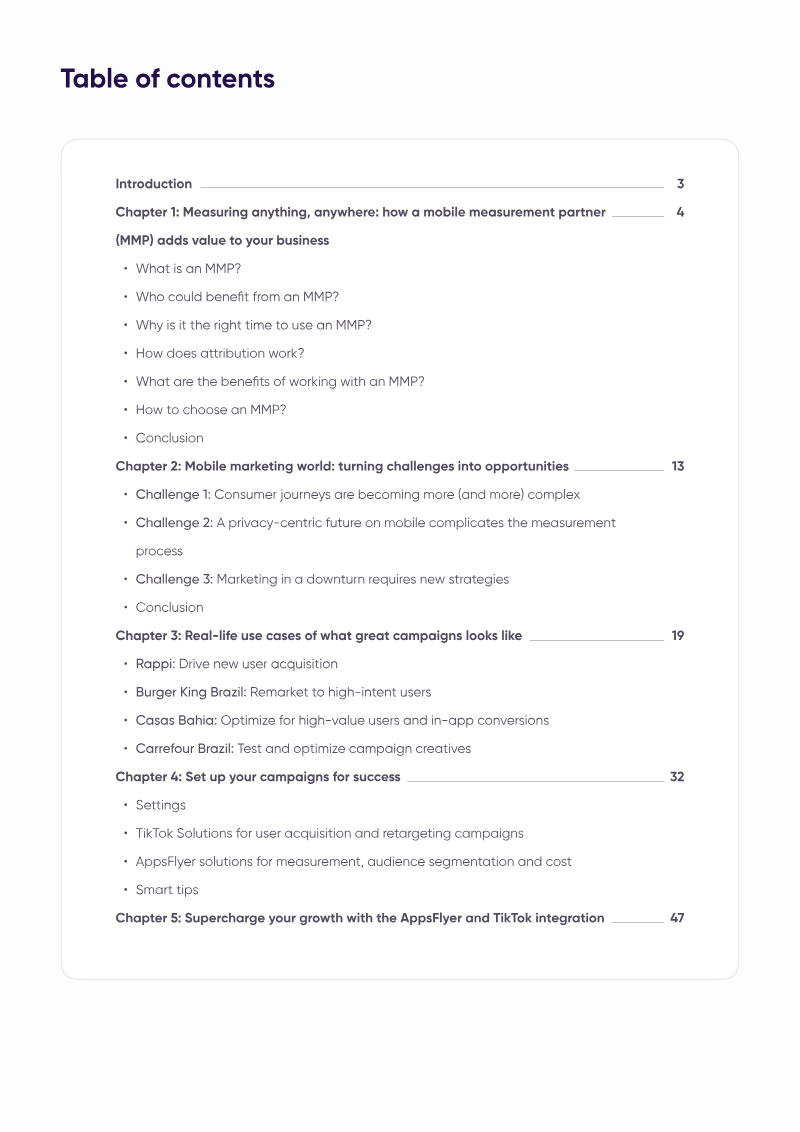
Table of contents Introduction 3 Introduction 3 Chapter 1: Measuring anything, anywhere: how a mobile measurement partner 4 (MMP) adds value to your busines2 8 What is an MMPF 8 Who could benefit from an MMPF Why is it the right time to use an MMP? 8 Why is it the right time to use an MMPF How does attribution work? 8 How does attribution workF What are the benefits of working with an MMP? 8 What are the benefits of working with an MMP?[ How to choose an MMP? 8 How to choose an MMPF 8 Conclusion Chapter 2: Mobile marketing world: turning challenges into opportunitie2 13 8 Challenge 1: Consumer journeys are becoming more (and more) complem 8 Challenge 2: A privacy-centric future on mobile complicates the measurement procesf 8 Challenge 3: Marketing in a downturn requires new strategies[ 8 Conclusion Chapter 3: Real-life use cases of what great campaigns looks lik? 19 Chapter 3: Real-life use cases of what great campaigns looks like 19 8 Rappi: Drive new user acquisitioN Rappi: Drive new user acquisition 8 Burger King Brazil: Remarket to high-intent userf Burger King Brazil: Remarket to high-intent users 8 Casas Bahia: Optimize for high-value users and in-app conversions[ Casas Bahia: Optimize for high-value users and in-app conversions 8 Carrefour Brazil: Test and optimize campaign creatives Carrefour Brazil: Test and optimize campaign creatives 32 Chapter 4: Set up your campaigns for succes2 8 Settings[ 32 8 TikTok Solutions for user acquisition and retargeting campaigns[ 8 AppsFlyer solutions for measurement, audience segmentation and cosz 8 Smart tips Chapter 5: Supercharge your growth with the AppsFlyer and TikTok integration 47
tives 32 Chapter 4: Set up your campaigns for succes2 8 Settings[ 32 8 TikTok Solutions for user acquisition and retargeting campaigns[ 8 AppsFlyer solutions for measurement, audience segmentation and cosz 8 Smart tips Chapter 5: Supercharge your growth with the AppsFlyer and TikTok integration 47 Chapter 5: Supercharge your growth with the AppsFlyer and TikTok integration 47
Introduction Driving profitable app growth is one of the most complex challenges facing brands today. As privacy continues to take center stage in the mobile industry, it’s become increasingly difficult for marketers to connect all of the various touchpoints across the user journey and prove positive return on campaign investment. So how can your brand overcome these obstacles and ensure you drive growth even during challenging times? The short answer is by transforming your user acquisition and remarketing strategies with proven solutions that fuel returns. Now, you may be asking yourself — how exactly do I do that? In this playbook, we aim to show you by taking you through the fundamentals of mobile measurement, showcasing the combined power of AppsFlyer and TikTok solutions, and highlighting successful strategies from major brands that you can adapt to your needs to help you achieve your goals.
Measuring anything, anywhere: how a mobile measurement partner (MMP) adds value to your business C:
Every marketer’s dream is to get a clear, full, and unbiased picture of where every advertising dollar goes and how it affects their bottom line. This includes identifying which campaigns are working (or not…) and which channels prove to be the most profitable. Howerever, for many marketing teams around the world across all app categories, this is not just a dream, but already a reality. They are empowered with complete and accurate measurement data of every user’s journey in real-time, and marketing analytics that guide their way to achieving their growth goals. In this chapter, you’ll get answers to critical questions for any mobile-first company seeking app growth. Before we dive into how to set up your campaigns for success, learn why having a powerful measurement platform at the heart of your marketing tech stack is a must. What is an MMP? A mobile measurement partner, or MMP, is a company that helps apps measure campaign performance across channels, platforms, and devices to support their mobile growth. Measuring all touchpoints enables marketers to attribute every app install and in-app engagement to the campaign and media source that drove it. Having access to accurate attribution and rich user behavioral data provides actionable insights that help marketers transform the user experience and optimize campaign ROI. Running campaigns that deliver positive return on ad spend (ROAS) is easy when you leverage a platform that analyzes every consumer interaction and attributes it correctly.
ser behavioral data provides actionable insights that help marketers transform the user experience and optimize campaign ROI. Running campaigns that deliver positive return on ad spend (ROAS) is easy when you leverage a platform that analyzes every consumer interaction and attributes it correctly. " AppsFlyer’s attribution platform is an everyday, every-hour tool for our team. Without it, the business does not happen.” Enric Pedró VP of Growth, Tilting Point
Achieving sustainable mobile app growth in a privacy-centric digital landscape requires a sophisticated integration of precise measurement tools and advanced advertising optimization. The primary objective of modern mobile marketing is to shift focus from simple installation metrics toward high-value user engagement and long-term profitability. By leveraging Mobile Measurement Partners (MMPs) in tandem with platform-specific optimization features, brands can navigate complex cross-channel user journeys, mitigate ad fraud, and significantly improve their return on ad spend. Data-driven strategies, specifically those utilizing App Event Optimization and Value-Based Optimization, serve as the foundation for scaling performance. These methodologies allow advertisers to move beyond broad acquisition tactics, instead employing granular audience segmentation and real-time tracking to identify and retain high-value users. Case studies involving major global brands such as Burger King, Rappi, and Carrefour demonstrate that this technical synergy consistently yields substantial improvements in conversion rates and overall revenue. For instance, integrated campaigns have successfully driven multi-fold increases in return on investment, proving that technical precision directly correlates with commercial success. The scope of these strategies encompasses global mobile markets, focusing on the intersection of social media advertising and third-party attribution. Success in this environment relies on a structured, agile approach that prioritizes diversified creative testing and consistent budget management. By combining the analytical depth of an MMP with the reach and targeting capabilities of platforms like TikTok, developers can effectively lower customer acquisition costs while maximizing user lifetime value. Ultimately, the integration of these technologies is essential for any organization seeking to maintain a competitive edge in the evolving mobile ecosystem.
The mobile gaming industry is entering a period of strategic recalibration, projected to reach $126.1 billion in revenue by 2025. This growth is underpinned by a transition toward hybrid monetization models and the integration of AI-powered personalization to combat persistent retention challenges. While global install volume grew by 4% in 2024, the market exhibits a distinct geographic divide; North American and European markets face stagnation, whereas Latin America and the Middle East and North Africa regions demonstrate robust expansion. Success in this evolving landscape requires developers to move beyond traditional acquisition, favoring diversified channels such as Connected TV and localized, player-centric engagement strategies. Data from early 2025 indicates that user tracking remains a pivotal operational hurdle, with global App Tracking Transparency opt-in rates hovering at 37.9%. Although arcade games have seen notable improvements in opt-in performance, the United States remains relatively static at 32%, underscoring the necessity for refined messaging strategies to maintain visibility. Concurrently, the industry is grappling with a complex financial environment characterized by rising costs per install and declining average revenue metrics. These headwinds are forcing a shift in marketing tactics, as developers increasingly rely on a broader array of acquisition partners and data-informed creative experimentation to sustain growth. Ultimately, the path to profitability in 2025 lies in prioritizing long-term player value over short-term acquisition metrics. By leveraging AI-driven optimization and fostering community-building initiatives, developers can mitigate the impact of declining revenue per user. The industry is clearly moving toward a more sophisticated, data-reliant ecosystem where the ability to measure performance across fragmented channels—including mobile and Connected TV—is essential for maintaining a competitive advantage in a maturing global market.
This industry guide provides a strategic framework for mobile game developers to transition from initial organic traction to sustainable, long-term revenue growth. The central thesis argues that while organic "sparks" are invaluable, lasting success requires a rigorous, two-step approach: first, optimizing the game’s internal economy for maximum Lifetime Value (LTV), and second, deploying data-driven paid User Acquisition (UA) campaigns. The first phase focuses on monetization through ad mediation and in-app purchases (IAP). Key findings suggest that implementing a hybrid ad mediation setup—combining real-time bidding with manual waterfalls—can yield a 10% to 20% uplift in Average Revenue Per Daily Active User (ARPDAU) immediately. The analysis emphasizes the importance of rewarded ads over intrusive interstitials and highlights that personalized, segmented IAP offers can increase player spending by up to 23%. It also advocates for regional pricing, noting that price cuts in lower-purchasing-power markets can boost ARPDAU by as much as 30%. The second phase details a methodology for scaling through paid UA, emphasizing the necessity of accurate data post-IDFA. The guide recommends a three-step framework of assessment, preparation, and optimization. It advises that while platforms like Meta and TikTok are accessible for smaller budgets, larger networks typically require a minimum monthly spend of $20,000 to exit the "learning phase" effectively. Furthermore, it stresses the role of App Store Optimization (ASO), citing a case where a simple icon change resulted in a 90% install uplift. The scope of the analysis covers the global free-to-play (F2P) mobile gaming market, applicable to various genres and studio sizes. The methodology relies on industry benchmarks, case studies, and data from SuperScale’s proprietary analytics engine, SuperInsights. The overarching conclusion is that developers must treat monetization and UA as iterative, scientific processes, using predictive modeling to forecast Return on Ad Spend (ROAS) up to a year in advance to ensure business-level profitability.
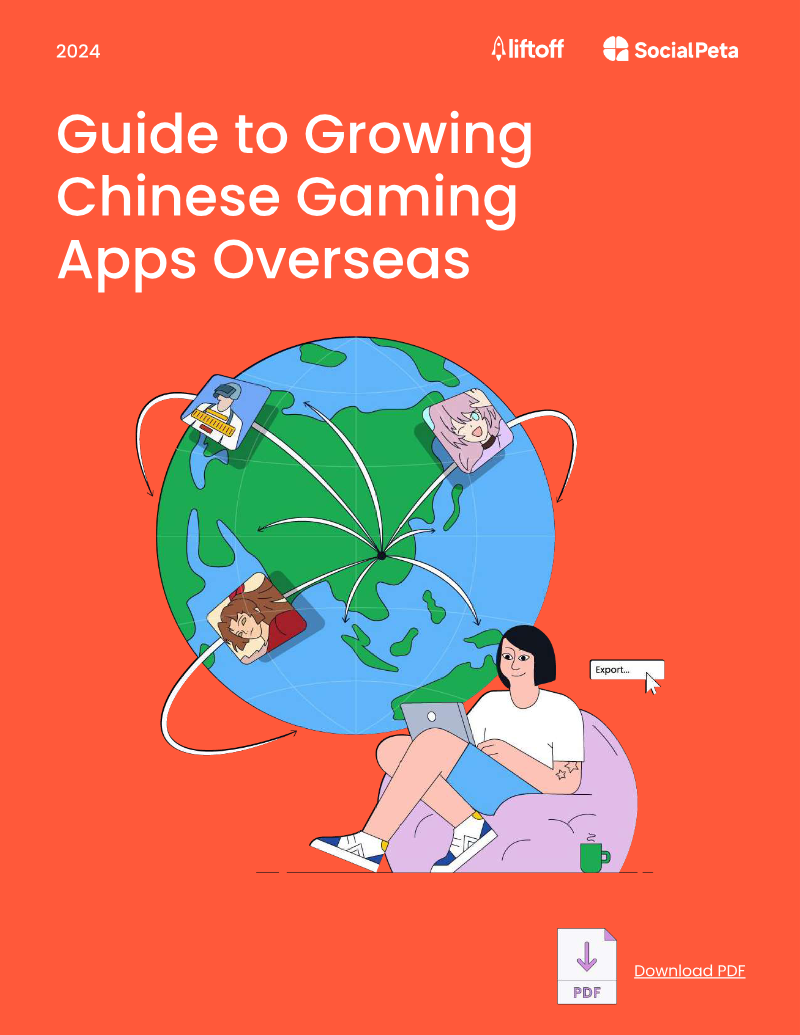
Chinese gaming applications continue to exert a dominant influence on the global stage, particularly within the strategy and role-playing game segments in mature markets such as the United States, Japan, and South Korea. While these regions offer substantial revenue potential, they are characterized by intense competition and elevated costs per install. To navigate these challenges, successful publishers are shifting toward hyper-localized strategies that tailor art styles to regional aesthetic preferences—favoring manga-inspired visuals in Japan and realistic or cartoon aesthetics in Western markets—while utilizing local influencers to establish brand credibility. Technological innovation serves as a primary driver for operational efficiency and user acquisition. The integration of generative AI has become essential for the rapid localization of ad creative, voice-overs, and marketing copy, ensuring both speed and brand compliance. High-performing titles currently leverage high-volume, innovative campaigns that incorporate minigames and AI-enhanced visuals to capture player attention. Beyond acquisition, long-term retention is increasingly supported by the implementation of social hangout spaces, home-building systems, and character trial models that balance accessibility with monetization. Monetization strategies have evolved to prioritize engagement through sophisticated, time-limited mechanics. Publishers are frequently employing box gachas, pull-milestone rewards, and gamified event structures such as diceboards and bingo to incentivize spending. Furthermore, the consistent deployment of diverse live events remains a critical requirement for maintaining player interest and competitive viability. By combining these aggressive monetization tactics with a commitment to continuous content updates, Chinese developers are effectively sustaining growth and deepening their footprint across the global gaming landscape throughout 2024.