Report1 pages
Raport Bieżący Nr 41/2021: Informacja o Transakcjach Wykonywanych przez Osoby Pełniące Obowiązki Zarządcze
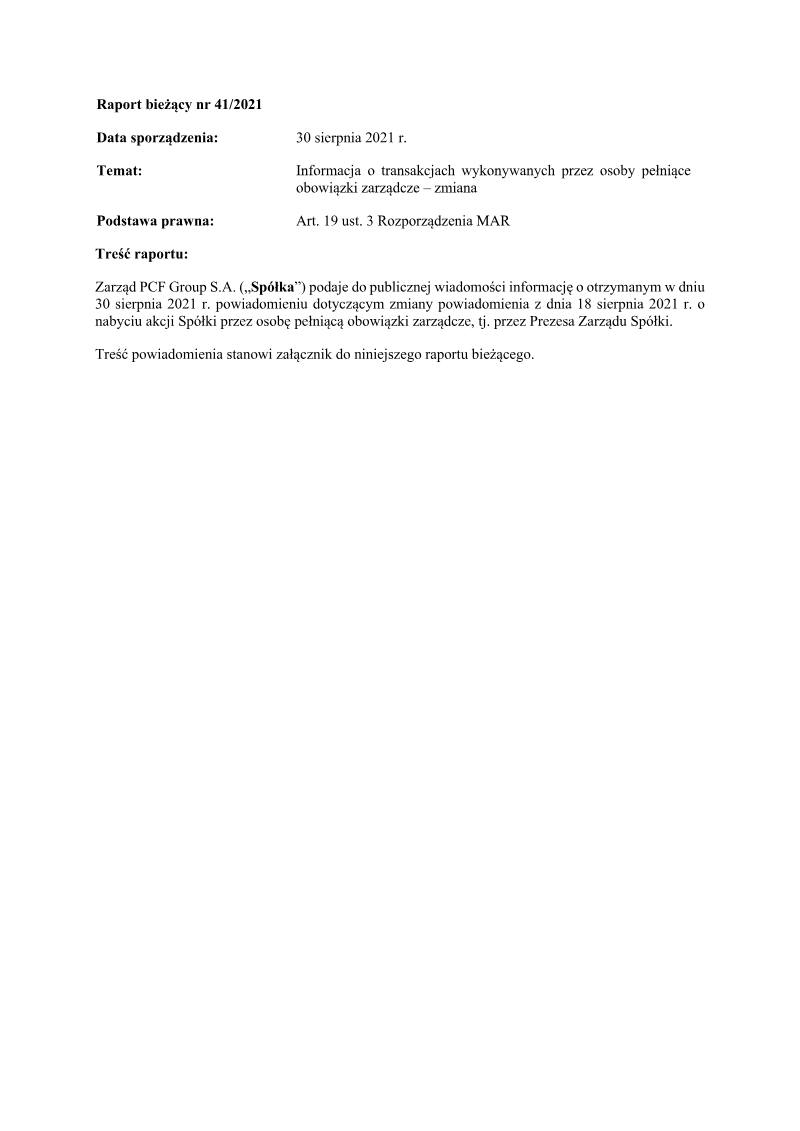
The report, dated 30 August 2021, informs the public that PCF Group S.A. has received a notification concerning an amendment to a prior disclosure made on 18 August 2021. The original notice detailed the acquisition of company shares by a person exercising managerial duties, specifically the Chairman of the Board. The amendment, communicated on 30 August, updates or corrects information related to that transaction. The report references Article 19(3) of the MAR regulation as its legal basis, indicating compliance with market‑authorisation rules for material disclosures. No additional data such as share quantity, price, or transaction value are provided within the brief; instead, the full amended notification is attached as an annex. The scope of the disclosure is limited to a single corporate entity, PCF Group S.A., and pertains solely to an internal shareholding change by a senior executive. The methodology is straightforward: the company reports changes in accordance with regulatory requirements, submitting the amended notice to the relevant supervisory authority and making it publicly available. The concise nature of the report reflects a routine update rather than an analytical study, focusing on transparency and regulatory compliance for stakeholders.
- PCF Group S.A. issued a formal amendment on 30 August 2021 regarding a previous share acquisition disclosure made on 18 August 2021.
- The transaction involved the acquisition of company shares by the Chairman of the Board, who is a person exercising managerial duties.
- The disclosure was filed in accordance with Article 19(3) of the Market Abuse Regulation (MAR), which governs transparency for managerial transactions.
- The report serves as a routine regulatory compliance update rather than an analytical assessment of company performance.
- Specific details regarding share quantity, transaction price, and total value are contained exclusively within the annex attached to the original filing.
PCF Group
Report1 pages
Current Report No. 36/2021: Admission and Introduction to Trading on the Regulated Market
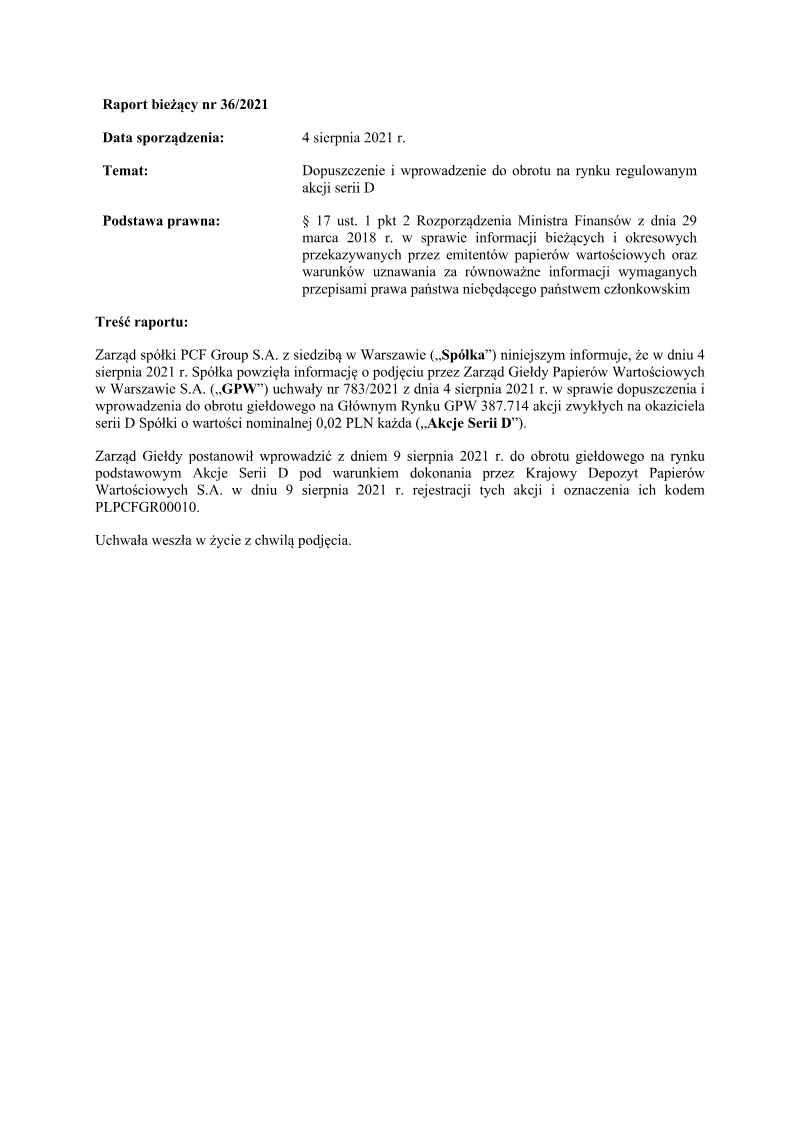
The report announces that PCF Group S.A., a Warsaw‑based company, has received approval from the Warsaw Stock Exchange (GPW) to list 387,714 bearer shares of Series D on the Main Market. The GPW board adopted decision 783/2021 on 4 August 2021, authorizing the admission and introduction of these shares to trading. The shares carry a nominal value of 0.02 PLN each and will be registered by the National Securities Depository (Krajowy Depozyt Papierów Wartościowych) on 9 August 2021, at which point they will receive the market code PLPCFGR00010. The decision became effective immediately upon adoption, allowing the shares to enter primary market trading from 9 August 2021.
The document is a regulatory filing under Polish financial legislation, specifically §17(1)(2) of the Minister of Finance Regulation dated 29 March 2018, which governs current and periodic information required from issuers. The filing covers a single geographic jurisdiction—Poland—and pertains exclusively to the equity segment of the regulated market. No survey or statistical methodology is presented; the report simply records the administrative approval and registration timeline for the new share class. The information is intended to inform market participants of the availability of Series D shares for trading and the procedural steps completed by the issuer and exchange.
- The Warsaw Stock Exchange (GPW) authorized the admission and introduction of 387,714 Series D bearer shares for PCF Group S.A. to the Main Market.
- The Series D shares have a nominal value of 0.02 PLN each and are identified by the market code PLPCFGR00010.
- Trading for the new Series D shares officially commenced on the primary market on 9 August 2021.
- The National Securities Depository (Krajowy Depozyt Papierów Wartościowych) completed the registration of the shares on 9 August 2021.
- The GPW board finalized the authorization decision (No. 783/2021) on 4 August 2021, with immediate effect upon adoption.
PCF Group
Report1 pages
Current Report No. 39/2021: Information on Transactions by Persons Discharging Managerial Responsibilities
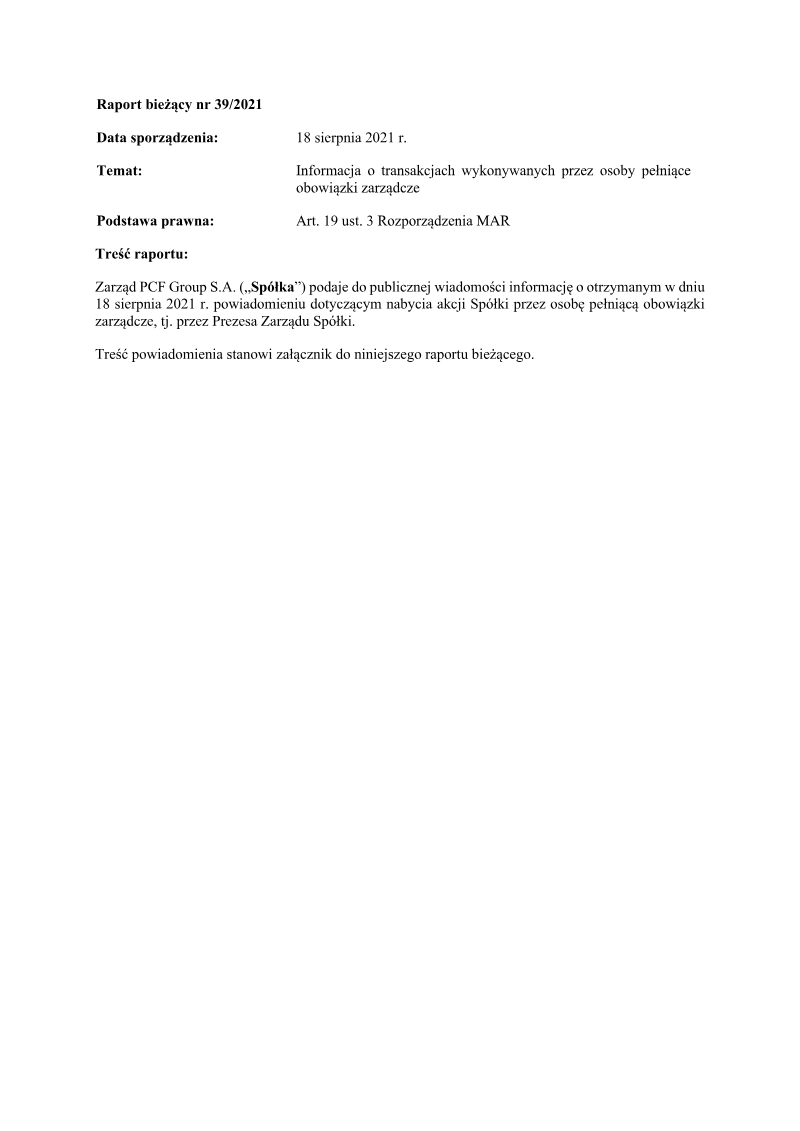
The report, dated 18 August 2021, informs the public that PCF Group S.A. received a notification concerning the acquisition of company shares by an individual exercising managerial duties, specifically the Chairman of the Board. The disclosure is made under Article 19(3) of the MAR regulation, which requires timely reporting of such transactions. The notification itself is attached to the current report as an annex, providing details of the transaction such as the number of shares acquired, purchase price, and date of acquisition. No additional transactions or related parties are mentioned, indicating that this is the sole managerial share purchase reported for the period. The scope of the disclosure covers only PCF Group S.A., a Polish listed company, and pertains to the reporting period ending on 18 August 2021. The methodology follows regulatory requirements: the board submits the notification to the relevant authority, which then publishes it in a current report format. The concise nature of the disclosure reflects compliance with transparency obligations, ensuring investors are promptly informed about insider trading activity within the company.
- The Chairman of the Board of PCF Group S.A. acquired company shares on 18 August 2021.
- This transaction was disclosed in compliance with Article 19(3) of the Market Abuse Regulation (MAR), which mandates the reporting of trades by persons discharging managerial responsibilities.
- The disclosure serves as a formal notification to the public and investors regarding insider trading activity within the company.
- The specific details of the transaction, including the volume of shares acquired and the purchase price, are contained in the annex of the 18 August 2021 report.
- No other transactions or related parties were reported alongside this acquisition, identifying it as the sole managerial share purchase for the specified period.
PCF Group
Report2 pages
Current Report No. 40/2021: Investment Agreement with Square Enix Limited
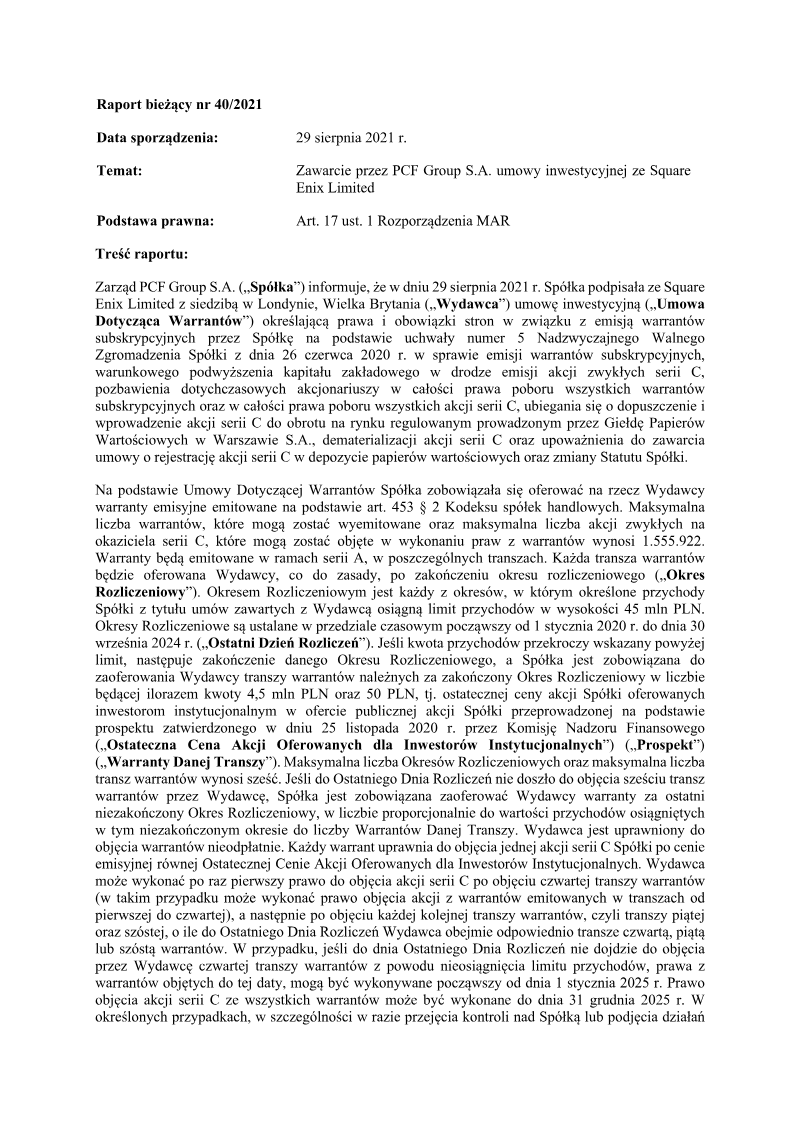
The report announces that PCF Group S.A. entered into an investment agreement with Square Enix Limited on 29 August 2021, formalizing the issuance of subscription warrants and related capital‑raising activities. The agreement stipulates that PCF will offer up to 1,555,922 warrants, each convertible into one Series C ordinary share, in up to six tranches linked to revenue milestones from contracts with Square Enix. Each tranche is released once cumulative contract revenue reaches a 45‑million‑PLN threshold, with the final tranche capped by 30 September 2024. The number of warrants per tranche is calculated as the ratio of 4.5 million PLN to the final share price offered in the public offering, ensuring a proportional allocation relative to revenue performance.
Square Enix may exercise its conversion rights after the fourth tranche and subsequently with each additional tranche, subject to a 31 December 2025 expiry. The agreement allows for accelerated tranching or conversion in events such as a change of control or delisting from the Warsaw Stock Exchange. Square Enix also retains an opt‑out clause, enabling it to relinquish conversion rights in exchange for compensation if the parties decide against further investment.
As of the report date, PCF’s revenue from Square Enix contracts exceeded 90 million PLN, triggering the obligation to offer two warrant tranches. The potential conversion of these warrants would represent roughly 1.8 % of PCF’s share capital, indicating a modest dilution impact. The agreement concludes prior negotiations that began with an initial memorandum of understanding on 31 July 2020, thereby formalizing the terms outlined in PCF’s prospectus.
- PCF Group S.A. entered an investment agreement with Square Enix Limited on 29 August 2021, establishing a mechanism for issuing up to 1,555,922 subscription warrants convertible into Series C ordinary shares.
- Warrant issuance is tied to revenue milestones from contracts with Square Enix, with each tranche triggered by cumulative revenue increments of 45 million PLN.
- As of the report date, PCF had already exceeded 90 million PLN in contract revenue, triggering an immediate obligation to offer two warrant tranches.
- The potential conversion of all 1,555,922 warrants represents a modest dilution of approximately 1.8% of PCF’s total share capital.
- Square Enix may exercise conversion rights starting after the fourth tranche, with all rights subject to a final expiry date of 31 December 2025.
+1
PCF Group
Report1 pages
Current Report No. 42/2021: Information on Transactions by Persons Performing Managerial Responsibilities
The report discloses transactions executed by a managerial officer of PCF Group S.A. on behalf of the company, in compliance with Article 19(3) of the MAR regulation. It was prepared on 30 August 2021 and covers disclosures received on that same day concerning acquisitions of the company’s shares made by the Managing Director. Three separate notifications are referenced, relating to purchases on 26 August 2021, 27 August 2021, and 30 August 2021. Each notification is attached as an annex to the current report, providing detailed information on the quantity of shares acquired, transaction dates, and purchase prices. The scope is limited to a single corporate entity within the Polish market and pertains exclusively to managerial‑level transactions over a three‑day period in August 2021. No additional data sources or survey methodology are mentioned, as the report relies solely on regulatory filings submitted by the company’s board. The primary conclusion is that the Managing Director engaged in multiple share purchases during the specified dates, and these transactions have been duly reported to meet transparency obligations under MAR.
- The Managing Director of PCF Group S.A. executed multiple share acquisitions between 26 August 2021 and 30 August 2021.
- Three separate share purchase transactions were disclosed in compliance with Article 19(3) of the MAR regulation.
- The transactions occurred over a three-day period, specifically on 26, 27, and 30 August 2021.
- The report serves as a formal regulatory filing to satisfy transparency obligations regarding managerial shareholdings.
- Detailed data regarding the specific quantity of shares acquired and the purchase prices for each transaction are contained within the report's annexes.
PCF Group
Report1 pages
Current Report No. 44/2021: Information on Transactions by Persons Discharging Managerial Responsibilities
The report discloses a transaction involving a senior executive of PCF Group S.A. On 13 October 2021, the company’s President of Management acquired shares in PCF Group S.A., a transaction reported to regulatory authorities on 18 October 2021. The disclosure is made pursuant to Article 19(3) of the MAR regulation, which requires public companies to provide timely information on transactions by persons exercising managerial responsibilities. The report is dated 18 October 2021 and serves to inform shareholders and the market of the share purchase by a key executive. No additional details such as the number of shares, transaction value, or price are provided within this brief notice; the full notification is attached as an annex. The scope of the disclosure is limited to a single transaction by one executive within PCF Group S.A., covering the Polish market and the period up to 18 October 2021. The methodology follows regulatory reporting requirements, with the company submitting a formal notice to the relevant supervisory authority and publishing it for public access. The report confirms compliance with disclosure obligations under MAR, ensuring transparency regarding insider trading activity by senior management.
- On 13 October 2021, the President of the Management Board of PCF Group S.A. acquired shares in the company.
- The transaction was formally disclosed to regulatory authorities on 18 October 2021.
- The disclosure was made in compliance with Article 19(3) of the Market Abuse Regulation (MAR), which mandates transparency regarding transactions by persons discharging managerial responsibilities.
- The report serves as an official notice to shareholders and the market regarding insider trading activity by a senior executive.
- Specific details regarding the number of shares purchased, the transaction value, and the share price are contained only in the annex attached to the original filing.
PCF Group
Report1 pages
Zawarcie umowy produkcyjno-wydawniczej z Incuvo S.A.
The report announces that on 13 December 2021 PCF Group S.A., a Warsaw‑based company, entered into a production and publishing agreement with Incuvo S.A. of Katowice. The contract focuses on adapting a title from the People Can Fly portfolio for all major virtual‑reality platforms, including code adjustments to meet VR hardware specifications. PCF Group will finance the entire VR production through milestone payments tied to key development stages, with contract terms aligned to market standards for similar agreements. Upon completion and launch of the VR game, Incuvo will receive royalties contingent on sales revenue that covers PCF Group’s production, marketing, and distribution costs; the royalty rate depends on the defined sales thresholds. The game’s release is targeted for late 2023. No special contractual clauses or penalty provisions deviate from common practice for this type of agreement, ensuring standard industry compliance.
- PCF Group S.A. and Incuvo S.A. signed a production and publishing agreement on 13 December 2021 to adapt a title from the People Can Fly portfolio for virtual reality.
- Incuvo S.A. is responsible for all code adjustments and technical adaptations required to meet the hardware specifications of all major VR platforms.
- PCF Group S.A. will fully fund the VR production through milestone-based payments tied to specific development stages.
- Incuvo S.A. will receive royalties based on sales revenue only after PCF Group S.A. has recouped all production, marketing, and distribution costs.
- The royalty rates for Incuvo S.A. are structured according to defined sales thresholds, with a targeted game release date of late 2023.
+2
PCF Group
Report1 pages
Aktualizacja strategii PCF Group S.A.
PCF Group S.A. announced on 27 September 2021 that its board adopted an updated development strategy for the company and its capital group. The update builds on a prospectus approved by the Polish Financial Supervision Authority in November 2020 and introduces three key expansion directions. First, the group plans to broaden its game portfolio by adding AA titles that can be produced more quickly and at lower budgets while maintaining quality comparable to Triple‑A releases. Second, it aims to develop AAA and AA games in new genres beyond its current focus on shooters and action titles, incorporating RPG elements. Third, the strategy includes acquiring or partnering with new production teams or companies that operate in these newly targeted segments.
The overarching objective is to position the group as one of the world’s leading independent development studios, with a target of releasing at least one new title annually from 2024 onward under either publisher collaboration or self‑publishing models. The update does not alter the existing strategic goals; it confirms the continued dual model of producing multiple Triple‑A games in partnership with major global publishers while expanding self‑publishing efforts for AAA titles based on existing or newly created intellectual property. The strategy therefore seeks to diversify genre offerings, streamline production pipelines for AA titles, and strengthen the group’s global competitive standing through both external partnerships and internal publishing capabilities.
- PCF Group S.A. aims to release at least one new game title annually starting in 2024.
- The company is expanding its portfolio to include AA-budget titles, which are intended to be produced faster and more cost-effectively than AAA projects while maintaining high quality.
- The group is diversifying its genre focus beyond shooters and action games by incorporating RPG elements into future AAA and AA developments.
- The strategy maintains a dual business model that combines collaborative projects with major global publishers alongside an increased focus on self-publishing AAA titles.
- PCF Group plans to strengthen its market position through the acquisition of or partnerships with new production teams that specialize in these targeted genres.
+2
PCF Group
Report1 pages
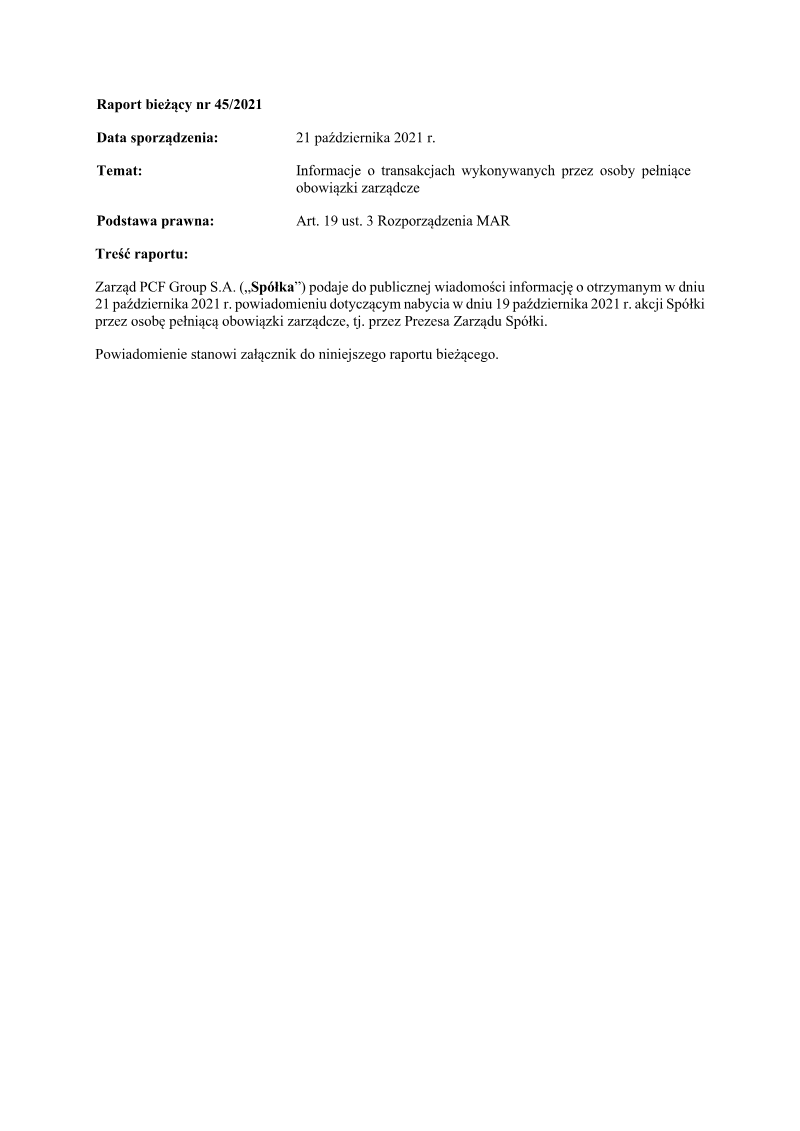
Raport Bieżący Nr 45/2021: Informacje o transakcjach wykonywanych przez osoby pełniące obowiązki zarządcze
The report, issued on 21 October 2021, discloses a transaction involving a senior executive of PCF Group S.A. The disclosure is mandated under Article 19(3) of the MAR regulation and follows a notification received on that same day. The transaction concerns the acquisition of shares in PCF Group S.A. by the company’s Chief Executive Officer, executed on 19 October 2021. The notification is attached to the current report as required by regulatory protocol.
The primary purpose of this filing is to provide transparency regarding insider trading activities within the company, ensuring that shareholders and market participants are informed of significant share purchases by key management personnel. The report confirms the identity of the purchaser, the date of acquisition, and the nature of the transaction (share purchase). No additional financial details such as quantity or price are disclosed within this brief summary, implying that the attached notification contains those specifics.
The scope is limited to a single transaction involving one executive within PCF Group S.A., covering the Polish market and the period up to 21 October 2021. Methodologically, the report follows standard regulatory disclosure procedures, relying on internal notification from the executive and subsequent public filing. The conclusion underscores compliance with MAR requirements and reinforces the company’s commitment to market transparency.
- The CEO of PCF Group S.A. acquired company shares on 19 October 2021.
- The transaction was formally disclosed by PCF Group S.A. on 21 October 2021 in accordance with Article 19(3) of the MAR regulation.
- The filing serves as a mandatory regulatory disclosure to ensure market transparency regarding insider trading activities.
- The report confirms the identity of the purchaser as the Chief Executive Officer of PCF Group S.A.
- Specific financial details, including the total quantity of shares purchased and the transaction price, are contained within the attached notification rather than the summary text.
PCF Group
Report2 pages
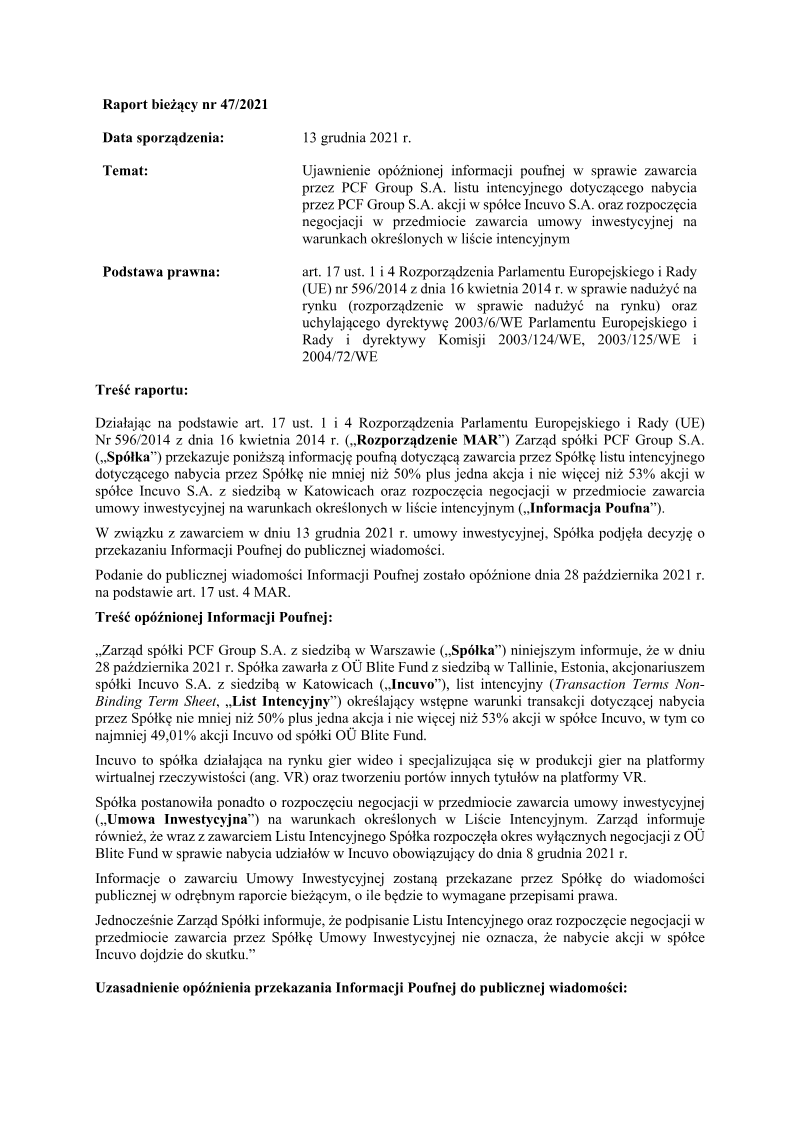
Aktualny Raport 47/2021: Nabycie Akcji Incuvo S.A.
The report discloses that PCF Group S.A., a Warsaw‑based company, entered into a non‑binding letter of intent on 28 October 2021 with OÜ Blite Fund, an Estonian shareholder of Incuvo S.A., a Katowice‑based virtual reality game developer. The intent is to acquire between 50 % + 1 share and 53 % of Incuvo’s shares, including at least 49.01 % from OÜ Blite Fund. Negotiations for a definitive investment agreement are to commence under the terms outlined in the letter, with an exclusive negotiation period lasting until 8 December 2021. The report explains that the disclosure of this confidential information was delayed until 13 December 2021, citing Article 17(4) of the EU Market Abuse Regulation (MAR). The board justified the delay by arguing that immediate disclosure could jeopardise ongoing negotiations, risk adverse third‑party reactions, and potentially distort market perception of the transaction’s likelihood. The board ensured confidentiality through an access list compliant with MAR Article 18 and pledged to notify the Polish Financial Supervision Authority of the delay. The disclosure clarifies that signing the letter and initiating negotiations does not guarantee a completed share purchase. This communication covers a single transaction involving PCF Group S.A., OÜ Blite Fund, and Incuvo S.A. in the European gaming sector, with a focus on virtual reality titles. The methodology is purely regulatory compliance reporting, based on internal board decisions and MAR provisions.
- PCF Group S.A. has entered into a non-binding letter of intent to acquire a majority stake of 50% + 1 share to 53% in the virtual reality developer Incuvo S.A.
- The proposed acquisition includes the purchase of at least 49.01% of Incuvo S.A. shares currently held by the Estonian shareholder OÜ Blite Fund.
- The parties established an exclusive negotiation period for the definitive investment agreement that lasted until 8 December 2021.
- PCF Group S.A. delayed the public disclosure of this transaction until 13 December 2021, citing the protection of ongoing negotiations and market stability under Article 17(4) of the EU Market Abuse Regulation.
- The company maintained regulatory compliance during the delay by managing an access list under Article 18 of the Market Abuse Regulation and notifying the Polish Financial Supervision Authority.
PCF Group
Report1 pages
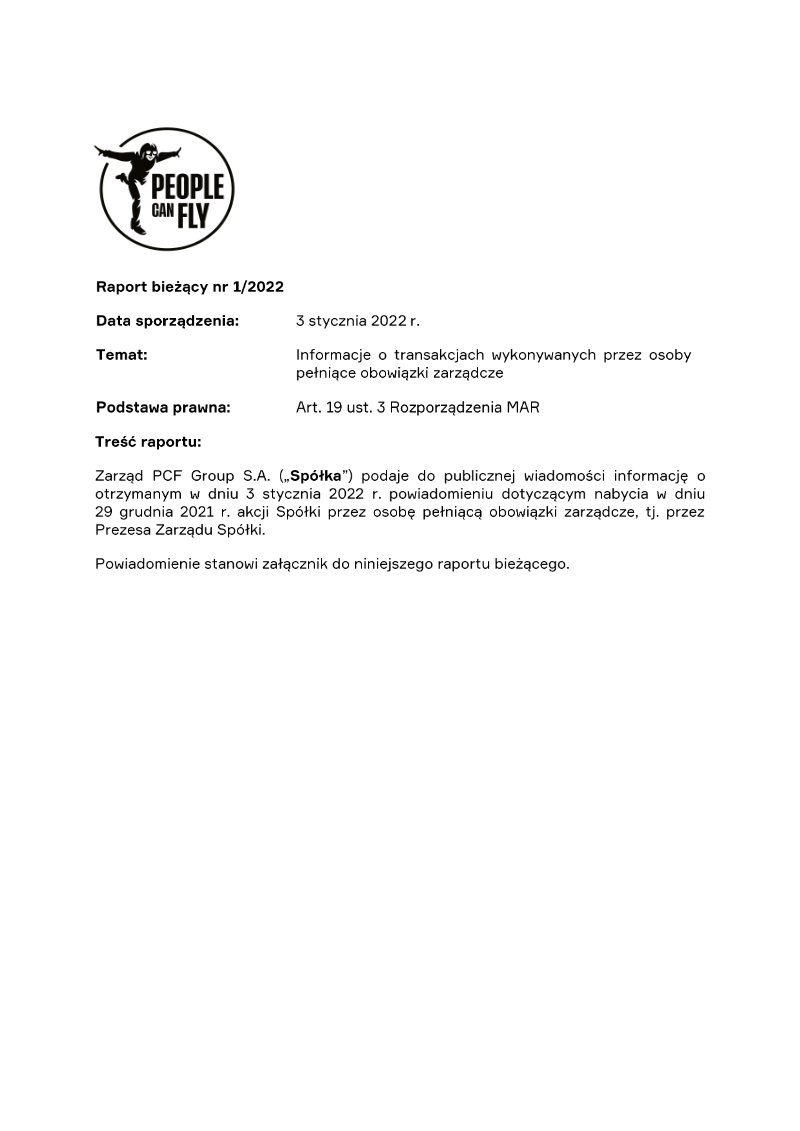
Current Report No. 1/2022: Transactions by Persons Discharging Managerial Responsibilities
The report discloses that on 3 January 2022 the board of PCF Group S.A. received a notification concerning a transaction executed by an individual holding managerial responsibilities, specifically the company’s President of the Board. The notification indicates that on 29 December 2021 this executive acquired shares in PCF Group S.A. The disclosure is made pursuant to Article 19(3) of the MAR regulation, fulfilling regulatory obligations for transparency in insider transactions. The scope is limited to a single transaction involving the company’s top executive and pertains exclusively to share ownership within PCF Group S.A. No additional data such as transaction volume, price, or comparative market impact are provided; the report merely confirms receipt of the notification and attaches it as an annex. Methodologically, the information is sourced directly from regulatory filings submitted by the executive to the relevant supervisory authority. The report serves to inform shareholders and market participants of potential insider activity, ensuring compliance with disclosure requirements under the Markets in Financial Instruments Regulation.
- On 29 December 2021, the President of the Board of PCF Group S.A. acquired shares in the company.
- PCF Group S.A. officially received notification of this insider transaction on 3 January 2022.
- The transaction disclosure was filed in compliance with Article 19(3) of the Market Abuse Regulation (MAR).
- The report confirms the acquisition of shares by a person discharging managerial responsibilities at PCF Group S.A.
- Specific details regarding the volume, price, or total value of the shares acquired were not disclosed in the report.
PCF Group
Report1 pages
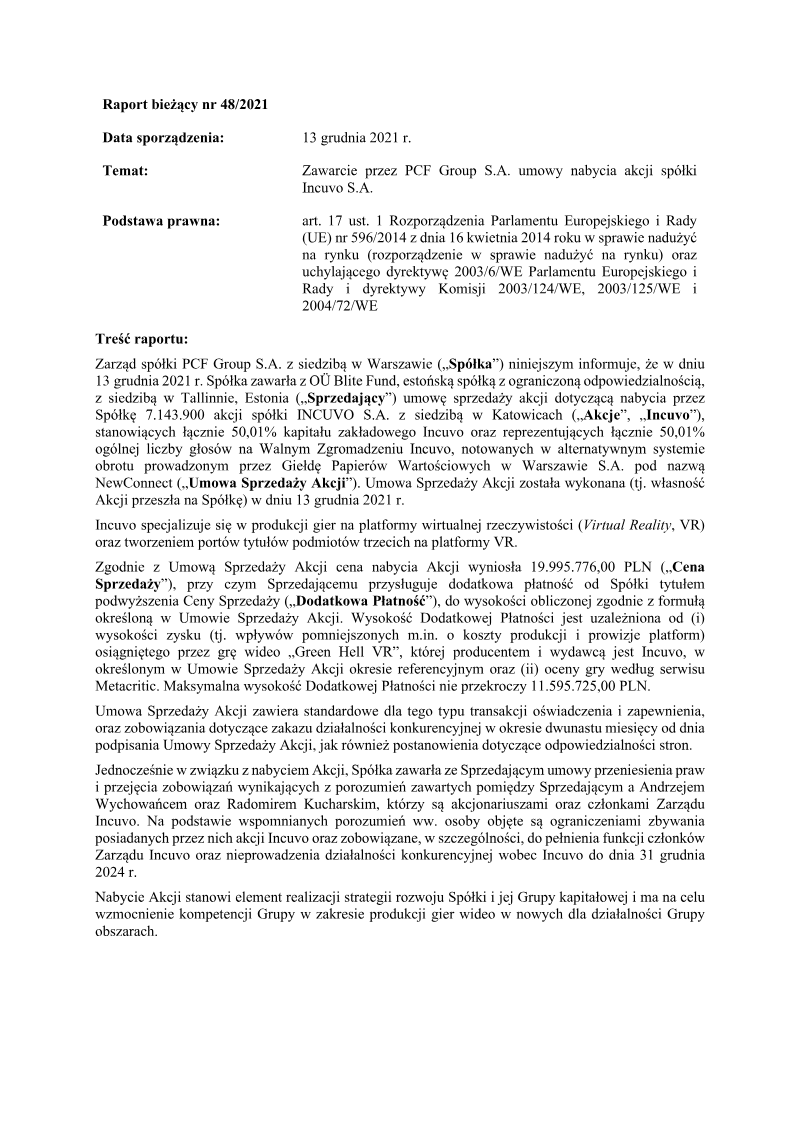
Current Report No. 48/2021: Acquisition of Incuvo S.A. Shares
PCF Group S.A., headquartered in Warsaw, completed the acquisition of 7,143,900 shares of Incuvo S.A. on 13 December 2021, representing 50.01 % of Incuvo’s share capital and voting rights. The transaction was executed under EU market‑abuse regulation, with the purchase price set at PLN 19,995,776.00 and an additional payment clause that may add up to PLN 11,595,725.00 based on the profitability of Incuvo’s VR title “Green Hell VR” and its Metacritic rating during a specified reference period. Incuvo specializes in virtual‑reality game development and porting third‑party titles to VR platforms.
The agreement includes customary representations, warranties, non‑competition restrictions for twelve months post‑closing, and liability provisions. Concurrently, PCF entered into transfer agreements with Incuvo’s shareholders Andrzej Wychowń and Radomir Kucharski, imposing sale restrictions on their shares and mandating continued board participation while prohibiting competitive activities until 31 December 2024.
This acquisition aligns with PCF Group’s strategic expansion into video‑game production, aiming to strengthen the group’s capabilities in emerging sectors. The transaction covers Poland and involves the NewConnect market of the Warsaw Stock Exchange, reflecting a focused geographic scope within the European VR gaming industry.
- PCF Group S.A. acquired a 50.01% majority stake in Incuvo S.A. on 13 December 2021 for a base price of PLN 19,995,776.
- The deal includes an earn-out provision of up to PLN 11,595,725, contingent on the profitability and Metacritic performance of the VR title 'Green Hell VR'.
- Incuvo S.A. specializes in virtual-reality game development and the porting of third-party titles to VR platforms.
- Key shareholders Andrzej Wychowń and Radomir Kucharski are bound by non-competition agreements and mandatory board participation until 31 December 2024.
- The acquisition is part of PCF Group’s strategic expansion to bolster its production capabilities within the emerging VR gaming sector.
+1
PCF Group
Report2 pages
Current Report No. 2/2022: Publication Dates of Periodic Reports
The report outlines the scheduled publication dates for various periodic financial statements of a company during 2022. Its primary objective is to inform stakeholders about the timing and availability of interim reports, including both individual and consolidated quarterly statements. The document specifies that an interim report for the first quarter of 2022 will be released, containing a condensed financial statement as required by § 62(3) of the relevant regulation. Additionally, it notes that the company will postpone the release of its individual and consolidated quarterly reports for Q4 2021, as well as the consolidated quarterly report covering Q2 and Q4 of 2022, in accordance with § 79(2) of the regulation.
Key findings indicate that the company adheres to statutory deadlines while also adjusting its reporting schedule in response to regulatory requirements. The report covers the entire 2022 fiscal year, focusing on quarterly and interim financial disclosures. No specific data points or statistical analyses are presented; the emphasis is purely on publication timelines and compliance with regulatory provisions. Methodologically, the information appears to be derived from internal scheduling and legal mandates rather than external surveys or market data. The scope is limited to the company's own reporting obligations within Poland, reflecting a compliance-focused approach rather than broader industry analysis.
- The company will release its Q1 2022 interim report containing a condensed financial statement in compliance with § 62(3) of the relevant regulation.
- The release of individual and consolidated quarterly reports for Q4 2021 is officially postponed.
- Consolidated quarterly reports for Q2 and Q4 of 2022 are postponed in accordance with § 79(2) of the regulation.
- The 2022 reporting schedule is structured to maintain adherence to Polish statutory deadlines and specific regulatory provisions.
- The report focuses exclusively on internal financial disclosure timelines for the 2022 fiscal year rather than providing market analysis or statistical data.
PCF Group
Report1 pages
Current Report No. 3/2022: Resignation of a Supervisory Board Member of PCF Group S.A.
The report announces the resignation of Dr. Aleksander Ferenc from the Supervisory Board of PCF Group S.A., effective March 3, 2022. The board’s decision is communicated in compliance with Polish financial regulatory requirements, specifically the 2018 Minister of Finance regulation on ongoing information obligations for issuers. The announcement confirms that Dr. Ferenc’s resignation was submitted and accepted on the same day, and expresses gratitude for his contributions to the company.
Simultaneously, the report states that Dr. Ferenc will continue to support PCF Group S.A.’s parent company, People Can Fly, in mergers and acquisitions (M&A) and integration activities from March 3, 2022 onward. No additional data on financial performance or strategic initiatives are provided; the focus remains strictly on governance changes and the continuity of Dr. Ferenc’s advisory role within the broader corporate group.
The scope is limited to PCF Group S.A., a Warsaw‑based entity, and its parent company People Can Fly. The time frame is the specific date of resignation, March 3, 2022, with implications for ongoing M&A support. Methodology is not applicable beyond the regulatory reporting framework mandated by Polish financial law.
- Dr. Aleksander Ferenc resigned from the Supervisory Board of PCF Group S.A., effective March 3, 2022.
- Following his resignation from the board, Dr. Ferenc transitioned to an advisory role supporting the parent company, People Can Fly, specifically focusing on mergers, acquisitions, and integration activities.
- The resignation was formally processed and accepted on March 3, 2022, in accordance with Polish financial regulatory requirements.
- The governance change is limited to the Supervisory Board of the Warsaw-based PCF Group S.A. and does not impact the company's broader operational or financial reporting.
- No changes to the company's strategic initiatives or financial performance were announced in conjunction with this board-level personnel shift.
PCF Group
Report1 pages
Raport Bieżący Nr 8/2022: Zmiana Daty Przekazania Raportów Rocznych za 2021
The current report announces a revised deadline for the publication of PCF Group S.A.’s consolidated and individual annual reports for 2021. The change follows an earlier communication (current report no. 2/2022) that had set the release date for 20 April 2022. The board now confirms that both reports will be published on 21 April 2022, shifting the deadline by one day. This adjustment is made under § 80(2) of the Minister of Finance regulation dated 29 March 2018, which governs ongoing and periodic disclosures required from issuers of securities. The notice is dated 14 April 2022 and serves to inform stakeholders, investors, and regulatory bodies of the new publication schedule. No additional data, statistics, or broader industry context are provided; the scope is limited to the timing of the PCF Group’s annual reporting for the 2021 fiscal year. The methodology is simply a procedural update issued by the company’s management board, with no survey or external data sources referenced.
- PCF Group S.A. has rescheduled the publication date for its 2021 consolidated and individual annual reports to 21 April 2022.
- The new release date represents a one-day delay from the previously announced schedule of 20 April 2022.
- This procedural update was formally issued by the company's management board on 14 April 2022.
- The reporting adjustment is compliant with § 80(2) of the Minister of Finance regulation dated 29 March 2018 regarding issuer disclosure requirements.
PCF Group
Report1 pages
Current Report No. 9/2022: Change of Date for Quarterly Report
The report announces a change in the publication date for PCF Group S.A.’s consolidated quarterly report covering the first quarter of 2022. The board, acting under § 80(2) of the Polish Ministry of Finance regulation dated 29 March 2018, informs stakeholders that the report will now be released on 30 May 2022 instead of the previously scheduled 27 May 2022. This adjustment follows the earlier current report No. 2/2022 issued on 20 January 2022, which had set the original publication date. The notice is issued on 12 May 2022 and serves to update investors, regulators, and other interested parties about the revised timeline. No additional data, financial figures, or analytical findings are presented in this communication; it functions solely as a procedural update regarding the reporting schedule for the PCF Group’s first‑quarter results.
- PCF Group S.A. has rescheduled the publication of its consolidated quarterly report for Q1 2022.
- The new release date for the Q1 2022 financial results is 30 May 2022.
- The report was originally scheduled for release on 27 May 2022, per the previous announcement on 20 January 2022.
- This procedural update was issued on 12 May 2022 to notify investors and regulators of the timeline adjustment.
- The date change is conducted in accordance with § 80(2) of the Polish Ministry of Finance regulation dated 29 March 2018.
PCF Group
Report2 pages
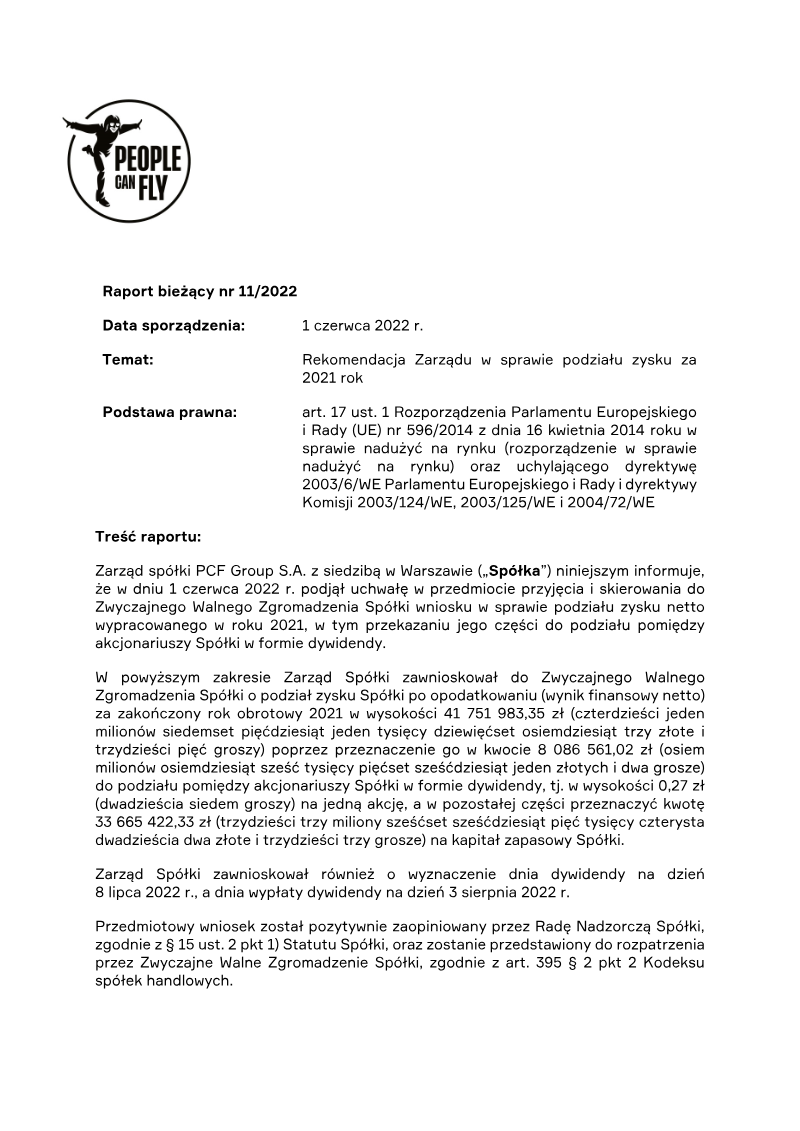
Current Report No. 11/2022: Management Board Recommendation Regarding Profit Distribution for 2021
The recommendation issued by the Board of PCF Group S.A. on 1 June 2022 proposes a distribution of the company’s net profit for 2021, amounting to PLN 41 751 983.35. The Board recommends allocating PLN 8 086 561.02 (approximately 19.37 % of net profit) to shareholders as a dividend, translating into PLN 0.27 per share. The remaining PLN 33 665 422.33 will be retained as a reserve in the company’s capital. Dividend declaration is set for 8 July 2022 with payment scheduled for 3 August 2022. The proposal received approval from the supervisory board in accordance with the company’s charter and will be presented to the ordinary general meeting for final approval under Polish commercial law. The recommendation aligns with PCF Group’s established dividend policy, emphasizing a consistent payout ratio relative to net earnings. The proposal reflects the company’s financial performance for 2021, indicating a solid profit base and a commitment to returning value to shareholders while strengthening reserves.
- PCF Group S.A. reported a 2021 net profit of PLN 41,751,983.35.
- The Board recommended a dividend payout of PLN 8,086,561.02, representing approximately 19.37% of the 2021 net profit.
- Shareholders will receive a dividend of PLN 0.27 per share, with a declaration date of 8 July 2022 and a payment date of 3 August 2022.
- The company will retain PLN 33,665,422.33 of the 2021 net profit as reserve capital.
- The dividend proposal has received supervisory board approval and is pending final authorization by the ordinary general meeting.
PCF Group
Report2 pages
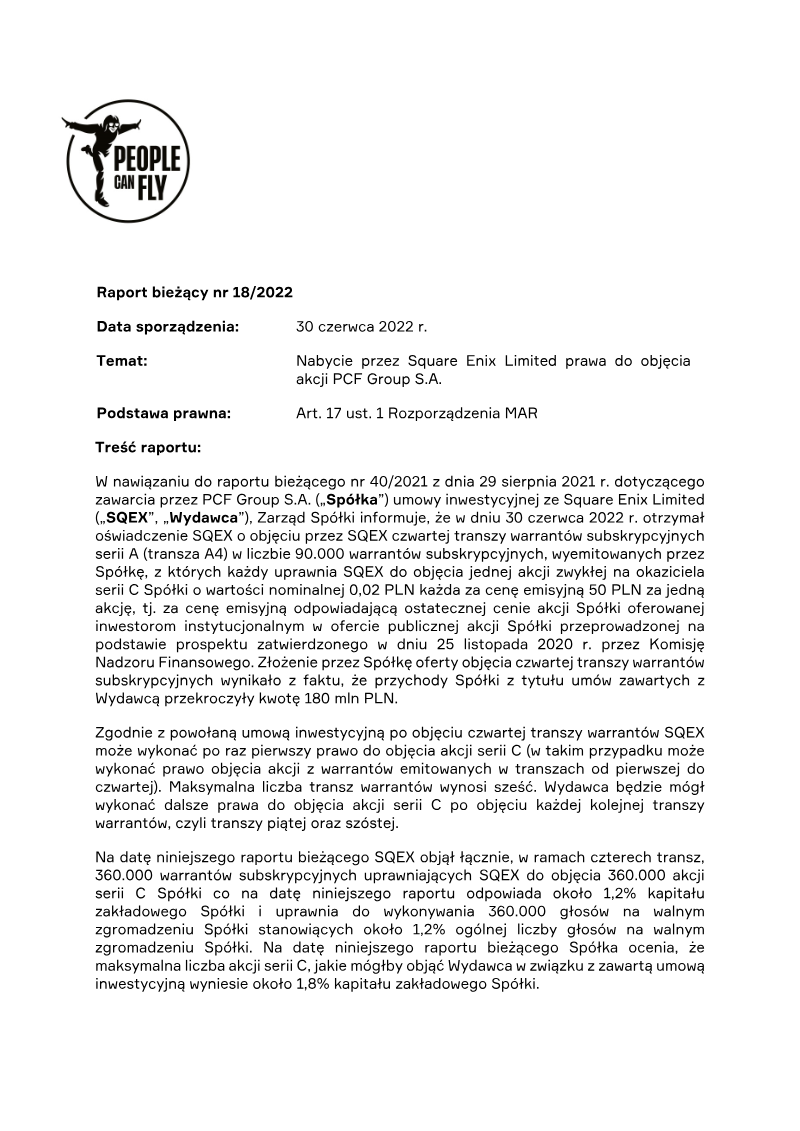
Raport Bieżący Nr 18/2022: Nabycie przez Square Enix Limited Prawa do Objecia Akcji PCF Group S.A.
The report informs that on 30 June 2022 Square Enix Limited (SQEX) exercised its right to acquire the fourth tranche of 90,000 subscription warrants (Series A4) issued by PCF Group S.A. Each warrant entitles SQEX to purchase one ordinary Series C share at an issue price of 50 PLN, matching the final public offering price approved by the Polish Financial Supervision Authority on 25 November 2020. The issuance of this tranche was triggered by PCF’s revenue from contracts with SQEX exceeding 180 million PLN.
Under the investment agreement, SQEX may exercise its option to acquire Series C shares for each tranche received, up to a maximum of six tranches. By the date of this report, SQEX had accumulated 360 000 warrants across four tranches, allowing the purchase of an equivalent number of Series C shares. This represents roughly 1.2 % of PCF’s share capital and confers the same proportion of voting rights at general meetings. The company estimates that, if all six tranches were exercised, SQEX could ultimately acquire about 1.8 % of the share capital.
The warrants can be exercised until 31 December 2025. PCF currently lacks information on SQEX’s intentions regarding the exercise of these rights. The report is dated 30 June 2022 and follows a prior disclosure (report no. 40/2021) concerning the initial investment agreement between PCF and SQEX.
- Square Enix Limited exercised its right to acquire the fourth tranche of 90,000 subscription warrants from PCF Group S.A. on 30 June 2022.
- The issuance of this fourth tranche was triggered by PCF Group S.A. generating over 180 million PLN in revenue from contracts with Square Enix.
- Each warrant allows Square Enix to purchase one Series C share at a fixed price of 50 PLN, consistent with the 2020 public offering price.
- Square Enix has accumulated 360,000 warrants across four tranches, representing approximately 1.2% of PCF Group S.A.’s total share capital and voting rights.
- The investment agreement allows for a maximum of six tranches, which would result in Square Enix holding approximately 1.8% of PCF Group S.A.’s share capital.
+1
PCF Group
Report1 pages
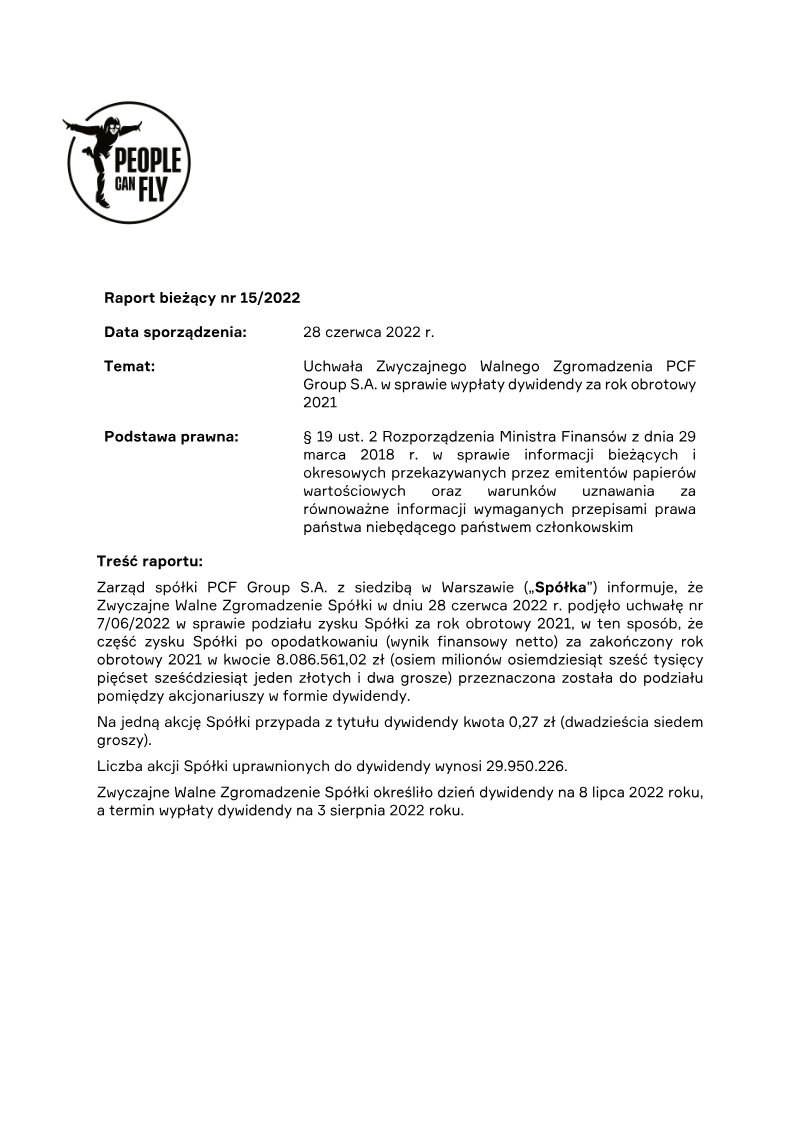
Raport Bieżący nr 15/2022: Uchwała w sprawie wypłaty dywidendy za rok obrotowy 2021
The report announces that the ordinary general meeting of PCF Group S.A. held on 28 June 2022 approved the distribution of the company’s net profit for the fiscal year 2021. The meeting resolved to allocate a dividend of 8,086,561.02 zł (eight million eighty‑six thousand five hundred sixty‑one złoty and two groszy) to shareholders. Each share entitles the holder to a dividend of 0.27 zł (twenty‑seven groszy). The total number of shares eligible for the dividend is 29,950,226. The ex‑dividend date was set for 8 July 2022, with the payment scheduled for 3 August 2022.
The decision follows Polish financial regulation §19(2) of the Minister of Finance’s 2018 decree on ongoing and periodic information required from issuers of securities. The report confirms that the dividend distribution is based on the company’s after‑tax net income for 2021, reflecting the board’s assessment of profitability and shareholder return policy. No further operational or strategic details are provided, as the document’s purpose is strictly informational regarding dividend allocation.
- PCF Group S.A. approved a total dividend payout of 8,086,561.02 zł from its 2021 net profit.
- Shareholders will receive a dividend of 0.27 zł per share for the 29,950,226 eligible shares.
- The dividend payment date for eligible shareholders is scheduled for 3 August 2022.
- The ex-dividend date for PCF Group S.A. shares was set for 8 July 2022.
- The dividend distribution was formally approved during the company's ordinary general meeting held on 28 June 2022.
PCF Group
Report2 pages
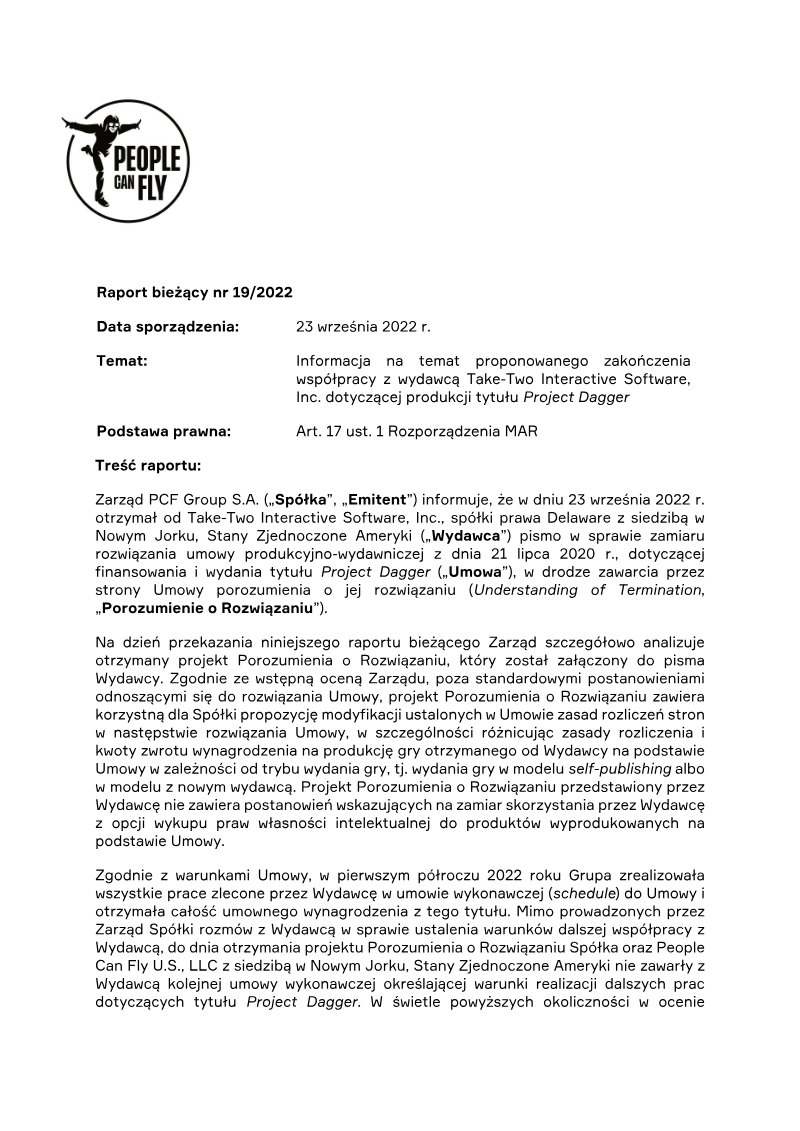
Current Report No. 19/2022: Termination of Collaboration with Take-Two Interactive Software, Inc.
The report informs that on 23 September 2022 the board of PCF Group S.A. received a letter from Take‑Two Interactive Software, Inc., indicating its intention to terminate the production‑publishing agreement dated 21 July 2020 for the title Project Dagger. The board has reviewed the proposed termination agreement, which includes a favourable modification of settlement terms for the parties. The proposal differentiates repayment amounts based on whether the game will be released via self‑publishing or through a new publisher, and it does not contain any clause suggesting that Take‑Two intends to exercise an intellectual‑property buy‑out option.
During the first half of 2022, PCF Group completed all work specified in the original contract’s schedule and received full contractual remuneration. Despite ongoing negotiations, no new execution agreement has been signed to continue development of Project Dagger. Consequently, the board expects the contract to be terminated under terms essentially matching those in the proposed agreement.
Under International Financial Reporting Standard 38, costs incurred for further development of Project Dagger will be capitalised as intangible assets. This accounting treatment is projected to materially affect the group’s financial results for the first half of 2022 and will continue to influence subsequent reporting periods as development proceeds under a self‑publishing model. The group remains committed to continuing Project Dagger’s development using internal funds, with the possibility of debt financing or partnership with a new publisher. The board will provide additional updates on the termination in accordance with applicable legal requirements.
- Take-Two Interactive Software, Inc. notified PCF Group S.A. on 23 September 2022 of its intent to terminate the July 2020 production-publishing agreement for Project Dagger.
- PCF Group retains full intellectual property rights for Project Dagger, as the proposed termination agreement contains no buy-out clause for Take-Two.
- PCF Group completed all contractual work and received full remuneration for Project Dagger through the first half of 2022.
- The termination agreement includes tiered repayment terms that vary depending on whether PCF Group chooses to self-publish or secure a new publishing partner.
- PCF Group intends to continue developing Project Dagger using internal funds, with potential future support from debt financing or a new publishing partner.
+1
PCF Group