Vector
Game
31 documents in the library are about Vector, from writers such as Deconstructor of Fun, GameMakers and Unity. Each has a summary and key insights with the page they come from.
- Videos
- 17
Connections
The documents about Vector on the inner ring, the other games and companies they name on the outer one. Select a cover to see it up close and open it in a new tab; drag to move, pinch or Ctrl + scroll to zoom.
Key figures from the reports
Unity sold its Supersonic publishing arm to Triple Dot for $40 million, marking a strategic pivot away from direct publishing to focus on its Vector AI ad-tech infrastructure.
Deconstructor of Fun, 2026 · TWIG #396: AppLovin's Q2, Unity's Supersonic Fire Sale and GTA VI's Netflix Trailer Drama, p. 30
Unity’s financial turnaround is anchored by its Vector adtech product, which achieved an 80% year-over-year revenue increase.
Mobilegamer.biz, 2026 · Sega-Rovio woes, Playtika goes casual, Unity's turnaround, pitching investors, data nuggets, more, p. 12
Unity is restructuring its ad business by sunsetting the ironSource network and divesting its Supersonic publishing arm to prioritize its Unity Vector ad stack, which has achieved 15% sequential growth.
Two & a Half Gamers, 2026 · 🚨📢 BREAKING NEWS: Unity kills ironSource, Meta lawsuits, AppLovin moves, p. 5
Unity’s Vector platform achieved a 72 percent year-over-year revenue increase as of January 2026 by utilizing engine-level gameplay data for user acquisition.
Mobile Dev Memo, 2026 · Podcast: Understanding Unity’s Vector
Revenue growth was driven by the Create segment (up 8% to $165 million) and the Grow segment (up 11% to $338 million), with the Vector platform contributing 56% of Grow revenue.
Unity, 2026 · Unity Fourth Quarter and Fiscal Year 2025 Financial Results, p. 1
Documents about Vector
Unity vs AppLovin: Which One Is Actually Winning?
The mobile gaming industry is currently navigating a period of significant volatility and strategic realignment, characterized by intense competition between major ad networks and shifting market valuations.
- AppLovin experienced a $27 billion loss in market value and a 29% share price decline despite reporting a 53% year-over-year revenue increase to $1.9 billion.
- Unity is attempting a strategic pivot by integrating engine data into its advertising infrastructure through its Vector AI initiative and new day-28 (D28) optimization models.
- Unity remains at a competitive disadvantage because it must pay fees to bid into AppLovin’s MAX platform while simultaneously competing against AppLovin’s superior data scale.
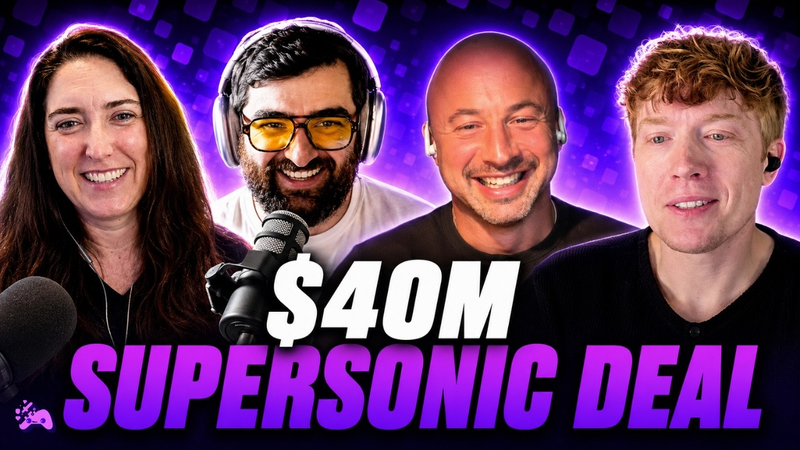
TWIG #396: AppLovin's Q2, Unity's Supersonic Fire Sale and GTA VI's Netflix Trailer Drama
The mobile gaming industry is currently navigating a period of significant structural realignment, characterized by aggressive consolidation, shifting monetization strategies, and a cooling of growth expectations for major ad-tech players.
- AppLovin experienced a 29% share price decline despite 53% year-over-year revenue growth, as investors reacted to decelerating AI performance improvements and conservative forward guidance.
- Unity sold its Supersonic publishing arm to Triple Dot for $40 million, marking a strategic pivot away from direct publishing to focus on its Vector AI ad-tech infrastructure.
- The mobile gaming industry is shifting its primary performance metric from short-term acquisition cycles to 28-day return-on-ad-spend (ROAS) to prioritize sustainable user value.

The Most Important Number in Unity’s D2C Launch Is Zero
Unity’s introduction of a free direct-to-consumer payment integration within its IAP SDK marks a strategic shift toward enabling developers to bypass traditional platform billing systems.
- Unity’s IAP SDK, updated as of June 30, now enables developers to sell digital goods directly to players via web shops, bypassing exclusive reliance on Apple and Google app store payment flows.
- Unity is positioning itself as a mediator for direct-to-consumer (D2C) payments by integrating third-party providers like Stripe and Coda, with plans to add Stash and others to its roadmap.
- The primary strategic value of Unity’s D2C initiative is not just margin improvement, but the ability for developers to own first-party player data to optimize user acquisition and monetization.

The Most Important Number in Unity’s D2C Launch Is Zero
Unity has introduced a new direct-to-consumer (D2C) infrastructure within its IAP SDK, enabling game developers to bypass traditional app store billing by establishing proprietary web shops.
- Unity has launched a free direct-to-consumer (D2C) webshop solution that allows developers to integrate payment providers like Stripe and Coda without paying Unity any additional fees.
- The primary value proposition of D2C is not margin improvement, but the ability to own the direct relationship with players and gain granular data on purchase journeys that platform stores do not provide.
- Unity’s IAP product acts as an abstraction layer, enabling developers to run platform-based and D2C purchasing flows side-by-side and route users between them.
Sega-Rovio woes, Playtika goes casual, Unity's turnaround, pitching investors, data nuggets, more
The mobile games industry is currently defined by a shift toward pragmatism, consolidation, and a strategic pivot away from traditional free-to-play models.
- Sega is pivoting away from free-to-play mobile initiatives following a $200 million write-down related to the underperformance of its Rovio acquisition.
- Unity’s financial turnaround is anchored by its Vector adtech product, which achieved an 80% year-over-year revenue increase.
- Playtika has officially shifted its corporate strategy to prioritize casual gaming titles, such as Disney Solitaire, while treating its legacy social casino business as a non-growth asset.
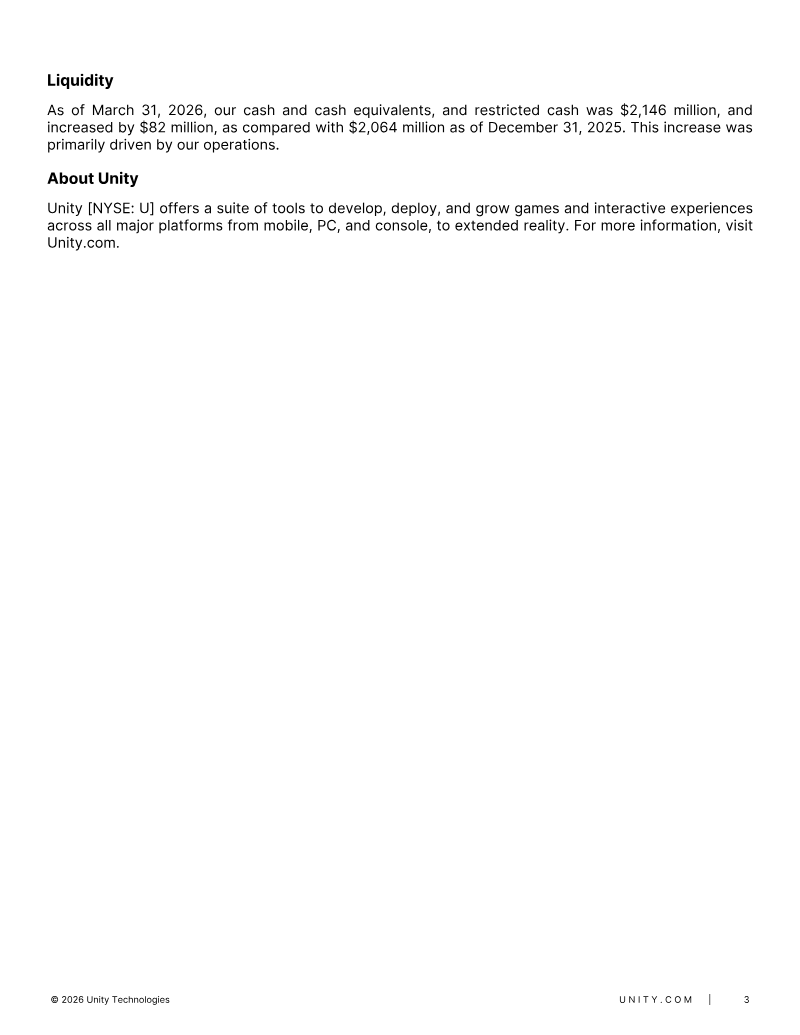
Unity Reports First Quarter 2026 Financial Results
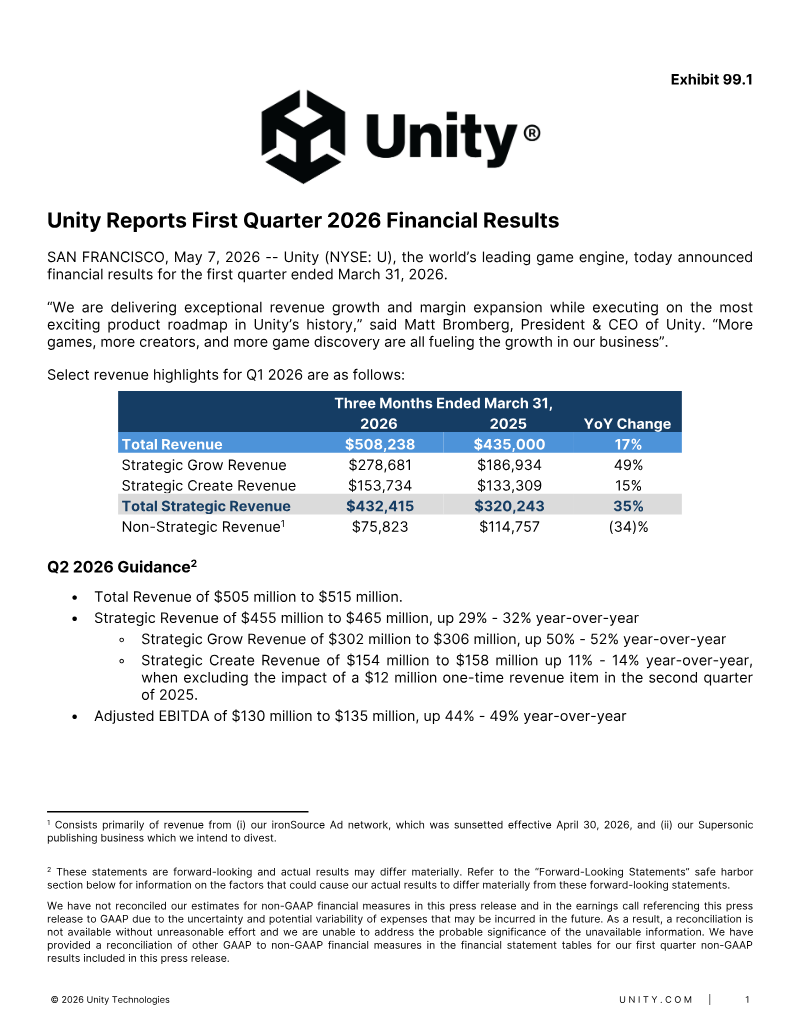
Unity reported its financial results for the first quarter of 2026, highlighting a period of strategic realignment and significant revenue growth.
- Unity reported Q1 2026 total revenue of $508 million, a 17% year-over-year increase, driven by a 35% surge in strategic revenue to $432 million.
- The company recorded a $347 million GAAP net loss, primarily due to $279 million in impairment charges from sunsetting the ironSource Ad network and divesting the Supersonic publishing business.
- Adjusted EBITDA reached $138 million (a 27% margin), up from $84 million in Q1 2025, while free cash flow improved significantly to $66 million from $7 million.
UA Monthly #3: Freecash Ban, Unity Kills ironSource & Vector’s Rise
The recent deplatforming of the rewarded ad network Freecash underscores a critical shift in the mobile user acquisition landscape, signaling that app stores are increasingly intolerant of aggressive, non-native incentive models.
- The deplatforming of Freecash signals that app stores are increasingly penalizing aggressive, non-native incentive models and deceptive affiliate marketing practices.
- Advertisers should treat rewarded traffic as a transient resource and diversify spending away from high-risk, single-network dependencies to mitigate performance decay.
- Unity is pivoting its advertising strategy toward the Vector AI solution following the integration of ironSource, though current performance metrics remain inconsistent.
🚨📢 BREAKING NEWS: Unity kills ironSource, Meta lawsuits, AppLovin moves
The mobile gaming and ad tech sectors are currently undergoing a significant transition characterized by market stabilization, consolidation, and a shift toward operational efficiency.
- The mobile gaming market is stagnating, with in-app purchase revenues plateauing at $20 billion for three consecutive quarters and download volumes hitting multi-year lows as of Q1 2026.
- Unity is restructuring its ad business by sunsetting the ironSource network and divesting its Supersonic publishing arm to prioritize its Unity Vector ad stack, which has achieved 15% sequential growth.
- Meta is moving toward a fully autonomous AI-driven advertising model by 2026 via its Advantage Plus and Andromeda systems, shifting the focus from manual campaign management to creative diversity and first-party data.

Unity copies the AppLovin playbook with Vector | Week in Mobile Games podcast
This analysis covers recent developments in the mobile games industry, focusing on strategic shifts by major technology firms, legal challenges, and performance trends for specific titles.
- Unity is shifting its business model to mirror AppLovin by divesting its game publishing division, Supersonic, to focus exclusively on its 'Vector' growth strategy.
- The Ninth Circuit Court of Appeals has denied Apple’s request for a rehearing in the Epic Games App Store dispute, maintaining the current legal pressure regarding external transaction fees.
- Supercell’s Brawl Stars has seen a revenue resurgence, recording $33 million in February, a 9.2% increase since November 2024.

That DLSS 5 Reveal Will Have Long Lasting Damage for Games
The recent unveiling of Nvidia’s DLSS 5 represents a critical inflection point in the gaming industry, signaling a deepening divide between aggressive corporate AI integration and the expectations of developers and consumers.
- Nvidia’s DLSS5 release has faced significant backlash for applying unwanted AI-driven post-render effects that alter facial features, lighting, and artistic intent, resulting in a video demonstration with over 100,000 dislikes compared to only 16% likes.
- The DLSS5 technology is currently criticized for technical failures including inconsistent facial alignment, waxy skin textures, and lighting discrepancies, with industry experts noting that it is not yet feasible to run on a single GPU.
- The controversy has forced a public realization among gamers that DLSS functions as a form of generative AI, potentially damaging consumer trust and driving interest toward competitors like AMD, whose hardware powers current and next-generation consoles.
Unity Q1 2026 Preliminary Results
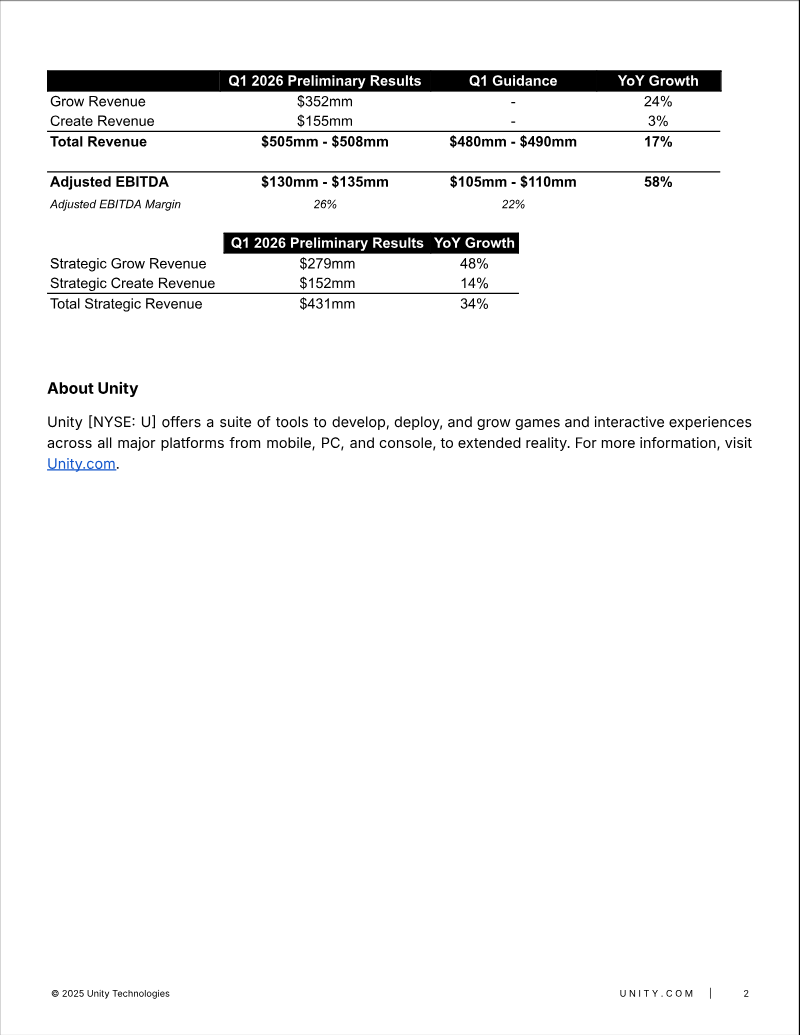
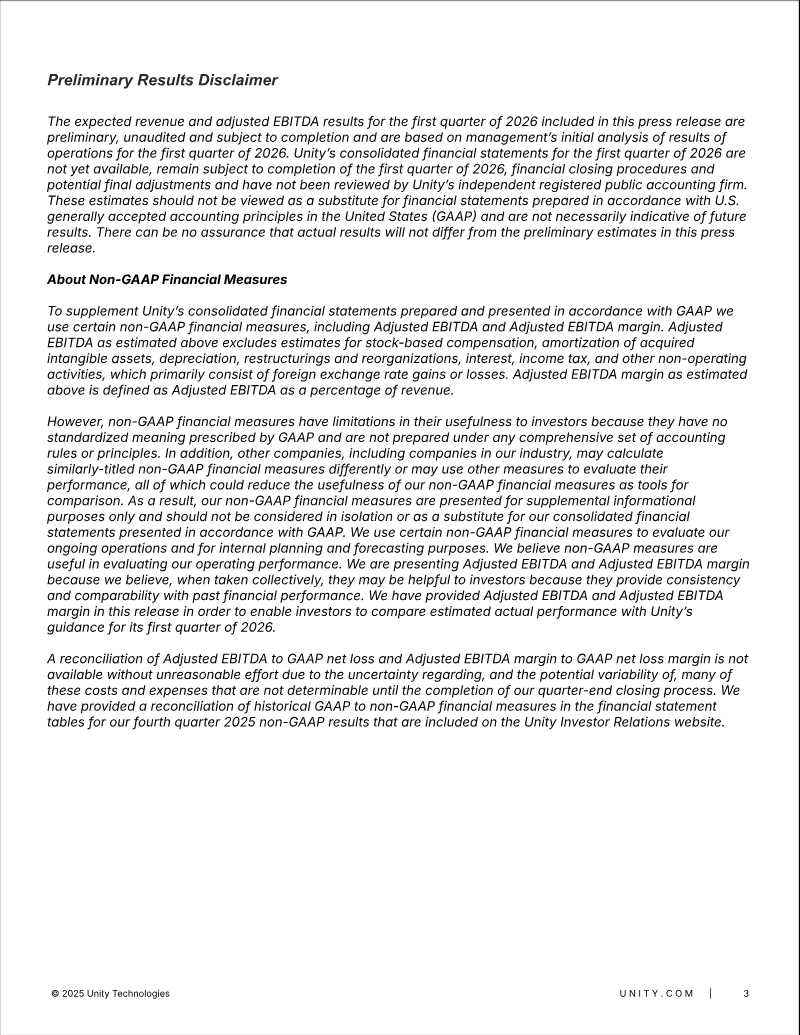
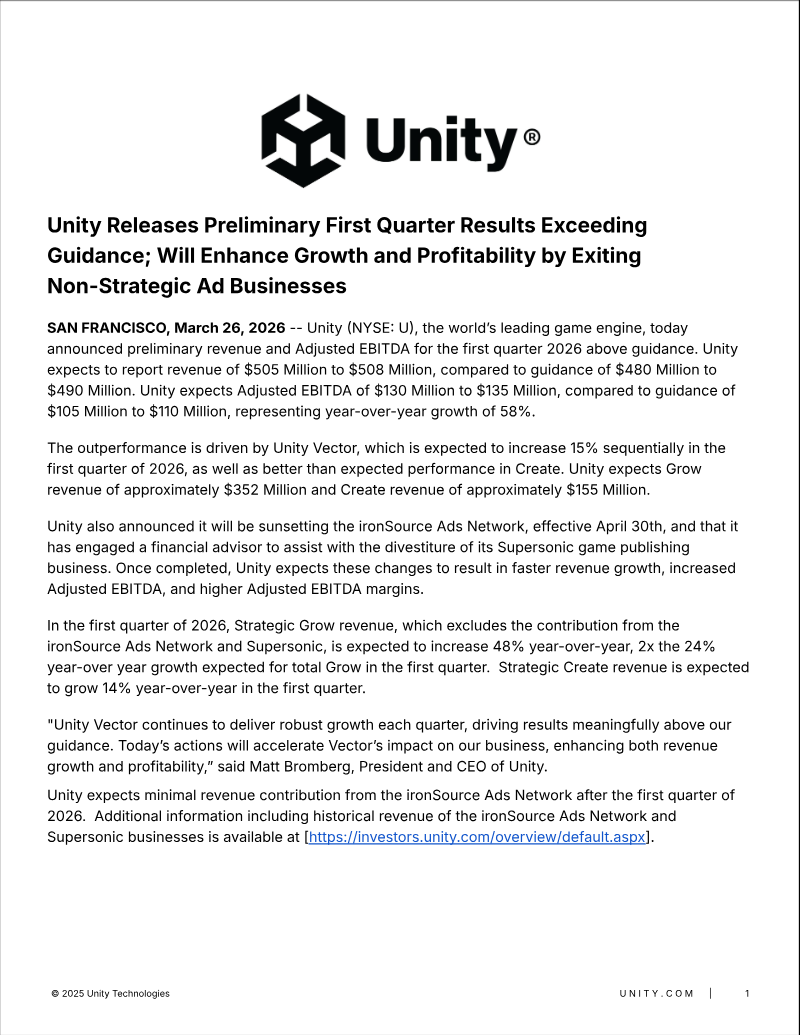
Unity has released preliminary financial results for the first quarter of 2026, reporting performance that exceeds previous guidance.
- Unity expects Q1 2026 revenue of $505 million to $508 million, exceeding its initial guidance of $480 million to $490 million.
- Adjusted EBITDA is projected to reach $130 million to $135 million, representing a 58% year-over-year increase and a 26% margin.
- Unity is sunsetting the ironSource Ads Network by April 30, 2026, and initiating the divestment of its Supersonic game publishing business to focus on core growth.
UA Monthly #2: AppLovin's Social Network, Google Fee Cuts & Unity Vector
Unity is aggressively challenging the current user acquisition landscape by introducing D28 in-app purchase ROAS campaigns powered by its Vector engine.
- Unity is testing D28 in-app purchase ROAS campaigns using its Vector engine, moving beyond the industry-standard seven-day optimization window to better identify high-value players.
- Google has reduced Play Store fees from 30% to 20% for new installs, providing developers with marginal improvements in unit economics and increased bidding power for user acquisition.
- AppLovin is exploring expansion into e-commerce and social networking to secure first-party inventory, though analysts view this as a high-risk departure from its core B2B ad-tech expertise.
Companies behind it

As the documents state it.