
AI and Games
Game AI research and practical applications for developers, by Tommy Thompson.
Documents

AI Game Creation: An Aggressive Race to the Bottom
The primary objective of this analysis is to examine the evolving role of generative artificial intelligence within the video game industry, specifically highlighting the tension between technological advancement and industry sustainability.
- The video games industry is facing significant tension regarding the integration of Generative AI, with Japanese studios expressing particular sensitivity and concern about its implementation.
- Capcom is actively experimenting with AI ventures, though these initiatives are currently facing challenges in execution and industry reception.
- The upcoming AI and Games Conference 2026 will feature industry participation from major entities including Fenris Creations, Embark, Warhorse, and Wargaming.

Capcom’s New AI Venture Gets Lost in Translation
The recent discourse surrounding Capcom’s proprietary RE engine updates has been characterized by widespread media misinterpretation.
- Capcom is updating its proprietary RE Engine to integrate AI-driven tools for development support, quality assurance, and workflow efficiency rather than for generative asset creation.
- The industry-wide perception that Capcom is building an 'AI-generation engine' stemmed from a mistranslation of the Japanese term for 'generation,' which in this context refers to an 'epoch' or 'age of AI' rather than content production.
- Capcom's REX engine modules aim to streamline development as team sizes increase, with potential applications including data format translation and code generation based on visual editing workflows.
Microsoft’s New AI-Powered Patents Offer Little to Be Excited About
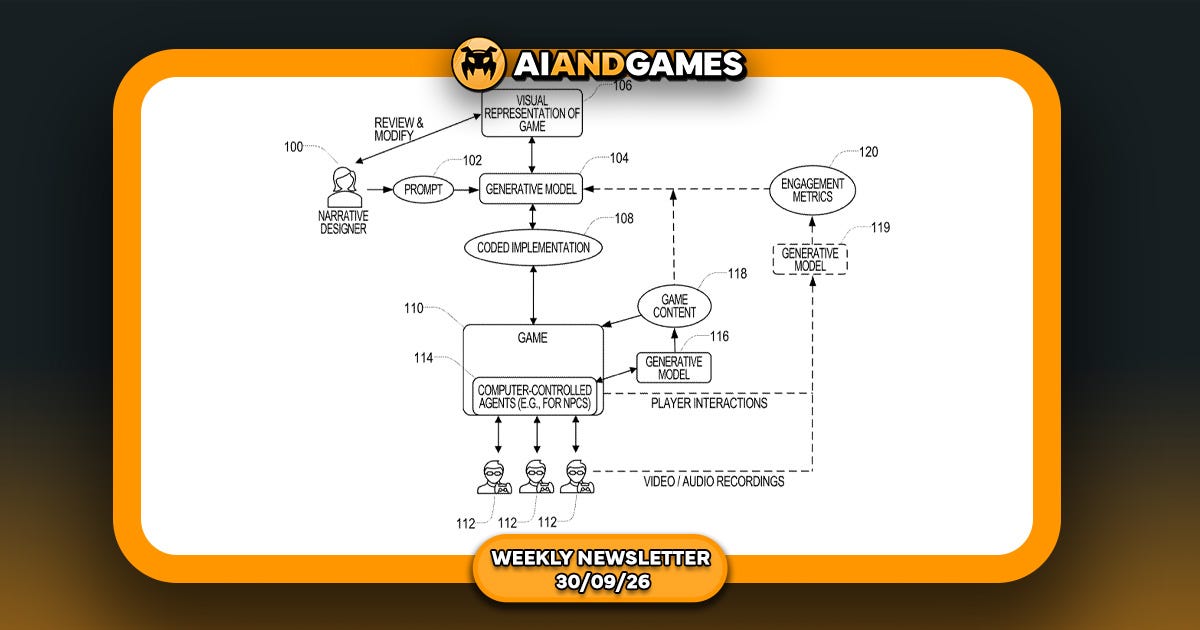
Recent patent filings from Microsoft indicate a strategic push to integrate artificial intelligence into cloud-based gaming, focusing on dynamic advertising and generative narrative systems.
- Microsoft has filed a patent for an AI-driven system designed to identify optimal moments to inject advertisements into video games by monitoring gameplay triggers and player state.
- A second Microsoft patent details a system that uses player engagement metrics—including quest completion, dialogue choices, and potential real-world audio/video signals—to influence and alter game narratives.
- Microsoft is expanding its cloud gaming strategy by allowing users to stream Xbox games without a Game Pass subscription starting in November 2026.

The Steam Fest That Proves Why Everyone Hates on AI in Games
The September 2026 "AI Gaming Festival" on Steam serves as a case study in the industry's contentious relationship with generative artificial intelligence.
- The 'AI Gaming Festival' on Steam is an independent third-party event organized by Invirtu Labs, not an official Valve production, and serves primarily to promote the company's own AI-driven distribution platform, Glitch.
- The festival focuses heavily on Generative AI tools for asset, code, and story replacement rather than gameplay-focused 'AI-Native' development, drawing significant negative sentiment from the Steam user base.
- The event functions as a marketing funnel for a ticketed, paywalled virtual conference featuring speakers who are largely founders of AI-focused startups, with minimal representation from the broader, traditional game development industry.

Exploring the AI of Command & Conquer
This analysis examines the artificial intelligence architecture of the original Command & Conquer (Tiberian Dawn) and Red Alert by reviewing the source code released alongside the 2020 Command & Conquer Remastered Collection.
- The original Command & Conquer and Red Alert source code, released alongside the 2020 Remastered Collection, reveals that both titles utilize a shared C++ architecture where unit behaviors and game logic are managed by a centralized AI() function.
- Unit movement relies on a lightweight 'Crash and Turn' algorithm rather than complex pathfinding, which calculates a straight-line path and only recalculates when an impassable obstacle is encountered to save CPU and memory.
- AI decision-making is heavily state-driven, utilizing Finite State Machines where units, buildings, and players are categorized into 'Houses' to determine available actions and rules.

A Deeper Look at PlayStation 5 Pro's Updated PSSR
This analysis examines the technical evolution of Sony’s PlayStation Spectral Super Resolution (PSSR) technology, as detailed in a recent presentation at the 2026 SIGGRAPH conference.
- Sony has updated PlayStation Spectral Super Resolution (PSSR) to move reconstruction mathematics out of the neural network and back onto the GPU, allowing the AI to focus exclusively on calculating blend weight 'kernels' for denoising.
- The original PSSR struggled with temporal noise in particles and translucent materials, particularly at high upscaling ratios like 720p to 2160p, due to an inefficient 8-bit neural network architecture.
- By offloading reconstruction to the GPU and shifting the AI model to a Kernel Prediction Network (KPN) approach, Sony has reduced the system's workload, improved performance at lower base resolutions, and lowered training costs.

Saber Interactive Unveils Schrödinger's Narrative Designer
The August 2026 industry update from AI and Games highlights a growing tension between game developers and the integration of generative artificial intelligence, specifically focusing on a controversy involving Saber Interactive.
- Saber Interactive is facing controversy over its new title 'Rideshare' after a former narrative designer claimed they were fired from the project in 2023, contradicting the publisher's assertion that the game's story was written entirely by humans.
- While Saber Interactive denies replacing writers with AI, it confirmed that the game's 'free-ride' mode uses AI to generate dialogue for an infinite number of passengers, despite this use of generative technology not being disclosed on the game's Steam page.
- FACEIT launched a new machine learning-based anti-cheat system on August 5, 2026, for Counterstrike 2, which has already banned high-ranked players for using AI-driven cheats that read screen pixels to mimic human input.

What Does the EU's AI Transparency Rules Mean for Games
The European Union’s AI Act establishes a rigorous regulatory framework that mandates comprehensive transparency for artificial intelligence applications, including strict requirements for labeling AI-generated content and disclosing user interactions with automated systems.
- The EU AI Act's transparency rules, effective August 2026, mandate labeling of AI-generated content (images, audio, video) with machine-readable metadata, particularly for simulations of real-world people/places (deepfakes), and require informing users when interacting with AI systems.
- Failure to comply with the EU AI Act's transparency obligations can result in fines up to €15 million or 3% of worldwide annual turnover, whichever is higher.
- The EU AI Act defines 'AI' broadly, including systems capable of inference through machine learning or logic/knowledge-based approaches, which can influence physical and virtual environments, and derive models or algorithms from data.

UK and China's Shifting AI Mandates
Generative artificial intelligence has become the foundational pillar of modern game development, with full adoption now standard among major studios.
- The UK government has undergone a cabinet reshuffle, abolishing the Department for Science, Innovation and Technology and creating the Department of Business, Innovation, Science and Trade (DBIST). Kanishka Narayan has been appointed as the UK's first Minister for AI within DBIST, and Lord Vallance now chairs a dedicated AI taskforce.
- China is actively building a broader AI ecosystem reliant on Chinese open-source models and has established WAICO, a competing international AI governance body focused on the 'global south' (Africa, South America, South Asian countries, and Russia), in contrast to the US-dominated Pax Silica.
- A 2026 survey by Japan’s Online Game Association (JOGA) found that 100% of polled Japanese online game studios are utilizing Generative AI, with Google Gemini, Anthropic's Claude, and Microsoft's GitHub CoPilot being the top three tools.

Reaching the Next Level with Mike Cook
The second episode of the AI and Games podcast features a discussion between host Dr. Tommy Thompson and guest Dr. Michael Cook, a senior lecturer at King’s College London.
- Dr. Michael Cook, a senior lecturer at King's College London with over a decade of experience in procedural content generation (PCG) and generative design for video games, recently published 'Next Level'.
- 'Next Level' is an introductory book on PCG in games, designed to be accessible to a general audience without a computer science background.
- The book discusses the challenges of introducing complex subjects to a broad audience and the selection of topics to cover.

My Favourite Games of 2026 Thus Far
The gaming landscape of 2026 is defined by a diverse array of titles that prioritize mechanical innovation and narrative depth over traditional blockbuster spectacle.
- The report, published on July 22, 2026, highlights several notable games released or anticipated in 2025 and 2026, including "Outhold" (2025), "Forza Horizon 6" (2026), "Pragmata" (2026), and "Vampire Crawlers" (2026).
- Capcom has released two significant new titles in 2026: "Pragmata," a new IP building on third-person combat with puzzle-solving and hacking mechanics, and "Requiem," which preceded "Pragmata" by two months.
- "Vampire Crawlers: The Turbo Wildcard from Vampire Survivors" (2026) by Poncle and Nosebleed Interactive reimagines "Vampire Survivors" as a deck-building roguelike, emphasizing strategy and deck crafting.

Post-Develop: Brighton Musings
The Develop:Brighton 2026 conference served as a focal point for assessing current industry sentiment, revealing a growing frustration among developers regarding institutional inaction and a shift toward community-led initiatives.
- Unity's 2026 roadmap will focus on AI tools that developers want, specifically integrating AI upscaling tools (Nvidia DLSS, AMD FSR, PlayStation PSSR) into the render pipeline and using Neural Rendering for AI-powered texture compression.
- AI governance is a major discussion point in the game industry, with many studios still lacking policies despite the increasing prevalence of Generative AI tools and associated risks.
- The decline of traditional gaming press is making it harder for publishers to promote games, leading to a rise in alternative platforms like Debug magazine (for high-quality reporting) and Brilliant Indie Treasures (BITS) for indie showcases.