VideoDeconstructor of Fun
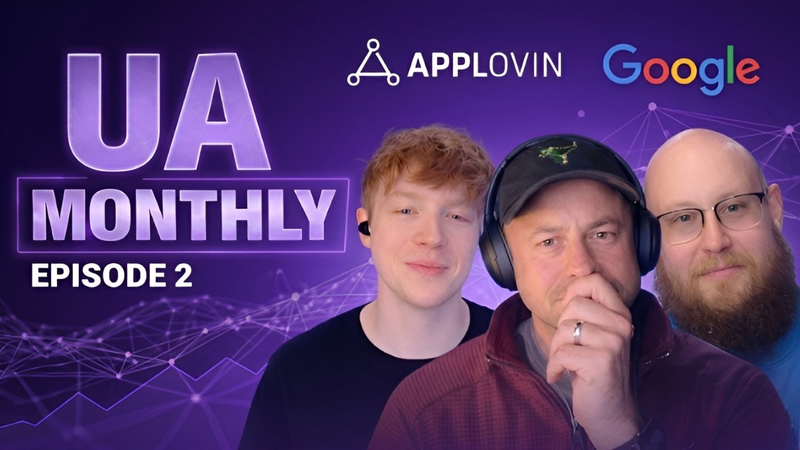
UA Monthly #2: AppLovin's Social Network, Google Fee Cuts & Unity Vector
25 Mar 202661 min video
Transcript
I live a I live a few miles away from a a Boeing 737 Max factory. Not so long ago, that plane became famous for for slamming itself into the ground and murdering people. It was literally banned from being flying. Today, it's Boeing's number one selling aircraft. The the lesson there is if you help your customers make more money, they'll forgive a lot of sins. [music] Welcome everybody to the second UA monthly. As always, first chair goes to
Josh Chandley, president and COO at Wildcard Games.
And today we have a new co-host, Mr. John Wright.
Hello everyone. Thank you for being here. I'm John Wright and I'm the CEO of Turilla.
Today we are we have three very interesting topics. So number one, Unity Vectors D28 campaign. Cannot wait to talk about this one. [laughter] Then we have Google's fee cut in the
context of growth and user acquisition. And finally, the third topic is going to be apploven's social network. Uh but before we jump into this, we have to shill Josh's uh blog post on deconstructor of fun. Now blog post is called the systems the platform can't build for you and this is out after a brief soft launch. Josh, what happened? Well, you know, like any good soft launch, we went live before the the product was fully feature complete. Uh, nothing wrong with that. Yeah. The the article is titled the the UA systems the platforms can't build for you. Um, and what we're observing is that the the role of UA is being rewritten in real time. You know, we're always chasing this new optimal and it's almost impossible for most studios to stay fully caught up. So this piece is for the growth leaders and the execs building what comes next. It's focused on where your margin actually lives, how strategy translates to execution, and
who in your org should own it. Awesome piece, really deep dive, talks about the roles and everything. And just to be clear, the first version that was shipped two weeks, yeah, two weeks ago, that was classic product manager thinking. That was me who committed without asking. and then left and so we had to pull it down. Anyways, anyways, don't let don't let PMs commit anything. Um, let's talk about Unity Vector launches. So, so in in short, right before GDC, Unity launched D228 inapp purchase rorowass campaigns powered by Vector. That's a purchase rorowass, not an ad revenue rorowass, which is not yet available, but will be probably coming later on. Apploving has owned longer window optimization for two years through Axon. Unity is now directly challenging that advantage with Vector. I love these names of these products. Um Josh, what's going on here?
Yeah, I mean first of all, you're
absolutely right. The the algorithm naming war is epic, but for Unity Grow, this is the biggest product move they've made like since the launch of since the launch of Vector. You know, at this point, day seven has been table stakes almost as long as I've been in the industry. Um, every network does it. Um, you know, Meta for now is also bidding on a day seven snapshot, but Axon gets to price in, you know, four weeks out. Unity just proved vacancy further, too. So, that's a direct shot at Apploven's one part of Apploven's core structural advantage. Um, so the question I guess is like why why does this move the needle for advertisers? Well, right now advertisers set their day seven target on what backs out to hit their long-term yield goal. And a simple way of saying it is that your your D7 campaigns kind of give you two segments of users. One is users that achieve your D7 target and then meet or
beat your long-term target and then users that hit that day seven target but they turn too quickly to achieve your long-term goal and you're just trying to to win on average.
Yeah, exactly.
Yeah. Moving to D28 means that networks can start to arbitrage around that first. They can keep buying those users that achieve D7 and meet or beat the long-term goal. But those users that meet D7 and don't, they can let the the D7 optimized ad networks buy that low quality and just skim the good off the top. Additionally, there's a new area of attack where players that might not hit your day seven target, but mature really, really well and still hit that long-term goal, you can now buy those, too. So in short, like day 28 is enabling Vector to on average deliver more valuable users while filtering out some of the underperforming segments that Meta and
Google are forced to buy today, you know. So that that's the that's the upside, but you know, we have to be honest about where Unity specifically stands. We only have one case study to hang our hats on right now. homo 3x scale with this and that's really promising but it's not proven it's a highlight um the the real question is what happens after GA you know okay maybe maybe Homa can scale when almost nobody else has the algo but what's going to happen when everyone can buy those users um so yeah I'm excited the race to move to move beyond day seven has finally entered a new phase You know, I don't know how Vector will perform, but the the era of app exclusivity is over. That's exciting.
Yeah. Look, I I think everything Josh said, guys, is completely accurate. But for me, it's it's been a long time
coming. Like Unity should have deployed this, you know, a while back. Obviously, it's tough when Vector was new to market compared to Axon. So, there is a time of learning, optimization, all of that stuff. But but look if if we compare Axon right now we were running uh day seven rorowass blending campaigns. We were running day 28 as well as day seven at the same time. And uh you know Axon advised us to stop doing that. They said just put everything on day 28. Um and I think you know it's quite powerful if the network is telling you that right is saying okay the best best practice and their advice is going for the longer cohorts the bigger periods. is because exactly what Josh said, the longer the the period is, the more data you have, the more time they have to optimize and also the more actualization, right? So if you if you're actualizing against a goal, say day seven 30%, you've only got, you know, uh a small amount of of of actualization up to that point to hit that rorowass, but at day 28, some studios are nearly profitable or
profitable, right, if it's hybrid casual and stuff like that. So they're just having that longer window gives a lot more security and they can play with all of the the metrics, all of the sources, everything on a much bigger uh poll. So even if the um some of the traffic to begin with is low quality and doesn't deliver like Josh says, they've got a lot longer to understand what the other things they've got to do to balance it out versus 7 days, right? They're giving themselves 4x of a window. It's not rocket science. It's logic. So, so yeah, I think look the fact that Unity is now doing this is great because I think it's become best practice with Axon and and again someone who's doing these campaigns personally um I s I'm seeing results on the day 28s much better than the day sevens. So I think it's it's great move by unity and I just wish it was sooner Mishka you know
it was uh but but we are we're testing it you know as part of the beta and I think the homer case study is great but
also there was no yaxis it's like okay so it's 3x but how big was the scale right like come on give me some numbers Booby like [laughter] so the these case studies you know they they make me laugh man you know if you're not giving me actual numbers it could be smoke and mirrors So, let's just see. But again, I'm seeing great results on on Vector at the moment. So, from personal perspective, everything's good.
Oh, that's that's good to hear. Um, looking at this again, as an outsider that doesn't deal with the campaigns all the time. Uh, you know, looking at the other networks, like you mentioned, AppLin, but also Meta and Google, they've all been pushing the the longer attribution window for years now. Is this Unity just catching up or is there structurally something different in the way Vector has been modeled?
Uh I mean look Josh is more uh more up to date on this stuff than I am and smarter than I am. But I would say look vector was there reestablishing the ML right? So they had something that worked but it didn't work as well as Axon. They
went back to the drawing board. They redesigned with more modernday standards. Right? again got a lot more ML AI whatever you want to call it sort of learnings within that um and probably taking in more data points you know utilizing the unity sort of engine data to become smarter. So they were they were just in my opinion one step behind dudes and it took time to establish vector and and for it to do what it should do before they started over complicating things with longer cohorts and and bigger data pools and all of that stuff. So, I think it's them catching up to to Axon, but quite frankly, a lot of the other networks are not a day 28 optimization yet either. So, you know, it's uh Uni are making the right moves and I think a lot of other networks will will move down the same path in the next year.
And who does this benefit?
Games that need longer maturation. So, most AP monetized games um will will
benefit from a transition. um because most AIP monetized games have retention. Um, additionally, any AP monetized games that are currently spending heavily into day 28 u acts on AP, they're going to benefit hugely because ideally you you don't want to have one ad network who has exclusive access to a certain segment of your users. And so having two ways to access that starts to give you some element of negotiating power back.
Agreed. you you don't want to have too much of a monopoly and the competitive advantage, right? It's the same thing with Meta with the how they attribute it's much more aggressive than other channels, which is not fair. We do it because it's meta,
but ultimately who do we want to to have the advantage here, Mishka? It's us, right? Like we're the the people build games. Like it's it's we want to maximize our competitive advantage. We don't want to give the networks more and more. We want to make more money for ourselves. We want, you know, Kagar to go up. So, you know, like hopefully
these sort of moves then bring back some competitive advantage and it's not as much as a monopoly with the channels and then again we benefit.
Yeah. But looking at the ebida of the likes of Apploving then it's it's clearly who who benefits of of this.
Yeah. Look at the quarterly financials and tell me who's making money out of this, you know.
Yeah. [laughter] Today's podcast is brought to you by Appsflyer, inviting you to dive into their new firstofits-kind report, the state of creative optimization 2025 edition. It's not about how to make creatives. It's about understanding what makes users actually stop scrolling and what emotional and psychological triggers drive performance. Based on over a million creative variations and nearly $2.5 billion dollars in ad spend, the insights in the report will help you develop a winning creative strategy. Check out the link in the podcast description below or go to appslire.com and search the state of creative
optimization. That's appslire.com. The house always kept 30% until now. You already know the math. Every dollar your player spends on iOS or Android comes with a tax, a big one. And for years, the industry just kind of accepted it. Well, Appch charge doesn't. Built by monetization veterans from Platika, Huge, and Moonactive, backed by the likes of Supercell and Playrex, Appcharge is the full stack direct to consumer payment infrastructure purpose-built for game studios. the results. $750 million in transactions processed across top titles. No platform middleman, no fragmented handouts between payment vendors, no watching your LTV models fall apart because you don't own the checkout experience. So, own your players, own your revenue, own your economics. Reinvent how to monetize. Go to appcharge.com. Yeah, unfortunately. I'm talking about
unfortunate things when uh Unity's reputation like after the uh the repricing debacle and all the structural changes uh does this type of a product launch does it actually move the needle on trust towards unity? What do you guys think?
I'll give you another example from a from another industry. I live a I live a few miles away from a a Boeing 737 Max factory. Not so long ago, that plane became famous for for slamming itself into the ground and murdering people. It was literally banned from being flying. Today, it's Boeing's number one selling aircraft. The the lesson there is if you help your customers make more money, they'll forgive a lot of sins. And so, applying that to us, we need scale.
We we need options to access our players. And if we don't use these tools, our competitors will use these tools and just get even more access than we do. Um, so yeah, I think we're I
think it's going to have high adoption.
All depends on Benjamin's right where the money is. And if if Unity start making people loads of money, Mishka, then things are going to start moving again. Maybe you guys don't remember this. Do you not remember the outrage when Lion Studios launched? There was like people like people like us were in rooms having discussions about how we're going to boycott apploving like but hard like CEOs of big companies saying yo we're turning the campaigns off we're not funding their learning you know and and then look at look at it now you know apps on is 60% of UA in our industry that was only a few years ago dude people in our industry have short memory and don't get me wrong
business people in our industry have short memory I think that creative people, the people that are actually making games have a very um a different mindset, right? Cuz they're not driven by money. They're driven by other motivations and creativity and and all that stuff. So those people that they're
uni create clients, I think, you know, they're the ones that will take a bit longer, but they're unity grow clients, you know, they won't care. As long as it's up to the right, no one cares.
Yeah.
Yeah. But the Unity Create client that that kind of
that that you know Unity Create maybe is a bit out of scope of this episode, but
they're so locked in. Like I'm a Unity Create client. What am I going to do? Switch to Unreal and fire my whole dev? [laughter] Real dev? Like what am I going to [ __ ] do? Uh uh I am exponentially more locked in there than anybody else um than anywhere else in my business. So I
I'm not worried about that for them either to be honest.
Yeah. Again, I don't know if you remember two years ago, everyone was like, "Chad dot is going to take over."
Yeah. When I was like And I was like, "Absolutely [ __ ] not. You are high. You need to go back to the tender line and smoke crack." [laughter]
No, it's like a It's kind of like a hippie thing like devs like to contribute to every now and again just to like make their
contribution to the ecosystem, but the Yeah. the adoption isn't the use case isn't there. And so when it's a tool that's just for looking at, that makes it art more than a tool.
Yeah, exactly. Look, I I'm not [ __ ] on GDAT. I think, you know, they've done some great, you know, great stuff in the last couple of years, but it's not the product you need to mass market and scale games, you know, it's it's not Unity is still the bread and butter of our industry. And I don't think that will change even with all the the AI hype about, you know, game development prompting. I still don't still don't believe it or it will come in many years time. It's not going to happen now.
These networks are powerful. I still remember when Apple loving had the uh match mansion. Was that the game when when they copied Player Rick's games and and faked it that it was made in some coffee shop in San Mato address
and um you know it was amazing and then nobody worked in that studio on LinkedIn. So uh that was that was fun times and we forgave it and came back. I
mean, [laughter] what are you going to do? One great offsite and we're back on board for the next quarter. [gasps] Um, let's talk about another giant making big moves and that is Google overhauling its Play Store economics. I don't I think overhauling is a pretty bold statement.
That's a strong strong way of describing it, dude. I wouldn't say overhauling, you know. Let's just let's just say that the PR was was you know talking about major changes but the the reality is as Chris would say mice nuts. In the game of growth everyone is looking for [music] that power up. Vibes is exactly that. It's built by industry people. [music] So they actually get the challenges you're dealing with. As a result they become the fastest growing gamified rewards platform out there. [music] And the results are kind of nuts. With their AI powered targeting you're not just buying stalls. you're bringing in the right players and now they've got this new rorowass optimization engine so your campaigns
basically level up automatically. Vibes is built different. It's designed for growth and I guess you could say it's powered by good vibes. Check out their doof [music] exclusive case studies by following the link in the description and go [music] to vybs.co. That's v ybs.co. Share your email and join the weightless list. So, the headline was a 20% fee on inapp purchases for new installs down from 30. So, over like a third down and that the changes roll out as soon as the June 30th. Josh, what's your take on this? Uh, [sighs and gasps] I mean what it actually is is, you know, Google has blinked, right? Um, it's taken a while. 30% has been the number for almost two decades. We're still not there yet, but at least in the US, but
we're looking at 20% for for new installs. I how will they measure new installs? like nobody knows, but certainly it will be more conservative than your MMP. Um, DTC is going to be interesting. Uh, I think the amount of value creation is undeniably a little lower, right, than when Google was effectively providing their services for free. But this was always where they were headed. There was never a scenario where Google and Apple were just going to provide distribution for free forever. um DTC, you know, has a clear path to provide value um uh especially when they're delivering more ways to touch the user. Um but on actual UA um for new games or games that are scaling user acquisition, if your LTV was $7 when Google took a 30% cut, when this rolls out, your LTV
instantly becomes $8 for new users. That's 14% more bidding power. Um, you know, I don't think it's going to transfer all the way over to networks. It means the um your rowass targets will stay the same, but your your revenue will jump 14%. Um, for for those players and UA spend will kind of climb uh to towards that. Um, it's also potentially a little expansionary. Um, you know, if we're making 14% more, you know, that means mobile apps are making 14% more, but advertisers like ecom, they're they're making the same. That means the mobile gaming is 14% more competitive on Meta, 14% more competitive on YouTube, 14% more competitive on Tik Tok. That that means we're going to be able to bring more players into the ecosystem, and that's kind of cool, too. Um, in terms of right now, what action
should be taken today? I mean, nothing. What's with the excitement? Uh, see if it gets struck down. I'm really curious, especially for the public gaming companies, to keep an eye out for how Google decides what a new user is. That's a key detail. I'll give you an example. There's no MMP on this planet that with me as a user. I I I played Heyday in my 20s like 10 years ago. Every MMP on the planet is going to say I'm a new user if I download Heyday.
Y
is Google It knows I downloaded it 10 years ago. Is it going to charge me 20 or 25?
Um so for the the big companies that have very live products, this could actually be less bullish than for new games. it could actually entrench a pricing advantage for new games and make it easier to scale those games because they get to be pricing for new
users. Um so that that's my one thought there. For almost two decades, you know, we've been doing business at 30%. Now it's 20 or 25. Um LTV is going to go up, budgets will follow. Uh this is one of the rare moves where um both ad networks and the pubs you know win at the same time.
Yeah, look it's it's a unit economics play at the end of the day, right? like anything that can put you know more money into our hands or or improve you know profitability uh extend rorowass reduce recoup windows all of that stuff is net positive for us in the industry right um this discoverability piece I didn't actually think of but what Josh just said I think is actually very interesting because again an MMP normally has a 12 month period where you're a new user so as soon as you're out of 12 months as Josh said not even 10 years it's 13 months Like you, Mr. Katov, haven't played
Brawl Stars in in 14 months. You download, you know, you're you're a new user, right? What about new devices? What if I've just bought a new iPhone and updating the device? Is that accounting or not? I have no idea right now. So, but if if it does give some advantage to to new companies and new games, then that could help fix part of the discoverability problem, which is obviously new games right now are facing, right? Like if you look at you know that famous graph Mishka that you know you always show that I always show you know how much revenue over the for games 5 years older or above it's like 65% of games now is five years
70 yeah
right yeah it's crazy right so there isn't any competitive advantage really for new games it's like older games that are really winning and becoming like uh you've got a few examples right Monopoly goal match blah blah blah but those are unicorns man you know you don't get them every day, every month, every quarter. So, anything that can help with
discoverability piece would be very interesting. And look, my but my thoughts about this in general is it's a little bit too uh a little bit too little too late, right? Like Google should have made this proactively a few years ago and the DTOC space wouldn't have exploded the way it has, right? Like, you know, our friends at Appch Charge or or Stash are closing business all the time. Like play tikka came out last month and said they're doing a billion a year through DTOC now. It was 600 million the year before like this is serious money you know and if they're playing they're paying 5% rather than 20 or 30 they're racking up hundreds of millions that's hitting the bottom line. So one I think is overall positive for the industry and and you know that's going to have a positive effect but the big boys and the mediumsiz companies are still going to work with the D2C providers let whilst they can whilst it's legal and they're allowed to because the margin between five and 20 is so big. Yes. It's like
the divide you know like Moses split in the Red Sea for Christ sake you know [gasps] and uh yeah it's just it's it's like for me I think Google should have done something a long time ago. I think they've dined out on on our money for a long time in the bygotten time in the bygotten price. 30% is no reason why you should be paying 30% with minimal discoverability. Like 10 15 years ago, you got a featuring on Google or Apple and it made the world of difference. You know, you could make super money, hundreds of grands a day if you get a good featuring. Now, like last what 10 nearly 10 years since they changed the app store, you don't get those booths anymore, you know? we don't see that sort of traction, why are we paying 30%. Um, so look, for the overall impact, it's great, but the big boys and the mediumsiz people are still going to go with the DTOC providers, but it's also good from for lifting the bottom, right? Like, how do you improve averages? It's by reducing the bottoms. And so, I think overall it will be good, but maybe it
won't have the big impact that we hope. Um, but I do think that Josh had a very smart point on discoverability and if it proactively promotes new games, new companies, then that will be a massive sort of uh impact and incremental effect that we need right now for new studios and new games.
Interesting. You guys have a very sort of a positive uh and almost like a curious take on this and sort of like,
well, we're shooting more money into the system. This is good.
Yeah.
Yeah. I like money.
I like money.
Yeah. Um, we're we're shooting in liquidity. Yeah,
I'm I'm kind of going back cuz this comes through the settlement with Epic and there was this narrative that came out that Epic won like they beat Apple and they beat Google when in fact Epic settled after winning in court and this is the result of litigation of five years. I don't know how much that costs, but it must be some, you know, some meta money that
that that they paid for this. And in order for them to, as Johnny said, little too little too late in order for this to be meaningful for the industry, they should have probably literally get it 5 years more. Like they should have done a GoFundMe for the game industry so that we could have continued to fund the fight against the platforms.
Yeah. Um, but I understand like Epic has way more investors now than they had what, five or six years ago when they started this crusade. And I bet the uh the big investors, the Disneys of the world be like, "Hey Tim, let's uh like the Fortnite is not looking as big as it needs to and metaverse is not happening. How about we focus on, you know, the main thing and stop fighting Apple and Google simultaneously on a two-front war?"
Yeah. But also remember, dude, you don't know what the deal Epic got was,
right?
Like what we might Epic might be paying 15% now rather than 20, right? They they they announced his 20% as the blanket. I
don't know what Tim's doing behind closed doors.
You know, Fortnite could be paying 10 15% on Google now. And and he's laughing all the way to the bank. Who knows?
Maybe. But but Epic is has is launching their I mean they launched their store and now the store will be sort of an official store where it's much easier to get than it was before and so probably through that store they're paying 5% on on whatever you know Fortnite is making but at the same time Fortnite is tiny compared to the moment when they pulled it off the store when they when they did this uh uh one-sided announcement that here you go you can now pay directly in Fortnite using D2C when when you linking out when that wasn't possibility back then. Um, [snorts] another thing that I want to mention about this is that, you know, as you said, it's too little too late. I would kind of agree with that because the math is definitely not transformative. We're talking actually about going from 30 to 25% because it's 20 plus 5% because that 5% is the payment fee that will be. So
it's it's almost like they're giving these numbers in an American way where there's a tip and you Yeah, you you need to pay 20% tip. You like of course you pay 20% tip. It's like it's not in the price. Well, what are you like of course? So it's uh we're being bamboozled uh by by these numbers. Uh it's it's only 5%. And and it is a question because like if you're a midtier mobile developer um like wild cards, the delta between going unprofitable, surviving or thriving, I think is bigger than than you know five percentage points. Am I right, Josh?
Uh [ __ ] definitely. Yeah, absolutely.
Yeah. And and and I think you guys said that, you know, like it's it's kind of good for like everybody gets a slice like this is a good discount. It's everybody's margins improve. I my question was like like the way I thought about it is like network's going to win because all this extra slice of dough is
just going in their pockets as we are advertising more and the CPIs are going up,
right?
Could be.
Hey, I I'm too cheap for that. I I think that uh I think that um what you're what you're going to see is 14%. In in a scenario where your LTV improves 14%. Let's just let's just assume that's the the number for a studio A. You're going to see revenue jump 14%. Eventually UA spend jump 14%. Um and then eventually cash flow jump 14%. what you're not. So, what you're going to do if it goes from like $7 to $8 LTV and you were paying five bucks, you're not going to just pay that whole dollar more to the ad networks. You're going to maintain your goal and you're going to scale up cleanly. Um, so that I don't expect it to flow all to the ad networks. However, I mean, John, you do a little bit of admon too, right?
Um, means
Yeah, I mean, too.
Yeah. dabble
dabble a little bit.
Um
once upon a time
I think weirdly we this could be the biggest winner here. Ad monetized game studios um last time last time adap monetized games um postcoid fell 8% per year. The numbers I've seen are ad monetized game CPMs fell 30 to 40 because what happened was everyone's happy, everything's going well, then AP monetized games drop 8%. And so CPMs go down for ad monetized games. There's less demand and so we have to lower our bids, right? Because our LTV just dropped and us dropping our bids causes CPMs to drop. Yeah, this was then just lowered our own LTV. Yeah, this is a vicious
This was a double effect that happened.
No one ever spoke about this, but this is exactly why we got a double.
Essentially, we had to lower our own bids because LTV was dropping and that caused us to lower prices even more in the inventory we were buying, which lowered our LTV because our inventory monetization. Now, what are we seeing? We're seeing competition returning on the ad networks we talked about earlier. But if AP games are able to spike their UA bids, all of these things are going to increase CPMs for for ad publishers, which will mean that we then are able to to bid more. And if we start bidding more too, we'll increase our own LTVs, which will allow us to bid more. And so Admiral has games are so freaking cyclical. I think we've been out of favor for a little bit but I can see some normaly there too and that's exciting on the UA side
and this is all the growth loop Josh right like the better the monetization you know behind the old TV and then that feeds into the growth uh the UA part and
then it just becomes circular like it's okay yeah
more money in all these second order effects
and you know yeah this sort of thing can be quite like transformative in that way like it can ratchet it up both sides.
Yeah.
Yeah. But the hypothesis the hypothesis Josh is using here is or both of you are using is that everybody adopts this. But you kind of mentioned before that this is most something that is adopted by mid and small tier studios while the large ones will continue to do their DDC D2C uh so direct to consumer web shops. And I've had some conversations with a few very big publishers and both of them were not jumping on board of this. Uh and that seems to be the consensus that they are continuing to use the web shop rather than uh opening up. And actually, I believe that this will only increase the use of web shops because the removal of the scarecreen um which according to Sweeney in the
article, he said that over half of the players dropped off trying to install the Epic Game Store. I think the same type of scare screens have been with when you're trying to get uh external payment through uh doing DTOC. you remove that. So that increases the conversion
and yeah and that means the DTOC companies might be one of the biggest winners in addition to admonetized companies because their solution is much now much more accessible.
My my my push would be well actually no I I agree with you. I agree with you. Big gigantic studios are public or could be public. Um, they're not going to be moving quickly. And I also think that alternative app stores, especially with the lack of a scarecreen, have a a lot of upside. But but but here's the rub. Here's the rub. Um, gigantic studios have one thing in common.
Big ass titles that have been live forever.
Yeah. Actually, two things in common. one, money, two, big ass titles that have been live for a long time. And when you look at games like Heyday I brought up earlier or even Monopoly Go now, the percent of revenue that goes towards user acquisition is smaller.
Mhm.
And so that means any savings that they generates don't trickle down in the same way. Um whereas if a brand new studio comes out or a brand new game comes out and it wants to scale, its percent of revenue going towards UA could be over a 100%.
Yeah, exactly.
Um and that's [clears throat] going to aggressively feed the ecosystem much more efficiently than a game that's in more of a a live more of a harvest mode where it has its users and it's not worried about acquiring more. And so I think that the economics will play out
differently for for for that scenario.
But in order to get these discounts like one of the things that we haven't mentioned is that you have to capitulate to Google's level up was it level up program uh where they essentially put in a sidebar with with Gemini and Nano Banana and and of course Teimo Ads and you name it and and bake your data. So there's that.
Yeah.
Bring the model.
There's also that
bring in the model.
Yeah. And and that is the reason why the big studios are not jumping in because they don't need that sidebar with uh with a bunch of AI.
Yeah. And none of this is final yet.
Yeah. 30th, right, Mishka?
Yeah.
Yep. Yeah. And and if it goes through and then Apple is going to do some [ __ ] uh and and we'll see how this goes. But again, removal of scarecreen, uh, improving margins even a little bit, networks, web shops, and admonetized games, they can all high- five together.
Yeah, look, to sum up, this is this is a good thing, right? It just depends on what level of good it will be. What is the real impact going to be? We'll see in 9 months, right? 2027, we'll see what the results are.
But my I'm I'm an optimist. I'm going to say this is going to be net positive for all, you know, all of us and let's let's just wait and see, you know, but we'll see next year.
100%.
It might not be the end of the negotiation like it's being framed as. It might be the middle. We don't know.
Well, part of this was Tim receives a gag order uh not to talk about Google for 10 years. That was that was part of the deal.
Is it 10 years?
Yeah.
Damn it. X is going to be so much more boring now, you know.
Yeah. Yeah. He he called Android fake open platform. Uh not anymore. We'll not call that anymore. Um your competitor is scaling. You're running the same ads, same channels, similar creatives, and it's just not
working for you. So what are they seeing that you're not? Sensor Tower's Pathematics shows you exactly that. real ad creatives, spend estimates, channel breakdowns, and impressions data across Facebook, YouTube, Snapchat, Instagram, AppLoving, and many, many more. See where your competition is investing, what's performing, and most importantly, why. Just stop wondering and start knowing. Check out Pathmatics by Sensor Tower. Go to sensor tower.com. Okay, last piece. This is an interesting one. Apploving plants a social network. Why not? So Apploven is building a or or considering building its own social network after failing to buy Tik Tok. These guys are on crack. Uh their CPO before that they wanted to get Unity too, which would have been a good deal. Uh their CPO said they're inverting Meta's playbook. Ads infrastructure first, audience second. JC, what's going on?
I mean, Meta and Google must really [ __ ] hate these guys.
Oh, yeah. They they do hate them. They do hate them. Every every conference they have, I they whisp they well somewhat whispered to me. They're like, "What do you know about Applov?" And I'm like, "I don't know what I know." And why are you whispering? I didn't know [laughter] this.
Yeah, I I Yeah, I couldn't I couldn't possibly comment on the meta like their actual opinions right now. Um, but the the evidence is just like uh I'd be pissed if I were them. You know, first they went after ecom apploven. That's Meta's biggest ad vertical. You know, uh we're seeing Axon reported I think 5 and a half thousand merchants um already on Axon adding 200 a week. That's like going straight at Meta's money. And now they're uh they're trying to like buy or or build social networks. Um that's not competing with meta for ad
dollars. That's competing with meta for ad dollars and for user base. Um yeah, I that's how you go from a partner to a threat. Um you know, that said, I don't think they can build one themselves. uh consumerf facing social media apps are a completely different muscle than B2B ad tech. So maybe if they bought something it could potentially work. Um but we've seen other ad networks and other platforms do this kind of acquisition and the integration always tends to be a lot harder. Um, so here's what [clears throat] matters for for gaming executives and UA people today. Probably none of this. Uh, um, you know, I if it were to happen, you know, for the UA side, success here would make app even more crucial part of your portfolio. And
second, for ad monetization, if AppL builds its own kind of demand surface, your inventory becomes optional. But I I I think that that the bigger thing here is um the these kind of actions are just not going to go unanswered forever. If you're going after people's customers and you're going after people's platforms, um that's just business. That that really is just business. But so is responding to a a competitive threat. So it's going to be interesting.
Yeah. I mean, look, I'm going to say one company name and and this is this and this is Be Real. What the [ __ ] happened to be B Real? Like they were acquired by Voodoo and I haven't heard about this company in like I don't know 18 months, two years, Mal. I don't know what the [ __ ]
Let's be honest. I I haven't heard about Be Real before they got acquired. So,
there's there's also that. [laughter] And
let's let's be real. Let's be real.
Let's be real. Boom. Um, but
took me a second to get that.
Yeah, man. That That was straight up British like humor. I was ready for the drum solo. Ready to hit that. But no, no, like look, I'm loving they're they're dominating gaming. They're moving into ecoms. they're becoming a threat for Meta in some way or means as Josh said um you know and and I do wonder how long they will be allowed to do that you know there's there was a point where I think um like does Zuks think look at app loving and think threat you know or does he think like okay this is like you know flee on the back you know I'm I'm
well I think the answer is clear I think that okay so they're pulling ecom away from meta they're trying to buy Tik Tok and Suddenly, uh, someone who's not talking right now on
this podcast starts doing podcasts with Meta about how they're coming back into gaming. That seems like a that seems like a response. Um, that that seems like a response. Um,
yeah,
the timing is is like probably not coincidental.
No. So, look, I think, you know, maybe a couple of years ago again, Zuckerberg wouldn't be looking at this in uh in the same way. I think you like you said Josh there's been some recorded evidence lately where you know uh and and probably all of us had little meetings with Meta and we've heard them ramping up their gaming and all of that stuff right so you know maybe maybe you know they are aware and they are trying to combat this but I still think look it's going to be it's going to be an uphill battle to try and beat Meta at at being a social platform you know even if they acquire like the B real voodoo example like I don't I think they're going to acquire something that is going to be the size to compete and if to get it to
the size to compete is going to take a very very long time. Um the only you know uh difference would have been if they would have been able to acquire Tik Tok which would have been completely out like out of their means in my opinion. Um so but look I I I don't really think like honestly I don't think this is a massive viable strategy for them. I I think maybe it was like an opportunistic thing then they would do it but I don't I don't see you know apploving you know building or buying a huge social network where this becomes you know big part of their business. Um yeah I I'll be interested if it does but I just can't see it. It's going to be very expensive. You know they've been coveting the uh sort of um revenue and profitability per headcount for the last couple of years. is, you know, stronger bea. I don't see how you can continue to do that and keep your shareholders happy. If you buy like a massive org with hundreds of people, you know, it goes against kind of what they've done with selling the the
catalog off and the headcount off to to triple dot. I think it's counterproductive to their uh to their public kind of financials and uh and the outlook and what their shareholders want. So, I don't know. Like I said,
that's a really good point.
We we we'll see, man. I I just I don't see it matching up. I don't
Let's see.
Yeah. I mean, the last major platform to come out was, I think, Tik Tok, right?
And that was 2018 in the US. So, there's not there's not that many of them about for sale to be bought, let alone for sale.
Yeah. Uh you guys are both skeptical about Apploven uh that they can build the social platform, this meta competitor uh from the ground up, but their CPO explicitly said that they are not building meta that they're inverting the model and they're being ads engine first, social layer second. When you think that way, is there still the same level of skepticism?
What does that mean?
Yeah. Like
it means they already have an algorithm, but they don't have an ad network yet.
Yeah. [laughter] It means they want a It means they want an apple and an orange and um they have an apple, so they're saying an orange is next.
Um [clears throat] that's what that's what that's what they're saying. Um
Yeah. Or they have this they have the seasoning, but they don't have the steak.
Yeah. [laughter] Yeah. Well,
that's a good way of put it. That's a good way of put it.
That's true.
Yeah. Yeah, I mean [clears throat] it's no it's no uh I I think that the the one reason that you're going to see any network want a social media platform or anything like that is like they want they want O and O inventory.
Yeah,
that's that's that's incredibly powerful. Um is when you when you think about it, if if Unity, let's say, starts to bid 5% more effectively, how does that affect Meta's pricing on Instagram? Um, but for for Axon and for anyone
who's buying gaming or inapp ad inventory, you've got two algorithms going. Algorithm one, how much how much can you charge um the advertiser Dream Games and still hit their goal. The other algorithm is how little can you pay Josh and John and still win the impression. And that second one is ultimately set by the second highest bidder. So if network A can bid 20 bucks and network B can bid 10, network A can pocket a $10 margin. Now if network B gets 5% better and can bid 11. Even if network A still wins with 20 bucks, their margin just dropped 10% from from 10 to 9.
And that's so not owning not owning the inventory is a material risk for an ad
network because you're facing compression from two sides. you're creating how much you can one is like how much can you charge and still create value but the other is like well your alpha is actually not how much value you can create it's how much more value can you create than the competitors and that's like not a situation you really want to be in if you can help it.
Yeah. No, I think I think you're right, Josh. At the end of the day, if you can if you own the user and you own the the the direct supply, that's part of the strategy they operated with acquiring all the studios, right, was was getting their own supply in and you know, then it was the the acquisitions data companies like Adjust, etc., right? Getting more and more data and and allowing them to, you know, kind of do what they did and and conquer the big part of the industry for a long time. But, you know, it's the thing is as quick as they were able to do that, all it takes is someone else to do the same
thing, right? Like, uh, if Google wants to double down on ADM Mob, if Cloud X actually does what what people are saying, like there's there's always going to be competition when you don't own the user. So, I mean, look, even if even if you look at Apple, for example, like again, Apple decided, you know what? We're going to do ATT, but they kept the IDFA, right? Like, cuz it was their first party data
for themselves.
Yeah. For themselves, but they got rid of it for everyone else, Josh, right? Because it was their user, their data. So, so like you can, you know, if you're playing someone else,
Apple search explodes. Yeah.
Yeah. Exactly. Right. Exactly. Look, it wasn't it was [ __ ] extremely tactical and logical what they did, you know, and it had a massive effect for them, but they could do it because we are playing in their sandbox. And you know, if if Apploving were to build first party platform, social network, whatever, where they the user was theirs, then they would be able to control that a lot more. There would be a lot more
security. There wouldn't be any of the situation that you're describing in the arbitrage. So it's I mean from that perspective it's it's smart idea it's good business but the execution is going to be key and again that over the last 20 years you know you know uh MySpace has come and gone right but there's there's probably less than 10 social platforms that are successful right maybe five in in you know current circulation so
maybe they buy Discord maybe they buy Discord is going public that's a good one
it's a new age one. If you want a younger demographic for the future,
it's it's a very good idea actually. I mean, I would
if I was them, that's if they're listening, listen to Mishka.
Yeah.
Yeah. Um advice for free. U so [laughter] what what do you what do you think about like app like Apploven has their stack uh their advertising stack? It's it's as as foolproof as any. Does that give them
an advantage if they want to build on top of existing user base? Let's say they acquire Discord that has been actually trying to get into advertising space tremendously, but it doesn't mean it's going to hit the same CPMs. Um, [clears throat] what when you when you see like especially Discord, but when you look at like Meta and YouTube, there there are two key challenges for an ad network with social media versus inapp ads. Challenge one. Um, it's a it's a candy store versus like an infomercial or c like uh the checkout aisle versus um an informed purchase. When you're looking on a real while or you're scrolling on a news feed, the whole purpose of that [ __ ] ad is just please stop stop scrolling. U that's the whole purpose on on inapp ad. With RV, you've got a 30 secondond infomercial and then a playable experience, then an end card. you can the user is going to watch and and so a lot of their targeting is and assumptions are based off of that. Um the second thing is and
and I mean no offense to any of my friends at ad networks for inapp ad companies. It is a little bit easier to target um games in or target ads in a game than in a social network. Uh if you are watching an ad inside solitire, you are much more likely to behave a certain way. So like if you walk in real life, if you walk into a bookstore, the probability that that person likes books is quite high.
Yeah. Exactly.
And so by having a million different applications that you're moving inside of and out of, you're showing behavioral intents. If you open Tik Tok, that says [ __ ] nothing about you. That says literally everyone opens Tik Tok. What What contextual advantage do they have from from opening Tik Tok versus Apple being
able to see, oh, they they opened a card game? Oh, they opened an MMO. Oh, they opened a Forex game. That the the the ability to to use even just that basic feature is really impactful. And so Meta and Google have way harder jobs. um their their technology has to be way better. And so it's not that they can't do it. It's that that um I would assume that Applovven's technology like Axon wouldn't be plugandplay. It has a unique challenges and like the inventory itself would would fundamentally change.
Final question. Do you think uh
do you think Apploven is overextending here? because they're they they kind of succeeded by going for the cash cows of the big ones as the big ones were chasing next set of unicorns from metaverses to AI and these guys were just eating their lunch that they left behind and now they're coming back for
their lunch while apploving is coming for their core. Is this overextension?
In my personal opinion, yes. I I think it's going to be extremely hard for them to execute on this. Doesn't mean that it's impossible, but I think it's very, as Josh said, there's a number of differences. You know, when you're targeting users and having like certain infrastructures that are from a games versus uh social media platform, I think it's going to be very very tough for them. I, you know, how much on R&D are they willing to spend on this, right? Like how much does it cost to build a social network? 100 million, 500 million billion
or buy a Discord. What's a Discord IPO?
Okay, you buy a Discord for a couple of billion, right? It's a lot of money. Um, so you know, you can't just throw money at every solution. Some things you're good at, some things you're not. So, if I was them, I would focus more on the ecom side because I think that they're more poised to win in that. But look,
you know, if if they've got more of a gambling nature and they risk and reward, there's a very it's very high risk. If they nail it, the reward will take them to a $500 billion company,
you know, rather than
I think you're you're dead on. I I would say that the
I don't know the headcount assigned to this initiative and therefore I can't truly say if they are overextending cuz what if there's like one dude or zero dudes on technically maybe maybe it's not. Um, however, if in the idea of like we want to get our own supply, we want to have enhanced control over supply. Um, I would say if that was an initiative that they were focused on, um, first of all, John's totally a thousand% right. The ecom thing is crazy. It is it's been like I thought it was going to be meh. It's blown my mind how effective that's been. Um, so just like kudos to them for the
vision on that, but if they were going to be focusing on enhancing their control on supply, John, when was the next the last time your Max dashboard changed?
Couldn't tell you, dude. I log into it every week. Couldn't tell you.
Yeah, and it it's been the same. It's been basically the same. Like I remember when I got sold max 20, six years ago, whatever that is. It hasn't really changed. Um, so if they're trying to lock down inventory better, improving their lockdown and their value proposition to their current supply, I think is really beneficial. Um, and ignoring that has some risks and start to offer more mediation services or more mediation adjacent services via things like their ad quality tool. Uh now technically technically Max already has an ad quality tool but no one uses it because it doesn't give you the key data that you need to make business decisions.
And so by offering people the key data that you need to make business decisions, Unity was able to um convince developers to allow an SDK to to look very closely at what ad creatives are being shown. Um, and so the more they don't invest in that platform, the more they're going to see other bolt-on products come in and start seeing little bits of the information that was exclusively theirs. Um, and and the more they're going to be exposed to that risk. So, if I were in their shoes and I wanted to have better access or control over supply, I would focus very heavily on making Mac that's the best damn platform it can be. My mind is racing thinking about what Applian would do because they have been such a great executioners on almost everything that they've tried. Even games, they did really well. Um, you
know, the sales price was at at a loss, but nobody was buying.
It was go away. It was it was it was a sweetheart deal for Triple Dub. Just they're like just make sure you swallow this. [laughter] Other than that, like I don't know what to say. And and with this one, like of course they probably can't buy Reddit because you guys were talking about what platforms there are. That's a $25 billion company. But when Discord goes live with like 10 billion IPO and then eat [ __ ] for the first quarter, maybe that's a good one to pick up. So
maybe.
Yeah,
it's actually a good point. Maybe there's a lot more available than I think, but I would say like Reddit and and Discord are like
Reddit is too expensive.
Yeah, Discord is definitely undermonetized. And that when when when they release their first couple of quarterlys, they're going to get smashed in the head by by Wall Street. And at that time, Applovin will throw them the ladder and say, "Hey, come on. Come on, boys. Let's be real. You can't survive
alone." It's It's really not a bad suggestion, dude. It It really
I'm changing my mind. You're actually changing my mind on this. Maybe they could make a play.
The only thing I would say is the Discord audience would it would it um marry up, you know? Like would would the Discord audience like do the Discord audience want to go public? Probably not, right? Like the the users themselves, would there be a little bit of a revolt if there was some sort of like corporate transaction? Would there be like a drop in Dow? I would say kind of absolutely. Um, do do people in Discord want to be monetized? Absolutely not.
So, and then Apploving are the the strongest monetizers in the industry, right? So, I don't know like,
you know, it's got to be the right home.
Any acquisition needs right home. So,
we're just ideiating here of what the platform could be rather than building. Buy, don't build. Um, thank you everybody for listening. Thank you John
and Josh joining the podcast. On that note, catch you next time next month. You did it. You made it to the end of the episode. As a fan of the show, it would help us out if you'd subscribe and leave us a review on the podcast service of your choice. Those stars and likes, while a small action on your part, mean a lot to us and help to grow the show. More importantly, are you a member of the Deconstructor of Fund Slack group? If you have 5 years or more of games industry experience, go to deconstructorof fun.com/slack and apply to join. Join the games industry best professional community filled with peers always willing to lend a hand. [music] Or subscribe to our newsletter to get all the latest insights from the deconstructor of fun content creators. Thanks for listening.
[music]
Auto-generated captions from YouTube — names and numbers may be misheard.





















Comments