The Game
Game
Documents about The Game


FY2020 Third Quarter Consolidated Financial Results [Japanese GAAP]
CyberAgent’s consolidated financial results for the third quarter of fiscal year 2020, covering the nine-month period ending June 30, 2020, indicate steady growth across most business segments despite global economic uncertainties.
- CyberAgent reported a 230.9% surge in profit attributable to shareholders, reaching ¥5.88 billion for the nine-month period ending June 30, 2020.
- Consolidated net sales grew 4.6% year-on-year to ¥357.7 billion, while operating income increased 21.9% to ¥28.5 billion.
- The Game Business, featuring subsidiaries like Cygames and Craft Egg, drove profitability with a 21.6% rise in operating income to ¥23.1 billion.

GduX.me 2020 | Day 3
The Game Dev Unchained Expo (GduX.me) 2020 serves as a comprehensive forum for navigating the complexities of the modern gaming industry, emphasizing the necessity of balancing artistic ambition with pragmatic business strategy.
- Long-term success in game development requires shifting focus from 'external quality' (visual polish) to 'internal quality,' which prioritizes business strategy, asset reuse, and process replicability.
- The 2020 pandemic accelerated a permanent shift toward remote work, enabling studios to access global talent pools while necessitating more resilient and flexible operational infrastructures.
- Lighting has evolved from a secondary task into a foundational storytelling discipline that requires balancing artistic composition with GPU performance constraints.

Presenter Announcement | GduX.me 2020
The Game Dev Unchained Expo (GduX.me) serves as a free, virtual conference designed to democratize access to industry knowledge for developers worldwide.
- The Game Dev Unchained Expo (GduX.me) is a free, virtual conference scheduled for June 1st–3rd, 2020, designed to provide global access to industry knowledge without financial or geographic barriers.
- The event features over 12 presenters who provide technical breakdowns and case studies on industry realities, focusing on both professional successes and personal hardships.
- Educational sessions cover critical business and legal topics, including long-term career sustainability, marketing strategies, intellectual property protection, and the legal implications of user-generated content.

FY2019 Operating Results: DeNA
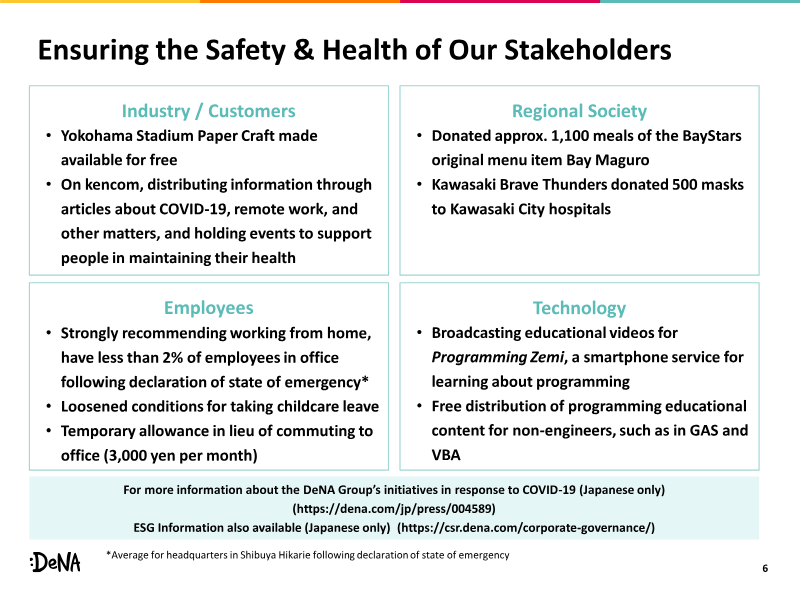
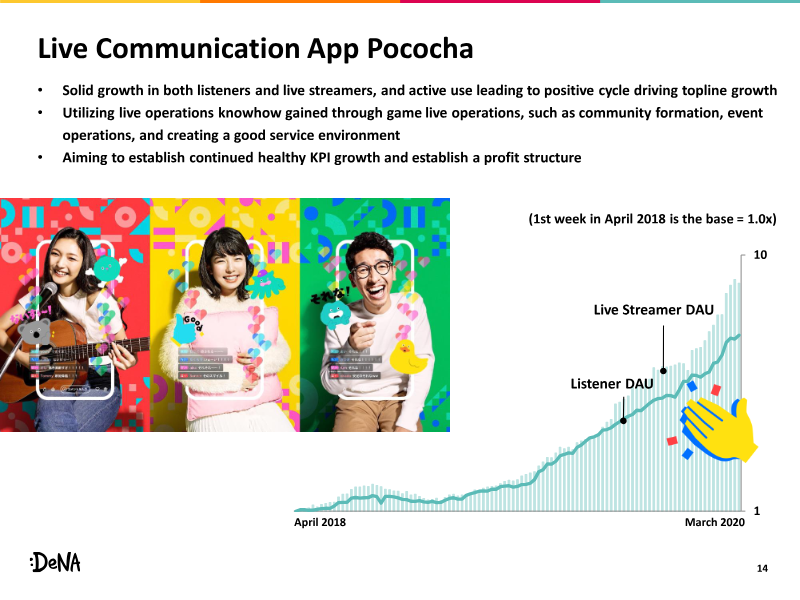
DeNA’s FY2019 operating results reflect a challenging fiscal year characterized by significant impairment losses and the onset of the COVID-19 pandemic.
- DeNA reported a significant decline in FY2019, with operating profit dropping to -45.7 billion yen compared to 13.5 billion yen in FY2018, largely driven by substantial impairment losses.
- Revenue for FY2019 reached 121.4 billion yen, a 2% decrease from the 124.1 billion yen recorded in FY2018.
- The Sports business, which includes the Yokohama DeNA BayStars, saw revenue grow to 20.2 billion yen in FY2019 from 18.1 billion yen in FY2018, though it faces significant uncertainty due to COVID-19-related game cancellations and attendance restrictions.


FY2020 Second Quarter Consolidated Financial Results (Japanese GAAP)
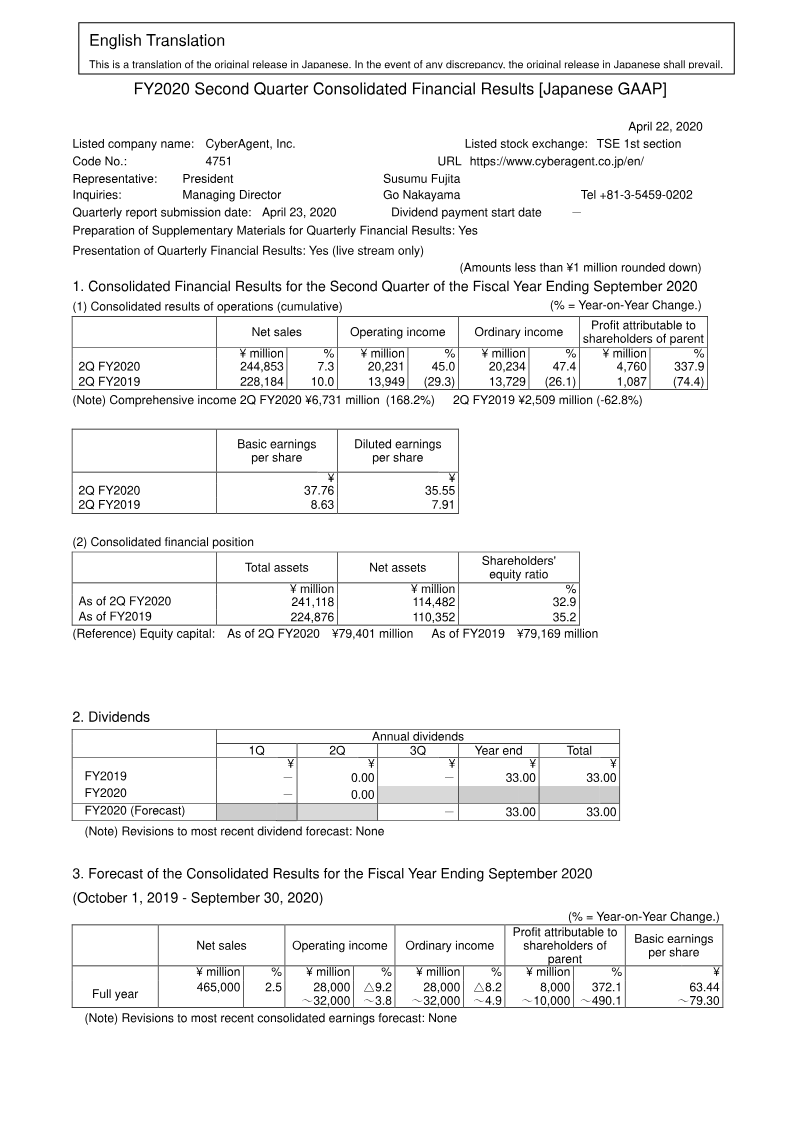
CyberAgent, Inc. reported strong financial growth for the first half of fiscal year 2020, covering the period from October 1, 2019, to March 31, 2020.
- CyberAgent reported strong H1 FY2020 growth with net sales of ¥244.85 billion (up 7.3%) and operating income of ¥20.23 billion (up 45.0%).
- Profit attributable to shareholders surged 337.9% year-over-year to ¥4.76 billion.
- The Game Business served as the primary profit driver, achieving a 45.9% increase in operating income to ¥15.56 billion due to successful new releases and anniversary events.


Summary of Financial Results for Fiscal Year Ending December 31, 2019 (Japanese GAAP) (Consolidated)
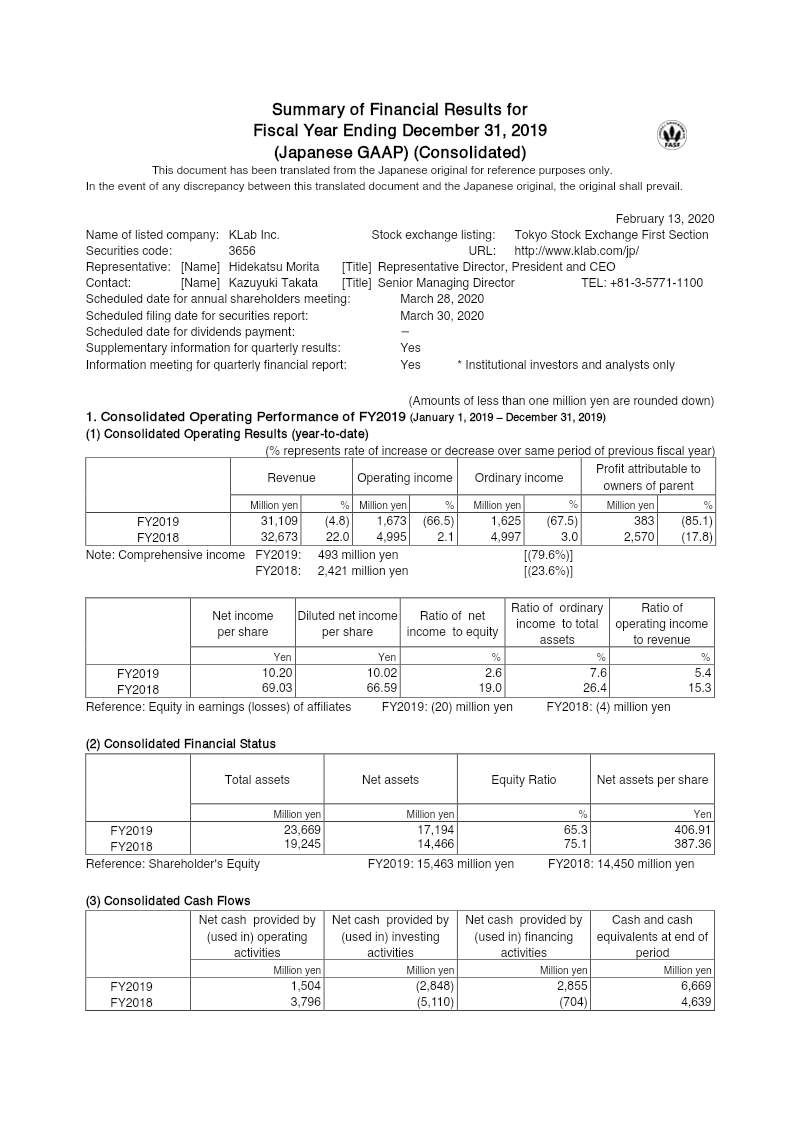
The fiscal year ending December 31, 2019, was characterized by a contraction in profitability for KLab Inc. despite the continued global strength of its core intellectual properties.
- KLab Inc. experienced a significant profitability contraction in fiscal year 2019, with net profit falling 85.1% to 383 million yen and operating income dropping from 5.0 billion yen to 1.7 billion yen.
- Total revenue for the year declined by 4.8% to 31.1 billion yen, primarily due to the natural lifecycle decline of older titles and high operational expenses.
- A substantial 1.3 billion yen impairment loss related to the title 'Magatsu Wahrheit' significantly impacted the company's bottom line.


The Game Industry of Poland: 2020
The Polish game development industry has matured into a significant global powerhouse, characterized by a diverse ecosystem of over 440 studios and a workforce of approximately 9,710 full-time professionals.
- The Polish game industry has over 440 studios and companies, with 43 of them listed on the Warsaw Stock Exchange (12 on the main floor, 31 on NewConnect).
- Between 2017 and 2020, over 120 studios closed down while over 160 new ones were established, indicating a high variability in the sector, though the rapid growth observed before 2017 has slowed.
- 11 bit studios, founded in 2009 by former Metropolis studio members, developed 'This War of Mine' (the first video game on Poland's official school reading list) and 'Frostpunk', and has 140 employees.

The Game Awards Biggest Announcements | Games ReCAP
The Game Awards serve as a critical industry barometer, functioning as a primary venue for major hardware reveals and high-profile software announcements.
- The shift toward standardized, PC-like console architecture, exemplified by the Xbox Series X, is designed to simplify cross-platform porting and provide developers with a stable baseline for optimization.
- High-profile exclusives remain the primary driver of consumer interest, with titles like Ghost of Tsushima and the Final Fantasy 7 remake serving as critical anchors for platform adoption.
- Technical performance alone is insufficient for success, as evidenced by the reception of Godfall, where poor visual design undermined its impact as a PS5 launch title.

The Prisoner's Dilemma - The Game Theory of Decision-Making - Extra Credits
The Prisoner’s Dilemma serves as a foundational concept in game theory, illustrating why rational individuals often make decisions that result in suboptimal outcomes for the group and themselves.
- The Prisoner's Dilemma demonstrates that rational individuals often pursue self-interest at the expense of the group, leading to a Nash equilibrium where both parties achieve a suboptimal outcome.
- Mutual cooperation yields the best aggregate result for all participants, yet the individual incentive to defect—driven by a desire to avoid worst-case scenarios—frequently prevents this outcome.
- In multiplayer gaming, this framework explains why players prioritize individual performance metrics like kill counts over team-based objectives.

Game Developer Resource Kit: Africa
The Game Developer Resource Kit serves as a foundational guide for aspiring and independent game developers across the African continent.
- Independent game developers can access various funding models through platforms like Fig, Kickstarter, Indiegogo, FundedByMe, and Patreon to sustain development beyond self-funding.
- Specialized incubators and accelerators such as the Indie Games Accelerator (Google Play), Carbon, Stugan, GameFounders, and Stadia Ventures provide mentorship, curriculum, and investment for emerging game studios.
- Publishing support for indie titles is available through companies like Avid.Ly for mobile, and Paradox Interactive, Humble Bundle, Annapurna, and Raw Fury for premium PC and console experiences.

Amazon Gaming Has Hit a Rough Patch
Amazon’s internal video game development efforts are currently facing significant challenges, contrasting sharply with the company’s success in film and television.
- Amazon’s internal game development division is struggling to produce hits despite heavy investment, evidenced by the cancellation of Breakaway, poor sales for The Grand Tour Game, and recent developer layoffs.
- Amazon may shift its gaming strategy toward relying on third-party publishers to populate its platforms rather than continuing to prioritize internal development.
- Twitch remains a dominant industry force, recently strengthening its esports and tournament capabilities through the $25 million acquisition of the platform Bebo.

Save Scumming - The Game Design of Save Systems - Extra Credits
Save scumming—the practice of repeatedly saving and reloading a game to manipulate outcomes or uncover hidden information—is a common player behavior that can significantly impact game pacing and engagement.
- Save scumming is a byproduct of specific design choices, occurring when games combine high-stakes incentives for perfection with generous, manual save systems.
- Developers can mitigate the friction of manual save-and-reload loops by implementing invisible, frequent restore points that automate player recovery.
- Restricting save points to prevent save scumming risks frustrating players if checkpoints are spaced too far apart, leading to excessive repetition.