1 free read left. Create a free account for unlimited reading + AI research.
Create free account
The Prisoner's Dilemma - The Game Theory of Decision-Making - Extra Credits
Key insights
6 takeaways- 01The Prisoner's Dilemma demonstrates that rational individuals often pursue self-interest at the expense of the group, leading to a Nash equilibrium where both parties achieve a suboptimal outcome.
- 02Mutual cooperation yields the best aggregate result for all participants, yet the individual incentive to defect—driven by a desire to avoid worst-case scenarios—frequently prevents this outcome.
- 03In multiplayer gaming, this framework explains why players prioritize individual performance metrics like kill counts over team-based objectives.
- 04Global challenges like climate change are modeled by this dilemma, as nations may avoid unilateral carbon reduction due to perceived economic disadvantages despite the necessity of collective action.
- 05The model is a simplification that often overlooks real-world variables such as long-term social repercussions, relationship dynamics, and community welfare.
- 06Overcoming the dilemma requires shifting the definition of rational behavior from maximizing immediate personal gain to fostering sustainable, long-term cooperative outcomes.
Ask AI about this video
Transcript
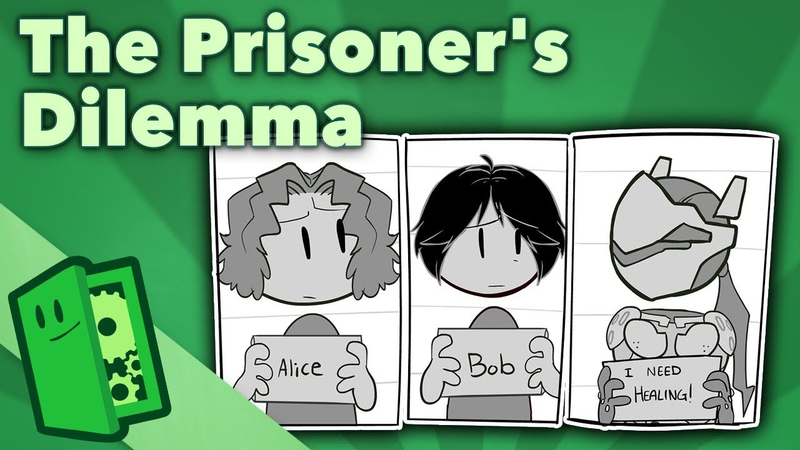
Let me tell you a story. It's a murder mystery. It's a human drama. But it's also the most famous game theory problem ever proposed. Big thanks to NordVPN for sponsoring this episode. Start protecting your internet experience today with 75% off a 3-year plan and 1 month free when you use the code extra credits at the link below. A call comes into the station. There's been a murder. The police rush out to the scene. The scene's clean. No prints, no weapon, no leads. It's time to round up the usual suspects and see who talks. Word on the street is that Alice "Two Guns" McKenzie and Bob "The Knife" Stefano did the deed. Everyone knows it, but no one's willing to go on record and help us make the case. So it's time to bring in the suspects and see if we can get one of them to flip.
Alice and Bob, or as our files refer to them A and B, are in two separate holding cells. The detectives are pressing them. They both have outstanding warrants for minor crimes, so if neither of them talk, they're both going to still get a year in the slammer. But the cops don't want that. They need a conviction, so they offer both A and B the same deal. If they rat out the other one, then the one who did the squawking gets to do the walking. No jail time and old warrants swept under the rug. But A and B know that if they both blame one another, the cops are just going to call them both accessories to the murder, and they're each going to get 10 years upstate. They have no way to communicate with each other, and they're told they have an hour to decide. Time's up. What do A and B do? Now, assuming that there's no later repercussions, like getting whacked for being a snitch, there's actually only one rational course of action here. But the reason this problem is so interesting is that that course of action is bad for everyone. And it's why the prisoners dilemma serves to provide
us with an understanding of why so often as a species or as a group, we'll all agree that a particular course of action is bad and yet proceed to do it anyway. How? Well, let's look at the prisoners dilemma more closely. You can think of it as a two by two grid with participants, choices, and outcomes. So, as you can see here, if A turns over B and B stays silent, A gets to walk out free and B gets a lifetime in jail. If A stays silent and B turns over A, then A gets a lifetime in jail and B gets to walk free. If they both rat each other out though, they both spend 10 years in prison. And if both stay silent, they both get off with only 1 year in jail. So, what's the best option for the two of them? To both stay silent. If they did that, they'd serve a sum of 2 years total. But, what's the best option for either of them individually? Clearly, to turn state's evidence. Because in this situation, it's the choice you'll never regret. If your partner stays silent and
you give up the goods on them, you get to walk away free. But if your partner tries to pin the murder on you, well, at least this way you're only going to be serving 10 years instead of a life sentence. If both players are playing optimally for themselves, then the only logical choice is to blame the other person. In fact, the only outcome where neither participant regrets their decision or feels as though they should have done something else when both players decisions are revealed is both A and B blame each other. This is called a Nash equilibrium and it's something we might talk about in detail some other day. But you can see that outcome is actually terrible, even though it's the only rational choice from each individual player's perspective. This behavior comes into play all the time in teamwork-based games. Ever play a MOBA where one player hogs all the kills? This is why. Or if you've ever been in a game where one of the DPS characters spams, "I need healing." when it's clear you should be healing the tank. The root of that behavior can be found here, too. But nowhere is this clearer than in the real world. And a great example of this
is as a group, the overwhelming majority of nations agree it would be best for the world if we banded together and did something about climate change. But let's look at that decision grid for any individual country. Your country can either opt in to lower its carbon output and pay for research or not. If you do and the rest of the world does not, then you're bearing the majority of the cost. Your economy is weaker for not exploiting fossil fuels and climate change still isn't solved because it required a group effort. If you don't and the rest of the world does, everyone else is left shouldering the cost of fighting climate change while you still get to reap your oily rewards. If you and everyone else decide to actually fight climate change, well then you had to bear some of the costs, but climate change might actually get solved. And finally, let's say you nor any other country tries to do anything at all. Well, at least you didn't have to pay any cost for trying. So with all that in mind, what's the only rational answer from an individual actor's perspective? To not try. Of course, this is terrible reasoning
and it shows the fundamental problem with the prisoner's dilemma. It's not actually how real-world problems work. It's a simplification that ends up leaving out a lot. I mean, on the positive side, there's all sorts of ancillary benefits to getting off fossil fuels or developing alternative energy technologies. Or if Alice rats out Bob, she's going to have to watch her back for the rest of her life. Which is a pretty big negative. Unfortunately, people in real-life situations do often think in terms of the prisoner's dilemma, especially when those individuals involved are actually large bureaucratic organizations like governments or corporations. Which leads us to a world where individual actors are continuously making decisions that appear to be the right one for them that really end up being worse for everyone, themselves included. But with all that said, we can actually end this episode on a positive note because a large number of psychological studies have shown that at least when dealing with each other as active individuals, as specific human beings, where we know other human beings welfare's are at
stake, we tend to choose cooperation. Perhaps it's an evolutionary holdover, perhaps it's out of some sense of fairness or community, but we do often opt to work together well beyond the bounds of any statistical noise. So in the spirit of that, please don't be an Alice or a Bob or even a bad Genji because sometimes the best possible outcome requires a decision that doesn't seem best for you. We'll see you next week. Once again, thanks so much to Nord VPN for sponsoring this episode and solving my personal dilemma of how to protect my information online. Nord doesn't log and keep your data, which means it's not being saved and shared with Big Brother. Plus, they use military-grade encryption, have 24/7 customer support, and use thousands of servers across 60 countries. One of which our internet overlords think I'm logged in from right now. Start protecting your internet experience today with 75% off a 3-year plan and 1 month free by using the code Extra Credits at the link below.
Summary
The Prisoner’s Dilemma serves as a foundational concept in game theory, illustrating why rational individuals often make decisions that result in suboptimal outcomes for the group and themselves. By analyzing a scenario where two suspects must decide whether to cooperate with each other or betray one another to secure a lighter sentence, the model demonstrates the tension between individual self-interest and collective benefit. The core finding is that while mutual cooperation yields the best aggregate result, the individual incentive to defect—to avoid the worst-case scenario or secure a personal advantage—leads to a Nash equilibrium where both parties act against their own long-term interests.
This framework explains various dysfunctional behaviors in both gaming and real-world contexts. In multiplayer gaming, it accounts for players prioritizing personal kill counts or individual performance over team objectives. On a global scale, it models the difficulty of international cooperation regarding climate change, where individual nations may perceive an economic disadvantage in unilaterally reducing carbon emissions, even when collective action is necessary for global survival.
While the model highlights the dangers of purely rational, individualistic decision-making, it is noted as a simplification of complex human interactions. Real-world scenarios often involve long-term consequences, social repercussions, and ancillary benefits that alter the decision-making grid. Furthermore, psychological research indicates that humans frequently choose cooperation over the purely logical, self-interested path when personal relationships and community welfare are involved. Ultimately, the analysis suggests that overcoming the Prisoner’s Dilemma requires recognizing that the most rational choice for an individual is not always the one that maximizes personal gain, but rather the one that fosters sustainable, cooperative outcomes.
























Comments