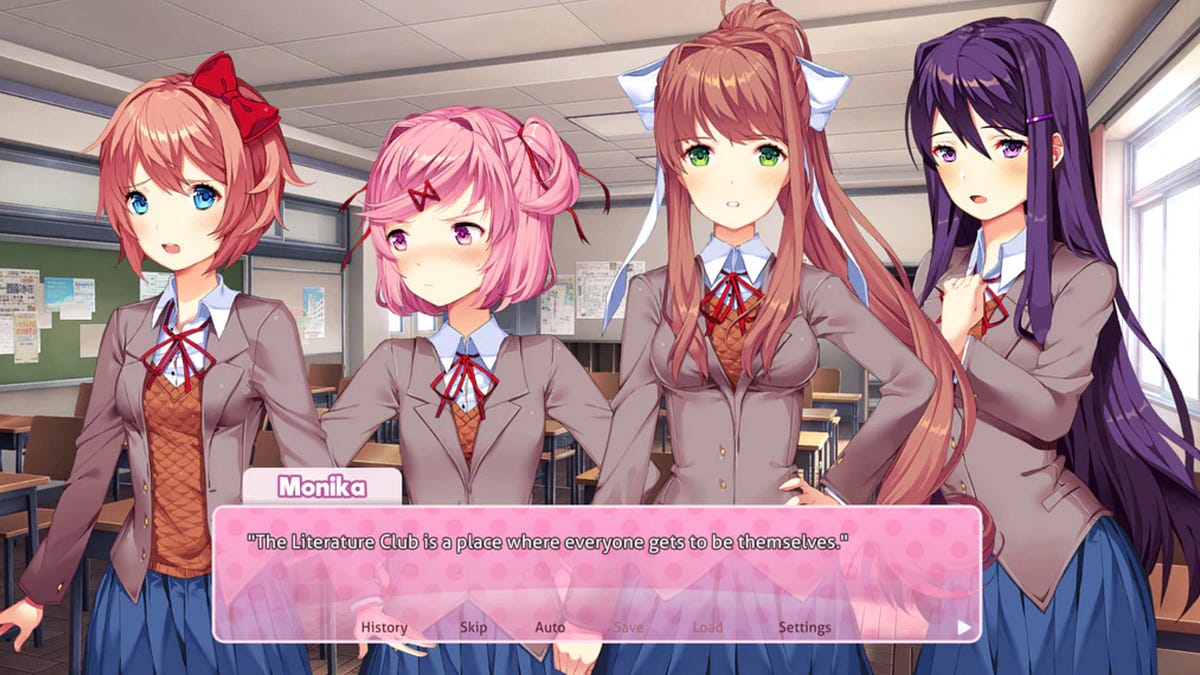
Doki Doki Literature Club
Game
Documents about Doki Doki Literature Club

Weekly Industry Round-up: Mobile Game News and Analysis
This weekly industry update provides a comprehensive overview of significant developments within the global mobile gaming sector as of September 18, 2026.
- King employees may initiate strike action on September 25 following the company's rejection of a collective bargaining agreement.
- Roblox announced at RDC 2026 that it will allow creators to turn their games into standalone apps, alongside new features for offline play and 2D game support.
- Roblox shares increased by 11% following recent company announcements.
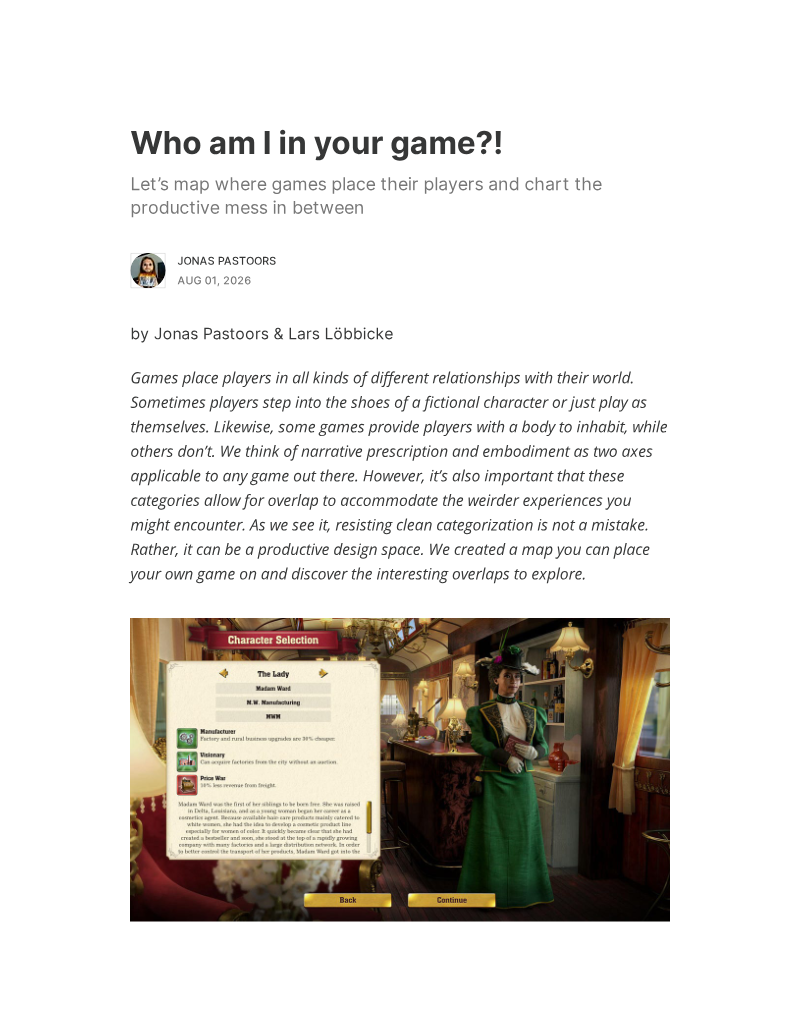
Who Am I in Your Game?! Let's Map Where Games Place Their Players and Chart the Productive Mess in Between
This article proposes a two-axis framework for classifying the relationship between players and their characters in games.
- The article proposes a two-axis framework for player-character relationships: narratively prescribed versus unprescribed roles, crossed with embodied versus abstract characters, yielding four buckets.
- Its central thesis is that overlapping boundaries between these categories are a productive design space rather than an inconsistency, since blurred categories can produce effects that clean categorization cannot.
- Crusader Kings III is cited as a case where the player acts as an all-seeing ruler who must also inhabit mortal successive bodies, creating incentive alignment that mirrors medieval monarchs' concerns.
What Discs Mean to a Publisher of Meaningful Games
The industry discourse surrounding the future of physical media has intensified following Sony’s announcement that it will cease the production of game discs for new releases beginning in January 2028.
- Sony has officially announced it will cease the production of physical game discs for all new PlayStation titles starting in January 2028.
- Major industry publishers, including Take-Two, EA, Ubisoft, Capcom, Square Enix, Bandai Namco, and Microsoft, have declined to comment on Sony's decision to end disc production.
- Zhenghua Yang, CEO of publisher Serenity Forge, maintains that physical media is a core component of his company's mission to reach global audiences that digital distribution channels may not capture.
When a Game Is More Than Just a Game: Metanarrative Integration Tools in Video Games
This paper examines "metanarrative integration tools," design mechanisms through which video games position players within ideological systems.
- The paper introduces 'metanarrative integration tools' as design mechanisms that position players within ideological systems, drawing on Lyotard's theory of metanarratives, with BioShock's 'Would you kindly' twist cited as exposing the ideological assumptions behind player agency.
- The framework separates three layers, theme, narrative, and metanarrative, and identifies five recurring tool categories: fourth-wall breaks, agency subversion, symbolic-environmental storytelling, ethical constraint, and systemic framing.
- The authors argue these tools are effective because of deliberate design deployment and timing, not merely their presence, framing them as design outcomes rather than purely interpretive effects.
From Paper to Pixels: Horrific Remediation in Inscryption
"From Paper to Pixels: Horrific Remediation in Inscryption" examines how Daniel Mullins' hybrid analogue-digital game produces horror by oscillating between immediacy and hypermediacy, drawing on Bolter and Grusin's remediation theory.
- The report argues that Inscryption solves the problem of conveying dread in a digital medium, which lacks tactile presence, by remediating the comfort of playing a card game at a physical table and then subverting that comfort into unease.
- Its analysis draws on Bolter and Grusin's remediation theory and oscillates between immediacy and hypermediacy, focusing on the cabin environment of Act One.
- The authors use Dolan's hauntological framework to explain how the game's low-poly, nostalgic aesthetic corrupts familiar formats into something unknowable.
Switch Charts Hit the U.S., Steam Hype Goes on Holiday
This analysis examines current performance trends across major gaming platforms, focusing on the Nintendo Switch, Steam, and mobile subscription services as of July 2021.
- Nintendo Switch eShop 'Popularity' rankings are now manually curated rather than sales-driven, requiring analysts to rely on download-based tracking to measure actual market activity.
- Switch consumers show a strong preference for remakes of classic titles like Legend of Mana and Tony Hawk’s Pro Skater 1+2, alongside original games featuring high-quality 2D aesthetics.
- Steam titles like Wildermyth and Ender Lilies achieved significant post-launch growth by leveraging consistent Early Access development, streamer engagement, and high user review scores.
Plus: The Post-Summer Sale (Semi)-Rush of Game Hype
This analysis examines the state of game discovery and market performance following the Steam Summer Sale, focusing on upcoming releases and recent launches across Steam, Nintendo Switch, and Twitch.
- Construction and management sims are high-performing categories, evidenced by The Immortal Mayor securing over 15,000 followers and 150,000 wishlists prior to its July 2021 launch.
- Established franchises like F1 2021 maintain strong market momentum, building on a predecessor that achieved 20,000 Steam reviews and estimated lifetime sales of 500,000 to 1 million units.
- Marketing strategies involving free 'prologues' are effective for indie discovery, as demonstrated by the traction gained by SuchArt: Genius Artist Simulator.
Plus: Who Is Steam's Long Tail Paying Off For?
This analysis examines the commercial performance and "long tail" sustainability of video games on Steam, focusing on how initial launch momentum translates into long-term sales.
- Steam review volume serves as a reliable proxy for sales, with a typical multiplier of 30 to 40 units sold per review.
- Top-tier long-tail performers like Guilty Gear Strive and Doki Doki Literature Club Plus! maintained approximately 500 reviews per week six months post-launch, equating to 15,000–20,000 weekly unit sales.
- Long-term commercial success is heavily dependent on genre-specific appeal, particularly in online co-op and tactical shooter categories, and the ability to convert initial launch hype into sustained community engagement.
Plus: Next Week's Hype Makes an Ascent to the Starbase
Analysis of Steam Hype data and platform sales charts for late July 2021 reveals a busy release window dominated by high-profile indie and mid-tier titles.
- The Nintendo Switch digital ecosystem is shifting toward free-to-play titles like Pokémon Unite and Sky: Children of the Light, which is negatively impacting the discoverability and sales performance of new premium indie games.
- Starbase and The Ascent are the primary drivers of Steam consumer interest for late July 2021, with Starbase entering Early Access backed by 40,000 followers.
- Death’s Door achieved breakout success with a 92% positive review rate, while Cris Tales underperformed commercially due to technical instability and a $40 price point.
Is This Really Happening?: Game Mechanics as Unreliable Narrator
Game mechanics, together with audiovisual modes, can function as a non-personified "Game Narrator" capable of unreliable narration.
- The report argues that game mechanics combined with audiovisual modes can act as a non-personified "Game Narrator" capable of unreliable narration, shifting focus away from games with explicit narrators such as The Stanley Parable.
- Unreliability is generated through conflicting information, forced choices offered without context, and metaleptic breaches, leading players to repeatedly reconstruct the narrative and doubt their own actions, as seen in Tales from the Borderlands Episode 1.
- In Doki Doki Literature Club, Monika is the only character who breaches metaleptic boundaries, and her unnatural cues undermine players' initial assumptions about the game world.
Companies behind it


As the documents state it.