1 free read left. Create a free account for unlimited reading + AI research.
Create free accountArticle DiGRA
1 free read left. Create a free account for unlimited reading + AI research.
Create free accountArticleDiGRA
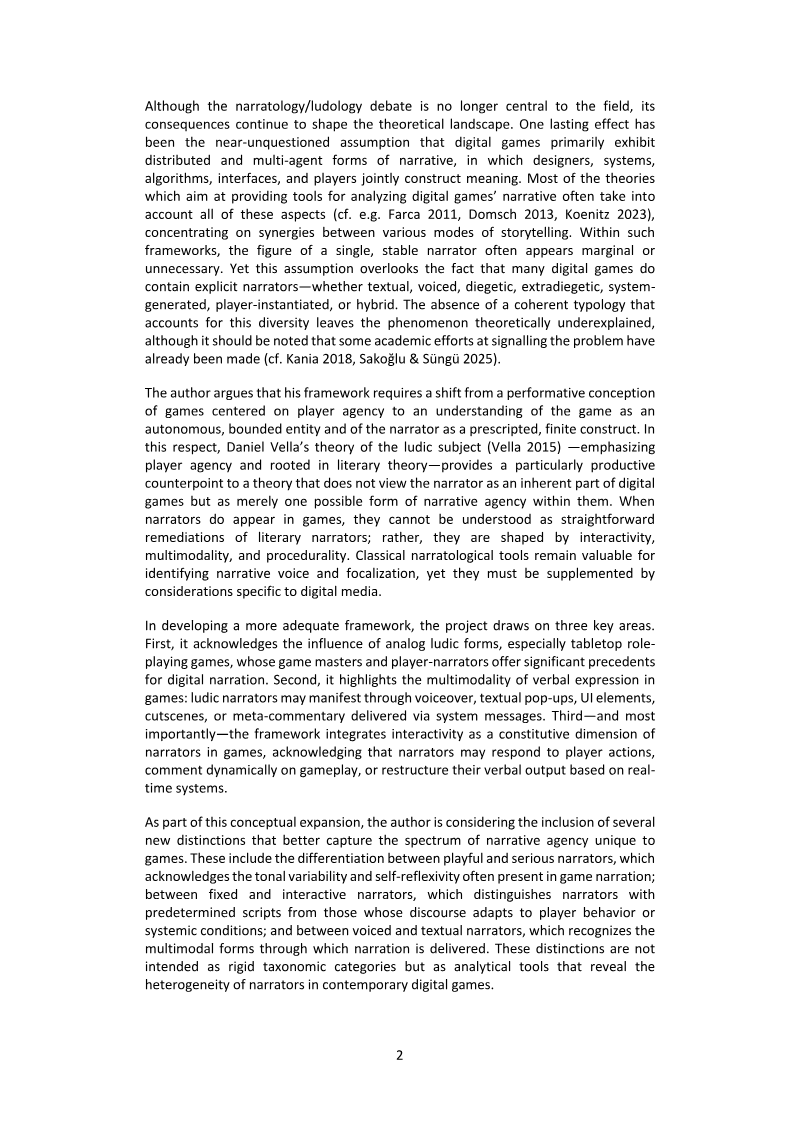
It draws on Lyotard's theory of metanarratives.
This paper examines "metanarrative integration tools," design mechanisms through which video games position players within ideological systems. Drawing on Lyotard's theory of metanarratives, the authors argue that titles such as BioShock do more than reverse a story; their "Would you kindly" twist exposes the ideological assumptions underlying the player's agency. The work builds its framework inductively through autoethnographic analysis of a ten-game corpus, focusing on five representative titles, and situates its concepts within research on reflective play, ludonarrative dissonance, and player involvement. The methodology is explicitly exploratory and subjective, and the authors acknowledge that their findings are illustrative rather than generalizable.
The authors propose a layered framework distinguishing theme, narrative, and metanarrative, and identify five recurring tool categories: fourth-wall breaks, agency subversion, symbolic-environmental storytelling, ethical constraint, and systemic framing. Illustrative cases come from Spec Ops: The Line, Doki Doki Literature Club, BioShock, and This War of Mine. A central conclusion is that these tools derive their effectiveness from deliberate design deployment and timing rather than from their mere presence, functioning as design outcomes rather than purely interpretive effects. Systemic framing receives particular attention: mechanisms such as ludonarrative dissonance and survival-driven moral pressure normalize ethically compromised behavior by making it structurally necessary or rewarded. Tables mapping the five tools across five titles suggest that these patterns recur across genres, and the authors offer a functional typology rather than an exhaustive taxonomy.
The scholarship underpinning the paper spans game studies, narrative theory, and critical media analysis, engaging with work on fourth-wall breaks, metafiction, and metanarrative in games. Its evidentiary base is qualitative and interpretive, describing patterns within a selected corpus rather than measured player responses, a limitation that bounds how broadly its claims about player experience can be extended.
DiGRA · 2026
DiGRA · 2026