windows
Company
Documents about windows

A Single Source of Truth for Measurement
The mobile marketing landscape underwent a fundamental shift following the introduction of iOS 14 and Apple’s App Tracking Transparency (ATT) framework.
- The shift to Apple’s App Tracking Transparency (ATT) framework and the loss of IDFA has created a fragmented measurement environment that requires reconciling anonymous SKAdNetwork data with traditional MMP reporting.
- Implementing a conversion studio allows advertisers to automate the encoding and decoding of conversion values, enabling the measurement of revenue, engagement, and funnel events without frequent code updates.
- Advertisers can extend post-install measurement windows up to 72 hours to capture more granular user behavior data within the constraints of privacy-centric design.

Panel: UA & Retention: How to Pick the Ideal Tactic for Your Target Demographic
Effective user acquisition and retention in the mobile gaming sector require a strategic alignment between monetization models and specific payback windows.
- Developers must align monetization models with specific payback windows, prioritizing rapid returns for hyper-casual titles and long-term lifetime value for midcore games.
- Success in user acquisition relies on a formalized, iterative approach to creative testing to identify and scale concepts that resonate with target demographics.
- Machine learning and AI are essential for automating bidding and hitting return on ad spend targets, though they require human oversight to manage channel volatility and performance tracking.

Curated Panel: IDFA Effect' on UA Performance & New Changes for ASO
The mobile gaming industry is undergoing a fundamental transition from granular, device-level user acquisition to an aggregated, privacy-centric model following the implementation of Apple’s App Tracking Transparency framework.
- The implementation of Apple's App Tracking Transparency (ATT) and IDFA deprecation forced a shift toward probabilistic attribution and the use of Apple's SKAdNetwork (SKAN) to maintain user acquisition measurement.
- To address limited data visibility, advertisers are utilizing Conversion Studio tools to measure flexible activity ranges (e.g., levels 1-3) and sequences of events rather than relying on a single 24-hour window.
- Game developers are increasingly shifting UA budgets toward Android and exploring alternative acquisition methods, such as web-to-app flows using landing pages and smart banners to bypass iOS tracking limitations.
Superstar Session: Key to Success in Post-iOS 14 Advertisements: SKAdNetwork Data Reconciliation
The implementation of Apple’s App Tracking Transparency policy has fundamentally restructured the mobile user acquisition landscape by restricting access to the Identifier for Advertisers.
- The mobile user acquisition landscape has shifted from deterministic tracking to the privacy-centric SKAdNetwork framework following Apple’s App Tracking Transparency policy, which saw opt-in rates reach only 24 percent by mid-2021.
- Developers must pivot to aggregate analysis and channel-level monitoring because SKAdNetwork introduces reporting latencies of 24 to 48 hours and masks granular data through privacy thresholds.
- Long-term user value prediction now relies on the strategic use of conversion values as a proxy within the restricted tracking windows provided by SKAdNetwork.

Superstar Session: Seize the Moment-Seasonal Changes in the Asian Market -The Best Times to Monetise
The Asian mobile gaming market operates on a distinct seasonal rhythm, where revenue and user acquisition are heavily influenced by cultural festivals, regional shopping events, and academic calendars.
- Align live-ops and advertising spend with peak regional windows, specifically Chinese New Year, Japan’s Golden Week, Korea’s monthly pay cycles, Ramadan, and Songkran.
- Avoid launching new titles during intensive academic periods, as these times consistently correlate with reduced player engagement.
- During high-traffic e-commerce periods when advertising inventory costs spike, shift focus from user acquisition bidding wars to retention and in-game content to capture spillover traffic.

Easy Modes Aren't Easy - Designing Dynamic Difficulty - Extra Credits
The design of difficulty settings in AAA action-adventure games is evolving from simple health and damage adjustments toward nuanced, accessible, and customizable experiences.
- The industry is shifting from binary difficulty tiers to granular, customizable gameplay settings that allow a broader audience—including casual players and those with disabilities—to engage with AAA action-adventure titles.
- The Last of Us Part II serves as the current industry benchmark by offering a comprehensive suite of accessibility features, including combat modifiers, motor-skill assistance, and puzzle-bypass options.
- Modern design strategies prioritize adjusting mechanics like enemy aggressiveness and reaction windows rather than relying solely on traditional health and damage scaling.
Superstar Session: Hypercasual in 2021: West & East
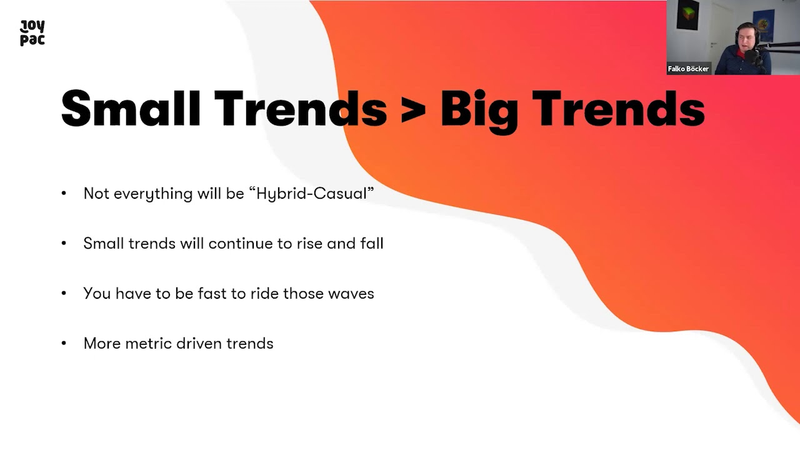
The hypercasual gaming sector is undergoing a structural transformation as it moves away from simple, rapid-fire releases toward a model defined by higher production values and long-term engagement strategies.
- Hypercasual gaming is shifting from simple, rapid-fire releases to a model emphasizing high-fidelity 3D visuals and meta-game elements to combat market saturation and improve long-term retention.
- Rising user acquisition costs and Apple’s IDFA privacy changes are forcing publishers to pivot toward creative-led targeting and tournament structures to maximize player lifetime value.
- The industry is undergoing consolidation, with publishers prioritizing long-term partnerships and the acquisition of superstar studios to secure a consistent content pipeline.

Panel: Lessons Learnt in Game Monetisation
Modern game monetization is defined by a strategic shift toward hybrid models that integrate in-app purchases, subscriptions, and advertisements to accommodate diverse player behaviors and genre-specific requirements.
- Modern monetization relies on hybrid models that integrate in-app purchases, subscriptions, and advertisements to cater to diverse player behaviors rather than relying on universal industry benchmarks.
- Developers should prioritize iterative testing and data-driven insights to balance complex in-game economies and maintain long-term player retention.
- Machine learning and automated bidding systems have replaced manual waterfall management to improve the precision of user acquisition and targeted offer delivery.

Jumpstarting Your Creativity: From Hobbyist to Professional
The transition from hobbyist to professional game developer is often hindered by a cycle of starting ambitious projects, encountering technical hurdles, and losing motivation before reaching completion.
- Prioritizing the completion of small-scale projects over ambitious, complex ideas is the most effective way to break the cycle of unfinished work and stalled professional growth.
- Finishing projects is the critical metric for development, as evidenced by a shift from zero output to the release of eight projects over a two-year period through disciplined completion.
- Developers should implement strict time constraints, such as two-day or two-month windows, to force the completion of projects and prevent scope creep.

Mobile Marketing for Card Games | Growing WildCard Games Ultimate Cribbage (UA Coffee)
Scaling a niche mobile title like Ultimate Cribbage requires a disciplined approach to user acquisition that balances aggressive automated bidding with rigorous creative testing.
- Scale niche titles by using a tiered geographic strategy, starting in low-cost markets like India before expanding to higher-value regions like Canada and the United States.
- Target specific D90–D120 payback windows to ensure long-term profitability rather than focusing solely on short-term acquisition metrics.
- Diversify marketing channels beyond Facebook’s automated bidding to avoid unpredictable costs and fragmented data that obscure true player lifetime value.

User Acquisition Under Crisis | UA Coffee Talk
Effective user acquisition during periods of economic volatility and environmental crisis requires a fundamental shift from long-term historical modeling toward a conservative, short-term focus on immediate performance metrics.
- Shift user acquisition strategy from long-term historical modeling to a conservative, short-term focus on immediate performance metrics like day-three or day-seven return on ad spend (ROAS).
- Avoid reactive, across-the-board budget cuts by segmenting performance data by geography, platform, and specific game design to identify pockets of sustainable growth.
- Maintain a proactive, competitive spending mentality during economic volatility to capture market share while competitors retreat, rather than defaulting to purely defensive budget reductions.

Last of Us Part 2 Delayed Indefinitely | Games ReCAP
The indefinite delay of The Last of Us Part 2, originally scheduled for a May 2020 release on PlayStation 4, serves as a primary case study for the logistical challenges facing the video game industry during the COVID-19 pandemic.
- Sony Interactive Entertainment indefinitely delayed the May 2020 release of The Last of Us Part 2 due to the logistical inability to guarantee a synchronized global launch.
- The decision to delay was primarily driven by disruptions in physical distribution chains and concerns that global internet infrastructure could not support a purely digital-only rollout.
- Naughty Dog confirmed the game was in its final stages of development, focusing on bug fixes, when the pandemic-related constraints forced the postponement.