1 free read left. Create a free account for unlimited reading + AI research.
Create free account
Superstar Session: Hypercasual in 2021: West & East
Key insights
7 takeaways- 01Hypercasual gaming is shifting from simple, rapid-fire releases to a model emphasizing high-fidelity 3D visuals and meta-game elements to combat market saturation and improve long-term retention.
- 02Rising user acquisition costs and Apple’s IDFA privacy changes are forcing publishers to pivot toward creative-led targeting and tournament structures to maximize player lifetime value.
- 03Developers are increasingly targeting the Android ecosystem as a strategic hedge against iOS-specific tracking restrictions and monetization challenges.
- 04Operational agility remains critical, with standard development cycles for hypercasual titles compressed into two-month windows from initial prototype to final release.
- 05Success in Asian markets like China, Japan, and Korea requires navigating complex regulatory environments, including China’s specific ISBN licensing requirements.
- 06The industry is undergoing consolidation, with publishers prioritizing long-term partnerships and the acquisition of superstar studios to secure a consistent content pipeline.
- 07To ensure reliable performance data, developers must maintain a minimum of 100 daily installs over a four-to-five-day period, excluding weekends and holidays to avoid data volatility.
Ask AI about this video
Transcript
i'd like to welcome to the stage our next speaker now um falco boca is actually representing joypack who's the sponsor of this track so uh if we uh like falco to the stage hi hey dave how are you i'm very well how are you doing good good good ready to go uh great well look i'm going to um retreat into the background what we'll do is we'll hand over to you you're going to give a talk about hyper casual in 2021 west and east if anyone in the audience has questions for falco please drop them into the q a box i'll come back at the end take your time falco we're doing okay for time this morning i'll come back at the end uh and help curate those questions for you but in the meantime i'll fade into the background and um yeah take it away perfect yeah let me start by sharing my
screen thanks dave and welcome to the hyper casual in 2021 west and east talk um this is the talk where we look into our crystal ball maybe just the magic eight ball to kind of see what is going to happen um in this year maybe it's just like what i think or we at joypeck think is going to happen in this year um but yeah let me get right to it quickly to get this out of the way my name is falco i'm coming up on 14 years in the games industry and since 2016 i'm purely doing mobile games but i've always been around partially mobile games always free to play since the beginning and i'm at joypack i'm the senior publishing manager so i'm kind of the first contact for developers from like meeting me at conferences digital or in person signing the contract but also post that i'm pretty much the person that as a as a studio you will talk to at least one of the one of the people that you will talk to it um at joypack i'm a gamer through and through i don't um
differentiate between any console pc mobile i love all kind of gaming my favorite game is shadow of the colossus if you haven't played that check that out but a little bit about joy packs we understand a bit our background where i'm coming from with a lot of these opinions is we are a hyper casual publisher solely focusing on mobile hyper-casual games we have offices in beijing and copenhagen the beijing office being slightly bigger originally we came from transforming western games to the chinese market adapting them releasing them um advertising them there but these days we're a fully global publisher we have more team members across europe and and asia mostly to be in direct contact with the developers there overall we have a about 150 million downloads over our whole portfolio we had multiple games on the top one download charts on ios both in the us and china so for us we try to take a real global approach
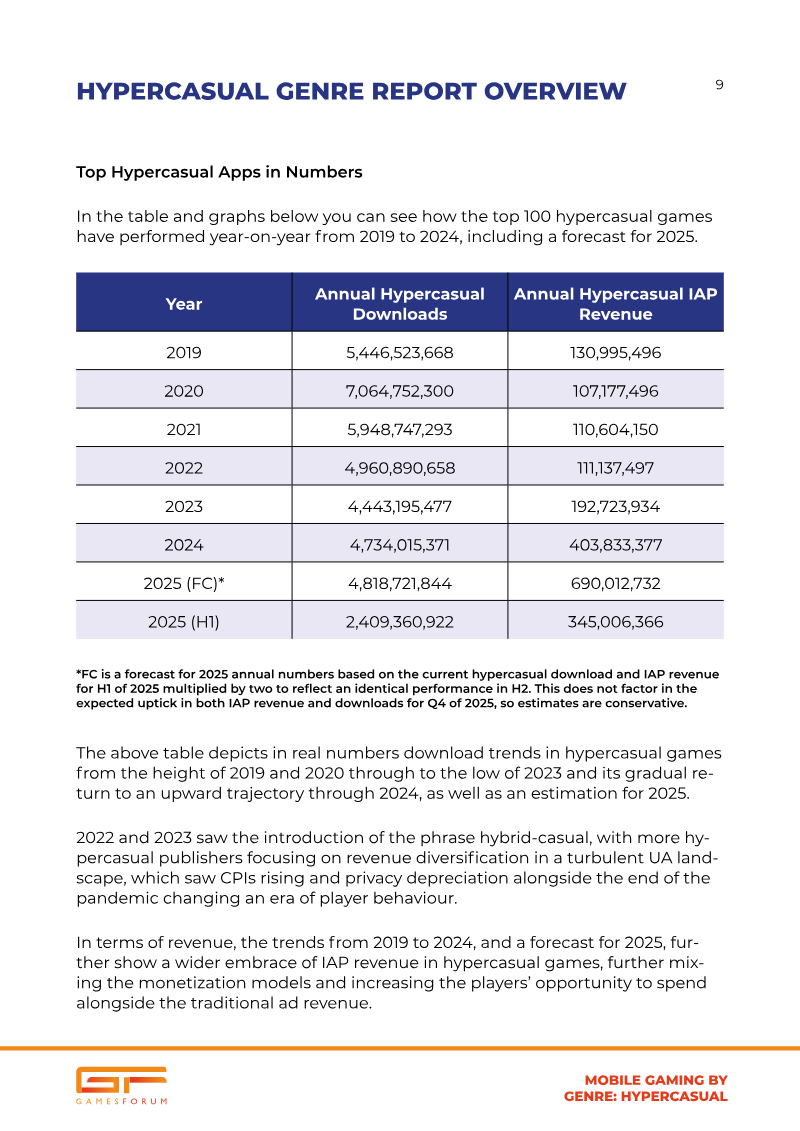
but then it's hyper casual so it's not about just a single game so we had more than 10 i think we're coming up with 15 games that uh reached top 50 positions in either one market or the other i'm not counting anything double that that managed to do that in both markets talking a little bit about 2021 we have to take a look back at 2020 because i think there are a bunch of trends that already started that we're going to see continue um towards this year but first i want to address something that actually happened at the end of 202 2019 where there were a bunch of people that says oh this is it for hyper casual right um the cpis are rising it's getting more competitive there's no way this is going to continue it's just companies pushing money around to each other no real money comes into the ecosystem and um the games really have to change in a major way to bind people long enough to make back those cpis but then that is definitely not what happened in 2020 right 2020 was a crazy year for mobile gaming downloads
doubled in q1 2020 compared to what we saw in the last quarter of 2019 and in march we had like a record-breaking week of globally 1.2 billion downloads for of of mobile games and hyper casual games continue to be a strong big part of that of course this is partially due to the pandemic that helped uh to put it that way with um people try to look for a distraction right you're stuck at home and a free snackable mobile game is of course a perfect way to kind of distract yourself spend a little bit of time doing something something else and that is one of the main reasons why we saw across a lot of digital media but mobile games specifically a huge uplift in download specifically through the february march period it peaked a bit and then depending on the country it went back down not down to the previous levels we had in 2019 and depends a bit on the country how fast it tapered off but we are still at a at a pretty
healthy level for for downloads and hyper casual went through that year without any major problems i would say continue to a large part like 2019 even grew through that uplift it didn't lose any share like percentage-wise i would say but what we saw in 2020 is that the quality bar is still rising for hyper casual games if you think way back 2017 uh 2018 maybe i saw a lot of hyper casual games that were very simple right very simple 2d graphics sometimes or if it's 3d simple geometric shapes anything that's fast to do and after after that we saw more and more production values go into these games i think these days doesn't really matter what any kind of any kind of experience that you can have at home that's somewhat satisfying you can put 3d after it look at it at the app store and you'll find something um that has a realistic uh depiction of
that hobby or or thing that you do in 3d and beautifully rendered 3d but coming to 2021 there are a couple topics that i want to talk about and i want to start with idfa because it's still right now in everybody's mind for people that don't know idfa is the identifier for advertisers which on ios platforms allows you to identify users very specifically across different apps and environments and that helps you to advertise towards specific players that you're trying to get to and there is an update um announced that this idfa will not necessarily be removed but whenever app will use it the user will get a pop-up and will be asked if he wants to be tracked because it's a move for more privacy from advertisers in your mobile ecosystem and we suspect as many others that 90 of players at the very least will say no to this kind of tracking it's already possible in ios but you really have to deal dig into some menus to get there
so the question is how will this affect hyper casual games i personally think it will not be a huge impact right away because of the kind of targeting we do in hyper casual though the way hyper casual gets these super low cpi's is of course simple very easy to understand gameplay but also kind of relying on a very wide audience and metaphors that are picked up by pretty much everybody around the world or at least in one geo and when you're aiming at male female 18 to 65 you you don't really care about like finding specific whales like a mid-core game or even more advanced casual games would right so the direct impact in our ua i think will be fairly minor at first because we'll still continue to across hyper casual as a whole not only joy pack continue to aim our marketing as as wide of a target audience as possible however the problem is a secondary one because will the app money go away with the idfa
tracking because um i mentioned before one of the criticisms of hyper casual is that there's a lot of money pushed between different publishers if i um advertise a game for another another casual publisher i make money by showing that ad the user starts playing his game and then i'll pay that publisher to to show my ads eventually this will run out and not work there needs to be fresh money coming into the into the system and mid core games more advanced uh puzzle casual games are usually where this money comes from so if if those guys are hit by this idea of a change a lot and they don't spend a lot of money the amount of money that you can make by showing ads to your players will go down significantly and then you have to see can you adjust for that is it possible to to compensate with brands or other ways or um do you have to change the games themselves to to be ready to keep people around a bit longer to pretty much hire the ltv the lifetime value of your users one of the things that i think companies
would deal with this or try to deal with this is more targeting through creatives so i also heard this in some great panels during the conference that if you can't look for a specific player type through the programmatic portion before when it picks who's showing the ad to then you can maybe do that through the creatives the videos the ads that you show to the people themselves by presenting gameplay in a specific way that is especially appealing to the people that you want to join your game maybe it becomes less attractive to to twist games a little bit sometimes you see games that that really don't work the way that they look in the ads and it's going to be interesting to see if that still works because in general that's good if you have a good pre-selection because the more of that pre-selections download the game it doesn't really matter if it doesn't if the game is not exactly what they're expecting but we have to see if this still is true in an environment where you where you have to target really wide and i think this kind of advertisement targeting
through creatives at least some of the techniques that are used there could trickle down towards hyper casual publishers as well so they use that a bit more once that experience spreads throughout the user acquisition community android might become a new battlefield as well we already see a few publishers of midcore and more advanced puzzle games casual games moving over to android because right now um they're trying to find like a a second a second base or at least kind of trying to figure out that market more so if idfa goes away on ios that they can prepare or are already prepared of making some money and more money in that ecosystem to kind of like account for for that and it's going to be interesting to see if hyper casual publishers then follow the money because as i said they need this other environment to live off um like they're not that great at surviving by themselves so if all the money moves over to android you might see a lot of hyper casual publishers focus a little bit more on the android market that they did
before at least until android implements the same privacy restrictions so there's already rumors that google who are very involved in the marketing process of course so it's not something that they're gonna gonna be the first and foremost company to implement something like that but um there are rumors that they will follow suit after after apple implements those changes because they need people to be in the google and android ecosystem so having people um perceiving apple as the main or this is the privacy base like if i want my private data connected and not be hassled by advertisers i going apple i don't think that google will will let that happen for a very long time it's pretty likely that eventually they will they will implement a similar system and then it depends on how well are you already set up in google to kind of protect yourself or maybe you have learned how to how to do business on apple um
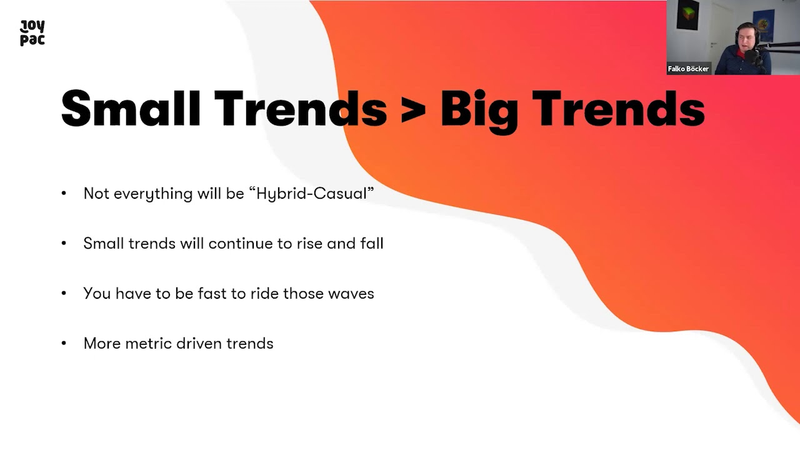
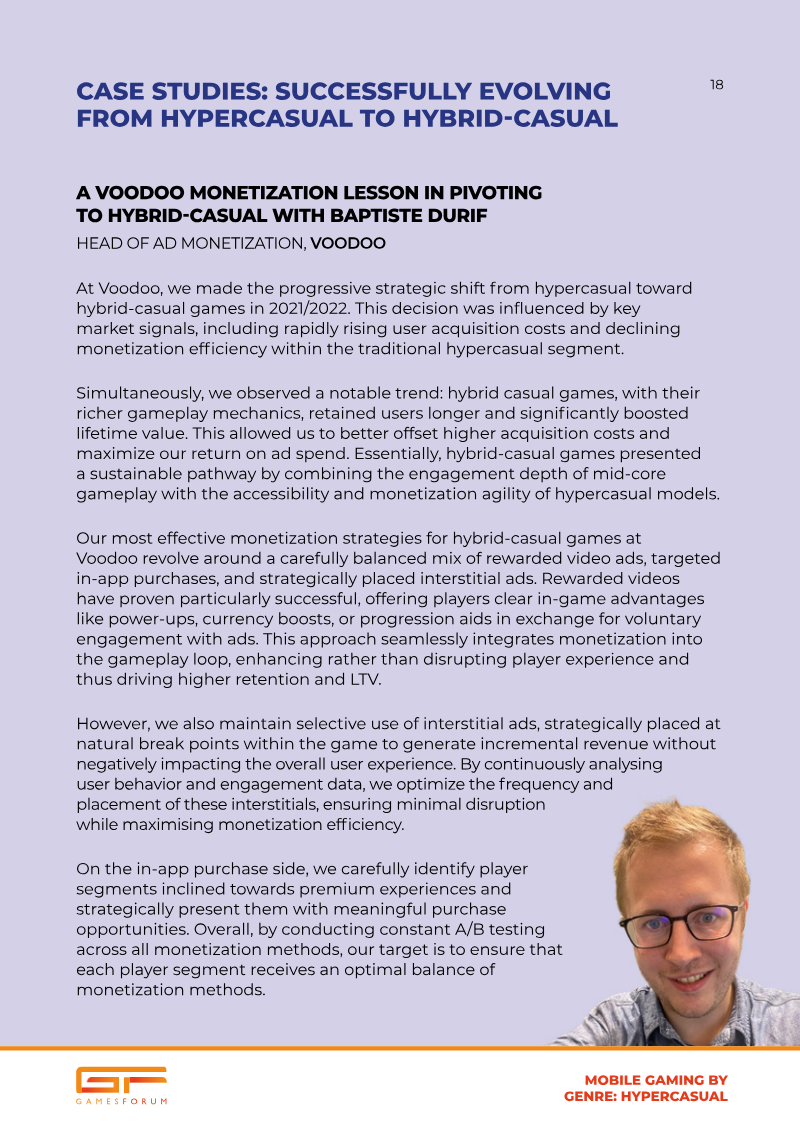
without the idfa by the time that google implements it as well so it gives you maybe a little bit of a time buffer when it comes to general trends i think we'll see a lot of small trends and very few big trends um not everything is going to be hybrid category right that's that's what we heard last year i remember pocket gamer london in early 2020 um the last still physical physical conference i attended i met a friend from a different uh publisher and he said this was really archero the conference like every second game i saw was in our tarot clone and um we didn't really see a lot of art tarot clones high in the behind the charts or other games that i would describe so much as hybrid casual as as that game is so like a very advertisable core mechanic but then very in-depth rpg systems um item systems and stuff like that build around it we see a lot of these things in small parts coming up in in hyper casual games because people want to keep people a little bit longer raise
the ltv a little bit but it's not like the whole genre suddenly completely changed we saw all kinds of of different trends that rise and fall kind of like the tides one week it's all about games with babies or pregnancy pregnancies in them the other week it's about word trivia games we see a lot of changes and i think those going to continue throughout this year as well and the big change this year is you have to be faster to write on those waves for a while it was possible to just look at the chart see what was rising through the top 50 2010 and make a game not not copy a game but make something that was um similar in setting and v maybe in core mechanic and put a spin on it and you could have very good success with that but these days these trends are jumped on so extremely quickly every developer we work with when we put out a prototype we generally get or the developer gets two three contacts by by other publishers saying like hey we saw that you that you're testing this prototypes looks looks interesting can we work on this
together and they're getting very sophisticated following the right accounts using the right tools to keep track of that and then either they work with that developer or they start putting out their own prototype so it was not rare for us to have a prototype that tests very well and while we're working on the game we see two very similar prototypes from other publishers popping up so i think if you want to participate in these in these small trend periods you're going to have to have something that is that is similar or you have to have something that is already being worked on before that game really climbs to the top of the charts what we see though with those things i i think will be metric driven trends kind of like part of the arterio things that we saw it is something that we've seen throughout the history of hyper-casual um one example is that we have everything level based now very rarely you see endless games which used to be just the norm for almost every hyper-casual games because it's just a good opportunity to show ads right you don't want to stop the
gameplay flow just randomly in the middle and and show a person an ad or even the option to watch a rewarded ad most cases people won't do that um until the end of like a session or at least of their that level that they're playing right and i think we're going to see a lot of these trends so a lot of little things that people implement to either increase play time or retention to keep people around a little bit longer and maybe watch a few more ads one thing and we did this in a game recently as well is to have like a battle royale or fall guys-esque kind of tournament set up where multiple levels are connected through like a meta message even if that's not really what is happening technically behind the scenes that can be very helpful um to keep people around so i'm expecting a lot of these trends especially when we see some of the shake-ups like idfa happening to accommodate for that a little bit then asia of course for us as a mainly chinese company is extremely important because it's also
still a growing market right we see the western market very competitive almost saturated but in asia you don't see that many hyper-casual games in the charts but you see more and more and more it's not like the west where we see more than half of the top 20 being hyper-casual but every fourth game at least in china korea japan right now is a hyper casual game and we expect that to grow more and more throughout the years but we also expect the local competition to rise to that we have a few publishers us included that have been working mostly with western developed games but we also did a lot of japanese developed games in china for example and we see a lot more developers from the region picking up on on hyper casual as a as something they could be good at and right now i would say they're finding their own style of hyper-casual games things that are twists on established hyper-casual games but specifically for the asian market one example i have here pictured is our
game tofu girl by usaya in japan and yeah it's a fairly known mechanic it's like a stack game you jump this little girl up the tofu and you would say like 2d graphics tofu i can't really see that being big in the west and you'd be right it was relatively successful for us in the west but in the apec region the game has over 20 million downloads for us it was extremely successful there we're very happy with it um and it shows kind of like how people adapt local things to [Music] um local topics that people there understand to get the same interest that you would in the west right because hyper casual games are often based on things that everybody kind of understands so after a while we expect those studios then to mature to topics that are more global that are more aimed at people around the world and then developers will have a bit more competition for asia for the western market as well there's one big sort of democrats if you want
in china right now which is the isbn number it's something that is required for all games that have in-app purchases in them it used to be only android it wasn't enforced on ios until a few months ago it basically means that you need a government license to publish any game that has in-app purchases in it and getting this license is a long partially expensive process that can take six to 12 months to launch a game and right now everything that is purely ad based is excluded so hyper casual games can very successfully operate in the in the chinese market outside of that system or in that gray zone that they happily occupy but there are some rumors that the government is now looking at extending this to purely ad monetized games and of course that would be a very big blow in the chinese market specifically which is a huge market on par with the us market for uh potentially for for any given hyper casual games so that is something to to watch out for if
that's going to happen and i want to talk a little bit about like closer cooperations between companies a trend that we already started seeing in 2020 we did it with our hyper fuel program is to set up longer relationships with developers right rather than picking one game but we still see that publishers looking for that one game with a good kpis but we see a lot of publishers now forming longer lasting relationships with developers where they take on some of the risk involved in financing these games and testing multiple prototypes in succession right and we did that with a studio called umami games from denmark recently very successfully over a few months the process just improved from prototype to prototype until last week we had abc runner reached the top one charts in the us that is not just a one-off success that was month of work of like improving from prototype to prototype getting better and faster working
together to get to this point and we don't expect it to end there we think that we'll now be able to recreate this the success with the studio and we have other studios that we have this this relationship with so i think they're going to be some what we would call superstar studios like teams that are really thought after that have a couple successes under their um on their belt where publishers will try to get these relationships very specifically with these studios which might make it more difficult in 2021 for new and upcoming hyper casual studios to find a partner at least for a partnership like that that's a bit more reliable because people will be looking for whoever can produce hits on a more consistent basis because hyper-casual publishers want and need a consistent output of of new games because the games are um not living extremely long in the in the app store like other genres would and i think eventually this will tip over into more internal studios with
a lot of publishers so either by building new studios completely or acquiring studios that they already have a working relationship with and we're already seeing that and started seeing that in 2020 more and more and i think that's a trend that will intensify during 2021. so to close it out i don't think hyper casual is going anywhere we have a couple of potential shakeups idfa and google's reaction china's isbn regulation but hyper casual is set up to evolve and adapt to these changes and that's what it's always done if you look at hyper casual now versus two years ago um it is now very different but it's not like it suddenly became something completely a completely different genre just adjusted in little little elements and i think this is something that we're going to continue seeing the genre will keep changing and you have to keep up to date with it you have to find creative solutions for for problems or just to improve the games overall and um
yeah that is what i think we're gonna see through 2021 and that is it for me if anything like this sounds interesting you want to get in touch feel free to send me an email at falco joypackgames.com and happy to get back to you also try to hang out in the discord a little bit and yeah good luck with your hyper casual games on 2021 thank you very much falcao round of applause from all of us here uh as you say i think the last event that i went to was london in 2020 so that's probably when i saw you last so hopefully we'll get back to that soon but in the meantime you'll have to imagine everyone giving you a round of applause we've got a few minutes before our panel comes on and i can see there's six questions here so do you mind taking some of these perhaps if i um so um let's dive in here we've got an anonymous attendee asks um so uh in android specifically um uh do hyper casual um i guess the question here is uh so the question is do hyper casual do
user acquisition in apac countries like india are they seeing positive uh return on ad spend here um gonna guess that's a question about territories what do you make of that um yeah so india is becoming more and more interesting to a lot of um to a lot of companies it's not high on our priority list yet because i mean we come from a purely asian standpoint now we expanded into the u.s quite successfully so on a high on our list are now um some major european countries right german versions french spanish italian versions and so on um and potentially the south american market but it's becoming more and more interesting and i see a lot of hyper-casual publishers starting to to launch their games there it's also an extremely active scene for hyper casual development so what we're seeing is a bunch of good developers uh with very high quality games from there and i think that can be a big advantage because they understand that territory and usually i when people ask me like what to avoid in games is not not making games for another territory
that you want to be in right if you're a european studio don't make a game for the chinese market because they're better chinese studios that understand that market better and i think that is where a lot of potential lies with the with the indian market specifically because those studios understand hyper casual games very well so they have a bit of a head start oh that's great thank you so another another attendee asks uh will hyper casual ua depend more on source bidding in the future is it enough for scale yeah i'm not a hype i'm not a ua expert so i'm not 100 sure but um but bidding header bidding is something that is was kind of like a buzzword in in 2020 and you see a lot of networks switch over to that um so i think it it's going to um spread even further but i'm not i'm not deep enough in that to kind of um say how much that would work with with the idf a changes and some other changes we're going to see in 2021 specifically
that's interesting thank you so another attendee asks um what is the southeast asia market like viper casual ios and android are there any trends there in southeast asia um i don't think there's any kind of like game specific is still something that i maybe forgot to mention right now most of the hyper casual games that are big in these markets including china and japan and korea are um western developed hyper casual games so the same game that you see um that you see popular in the stores in the west is usually also pretty high in the asian market and that's still the case in in southeast asia there is also again a very active development scene i think a lot of uh areas that you didn't really have on your on your ticket for like big console productions or even like some of the bigger mid core productions they just thrive in hyper casual right vietnam has become a hot spot but we see cool stuff coming out of malaysia and singapore as well um so i think
partially similar to a um to india with the advantage that usually english goes in a lot of these countries as well so you see a lot of games that come out there we'll see some studios that will make use of the knowledge of the area and the the culture there to have games that specifically appeal to those players just before we move on to our next question while we're talking about territories someone's asked about um latin america as well countries like brazil is that a growing market for hyper casual what's the the roi right there yeah i mean it's um i don't think it's like again it's like the the highest on the list but um you can cover a lot of people with a spanish and portuguese version of a game um so yeah i think it's interesting by by the amount of people alone it's not the strongest ios market traditionally as far as i'm aware but with android being more and more of a trend in hyper casual i see that i see that growing quite significantly it's definitely a market that most hypercasual publishers don't just leave out or anything like that it's
still worth going into them a little bit and optimizing your ua for it a little bit the uh i was interested actually myself just something that you said during your talk about how um publishers can be quite uh proactive in seeking out developers in this area it was interesting that you said that our first speaker of the day spoke a little bit about developers approaching publishers with their games that they're developing whereas you actually implied that there's a the traffic goes another way sometimes that hyper casual publishers are keeping their eye out on what's being tested in our second developers is that common uh yeah i think it goes both ways definitely we'll get contacted by a lot of developers as well um but that goes to those hype the superstar studios that i mentioned where people like really zone in on studios that they saw like either had a couple successes um and pretty much every hyper-casual publisher opens every single hyper-casual game to see which logo pops up because often that's the that's the easiest way to find out um who developed the game or people that they worked on on
prototypes in the past and thought it was very interesting but maybe the studio wasn't quite there yet or it just didn't have that one idea specifically when publishers were looking only for the single game and then they follow started following all their app store accounts of every single employee that has one to see whenever something is pushed live to get a quick glimpse at that discuss hey should we get this from those guys or should we make uh something ourselves um to kind of yeah see as early as possible what's going on in the market and there are a couple of websites and even instagram channels now that are uh made to like show hey these are the prototypes being tested um and people like see trends coming up there as well that's interesting that's interesting actually talking about um types of kinds of game i know that um uh you know we spoke a lot about ios and and android apps and i know what joy packs speciality is here but someone's asked a question uh why aren't hyper casual studios leveraging facebook more as a gaming platform it has a huge potential built-in reach uh what do we think about facebook as a place for gaming yeah i
think um ios is still the dominating um platform facebook is mostly used as a user acquisition channel here there are a couple other channels overall that are interesting the same goes for html5 in asia for example platforms like um uh wechats minigames platform or other similar platforms that are usually being used by by hyper-casual publishers as well but it's the third biggest one right it's uh it doesn't work as well as it as it used to be for facebook specifically they're um they're not really pushing um their um their games channels as much as they used to it's a bit more difficult and the market is just smaller so the focus usually lies on ios that's why you see everybody testing ios us specifically first we also do china and a couple other ones but then you spread out from there because you have so limited time you're not going to do a global launch on all platforms everywhere you focus on the on the biggest ones because if everybody else sees your prototype and is working on the same thing you have this pressure of like from idea to releasing the game if it's more than
two months um you're you might be in trouble yeah absolutely and i think this is it for for those who maybe have just joined this this conversation we have i see here in the q a um someone's asked the question if we can define hyper casual a little bit a hybrid casual a little bit and so on so i just thought it'd be worth talking about some of those for a second yeah of course one of the things about hyper casual games and hybrid casual games is that they're um they're iterated very fast right it's about it's about you know very quickly getting to market with a with a very simple idea isn't it that's that's at the core of what we're what we're doing here yeah so actually i'm talking to which we've got a question here from um one anonymous attendee asking so what about the minimum daily active user and the minimum number of days that you think is needed to test roi i think um you need at the very least 100 installs per day um everything under that just like even over that even up to a thousand sometimes you can see wildly different results on different days but a hundred users a day and then
testing on a consistent basis so not testing weekends with one tests weekdays with another christmas with the third should give you a good um good impression if you do four or five days with 100 players a day your retention data will be somewhat reliable that's the absolute minimum right right right no that's great thank you well i think we're kind of coming up to the at the end of the timing i don't know whether we've got um yeah i think we're going to have to move on we've already we've got a little bit over time we've got our next panel lined up so i'm going to just thank again falco thank you very much round of applause for everyone here really really great talk really really insightful insight into what's going on in hypercas thank you very much and everyone yeah stick around if um you have further questions for falco discord meet to match and your uh your email was there at the end of uh at the end of the presentation so thank you very much we'll move on thank you
you
Summary
The hypercasual gaming sector is undergoing a structural transformation as it moves away from simple, rapid-fire releases toward a model defined by higher production values and long-term engagement strategies. Driven by a surge in demand during 2020, the industry now prioritizes high-fidelity 3D visuals and the integration of meta-game elements to combat market saturation. As user acquisition costs rise and privacy regulations like Apple’s IDFA changes disrupt traditional tracking, publishers are increasingly focused on maximizing lifetime value through creative-led targeting and the implementation of tournament structures to improve player retention.
Strategic operations are shifting toward consolidation, with publishers favoring long-term partnerships and the acquisition of superstar studios to ensure a consistent pipeline of content. While the United States remains the primary launch market due to its high monetization potential, developers are increasingly looking toward the Android ecosystem as a hedge against iOS-specific restrictions. Simultaneously, the Asian market—specifically China, Japan, and Korea—offers significant growth potential, though success in these regions requires navigating complex regulatory environments, such as China’s ISBN licensing requirements.
Operational agility remains the defining characteristic of the industry, with development cycles often compressed into two-month windows from prototype to release. To ensure reliable return on investment and accurate performance data, rigorous testing protocols are essential. Developers typically require a minimum of 100 daily installs over a consistent four-to-five-day period, carefully avoiding volatile periods like weekends or holidays to ensure that retention metrics reflect genuine player interest. This disciplined approach to data-driven development is now critical for maintaining competitiveness in an increasingly crowded and regulated global landscape.



















Comments