Digital Games
Company
Documents about Digital Games
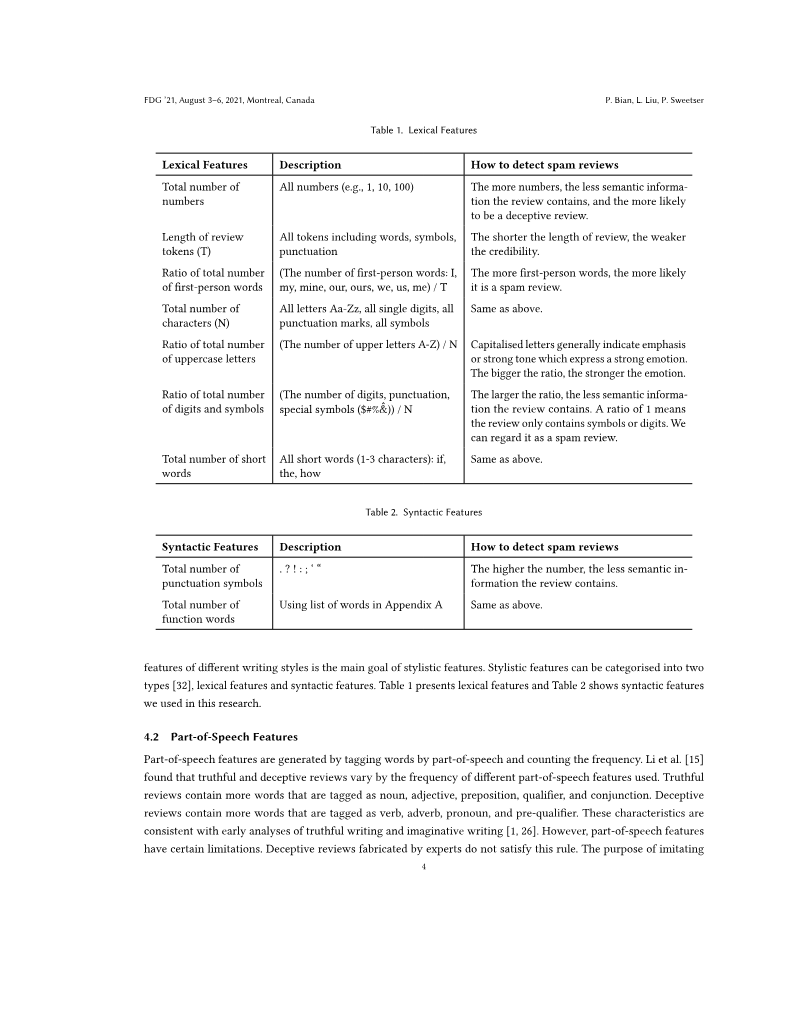
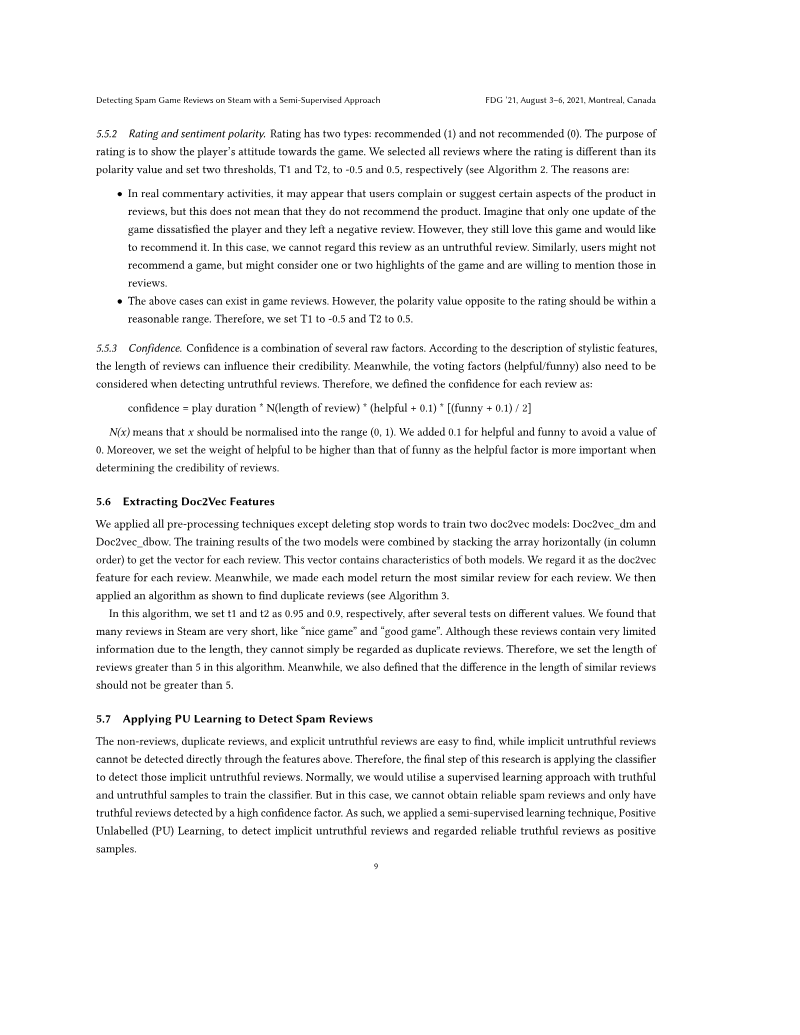
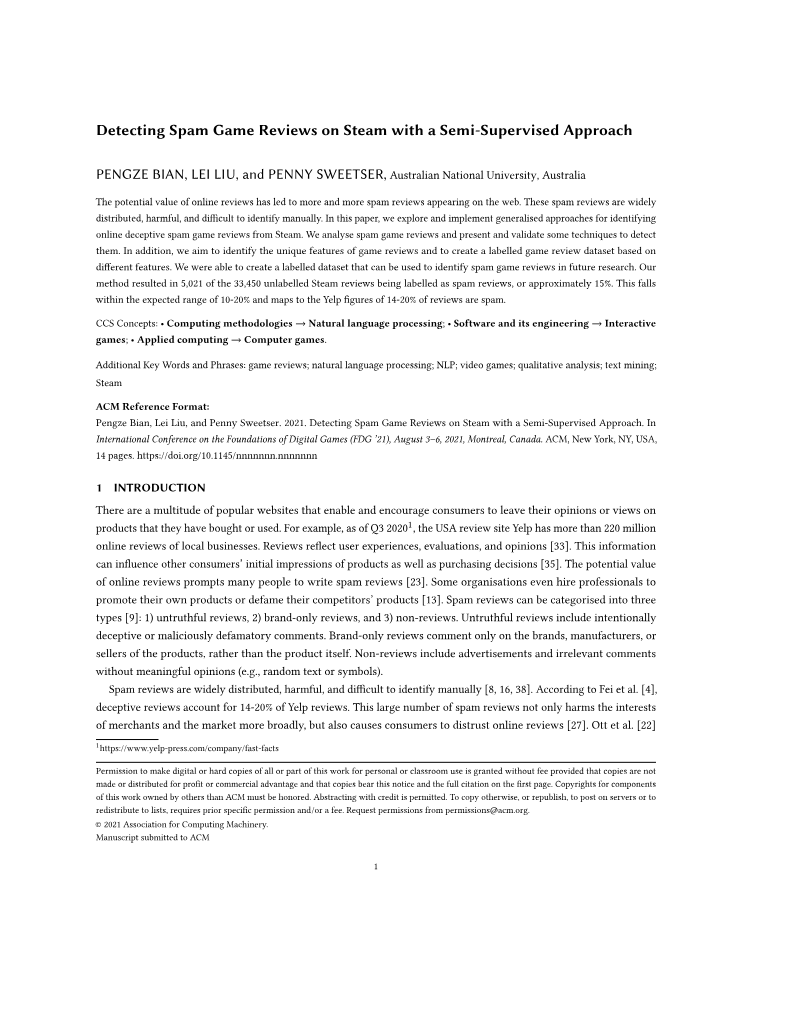
Detecting Spam Game Reviews on Steam with a Semi-Supervised Approach
The authors of this Foundations of Digital Games (FDG '21) paper from the Australian National University study how to detect spam reviews of video games on Steam.
- The authors' method labelled 5,021 of 33,450 unlabelled Steam reviews as spam, approximately 15%, which they say falls within the expected 10-20% range.
- On the Gold-standard dataset, the best PU-bagging F1 score was 80.0%, with 100 positive samples, below the 83.7% reported by Hernandez et al. at the same size.
- The authors state their method performed better than the comparison work when there were fewer positive samples.
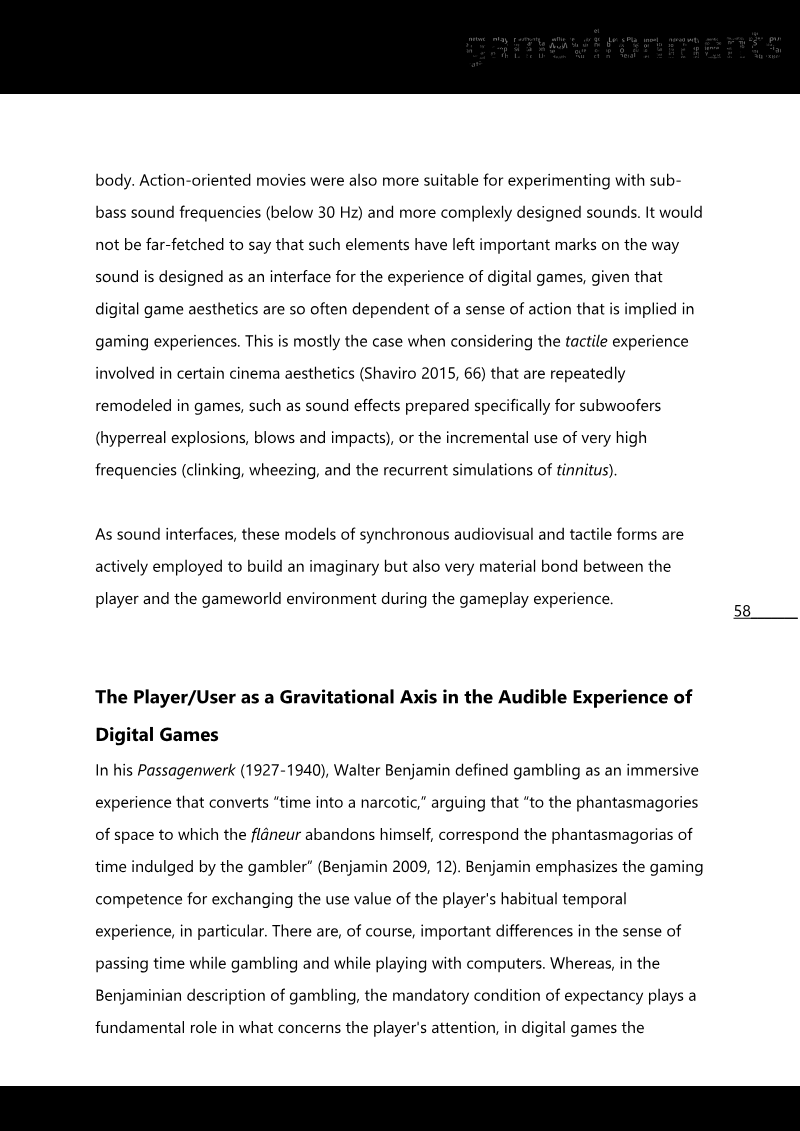

Inaudible Systems, Sonic Users: Sound Interfaces and the Design of Audibility Layouts in Digital Games
Eduardo Harry Luersen's article, published in issue 14 of gamevironments (2021), examines sound design in digital games as sonic user interfaces.
- The author argues that first- and third-person games center the avatar as a gravitational axis around which spherically imagined auditory space is organized.
- Platform games are described as using a much more uniform, cacophonic sound mix with repetitive sounds and looping tracks, rather than a three-dimensional spherical sound perspective.
- The article identifies the bright clinking sound of scoring in platform games as referring to the contact of coins with metal in gambling machines.
The Musical Ludo Mix of Taiko no Tatsujin
Costantino Oliva's paper, published in the Transactions of the Digital Games Research Association in March 2021 (Vol. 5 No 2, pp.
- The author argues that the musical literacy conveyed by Taiko no Tatsujin extends beyond media references to taiko drumming culture, which the paper describes as a largely oral, non-notated practice.
- The paper reports that by the end of the 1990s, over 350 CDs of game music were available on the Japanese market, citing Yamakami and Barbosa.
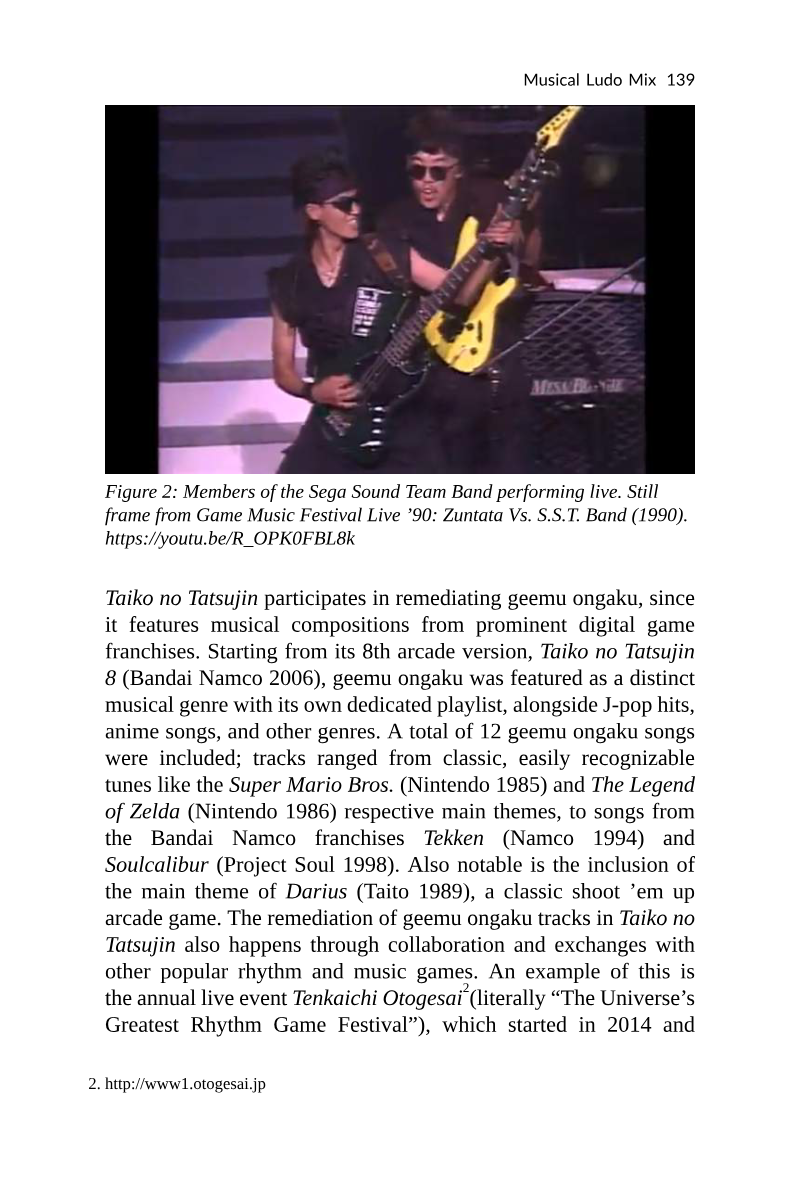
- Starting with Taiko no Tatsujin 8 in 2006, game music was featured as a distinct genre with its own dedicated playlist, containing 12 geemu ongaku songs.
The Ludo Mix and the Loss of In-Game Narrative: A Case Study of the Final Fantasy XV Universe
This article, published in the Transactions of the Digital Games Research Association (March 2021, Vol. 5 No 2, pp.
- Tabata gave the reason for the transmedia approach as avoiding having to ship the story as multiple games, which the author notes presupposes that a single story needs multiple games.
- The article reports that Insomnia, which is perhaps even more relevant to the plot of the game, is prominently featured in the film and anime but has been relegated to a mere dungeon in the main game.
- The author states that the Final Fantasy XV Universe includes a CGI feature film, an anime series, an audio drama, a novel, manga, six separate games, and episodic DLC.
Game Designers and the Ludo Mix: Constructing an Aesthetic Experience
This paper by Laureline Chiapello, published in the Transactions of the Digital Games Research Association (March 2021, Vol. 5 No 2, pp.
- The author argues that ludo mixes ought to be seen as grand experiences rather than grand narratives, shifting focus from story to a whole experience.
- In the first phase, students mostly transposed anime elements into games in a straightforward manner, ending with "a bunch of mechanics" rather than cogent game systems.
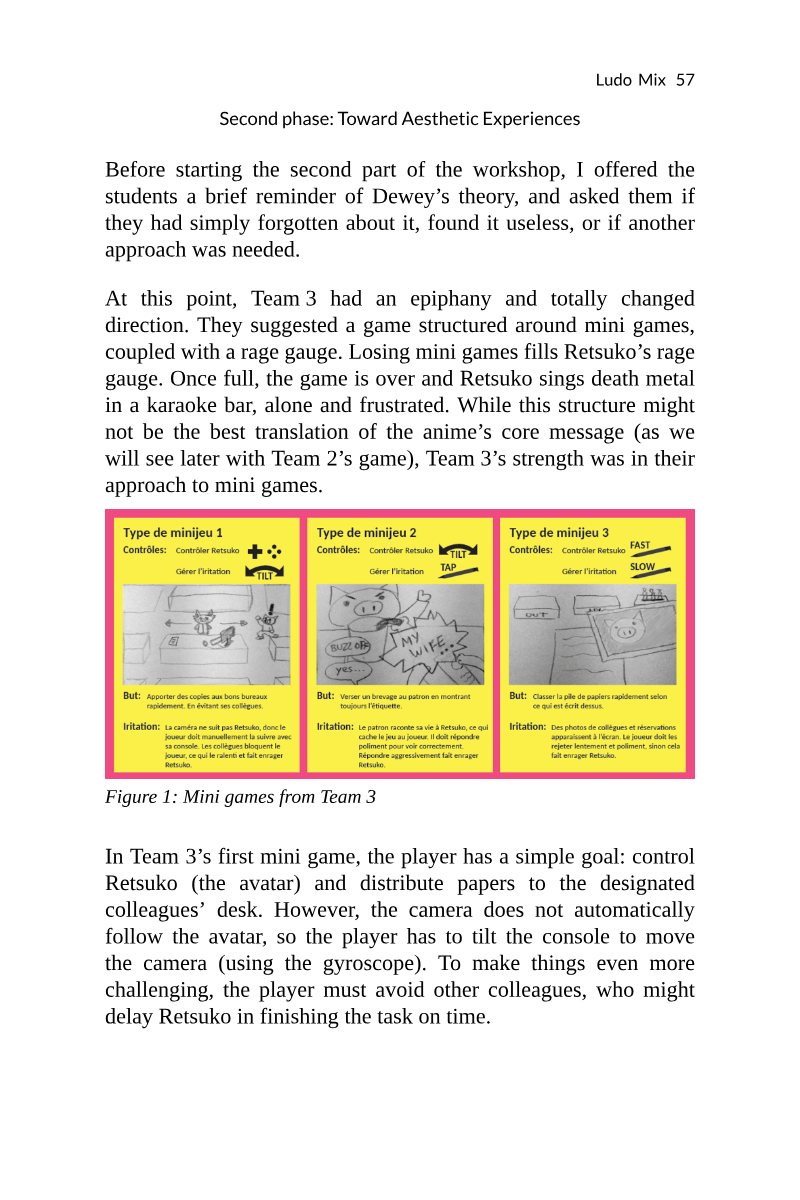
- After a reminder of Dewey's theory, one team restructured its game around mini-games coupled with a rage gauge, where losing mini-games fills Retsuko's rage gauge.
The Game Itself?: Towards a Hermeneutics of Computer Games
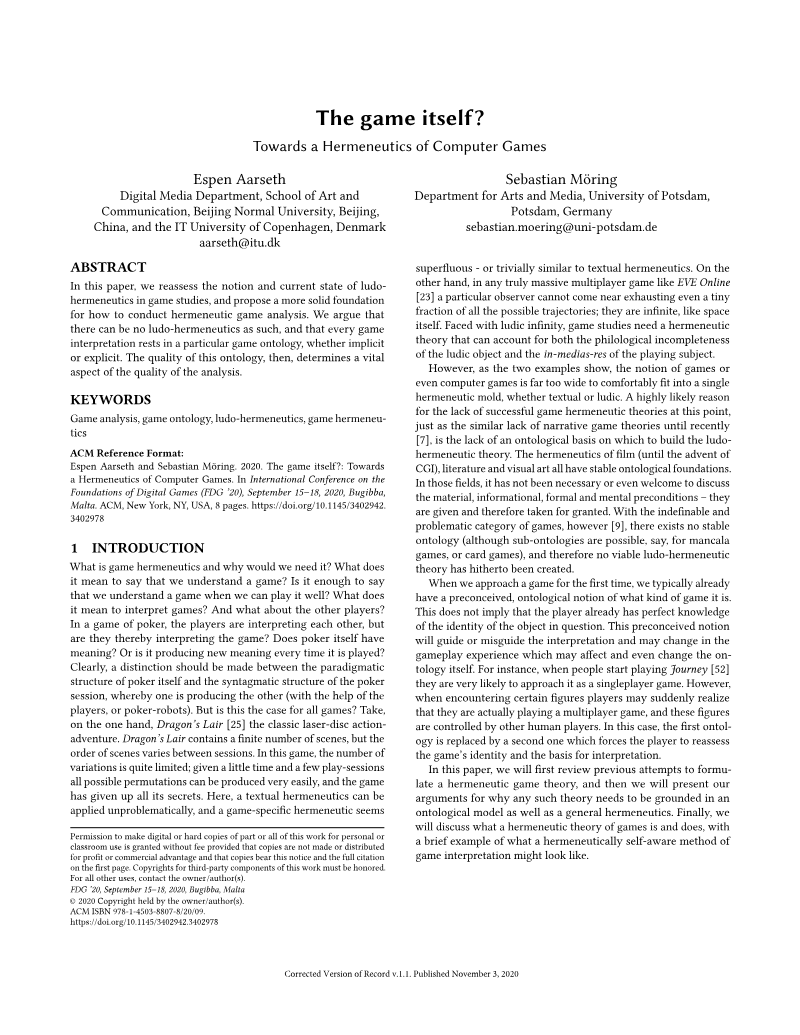
The paper by Espen Aarseth and Sebastian Möring, published at the 2020 International Conference on the Foundations of Digital Games (FDG '20) in Malta, reassesses hermeneutic approaches to game studies.
- The authors argue that there can be no ludo-hermeneutics as such, because games are not one type of phenomenon and any theory must be a family of models.
- Identifying the game's ontological nature is presented as the first step of ludo-hermeneutics and the only step that is necessarily required.
- The authors assume a game ontology laid out in Calleja and Aarseth, in which a game is a four-dimensional field of mental activity, a semiotic system, a mechanical system and a materiality.
Towards a Taxonomy of AI in Hybrid Board Games
The paper by Gómez-Maureira, Barbero, Freese and Preuss, published at the 2020 Foundations of Digital Games conference (FDG '20), proposes a first taxonomy of artificial intelligence in hybrid board games, which the authors define as games that combine intentionally designed digital and physical modalities to create a game…
- The authors define hybrid board games as games that combine intentionally designed digital and physical modalities to create a game experience for players.
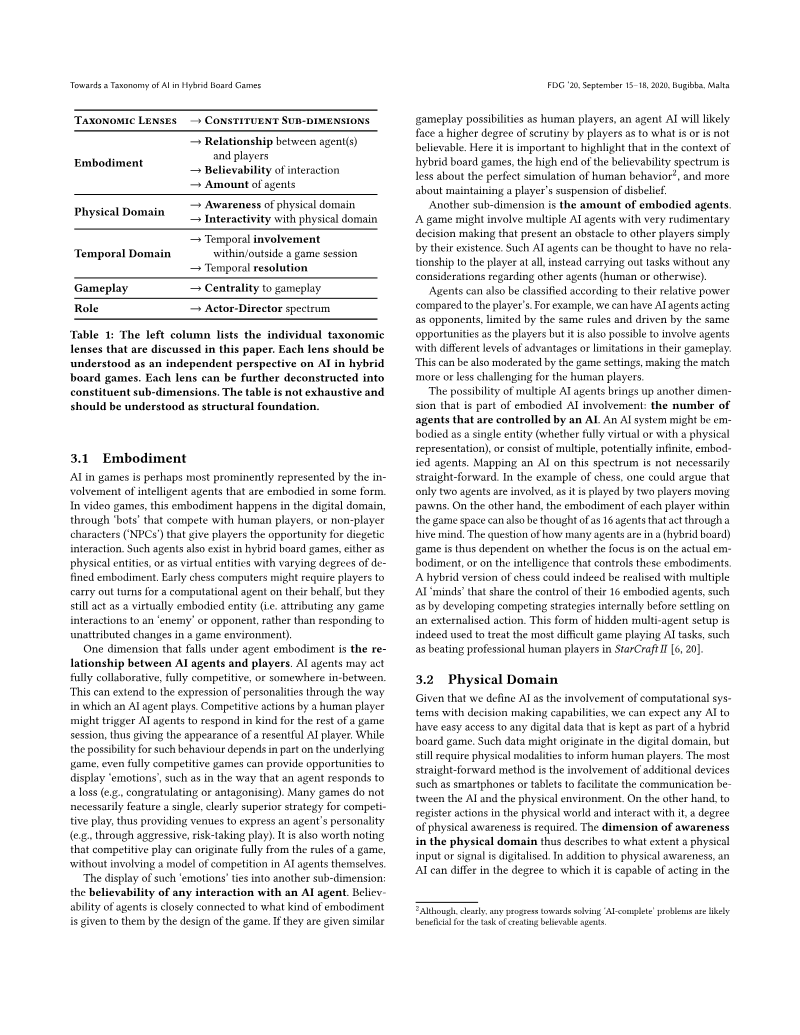
- The authors propose five taxonomic lenses for AI in hybrid board games: embodiment, physical domain, temporal domain, gameplay, and role.
- The authors argue that the temporal lens distinguishes AI involvement before, during, or after a game session, and that it is better framed as ordinal categories than as a continuous spectrum.

10 Years of the PCG Workshop: Past and Future Trends
This paper by Antonios Liapis, from the Institute of Digital Games at the University of Malta, celebrates the first ten years of the international workshop on Procedural Content Generation (PCG), hosted by the Foundations of Digital Games conference.
- Level generation was the most common type of content generated, with the document reporting it in 51% of the workshop's papers.
- Only 32 of the 95 papers included an empirical evaluation, with most instead offering a couple of generated samples and a qualitative discussion.
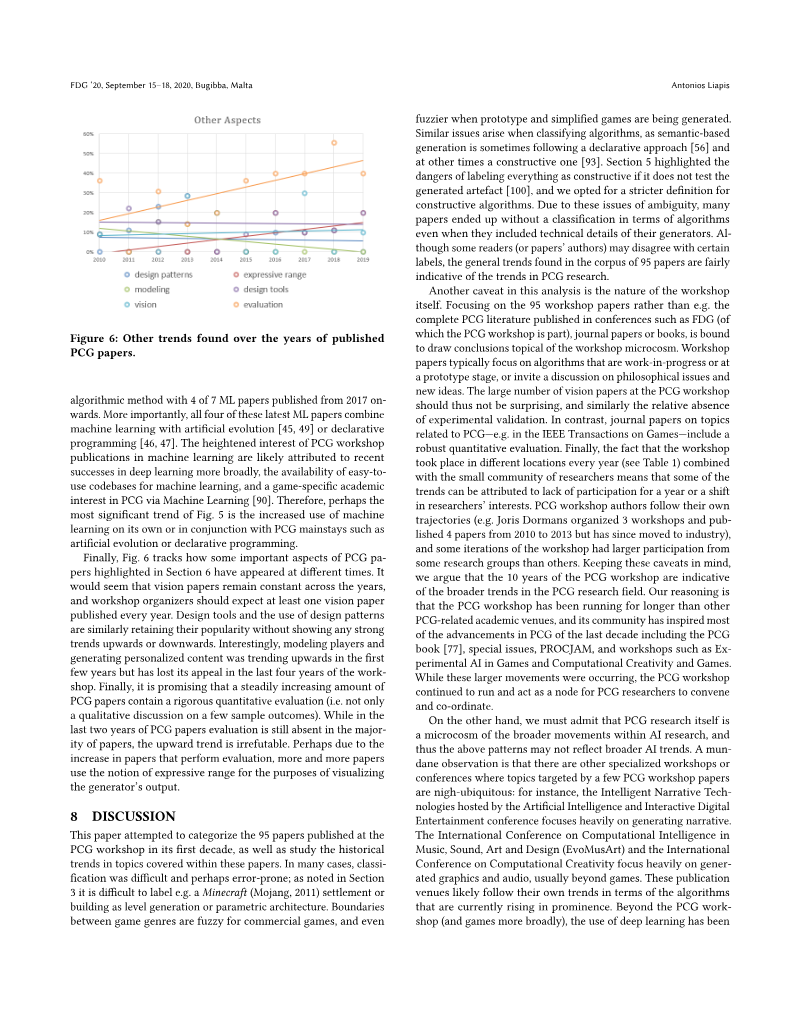
- Machine learning is described as the most upwards-trending algorithmic approach, with four of seven ML papers published from 2017 onwards.
Collaborative Agent Gameplay in the Pandemic Board Game
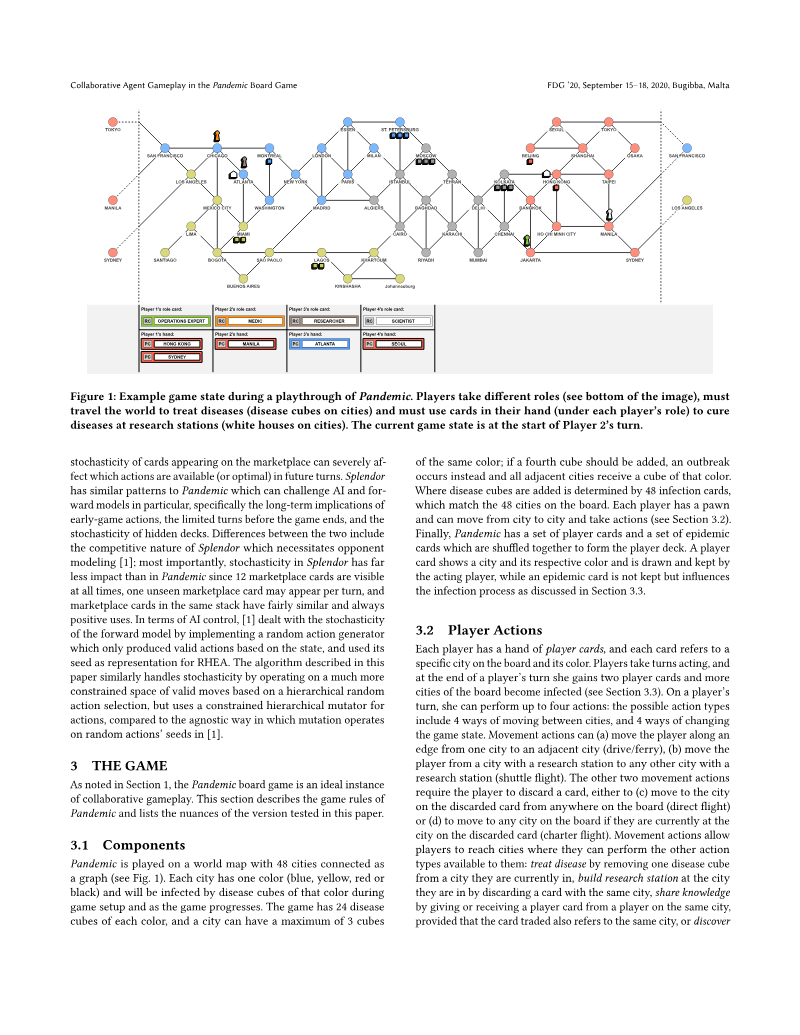
The paper by Konstantinos Sfikas and Antonios Liapis of the Institute of Digital Games, University of Malta, studies AI control of all players in Pandemic, a collaborative board game where players work together against escalating threats.
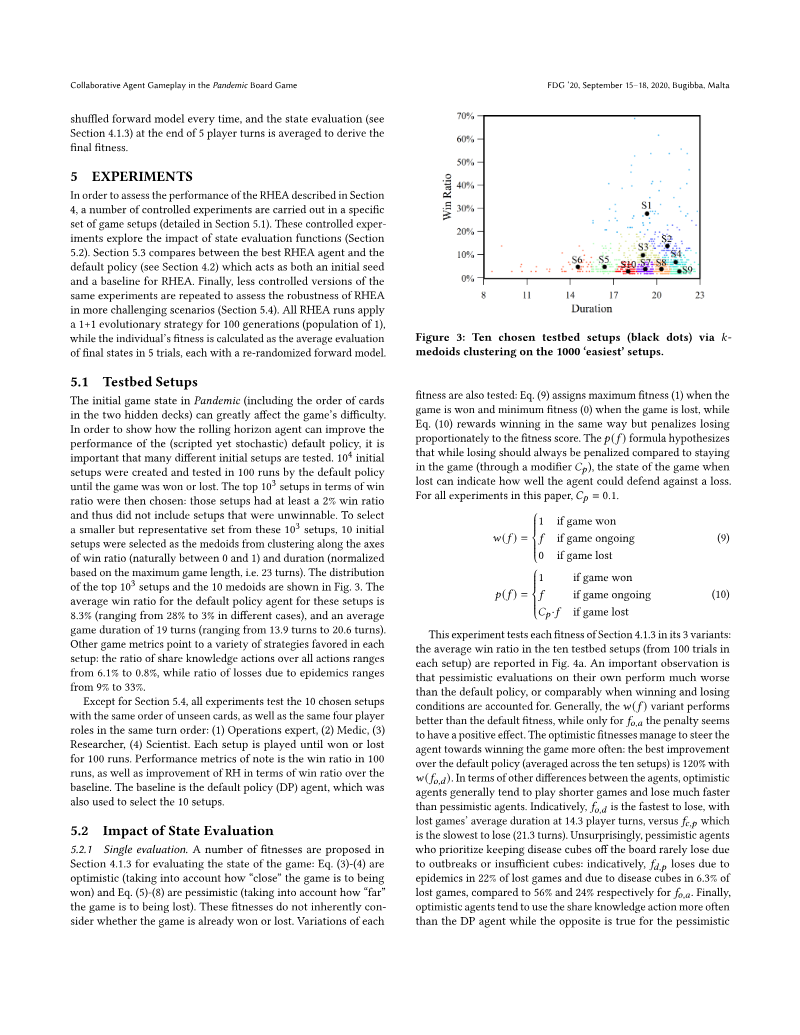
- The best RHEA agent achieved an average win ratio of 29.3% across the ten setups, which the authors report as a 302% improvement over the default policy.
- Optimistic and pessimistic state evaluations performed differently when used alone, but combining them in a naive aggregate often performed better than the conditional variants.
- A simple reordering of player roles dropped the baseline's win rate by 68%, while RHEA's dropped by 25%.
A Hybrid Approach to Procedural Generation of Roguelike Video Game Levels
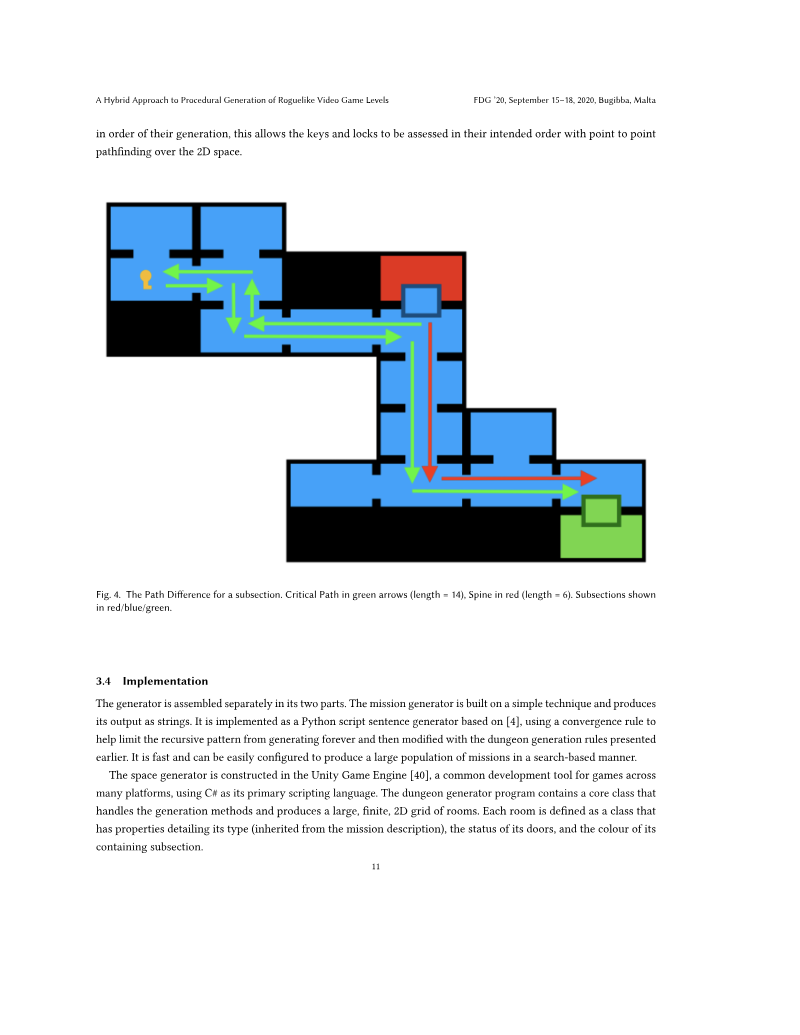
Alexander Gellel and Penny Sweetser, of the Australian National University, present a prototype level generator for roguelike dungeon-style levels, described in a paper for the 2020 International Conference on the Foundations of Digital Games.
- The baseline Random Neighbour Search generated completable levels only 53.2% of the time in the authors' tests, while both Subsection Search variants reached 100% completability.
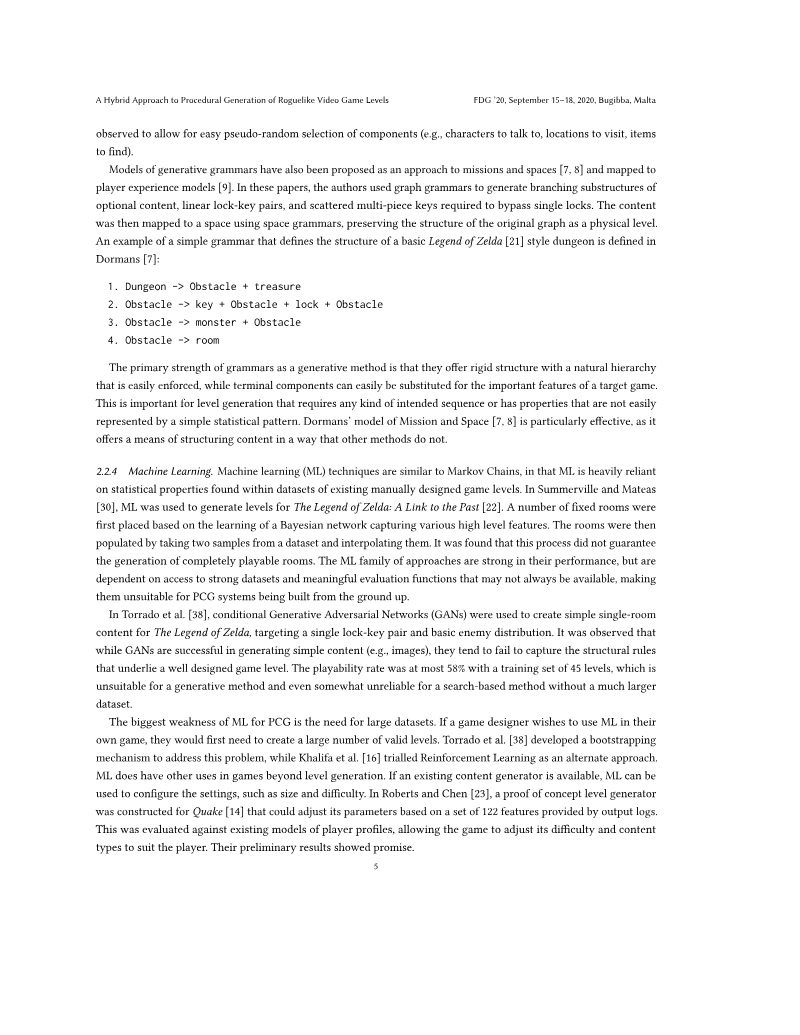
- The authors combined context free grammars for mission structure with a cellular automata-inspired process for physical space, arguing the two complement each other's weaknesses.
- The authors' grammar-based generator generated 100% of lock-key pairs appropriately in automated evaluation across numerous sample sets.
Do Game Bots Dream of Electric Rewards?: The Universality of Intrinsic Motivation
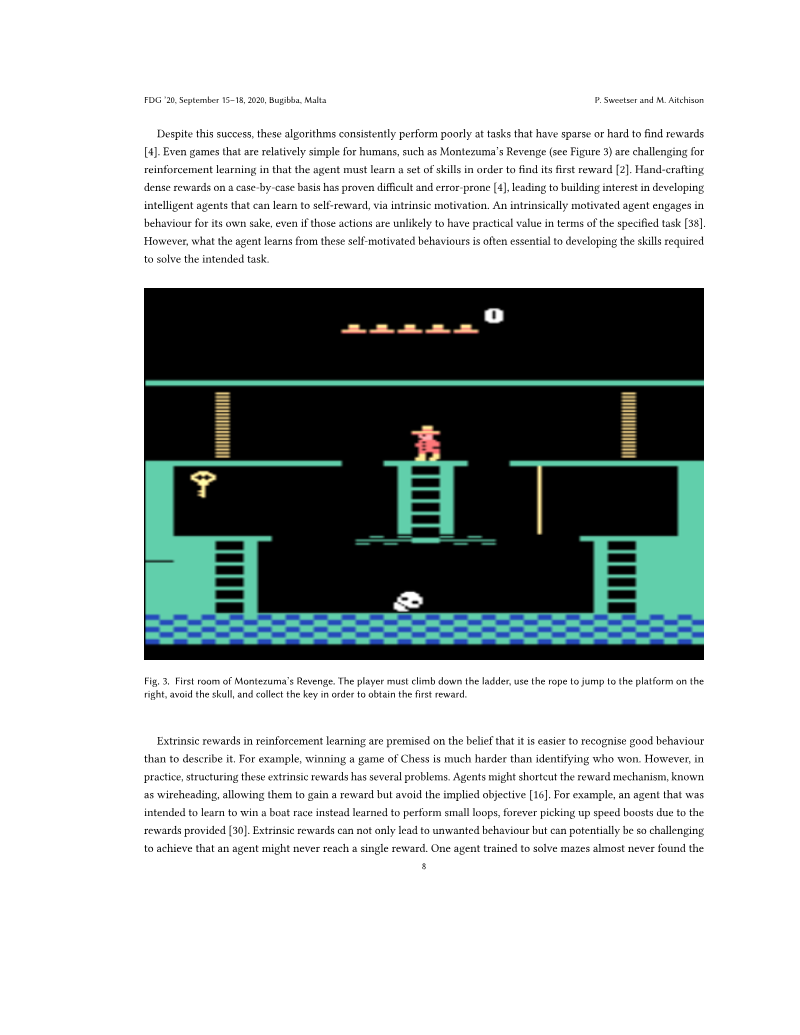
This paper by Penny Sweetser and Matthew Aitchison of the Australian National University, presented at the 2020 International Conference on the Foundations of Digital Games (FDG '20) in Malta, draws together theories of reinforcement, rewards, motivation, flow, play, games, gamification and machine learning.
- The authors cite Kohn's analysis of decades of research, which concludes that rewards are unethical and ineffective, because interest in the behaviour diminishes and people stop when rewards stop.
- The authors state that the most commonly used forms of gamification are points, levels, leaderboards and achievements, which they describe as reward-based gamification.
- Citing Nicholson, the authors note that gamification often uses the least interesting part of a game, the points system, despite assuming that calling an activity a game makes it more engaging.
Visuospatial Abilities Training with Digital Games in a Primary School
The paper reports the "A me gli occhi" ("Eyes on Me") project by researchers at the Italian National Research Centre's Institute for Educational Technologies.
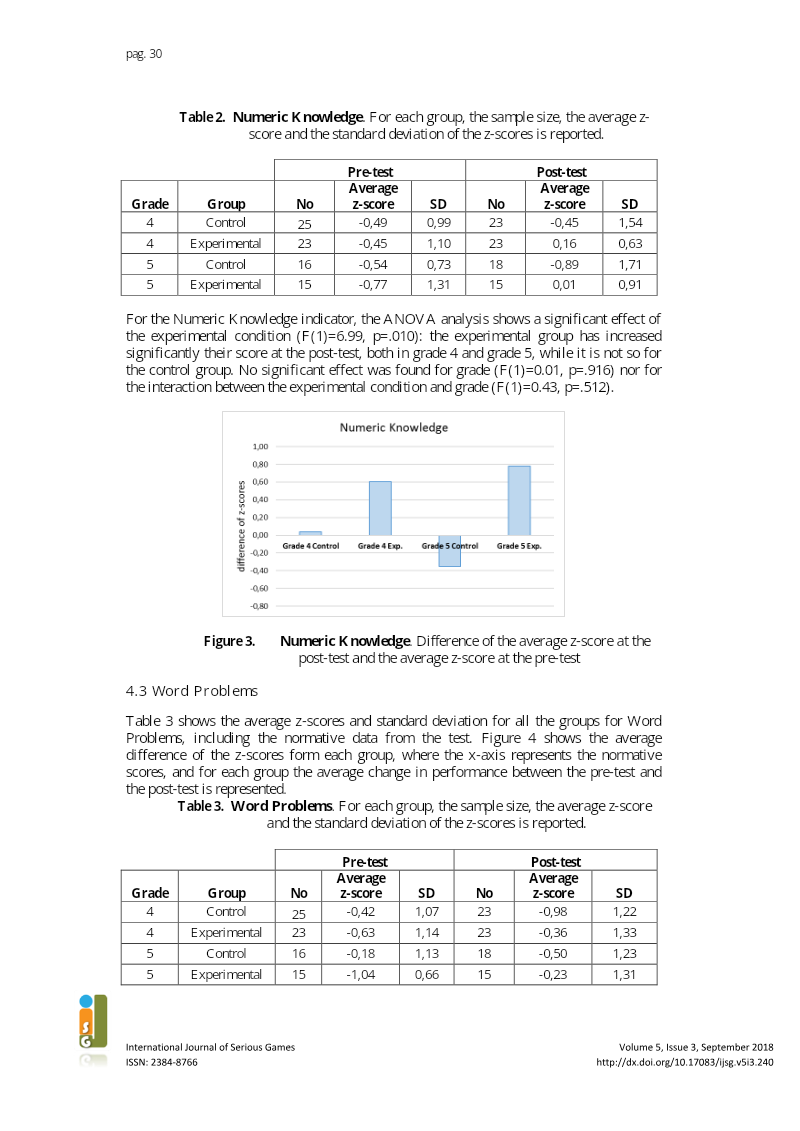
- On the AC-MT 6-11 test, the experimental group's z-score gain over the control group was statistically significant for Numeric Knowledge (F(1)=6.99, p=.010) and Word Problems (F(1)=11.03, p=.001).
- For Written Operations, the significant effect was an interaction between experimental condition and grade (F(1)=8.47, p=.005), with experimental grade 5 performing significantly better than control grade 5.
- In the INVALSI comparison for grade 5 only, the experimental class scored better than the control class at year end, with an overall evaluation 3 points below the Italian average versus 10 points below for the control class.