Digital Games
Company
Documents about Digital Games
On the De-Familiarizing and Re-Ontologizing Effects of Glitches and Glitch-Alikes
Stefano Gualeni, of the Institute of Digital Games at the University of Malta, presents a paper written for a DiGRA conference, examining non-catastrophic computer malfunctions (glitches) and deliberately designed imitations of them (glitch-alikes) in interactive virtual worlds.
- The author argues that the implicit preference for self-consistent and verisimilar experiences makes imperfections and technical anomalies particularly evident and unsettling for digital game audiences.
- The paper proposes that glitch-alikes can produce 're-ontologizing' effects by making audiences question the validity and stability of conceptual frames applied to the actual world.
- The author contends that interactive, persistent glitched worlds differ from glitches encountered merely as representations, since they can be experienced dynamically and repeatedly as worlds.
Heritage Destruction and Videogames: Ethical Challenges of the Representation of Cultural Heritage
The paper, by José Antonio González Zarandona, Adam Chapman, and Darshana Jayemanne, was published in the Transactions of the Digital Games Research Association in November 2018.
- The authors state that Vijećnica was targeted because the cultural identity it reflected at the time of the conflict was a contested issue.
- The authors argue that the game presents the library mainly as a navigational aid or source of cover rather than as a site where meetings and discussion took place.
- The authors argue that the fictional framing of the game creates an ambiguity that can deflect criticism of its depiction of real destruction.

How Players Speak to an Intelligent Game Character Using Natural Language Messages
This study by Fraser Allison, Ewa Luger, and Katja Hofmann, published in the Transactions of the Digital Games Research Association in November 2018, examines how players communicate with an intelligent companion character through natural language text.
- Most player messages were imperatives, and a large majority omitted a grammatical subject, with the implied subject being the character.
- Players' wording was highly varied: of 186 messages, 128 were unique, and only 12 were sent by multiple players.
- Only two-fifths of interrogative messages were punctuated with a question mark, and most intended queries ended with one while most intended commands did not.
Player Experience and Deceptive Expectations of Difficulty Adaptation in Digital Games
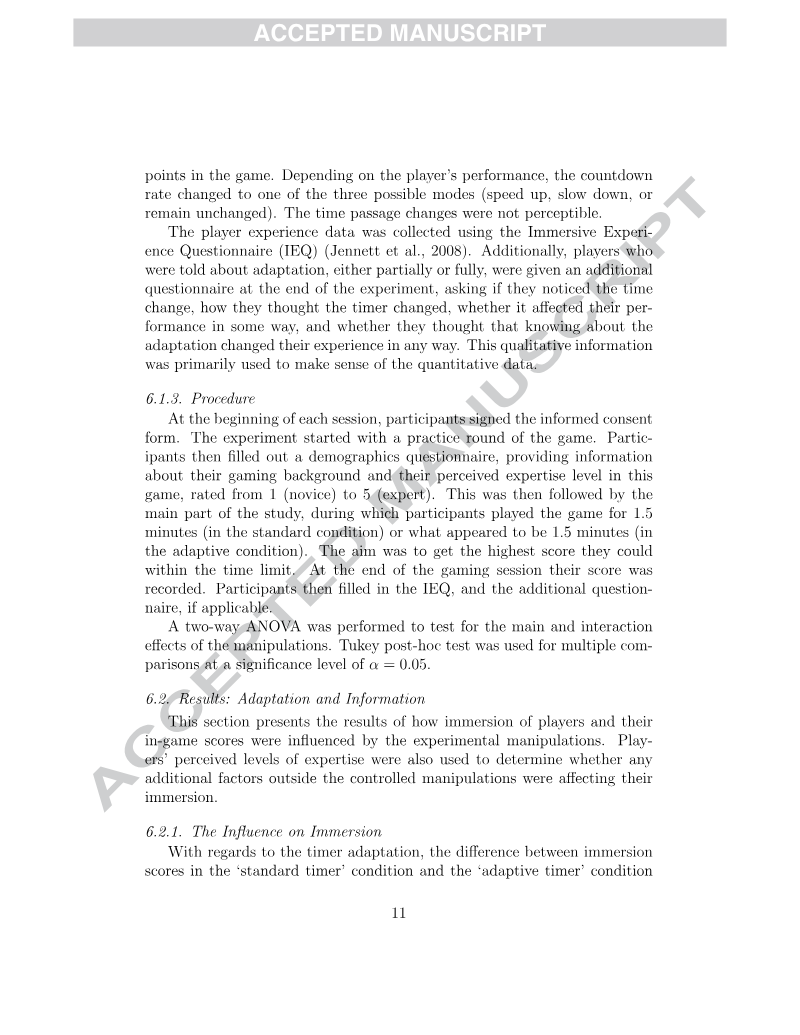
Denisova and Cairns report two experimental studies, published in Entertainment Computing (2019), on how players' knowledge of difficulty adaptation affects immersion in single-player digital games.
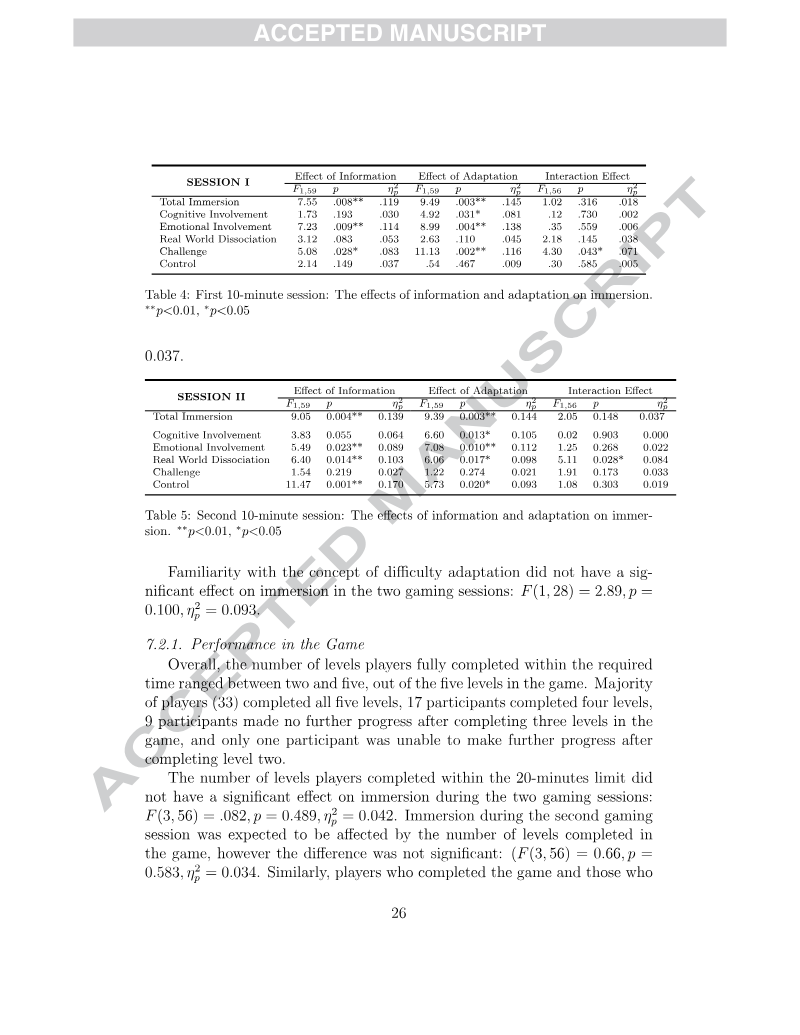
- Players told the game adapts to them felt more immersed whether or not the adaptation was actually present, according to the authors' findings across both studies.
- In Study I, players who received a full description of the adaptive timer felt significantly more immersed than players with no knowledge of the adaptation.
- The adaptive timer in Study I raised total immersion significantly, with a medium effect size.
DiGRA Chapter Diversity
This analysis examines the role and perceived value of regional chapters within the Digital Games Research Association (DiGRA).
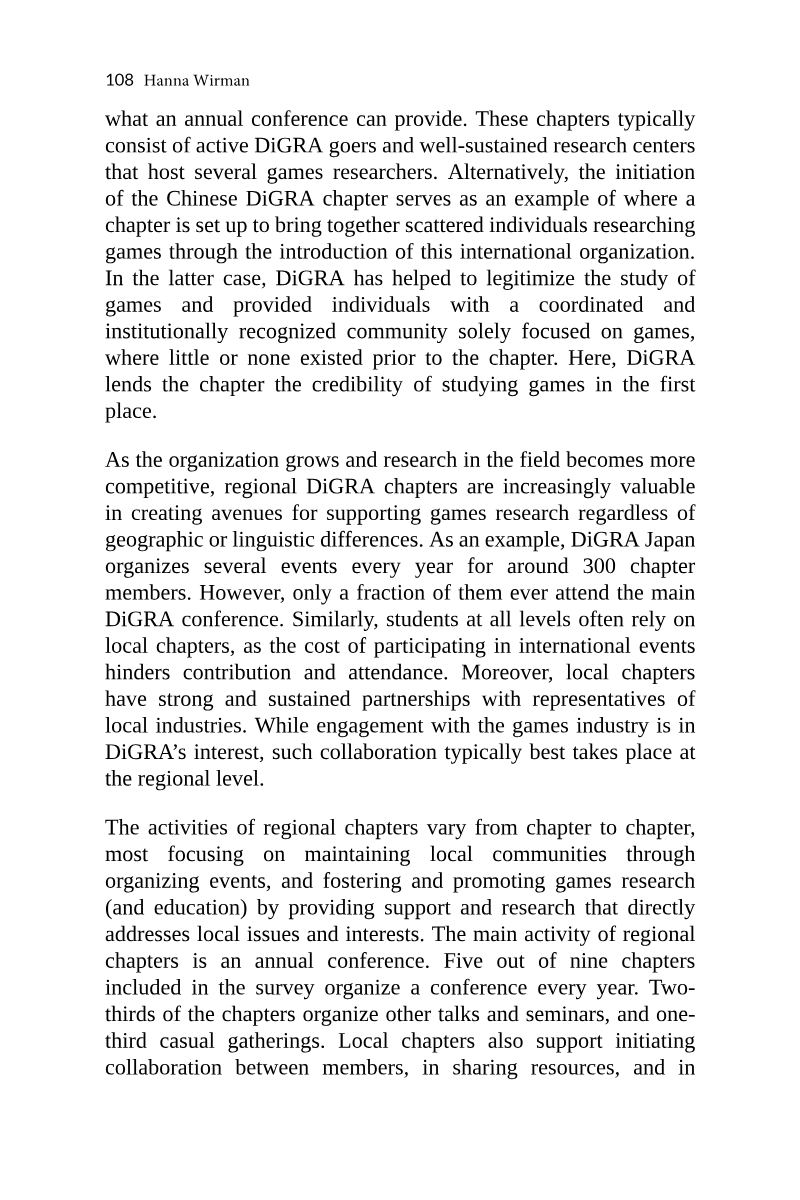
- Regional DiGRA chapters serve as vital hubs for game research in areas where international conference participation is low, such as Japan, China, and Israel, often due to language barriers and the high costs of global travel.
- The DiGRA brand provides essential institutional legitimacy for local chapters, helping researchers gain credibility with local industries and providing a framework for community building where none previously existed.
- Local chapters foster diversity by addressing niche, regional, or politically sensitive topics that are often overlooked by the broader, Euro-American-centric DiGRA organization.
Character Diversity in Digital and Non-Digital Games
This paper by Alexandra To, Joselyn McDonald, Jarrek Holmes, Geoff Kaufman, and Jessica Hammer, published in the Transactions of the Digital Games Research Association (August 2018), examines how digital and non-digital games represent diverse characters, meaning representations of marginalized groups to which players may or…
- The authors identify five ways character diversity is communicated in games: visual design, abstract representation, setting and roles, conversation design, and rule and system design.
- The authors argue that representation in games has focused almost exclusively on a small number of categories, and that even race and gender representation often stays at the level of physical features.
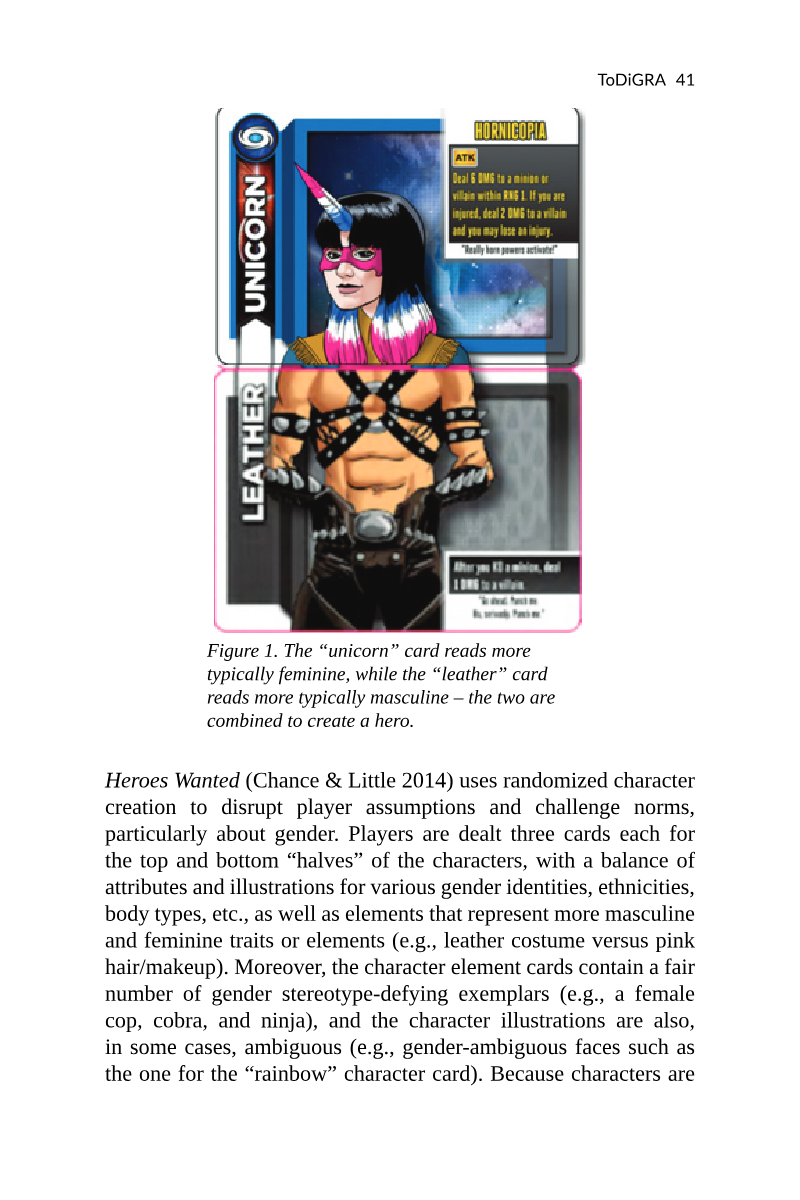
- Heroes Wanted randomizes character creation by combining cards, so that unusual combinations challenge gender norms and stereotypes.
ToDIGRA Diversity Workshop Special Issue: Introduction
The inaugural Digital Games Research Association (DiGRA) Diversity Workshop, held in Melbourne in 2017, sought to critically interrogate the meaning of diversity within the field of Game Studies.
- The inaugural DiGRA Diversity Workshop, held on July 2, 2017, at The University of Melbourne, established a framework for critically interrogating diversity as a discourse within Game Studies and the academic community.
- Conference organizers implemented specific diversity initiatives, including sliding-scale fees based on socio-economic status, dedicated networking events, and social media policies, to serve as a model for future committees.
- Key operational challenges identified for the organization include addressing regional disparities, standardizing accessibility for scholars of different abilities, and mitigating the alienating effects of field-specific jargon on new or interdisciplinary attendees.
Why Game Designers Should Study Magic
Kumari, Deterding and Kuhn, from the University of York and Goldsmiths, University of London, argue in this 2018 Foundations of Digital Games paper that video game designers face the same challenge as magicians: crafting believable and engaging illusions.
- The authors argue that games can teach their causal laws through the interaction of objects, rather than through artificial tutorials.
- The paper cites a study in which participants accepted that a stamp could be removed when the suggested cause was physical rather than magic.
- Citing a 2015 study, the authors report that a visual saliency technique effectively directed people's card choice 98% of the time.
Intrinsic Elicitation: A Model and Design Approach for Games Collecting Human Subject Data
This paper by David Gundry and Sebastian Deterding (University of York, presented at the 13th International Conference on the Foundations of Digital Games, FDG 2018) proposes a theoretical model of why people provide data in games, the Rational Game User Model, and a design approach for human subject data collection games…
- The authors argue that the dominant gamification-plus-validation approach treats player motivation and data quality as separate design concerns, which they say is a significant shortcoming for human subject data.
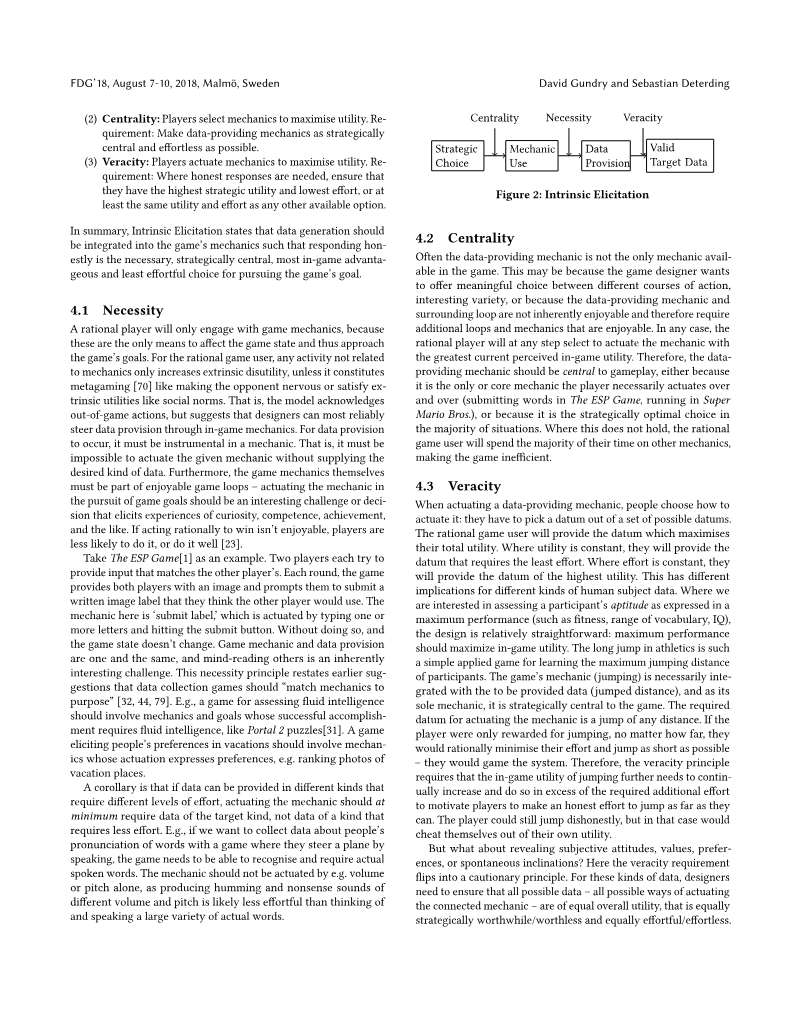
- The paper proposes Intrinsic Elicitation, under which data provision should be the necessary, strategically optimal, and least effortful way for players to pursue the game's goal.
- The authors state that for subjective attitudes, values, or preferences there is by definition no subject-external ground truth to assess them against.
Measuring Quality of Grammars for Procedural Level Generation
The paper by R. van Rozen and Q. Heijn, published at the 2018 Foundations of Digital Games conference, addresses quality assurance for grammar-based procedural level generation for tile-map games such as dungeon crawlers and platformers.
- The authors argue that grammar-based level generation raises designer productivity at the cost of quality assurance, and that authoring, improving and maintaining grammars is difficult because it is hard to predict how each grammar rule impacts overall level quality.
- The proposed Metric of Added Detail scores each rule as removing detail (-1), adding detail (+1), or retaining detail (0) for each symbol it rewrites.
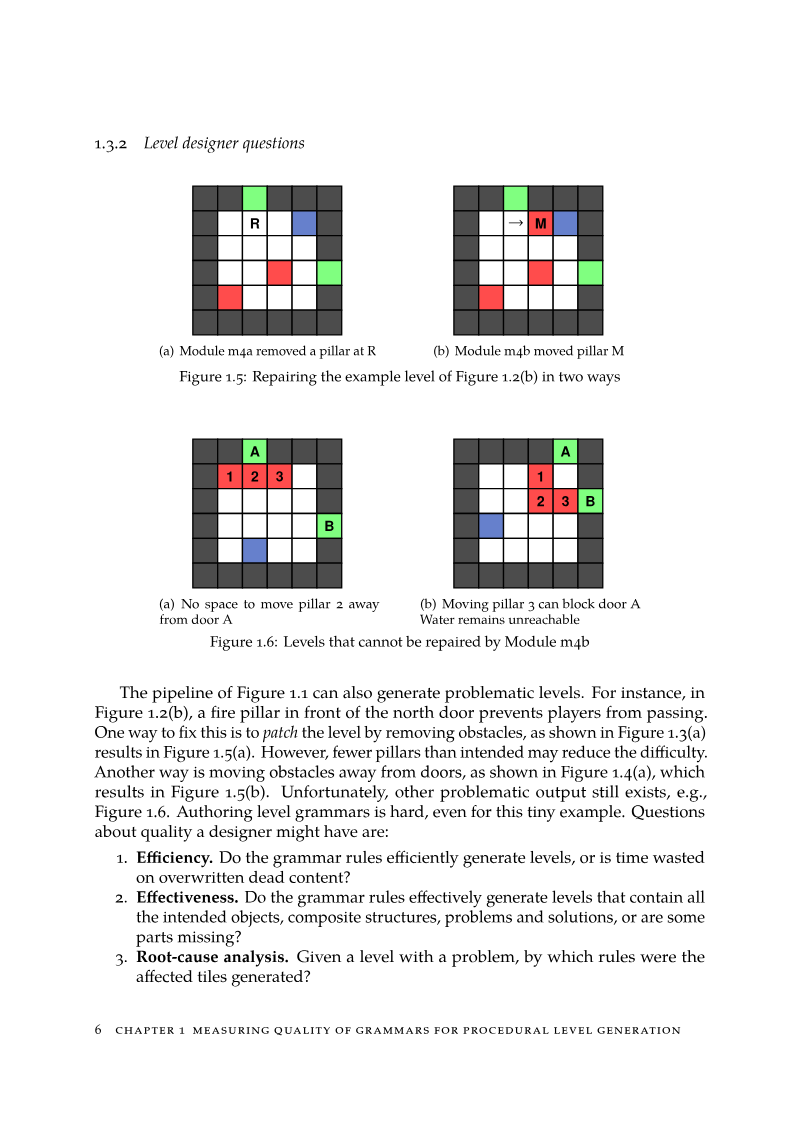
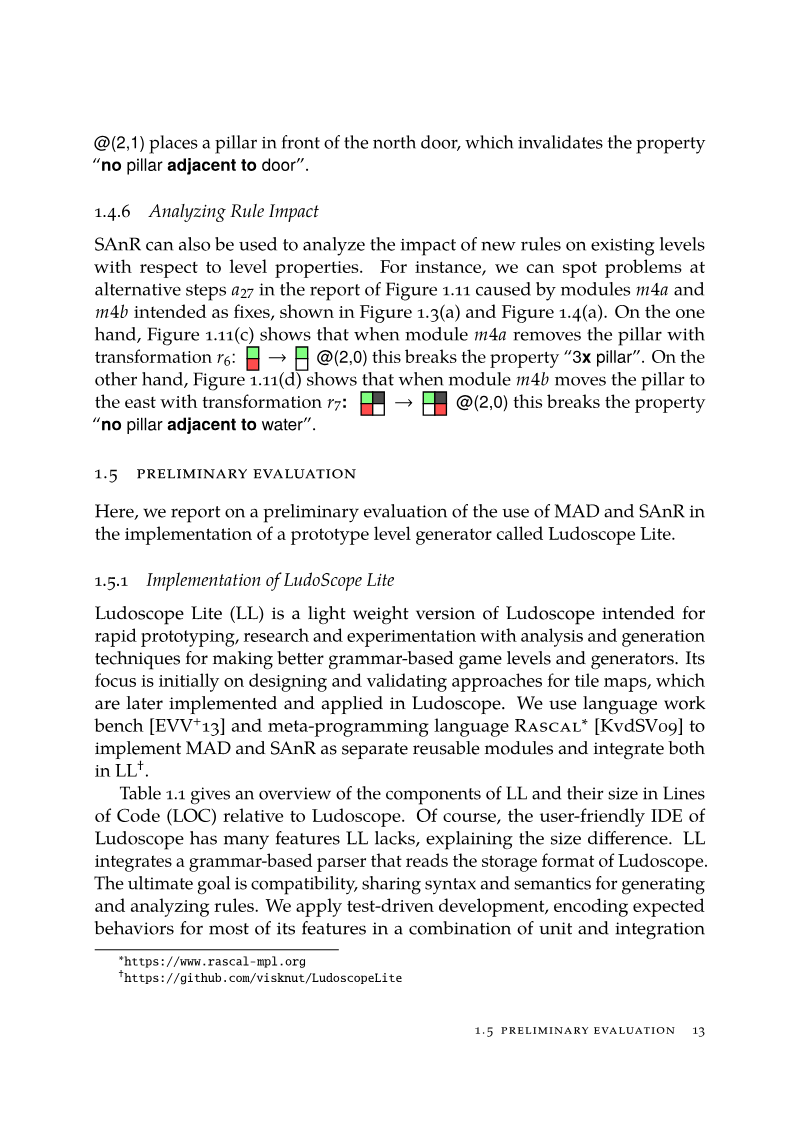
- In the MAD evaluation, the rule removing fire pillars received a negative detail score, while the rules moving them received a neutral score.
Developing Digital Games to Address Airway Clearance Therapy in Children With Cystic Fibrosis: Participatory Design Process
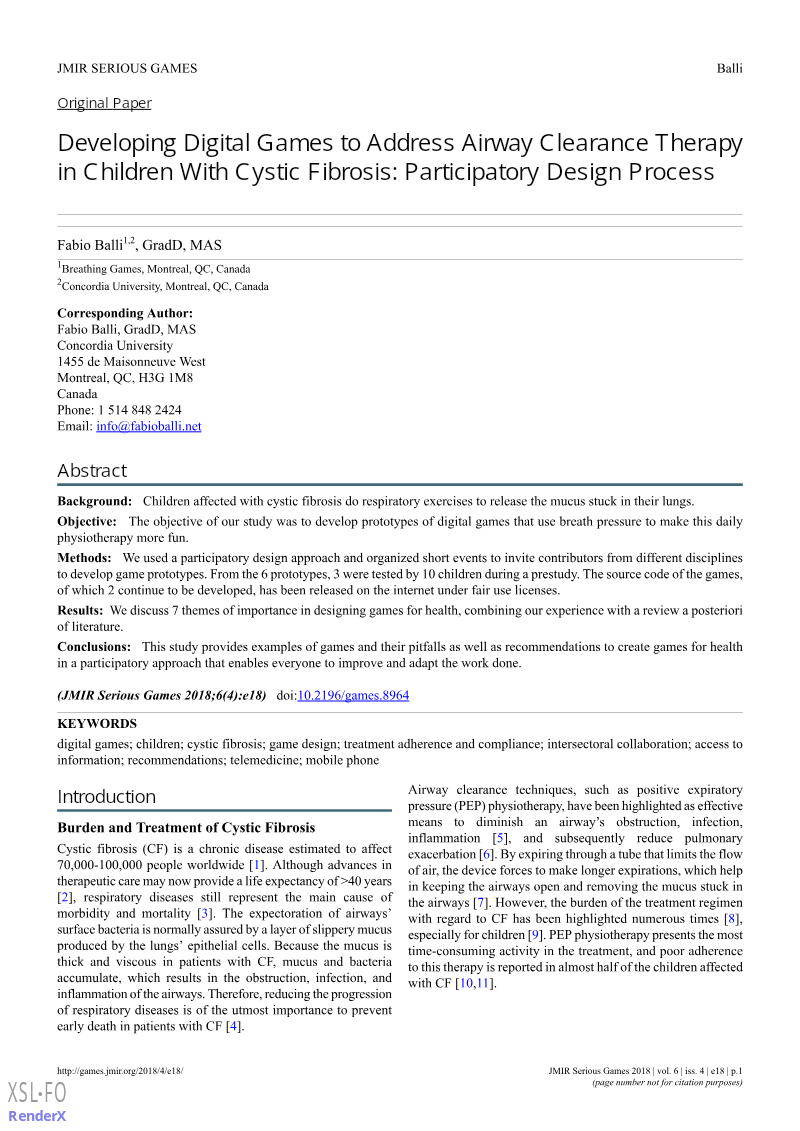
Fabio Balli, of Breathing Games (Montreal) and Concordia University, reports a participatory design process for digital games that use breath pressure to make airway clearance physiotherapy for children with cystic fibrosis more engaging.
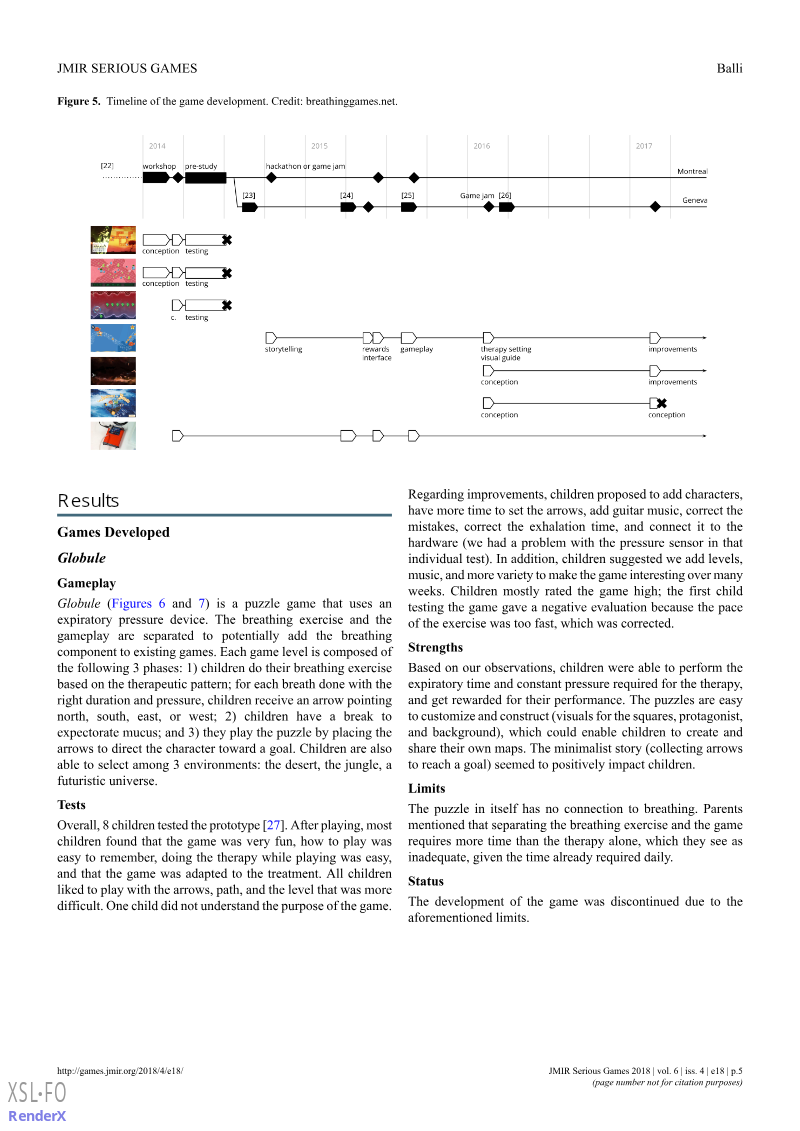
- Of the six prototypes, three were abandoned because of unsatisfactory design choices, technical issues, or an overly ambitious scope.
- Children in the prestudy with Globule, Ange-Gardien and PEP Hero mostly found the games very fun and adapted to the treatment, though some parents felt Globule's separated breathing exercise took too much time.
- The author reports that children were able to perform the expiratory time and constant pressure required for the therapy while playing Globule.
Interpassivity and the Joy of Delegated Play in Idle Games
Sonia Fizek, writing in the April 2018 Transactions of the Digital Games Research Association, examines idle (incremental) games, also called passive, self-playing or clicker games, in which gameplay progresses largely without active player input.
- Idle games are built around ambience acts: the game progresses whether or not the player participates, and changes made in the player's absence are permanent and significant. Without player input, progress is only slower, not stopped.
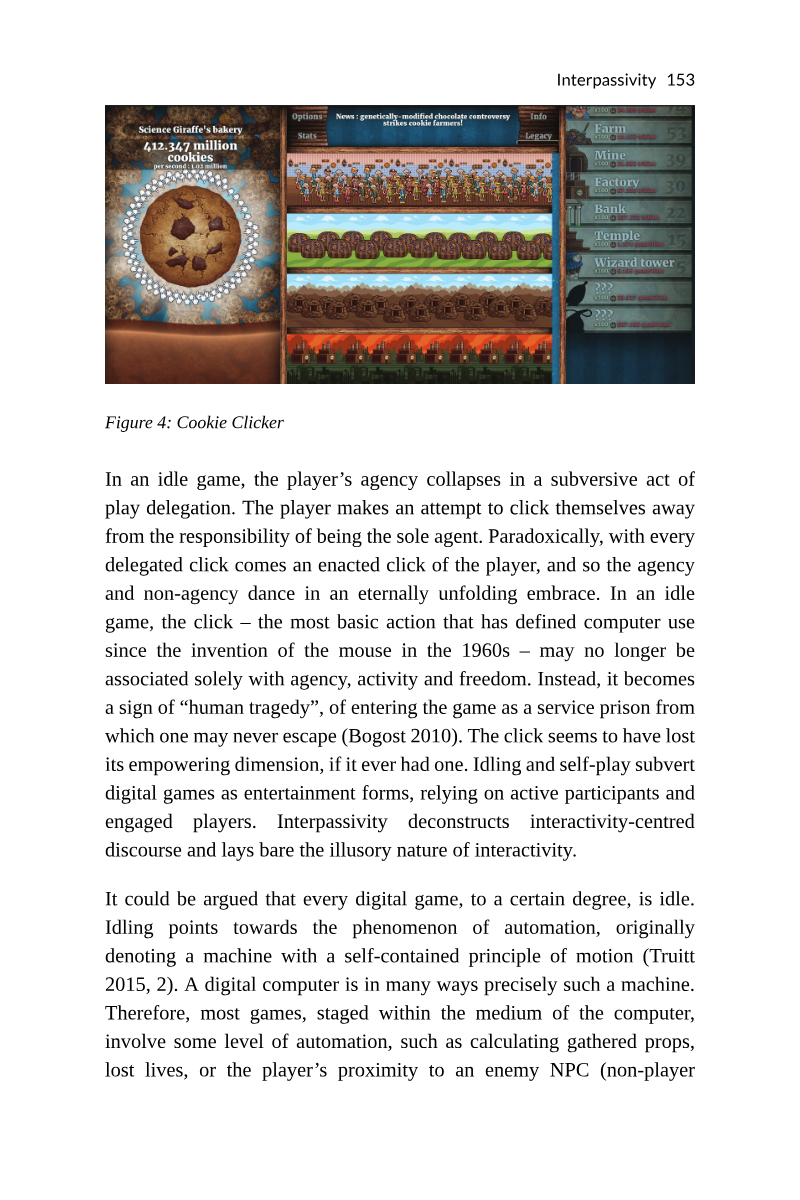
- The author argues that idling is delegated pleasure, in which players outsource gameplay to the game and step away from their role as active agents.
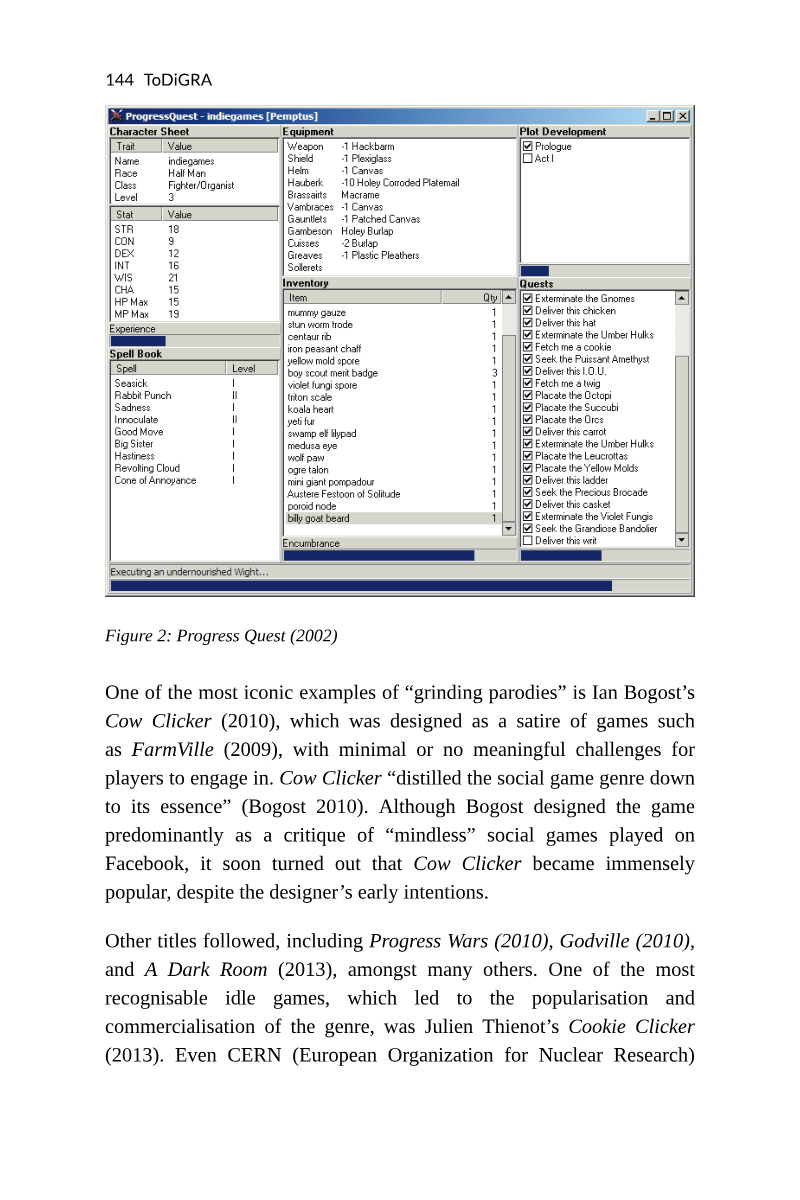
- The genre is described as having emerged as a satire of social games and an ironic response to the mechanics of progression in role-playing games, with its history allegedly beginning with Progress Quest (2002).