Digital Games
Company
Documents about Digital Games
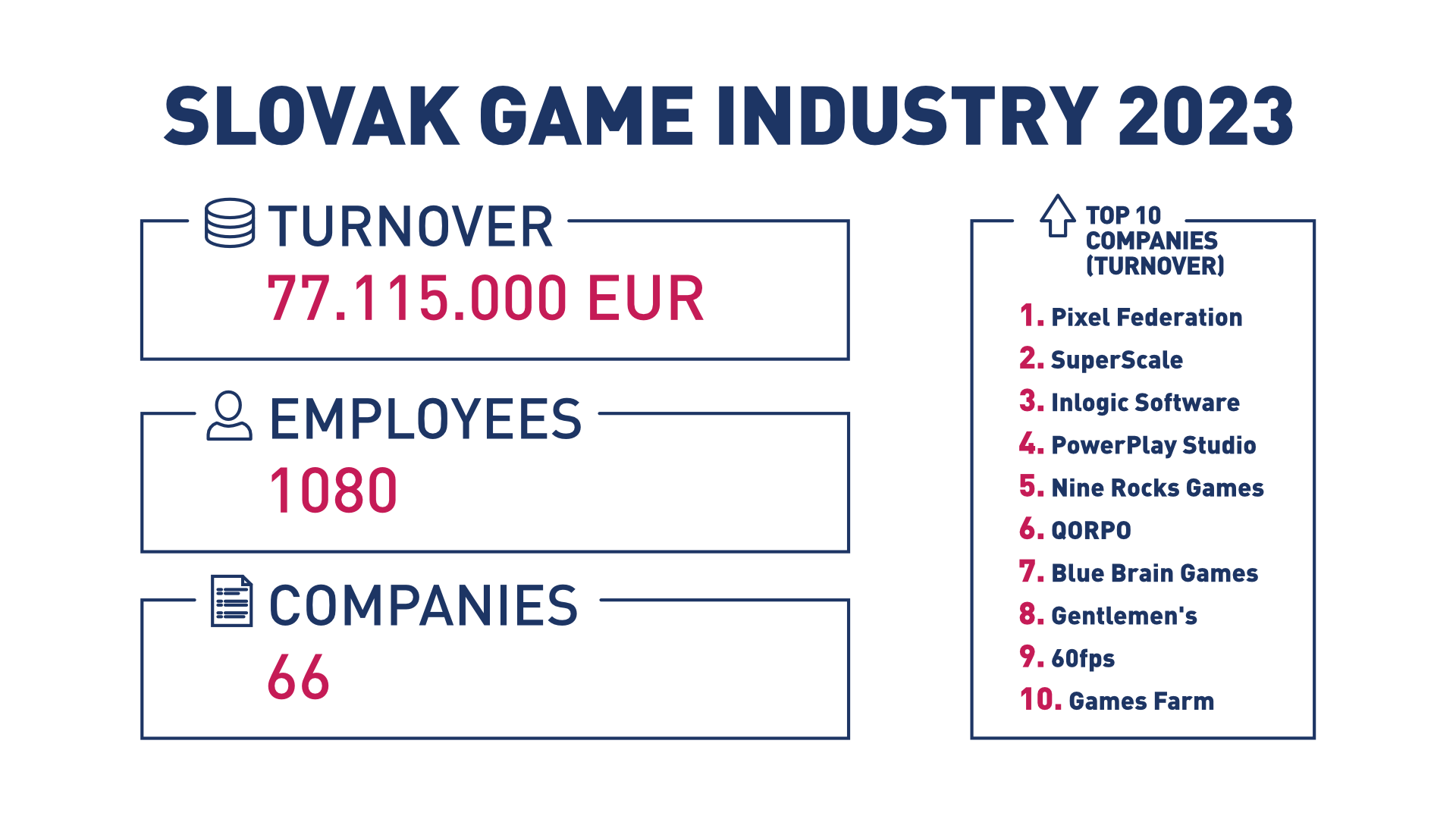
Slovak Digital Games Industry: 2022 Annual Report
The Slovak Game Developers Association's 2022 annual report details the performance and characteristics of the Slovak digital games industry.
- The Slovak digital games industry experienced a slight downturn in 2022, with total turnover falling to EUR 77.1 million from EUR 80 million in 2021.
- The industry consists of 66 companies employing 1,080 professional developers, with 19% of the workforce being women and 9% international staff.
- Market concentration remains high, as the top 10% of companies generated EUR 65.3 million of the total annual turnover.
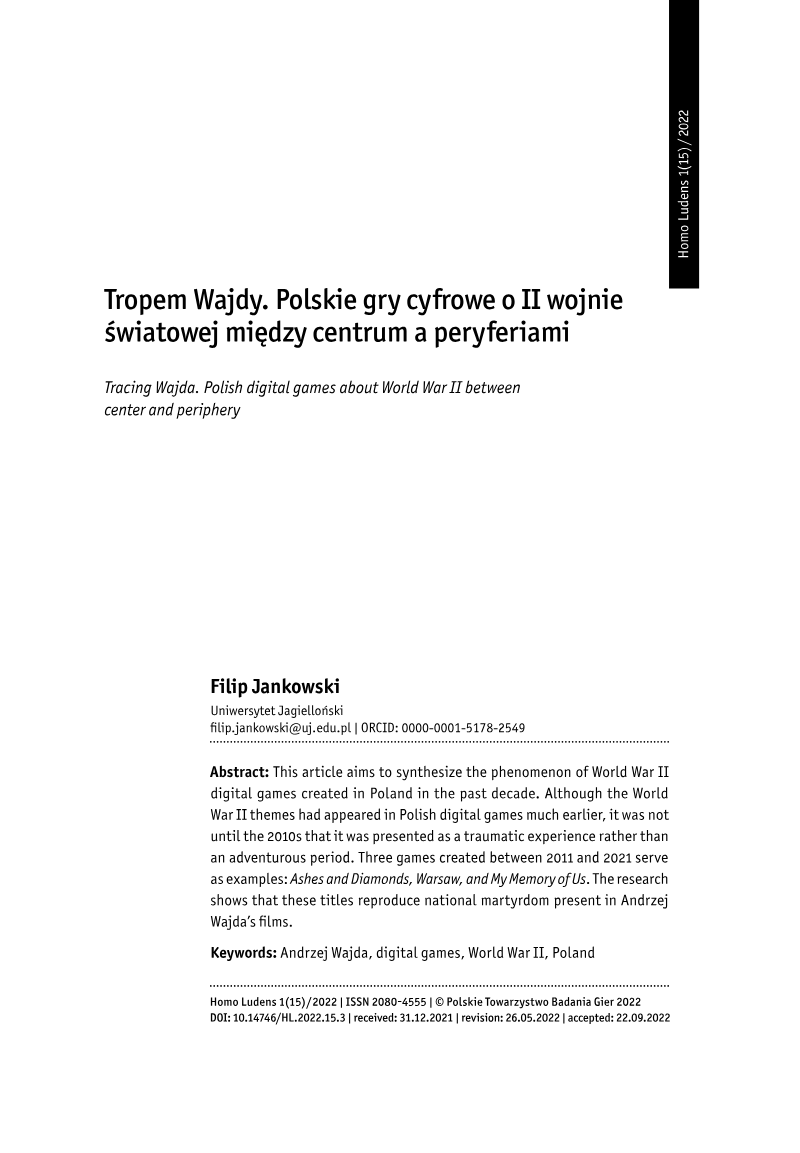
Tracing Wajda: Polish Digital Games About World War II Between Center and Periphery
This analysis synthesizes the phenomenon of Polish digital games about World War II created between 2011 and 2021, arguing that these titles reproduce the national martyrdom present in Andrzej Wajda's films.
- Polish digital games about World War II shifted in the 2010s from treating the war as adventure or comedy to portraying it as national trauma, with each examined title reproducing the martyrological framing associated with Andrzej Wajda's war trilogy.
- The study analyses three games released between 2011 and 2021: Ashes and Diamonds, Warsaw, and My Memory of Us.
- The analysis frames Polish developers as occupying a periphery relative to a cultural center identified with the American games industry, and notes that Western critics often dismissed their work as derivative.
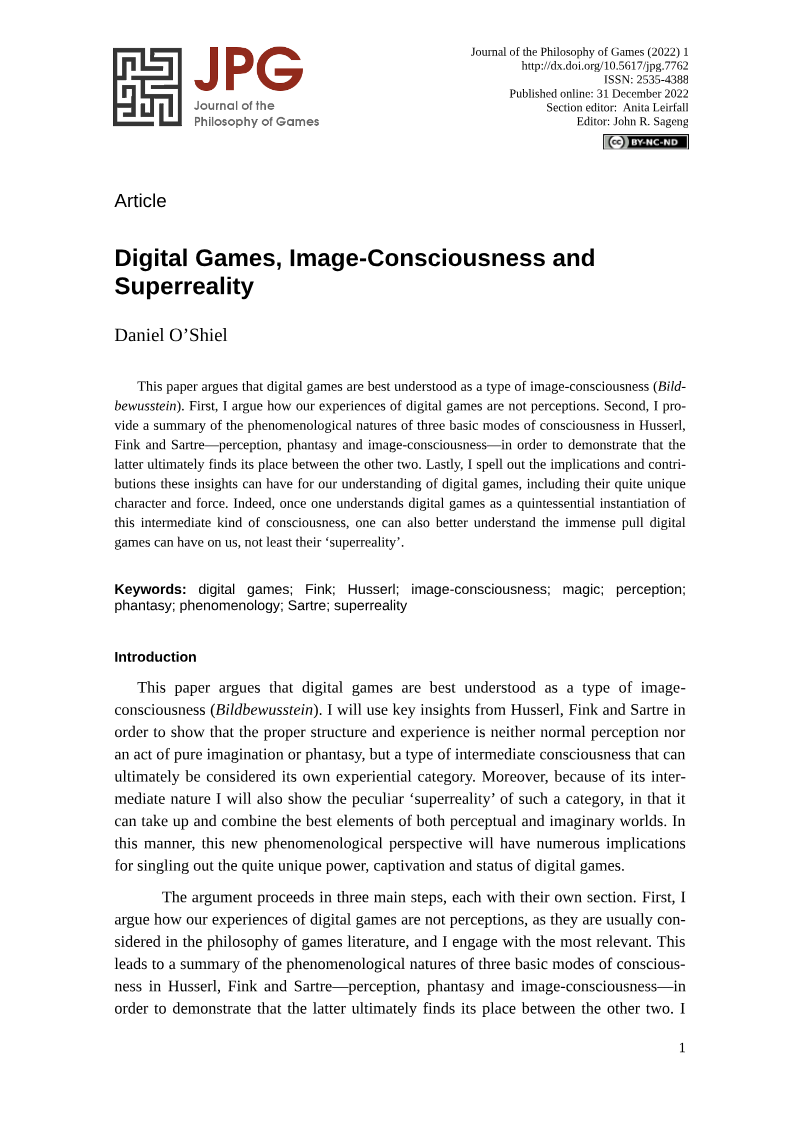
Digital Games, Image-Consciousness and Superreality
Digital games represent a distinct phenomenological category of experience that transcends the traditional binary of perception and imagination.
- Digital games create a unique 'superreality' that functions as an experiential bridge, blending lifelike perception with non-physical, fantastical possibilities.
- Gaming constitutes a distinct form of 'image-consciousness' that transcends the traditional binary of sensory input and mental imagination.
- The high level of interactivity in digital games fosters deeper psychological investment and cognitive engagement than passive media.
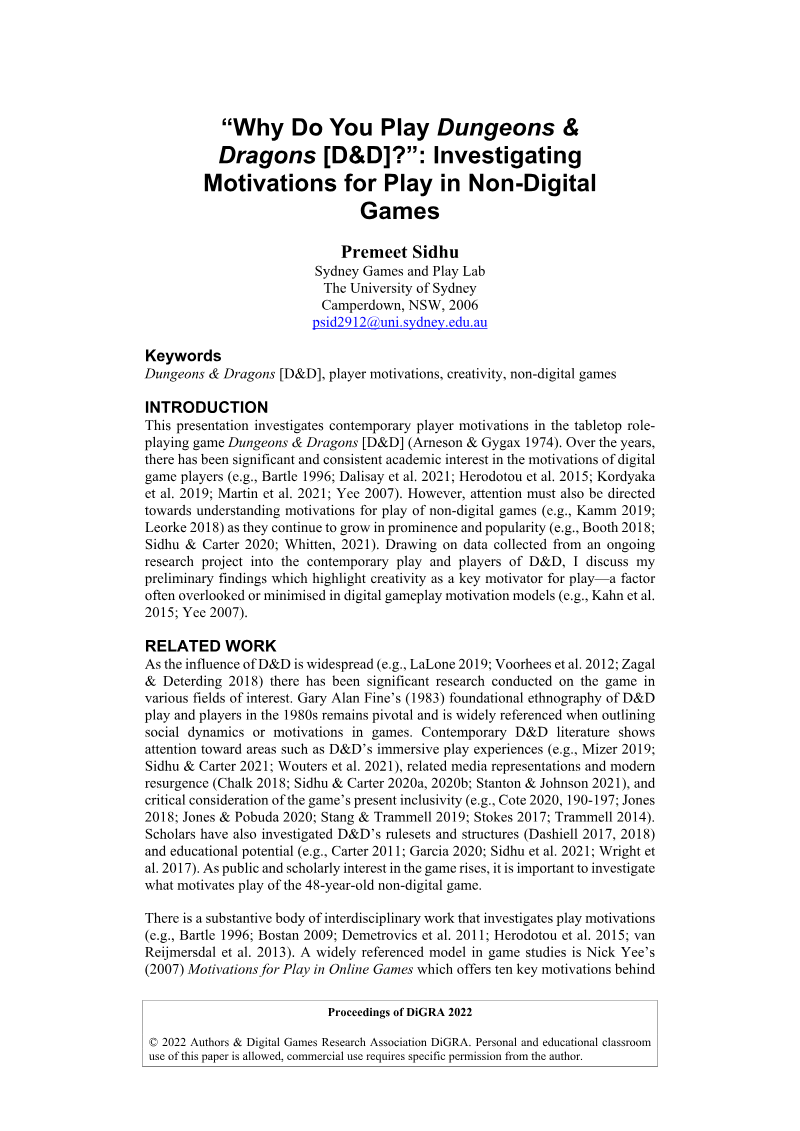
Why Do You Play Dungeons & Dragons [D&D]?: Investigating Motivations for Play in Non-Digital Games
This DiGRA 2022 presentation abstract examines why people play Dungeons & Dragons today, arguing that creativity is a key motivator that existing play-motivation models tend to overlook or minimise.
- The study argues that creativity is a key motivator for contemporary Dungeons & Dragons play, a dimension that existing player-motivation frameworks such as Nick Yee's model of online game motivations tend to overlook or minimise.
- Creativity was mentioned by roughly 70% of interview and observation participants (20 people), 71% of focus group participants (14 people), and 34.5% of the 354 survey respondents aged 18 to 63.
- Participants frequently contrasted D&D's creative freedom and flexible ruleset with the predetermined rules and systems of digital games.
The Image of Nikola Tesla and His Inventions in Digital Games
Nikola Tesla's representation in digital games is examined through a qualitative analysis of twelve titles in which he appears as a character, released through the end of 2018.
- The study analyzes twelve digital games released through 2018 that feature Nikola Tesla as a character, using a cognitive definition method and Nikita Tolstoy's three-code framework to organize his attributes into seven categories.
- Across nearly all titles Tesla is depicted as slim, mustached, suited, exceptionally intelligent, and absorbed in his work, forming a consistent core image.
- Rivalry with Thomas Edison is the dominant relationship, appearing in about three-quarters of the games and often framed around the "War of Currents."
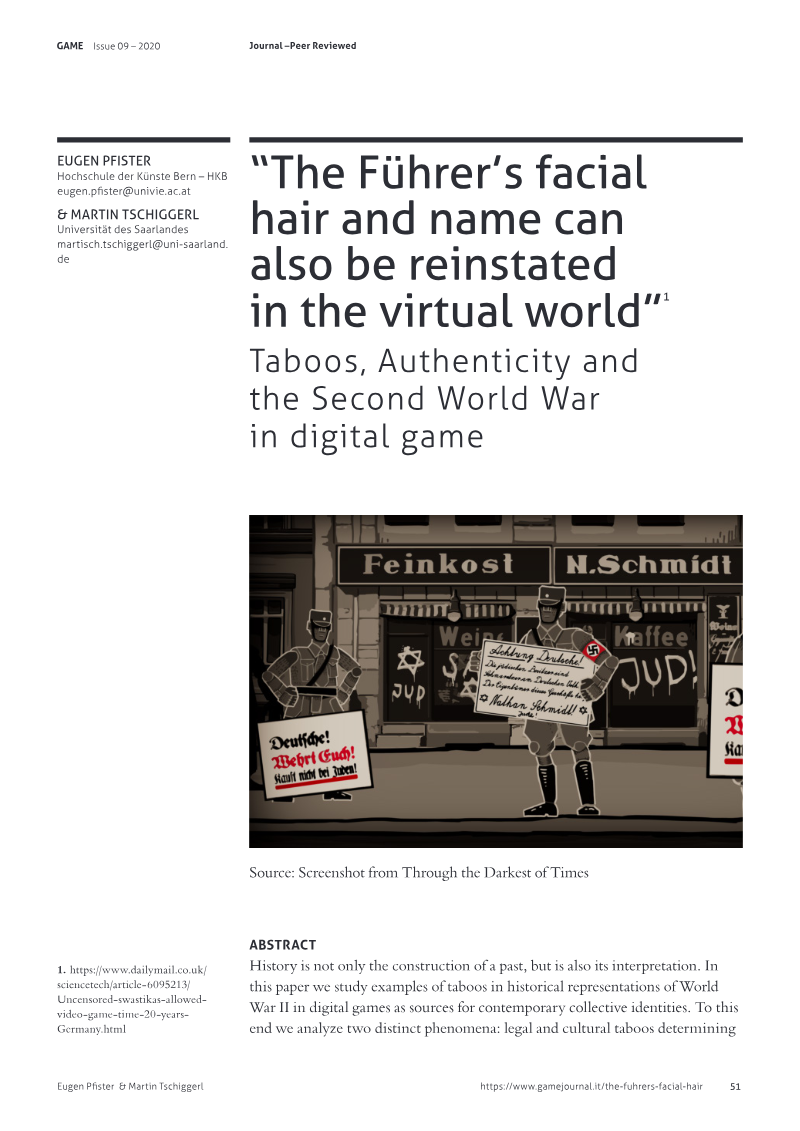
The Führer's Facial Hair and Name Can Also Be Reinstated in the Virtual World: Taboos, Authenticity and the Second World War in Digital Games
Legal and cultural taboos shape how the Second World War, and especially Nazism and the Holocaust, are represented in digital games, and those taboos have been shifting.
- German and Austrian bans on Nazi symbols, extended to games by a 1998 court ruling, led publishers to pre-emptively censor content through cosmetic changes such as covered swastikas and renamed characters, which the authors argue can depoliticize Nazi material rather than prompt critical engagement.
- Earlier controversies such as the 1980s KZ-Manager and the 2010 Sonderkommando Revolt mod drew sharp backlash and withdrawal, while a clear paradigm shift became visible in the late 2010s, partly attributed to the pulp, fantasy, or explicitly historical framing of titles like Wolfenstein: The New Order and Through the Darkest of Times.
- Players have internalized official taboos and generate additional taboos of their own around 'authentic' historical representation, so enforcement of standards comes substantially from the player community rather than only from regulators or publishers.

To Dream a Game: Dreams as Interactive-Narrative Devices in Digital Games
Frank Bosman's 2020 study examines dreams and dreamlike states, including hallucinations, visions, hypnosis, and virtual reality, as interactive-narrative devices in digital games.
- Dream sequences in digital games are almost always lucid because the medium's mandatory interactivity gives players control over dreamlike segments, with the exception of non-interactive cutscenes.
- Citing Gackenbach's research, the article reports that gamers, particularly hard-core players, tend to have more lucid and control dreams, more bizarre dreams, and more violent or nightmarish dreams, which they experience with less distress.
- Bosman proposes a working definition of dreams as a temporarily diminished-consciousness state experienced involuntarily, and applies it through close reading and game-immanent analysis of playable texts.
Animal Ethics in Digital Games
Digital games reproduce and reinforce anthropocentric cultural hegemony, and this extended abstract argues that the treatment of animals deserves the same critical attention that game studies has given to gender and race.
- The authors argue that the depiction of animals in digital games is shaped by anthropocentric cultural hegemony, in which humans alone produce and control the artefacts that define non-human life, and that animal ethics remain largely unaddressed compared with violence, sexualisation, or racial representation in gaming.
- The paper frames animal ethics through three moral positions: denying animals any moral status, advocating humane treatment while still treating animals as subordinate resources, and recognising animals as sentient beings with intrinsic rights.
- Using qualitative content analysis, the authors classify Cabela's Big Game Hunter 2010, Assassin's Creed IV: Black Flag, and Far Cry 4 as reflecting the first position; Shadow of the Colossus and Red Dead Redemption as the second; and Crash Bandicoot, Neko Atsume: Kitty Collector, and The Last Guardian as the third.
Perma-dying Worlds and the Limit of Eternal Return in Digital Games
Most digital games rest on an idea of eternal return: through saves, autosaves, and respawning, players die, learn, come back, and eventually master the game's world.
- Permadeath and permapermadeath mechanics turn repetition from a route to mastery into a source of emotional weight, because choices become permanent and the player's control over outcomes diminishes.
- The article draws on Nietzsche's eternal return, Freud's repetition-compulsion, and Jesper Juul's account of failure to frame why limiting return after death changes the meaning of play.
- This War of Mine offers no saving within a playthrough, so early choices remain memorable even though the game can be replayed.
Digital Games for Special Needs; Special Needs for Digital Games
This 2018 editorial introduces a peer-reviewed special issue of the Italian games journal GAME on the relationship between digital games and special needs, defined as physical, cognitive, and socio-cultural conditions requiring specific interventions in daily routines, learning, and accessibility.
- The games industry is becoming more inclusive through assistive hardware such as the Microsoft Adaptive Controller, accessibility interest groups, customizable input systems, and funding initiatives, yet players with disabilities remain underserved and scholarly literature on the topic is scarce.
- The authors justify further research on video games and disability on four grounds: games sit at the forefront of technological adoption, they shape cultural attitudes toward disability, they allow the social model and cultural lens on disability to be combined, and they show potential for supporting special education.
- Contributions from educational technology, computer science, games studies, design, and biology converge on inclusion and universal access, with asymmetrical roles and diverse input letting impaired and unimpaired players share the same play space rather than being segregated into simplified sub-sections.
Homo Includens: Surveying DiGRA's Diversity
The Digital Games Research Association (DiGRA) faces a critical need to dismantle systemic barriers that perpetuate Eurocentric and masculine hierarchies within its academic community.
- Nearly 64 percent of DiGRA members report feeling unsafe at association events, highlighting an urgent need for formal safety and recourse mechanisms.
- The organization’s membership is demographically skewed, consisting primarily of young, male researchers concentrated in North America and Northwestern Europe.
- Current diversity initiatives are perceived as largely symbolic, failing to address the material barriers that exclude women, genderqueer individuals, and early-career scholars.
Death Narratives: A Typology of Narratological Embeddings of Player's Death in Digital Games
Bosman proposes a typology of how digital games narratively embed the player's death, starting from the observation that in-game death is ludologically just a feedback mechanism, a temporary setback, yet only a minority of games give it a lore-consistent explanation.
- Bosman's study argues that most digital games treat player death as a trivial feedback mechanism, while only a smaller group embeds death within the fictional logic of the game.
- The proposed typology has three main types and seven subtypes: Type 1 covers narratively present deaths resolved by cloning, replacement, or avatar switching; Type 2 covers deaths circumvented through simulation or external help; Type 3 covers games with no explicit death narrative, including permadeath titles.
- Cloning and replacement mechanics nominally acknowledge the avatar's death but preserve near-unbroken player-avatar identification, rendering death narratively meaningless rather than truly preventing it.