Digital Games
Company
Documents about Digital Games
Videogames, the Anthropocene, and Other Problems of Scale: Methodological Notes for the Study of Digital Games in Times of Ecological Crisis
The study of digital games within the context of the Anthropocene requires a fundamental shift in methodology, moving away from traditional frameworks that treat games as either educational instruments for behavioral change or representational tools for depicting ecological collapse.
- Current research methodologies that treat games as educational tools or representational media for climate change fail because they incorrectly assume that in-game messaging scales predictably into real-world environmental action.
- Scholars should shift focus from broad, data-driven analyses toward 'molecular encounters,' which prioritize the micro-level, non-strategic interactions between players and digital systems.
- The Anthropocene should be studied as an underlying condition that shapes the nature of digital play rather than as a subject for explicit environmental representation.
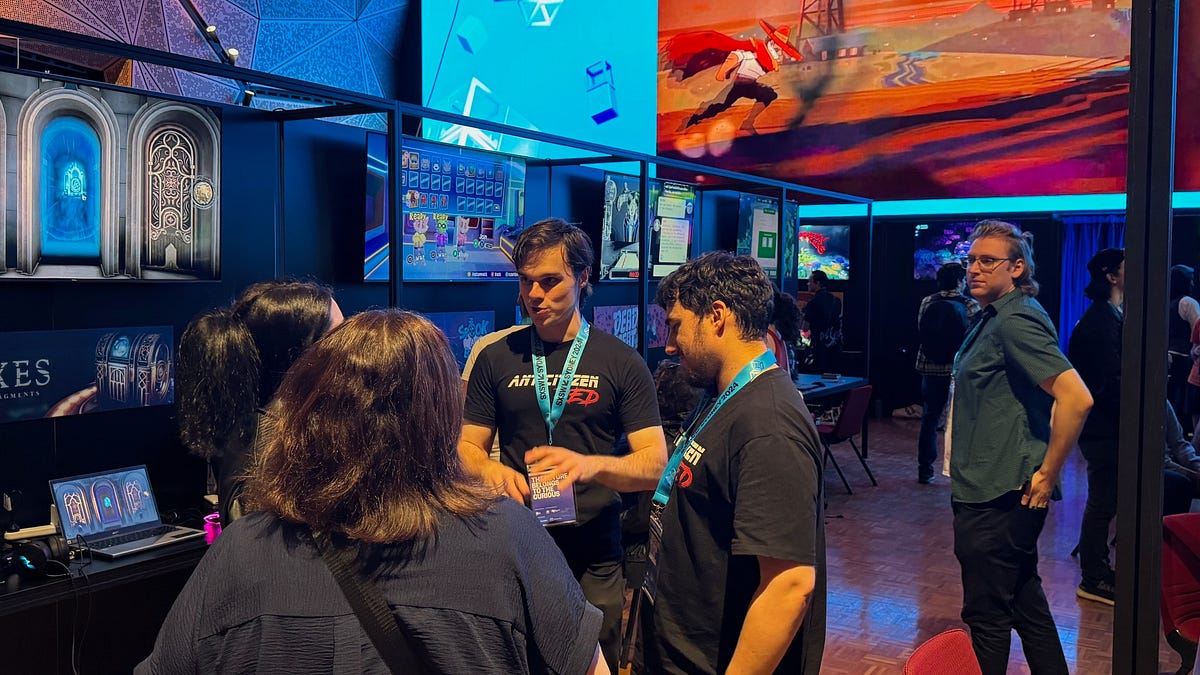
SXSW Sydney: Three Things I Learned from This Year's Festival
This document summarizes key observations from the SXSW Sydney festival, focusing on the Australian video games industry and broader trends.
- The New South Wales games industry faces significant instability due to a 2023 government attempt to withdraw $190 million in screen industry funding.
- Australian developers lack a robust professional services infrastructure, specifically in banking, legal, and corporate advisory sectors, which hinders access to specialized financial products.
- Twitch is strategically pivoting away from its 'games-only' brand identity to compete directly with short-form platforms like TikTok for broader audience engagement.

Press Start: Games Start-up Scholarship for German Developers
Germany's federal government is launching the "Press Start: Games start-up Scholarship," a funding program designed to help game developers establish their own studios.
- The German government is investing 8 million euros into the 'Press Start' scholarship to support up to 130 emerging video game studios.
- Selected participants will receive a monthly stipend exceeding 2,750 euros alongside an 18-month program of professional coaching and workshops.
- The initiative is open to entrepreneurs who have established a studio within the last 18 months or intend to launch one in the near future.
Avant-Garde Is Dead? On Arrière-Garde and Digital Games
The scholarly inquiry into the evolution of digital game aesthetics challenges the traditional assumption that the avant-garde remains the primary driver of innovation within the medium.
- The academic article 'Avant-Garde is Dead? On Arrière-Garde and Digital Games' was published in the journal Games and Culture by authors Aleksandra Prokopek and Agata Waszkiewicz.
- The research explores the conceptual shift from avant-garde to arrière-garde movements within the context of digital gaming.
- The study specifically examines the rise of 'cozy games' and 'bedtime digital games' as emerging categories in the industry.
Salmon Grief in Sámi Digital Games
This analysis examines how Indigenous digital game creation in Northern Fennoscandia addresses the profound environmental and cultural impacts of declining salmon stocks on the Sámi people.
- Two small Sámi games, The Story of the Rainbow Salmon and The Rainbow Salmon Talks With Fish, were created in 2023 during Skins workshops in Ohcejohka/Utsjoki and are presented as spaces for expressing salmon grief (luossamoraš).
- The grief stems from the collapse of Atlantic salmon stocks on the Deatnu River, leading to a fishing ban from 2020 after the 2017 New Deatnu Agreement, which the authors characterize as settler colonialism following Kuokkanen's analysis.
- Sámi communities anticipated losses of up to 80% of their fishing rights under the New Deatnu Agreement, and the authors frame the resulting grief as cultural and identity-related rather than merely ecological.

New Law Will Change How Digital Games Are Sold: California
A new California law, AB 2426, will significantly alter how digital games and other digital goods are sold in the state, effective January 1.
- Starting January 1, 2025, California law AB 2426 prohibits digital retailers from using terms like 'buy' or 'purchase' for digital goods unless they provide a clear, conspicuous warning that the consumer is acquiring a potentially revocable license rather than permanent ownership.
- The legislation applies to any digital game sold with digital rights management (DRM), effectively covering nearly all titles sold through major digital marketplaces like Valve, Xbox, and PlayStation.
- Retailers failing to comply with the new disclosure requirements face potential fines of $2,500 per non-compliant listing and sale, in addition to potential violations of California’s Unfair Competition Law.
The Many Facets of Culture in Digital Games Policy: The EU Dimension
The document examines the European Union's evolving approach to digital games within its cultural policy framework, specifically through the lens of State aid rules.
- The European Commission now treats culture and economics as intertwined in State aid decisions under Article 107(3)(d) TFEU, framing State aid for games as a form of cultural policy rather than competition policy alone.
- The Commission's stance on digital games has shifted from excluding them in the 2013 Cinema Communication and requiring proof of market failure, to demanding demonstrable cultural value, and later to a more industrial, creative-cluster view.
- A 2006 French tax relief case questioned whether games qualified as cultural products at all, while national schemes in the UK, Denmark, Germany, Italy, Belgium, and Ireland were initially scrutinised for cultural value, often favouring artistic or educational titles.
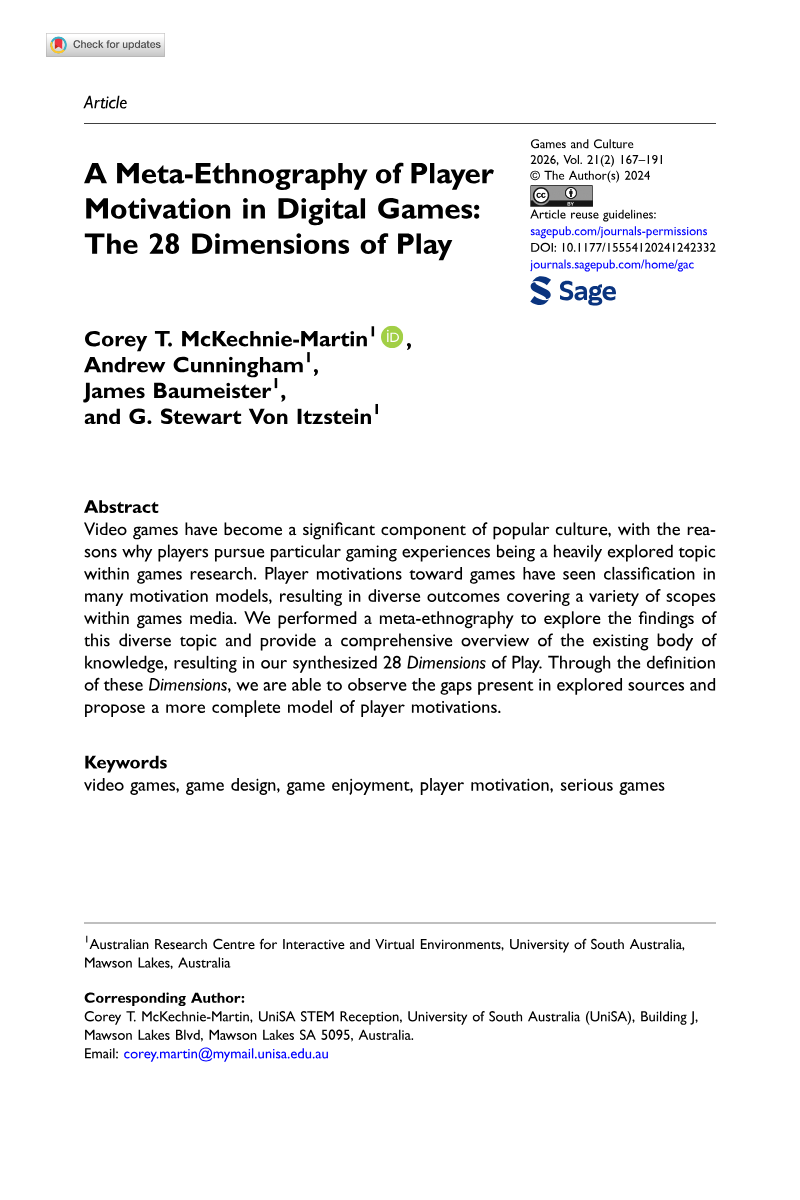
Motivation in Digital Games: The 28 Dimensions of Play
The study of digital game engagement has long suffered from fragmented research and overly simplistic player typologies that fail to capture the complexity of modern gaming experiences.
- A new meta-ethnographic analysis has synthesized 332 concepts into a standardized framework of 28 distinct dimensions of play to replace fragmented and simplistic player typologies.
- Existing industry models for player motivation are insufficient, currently accounting for less than 25% of the identified dimensions of engagement.
- The research identifies critical gaps in understanding player motivations within serious games, e-sports, and social media-integrated platforms.
Game On: Ireland's Digital Games Sector Gets Ready for Growth 2024
The document, "Game On: Ireland's Digital Games Sector Gets Ready for Growth 2024," asserts that Ireland's digital gaming sector is poised for significant expansion, driven by a new tax incentive and the presence of established industry players.
- Ireland's digital games sector is poised for growth, significantly bolstered by a new Digital Games Tax Credit, which many in the industry believe could replicate the success of the Section 481 relief for film and TV.
- Major international gaming companies like Black Shamrock, Riot Games (League of Legends), EA Games, and Demonware already have a significant presence in Ireland, with Black Shamrock planning to expand its Dublin studio to 200 people by 2022.
- The Digital Games Tax Credit offers a 32% tax credit on eligible expenditure, capped at €25 million per project, with StoryToys being the first company to successfully apply for and reinvest the credit.
A UK Games Plan: Why Government Needs a Dedicated Strategy to Grow the Sector
The UK games industry requires a dedicated government strategy to sustain its growth and competitiveness against international rivals.
- The UK video games industry generates £6 billion in gross value added and supports 76,000 jobs across regional clusters.
- The sector currently lacks a cohesive national government strategy, leading to fragmented regulation and inconsistent policy support.
- International competitors including Australia, Germany, and Saudi Arabia are actively implementing state-backed strategies to capture global investment and talent, threatening the UK's market position.
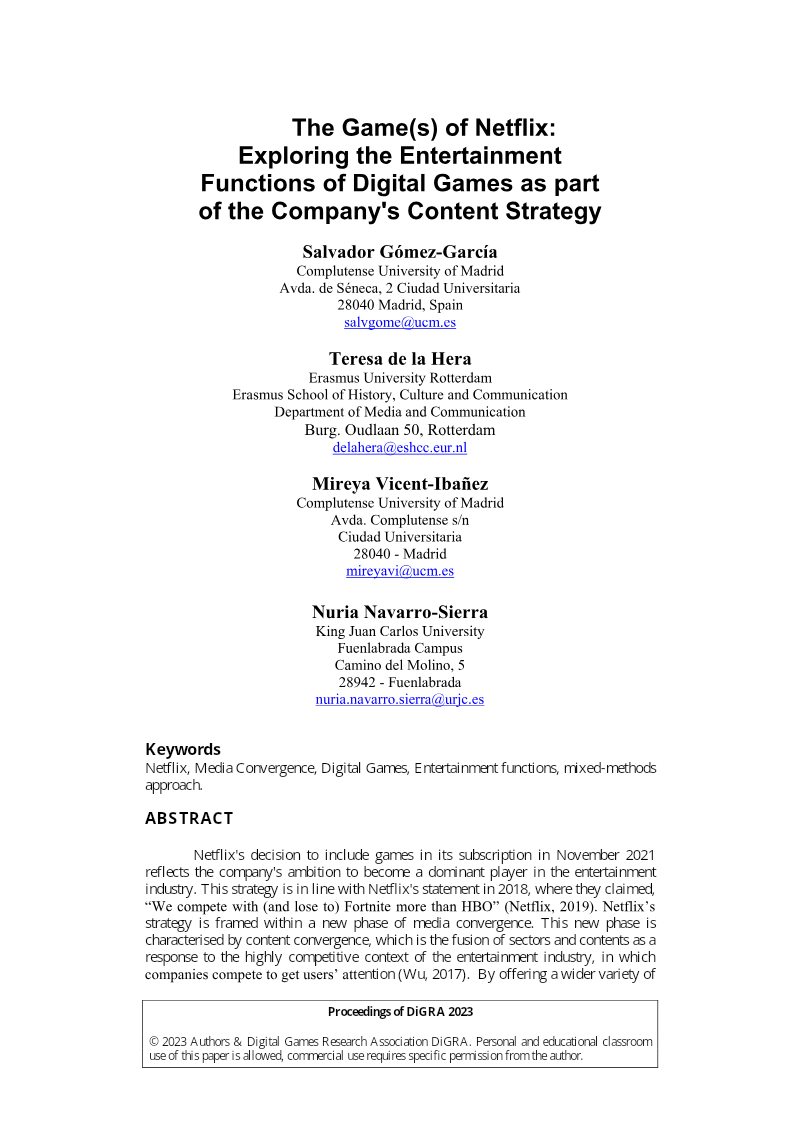
The Game(s) of Netflix: Exploring the Entertainment Functions of Digital Games as Part of the Company's Content Strategy
Netflix's integration of games into its subscription service, initiated in November 2021, represents a strategic move to solidify its position within the broader entertainment industry.
- Netflix began including games in its subscription in November 2021, a move the report frames as part of a broader ambition to become a dominant force in entertainment through content convergence.
- The study analysed the 48 games Netflix released through December 31, 2022, combining SensorTower app-monitoring metadata (genre, release date, downloads, age rating, links to audiovisual content) with a thematic play-based analysis.
- Netflix's primary approach centres on basic interactive entertainment meant to enhance the perceived value of its subscription, while transmedia, branded, and third-party licensing strategies are only beginning to emerge.
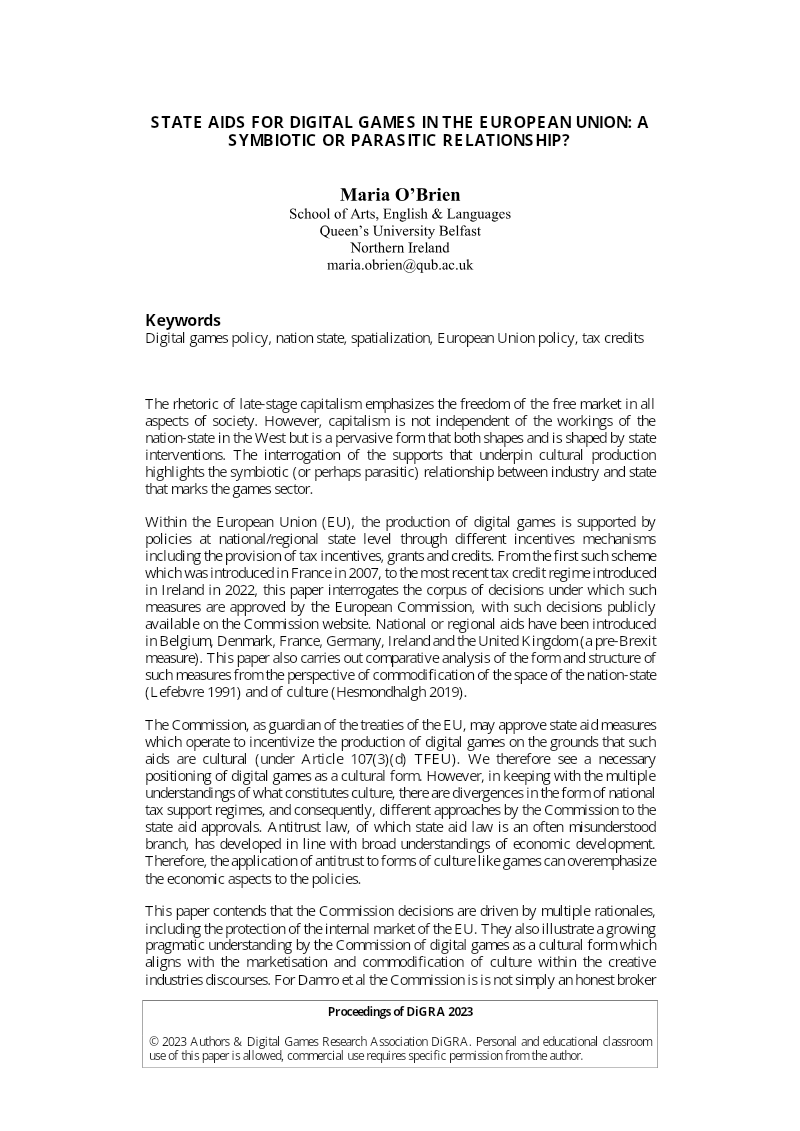
State Aids for Digital Games in the European Union: A Symbiotic or Parasitic Relationship?
The document analyzes state aid mechanisms for digital games within the European Union, examining the relationship between national/regional state interventions and the games industry.
- The paper's central thesis is that EU state aid for digital games is simultaneously symbiotic (genuinely supporting creative production) and parasitic (embedding that support within capitalist commercial logics).
- The European Commission treats digital games as a cultural form under Article 107(3)(d) TFEU, but its approvals are driven by multiple rationales, including protection of the EU internal market and alignment with creative industries discourses that emphasise the marketisation of culture.
- The study examines national tax incentives, grants, and credits in Belgium, Denmark, France, Germany, Ireland, and the United Kingdom (a pre-Brexit measure), with the earliest scheme introduced in France in 2007 and the most recent in Ireland in 2022.