2015
Company
Documents about 2015

Mobile Game Publishing Models
Mobile game publishing still largely follows a revenue-share model borrowed from boxed-goods distribution, with the publisher as distributor and the developer as content creator.
- The traditional mobile game publishing model, which relies on simple revenue sharing and platform featuring, is failing because it lacks the necessary investment in performance-based user acquisition.
- Mobile game revenue growth is projected to slow to approximately 14.5% annually through 2021, while investment volume in the sector reached its lowest level since 2010.
- Developers should define 'distribution' in publishing contracts as performance marketing rather than platform relationships, ensuring the publisher commits to financing and managing user acquisition campaigns.

New Digimeter Report: Mobile Gaming Takes First Place
The 2016 Digimeter, the annual study from imec (formerly iMinds) directed by Prof. Lieven De Marez of Ghent University, tracks media and technology adoption in Flanders and has done so since 2009.
- Mobile phones have become the primary gaming platform in Flanders, with 34% of the population playing mobile games as of 2016.
- Mobile gaming adoption grew from 30.4% in 2015 to 33.2% in 2016, while desktop/laptop gaming dropped from 31.2% to 24.4% and console gaming fell from 14.8% to 11.4%.
- The percentage of the population using mobile phones as their exclusive gaming device increased significantly from 6.9% in 2015 to 11.2% in 2016.

The Coming War Between Apple and Facebook
Eric Seufert argues that Apple and Facebook, which have long occupied separate roles as content platform and advertising platform respectively, are being pushed toward conflict by slowing smartphone growth and a maturing app economy.
- Apple and Facebook are competing for control over mobile app distribution, a struggle for the 'golden fleece' of directing user attention and app installs.
- Apple has shifted from viewing the App Store solely as a hardware differentiator to a direct revenue generator, evidenced by the introduction of App Store search ads to capture a share of the mobile install ad market.
- Facebook has built a dominant mobile advertising business by leveraging proprietary data, including the integration of WhatsApp phone numbers with Facebook profile data announced in 2016.
Three Mobile User Acquisition Megatrends in 2017
Eric Seufert presents "Three UA Megatrends for 2017," a talk delivered on January 16, 2017 at Pocket Gamer Connects in London.
- The provided document serves as a landing page for a presentation titled 'Three Mobile User Acquisition Megatrends for 2017' delivered by Eric Benjamin Seufert at the Pocket Gamer Connects conference on January 16, 2017.
- The report content does not contain the specific text or data points regarding the three identified megatrends.
- The source material functions as a directory for industry commentary and resources rather than a standalone summary of the 2017 trends themselves.
Finding Lost & Found: Designer's Notes from the Process of Creating a Jewish Game for Learning
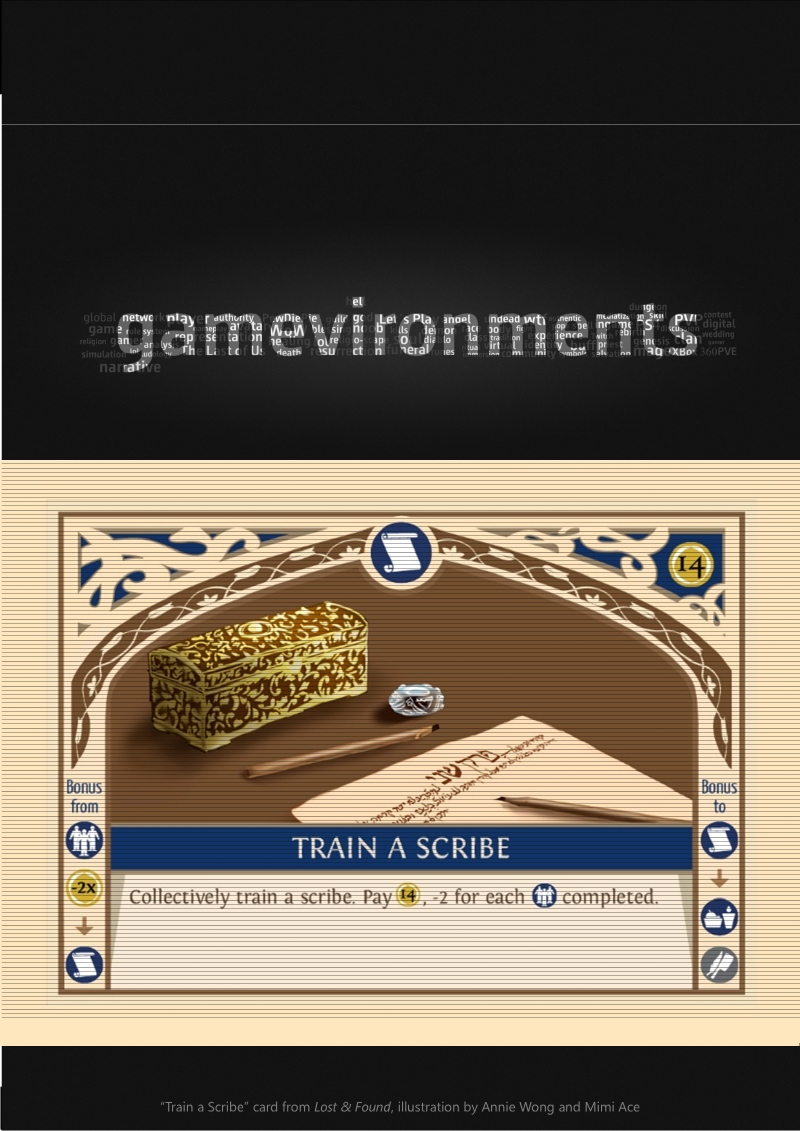
Owen Gottlieb's 2017 article in gamevironments applies design-case methodology to show how his team balanced player engagement with learning goals while creating Lost & Found, a tabletop-to-mobile game series that teaches medieval religious law.
- The game Lost & Found, developed by Owen Gottlieb through ConverJent at CLAL starting in 2011, teaches medieval Jewish law on lost property drawn from Maimonides' Mishneh Torah (1180) and Talmudic sources such as Sanhedrin 17b and Kiddushin 29a.
- The central design challenge was balancing the law's tension between communal obligation and protecting individuals from undue burden, which the team judged existing cooperative and 'coopetition' models such as Pandemic and Shadows Over Camelot could not adequately capture.
- Key mechanics included win conditions requiring cooperative construction of communal goals alongside individual family goals, hidden progress tracks, multiple win states including an all-lose outcome, and redefining winning as 'living a good life' through secret 'Acts of Meaning.'
Collecting, Preserving, and Interpreting the History of Electronic Games: An Interview with Jon-Paul C. Dyson
Jon-Paul Dyson, director of The Strong museum's International Center for the History of Electronic Games (ICHEG), argues that video games deserve the same serious collection, preservation, and scholarly treatment as any other cultural artifact, and that they are best understood as part of the longer history of play.
- The International Center for the History of Electronic Games at The Strong in Rochester, New York, has grown from fewer than 100 items in 2006 to a collection exceeding 60,000 games and related artifacts, and draws more than 550,000 visitors annually.
- Director Jon-Paul C. Dyson argues that electronic games are uniquely hard to preserve because they depend on obsolete hardware, fragile storage media, and social play contexts that are easily lost.
- The museum's five-part preservation strategy covers original hardware and software, published materials and archival records from industry figures, gameplay recorded on original equipment, and source code preservation with file migration, with digitization occurring only after items are stabilized and cataloged.
If You Are Feeling Bold, Ask for $3: Value Crafting and Indie Game Developers
Consalvo and Paul introduce "value-crafting," a concept extending Browne's "indie labor" and Paul's "theorycrafting," to describe how independent developers use experimentation, data, and metrics to determine what their games are worth, how to price them, and how to market them, often while bearing heavy personal financial risk.
- Indie games have no industry-standard price point, with prices ranging from free to roughly $30 and developers debating between $5, $10, or free-to-play, often based on anecdote rather than consistent evidence.
- Indie success has shifted from simply making a good game toward "value-crafting," which relies on analytics, pricing research, community engagement, and sustained marketing.
- By 2014 and 2015 Steam dominated indie sales, often accounting for the large majority of units sold, with Valve taking 30 percent of revenue.

2017 Economic Impact Report
Video Games in the 21st Century: The 2017 Report, published by the Entertainment Software Association, presents itself as the most current measurement of the US entertainment software industry's contribution to the American economy.
- In 2016, the U.S. video game industry generated over $24.5 billion in total software sales.
- The U.S. video game industry contributed more than $11.7 billion in value to the national GDP in 2015.
- The industry directly employed more than 65,000 people across the United States in 2016.
An Unwelcome Intrusion? Player Responses to Survey Research Recruitment on the World of Warcraft Forums
Academic research recruitment within the World of Warcraft forums between 2010 and 2015 reveals a profound disconnect between scholarly objectives and community expectations.
- Academic recruitment on World of Warcraft forums between 2010 and 2015 faced significant player hostility due to survey fatigue and the high volume of repetitive data collection requests.
- Players frequently perceive unsolicited survey requests as security threats, often conflating academic research with phishing or malware attempts.
- Successful research outcomes in gaming communities require moving away from extractive, transactional survey models toward collaborative, community-centered engagement strategies.
Bust A Cup: Reclaiming Risk in Play
Brian Schrank argues that contemporary "risk society," a term borrowed from Ulrich Beck, has stripped play of beneficial risk, and that games carrying real physical, legal, or perceived danger can help players confront self-imposed limitations.
- Schrank argues that contemporary risk society has drained games and everyday life of meaningful danger, leaving players in cycles of safe, low-stakes interaction while the perceived world grows more threatening.
- He contends that games with real, designed risk can help players confront self-imposed limits, reconfigure physical, spatial, legal, and personal boundaries, and build resilience against fear-based manipulation.
- The central example, Bust A Cup, is a two-player puppet brawl using coffee cups that softens the reality of street combat while preserving its capacity to unsettle and provoke.
Self-Reflexive Videogames: Observations and Corollaries on Virtual Worlds as Philosophical Artifacts
Stefano Gualeni argues that self-reflexive videogames, meaning titles that use unsettling, convention-subverting gameplay and deliberately exposed constructedness such as glitches and debug information, can serve as philosophical artifacts.
- Gualeni argues that self-reflexive videogames, which expose their own artificiality through subversion and unfamiliarity, can function as philosophical artifacts that prompt critical reflection on both game conventions and modes of thought.
- The argument draws on modernist precedents including Brecht's epic theater, Surrealism, and the Russian Formalist concept of defamiliarization associated with Shklovsky and Pound.
- The essay's main case study, NECESSARY EVIL (2013), casts the player as a disposable minion of evil confined to a room with deliberately non-functional interactions, exposing the player-centric ideology behind many virtual worlds.
Critical Jostling
Videogames can function as critique as well as targets of it, and this essay argues that critical game design can work through reconfiguration.
- Pippin Barr proposes "reconfiguring the remainder" as a critical method: shifting conventional design standards to expose what games omit or take for granted, while keeping the work functional and playable, drawing on Dunne and Raby's critical design and DiSalvo's adversarial design.
- Barr's Jostle Bastard reworks Hotline Miami by replacing killing with non-fatal "jostling" and adding social consequences such as arrest, job loss, eviction, and victim revenge, plus a mundane non-violent life option that makes violence feel unnecessary.
- Jostle Parent reworks the comic parenting scenario of Octodad: Dadliest Catch into an emotionally serious game by letting the player's children die permanently, recorded via gravestones and named children, removing the source's linear, consequence-free narrative.