2015
Company
Documents about 2015
(Re)Play the Beginning of the End: 1988 as Prequel to Umbrella Movement in Hong Kong
This study examines 1988, a 2015 alternative history game by Hong Kong designer Cheng Lap, as a form of digital activism in the aftermath of Hong Kong's 2014 Umbrella Movement.
- The study treats 1988, a 2015 alternative history game by Hong Kong designer Cheng Lap, as a form of digital activism emerging from the aftermath of the 2014 Umbrella Movement, set a decade before the 1997 handover to China.
- The game places a teenage immigrant from mainland China against a hegemonic alliance of the Chinese Communist Party and real estate interests, and the author argues it actively constructs and circulates "Hong Kong local" identity as an emerging nationality.
- The analysis distinguishes two dimensions of "Hong Kongness": the richly detailed fictional Hong Kong built within the game, and the online community that treats playing and discussing it as a progressive political act.

"A Pure Meritocracy Blind to Identity": Exploring the Online Responses to All-Female Teams in Reddit
Siutila and Havaste's study examines online reactions to the announcement of all-female esports teams, drawing on 952 Reddit comments from two subreddits, r/leagueoflegends and r/GlobalOffensive, which are dominated by what the authors term "geek masculinity."
- Commenters on r/leagueoflegends and r/GlobalOffensive (952 Reddit comments analysed by Siutila and Havaste) overwhelmingly described esports as a meritocracy "blind to identity" while viewing all-female teams with suspicion.
- The dominant community view was that a sponsorship by a pornography company was a publicity stunt that damaged perceptions of women players, and that all-female teams' low rankings and rule-based exclusion from top competitions made them ineligible for higher-tier play.
- Many commenters asserted women showed less skill, though some cited Ratan et al. (2015), which found men and women acquire League of Legends skill at equal rates when time played is controlled.
The Last Jedi Premiere More Than Doubled Star Wars Mobile Game Downloads
The release of the film The Last Jedi in December 2017 served as a significant catalyst for the mobile gaming sector, driving a substantial surge in new user acquisition for Star Wars-themed titles.
- The opening weekend of 'The Last Jedi' drove a 153% increase in new Star Wars mobile game installs, resulting in over one million new downloads compared to approximately 413,000 the previous weekend.
- Top-performing titles significantly outperformed the franchise average: Netmarble's 'Star Wars: Force Arena' grew by 260%, EA's 'Star Wars: Galaxy of Heroes' by 216%, and Disney's 'Star Wars: Commander' by 201%.
- While the 2015 release of 'The Force Awakens' generated a higher total volume of 2.17 million downloads, 'The Last Jedi' achieved a stronger relative growth rate of 2.5x week-over-week compared to the 1.8x growth seen in 2015.
Interview with Joonas Laakso, Executive Producer at Next Games Oy, Finland
This interview, published in the 2017 issue of the gamevironments journal, features Joonas Laakso, Executive Producer at Next Games Oy, a Helsinki-based studio of roughly 120 people that develops mobile games built on established entertainment intellectual properties.
- Next Games Oy is a Helsinki-based mobile game studio of roughly 120 people, founded in 2013, that builds games on established entertainment IP and aims to be the preferred partner for bringing major entertainment brands into mobile gaming.
- Its flagship title, The Walking Dead: No Man's Land (2015), is followed by the upcoming augmented reality project The Walking Dead: Our World and a Blade Runner mobile game in development.
- Acceptable content varies sharply by region: blood, dead bodies, and religious symbols require careful handling, and South Korea imposes a strict age-rating barrier.

Games from Germany: Market Share Remains Stubbornly Low
The 2017 Annual Report of the Computer and Video Games Industry, published by the German Games Industry Association (BIU), highlights a concerning stagnation in the domestic market share for German-developed games.
- The total market share of German-developed games fell to 6.4% in 2016, down from 7% in 2014 and 6.5% in 2015.
- German developers’ market share for smartphone and tablet games experienced a significant decline, dropping from 7% in 2015 to 4.2% in 2016.
- In the PC and console segment, which represents the largest portion of the market, the German-developed share fell from 0.6% to 0.5% in 2016.

Gamers Are Spending More on Fee-Based Online Networks
The German games industry experienced a significant shift in consumer behavior during 2016, characterized by a sharp rise in spending on fee-based online network memberships.
- Sales for fee-based online gaming networks in Germany grew by 48% year-over-year, rising from 77 million euros in 2015 to 114 million euros in 2016.
- The total German market for computer and video games surpassed the two-billion-euro mark for the first time in 2016, reaching 2.13 billion euros—a 7% increase over 2015.
- Gamers aged 20–29 represent the largest demographic for paid network memberships, accounting for 34% of the user base.
Cataluña se Consolida como el Motor de la Industria Española del Videojuego
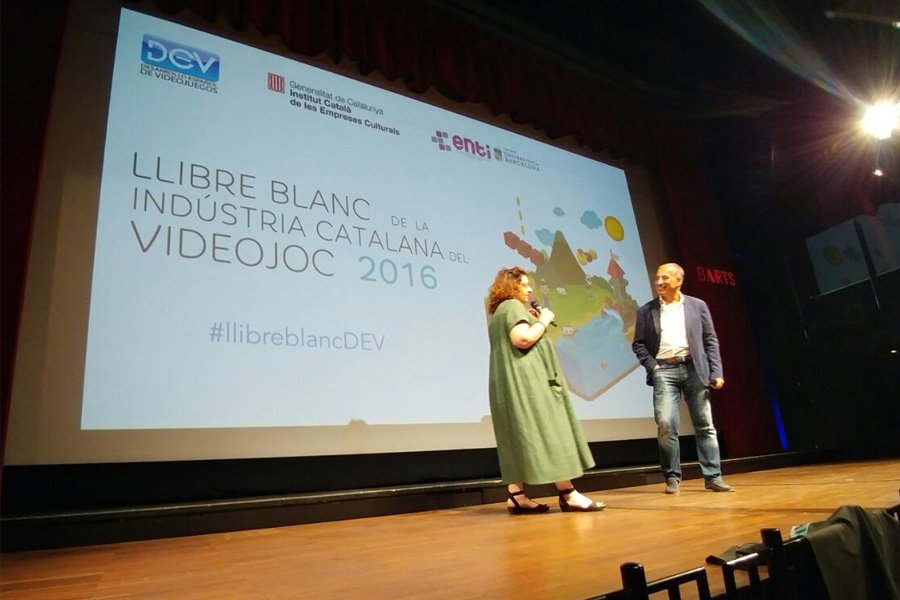
The first edition of the Libro Blanco de la Industria Catalana del Videojuego establishes Catalonia as the primary hub for the Spanish video game sector.
- Cataluña accounts for 25% of the Spanish video game industry, comprising 120 companies and generating over 40% of the national sector's total revenue.
- The Catalan video game industry generated 217 million euros in revenue in 2015, with projections to exceed 600 million euros by 2019.
- The sector employs 1,687 professionals directly, with a total of over 3,000 jobs linked to the industry, and is projected to surpass 4,600 direct jobs by 2019.
Gamers Are Increasingly Buying Additional Content for Segments Such as Free-to-Play Games: Germany
The German games industry experienced significant growth in 2016, driven largely by the increasing popularity of free-to-play titles and the monetization of virtual goods.
- The German market for virtual goods and additional content in games grew by 17% in 2016, reaching a total revenue of 659 million euros.
- The number of paying users for in-game content in Germany increased from 3.3 million in 2015 to 3.9 million in 2016.
- Average monthly spending per paying user rose from 12.02 euros in 2015 to 13.57 euros in 2016.
Clash Royale: Highest Earning Week Ever
The mobile strategy game Clash of Clans achieved its highest-grossing week in history following the release of the Builder Base update on May 22, 2017.
- Following the May 22, 2017, 'Builder Base' update, Clash of Clans achieved its highest-grossing week ever with over $25.7 million in U.S. consumer spending.
- The update drove a 250 percent increase in weekly revenue compared to the previous week's $7.3 million.
- The $25.7 million weekly total represents a 20 percent increase over the game's previous record of $21.3 million, set during the week of December 21, 2015.
Gardenscapes: One Big Pivot to Success
The success of Gardenscapes serves as a case study in the strategic pivot from a hidden object game to a match-three puzzle format.
- Playrix successfully pivoted Gardenscapes from a Hidden Object game to a Match 3 game during its 2015 soft launch, a move that established it as a top-grossing title by September 2016.
- Match 3 mechanics outperform Hidden Object games in scalability because they allow for faster content production and easier reuse of assets compared to the labor-intensive, unique scene requirements of Hidden Object titles.
- The transition to a Match 3 core introduced a 'failure state'—the inability to complete a level—which creates a more effective monetization loop by incentivizing players to purchase boosters and extra moves to avoid losing progress.

Market for Game Apps Grows by 30 Per Cent in 2016: Germany
The German games market experienced significant growth in 2016, driven primarily by the rapid expansion of the mobile gaming sector.
- The German market for game apps grew by 30% in 2016, reaching 409 million euros in sales.
- Total sales for computer and video games in Germany surpassed the two-billion-euro mark for the first time in 2016, totaling 2.13 billion euros.
- The mobile gaming segment has seen significant expansion, with sales increasing by approximately 70% over the two-year period from 2014 to 2016.

Strong Demand for Computer and Video Games: Sales Up 7 Per Cent (Germany)
The German games industry experienced a notable shift in revenue streams during 2016, characterized by strong growth in digital content and services despite a decline in hardware sales.
- The German market for computer and video games (including online network fees) grew by 7% in 2016, reaching 2.13 billion euros and surpassing the 2 billion euro threshold for the first time.
- Total market revenue, which includes hardware and peripherals alongside software, remained stable at 2.9 billion euros in 2016.
- Sales of games consoles and peripherals declined by 15% to 747 million euros, driven by a drop in average device prices.