Usa

48 documents·26 publishers

Documents

Page 1
Report20 pages

Match3 Genre Snapshot: US iOS (May 2021)

The Match3 subgenre represents the largest individual segment of the US iOS mobile gaming market, accounting for approximately 16% of total market revenue as of May 2021. While the category has long been dominated by established titles that have maintained chart positions for years, recent market shifts indicate a move away from traditional swapping mechanics. Notably, none of the new Match3 titles entering the top 500 grossing rankings over the last 18 months utilize standard swapping gameplay, signaling a diversification in core mechanics and the rising importance of meta-layers.

Meta-elements, particularly those focused on decoration and customization, have become essential components for modern success in the genre. Successful megahits like Royal Match and Project Makeover demonstrate the effectiveness of combining core puzzle gameplay with deep progression systems and sophisticated monetization strategies. Data indicates that recurring live events, special event rewards, and limited-time in-app purchase offers have the highest impact on revenue. Furthermore, social features such as guild mechanics and "send/ask help" systems are increasingly vital for driving engagement and retention.

Player motivation analysis, based on a survey of over 7,000 mobile gamers across English-speaking Western markets, reveals distinct psychological drivers within the genre. While "Thinking and Solving" remains the primary driver for traditional titles like Candy Crush Saga, newer successful entries increasingly lean into "Customization and Decoration" and "Role-playing and Emotions." This shift reflects a broader industry trend where loss aversion mechanics and social competition are leveraged to enhance the player experience and maximize lifetime value in a highly competitive landscape.

  • As of May 2021, the Match3 subgenre accounts for approximately 16% of total US iOS mobile gaming revenue.
  • No new Match3 titles entering the top 500 grossing rankings over the last 18 months utilize standard swapping mechanics, indicating a shift toward gameplay diversification.
  • Modern Match3 success is increasingly driven by meta-layers, specifically decoration and customization features seen in titles like Royal Match and Project Makeover.
  • Revenue performance in the genre is most heavily influenced by recurring live events, special event rewards, and limited-time in-app purchase offers.
  • Social features, including guild mechanics and help-request systems, are now essential for maintaining player engagement and retention.
+5
GameRefineryMay 2021
Page 1
Report21 pages

Market Snapshot: Q1 2021 US, China & Japan

The mobile gaming market in the first quarter of 2021 demonstrated regional divergence in genre performance, with the United States remaining relatively stable while China and Japan experienced notable shifts in market share. In the US, simulation games continued to grow, and Roblox Corporation solidified its position as the top-grossing publisher. Conversely, Japan saw a decline in RPG market share alongside a significant rise in sports titles, driven by the breakout success of Cygames’ Uma Musume Pretty Derby. China’s market moved away from traditional RPG and strategy dominance, favoring a surge in shooter games.

Data analysis reveals distinct trends in monetization and feature implementation across these regions. Collectible albums have become a staple in the US, utilized by over 70% of top-grossing games. In Japan, battle pass mechanics are gaining traction, appearing in over 25% of top-grossing titles. Meanwhile, Chinese developers have doubled the year-over-year utilization of special gacha mechanics, which now appear in 30% of top-grossing games. Social features, particularly guild mechanics and co-op modes, remain essential for retention across puzzle, RPG, and strategy genres.

The analysis utilizes a proprietary genre taxonomy and a motivation framework to categorize player archetypes. In the US market, the top 200 grossing games primarily appeal to five distinct archetypes, with a rising trend toward the Skill Master archetype, indicating an increased consumer appetite for competitive gameplay that rewards reflexes and skill. These findings are based on iOS market performance data, publisher share metrics, and an evaluation of soft-launch titles, providing a comprehensive view of the mobile landscape during the transition from late 2020 to early 2021.

  • In Q1 2021, mobile gaming genre preferences diverged globally: US markets favored simulation games, Japan saw a shift from RPGs to sports titles led by Cygames’ Uma Musume Pretty Derby, and China moved toward shooter games.
  • Roblox Corporation established itself as the top-grossing publisher in the US market during Q1 2021.
  • Monetization strategies varied by region, with collectible albums appearing in over 70% of top-grossing US games, battle passes in over 25% of top-grossing Japanese titles, and special gacha mechanics in 30% of top-grossing Chinese games.
  • Chinese developers doubled their year-over-year utilization of special gacha mechanics in top-grossing titles.
  • US mobile gaming trends indicate a rising consumer appetite for the 'Skill Master' archetype, reflecting a growing preference for competitive gameplay that rewards reflexes and skill.
+2
GameRefineryApr 2021
Page 1
Report21 pages

Casino Snapshot Report: Market, Features & Updates, Motivations (March 2021)

This analysis examines the state of the mobile Casino game category in the United States during the fourth quarter of 2020. Utilizing a proprietary three-layered taxonomy and data from the GameRefinery SaaS platform, the findings highlight that Casino games represent the second-largest revenue-generating category on iOS in the US, accounting for 17.2% of total mobile game revenue. The research identifies three primary subgenres—Slots, Poker/Cards, and Bingo—and evaluates their market share, competitive landscapes, and player motivations.

The data reveals that Slots is the dominant subgenre, responsible for 80% of the category's revenue. Unlike Poker and Bingo, which are characterized by "king of the hill" titles like World Series of Poker and Bingo Blitz, the Slots market is highly competitive with no single dominant leader. Market share is distributed relatively evenly among the top five titles, including Slotomania and DoubleDown Casino. The study notes that the Casino market is mature, with most top-grossing titles having maintained their positions for several years, making it difficult for new challengers to break into the top charts.

Methodology involves a survey of over 7,000 mobile gamers across English-speaking Western markets to identify key motivational drivers. Findings indicate that Casino players are primarily driven by excitement, competition, and treasure collection. Consequently, top-performing games increasingly adopt "meta" features from other genres to drive engagement. Key differentiating features include collectible albums, guild mechanics for social play, and "Piggy Bank" monetization systems. For instance, 60% of top-tier Casino games utilize collectible mechanics compared to only 36% of the broader category, illustrating a clear correlation between complex progression features and commercial success.

  • The mobile Casino category is the second-largest revenue generator on US iOS, capturing 17.2% of total mobile game revenue as of Q4 2020.
  • Slots dominate the category with 80% of total revenue, characterized by a highly competitive landscape where market share is evenly distributed among top titles like Slotomania and DoubleDown Casino.
  • In contrast to the fragmented Slots market, the Poker and Bingo subgenres are dominated by single 'king of the hill' titles such as World Series of Poker and Bingo Blitz.
  • The Casino market is highly mature, with top-grossing titles maintaining their positions for years, creating a high barrier to entry for new challengers.
  • Top-performing Casino games are increasingly integrating meta-features from other genres, such as guild mechanics and collectible albums, to drive player engagement.
+1
GameRefineryMar 2021
Page 1
Report26 pages

Gaming Spotlight: 2021 Review

The 2021 Gaming Spotlight provides a comprehensive analysis of the global digital gaming landscape, emphasizing the dominance of mobile gaming and the increasing integration of cross-platform experiences. The primary thesis posits that mobile gaming has become the central driver of industry growth, with its global lead over home consoles projected to reach 3.1x by the end of 2021. This shift is supported by data indicating that mobile game downloads and consumer spending in Q1 2021 increased by 30% and 40%, respectively, compared to pre-pandemic levels in late 2019.

The analysis highlights a significant evolution in player behavior, where social connectivity and cross-play capabilities have become essential for long-term engagement. High-grossing titles such as Roblox and Genshin Impact exemplify this trend, leveraging cross-platform features to scale rapidly across mobile, PC, and console environments. Furthermore, the report notes that console companion apps have become vital tools for managing accounts and maintaining social connections, reflecting a broader trend of merging mobile and console experiences.

Methodologically, the findings rely on market intelligence from App Annie and consumer survey data from IDC, which polled over 3,300 US gamers regarding their attitudes toward in-game advertising. The research reveals that while overall sentiment toward in-game ads improved between 2019 and 2020, player reception is highly dependent on the ad format. Rewarded video and playable ads, which offer a direct value exchange, consistently outperform traditional banner and video ads in user sentiment. The data warns that ad oversaturation, particularly in high-frequency genres like word and trivia games, correlates with more negative player sentiment and potential churn. Ultimately, the industry is trending toward casual, session-based gaming, with hyper-casual and simulation genres seeing the most significant growth in download market share.

  • Mobile gaming is the primary industry growth driver, with its global lead over home consoles projected to reach 3.1x by the end of 2021.
  • Mobile game downloads and consumer spending in Q1 2021 rose by 30% and 40% respectively compared to pre-pandemic levels in late 2019.
  • Cross-platform integration is essential for scale and engagement, as evidenced by the success of titles like Roblox and Genshin Impact across mobile, PC, and console.
  • Hyper-casual and simulation genres are capturing the largest share of download growth, reflecting a broader industry shift toward casual, session-based gaming.
  • Player sentiment toward in-game advertising is highest for rewarded video and playable ads, while traditional banner and video formats perform poorly.
+3
App AnnieJan 2021
Page 1
Report30 pages

The State of Mobile Game Advertising: U.S. 2021

The mobile game advertising landscape in the United States remained resilient throughout the first half of 2021, showing no immediate negative impact from industry-wide privacy changes such as the Identifier for Advertisers (IDFA) updates. Data indicates that mobile games continue to dominate the share of voice (SOV) across major ad networks, with several networks reporting an increased focus on gaming-related advertisements. The industry is characterized by a strategic alignment between specific ad networks and target demographics, where networks like YouTube cater to younger, male-dominated audiences interested in strategy and RPG titles, while platforms like Adcolony attract older, female-focused demographics, particularly within the casino genre.

Video remains the primary creative format for mobile game advertisers, though playable ads have gained significant traction. While playable formats were historically reserved for hypercasual and puzzle games, mid-core titles such as Call of Duty: Mobile and State of Survival have increasingly adopted simplified mini-game versions of their titles to drive user acquisition. This trend highlights a broader shift toward creative experimentation, which also includes the use of relaxing background music to differentiate casual titles and the deployment of real-world conversational ads that emphasize social proof or financial rewards.

The analysis, which covers the period from 2018 through the second quarter of 2021, utilizes data from major ad networks including AppLovin, MoPub, Facebook, AdMob, and Unity. Findings suggest that successful user acquisition strategies rely on matching game genres with networks that possess compatible user bases. As the market evolves, publishers are increasingly leveraging these granular insights to optimize their creative assets, moving beyond traditional video formats to more interactive and narrative-driven advertising techniques that capitalize on player psychology and specific genre appeal.

  • Mobile game advertising in the U.S. remained resilient through H1 2021, showing no immediate negative impact from IDFA privacy changes.
  • Mobile games continue to dominate the share of voice across major ad networks, with platforms like AppLovin, MoPub, Facebook, AdMob, and Unity reporting an increased focus on gaming-related advertisements.
  • Successful user acquisition strategies are increasingly dependent on matching specific game genres to networks with compatible demographics, such as YouTube for younger, male-dominated strategy/RPG audiences and Adcolony for older, female-focused casino players.
  • While video remains the primary creative format, mid-core titles like Call of Duty: Mobile and State of Survival are increasingly adopting playable ads, a format previously limited to hypercasual and puzzle games.
  • Publishers are shifting toward creative experimentation, incorporating tactics such as relaxing background music for casual titles and real-world conversational ads that emphasize social proof or financial rewards.
+3
Sensor TowerJan 2021
Page 1
Report78 pages

The State of Mobile Gaming 2021: U.S., Europe, and Asia

The global mobile gaming market experienced an unprecedented surge during the 2020–2021 period, fueled by pandemic-related shifts in consumer behavior that accelerated both spending and engagement. By early 2021, quarterly consumer spending reached $22 billion, representing a 25% year-over-year increase. While the United States maintains its position as the primary revenue generator, Asia remains the dominant force in total download volume, led by high adoption rates in India and Indonesia. Europe has also demonstrated significant growth, particularly in Germany, where social and multiplayer titles have sustained long-term engagement even as initial pandemic-era download spikes began to normalize.

Monetization remains heavily concentrated, with the top five global markets accounting for 77% of total spending. The freemium model continues to define the industry, generating 99% of App Store revenue, while premium titles face a continued decline. Although one-time in-app purchases remain the standard, subscription models are gaining momentum, currently utilized by 29% of top-grossing titles. Advertising remains a critical revenue stream, particularly within the hypercasual and puzzle genres, which lead the market in ad publishing volume and network spend. Major industry players like Zynga and Playrix continue to dominate the share of voice, though developers are increasingly cautious as they navigate the evolving landscape of user privacy and advertising attribution.

Looking toward 2023, the industry is projected to reach $117 billion in consumer spending and 67.2 billion annual downloads. While role-playing games maintain their status as the highest-grossing genre, hypercasual titles continue to drive the majority of download volume. Future growth is expected to be particularly robust in emerging markets across Southeast Asia and Europe, which are anticipated to outpace global revenue growth rates. As the market matures, the strategic shift toward diversified monetization—balancing freemium, subscription, and ad-based models—will be essential for developers to sustain growth in a post-pandemic environment.

  • The global mobile gaming market reached $22 billion in quarterly consumer spending by early 2021, marking a 25% year-over-year increase.
  • The industry is projected to reach $117 billion in consumer spending and 67.2 billion annual downloads by 2023.
  • Monetization is highly concentrated, with the top five global markets accounting for 77% of total spending and the freemium model generating 99% of App Store revenue.
  • Subscription models are gaining traction, currently utilized by 29% of top-grossing titles, while advertising remains a primary revenue stream for hypercasual and puzzle genres.
  • The United States leads in revenue generation, while Asia, driven by India and Indonesia, dominates total download volume.
+4
Sensor TowerJan 2021
Page 1
Report25 pages

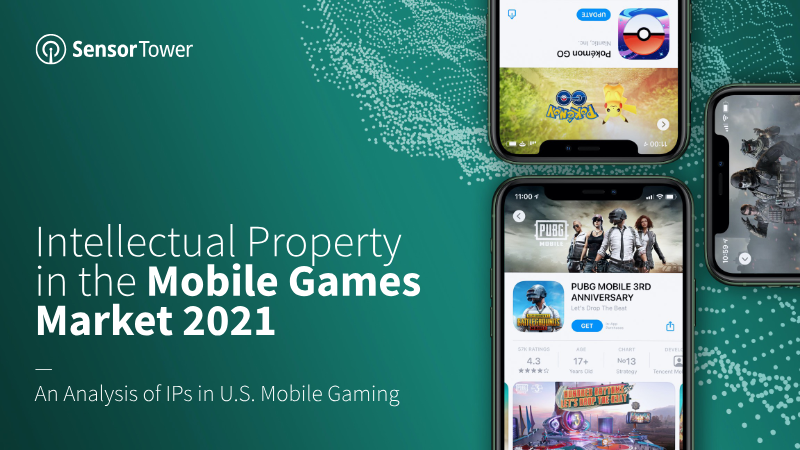
Intellectual Property in the Mobile Games Market 2021: An Analysis of IPs in U.S. Mobile Gaming

The mobile gaming landscape in the United States is significantly influenced by intellectual property (IP), which serves as a powerful driver for both revenue and user acquisition. While IP-based titles represent only 9 percent of the total mobile game market, they command an outsized share of industry performance, accounting for 23 percent of total player spending and 17 percent of all downloads in 2020. This trend underscores the efficacy of established brands in capturing market attention and maintaining stable growth compared to non-IP titles.

Video game-based IPs are the most dominant category, generating one-third of all licensed mobile game revenue in 2020. Other significant contributors include Manga, which emerged as the fastest-growing IP type with a 54 percent year-over-year revenue increase, followed by Television and Comics. Notably, the Marvel brand maintains a pervasive presence across multiple media formats, illustrating how successful IPs often transcend their original medium to achieve cross-platform dominance.

The impact of IP is most pronounced within mid-core genres, specifically Geolocation AR, Action, RPG, and Shooter. Geolocation AR is almost entirely comprised of licensed titles, while Action, RPG, and Shooter genres show the strongest correlation between IP usage and rapid revenue growth. Conversely, massive categories like Puzzle remain largely untapped by IP, with only 5 percent of revenue derived from licensed games, suggesting a potential area for future expansion.

This analysis utilizes data from the U.S. App Store and Google Play throughout 2020, employing a taxonomy that categorizes IPs originating from films, books, television, toys, celebrities, sports, board games, video games, comics, and manga. The findings suggest that as the mobile marketing landscape evolves, particularly following changes to identifier tracking, the strategic deployment of recognizable IPs will become increasingly vital for developers seeking to build awareness and drive sustainable user acquisition.
  • While IP-based games represent only 9 percent of the total U.S. mobile market, they account for 23 percent of player spending and 17 percent of all downloads.
  • Video game-based IPs are the leading category, generating one-third of all licensed mobile game revenue in 2020.
  • Manga is the fastest-growing IP category, experiencing a 54 percent year-over-year revenue increase.
  • IP usage is most concentrated in mid-core genres, with Geolocation AR being almost entirely composed of licensed titles, while Action, RPG, and Shooter genres show the strongest correlation between IP and revenue growth.
  • The Puzzle genre remains an untapped opportunity for IP expansion, as licensed titles currently account for only 5 percent of its total revenue.
+3
Sensor TowerJan 2021
Page 1
Report25 pages

An Analysis of IPs in U.S. Mobile Gaming

The analysis evaluates the influence of licensed intellectual property (IP) on the U.S. mobile gaming market during 2020, using Sensor Tower’s taxonomy and revenue data from the App Store and Google Play. It finds that only 9 % of mobile titles in the United States carry an IP license, yet these games generated 23 % of total player spending and 17 % of installs, indicating a disproportionate revenue contribution. Video game IPs dominate the licensed segment, accounting for one‑third of IP revenue and 60 % of that share; manga IPs represent the second largest category at 13 %, followed by television (12 %) and comics (10 %). The report highlights that action, shooter, and role‑playing game genres exhibit the highest proportion of IP revenue—64 % in action, 45 % in shooter, and 47 % in RPG—while genres such as racing and puzzle show minimal IP influence. Top performers include Pokémon GO (video game IP), Call of Duty: Mobile (shooter IP), and Marvel Contest of Champions (comics IP). Year‑over‑year growth for IP titles matched non‑IP titles at 33.8 %, driven largely by Call of Duty: Mobile and new releases like PUBG Mobile. The findings suggest that, despite a small market share in terms of titles, IP‑based games command significant revenue and are poised for continued expansion as publishers leverage popular franchises across multiple genres.

  • Licensed IP titles represent only 9% of the U.S. mobile market but account for 23% of total player spending and 17% of all installs.
  • Video game franchises are the primary drivers of IP revenue, contributing one-third of the total, followed by manga (13%), television (12%), and comics (10%).
  • Action, shooter, and role-playing games rely most heavily on licensed IP, with these genres deriving 64%, 45%, and 47% of their respective revenues from such titles.
  • IP-based mobile games achieved a 33.8% year-over-year growth rate in 2020, matching the growth performance of non-IP titles.
  • High-performing titles such as Pokémon GO, Call of Duty: Mobile, and Marvel Contest of Champions demonstrate the significant revenue potential of leveraging established franchises.
Sensor TowerJan 2021
Page 1
Report20 pages

Market Snapshot: Q2 2021 US, China & Japan

The mobile gaming market in the second quarter of 2021 experienced notable shifts in genre performance and publisher dominance across the United States, China, and Japan. The primary objective is to provide a comparative analysis of these regional markets, highlighting evolving trends in genre market share, publisher success, and the increasing importance of live-service feature updates. The analysis utilizes a proprietary taxonomy and motivation framework, supported by a survey of over 7,000 mobile gamers in English-speaking western countries, to categorize games and identify player archetypes.

Key findings indicate that the United States saw a decline in the Puzzle genre’s market share, while the Strategy genre experienced significant growth. In Japan, the Sports genre continued to gain momentum, largely driven by the success of titles like Umamusume Pretty Derby, while RPGs faced a decline. China exhibited a trend reversal from the previous quarter, with RPG and Strategy genres regaining market share at the expense of Shooters. Publisher performance was marked by strong results from Supercell in the US and Cygames in Japan, while Leiting Games nearly doubled its market share in China.

A critical trend identified is the 37% year-over-year increase in feature updates, with Strategy games leading this surge at 208%. Developers are increasingly prioritizing engagement through non-recurring live events and limited in-app purchase offers, which saw frequency increases of 143% and 122%, respectively. These features are becoming essential for retention and monetization across major genres. Furthermore, player motivation data reveals that games appealing to fast-paced action and competitive play continue to dominate the top-grossing charts in the US, with specific archetypes like King of the Hill and Skill Master remaining highly relevant.

  • Live-service feature updates increased by 37% year-over-year, with Strategy games leading the surge at 208% growth.
  • Engagement tactics are shifting toward non-recurring live events and limited-time in-app purchase offers, which saw frequency increases of 143% and 122% respectively.
  • In the US, the Strategy genre grew while the Puzzle genre declined, with Supercell emerging as a top-performing publisher.
  • China experienced a market reversal in Q2 2021 as RPG and Strategy genres regained share from Shooters, while Leiting Games nearly doubled its market share.
  • Japan’s market saw the Sports genre gain momentum behind the success of Umamusume Pretty Derby, while RPGs faced a decline and Cygames maintained strong publisher performance.
+3
GameRefineryJan 2021
Page 1
Report30 pages

The State of Mobile Game Advertising: An Analysis of U.S. Mobile Game Advertising Trends in 2021

Mobile game advertising in the United States remained resilient through the first half of 2021, showing no immediate negative impact from privacy changes such as the deprecation of IDFA. Analysis of the advertising landscape reveals a strategic divide between ad networks. Specialized platforms like AppLovin, Chartboost, and Vungle maintain a high concentration of gaming content, often exceeding 90 percent share of voice. In contrast, diversified platforms like Facebook, TikTok, and YouTube maintain a more balanced split between gaming and non-gaming advertisements, serving as critical channels for reaching broader audiences.

Market trends indicate that ad network selection is increasingly driven by genre and demographic alignment. Puzzle and Hypercasual games dominate gaming-focused networks, while mid-core genres like Strategy and Shooter find higher engagement on social platforms like YouTube and Instagram. Notably, Adcolony emerged as a primary hub for Casino games, catering to an older, female-leaning demographic. Across most platforms, video remains the dominant creative format, though playable ads have gained significant traction, particularly on AppLovin where they account for over 40 percent of gaming share of voice.

Creative strategies are evolving to include "fake playables," relaxing music for casual titles, and real-world testimonial-style conversations. Even mid-core titles with complex mechanics, such as Call of Duty: Mobile, have begun adopting simplified playable "mini-games" to lower the barrier for user acquisition. This data, compiled by Sensor Tower using its Ad Intelligence platform, covers U.S. trends across iOS and Android from 2018 through the second quarter of 2021, suggesting that success in the current market requires a sophisticated mix of genre-specific network targeting and experimental creative formats.

  • Mobile game advertising in the U.S. remained resilient through H1 2021, showing no immediate negative impact from the deprecation of IDFA.
  • Playable ads have become a dominant creative format, accounting for over 40 percent of the gaming share of voice on AppLovin.
  • Specialized ad networks like AppLovin, Chartboost, and Vungle maintain a gaming-focused inventory exceeding 90 percent share of voice, while platforms like Facebook, TikTok, and YouTube provide broader audience reach.
  • Ad network selection is increasingly genre-specific, with Puzzle and Hypercasual games favoring gaming-focused networks, while Strategy and Shooter titles find higher engagement on social platforms like YouTube and Instagram.
  • Adcolony has established itself as a primary hub for Casino games, effectively targeting an older, female-leaning demographic.
+1
Sensor TowerJan 2021
Page 1
Report17 pages

Diversity and Inclusion in Gaming: Insights and Opportunities 2021

This analysis examines the state of representation and accessibility within the United States gaming market, challenging the misconception that the gaming audience is primarily composed of young, white males. Based on a 2020 study of 1,824 gamers aged 10–65, the research argues that the industry’s future growth depends on its ability to cater to a diverse global population of 2.7 billion players. The thesis posits that strengthening diversity and inclusion (D&I) requires a dual approach: improving the representation of marginalized groups in software and increasing the affordability of hardware.

Key findings indicate that 47% of U.S. gamers avoid titles they feel are not made for them, while over half believe it is important for games to feature diverse characters. This sentiment is particularly strong among LGBTQIA+ players and people with disabilities. Data shows that players of color are often more "serious" gamers than their white counterparts; for instance, Black and Asian PC players skew younger and more female. Furthermore, the popularity of the fighting game genre among Black players is linked to historical arcade accessibility, suggesting that low barriers to entry foster long-term community engagement.

The research highlights a significant correlation between socioeconomic status and gaming habits. Black and Hispanic/Latinx players are more likely to use standard laptops or consoles rather than expensive high-end desktops and are more inclined to use subscription services like Xbox Game Pass to manage costs. Ultimately, the analysis concludes that brands taking active stances on social issues and prioritizing inclusive character design can drive higher engagement and revenue, as gamers increasingly prefer companies that reflect their values and identities.

  • 47% of U.S. gamers avoid titles they perceive as not designed for them, indicating that inclusive character representation is a critical factor for market reach.
  • Over half of the gaming audience considers the presence of diverse characters important, with particularly high demand for representation from LGBTQIA+ players and people with disabilities.
  • Socioeconomic barriers significantly influence platform choice, as Black and Hispanic/Latinx players are more likely to utilize standard consoles or laptops and subscription services like Xbox Game Pass rather than high-end desktops.
  • The gaming audience is highly diverse, with Black and Asian PC players skewing younger and more female than their white counterparts.
  • Historical accessibility, such as the low barrier to entry provided by arcades, directly correlates with long-term genre engagement, as seen in the popularity of fighting games among Black players.
+1
NewzooJan 2021
Page 1
Report3 pages

Essential Facts About the Computer and Video Game Industry: 2013

The computer and video game industry in the United States demonstrated significant economic strength in 2013, generating a total revenue of $21.53 billion. This financial performance underscores the sector's role as a major contributor to the national economy, driven by robust consumer demand for interactive entertainment across various platforms and delivery methods.

Consumer spending on game content accounted for $15.39 billion of the total industry revenue. A notable shift in purchasing behavior is evident in the 11 percent year-over-year growth of digital format sales. This trend highlights a transition toward digital distribution models, reflecting evolving consumer preferences for immediate access to content over traditional physical media.

These findings provide a snapshot of the domestic gaming market during the 2013 calendar year, focusing specifically on revenue generation and sales distribution. By tracking the growth of digital formats alongside total content expenditure, the data illustrates a maturing market that is increasingly reliant on digital infrastructure to sustain its financial trajectory. The industry maintains a strong foothold in the entertainment sector, characterized by consistent revenue streams and a clear movement toward digital-first consumption patterns.

  • The U.S. computer and video game industry generated $21.53 billion in total revenue during 2013.
  • Consumer spending on game content reached $15.39 billion, representing the largest portion of total industry revenue.
  • Digital format sales experienced an 11 percent year-over-year growth rate in 2013.
  • The gaming market is undergoing a structural shift toward digital distribution models, prioritizing immediate content access over traditional physical media.
  • The 2013 financial data confirms the industry's transition toward a digital-first infrastructure to sustain long-term revenue growth.
+2
Entertainment Software AssociationJan 2013

Publishers

Related Topics