VideoTwo & a Half Gamers
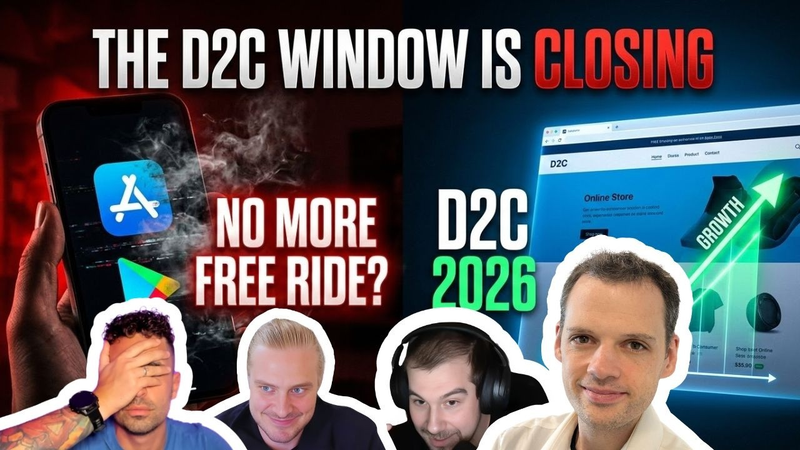
D2C Trends: Apple bringing back fees & Why is that a good thing!
4 Mar 202641 min video
Transcript
aware of the additional value they get from my web store and they trust that the web store will give them the items they want to make purchase in the game. Right? So, I've created this inherent stickiness by doing that. Go ahead.
It's a funnel. It's a funnel. And then I already have their email. So, I can then send an email like, "Hey, here is my web store. You should buy again [music] chasing the sky. [music] We're the two and a half gamers. The midnight crew talking UA adverts and game design too. Mat Felix Shak bringing the insight. We're rocking [music] those vibes till the early daylight. Kua master eyes on the prize. Tracking data through the cyber [music] space. Feeling stacks like a wizard in disguise. Jacks lift us to the high. Two and a half gamers talking smack. Slow hockey stick got [music] your back. Ads are beautiful. They like the way. Click it fast. Don't delay. [music] Uh-huh. Uh-huh.
Uh-huh. [music]
Yes. Hello. Hello everybody. Welcome. This is actually as we we said last last time when we had Chip on the podcast is a three and a half gamers because Chip Chip is here with us talking about D2C trends. Welcome Chip. Welcome to the podcast again.
Wow. Thank you. Uh fourth time is is a is a charm here. It's great to be back.
Very true. Very true. We we have very good feedback for all the episodes. So we should definitely keep talking about what's happening in the D2C world because there is always something happening in the D2C world. So before we go there, my name is Matthew Lanchich.
I'm Felix Braber and I'm Chip Thirsten.
Hey, we are your hosts. There you go. That's a that's very smooth. Very
smooth. Thanks. Thanks for coming again. So what's happening? Oh well, we are going to talk about what's happening and what's might be the future for D2C. Well, see how we have some questions and trends that we can we can discuss. Nice. Okay. So, how is everything on on your end, Chip?
It's great. It's great. We 2025 was such a whirlwind of a year coming like coming into the year we were on a nice growth trajectory. We being like direct to consumers and overall in the industry. Then the the ruling with Epic versus Apple hit in April and was just jet fuel for the year and so uh we were just riding that wave and then Epic versus Google came through later in the year and kept things going and so it's been a fun period of reflection for me as I think about 2026 now and where we go from here especially coming up with GDC now in a couple weeks and uh it feels like all roads lead to GDC at this time and so that's uh that's an exciting time too.
That's very true. I mean, uh, we are not going to JDC this year, but we're
definitely going to be going to be there next year. I hope. I hope so. We're going to be at MAU and we have something hopefully cooking with with you guys. Chief was talking to your colleagues already. So, it's going to be very interesting.
Yeah, I can't wait to see what we do at MAU together. We'll we'll definitely do something fun and everyone listening should be there.
Yeah, definitely come and see us. Yeah, MAU is uh is in amaze what's happening in terms of the the platform fees and like what are what's the the word on the street actually now uh for for D2C world
yeah I think the the most important part to understand from where we are today is that steering is still allowed in the United States without fees that's still the current state of play that has been throughout 20 most of 2025 with epic versus uprolling as I mentioned And that means you can link players from the mobile game directly into the web store or even directly into a product page on your website, have them check
out, and you don't have to share any of that revenue with Apple or Google. You only pay your merchant of record processor like Bassbring, which will be around that 5% range. So you have this tremendously more profitable channel, but it's important to remember that's only in that in the United States and that's a a temporary window. And so we'll talk about how much longer that window can be open, but that that's where we are today. So,
okay. So, why temporary window?
Well, you know, one I was talking with one major publisher last year and they said something that's really just stuck in my mind, which is that Apple and Google won't let us live rentree in their house forever. Right? There's this
this notion that like
sounds like Apple. So there right there's this notion that like we're we're able to install and distribute our games through these platforms and then we're able to take the revenue and drive it elsewhere and not share any of the revenue. And so I think it was the inevitable evolution of this to say at some point those
platforms will get cut into the revenue at some point. And so wasn't sure what that would look like or what those fees would look like. But we now have a good idea because if we look at Japan, there's actually the precedent there because in in December, the mobile software competition act went into effect. And what that meant was steering was unlocked in Japan. But to comply with that, Apple and Google introduced what we're calling platform fees where they take a percentage of the revenue driven through these direct channels. So, we can go through exactly what those fees look like, but big picture, the point is Apple and Google have demonstrated what their strategy is for compliance. They can't implement those fees yet in the United States because of court orders. The courts have said they cannot charge fees as of today, but those rulings are getting appealed and it's going to play out over time. And so, I do expect it's a matter of time before we see a similar approach taken in the United States.
What are the fees they charging?
Yeah. So the fees, good good question. The fees in Japan right now, uh 20% of
revenue for Google and 15% of revenue for Apple. And there's a specific attribution window on these which we'll talk through.
How do they know the revenue?
So it's it's 20. So say I take a player, link them directly from the mobile game into the web store. That player makes a $10 purchase. Okay. $2 goes to
Google. then maybe 50 cents to my merchant record and then I take the other $7.50 myself.
But how did Google know that he the player that I just took from the store mobile to web to my web store did the $10 purchase? I need to disclose it or like what's the
there's a new
So this is being facilitated by an API and it's through what Google is called the external content links program. So, there's a new program, and this actually is in effect in the United States, just without fees. But this program went into effect January 28th. And it says that if
you steer, if you link from your game into a website for uh transactions or for downloads to download an app from an alternative store, you need to be enrolled in this program called the external content links program. And then you sign up for it and Google approves you and then you can you can link. So, does this mean you can do it also without it? But you're breaching the terms of agreement policy?
Yes. You know what I mean? Like how to circumvent this completely like basically black hat stuff.
Well, you can apparently link to the website not for the actual purchase option just because hey, I have a great article there. You should definitely read it. We we've seen this like
numerous times where like you just want to move people to the website not directly through a payment kind of situation but just move them there and then they pay as they are there which basically unlinks them from this whole process. So that's my kind of a question here.
I would say that's an open question is
what is considered external content for the external content links policy. It could be specifically it only applies if you link them directly into a store or to a page where they can download something. Or if Google wants to be more aggressive, they could say it's any link to any external page. You need to be enrolled in this program and then we'll track that if if revenue comes through from that. And I say that because they've said Google is applying as part of the external content links program a 24-hour attribution window. So if someone clicks from your game into your website and makes any purchase in the next 24 hours there, then that fee will apply.
No. No.
So you need to delay for 24 hours
for for 24 hours. Yes.
Aren't we back to square one here again? Like what happened? I I will tell you I think these are actually good in a way for the future of direct to consumer and I think they'll actually increase the direct to consumer revenue we see being processed across the industry and I say that because it
introduces a lot of certainty by having these fees and knowing what the future will look like and two because these fees are actually really limited in scope. I think they can sound scary and overbearing at face value, but I think when we actually look at uh the scope of when they apply, there's a lot of room to operate and it just means we as game publishers need to be more strategic in how we're driving that direct to consumer revenue.
So let's then think obviously
I know this directly but let's think like minmaxing like how can currently circumvent this? No, no, it's not about circumventing like it's actually about the repeat purchases and then what happens after the f the fountain of the 24-hour window, right?
Exact. So, yeah. So, the first that's the first place my head went mate is like let's think about treating these platform fees as almost a direct to consumer customer acquisition cost, right? you. So, if I segment my players, right, and I say all my players who have never made a purchase on the web store, I'm going to put them in one bucket and I'm going to link them at every
opportunity to the store. Everywhere in the game, there's web store buttons all over the place because if they don't purchase, like there's no fee. So, like I can link them as much as I want. I'm driving all this awareness for my web store. Then eventually they go to the web store and they make a purchase. Okay, as soon as they make that purchase, I pull them out of that segment and put them in a different bucket of direct to consumer customers. Now, I'm not linking them anywhere in the game, but they're aware of my web store. They're aware of the additional value they get from my web store, and they trust that the web store will give them the items they want to make purchase in the game. Right? So, I've created this inherent stickiness by doing that. Go ahead.
It's a funnel. It's a funnel. And then I already have their email. So, I can then send an email like, "Hey, here is my web store. You should buy again." There you go. Okay. That's
so when do we take the 20% fee
when?
Mhm.
Right after the first purchase. But then you are not linking the player because you only need to process the fee when you're linking the player from your game
to your store when you from the game. If you link him or her from an email, you're fine. So this is a habit creation pretty much,
right?
You understand? So, so, so that's what she said basically that the 20 whatever fee will be just on the first purchase until we move him to that payer segment and then it's kind of
hypothetically but then if you're keep linking the players to your web store then it's going to be on every click on every purchase from the game. That's the thing.
Yeah. But obviously you don't want that because now you have it in your system. So you want to use other distribution sources outside of the store. But then as we as we discussed before we started recording like now people are really not leveraging web stores and D2C because they're afraid if they do it now they lose all the advantage from Apple and Apple is not getting any money. So then I'm actually agreeing with Chip here because this is going to open up way more kind of people to the web store
because they're not going to be afraid because Apple are going to get their cut and it's going to be kind of legit now.
They're cut once. Yeah. Yeah. Once.
Yes. Still it's more than zero.
Yeah. Yeah. Of course. But this also basically reinforces the situation we were talking last time like everybody should be doing this as fast as possible to kind of move their whole payer player base there immediately so they don't incure any fees.
I have a I have a question here Chip. So basically, let's say I have a gaming studio, ingenious ideas incorporated, and I have an ingenious idea here that basically, let's say I'm doing subscriptions or IPS, but I delay the charging of the card by 24 hours or 48 hours, but I give the gems anyway. What happens then to Ingenious Ideas Incorporated?
Now we're talking.
Now we're Now we're getting good.
That's a good idea. I I can speak to uh playing by the rules. for the call my lawyer. [laughter]
I am I am not a lawyer. For the ingenious ideas, I would defer to uh other counsel for how to proceed with that.
No, what what I'll say is um pivoting back to to Mate's point, like I do think from an adoption standpoint, the
there are still publishers I talk to all the time who are have this fear of uh repercussion from Apple and Google, right? And that's one of the reasons that we did see I think we talked about it last time but the survey we ran that saw 43% of studios have not started pursuing direct to consumer yet but plan to in the near future. And so by having this uh situation that does cut in Apple and Google, it not only represents a way to maintain and cultivate that relationship where you are sharing some of the revenue with them um but it also introduces more certainty because when the Epic versus Google settlement was proposed, it proposed these fees, right? That was the nonsense we talked Well, shouldn't say nonsense. Those were the terms we talked about last time of the
uh 20% versus 9%
uh in terms of 20% being on like randomized purchases and competitive purchases, but 9% on cosmetic purchases and you know, content purchases. And so that part is still not played out and we're still waiting to hear how the courts receive that and actually act on that. But the point is to say when that ruling does roll out, that's when we'll have some degree of finality around this and say yes, some things might shift a little bit. Maybe the fee changes a little bit, maybe when it can apply or the terms change a little bit, but this is what it's going to look like moving forward in the broadest sense. And so as a publisher that will instill more confidence and give people the the certainty to say, "Okay, there's not these looming lingering appeals that could like completely ruin my investment that I'm making in this direct to consumer solution. I know this will be here to stay and now I can invest in that and operate within that."
So I guess so. So So basically we're moving from like get everyone as fast as possible to
get everyone as fast as possible anyway, but you will incur whatever fee they pretty much get onto it. But then we're basically back to this kind of a square of I mean like mainly midcore games and people that are having high LTV players.
Are we back to square one though?
It's like you know that what they say never get between a lioness and a cub. But basically in this case is don't get in between the Fortune 500 and their fees right trying to claw a bit of them back. Right.
I didn't I didn't meant to say that like we're back into the problem of like having the like giant fees on our hand. I mean like Apple and Google will get into the same square one whereas like you offload most of the payers eventually and then they won't have their you know pound of flesh to continue. So they come up with something else I guess.
I don't Yeah.
Yeah. I the way I think of it is um it's a pendulum, right? And if I think back to like 2022 21, we at this really early stage with direct to consumer where there was zero steering allowed and it was very draconian in terms of how Apple and Google were regulating that,
disapproving games if they started to steer players into offplatform solution like a web store. And then 2025, the pendulum swung completely the other direction. They said steering without fees is here overnight and publishers can go do that. This is it. the pendulum settling somewhere in the middle, right? Saying steering is allowed, but there's some fees. And so we're seeing kind of the regulation between the two extremes is what the solution is with these platform fees.
I'm thinking if this is going to help on board more companies, but it should pretty much
but but this still means that like this this whole stealing thing won't go away one way or the other. It's just going to be as like chip said like either like incure nothing or incqure something in the process and you still win in the end because you just increase your margin on your high TV players and get more control over them eventually.
So even though if the fee would be the same basically of same 30% as it's on the store it still pays off because you get more control over your consumers. So you should still do this even if it
would be same 30% fee.
Yeah. Yeah. I think it you're thinking of it as a one-time fee to create a recurring revenue stream on your Webster, right? And that's a great business solution. The other pieces to this to consider, and Mate alluded to this earlier, but I want to go a little deeper on it, is that there are other channels, other growth vectors for your web store beyond the game itself. Like when I think about my time uh leading direct to consumer strategy and game development, when I had a new feature, a new campaign I wanted to launch for the web store, I would list out all the marketing vehicles that we had at our disposal. So yes, inapp communication was one of them, but it would also be like social media channels, our Discord community, maybe content creators on Twitch, maybe a subreddit, email campaign. Like look at all these different places that we could communicate with our players. And when I think about these platform fees, they only apply to the inapp communication side. Like that's the only place they'll be able to track the revenue and attribute a fee back to that. If I'm routing a player from an email into a web store or a social media post into a
web store or a Discord amplification through back to a web store, there's no fee attached to any of those. And so, yes, you're steering to create that initial conversion and get them over that hurdle, but you're not then just saying, "Okay, great. We'll rely on that inherent stickiness for all future conversions." You're saying we'll rely on that stickiness, but we'll complement that with all these other vehicles that we have and we can use those to funnel them back into the store as well.
Yeah, it's pretty much what like let's say part of the the whole UA DTOC. Although it's the strongest one. I mean, come on. It's like the blinking out from the game where you don't really need to go from seven hoops. It's better. And not every game has a strong social media presence or discord group or email audience. Yeah. Yeah. So you need to you need to build that pretty much. I mean
Yeah. Yeah. Different different games will have different growth vectors available and I think that's why midcore will continue to be perfectly suited for something like direct to consumer
revenue. Visual can certainly still succeed there. It might just have a lower ceiling um because it doesn't have those channels, right? people don't talk about the game outside of the game as much on the casual side as they do.
Well, then if you think about it and you do albums and groups on Facebook, then you still can. Come on. I mean, there is
those communities are pretty strong.
So, those communities are insane. I mean, I've seen what like hundreds of thousand people, millions of people.
Polygon official trading group on Facebook is 10 million people. Just one group,
Sweden. You post one link there as a web shop and then you're fine. Come on. That's insane. So, I just don't think like casual games are leveraging all these other channels that well because they're like it's not suitable for us. We don't have discords and and stuff.
I think Monopoly is doing it pretty well with their monopoly. Yes. But
yeah, not all of them.
Like a great casual game that we are talking about like it's not very casual. I have I have a question basically
around payments and it's actually one that I've been thinking about since I listened to a podcast with you Mate and Eric Soyfort because basically he they were talking a lot about signal and how a lot of publishers right now are a bit afraid of losing signal giving the signal to Google or Apple they have a lot of purchases for organic downloads. Are you able to talk a little bit about that and like yeah if that's actually a point of concern or not?
Me or mate?
I'd love I'd love to start with you and then we can dovetail it into uh our famous co-host.
Yeah. I mean I I think that's kind of the black box of Apple and Google, right? It's like we don't know exactly what the impact of that would be. At the end of the day, you are sharing less data like you're processing less data through Apple and Google through these platforms when you are routing more offplatform. I don't I haven't seen anything to bear that out, but I also think it would be hard to really quantify the exact impact there. So, I think it's an interesting like
theoretical conversation and would require pretty broad study to deeply understand if there are ramifications there. But in the immediate term, I haven't I haven't seen anything that would convince me one way or the other on that. But I think it's something to really think about.
By ramifications, you mean losing organic reach?
Yeah.
Yeah. Yeah. Like I haven't seen games with extremely successful direct to consumer have lower organic reach or any correlation or anything on that.
Yeah. Because what what Felix is talking about was pretty much the example that one app just switched completely from Apple Payments inside the app on mobile to web. So basically going from let's say thousands of purchases in in a month to zero which had a pretty big impact on the or actual organics because if you think about it how would Apple know that your app or game is actually solid because they are not taking retention into consideration in rankings but payments and Google definitely yes. So
that's why I mean of course like if you're steering people to web shop you're not losing pretty much all the revenue maybe you're losing some purchases and some signals not all of them.
Yeah. Yeah. I think that's fair. And I I think yeah if you take 100% of your revenue off of Apple like I I think there's likely some negative impact from that. Uh, for what it's worth, I've always um said like I would never advocate for an entirely direct to consumer strategy. I would love all the revenue to go through Fastpring, but like at the end of the day, I think what's best is this hybrid monetization approach. Um, and especially in a world with these platform fees where you it just the convenience and trust uh that players have with mobile has a lot of value, but complementing that with a successful direct to consumer strategy enables you to be more successful and much more profitable.
Yeah. I mean, and also something we discussed with uh with Eric as well, like do you think like when and I have my opinion about this obviously, but when do you think like it's the like the
best baseline revenue for like implementing a web shop? Like is it 50k per month? Is it 100k per month? Is it billions? Because it's like it's obviously requires some resources for implementation on the gaming studio side.
Yeah, I think certainly games need to be successful like before.
But what the successful means? Come on. Come on. Well, yeah. I just say like top priority make a successful game. Second priority could be, you know, layer on the web store.
But what I do tell I've talked to some of our sellers who have games in development. And what I say for that stage is like just make sure you're building the foundation in a way that will easily accommodate a web store later. You want to have that ability to have an off-platform store that communicates with your in-game store. So, if you have a stock limited item that players can only purchase one time, make sure your stores, whether they're inside the game or on your web store, communicate so players can't exploit that and purchase more than once quickly in both places or something like that. Like, it's just something to keep in mind from the beginning. That's not to
say you have to have the web store from launch day, but you want to at least have that infrastructure in place. Otherwise, you you'll create headaches for yourself down the line trying to stack that web store on top of a different infrastructure later on. So first is you you build that foundation from the beginning with the future expectation of a web store.
Yeah.
As for when to launch like I think it really that depends so much on the size of the publisher and the the studio and their expectations for the game. There are games that we've worked with where we have been there on launch day and they've been games with big expectations. And so I think that's a a great place to be where you have that ability to make that investment and just say we're we're up and running and ready to go. But I also recognize for most games they may not have that. They may have other priorities on the road map they need to address going up to launch. And so the web store comes a little later. I think certainly if you get to a point where 50k a month feels like plenty to me to justify like carving out the revenue, right? Because then let's say you drive even 10% of that revenue to your store. Well, now you're looking
at 5,000 a month over the course of the year, 60,000 over the year. And then how much more profitable that can be. And so, and then of course, as your game scales up, that will scale up. And then as you mature and get more sophisticated in your direct to consumer strategy, that will also scale up. And so, it's really just about getting that initial uh hurdle overcome in terms of getting your web store, get players familiar with it, and then it can quickly grow from there.
I mean, that's that's a pretty good size of the revenue. I mean, 50K is pretty pretty solid. Can you can you remind our listeners like how long does it take to actually spin up a web store?
Yeah, if uh I mean it depends on the solution and what you have in place. If you want to manage that in-house, if you want to use a tool that is provided by a merchant of record to create that for you
which is which is called fastspring. Let's say I want to yeah let's say I want to work with uh with you guys obviously. So, how quickly can I can I launch a web store? I have few apps and I have one
game already. I mean, if I get to the 50k revenue, then I might give you a call.
Yeah. Yeah. Let's let's continue that conversation. I think that's one that might be good for a future podcast is I have a bit more I can share. We have some some exciting solutions in development right now as we're deepening our investment in gaming. And I think it will really streamline the time it takes to go from zero to web store.
Okay.
And being able to do that on a pretty big scale across a wide number of apps and games. Yeah. I I'm excited to tell you more about that in the future.
Okay. Okay. Perfect. Very good. But then still uh right now if any like I mean are we talking about days or weeks or months? That's important for small developers and
yeah I think it should be best case would be days more practically it's like weeks because there are
yes making the website itself can be pretty basic and how you stand that up but there's the process of say
onboarding with a merchant of record making sure your product catalog talks with that like all the implementation details that come along with that and we have full teams that our pre-sales implementation team helps to facilitate that and streamline that as much as possible. So there are times we've gone live in days if we have like really good rapport and communication with sellers. But more traditionally it will take a little more time but usually that's just based on whatever priorities the game publisher might have and so it can be as quick as weeks. Uh but if you are one of those smaller ones it might might take a little bit longer.
Yeah.
Do I get that right that this is mainly backend programmer's shop?
Yeah. Yeah. Well there's there's the back there's of course the front end too of like the website and like
Yeah. Yeah. Of course. Like I mean technically most of the I guess behind the scenes stuff is back and programmers capacity basically that you need to sacrifice for this.
Yeah. Yeah. Exactly.
Yeah. Okay.
I need to have one side.
That's right. Go on Felix.
So basically I used to take a quick look and I think I've asked you this question every single other podcast that you've been on as well. So I just looked
how much money you processing
giveaway. So if you if you Yeah. So I
looked in the US in the last 30 days according to sensor tower on the largest 200 gaming companies or gaming apps on iOS and Google Android they earned about or generated about 1.1 billion in APS in the last 30 days. How much do you think is on top of that revenue in web store revenue as of right now?
That was so we
1.1 in the US. Yeah. So, I'll reflect back to the survey we ran in August, which surveyed over 100 game developers, decision makers, different publishers in North America and Europe. And we asked them about web stores, and we talked a lot about the data on the last podcast, but the point I want to reference for this one is we did ask them how much revenue they were driving through their stores for those that had web stores in place. So, let's try to math this out in real time, which is always fun.
Like, let's there were 57% of the ones we surveyed had web stores, right? So let's let's round it to 50% and make it easy. So of that 50% that had web
stores, there was we asked them, you know, are you between 1 to 10%, 11 to 20%, 21 to 30%. Um the vast majority were in that under 20% range, right? And so it was either 1 to 10% or 11 to 20%. And I forget the exact split between those two, but if you got above 20%, you're doing great. Um, but just most of the studios when we surveyed them as of last summer, which bear in mind this was pretty soon after the Epic versus Apple ruling. So, I expect those numbers are higher now as companies have adapted more to the the no fee steering window and driven more revenue. Say it's under 20%. Round it to maybe a 10% somewhere in the middle. So, 50% of those studios are driving 10% of their revenue through the store. That can give you a ballpark number. I guess if we ballpark then using that from my little data finder around 1.1 billion we're looking at somewhere between 50 to 100 million dollars processed off store in the US in
the last 30 days roughly
sure
good now we have something to work with
speculative yeah that can give you a baseline to build from if we kind of take all that data extrapolation
was there any categorization of the developers regarding midcore casual or something that you ran in the survey or it's just developers as it is. I mean like if you see actually the significant differences between casual or midcore developers
uh we did and I can tell you this is um a survey that we'll plan to repeat. So we found a lot of value in this survey and getting this data and so I'm excited that we'll be thinking about how to iterate on this survey in 2026. uh it's not just going to be a copy paste but we will think about which ones we want to carry forward and so instead of a snapshot of the industry it'll become more of a longitudinal kind of data trends and and thinking about how these are evolving over time so I think we'll learn a lot more this year and that's my way of vamping and saying I don't recall exactly what
the uh genre split was for the percentage of revenue driven but we published on our website I can't remember if we dug into that but
social casino
I just I just can you know say my little anecdotal evidence that when I speak to my friends that are running midcore stuff. It's not unusual when I hear 40 to 50%. That's usually social casino. I hear that usually. I don't have that many social casino friends. You know, I'm an RPG guy. So, just
you don't have that many friends anyway. So, this is a great insight.
So, those are actually those are two really good examples to unpack a little bit because Midcore and Social Casino both succeed, but for very different reasons with direct to consumer. midcore is because the purchases are premeditated. Players have a good idea of what they want to purchase at a given time. It's based around content at a specific time
and because usually it's guild driven and player like the direct to consumer value spreads organically very well in those games through word of mouth in a
guild and they find out I get 20% more 10% more on the web store. I'm going to tell everybody else in my guild, hey, go purchase there because we'll have more.
They kick you out if you don't spend. It's easy,
right? and spend on the web store specifically, right? You want players going there and so it has all these great things working in its favor. But on social casino, you don't really have that as much. You don't have as much of like the guilds of the premeditation. But what you do have is extremely VIP heavy revenue, like even more so than midcore. And so you don't need to shift over that many players to your web store to shift over a ton of your revenue to your web store. And so it's you you become like lasertargeted in your approach on social casino of like let's make sure we get these players over because if we do then we'll become much more profitable.
That's the golden tablet story right there.
Yeah.
If you heard that one.
Yeah. I mean it was on the first or second uh recording that Felix was talking about the golden tablet right there.
Yeah.
Okay. So what's so what's uh then 2026 all going to be about? So more adoption
in that case.
By the way, do we have any I always ask this on this on this podcast. Do we have any major deadlines or dates to kind of you know cross check in the calendar as for like rulings or appeals or anything that's on your radar that's significant this year?
Yeah, I think the there's a couple interesting ones. one is um Brazil has actually announced compliance with the steering ruling that they're going to allow steering um and fees will be allowed as part of that and so Brazil is another country on my radar that's supposed to go into effect in April and Apple has actually already announced their compliance with that and said they'll charge a 15% fee
um for that and so it's a little lower than Google's how generous the point is this is in the United States without fees today Japan is with fees today. Brazil is coming with fees and then eventually once some of these settlements and appeals play out in the United States, I think we'll see platform fees applied there, too. So, the timeline on that for the United States is a little more uncertain. Epic
and Google proposed this settlement back in late October that includes the fees. The judge has approached it with skepticism and has not made a final decision as to whether or not that will be allowed. And that was as of January, February. Still, they're still mulling it over. uh there was another hearing in late January and they still haven't made a decision coming out of that. So the wheels of justice turns slowly but I do expect we will get some resolution on that in the near future maybe in March where maybe it means they get a green light on this settlement and fees start to be applied or maybe it means they need to go back they need to go back and make some changes to this settlement and then the judge will approve it. So we'll just have to wait and see on that. Like you said earlier in the meantime they're steering without fees right now and we need to act with urgency to maximize that opportunity
and do I get it right that the situation that it's in US won't repeat in other countries. I mean like without any fees yet. So it's more of a like Japan Brazil model that's going to happen later down the line with other countries.
Yeah, that would be my expectation. I
mean it's always possible some other court does come in. Maybe there's a a more aggressive court that comes in and says, "Okay, you can't charge fees in this country or that country, but I haven't seen any reason to expect that. The president definitely seems to be allowing steering allowing Apple and Google to apply these fees to that offplatform revenue." And there is there's one other important distinction I should call out, which is Apple in their compliance in Japan and in what they've announced as their compliance in Brazil has a different attribution window than what Google has applied. So Google in their compliance in Japan and in the United States when fees are introduced is applying that 24-hour window. So linking from the game into the store any purchase within 24 hours has that fee. Apple intends to apply a 7-day attribution window. So it it you know whether this is actually implemented and approved in practice remains to be seen.
Exactly what's going to happen.
It it's one of the factors to watch for is my my point of mentioning that and say like just make sure you understand exactly what you're signing up for, what the policies are, what the fee uh is because that looks like it'll be different between Apple and Google, what the attribution window is, like there are several moving parts here. And so that's why ultimately when I say we just have to get more strategic in how we're driving direct to consumer revenue, it's pretty easy when there's not a platform fee attached. You just funnel your players into your store and have them make a purchase and it's pretty seamless. With these, there are just more factors to consider, but still plenty of opportunity for success.
And just for our dear listeners here, Mache, under what circumstances in user acquisition is it acceptable to run a 7-day attribution window?
Under circumstances of payer campaigns pretty much, and you have also day 28 attribution window campaigns on Apple. So, let's let's not go there, man.
Okay. Okay. I don't know. When I was doing retargeting, when when I was managing the 7-day attribution window, usually it
was known as a suckers deal.
Yeah. Yeah. Yeah. Yeah. It's like, nope. So, no. But for for purchase campaigns, seven days by default, you have way more time to actually gather more more events. Exactly why Apple is doing this pretty much. They earn more money on top of this. That that actually reminded me of one other piece that I think this will evolve to which is again these fees aren't in effect yet and we expect them to come in this year. So once they do maybe we start to pursue that direct to consumer customer acquisition right we eat that initial cost of creating that customer and then we stop steering them into the store. I think a later phase of that and this is where some of the data science might come into it but it's once a player say churns from the web store you then start steering them again and so if a player starts purchasing on mobile again and purchases exclusively on mobile for some period of time at what point do you say okay I'm going to start steering them again to get them back into the web store and try to
recreate them as a a web store customer you don't just do it for that initial purchase yes you do that and maybe that's enough for most of your players, but just then some trickle off and you steer them back into the store over a point of time. And it's it's these kind of moving parts where I think we can really grow web store revenue over time, even a in a world with these fees, but it's going to require that that deeper thinking and deeper data telemetry to really make the most of it. Yeah, I'm I'm I was talking about this in in Barcelona where I said that you need to think about the your web shop as pretty much like an e-commerce brand, an e-commerce shop pretty much like a normal brand because you have all these different KPIs and metrics and you still need to keep kind of retargeting the your player, keep reminding the player like introduce bundles. I was I was talking about buy one get one free and all these different things which like this is pretty much different marketing than a mobile game marketing. So I'm looking forward.
Yeah. Yeah. It's a good point. I think
just general revenue optimization on websites remains an opportunity
100%.
That will be true regardless of what happens with any reg.
Exactly. Yeah. That's true. Yeah. Yeah. Yeah. That's true. you still need to need to think about all these different KPIs and then and bundles and what what not cuz average order value I was like okay interesting and then you optimize for different things anyway so the future is bright I suppose
yeah it is definitely I'm also kind of quite surprised that we don't have anything from South Korea if I understand correctly because they are like also quite the massive midcore market which I would guess they would be jumping on this first
in terms of regulations Yeah, like if Japan has a law, I'm I'm guessing like South Korea should be around the corner or something. But like, you know, what do I know?
There there have been calls for it there. Like um the EU, UK, Colombia, Korea, like we've seen different rumblings of of uh legislation coming forward in those countries, but I
haven't seen anything like concrete. Certainly nothing with specific outlines of what the guard rails would be on those regulations or any timelines for what those look like. But South Korea is one of the ones that has said they they intend to get involved in this at some point. So, it's one to watch for and may maybe one of the next times we talk we'll have something more to say.
Yes, 100%. I think we can we can wrap it here because uh it was interesting again future is bright. Everybody should still I'm if you're not having a web shop, you still should because I'm not sure like why you're staying away cuz the window is closing. The window is closing. Thank you very much guys for listening and yeah start your web web store and see you next time. Bye-bye.
Auto-generated captions from YouTube — names and numbers may be misheard.




















Comments