Player Demographics

177 documents·72 publishers

Documents

Page 1
Report18 pages

Essential Facts 2012: Canada

Essential Facts 2012: Canada provides a comprehensive statistical overview of the Canadian video game industry and consumer landscape. Commissioned by the Entertainment Software Association of Canada (ESAC), the findings are based on 2012 custom research by the NPD Group involving over 4,000 participants, alongside 2011 economic data from Secor Consulting Group. The report establishes that gaming is a mainstream activity in Canada, with 90% of children and teens identifying as gamers and an average player age of 31.

The data reveals a significant shift in platform preferences. While 61% of households own a console and 95% own a computer, computer usage for gaming dropped by 12% since 2010. Conversely, mobile gaming has surged, with 80% of households owning a mobile device and 25% of Canadians citing it as their primary gaming platform. Demographically, the player base is nearly balanced at 54% male and 46% female, though genre preferences vary; for example, teen boys favor shooters while adult women prefer puzzle and mental challenge games.

Economically, Canada ranks third globally in video game employment, supporting approximately 16,000 direct jobs across 348 companies. The industry contributed an estimated $1.7 billion to the Canadian economy in 2011, with a projected growth rate of 17% for 2012. While large firms (150+ employees) employ 59% of the workforce, the industry is characterized by a high volume of micro and small businesses, particularly in Ontario. Quebec remains the dominant hub, accounting for over 8,000 industry jobs. Despite the rise of mobile and social platforms, traditional console development still commands 68% of the industry's labor resources. Finally, the report highlights the role of the ESRB, noting that 93% of parents find the rating system useful for managing their children's media consumption.

  • The Canadian video game industry contributed $1.7 billion to the economy in 2011 and supports approximately 16,000 direct jobs across 348 companies.
  • Gaming is a mainstream activity in Canada with an average player age of 31, and 90% of children and teens identifying as gamers.
  • While 68% of industry labor remains focused on console development, mobile gaming has surged, with 25% of Canadians now citing mobile as their primary gaming platform.
  • The industry is projected to grow by 17% in 2012, with Quebec serving as the primary hub, employing over 8,000 of the total workforce.
  • The player demographic is nearly balanced at 54% male and 46% female, though genre preferences diverge significantly between teen boys and adult women.
ESAC – Entertainment Software Association of CanadaJan 2012
Page 1
Report18 pages

Faits Essentiels 2012: Profil de l'industrie canadienne du jeu vidéo

The 2012 Essential Facts report provides a comprehensive profile of the Canadian video game industry, highlighting its significant economic impact and the evolving habits of its diverse player base. Data was synthesized from a 2012 study of over 4,000 Canadians conducted by the Entertainment Software Association of Canada (ESAC) and market research from the NPD Group and Secor Consulting Group. The findings reveal that 58% of Canadians identify as gamers, with an average age of 31. While 90% of children and adolescents play, the demographic is nearly balanced by gender, with women making up 46% of the player population.

The industry represents a vital pillar of the Canadian economy, contributing approximately $1.7 billion in direct impact. Canada ranks third globally in video game employment, supporting 348 companies and roughly 16,000 direct jobs. The sector is characterized by high-value labor, with an average annual salary of $62,000—more than double the national average for the general economy. Growth remains robust, with an 11% increase recorded between 2009 and 2010 and a projected 17% increase for the 2011-2012 period.

Geographically, the industry is concentrated in Quebec, Ontario, and British Columbia. Quebec holds a dominant position, accounting for 86 companies and 8,236 jobs, while Ontario hosts the highest number of micro and small enterprises. Methodologically, the report notes a shift in platform preference; while 68% of employees still focus on traditional consoles, there is rapid diversification into mobile and social gaming. Furthermore, the report emphasizes the importance of the ESRB rating system, noting that 93% of parents find these classifications useful for managing their children's media consumption.

  • The Canadian video game industry contributes $1.7 billion to the economy and supports 16,000 direct jobs across 348 companies, ranking Canada third globally in industry employment.
  • Industry growth is accelerating, with an 11% increase between 2009 and 2010 and a projected 17% growth rate for the 2011-2012 period.
  • The sector provides high-value employment with an average annual salary of $62,000, which is more than double the Canadian national average.
  • The Canadian player base is broad and gender-balanced, with 58% of the population identifying as gamers, 46% of whom are women, and an average age of 31.
  • Industry operations are geographically concentrated in Quebec, Ontario, and British Columbia, with Quebec leading the sector by hosting 8,236 jobs across 86 companies.
+1
ESAC – Entertainment Software Association of CanadaJan 2012
Page 1
Report21 pages

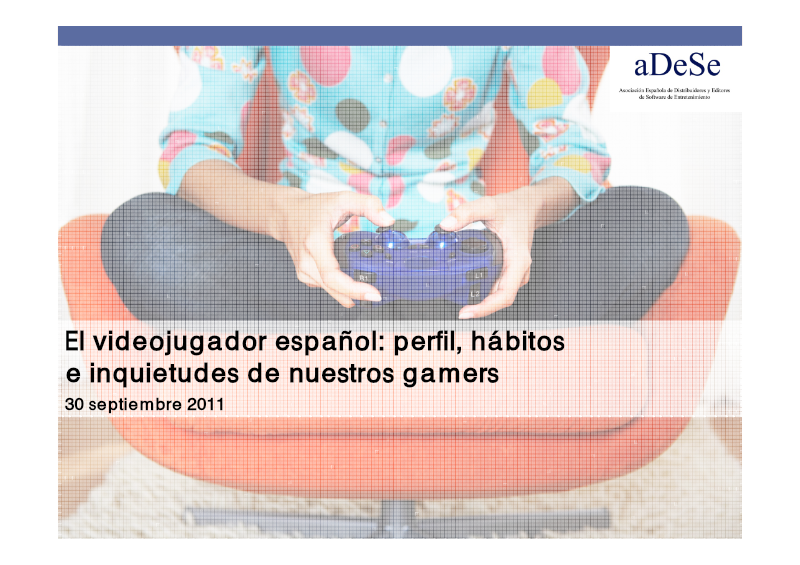
El Videojugador Español: Perfil, Hábitos e Inquietudes de Nuestros Gamers

The study commissioned by the Spanish Association of Distributors and Publishers of Entertainment Software aims to map the profile, habits and concerns of Spanish video‑game players as of 2011, positioning Spain within the broader European market. Spain ranks as the fourth largest European video‑game market, with sales exceeding €1.245 billion in 2010, while the continent records a 25.4 % adult gaming penetration (79.2 million regular players). In Spain, 24 % of adults play regularly, and the most active segment is aged 7‑34, representing 45.3 % of the population.

The typical gamer is 32 years old, with women accounting for 40 % of players over 15 years. Over half are married or cohabiting, and 43 % devote between one and five hours per week to gaming. Lifestyle data show that 70 % of gamers frequently engage in outdoor activities such as walking, café visits or restaurant meals, while 61 % exercise regularly. Health awareness is high: 57 % prioritize nutritious food, and 75 % actively practice environmental stewardship through recycling and energy‑saving habits.

Values analysis reveals a predominance of hedonistic (≈25 %) and authentic (≈19 %) orientations, followed by social‑rational and aspirational profiles (each around 15 %). Expectations for the next decade are strong: 90 % foresee gaming becoming a universal pastime, with 55‑88 % anticipating virtual‑reality immersion, multisensory experiences and a shift toward educational, medical and professional applications. The research draws on GfK Emer Ad Hoc surveys conducted across Europe in 2009‑2010, combining sales figures, penetration rates and attitudinal questionnaires to deliver a comprehensive portrait of Spanish gamers.

  • Spain is the fourth-largest video game market in Europe, generating over €1.245 billion in sales during 2010.
  • Gaming penetration among Spanish adults stands at 24%, with the 7–34 age demographic representing 45.3% of the population.
  • The typical Spanish gamer is 32 years old, with women comprising 40% of the player base aged 15 and older.
  • Gaming habits are moderate, as 43% of players dedicate between one and five hours per week to the activity.
  • Spanish gamers lead active, health-conscious lifestyles, with 61% exercising regularly and 70% frequently engaging in outdoor activities.
+1
AEVISept 2011
Page 1
Report19 pages

Faits Essentiels 2011 sur le Secteur Canadien des Jeux Vidéo et Informatiques

The study evaluates the Canadian entertainment‑software industry in 2011, outlining its structure, economic contribution, and consumer profile to illustrate why the sector ranks third worldwide in revenue and first in jobs per capita. Quantitative data show roughly 16 000 workers employed by about 350 firms, generating an estimated direct impact of C$1.7 billion and delivering an 11 % growth rate over the previous two years, with a projected 17 % increase in the next two. Traditional console development still dominates, employing 68 % of the workforce, while mobile, social and casual games together account for just under 12 % of resources, reflecting a rapid diversification of platforms.

Regional analysis reveals Quebec as the sector’s hub, housing 8 236 employees, 70 % of large firms and C$733 million in spend, and posting a 13 % annual growth rate. Ontario follows with 2 600 employees, 96 firms and a higher growth trajectory (20 % historic, 21 % forecast) driven by numerous micro‑ and small‑size companies. British Columbia’s 3 882 employees and C$393 million in spend show modest growth, while Saskatchewan is omitted due to lack of survey responses. Company‑size distribution indicates that 59 % of employees work for large enterprises (151+ staff), with the remainder spread across medium, small and micro firms.

Consumer insights, derived from an NPD Group survey of 2 579 adults, 398 teens and 547 children (margin of error ± 1.6 %), indicate that 48 % of Canadians identify as gamers, with a median age of 33 and a gender split of 62 % male to 38 % female. Thirty percent play daily,

  • Canada’s video game industry generated C$1.7 billion in direct economic impact in 2011, ranking third globally in revenue and first in jobs per capita.
  • The sector employed approximately 16,000 workers across 350 firms, with an 11% growth rate over the previous two years and a projected 17% increase for the following two.
  • Quebec serves as the industry hub with 8,236 employees and C$733 million in spending, while Ontario exhibits the fastest growth trajectory at 20–21%.
  • Large enterprises (151+ staff) dominate the labor market, accounting for 59% of total industry employment.
  • Console development remains the primary focus, employing 68% of the workforce, while mobile, social, and casual platforms represent 12% of resources.
+1
ESAC – Entertainment Software Association of CanadaJan 2011
Page 1
Report24 pages

El Futuro del Videojuego: Informe de Resultados (España)

The study set out to explore how Spanish video‑game players envision the medium’s evolution, focusing on genre development, social dimensions, technological advances, and the role of online and mobile gaming. It surveyed internet users aged 14‑44 who play at least once a month, using a quota‑based online questionnaire administered to a nationally representative sample of 332 respondents, with a 95 % confidence level and a 5.2 % margin of error. The sample reflects the regional distribution of Spain and is balanced by gender and three age brackets.

Findings show that gaming is as routine as sport or social outings, with 56 % of participants engaging in video games several times a week. Men play more frequently than women (65 % versus 42 % regular play). A striking 90 % anticipate that by 2020 gaming will be ubiquitous across all ages, including grandparents, and 78 % expect it to become highly social, with solitary play becoming rare. Nearly nine out of ten respondents believe most games will be rendered in 3D and that conventional controllers will be replaced by motion‑detecting devices, while older players (35‑44) express the strongest confidence in full‑immersion virtual reality.

The most appealing VR scenarios involve traveling to fantastical locations and learning new skills, interests that are especially pronounced among women, whereas men favor sports‑oriented experiences. Respondents also foresee extensive non‑gaming uses for VR, such as surgical simulation, virtual real‑estate tours, e‑commerce, and education from primary to university levels. Regarding online play, 72 % predict increased activity, with men leaning toward competitive environments and women toward social interaction. Parallel trends include a rise in home‑based cinema, social‑media use, and overall digital entertainment.

  • Gaming is a routine activity for 56% of Spanish players, with a notable gender gap where 65% of men play regularly compared to 42% of women.
  • 90% of respondents expect gaming to reach ubiquity across all age groups, including older generations, by 2020.
  • 78% of players anticipate a shift toward highly social gaming experiences, predicting that solitary play will become a rarity.
  • Nearly 90% of participants expect 3D rendering to become the industry standard and predict that motion-detecting devices will replace conventional controllers.
  • 72% of respondents foresee an increase in online play, with men primarily favoring competitive environments while women prioritize social interaction.
ADeSeJun 2010
Page 1
Report69 pages

Informe de Resultados: Cómo se proyecta el videojuego del futuro

The study, conducted in May 2010, projects the evolution of video‑games through the 2020‑25 horizon, arguing that immersive virtual‑reality experiences will become the dominant technological driver of the sector. By analysing current player demographics, consumption habits and emerging distribution channels, the research maps how the industry will restructure its business models while preserving the fundamental motivations and genre preferences that have long defined gaming.

Present‑day online play is still largely the domain of “hardcore” gamers, yet a significant share of moderately hardcore users—53 %—report connection latency as a primary pain point. This dissatisfaction is expected to accelerate the shift toward higher‑bandwidth, low‑latency networks that can support the projected surge in immersive content. The forecast anticipates that roughly 68 % of all game sales will be conducted through virtual stores or server‑based platforms, eliminating the need for physical distribution.

Future revenue streams are projected to diversify across several complementary models: periodic free expansions, low‑cost add‑ons priced around three euros, flat‑rate monthly subscriptions that may be tied to specific devices, micro‑transactions, and ad‑supported versions. Despite these commercial innovations, core genres, narrative settings and player motivations are predicted to remain largely stable, with the home environment continuing to serve as the principal venue for play, albeit increasingly complemented by mobile and cloud‑based access points.

Overall, the analysis underscores a transition toward fully digital acquisition and consumption, driven by advances in immersive technology and network infrastructure, while the cultural and experiential foundations of gaming persist across the coming decade.

  • Approximately 68% of all game sales are projected to transition to virtual stores or server-based platforms, effectively phasing out physical distribution.
  • Immersive virtual reality is identified as the primary technological driver for the industry through the 2020-25 period.
  • Network latency is a critical barrier for 53% of moderately hardcore gamers, necessitating a shift toward high-bandwidth, low-latency infrastructure to support immersive content.
  • Future revenue models will diversify into a mix of periodic free expansions, low-cost add-ons, monthly subscriptions, micro-transactions, and ad-supported versions.
  • Despite technological shifts, core gaming genres, narrative settings, and player motivations are expected to remain stable over the coming decade.
AEVIMay 2010
Page 1
Report17 pages

¿Cómo Se Proyecta el Videojuego del Futuro?: España

The study commissioned by ADESE explores how video games are expected to evolve, focusing on technological, social and market dynamics and projecting scenarios up to 2025. It seeks to understand current player behaviours, perceived barriers to online play, and the aspirations of different user segments for future gaming experiences.

Research combined three perspectives—regular gamers, industry experts and parents—through focus groups organized by Buzz Research. Participants were grouped by age (16‑18, 19‑23 and 25‑35) and by playing profile, distinguishing hardcore players, casual players and an emerging “Cani” segment that blends moderate skill with regular play. Findings reveal that hardcore gamers dominate online activity but still rely heavily on offline play, while casual players show limited interest in online modes due to slow connections, language obstacles, trust issues and unfamiliar payment models. Parents mirror casual attitudes, valuing online interaction mainly for its social companionship.

Projected developments for the medium term (around 2015) include cloud‑based distribution, motion‑sensing controls, high‑definition 3D graphics and AI‑driven personalization, with an emphasis on cross‑device compatibility. Long‑term visions (2020‑2025) anticipate immersive virtual‑reality environments, multisensory holographic interfaces, voice‑controlled menus and highly customizable controllers, suggesting a shift toward fully online ecosystems and digital‑only delivery. Experts anticipate that 100 % of future games will be online, driven by anti‑piracy incentives, streamlined matchmaking, enhanced security and ubiquitous broadband.

Beyond entertainment, respondents agree that gaming technology will expand into education, senior‑care, professional training and therapeutic applications, leveraging interactive simulations for language learning, psychomotor skill development, conflict resolution and cognitive rehabilitation. The overall outlook combines cautious optimism about technological breakthroughs with recognition of current infrastructural and cultural hurdles that must be addressed for widespread adoption.

  • Industry experts project that 100% of games will transition to online-only ecosystems by 2025, driven by the need for anti-piracy measures, improved matchmaking, and ubiquitous broadband.
  • Technological evolution through 2025 will shift from cloud-based distribution and motion-sensing controls toward immersive virtual reality, multisensory holographic interfaces, and voice-controlled navigation.
  • Casual players currently resist online gaming due to specific barriers, including slow internet connections, language obstacles, distrust of payment models, and a lack of interest in complex online modes.
  • Hardcore gamers remain the primary drivers of online activity, though they continue to maintain a significant reliance on offline gaming experiences.
  • Gaming technology is expected to expand beyond entertainment into sectors such as education, senior care, professional training, and therapeutic applications like cognitive rehabilitation.
+1
AEVIJan 2010
Page 1
Report35 pages

Estudio aDeSe 2009: Usos y Hábitos de los Videojugadores Españoles

The November 2009 aDeSe study set out to map the usage patterns and habits of video‑game players across Spain, providing a statistically robust portrait of the market for stakeholders seeking to understand consumer behavior. A nationally representative sample of 4,254 residents aged fifteen and older was surveyed, delivering results with a ±1.5 % margin of error at the 95 % confidence level. The research encompassed all Spanish households, capturing data on technology ownership, demographic characteristics, and geographic distribution of gamers.

Findings reveal that personal computers remain the dominant platform, with 58 % of households reporting PC ownership, while 35 % possess a dedicated video‑gaming console. This indicates a strong convergence between general computing and interactive entertainment within Spanish homes. The demographic profile shows that the majority of active gamers reside in municipalities ranging from ten thousand to fifty thousand inhabitants, a segment that accounts for 26 % of the gaming population, underscoring the importance of medium‑sized towns as key hubs of gaming activity.

Overall, the study highlights a mature gaming ecosystem in Spain, characterized by widespread access to PC hardware and a substantial, though smaller, console base. The concentration of players in mid‑size municipalities suggests that market strategies should consider regional nuances, while the high penetration of computing devices points to opportunities for cross‑platform content and services.

  • Personal computers are the primary gaming platform in Spain, with 58% of households reporting ownership compared to 35% for dedicated consoles.
  • The 2009 study surveyed a nationally representative sample of 4,254 residents aged fifteen and older, achieving a ±1.5% margin of error at a 95% confidence level.
  • Medium-sized municipalities with populations between 10,000 and 50,000 inhabitants represent the largest segment of the gaming population, accounting for 26% of total players.
  • The high penetration of PC hardware in Spanish homes indicates a mature market with significant potential for cross-platform content and services.
  • The concentration of gamers in mid-sized towns suggests that market strategies for the Spanish interactive entertainment sector should account for regional demographic distribution.
AEVINov 2009
Page 1
Report31 pages

Hábitos e Iniciación a los Videojuegos en Mayores de 35 Años: Diciembre de 2008

I’m ready to synthesize the material, but I need the remaining section summaries to produce a complete, accurate overview. Could you please provide the rest of the section-by-section information?

  • The report, published in December 2008, focuses on video game habits and initiation among individuals over 35 years old.
  • Among those aged 35-44, 43.4% play video games on weekends, 27.8% daily, and 28.8% did not specify.
  • For individuals aged 65 and older, 68.4% play video games on weekends, 7.9% daily, and 23.7% did not specify.
  • Entertainment/distraction is the primary appeal of video games for 50% of 35-44 year olds, 40% of 45-54 year olds, 30% of 55-64 year olds, and 20% of those 65 and older.
  • A significant portion of older gamers are new to video games: 76.3% of those 65+ started less than 3 years ago, and 41.5% of 55-64 year olds started less than 3 years ago.
+1
AEVIDec 2008

Publishers

Related Topics