Player Demographics

177 documents·72 publishers

Documents

Page 1
Report19 pages

State of Anime Gaming 2022

The analysis evaluates the global mobile market for games that employ an anime art style, focusing on performance metrics from 2018 through 2021. By applying data.ai’s Game IQ feature‑tag system to isolate titles with anime aesthetics across all genres, the study aggregates download and consumer‑spend data from iOS and Google Play (iOS‑only for China) and presents a comprehensive view of audience behavior, revenue trends, and regional dynamics.

Anime‑themed titles generated one‑fifth of all mobile‑game spend in 2021 while capturing only about one percent of overall usage, highlighting a highly engaged but niche user base. Worldwide downloads rose 15 % year‑over‑year in 2021 and 50 % since 2018, with South Korea leading growth (170 % increase in downloads, 85 % rise in spend), followed by the United Kingdom (30 % downloads, 75 % spend) and the United States (40 % downloads, 70 % spend). Japan remained the largest market, accounting for 55 % of anime‑game spend in 2021, though its share fell by nine percentage points from 2018. RPG, simulation and action subgenres dominate both downloads and revenue, while breakout titles such as Genshin Impact (top global spender) and Pokémon GO (top downloader in the US and UK) illustrate cross‑regional appeal.

Demographic profiling shows a strong Gen‑Z skew, with anime gamers on U.S. iPhones 217 % more likely to use Discord and 52 % more likely to use Snapchat than the average mobile gamer; similar patterns appear in Japan and other markets. Gender preferences vary by subgenre, and certain genres—particularly idol‑training simulations and open‑world RPGs—recorded double‑digit year‑over‑year revenue growth (e.g., Uma Musume Pretty Derby +117 %, Genshin Impact +233

  • Anime-themed mobile games generated 20% of total global mobile game consumer spend in 2021 despite accounting for only 1% of total usage.
  • Japan remains the dominant market, representing 55% of global anime-game spend in 2021, though its market share has declined by nine percentage points since 2018.
  • Global downloads for anime-style games grew 50% between 2018 and 2021, with South Korea emerging as a top growth market showing a 170% increase in downloads and 85% increase in spend.
  • RPG, simulation, and action subgenres drive the majority of revenue and downloads, with high-performing titles like Genshin Impact and Pokémon GO demonstrating significant cross-regional appeal.
  • Specific subgenres are seeing massive revenue acceleration, led by titles like Genshin Impact (+233% year-over-year) and Uma Musume Pretty Derby (+117% year-over-year).
+1
data.aiJan 2022
Page 1
Report24 pages

Games India Plays!: A Look into the Gaming Habits of Indian Mobile Gamers and How to Reach Them

The Indian mobile gaming industry is undergoing a significant transformation, driven by affordable data, increased smartphone penetration, and a shift toward digital entertainment. This analysis, covering the 2022-2027 period, segments the market into Real Money Gaming (RMG)—including card-based and fantasy sports—and non-RMG categories like adventure, battle royale, and puzzles. Utilizing data from Newzoo and Affle MAAS, the findings highlight a market of 373 million online gamers as of 2022, with 91% playing on mobile devices. Revenue for 2022 reached $2.2 billion, with RMG contributing over 50% of the total industry revenue in the preceding year.

Demographic data reveals a young, male-skewing audience, particularly in the adventure and battle royale genres, where 55% of players are aged 13-27. While non-RMG players are motivated by stress relief and time-filling, RMG players are driven by seasonal events and the opportunity to earn rewards. Fantasy sports see massive spikes during major cricket tournaments, while card-based RMG peaks during festive seasons. Engagement is exceptionally high, with over 80% of mobile gamers consuming gaming video content and 44% engaging with esports.

For advertisers, the report establishes critical benchmarks and growth strategies. Successful user acquisition relies on navigating a complex funnel where install-to-registration rates hover around 25-50% depending on the sub-genre. Experts suggest that growth is increasingly driven by Tier 2 and Tier 3 cities, facilitated by UPI-based micro-payments. To maximize return on ad spend, marketers are encouraged to use vernacular creatives, programmatic targeting to reduce audience overlap, and a mix of ad formats like playable and short-video ads. The industry is poised for further disruption through the integration of Web3 technologies, blockchain-based play-to-earn models, and the rise of "gaming malls" or super-apps.

  • The Indian mobile gaming market reached $2.2 billion in 2022, driven by a base of 373 million online gamers where 91% play exclusively on mobile devices.
  • Real Money Gaming (RMG), including fantasy sports and card games, accounts for over 50% of total industry revenue.
  • The core demographic for adventure and battle royale genres is young and male-skewing, with 55% of players falling within the 13-27 age bracket.
  • User acquisition in the mobile gaming sector faces a 25-50% install-to-registration rate, with future growth increasingly concentrated in Tier 2 and Tier 3 cities.
  • High engagement levels are evidenced by 80% of mobile gamers consuming gaming video content and 44% participating in esports.
+1
NewzooJan 2022
Page 1
Report44 pages

VR Games Market Report 2022

The virtual reality market is entering a period of significant expansion, with the global active hardware install base projected to reach 46 million units by 2024. This growth, characterized by a 42% compound annual growth rate, is primarily fueled by the rise of standalone headsets like the Meta Quest 2 and the release of high-quality software titles. While high-fidelity experiences still rely on PC-based hardware, the shift toward accessible, standalone devices has broadened the consumer base. Gaming remains the central pillar of the ecosystem, as 72% of headset owners identify it as their primary use case, and nearly 60% of users engage with their devices weekly.

Demographically, the VR audience consists largely of high-earning, tech-savvy males who prioritize immersion and social interaction. Popular genres such as adventure, shooters, and simulation dominate the landscape, mirroring traditional gaming trends, while survival horror and high fantasy themes capitalize on the unique immersive capabilities of the medium. The market is also seeing a diversification of content, with a balance between VR-exclusive titles and integrated experiences that offer VR support alongside traditional play modes.

The industry is maturing into a financially sustainable ecosystem through the adoption of hybridized monetization models, including downloadable content, subscriptions, and in-game transactions. Major investments from industry leaders like Meta, Sony, and Pico are driving the development of high-profile intellectual properties. Furthermore, the utility of VR is expanding beyond entertainment into social metaverse platforms and enterprise applications in healthcare, education, and manufacturing. This cross-sector growth is supported by the increasing versatility of 3D game engines, positioning VR as a critical technology for both consumer escapism and industrial innovation.

  • The global active VR hardware install base is projected to reach 46 million units by 2024, driven by a 42% compound annual growth rate.
  • Gaming is the primary driver of the VR ecosystem, with 72% of headset owners using devices for gaming and nearly 60% engaging with them on a weekly basis.
  • Standalone headsets, such as the Meta Quest 2, are the primary catalysts for market expansion by increasing accessibility compared to traditional PC-based hardware.
  • The VR market is achieving financial sustainability through hybridized monetization models that incorporate subscriptions, downloadable content, and in-game transactions.
  • Industry leaders including Meta, Sony, and Pico are fueling growth by investing in high-profile intellectual properties and cross-sector applications in healthcare, education, and manufacturing.
+1
NewzooJan 2022
Page 1
Report22 pages

Newzoo Gen Z & Gen Alpha Report 2022

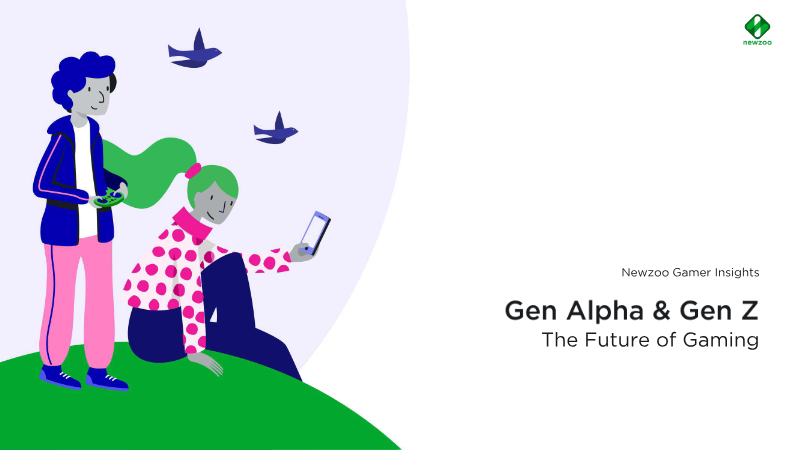
This analysis examines the gaming behaviors and preferences of Gen Alpha (ages 10-12) and Gen Z (ages 13-27), positioning these cohorts as the primary drivers of the industry's future. The central thesis asserts that for these younger generations, gaming has evolved beyond a mere pastime into a ubiquitous "lifestyle" platform that fulfills fundamental needs for socialization, self-expression, and immersion. This shift is characterized by high engagement across multiple dimensions, including playing, viewing content, and participating in virtual social communities.

Key findings indicate that 90% of Gen Alpha and Gen Z are "game enthusiasts," significantly higher than the 79% found in the total online population. These groups invest a substantial portion of their leisure time in gaming; it is the top entertainment source for Gen Alpha and a top-three source for Gen Z, rivaling social networks and streaming. Socialization is a critical driver, with 70% of Gen Z expressing interest in using game worlds for social gatherings beyond active gameplay, such as attending virtual parties or watching movies. This behavior suggests these generations will be the primary catalysts for metaverse adoption.

Economic engagement is also high, with 52% of Gen Alpha and Gen Z spending money on games, compared to 42% of the general population. Mobile is the leading platform for both play and spend, though Gen Alpha shows a unique affinity for consoles driven by franchises like Fortnite and Mario. The primary motivators for spending include unlocking exclusive playable content and personalizing the in-game experience through virtual goods like currencies and gear.

The data is derived from Newzoo’s 2022 Global Gamer Research, utilizing Computer Assisted Web Interviewing (CAWI) conducted between February and April 2022. The study features a representative sample of 75,930 respondents across 36 global markets, covering North America, Europe, MEA, Latin America, and Asia-Pacific.
  • 90% of Gen Alpha and Gen Z are game enthusiasts, significantly outpacing the 79% engagement rate found in the total online population.
  • Gaming is the primary entertainment source for Gen Alpha and a top-three source for Gen Z, competing directly with social networks and streaming services.
  • 70% of Gen Z are interested in using virtual game worlds for social activities beyond gameplay, such as attending parties or watching movies, positioning them as the primary drivers of metaverse adoption.
  • Economic engagement is higher among younger cohorts, with 52% of Gen Alpha and Gen Z spending money on games compared to 42% of the general population.
  • Mobile is the dominant platform for both play and spending, though Gen Alpha demonstrates a notable preference for consoles, specifically citing franchises like Fortnite and Mario.
+1
NewzooJan 2022
Page 1
Report18 pages

Key Insights into Brazilian Gamers

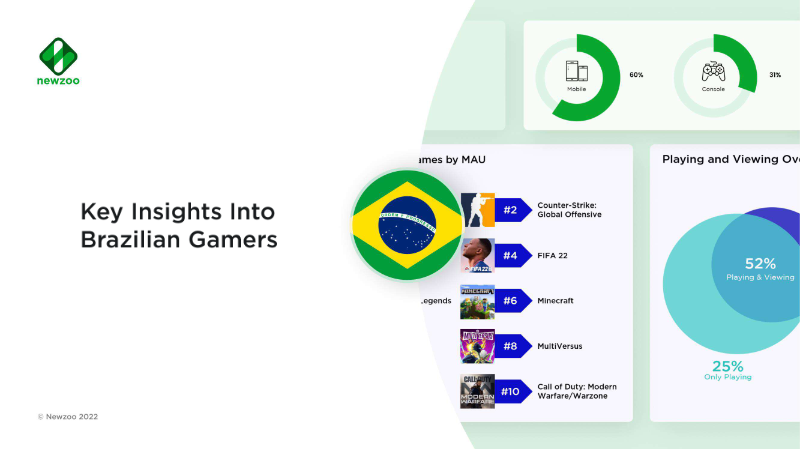
Brazil represents a significant force in the global gaming industry, ranking as the 10th largest market worldwide by revenue and 5th by total player count as of 2022. The region is characterized by high levels of engagement, with 80% of the online population identified as game enthusiasts. This engagement extends beyond play, as 60% of the audience both plays and watches gaming video content, while only 25% play without viewing.

The demographic profile of Brazilian gamers is diverse, though it skews toward younger males. Approximately 51% of players are male and 48% are female, with the 21–35 age bracket forming the largest segment at 43%. Mobile gaming is the dominant platform, utilized by 60% of the gaming population, followed by console and PC at 31% and 30% respectively. Despite the prevalence of mobile, average weekly play times are consistent across platforms, ranging from roughly four and a half to five hours.

Monetization trends indicate a healthy spending culture, with 43% of players classified as payers. The primary drivers for spending include unlocking exclusive playable content and personalizing in-game characters. Popular titles in the region include competitive and social games such as League of Legends, Fortnite, and Roblox.

The findings are based on a survey of 2,063 active internet users aged 10–65 in residential developed areas of Brazil. The methodology utilizes a "Residential Developed Approach," ensuring the data is representative of the connected population within these specific geographic zones. The research was conducted by Newzoo as part of their 2022 Global Games Market Report and Consumer Insights series.

  • Brazil is the 10th largest gaming market globally by revenue and 5th by total player count as of 2022.
  • Engagement is high, with 80% of the online population identified as game enthusiasts and 60% of players also consuming gaming video content.
  • Mobile is the dominant platform, used by 60% of the gaming population, followed by consoles at 31% and PC at 30%.
  • The player base is nearly evenly split by gender, with 51% male and 48% female, and the 21–35 age bracket representing the largest segment at 43%.
  • 43% of Brazilian gamers are payers, with spending primarily driven by the desire to unlock exclusive content and personalize in-game characters.
NewzooJan 2022
Page 1
Report11 pages

Key Insights Into American Gamers

The United States represents the second-largest gaming market globally, generating $47.3 billion in revenue from a population of 191 million gamers. Research conducted in 2022 indicates that 72% of the American online population are game enthusiasts, a broad category encompassing those who play, watch, or socially engage with video games. While 71% of the population plays games, there is a significant overlap with viewership, as 44% of the population watches gaming video content and 18% engages with esports.

The demographic profile of American gamers is nearly evenly split by gender, with 52% identifying as male and 47% as female. Engagement spans all age groups, though the 21-35 bracket is the most active at 35%. Player motivations are diverse, led by social interaction (37%), action (37%), and achievement (36%). While mobile is the most popular platform by reach, capturing 48% of players, console gaming commands the highest engagement time, averaging six hours per week.

Economic engagement is high, with 49% of the online population spending money on games. The primary drivers for spending include the desire to play with friends or family, taking advantage of sales, and unlocking exclusive content. Popular titles like Fortnite, Grand Theft Auto V, and Call of Duty dominate the market, with shooters and adventure games ranking as the top genres by monthly active users. This data is derived from a 2022 consumer insights survey of 3,054 online respondents in the U.S., part of a broader global study covering 36 markets.

  • The U.S. gaming market generated $47.3 billion in revenue from 191 million gamers, representing 72% of the online population.
  • Engagement is driven by a mix of play and viewership, with 71% of the population playing games, 44% watching gaming content, and 18% engaging with esports.
  • Mobile is the most popular platform by reach at 48%, while console gaming commands the highest engagement at an average of six hours per week.
  • The demographic profile is nearly evenly split, with 52% male and 47% female, and the 21-35 age bracket serving as the most active segment at 35%.
  • Nearly half of the online population (49%) spends money on games, primarily motivated by social interaction, sales, and exclusive content.
+1
NewzooJan 2022
Page 1
Report18 pages

Key Insights Into UK Gamers

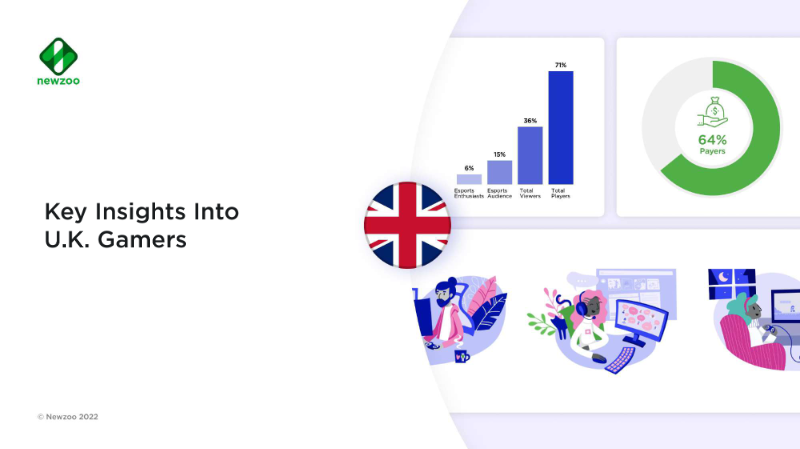
The United Kingdom represents a major global gaming hub, ranking as the sixth-largest market by revenue and tenth by player population as of late 2022. Research conducted among the online population aged 10 to 65 indicates that gaming is a primary entertainment pillar in the region, with 71% of the population identifying as game enthusiasts. This engagement is split between active play and content viewership, with 36% of the population exclusively playing games and another 35% both playing and viewing gaming video content.

The demographic profile of UK gamers is nearly balanced by gender, consisting of 52% male and 47% female players. While gaming spans all age groups, the 21-35 bracket is the most active. Motivation for play is driven primarily by the desire to unwind and relax, followed by the pursuit of achievement and social interaction. When categorized by persona, Time Fillers—those who play casually to pass the time—represent the largest segment, followed by Mainstream Gamers who engage deeply with both play and viewership.

Platform preferences show that mobile gaming has the highest reach at 46%, followed by console at 41% and PC at 29%. However, PC and console players demonstrate higher average weekly time commitments compared to mobile users. Financial engagement is also significant, with 63% of players identified as payers. The primary driver for spending is the availability of sales or special offers, though social motivations, such as spending to play with friends or family, also influence purchasing behavior.

The findings are based on a 2022 survey of 2,010 respondents in the United Kingdom, part of a broader global study covering 36 markets. The methodology utilizes a representative sample of the online population to track dozens of key performance indicators, including audience profiles, platform behavior, and monetization trends.

  • The UK is a major global gaming hub, ranking sixth in revenue and tenth in player population, with 71% of the population aged 10-65 identifying as game enthusiasts.
  • Engagement is evenly split between active players (36%) and those who both play and view gaming video content (35%).
  • Mobile gaming has the highest reach at 46%, followed by console (41%) and PC (29%), though PC and console users dedicate more time to gaming weekly.
  • The gamer demographic is nearly gender-balanced at 52% male and 47% female, with the 21-35 age bracket serving as the most active segment.
  • 63% of UK gamers are payers, with spending primarily driven by sales, special offers, and social motivations like playing with friends or family.
+1
NewzooJan 2022
Page 1
Report18 pages

Key Insights Into French Gamers

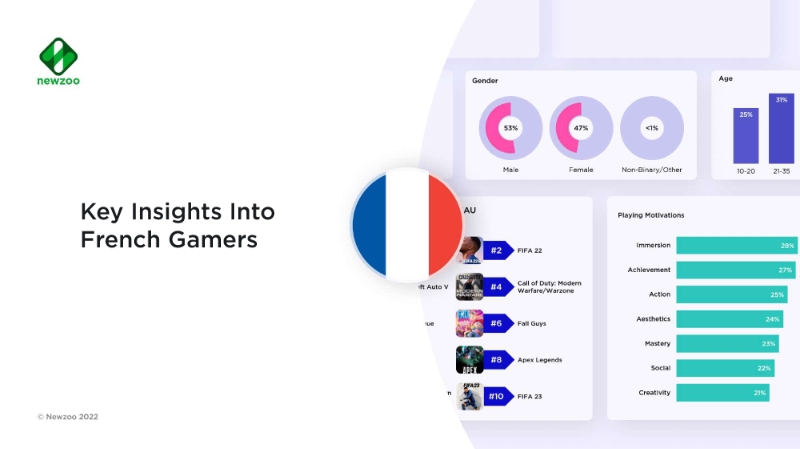
France represents a significant gaming market, ranking seventh globally in terms of revenue and fifteenth in total player count as of 2022. The French gaming population is highly engaged, with 71% of the online population aged 10 to 65 identifying as game enthusiasts. While 38% of this group only plays games, a substantial 34% also views gaming video content, and 15% are classified as esports enthusiasts who watch professional competitive gaming at least once a month.

The demographic profile of French players is nearly balanced by gender, consisting of 52% men and 48% women. The largest age cohort is the 21-35 bracket, representing 31% of the player base. In terms of behavior, Time Fillers and Mainstream Gamers are the most common personas. Time Fillers use games primarily to pass the time and show less interest in viewing content, whereas Mainstream Gamers are deeply invested in both playing and watching gaming media. Mobile is the most popular platform, utilized by 44% of the online population, followed by console at 41% and PC at 30%. Despite mobile's reach, PC players record the highest average weekly playtime at four hours and forty minutes.

Monetization data indicates that 56% of French players are payers, driven primarily by value-based incentives such as sales or special offers. Other significant spending motivators include unlocking exclusive content and the desire to play with friends or family, underscoring the social nature of the market. This analysis is based on a 2022 survey of 2,080 online consumers in France, part of a broader global study covering 36 markets and over 75,000 respondents.

  • France is a top-tier global gaming market, ranking seventh in revenue and fifteenth in player count as of 2022.
  • The French gaming population is highly engaged, with 71% of online users aged 10–65 identifying as enthusiasts, including 15% who follow esports monthly.
  • Mobile is the leading platform with 44% reach, followed by console at 41% and PC at 30%, though PC users record the highest average weekly playtime at four hours and forty minutes.
  • The player base is gender-balanced at 52% men and 48% women, with the 21–35 age bracket serving as the largest demographic segment at 31%.
  • 56% of French players are payers, with spending primarily motivated by value-based incentives, exclusive content, and social play with friends or family.
NewzooJan 2022
Page 1
Report11 pages

Key Insights Into Spanish Gamers

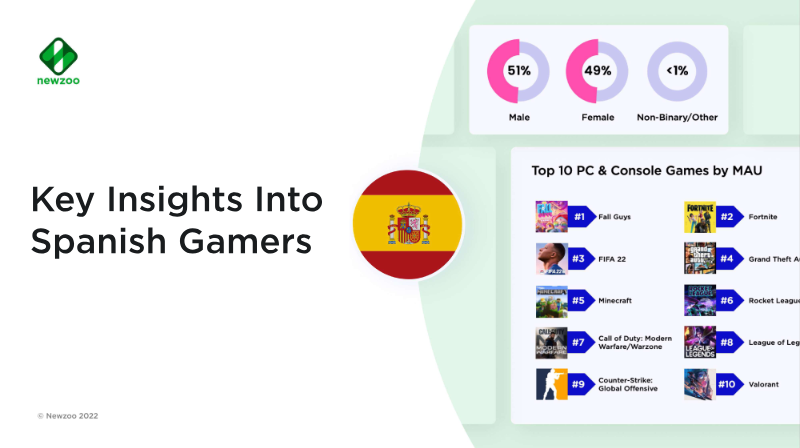
Spain represents a significant global gaming market, ranking 13th in the world with an annual revenue of $2.38 billion. The industry maintains a massive reach within the country, as 83% of the online population aged 10 to 65 are classified as game enthusiasts. Engagement is multifaceted, with 82% of the population playing games and 45% viewing gaming content. Notably, there is a high degree of overlap between these behaviors; 38% of the population both plays and watches games, while only 7% are exclusive viewers.

The demographic profile of Spanish gamers is nearly evenly split between genders, with 51% female and 49% male. Participation remains strong across age groups, though it peaks among those aged 21 to 50. Achievement, action, and mastery serve as the primary motivations for play. While mobile is the most popular platform by reach, utilized by 60% of the population, PC and console players demonstrate higher engagement depth, averaging four hours of play per week compared to three hours on mobile.

Market behavior indicates a strong propensity for spending, with 48% of the online population identified as payers. The primary drivers for monetization include sales or special offers and the desire to play with friends or family. In terms of content, the market is dominated by major global franchises such as Fall Guys, Fortnite, and FIFA 22, with adventure and sports ranking as the top genres by monthly active users. These findings are based on a 2022 consumer study involving a sample of 2,086 online respondents in Spain, forming part of a broader global research initiative covering 36 markets.

  • Spain is the 13th largest global gaming market, generating $2.38 billion in annual revenue with 83% of the online population aged 10 to 65 identified as enthusiasts.
  • The Spanish gaming audience is gender-balanced at 51% female and 49% male, with peak participation occurring between the ages of 21 and 50.
  • While mobile is the most popular platform with 60% reach, PC and console users exhibit higher engagement, averaging four hours of weekly play compared to three hours for mobile users.
  • Gaming engagement is highly integrated, as 38% of the population both plays and watches gaming content, while only 7% are exclusive viewers.
  • 48% of the online population are payers, primarily motivated by sales, special offers, and the desire to play with friends or family.
+1
NewzooJan 2022
Page 1
Report42 pages

For the Game

The global gaming industry is undergoing a transformative shift into a primary mass medium, projected to reach 3.5 billion players and $225 billion in revenue by 2025. This evolution is characterized by gaming’s role as a central pillar of culture and social connection, with over a third of players utilizing the medium specifically for socialization. Analysis across 21 global markets reveals that gamers are highly engaged "super-consumers" who spend nearly 60 hours a week across television and internet platforms, making them a critical demographic for brand attention.

To effectively reach this audience, the industry must move beyond traditional demographic stereotypes and adopt a motivation-based segmentation. This approach identifies six distinct player types, allowing for more authentic engagement. However, a significant gap remains between the diverse player base and the industry’s internal demographics, which remain predominantly male and white. Prioritizing equity, inclusion, and accessibility is essential for future growth, as evidenced by the commercial success of titles that prioritize inclusive design and representation.

Successful brand integration requires a departure from standard advertising in favor of intrinsic in-game experiences and value-driven partnerships. Strategies such as gamified commerce, immersive virtual events, and the utilization of original intellectual property yield higher attention and recall rates than traditional social media formats. By fostering mutually beneficial relationships and respecting established gaming codes, brands can leverage the medium not just for visibility, but as a sophisticated tool for long-term community building and commercial innovation.

  • The global gaming industry is projected to reach 3.5 billion players and $225 billion in revenue by 2025.
  • Gamers are high-value 'super-consumers' who engage with television and internet platforms for nearly 60 hours per week.
  • Over one-third of the global player base uses gaming primarily as a social platform, necessitating a shift toward community-focused engagement strategies.
  • Effective audience targeting requires moving beyond traditional demographics to a motivation-based segmentation model that identifies six distinct player types.
  • Internal industry demographics remain predominantly white and male, creating a strategic gap that can be addressed through inclusive design to drive commercial success.
+2
dentsuJan 2022
Page 1
Report11 pages

Key Insights Into South Korean Gamers

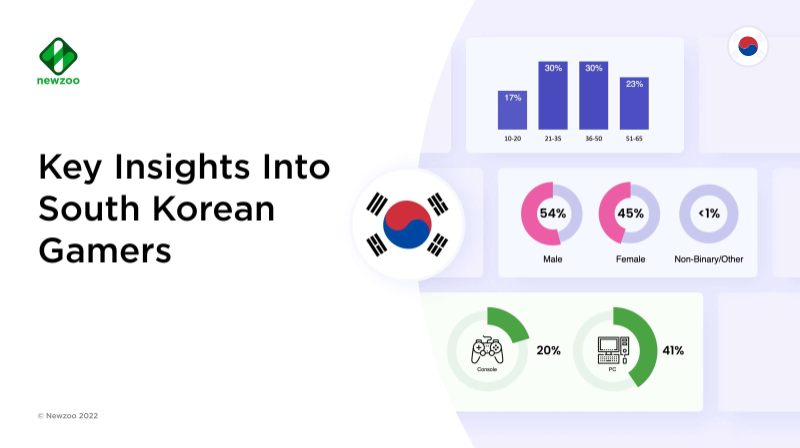
South Korea represents the fourth largest gaming market globally by revenue, valued at $8.3 billion, with a highly engaged population of 33 million gamers. Research conducted in 2022 indicates that 76% of the online population are game enthusiasts who engage with the medium through playing, viewing, or social interaction. While 72% of the population plays games, there is a significant overlap with viewership; 48% of South Koreans both play and watch gaming content, while 22% specifically engage with esports.

The demographic profile of South Korean gamers is diverse, with a nearly even split between males (54%) and females (45%) and broad representation across age groups, particularly those between 21 and 50. Socializing is the primary motivator for play, followed by action and achievement. Despite the high engagement levels, player personas vary; the most common types are Time Fillers, who play casually to pass the time, and Mainstream Gamers, who invest heavily in both playing and viewing.

Mobile is the dominant platform, utilized by 59% of the online population, though PC players record the highest average weekly engagement at five hours. In terms of software, League of Legends and Shooter genres lead in monthly active users. Monetization is also robust, with 38% of the population spending money on games. The primary drivers for spending include the desire to advance more quickly or easily in-game, followed by responding to sales or special offers.

The findings are based on a 2022 consumer insights survey of 2,094 respondents from the South Korean online population. The data highlights a mature market where gaming is a mainstream social activity integrated into daily life across all demographics, supported by a strong esports culture and a high propensity for in-game spending.

  • South Korea is the world's fourth-largest gaming market, generating $8.3 billion in annual revenue from a highly engaged base of 33 million gamers.
  • Gaming is a deeply integrated social activity, with 76% of the online population participating, 48% both playing and watching content, and 22% specifically following esports.
  • Mobile is the primary platform for 59% of the online population, though PC gamers demonstrate higher engagement with an average of five hours of play per week.
  • The player base is demographically balanced, with a 54% male and 45% female split and strong representation across the 21–50 age range.
  • Monetization is robust, with 38% of the population spending money on games, primarily driven by the desire for faster progression or to capitalize on special offers.
+1
NewzooJan 2022
Page 1
Report18 pages

Consumer Insights: Games & Esports 2022

Gaming has evolved into a multi-dimensional entertainment ecosystem where traditional play is no longer the sole driver of engagement. Findings indicate that 79% of the global online population are game enthusiasts, participating through playing, viewing content, or socializing in virtual worlds. This shift is most pronounced among younger generations; for Gen Alpha, gaming has surpassed social media and streaming video as the primary source of entertainment.

The research highlights a significant trend toward the "metaverse," with 75% of players and 44% of non-players engaging in game worlds for social interaction without playing the core game. This high level of engagement translates into substantial economic impact, with consumer spending in the sector projected to exceed $200 billion in 2023. Approximately half of Gen Alpha, Gen Z, and Millennial gamers are already classified as payers, a figure expected to rise as younger cohorts gain independent purchasing power.

Data suggests that gamers are a highly receptive audience for brands, exhibiting 36% more positive attitudes toward brand messaging compared to non-players. However, the diversity of the audience necessitates a nuanced approach. Using proprietary segmentation, the analysis shows that while older generations often act as "Time Fillers," younger audiences are more likely to be "Ultimate Gamers" or "All-Round Enthusiasts." Even within the same genre, such as Battle Royale, player demographics and motivations vary significantly between titles like Fortnite and Apex Legends, affecting their preferences for products like energy drinks or alcohol.

The findings are based on a 2022 study utilizing Computer Assisted Web Interviewing (CAWI) with a representative sample of 75,930 respondents. The scope covers 36 global markets across North America, Europe, Latin America, and Asia-Pacific, targeting the online population aged 10 to 65. Additional sentiment studies on the metaverse and blockchain gaming supplement the core consumer data.

  • Gaming has become a primary entertainment ecosystem for 79% of the global online population, with Gen Alpha prioritizing gaming over social media and streaming video.
  • Consumer spending in the gaming sector is projected to exceed $200 billion in 2023, driven by a payer base that includes approximately 50% of Gen Alpha, Gen Z, and Millennial gamers.
  • Game worlds are increasingly used for social interaction rather than gameplay, with 75% of players and 44% of non-players utilizing these environments for non-gaming social engagement.
  • Gamers are a highly receptive audience for advertising, demonstrating a 36% more positive attitude toward brand messaging compared to non-players.
  • Audience motivations vary significantly by demographic, with older users often acting as 'Time Fillers' while younger cohorts are more likely to be 'Ultimate Gamers' or 'All-Round Enthusiasts'.
+1
NewzooJan 2022

Publishers

Related Topics