Player Behavior reports and market data
Documents
Growing with Our Heroes - Why Childhood Favorites Get Dark Reboots - Extra Credits
The prevalence of dark, gritty reboots in modern media and gaming stems from a fundamental human desire to maintain a connection with the cultural touchstones of childhood while reconciling them with the complexities of adult life.
- Dark reboots of childhood properties are primarily driven by creators reaching professional influence who seek to reconcile their nostalgic attachments with their current adult identities.
- The industry follows a 10-to-20-year generational cycle, which represents the time required for a cohort to gain the creative control necessary to reshape the intellectual properties they consumed in their youth.
- Creators often use dark, gritty themes as a mechanism to validate their continued engagement with franchises that might otherwise be perceived as childish.
Affordances - How Design Teaches Us Without Words - Extra Credits
Affordance serves as a fundamental principle in design, describing how the physical or visual properties of an object intuitively communicate its function to a user without the need for explicit instruction.
- Affordance is the design principle of using an object's physical or visual properties to intuitively communicate its function to the user without explicit instruction.
- Designers bridge the gap between virtual and real-world experiences by leveraging existing physiological and cultural associations to make complex game systems feel natural.
- Effective use of affordance reduces player cognitive load, allowing for seamless interaction with game mechanics rather than requiring the memorization of abstract rules or mathematical formulas.

Cyber-psychologist Berni Good talks free-to-play gaming
The free-to-play gaming sector requires a sophisticated understanding of player psychology to successfully integrate monetization strategies without causing user disengagement.
- Transparency in monetization is the primary driver of player trust and long-term retention, as opaque or coercive payment structures lead to significant user backlash.
- Monetization strategies must be rooted in psychological triggers, as high levels of game satisfaction do not inherently correlate with a player's willingness to spend.
- Players are motivated by conspicuous consumption, using digital items and aesthetic upgrades to signal status and gain competitive advantages within the game environment.
The Magic Circle - How Games Transport Us to New Worlds - Extra Credits
The magic circle represents a fundamental psychological boundary that allows individuals to suspend disbelief and enter an agreed-upon, fictional reality.
- The 'magic circle' is a psychological boundary that allows players to suspend disbelief and treat fictional narratives as emotionally significant experiences.
- Designers facilitate entry into the magic circle by using sensory cues to sever the player's connection to mundane, real-world distractions.
- Audio design serves as a primary tool for immersion, signaling to the player that it is safe to emotionally engage with the game's narrative.

Community Management - The Unsung Heroes of the Game Industry - Extra Credits
Community management serves as a critical, yet frequently undervalued, pillar of the modern game industry.
- Community management has evolved from a peripheral support function into a central pillar of product success for modern, perpetual, and evolving game models.
- The profession currently suffers from systemic neglect, frequently ranking among the lowest-paid and lowest-status roles within game development studios.
- Industry hiring practices for community managers are often haphazard and lack rigorous vetting, largely due to a disregard for the specialized soft skills required for the role.
Collectible Games - II: Monetizing Our Collecting Urges - Extra Credits
The collectible monetization model in free-to-play gaming functions as a sophisticated psychological mechanism that mirrors the mechanics of slot machines.
- Collectible monetization models leverage psychological mechanisms similar to slot machines, using random rewards to trigger human impulses for exploration and completion.
- Developers utilize the illusion of scarcity and the sunk cost fallacy to increase player retention, as the time and financial investment required for a collection makes abandonment difficult.
- The model specifically targets 'achievers' driven by the compulsion to complete sets and 'explorers' motivated by the discovery of randomized content.

Negative Possibility Space - When Exploration Lets Players Down - Extra Credits
Negative possibility space represents the vacuum created when game design elements—such as level geometry or narrative choices—establish player expectations that remain unfulfilled.
- Negative possibility space occurs when game design elements, such as level geometry or narrative choices, create player expectations that remain unfulfilled, leading to wasted effort and diminished immersion.
- Designers must proactively reward exploration in obscure or difficult-to-reach areas with tangible items, achievements, or environmental storytelling to validate the player's curiosity.
- Narrative agency is maintained by acknowledging player decisions through unique dialogue or UI prompts, even when those choices do not fundamentally alter the game's final outcome.
How Much Agency Do Games Need? - Choices in Linear Games - Extra Credits
The quality and relevance of player choices are significantly more important to the gaming experience than the sheer quantity of options provided.
- Player agency is defined by the meaningful impact of actions on the game world rather than the sheer volume of choices provided.
- The binary debate between open-world exploration and linear narrative is reductive, as agency can be effectively integrated into both structures.
- Designers can foster deep emotional engagement in constrained, linear sequences by allowing players to physically navigate spaces, as demonstrated in the opening of The Last of Us.
The Feeling of Agency - What Makes Choice Meaningful? - Extra Credits
Meaningful choice serves as the foundational element of video game design, distinguishing the medium from all other forms of entertainment by granting the audience agency.
- Meaningful choice is the defining element of video games, as it transforms the audience from passive observers into active participants through agency.
- A choice is only meaningful if the player has sufficient context to weigh options against their goals or character traits, rather than making an arbitrary selection.
- Agency evaporates when players perceive that their decisions are inconsequential or when they are indifferent to the potential outcomes.
Myers Briggs and Character Creation - Psychology in Game Design - Extra Credits
The Myers-Briggs Type Indicator (MBTI) serves as a practical framework for game designers to develop nuanced, consistent, and multidimensional characters.
- The Myers-Briggs Type Indicator (MBTI) provides a structured framework for game designers to build multidimensional, consistent characters by establishing a foundational 'psychic makeup' that guides their reactions to narrative scenarios.
- The system categorizes personality through four dichotomies: introversion vs. extroversion, sensing vs. intuition, thinking vs. feeling, and judging vs. perceiving.
- These sixteen personality combinations function like 'handedness,' meaning characters can act against their dominant traits but will expend more energy and effort to do so.
Game Addiction - III: Why Does Game Compulsion Exist? - Extra Credits
This analysis explores the psychological drivers behind game compulsion, arguing that the phenomenon is less about mechanical addiction and more about a fundamental human search for purpose, agency, and validation in a complex, post-industrial society.
- Game compulsion is primarily driven by a search for purpose, agency, and validation rather than purely mechanical addiction or adrenaline-seeking behavior.
- Games provide clear objectives and immediate feedback loops that are frequently absent in modern bureaucratic workplaces and rigid educational systems.
- Digital environments offer a sense of mastery and contribution by allowing players to assume meaningful roles, such as healers or heroes, which mitigates feelings of powerlessness in a global society.
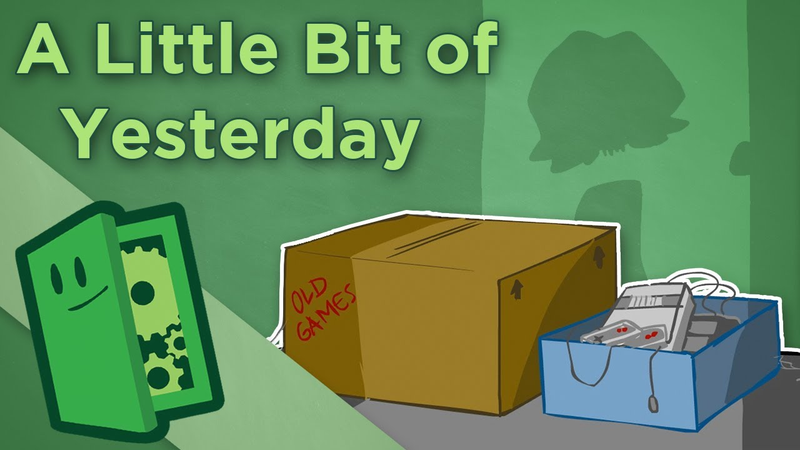
A Little Bit of Yesterday - Why We Love Retro Games So Much - Extra Credits
The enduring appeal of retro gaming stems from a desire to recapture a sense of uninhibited imagination, optimism, and playfulness that is frequently absent in contemporary, high-budget titles.
- The primary driver of retro gaming's popularity is a longing for the creative freedom, optimism, and over-the-top design choices that characterized early game development.
- Modern game design has increasingly prioritized realism and grounded narratives, which has inadvertently led to a loss of the exuberant joy and childlike wonder found in classic titles.
- The industry’s shift toward 'mature' themes was fueled by a sense of insecurity and a desire for mainstream legitimacy, causing developers to view the inherent silliness of games with shame.